
 100% FREE ACCESS
12th Standard CBSE Syllabus & Materials
12th Standard CBSE
CBSE 12th Economics Government Budget and the Economy Previous year Question Papers Study Material - QB365 Set A
NEW12th Standard CBSE
CBSE 12th Computer Science Interface Python with MySQL - New Previous year Question Papers Study Material - QB365 Set A
NEW12th Standard CBSE
CBSE 12th Computer Science Database Concept - New Previous year Question Papers Study Material - QB365 Set A
NEW12th Standard CBSE
CBSE 12th Computer Science Data Communication - New Previous year Question Papers Study Material - QB365 Set A
NEW12th Standard CBSE
CBSE 12th Computer Science Data Structures - New Previous year Question Papers Study Material - QB365 Set A
NEW12th Standard CBSE
CBSE 12th Computer Science Functions - New Previous year Question Papers Study Material - QB365 Set A

Published on: 25/10/2025
Download CBSE Class 12th Standard CBSE Chemistry question papers, sample papers, important questions, and previous year solved papers in PDF format. Get free study materials, NCERT solutions, and exam preparation resources for Class 12th Standard CBSE Chemistry
Questions + Answers key
Take MCQ Chemistry Test
1.
Explain the mechanism of following reaction:

2.
What happens when benzene diazonium chloride is heated with water?
3.
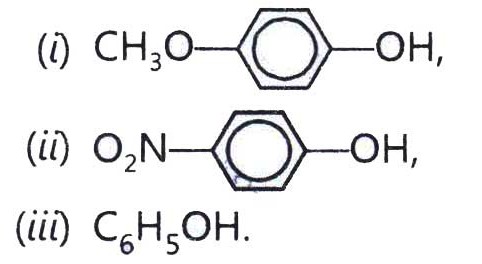
Arrange the following in decreasing order of their acidic character:
4.
Write the chemical equation for the preparation of phenol from benzene using oleum and sodium hydroxide.
5.
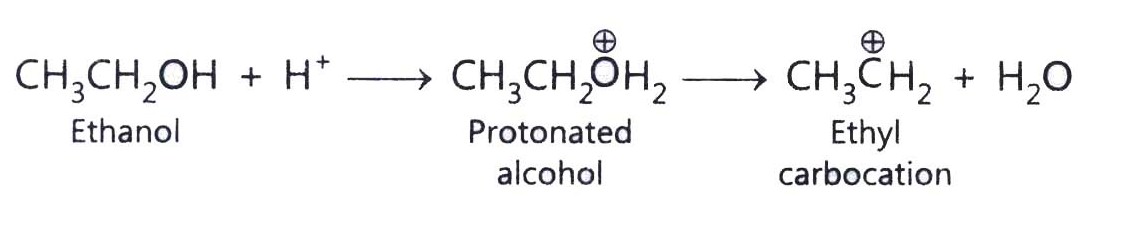
How would you convert ethanol to ethene?
6.
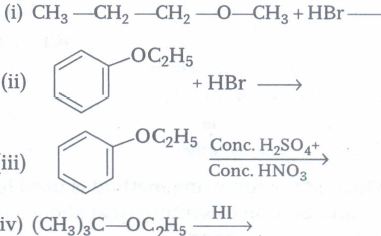
Predict the products of the following reactions:
7.
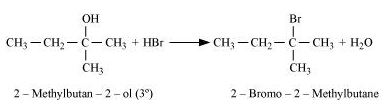
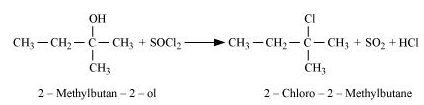
Give structures of the products you would expect when each of the following alcohol reacts with (a) \(HCl-Zn{ Cl }_{ 2 }\), (b) \(HBr\) and (c) \(SO{ Cl }_{ 2 }\) .
(i) Butan-1-o1
(ii) 2-Methylbutan-2-o1
8.
A compound A (C4H10O) is found to be soluble in concentrated sulphuric acid. (A) does not react with sodium metal or potassium permanganate. When (A) is heated with excess of HI, it gives a single alkyl halide. Deduce the structure of compound (A) and explain all the reactions involved.
9.
Write equations of the following reactions:
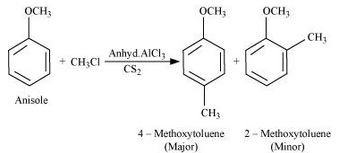
(i) Friedel-Crafts reaction - alkylation in anisole,
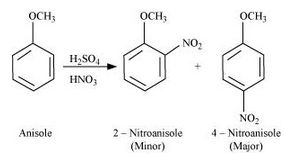
(ii) Nitration of anisole
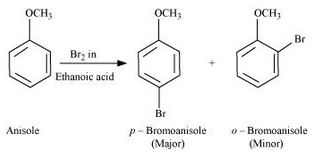
(iii) Bromination of anisole in ethanoic acid medium,
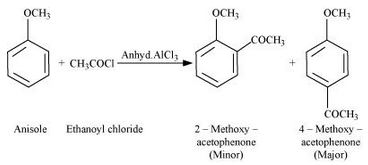
(iv) Friedel- Crafts acetylation of anisole.
10.
(i) What happens when phenol reacts with
(a) conc. HNO3 and
(b) CHCl3 in presence of aqueous NaOH followed by acidification?
(ii) Why does the reaction of CH3ONa with (CH3)3C - Br gives 2-methylpropene and not (CH3)3 C - O-O-OCH3?
11.
Predict the products of the following reaction:
\(\text { (i) } \mathrm{CH}_{3}-\mathrm{CH}=\mathrm{CH}_{2} \frac{\left(\text { i) } \mathrm{B}_{2} \mathrm{H}_{6}\right.}{\text { (ii) } 3 \mathrm{H}_{2} \mathrm{O}_{2} / \mathrm{OH}^{-}} \text {? }\)
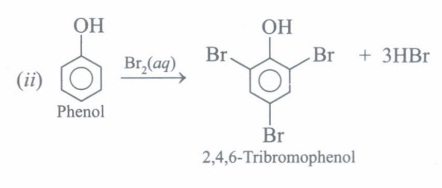
\(\text { (ii) } \mathrm{C}_{6} \mathrm{H}_{5}-\mathrm{OH} \stackrel{\mathrm{Br}_{2}(a q)}{\longrightarrow} \text { ? }\)
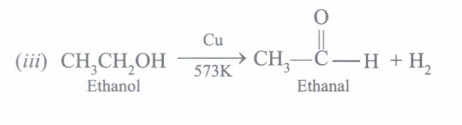
\(\text { (iii) } \mathrm{CH}_{3} \mathrm{CH}_{2} \mathrm{OH} \stackrel{\mathrm{Cu} / 573 \mathrm{~K}}{\longrightarrow} \text { ? }\)
12.
The following is not an appropriate reaction for the preparation of tert-butyl methyl ether:
\(\begin{equation}
\mathrm{CH}_{3} \mathrm{ONa}+\left(\mathrm{CH}_{3}\right)_{3} \mathrm{C}-\mathrm{Cl} \longrightarrow\left(\mathrm{CH}_{3}\right)_{3} \mathrm{C}-\mathrm{OCH}_{3}
\end{equation}\)
(i) What would be the major product of the given reaction?
(ii) Write a suitable reaction for the preparation of tert-butyl methyl ether, specifying the names of re agents used. Justify your answer in both cases.
13.
Compound A having molecular formula C4H10O , is found to be soluble in concentrated sulphuric acid. It does not react with sodium metal or potassium permanganate. On heating with excess of HI, it gives a single alkyl halide. Deduce the structure of compound A and explain all the reactions.
14.
Show how will you synthesise
(i) 1-phenyl ethanol from a suitable alkene?
(ii) cyclohexyl methanol using an alkyl halide by an SN2 mechanism?
(iii) pentan-1-ol using an alkyl halide?
15.
How is tert-butyl alcohol obtained from acetone?
16.
How do you convert the following:
(i) Phenol to anisole
(ii) Propan-2-ol to 2-methylpropan-2-o1
(iii) Aniline to phenol
17.
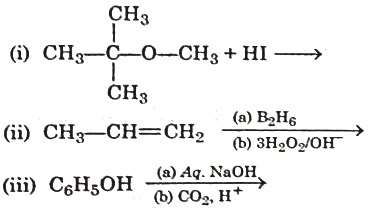
Write the main products(s) in each of the following reactions:
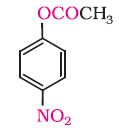
18.
Write the structures of the major products expected from the following reactions:
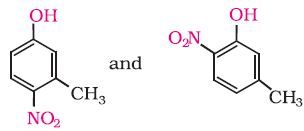
(a) Mononitration of 3-methylphenol
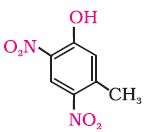
(b) Dinitration of 3-methylphenol
(c) Mononitration of phenyl methanoate.
19.
Name the reagents used in the following reactions:
(i) Benzyl alcohol to benzoic acid.
(ii) Dehydration of propan-2-ol to propene.
(iii) Butan-2-one to butan-2-ol.
1.

2.

3.
(ii) > (ii) > (i)
4.

5.

6.
(i)

(ii)
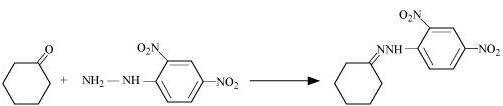
(iii)
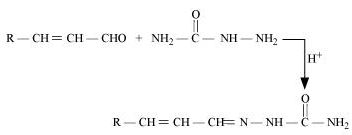
(iv)
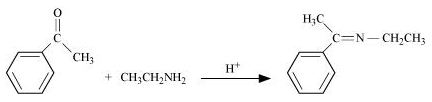
7.
(i)
\(\begin{array}{c} \mathrm{CH}_{3}-\mathrm{CH}_{2}-\mathrm{CH}_{2}-\mathrm{CH}_{2}-\mathrm{OH} \frac{\mathrm{HCl} \cdot \mathrm{ZnCl}_{2}}{\longrightarrow} \text { No reaction } \\ \quad \text { Butan }-1-\mathrm{ol} \end{array}\)
Primary alcohols do not react appreciably with Lucas' reagent (HCl-ZnCl2) at room temperature.
(ii)
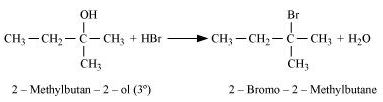
Tertiary alcohols react immediately with Lucas' reagent.
(b)
(i)

(ii)
(c)
(i)

(ii)
8.
(i) Since compound A (C4H10O) does not react with Na metal or KMnO4, it cannot be an alcohol.
(ii) Since compound A dissolves in cone, H2SO4, it may be an ether.
(iii) Since ether A on heating with excess of HI gives a single alkyl halide, therefore, ether (A) must be symmetrical. Now the only symmetrical ether having M.F. C4HIOO is diethyl ether (CH3CH2OCH2CH3).
9.
(i)
(ii)
(iii)
(iv)
10.
11.
\(\text { (i) } \mathrm{CH}_{3}-\mathrm{CH}=\mathrm{CH}_{2} \frac{\left(\text { i) } \mathrm{B}_{2} \mathrm{H}_{6}\right.}{\text { (ii) } 3 \mathrm{H}_{2} \mathrm{O}_{2} / \mathrm{OH}^{-}}{\longrightarrow} \mathrm{CH}_{3}-\mathrm{CH}_{2}-\mathrm{CH}_{2} \mathrm{OH}\)
propene propane-1-ol
12.
As the given alkyl halide is tertiary in nature, therefore on reaction with sodium methoxide, elimination reaction takes place in place of substitution and hence, alkene is formed as a major product. Therefore, in the given reaction, 2-methyl propene is formed as a major product.
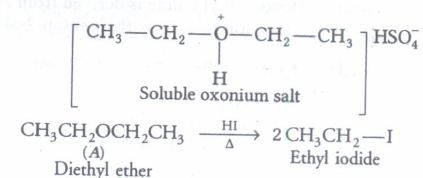
13.
(i) As compound A does not react with sodium metal or potassium permanganate, it cannot be an alcohol.
(ii) As compound A dissolves in conc. H2SO4, it may be an ether.
(iii) As compound A on heating with excess of ill, gives a single alkyl halide, therefore compound A must be a symmetrical ether.
(iv) The only symmetrical ether having molecular formula C4H10O is diethyl ether. Thus, compound A is diethyl ether,
\(\begin{equation} \mathrm{CH}_{3}-\mathrm{CH}_{2}-\mathrm{O}-\mathrm{CH}_{2}-\mathrm{CH}_{3} \end{equation}\)
\(\begin{equation} \mathrm{CH}_{3} \mathrm{CH}_{2}-\mathrm{O}-\mathrm{CH}_{2} \mathrm{CH}_{3} \stackrel{\text { Conc. } \mathrm{H}_{2} \mathrm{SO}_{4}}{\longrightarrow} \end{equation}\)
14.
(i) On adding H2O to ethenyl benzene in the presence of dil. H2SO4, we get 1-phenyl ethanol.

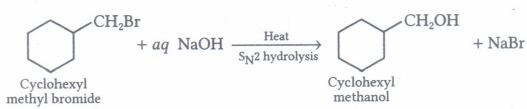
(ii) Hydrolysis of cyclohexyl methyl bromide by aqueous NaOH gives cyclohexyl methanol.
(iii) Hydrolysis of 1-bromopentane by aqueous NaOH, gives pentan-1-ol.

15.
(a) This is because pcc is a mild oxidising agent and can oxide methanol to methanal only while KMnO4 being strong oxidising agent oxidises it to methanoic acid.
(b) Because esterification rxn is reversible and presence of base (pyridine) neutralises HCl produced during reaction thus promoting forward reaction.
16.

17.
(i) \({ CH }_{ 3 }-\overset { \underset { | }{ { CH }_{ 3 } } }{ \underset { \overset { | }{ { CH }_{ 3 } } }{ C } } -O-{ CH }_{ 3 }+HI\longrightarrow { CH }_{ 3 }-\overset { \underset { | }{ { CH }_{ 3 } } }{ \underset { \overset { | }{ { CH }_{ 3 } } }{ C } } -I+\underset { Methanol }{ { CH }_{ 3 }OH } \)
(ii) \({ CH }_{ 3 }-CH={ CH }_{ 2 }\overset { (i){ B }_{ 2 }{ H }_{ 6 } }{ \underset { (ii)3{ H }_{ 2 }{ O }_{ 2 }/{ H }^{ - } }{ \longrightarrow } } { CH }_{ 3 }{ CH }_{ 2 }{ CH }_{ 2 }OH\)

18.
(a)
(b)
(c)
19.
(i) KMnO4/dil.H2So4. (acidified KMnO4)
(ii) Conc. H2SO4 at 443 K
(iii) LiAlH4

12th Standard CBSE Syllabus & Materials
12th Standard CBSE
CBSE 12th Computer Science Python Revision Tour I - New Previous year Question Papers Study Material - QB365 Set A
NEW12th Standard CBSE
CBSE 12th Business Studies Planning Important Questions And Answers Study Material - QB365 Set A
NEW12th Standard CBSE
CBSE 12th Business Studies Business Environment Important Questions And Answers Study Material - QB365 Set A
NEW12th Standard CBSE
CBSE 12th Business Studies Principles of Management Important Questions And Answers Study Material - QB365 Set A



NCERT Books

Syllabus

Exam Pattern

Sample Question Papers

Previous year Question Papers

Important Notes

MCQ Practice test

NCERT Exemplers

Case study Questions

Image Based Questions

Passage based Questions

HOT Questions

Value Based Questions

Model Questions Papers
NCERT ( Book Back ) Questions

Assertion and Reason
Important Questions And Answers

CBSE 12th Standard CBSE Subjects
CBSE Standards








