
 100% FREE ACCESS
12th Standard CBSE Syllabus & Materials
12th Standard CBSE
CBSE 12th Economics Government Budget and the Economy Previous year Question Papers Study Material - QB365 Set A
NEW12th Standard CBSE
CBSE 12th Computer Science Interface Python with MySQL - New Previous year Question Papers Study Material - QB365 Set A
NEW12th Standard CBSE
CBSE 12th Computer Science Database Concept - New Previous year Question Papers Study Material - QB365 Set A
NEW12th Standard CBSE
CBSE 12th Computer Science Data Communication - New Previous year Question Papers Study Material - QB365 Set A
NEW12th Standard CBSE
CBSE 12th Computer Science Data Structures - New Previous year Question Papers Study Material - QB365 Set A
NEW12th Standard CBSE
CBSE 12th Computer Science Functions - New Previous year Question Papers Study Material - QB365 Set A

Published on: 25/10/2025
Download CBSE Class 12th Standard CBSE Chemistry question papers, sample papers, important questions, and previous year solved papers in PDF format. Get free study materials, NCERT solutions, and exam preparation resources for Class 12th Standard CBSE Chemistry
Questions + Answers key
Take MCQ Chemistry Test
1.
Write the structures of the compounds where IUPAC names are as follows
(i) Hex-1-en-3-ol
(ii) 2-methylpropan-2-ol
(iii) 2, 6-dimethylphenol
2.
A compound 'X' with molecular formula C3H9N reacts with C6H5SO2Cl to give a solid, insoluble in alkali. Identify 'X' and give the IUPAC name of the product. Write the reaction involved.
3.
(a) Write the mechanism of the following reaction:
\(\mathrm{CH}_{3} \mathrm{CH}_{2} \mathrm{OH} \stackrel{\mathrm{HBr}}{\longrightarrow} \mathrm{CH}_{3} \mathrm{CH}_{2} \mathrm{Br}+\mathrm{H}_{2} \mathrm{O}\)
(b) Write the equation involved in Reimer-Tiemann reaction.
4.
How does Lucas reagent help in the distinction of primary, secondary and tertiary alcohols? Discuss the reactions involved.
5.
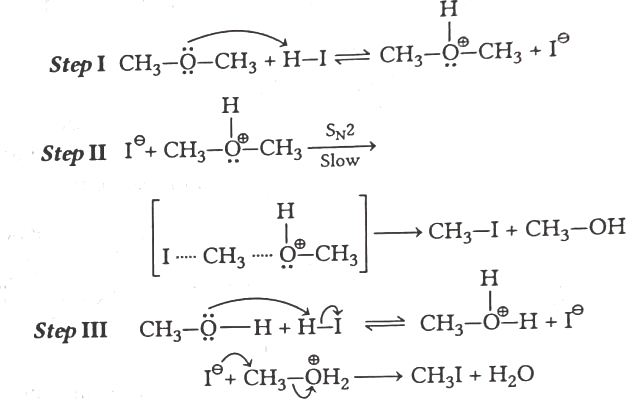
(i) What happens when CH3-O-CH3 is heated with HI?
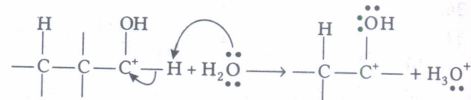
(ii) Explain mechanism for hydration of acid catalyzed ethene:
\(\mathrm{CH}_{2}=\mathrm{CH}_{2}+\mathrm{H}_{2} \mathrm{O} \stackrel{\mathrm{H}^{+}}{\longrightarrow} \mathrm{CH}_{3}-\mathrm{CH}_{2}-\mathrm{OH}\)
6.
a. R—Cl is hydrolysed to R—OH slowly but the reaction is rapid if a catalytic amount of KI is added to the reaction mixture.
b. What is formed if cylcopentanone is reduced with H2 /Pt . Give equation for the reaction.
7.
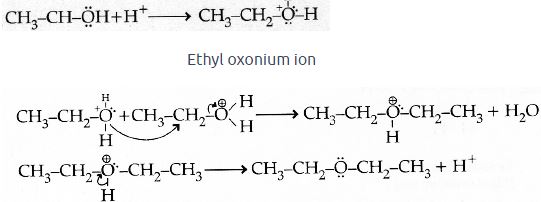
(i) Give mechanism of preparation of ethoxy ethane from ethanol.
(ii) How is toluene obtained from phenol?
8.
How are the following conversions carried out?
(i) Propene to propane-2-o1
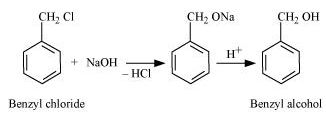
(ii) Benzyl chloride to Benzyl alcohol
(iii) Anisole to p-Bromoanisole
9.
Write the main products(s) in each of the following reactions:
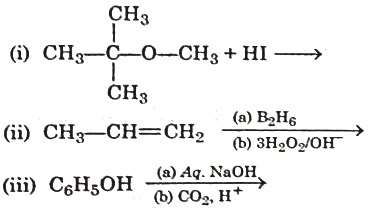
10.
Give the structures and IUPAC names of products expected from the following reactions:
(i) Catalytic reduction of butanal
(ii) Hydration of propene in the presence of dilute sulphuric acid.
(iii) Reaction of propanone with methyl magnesium bromide followed by hydrolysis.
11.
Write the mechanism of the reaction of HI with methoxy methane.
12.
(a) Name the starting material used in the industrial preparation of phenol.
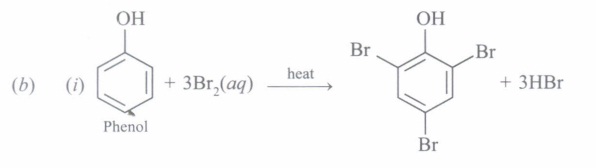
(b) Write complete reaction for the bromination of phenol in aqueous and non aqueous medium.
(c) Explain why Lewis acid is not required in bromination of phenol?
13.
Explain the fact that in aryl alkyl ethers,
(i) the alkoxy group activites the benzene ring towards electrophilic substitution and
(ii) it directs the incoming substitutions to ortho and para positions in benzene ring.
14.
Write IUPAC names of the following compounds:
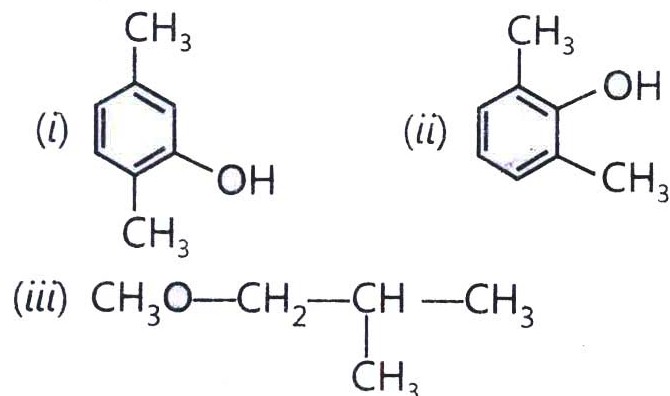
15.
Write IUPAC name of the following compounds:
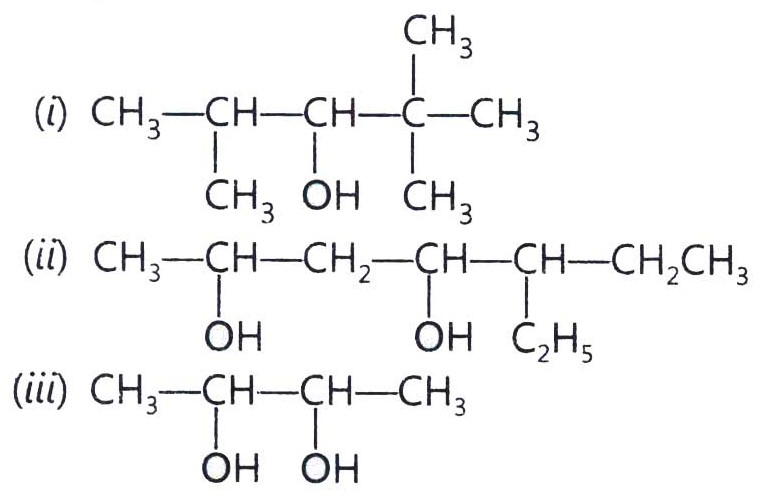
16.
Account the following:
(i) The boiling point of ethanol is higher than that of methanol.
(ii) Phenol is a stronger acid than an alcohol.
(iii) The boiling points of ethers are lower than isomeric alcohols.
17.
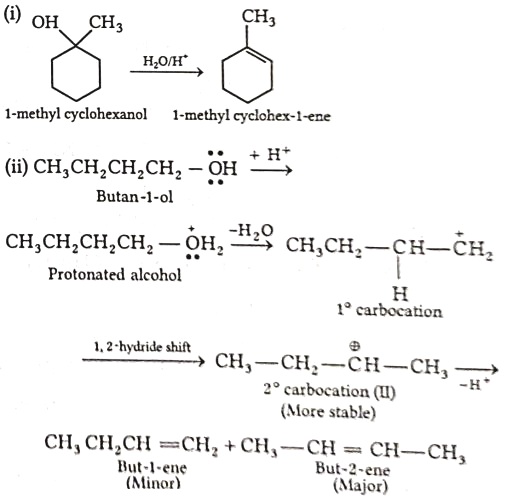
Predict the major product of acid catalysed dehydration of
(i) 1-methyl cyclohexanol, and
(ii) butan-1-ol
18.
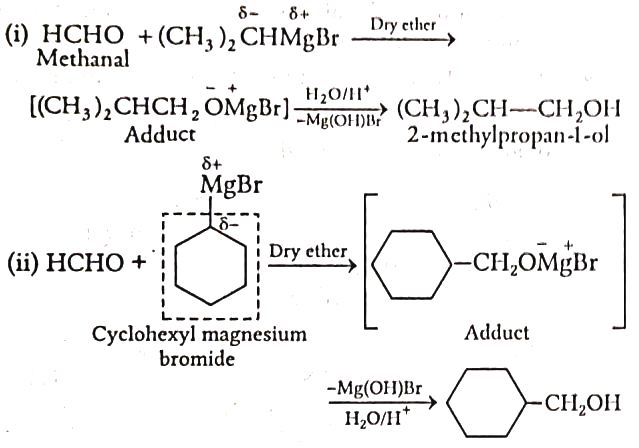
Show how are the following alcohols prepared by the reaction of a suitable Grignard reagent on methanal?
(i)
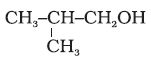
(ii)

19.
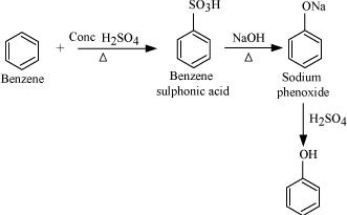
You are given benzene, conc. H2SO4 and NaOH. Write the equations for the preparation of phenol using these reagents.
20.
How are the following conversions carried out?
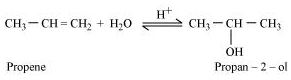
(i) Propene \(\longrightarrow \) Propan-2-ol
(ii) Ethyl magnesium chloride\(\longrightarrow \) Benzyl alcohol
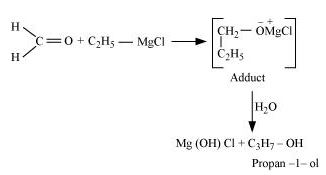
(iii) Ethyl magnesium chloride \(\longrightarrow \) Propan-1-ol.
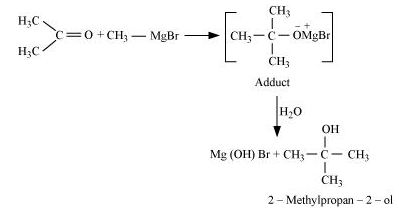
(iv) Methyl magnesium bromide\(\longrightarrow \) 2-Methylpropan-2-ol.
1.
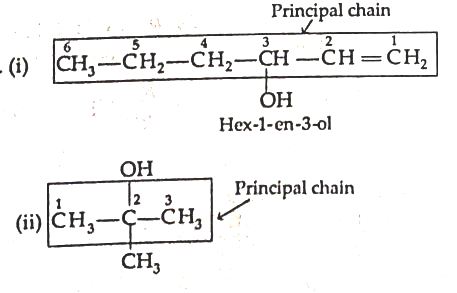
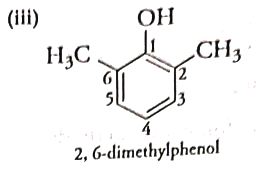
2.
As it is given that compound X on reacting with C6H5SO2Cl give a solid product which is insoluble in alkali, this shows that there is no hydrogen attached to N in the product.
Thus, the compound X is a secondary amine. The reaction involved is as follows
| \(\mathrm{CH}_3-\mathrm{N}-\mathrm{C}_2 \mathrm{H}_5+\mathrm{C}_6 \mathrm{H}_5 \mathrm{SO}_2 \mathrm{Cl} \longrightarrow\) | \(\mathrm{CH}_3-\mathrm{N}-\mathrm{SO}_2 \mathrm{C}_6 \mathrm{H}_5\) |
| | H (X) |
| C2H5 N-ethyl-N -methylbenzene sulphonamide |
3.
(a) \(\mathrm{CH}_{3} \mathrm{CH}_{2} \mathrm{OH} \stackrel{\mathrm{HBr}}{\longrightarrow} \mathrm{CH}_{3} \mathrm{CH}_{2} \mathrm{Br}+\mathrm{H}_{2} \mathrm{O}\)
Mechanism: HBr \(\longrightarrow\) H++ Br-
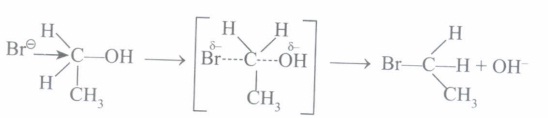
It fIlows SN2 mechanism.
(b) Reimer Tiemann reaction:

4.
The Lucas test differentiates between primary, secondary, and tertiary alcohols.
It is based on the difference in reactivity of the alcohols with HCl in an SN1 reaction:
ROH + HCl→RCl+H2O
It works because secondary carbocations are more stable and form faster than primary carbocations, and tertiary carbocations are so stable that the reaction takes place almost immediately.
5.
\(\begin{equation} \text { (i) } \mathrm{CH}_{3}-\mathrm{O}-\mathrm{CH}_{3}+\mathrm{HI} \longrightarrow \mathrm{CH}_{3}-\mathrm{OH}+\mathrm{CH}_{3}-\mathrm{I} \end{equation}\)
(ii) (a) Protonation of alkene to form carbocation by elecrophilic attack of H3O+.
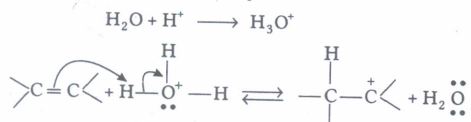
(b) Nucleophilic attack of water on carbocation.
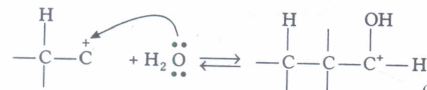
(c) Deprotonation to form an alcohol.
6.
Iodide ion is a powerful nucleophile and hence reacts rapidly with RCl to form RI.
KI ——— K+ + I-; R — Cl + I- ——— R — I + Cl-
Further I- is a better leaving group than CI- ion, therefore, RI is more rapidly hydrolysed than RCl to form ROH.
HO- + R — I ——— R — OH + I-
7.
8.
(i) \({ CH }_{ 3 }CH={ CH }_{ 2 }+{ H }_{ 2 }O\overset { { H }^{ + } }{ \rightleftharpoons } { CH }_{ 3 }-\underset { \overset { | }{ OH } }{ C } -{ CH }_{ 3 }\)
9.
(i) \({ CH }_{ 3 }-\overset { \underset { | }{ { CH }_{ 3 } } }{ \underset { \overset { | }{ { CH }_{ 3 } } }{ C } } -O-{ CH }_{ 3 }+HI\longrightarrow { CH }_{ 3 }-\overset { \underset { | }{ { CH }_{ 3 } } }{ \underset { \overset { | }{ { CH }_{ 3 } } }{ C } } -I+\underset { Methanol }{ { CH }_{ 3 }OH } \)
(ii) \({ CH }_{ 3 }-CH={ CH }_{ 2 }\overset { (i){ B }_{ 2 }{ H }_{ 6 } }{ \underset { (ii)3{ H }_{ 2 }{ O }_{ 2 }/{ H }^{ - } }{ \longrightarrow } } { CH }_{ 3 }{ CH }_{ 2 }{ CH }_{ 2 }OH\)

10.
\((a)\quad { CH }_{ 3 }\underset { Butanal }{ { CH }_{ 2 }{ CH }_{ 2 } } CHO\overset { { H }_{ 2 }/Ni }{ \longrightarrow } { CH }_{ 3 }\underset { Butanal-1-ol }{ { CH }_{ 2 }{ CH }_{ 2 } } OH\\ (b)\quad { CH }_{ 3 }\underset { Propene }{ -CH } ={ CH }_{ 2 }+{ H }_{ 2 }O\overset { { H }_{ 2 }/{ SO }_{ 4 } }{ \longrightarrow } { CH }_{ 3 }-\underset { \overset { | }{ \underset { Prppane-2-ol }{ OH } } }{ CH } -{ CH }_{ 3 }\\ (c)\quad { CH }_{ 3 }-\overset { \underset { \parallel }{ O } }{ C } -{ CH }_{ 3 }+{ CH }_{ 3 }MgBr\longrightarrow { CH }_{ 3 }-\overset { \underset { | }{ OMgBr } }{ \underset { \overset { | }{ { CH }_{ 3 } } }{ C } } -{ CH }_{ 3 }\overset { { H }_{ 2 }/O{ H }^{ + } }{ \longrightarrow } { CH }_{ 3 }-\overset { \underset { | }{ OMgBr } }{ \underset { \overset { | }{ \quad \quad { CH }_{ 3 }\quad } }{ C } } -{ CH }_{ 3 }\)
Propane Methyl magnesium Tert.butoxy 2-Methylpropan-2-ol
bromide magnesium bromide
11.
Reaction of HI with methoxymethane
12.
(a) Cumene (2-phenyl propane) is used in the industrial preparation phenol.
(ii) In non-aqueous medium
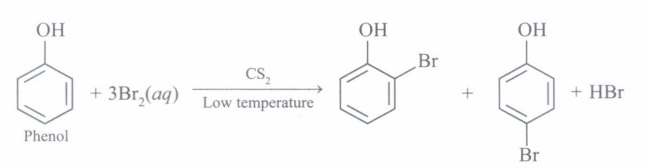
(c) In the case of phenol, the polarisation of bromine molecule takes place even in the absence of Lewis acid. It is due to highly activating effect of -OH group attached to benzene ring. Br2 + H2O \(\longrightarrow
\) HOBr.
Secondly, HOBr breaks into OH- and Br+: \(\mathrm{HOBr} \longrightarrow \mathrm{O} \mathrm{H}+\mathrm{Br}^{+}\) .
13.
(i) In aryl alkyl ethers, +R-effect of the alkoxy group (-OR) increases the electron density on the benzene ring thereby, activating the benzene ring towards electrophilic substitution reactions.
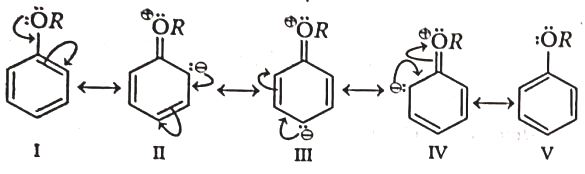
(ii) Alkoxy group (-OR) is ortho, para directing and activates the aromatic ring towards electrophilic substitution.
It directs the incoming electrophilic at o- and p-positions. This is because of the presence of the negative charges at o- and p-positions indicate the more electron density at these positions.
14.
(i) 2, 5-Dimethylphenol
(ii) 2,6-Dimethylphenol
(iii) 1-Methoxy-2-methylpropane.
15.
(i) 2, 2, 4-Trimethylpentan-3-ol
(ii) 5-Ethylheptane-2,4-diol
(iii) Butane -2, 3-diol.
16.
(i) It is due to higher molecular weight, more surface area more vav deer waals, forces of Attraction in C2H2Oh.
(ii) Phenol is the strongest acid than alcohol because phenoxide ion is more stable due to resonance than ethoxide ion.
(iii) It is because ethers are not associated with inter molecular H- bonding, whereas ethanol.
17.
18.
19.
Benzene is heated with conc. sulphuric acid to form benzene sulphonic acid. It is then heated with sodium hydroxide to give sodium phenoixde. Hydrolysis with sulphuric acid gives phenol. The reaction sequence is given above.
20.
(i) If propene is allowed to react with water in the presence of an acid as a catalyst, then propan-2-ol is obtained.
(ii) If benzyl chloride is treated with NaOH (followed by acidification) then benzyl alcohol is produced.
(iii) When ethyl magnesium chloride is treated with methanal, an adduct is the produced which gives propan-1-ol on hydrolysis.
(iv) When methyl magnesium bromide is treated with propane, an adduct is the product which gives 2-methylpropane-2-ol on hydrolysis.

12th Standard CBSE Syllabus & Materials
12th Standard CBSE
CBSE 12th Computer Science Python Revision Tour I - New Previous year Question Papers Study Material - QB365 Set A
NEW12th Standard CBSE
CBSE 12th Business Studies Planning Important Questions And Answers Study Material - QB365 Set A
NEW12th Standard CBSE
CBSE 12th Business Studies Business Environment Important Questions And Answers Study Material - QB365 Set A
NEW12th Standard CBSE
CBSE 12th Business Studies Principles of Management Important Questions And Answers Study Material - QB365 Set A



NCERT Books

Syllabus

Exam Pattern

Sample Question Papers

Previous year Question Papers

Important Notes

MCQ Practice test

NCERT Exemplers

Case study Questions

Image Based Questions

Passage based Questions

HOT Questions

Value Based Questions

Model Questions Papers
NCERT ( Book Back ) Questions

Assertion and Reason
Important Questions And Answers

CBSE 12th Standard CBSE Subjects
CBSE Standards








