
 100% FREE ACCESS
12th Standard CBSE Syllabus & Materials
12th Standard CBSE
CBSE 12th Economics Government Budget and the Economy Previous year Question Papers Study Material - QB365 Set A
NEW12th Standard CBSE
CBSE 12th Computer Science Interface Python with MySQL - New Previous year Question Papers Study Material - QB365 Set A
NEW12th Standard CBSE
CBSE 12th Computer Science Database Concept - New Previous year Question Papers Study Material - QB365 Set A
NEW12th Standard CBSE
CBSE 12th Computer Science Data Communication - New Previous year Question Papers Study Material - QB365 Set A
NEW12th Standard CBSE
CBSE 12th Computer Science Data Structures - New Previous year Question Papers Study Material - QB365 Set A
NEW12th Standard CBSE
CBSE 12th Computer Science Functions - New Previous year Question Papers Study Material - QB365 Set A

Published on: 25/10/2025
Download CBSE Class 12th Standard CBSE Chemistry question papers, sample papers, important questions, and previous year solved papers in PDF format. Get free study materials, NCERT solutions, and exam preparation resources for Class 12th Standard CBSE Chemistry
Questions + Answers key
Take MCQ Chemistry Test
1.
Give two reactions that show the acidic nature of phenol. Compare its acidity with that of ethanol.
2.
[Fe(CN)6]4- and [Fe(H2O)6]2+ are of different colours in dilute solutions. Why?
3.
Although phenoxide ion has more number of resonating structures than carboxylate ion, carboxylic acid is a stronger acid than phenol. Give two reasons.
4.
Classify the following amines as primary, secondary or tertiary:
(i)
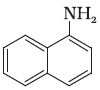
(ii)
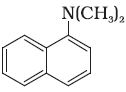
(iii) \(\left(\mathrm{C}_{2} \mathrm{H}_{5}\right)_{2} \mathrm{CHNH}_{2}\)
(iv) \(\left[\mathrm{C}_{2} \mathrm{H}_{5}\right)_{2} \mathrm{NH}\)
5.
The \(E^{\ominus}\left(\mathrm{M}^{2+} / \mathrm{M}\right)\) value for copper is positive (+0.34 V). What is possibly the reason for this? (Hint: consider it's high \({ \Delta }_{ a }{ H }^{ o }\) and low \({ \Delta }_{ hyd }{ H }^{ o } \))
6.
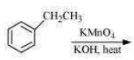
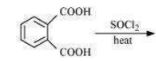
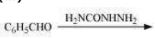
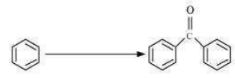
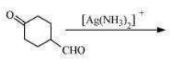
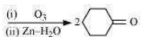
Complete each synthesis by giving missing starting material, reagent or products.
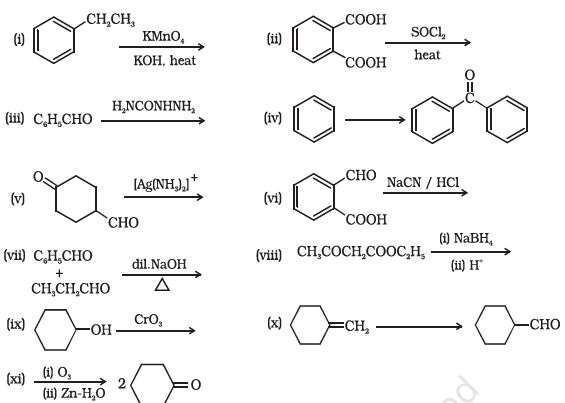
7.
Write short notes on the following:
(i) Carbylamine reaction
(ii) Diazotisation
(iii) Hoffmann's bromamide reaction
(iv) Coupling reaction
(v) Ammonolysis
(vi) Acylation
(vii) Carbylamine reaction
8.
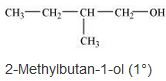
(a) Draw the structures of all isomeric alcohols of molecular formula C5H12O and give their IUPAC names.
(b) Classify the isomers of alcohols in above part as primary, secondary and tertiary alcohols.
9.
Mark the correct order of decreasing acid strength of the following compounds.
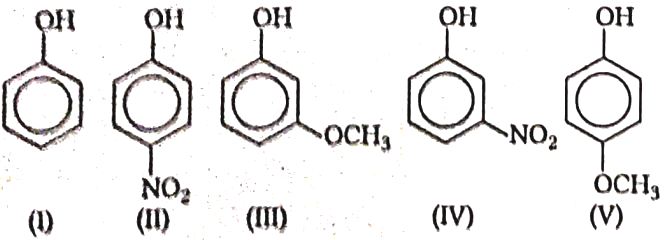
V > IV > II > I > III
II > IV > I > III > V
IV > V > III > II > I
V > IV > III > II > I
10.
Which of the following complexes is a 'Chelate' complex?
[CO(NH3)6]3+
[Co(en)3]3+
[Co(NH3)4 Cl2]
[CoF6]3+
11.
Which is most reactive towards Nucleophilic substitution reaction?
Benzaldehyde
Acetophenone
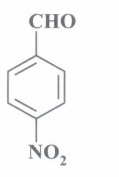
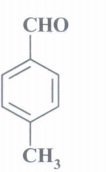
12.
Identify 'C' in the following:

Water
Ethanol
Propanone
Cumene hydroperoxide
13.
Which of the following statements are correct about this reaction?
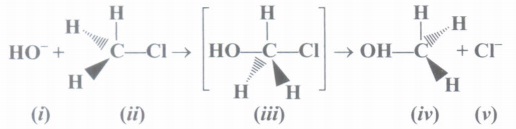
The given reaction follows SN2 mechanism
(ii) and (iv) have opposite configuration.
(ii) and (iv) have same configuration.
The given reaction follows SN1 mechanism.
14.
IUPAC name of \(\alpha\)- acetyl succinic acid is
2 - (1-oxoethyl) butane-1,4-dioic acid
3 - (2-oxoethyl) butane-1,4-dioic acid
Hexan - 1, 6-dioic acid
Butane -1,4 - dicarboxylic acid
15.
For the reaction of the type M+ 4L⇌ ML4
larger the stability constant, lower the proportion of ML4 that exists in solution
larger the stability constant, higher the proportion of ML4 that exists in solution
smaller the stability constant, higher the proportion of ML4 that exists in solution
none of the above
16.
Which of the following compounds will dissolved in an alkali solution after it undergoes reaction with Hinsberg's reagent?
CH3NH2
(CH3)3N
(C2H5)2NH
C6H5NHC6H5
17.
Which element do you expect to have the highest melting point ?
La
W
Os
Pt
18.
Identify the incorrect statement among the following :
Shielding power of 4f electrons is quit weak
There is a decrease in the radii of the atoms or ions as one proceeds from La to Lu
Lanthanoid contraction is the accumulation of successive shrinkages.
As a result of lanthanoid contraction, the properties of 4d series of the transition elements have no similarities with the 5d series of the elements.
19.
Gadolinium belongs to 4 f series. Its atomic number is 64. Which of the following is the correct electronic configuration of gadolinium ?
[Xe]4 f 9 5 s 1
[Xe] 4 f 7 5 d1 6 s2
[Xe] 4 f 6 5 d2 6 s2
[Xe] 4 f 86 d2
20.
The correct order of decreasing second ionization enthalpy of Ti (22), V(23), Cr(24) and Mn(25) is
V > Mn > Cr > Ti
Mn > Cr > Ti > V
Ti > V > Cr > Mn
Cr > Mn > V > Ti
21.
Identify the combination of compounds that undergo Aldol condensation followed by dehydration to produce but-2-enal.
methanal and ethanal
two moles of ethanal
methanal and propanone
two moles of ethanol
22.
The major product obtained on interaction of phenol with sodium hydroxide and carbon dioxide is
salicylaldehyde
salicylic acid
phthalic acid
benzoic acid
23.
Which of the following easily undergo nucleophilic substitution by SN1 mechanism in butanol ?
C6H5CH2Br
BrCH2CH = CH2
(CH3)3CBr
(CH3)3CCH2Br
24.
Ethylene chloride and ethylidene chloride are isomers. Identify the correct statements.
Both the compounds form same product on treatment with alcoholic KOH
Both the compounds form same product on treatment with alcoholic KOH
Both the compounds form same product on reduction
Both the compounds are optically active
25.
CuCl is insoluble in water but it dissolves in KCl solution. This is due to the formation of the complex
K2[CuCl3]
K3[CuCl4]
K[CuCl2]
All of these
26.
The number of geometrical isomers that can exist for square planer [Pt(Cl) (py) (NH3) (NH2OH)]+ is (py=pyridine)
4
6
2
3
27.
(i) What happens when phenol reacts with
(a) conc. HNO3 and
(b) CHCl3 in presence of aqueous NaOH followed by acidification?
(ii) Why does the reaction of CH3ONa with (CH3)3C - Br gives 2-methylpropene and not (CH3)3 C - O-O-OCH3?
28.
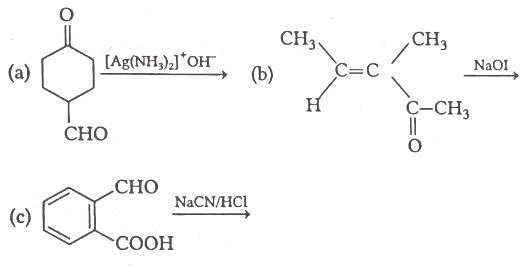
Draw the structures of major product(s) in each of the following reactions:
29.
Write the IUPAC name and indicate the shape of the complex ion [Co(en)2Cl(ONO)]+ (Atomic no of Co = 27)
30.
Write the structures of A, Band C in the following:
(i) C6H5-CONH2
(i) \({ CH }_{ 3 }-CI\overset { KCN }{ \longrightarrow } A\overset { { LiAIH }_{ 4 } }{ \longrightarrow } b\overset { { CHCI }_{ 3 }+alc.KOH }{ \longrightarrow } C.\)
31.
Write chemical tests to distinguish between:
(i) Formic acid and acetic acid
(ii) Acetic acid and acetaldehyde
(iii) Phenol and propanoic acid
32.
The oxidation number of the central atom in a complex is defined as the charge it would carry if all the ligands are removed along with the electron pairs that are shared with the central atom. Similarly the charge on the complex is the sum of the charges of the constituent parts, i.e. the sum of the charges on the central metal ion and its surrounding ligands.
Based on this, the complex is called neutral if the sum of the charges of the constituents is equal to zero. However, for an anion or cationic complex, the sum of the charges of the constituents is equal to the charge on the coordination sphere.
Based on the above information, answer the following questions.
(a) Define ambidentate ligand with an example.
(b) What type of isomerism is shown by [Co(NH3)5Cl]SO4 and [Co(NH3)5SO4]Cl?
(c) Define chelate effect. How it affects the stability of complex?
Or
(c) Find the coordination number and oxidation state of chromium in Na3[Cr(C2O4)3].
33.
Read the passage given below and answer the following questions:
When haloalkanes with \(\beta\)-hydrogen atom are boiled with alcoholic solution of KOH, they undergo elimination of hydrogen halide resulting in the formation of alkenes. These reactions are called \(\beta\)-elimination reactions or dehydrohalogenation reactions. These reactions follow Saytzeff's rule. Substitution and elimination reactions often compete with each other. Mostly bases behave as nucleophiles and therefore can engage in substitution or elimination reactions depending upon the alkyl halide and the reaction conditions.
The following questions are multiple choice questions. Choose the most appropriate answer:
(i) Among the following the most reactive towards alcoholic KOH is
|
(a) \(\mathrm{CH}_{2}=\mathrm{CHBr}\) |
(b) \(\mathrm{CH}_{3} \mathrm{COCH}_{2} \mathrm{CH}_{2} \mathrm{Br}\) |
(c) \(\mathrm{CH}_{3} \mathrm{CH}_{2} \mathrm{Br}\) |
(d) \(\mathrm{CH}_{3} \mathrm{CH}_{2} \mathrm{CH}_{2} \mathrm{Br}\) |
(ii) The general reaction, \(R-X \stackrel{\text { aq. } \mathrm{OH}^{-}}{\longrightarrow} R \mathrm{OH}+X^{-}\) is expected to follow decreasing order of reactivity as in (t- Bu = tertiary Butyl group)
| (a) t-BuI> t-BuBr > t-BuCI > t-BuF | (b) t-BuF> t-BuCI > t-BuBr > t-BuI |
| (c) t-Bu'Br> t-BuCI > t-BuI > t-BuF | (d) t-BuF> t-BuCI > t-BuI > t-BuBr |
(iii) Reaction of t-butyl bromide with sodium methoxide produces
| (a) sodium t-butoxide | (b) t-butyl methyl ether |
| (c) iso-butane | (d) iso-butylene. |
(iv) In the elimination reactions, the reactivity of alkyl halides follows the sequence
| (a) R - F > R - Cl > R - Br > R - I | (b) R - I > R - Br > R - Cl > R - F |
| (c) R - I > R - F > R - Br > R - Cl | (d) R - F > R-I > R-Br > R-CI |
34.
Read the passage given below and answer the following questions:
The f-block elements are those in which the differentiating electron enters the (n -2) forbital. There are two series of f-block elements corresponding to filling of 4f and 5f-orbitals. The series of 4f- orbitals is called lanthanides. Lanthanides show different oxidation states depending upon stability of f0, f7 and f14 configurations, though the most common oxidation states is +3. There is a regular decrease in size of lanthanides ions with increase in atomic number which is known as lanthanide contraction.
The following questions are multiple choice questions. Choose the most appropriate answer:
(i) The atomic numbers of three lanthanide elements X, Y and 2 are 65, 68 and 70 respectively, their Ln3+ electronic configuration is
| (a) 4f8, 4f11, 4f13 | (b) 4f11, 4f8 , 4f13 | (c) 4fo, 4f2, 4f11 | (d) 4f3, 4f7, 4f9 |
(ii) Lanthanide contraction is observed in
| (a) Gd | (b) At | (c) Xe | (d) Te |
(iii) Name a member of the lanthanoid series which is well known to exhibit +4 oxidation state.
| (a) Cerium (Z = 58) | (b) Europium (Z = 63) | (c) Lanthanum (Z = 57) | (d) Gadolinium (Z = 64) |
(iv) Identify the incorrect statement among the following.
| (a) Lanthanojd contraction is the accumulation of successive shrinkages. |
| (b) The different radii of Zr and Hf due to consequence of the lanthanoid contraction. |
| (c) Shielding power of 4f electrons is quite weak. |
| (d) There is a decrease in the radii of the atoms or ions as one proceeds from La to Lu. |
1.
The reactions showing acidic nature of phenol are:
(i) Reaction with sodium. Phenol reacts with active metals like sodium to liberate H2 gas.
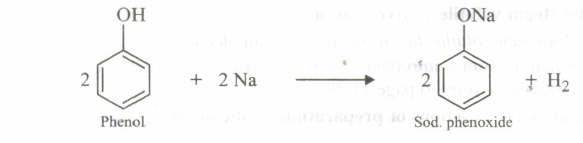
(ii) Reaction with NaOH. Phenol dissolves in NaOH to form sod. phenoxide and water.
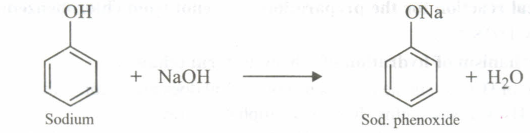
Comparison of acidic character of phenol and ethanol. Phenol is more acidic than ethanol. This is due to the reason that phenoxide ion left after the loss of a proton from phenol is stabilized by resonance (Refer to structures,VI to X on page 11/25) while ethoxide ion (left after loss of a proton from ethanol) is not.
2.
In both the complexes, Fe is in +2 state with the configuration 3d6, i.e., it has four unpaired electrons. As the ligands H2O and CN- possess different crystal field splitting energy, they absorb different components of the visible light (VIBGYOR) for d - d transition. Hence, the transmitted colours are different.
3.
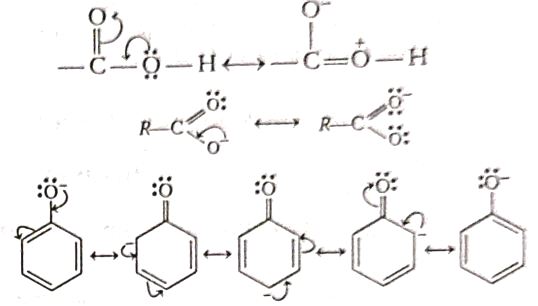
(i) Phenoxide ion has non-equivalent resonance structures in which the negative charge is at the lesser electronegative carbon atom, whereas in case of carboxylate ion both the resonating structures are equivalent.
(ii) The negative charge is delocalised over two electronegative oxygen atoms in carboxylate ion, whereas in phenoxide ion, the negative charge less effectively delocalises over one oxygen atom and less electronegative carbon atoms.
So, the carboxylate ion is more resonance stabilised than phenoxide ion. Thus, the release of proton from carboxylic acid is much easier than from phenol. Hence, carboxylic acid is a stronger acid than phenol.
4.
(i) Primary
(ii) Tertiary
(iii) Primary
(iv) Secondary
5.
It is because hydration energy and lattice energy of Cu2+ is more than that of Cu+.
6.
(i)
(ii)
(iii)
(iv)
(v)
(vi)
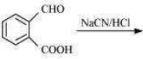
(vii)
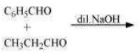
(viii)
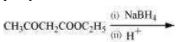
(ix)
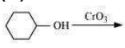
(x)

(xi)
7.
(i) Carbylamine Reaction: When primary amne reacts with CHCl3 and KOH, it forms isocyanide which is an offensive smelling compund.
\(RN{ H }_{ 2 }+CHC{ l }_{ 3 }+3KOH\rightarrow RN\overset { = }{ \rightarrow } C+3KCl+3{ H }_{ 2 }O\)
(ii) Diazotisation: When aniline is reacted with NaNO2 and conc. HCl at 0-5o C, benzene diazonium chloride is formed.

(iii) Hoffman's Bromamide Reaction: When amide react with Br2 and KOH or NaOH to form lower amines, it is called Hoffman's Bromamide Reaction.

(iv) Coupling reaction: When benzene diazonium chloride reacts with phenol, the orange azo dye is formed.

(v) Ammonolysis: When alkyl halide with an excess of NH3 primary amines are formed.
C2H5Cl+NH3 \(\rightarrow\)C2H5NH2+HCl
(vi)Carbylamine reaction (i) Carbylamine reaction When aliphatic/ aromatic primary amines are heated with chloroform and alc KOH, foul-smelling alkyl isocyanides or carbylamines are obtained. Secondary or tertiary amines do not give this test.
(vii) \(\mathbf{P h}-\mathbf{N H}_{2}+\mathbf{C H C l}_{3}+3 \mathbf{K} \mathbf{O H} \stackrel{\Delta}{\longrightarrow} \mathbf{P h}-\mathbf{N C}+3 \mathbf{K} \mathbf{C l}+\mathbf{3 H}_{2} \mathbf{O}\)
2 ° and 3 ° (aromatic/aliphatic) do not give this reaction.
8.
(a) \(\mathrm{CH}_{3}-\mathrm{CH}_{2}-\mathrm{CH}_{2}-\mathrm{CH}_{2}-\mathrm{CH}_{2}-\mathrm{OH}\)
(b)
(c)
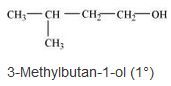
(d)
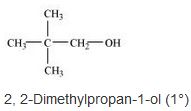
(e)
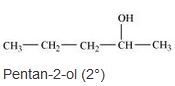
(f)
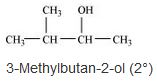
(g)
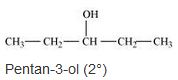
(h)
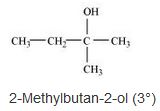
(ii) Primary alcohol: Pentan-1-ol; 2-Methylbutan-1-ol;
3-Methylbutan-1-ol; 2, 2 - Dimethylpropan-1-ol
Secondary alcohol: Pentan-2-ol; 3-Methylbutan-2-ol;
Pentan-3-ol
Tertiary alcohol: 2-methylbutan-2-ol
9.
(b)
II > IV > I > III > V
10.
(b)
[Co(en)3]3+
11.
(c)
12.
(c)
Propanone
13.
(a)
The given reaction follows SN2 mechanism
14.
(a)
2 - (1-oxoethyl) butane-1,4-dioic acid
15.
(b)
larger the stability constant, higher the proportion of ML4 that exists in solution
16.
Amines form benzenesulphonamides which are soluble in alkali, i.e., option (a) is correct.
17.
(b)
W
18.
(d)
As a result of lanthanoid contraction, the properties of 4d series of the transition elements have no similarities with the 5d series of the elements.
19.
(b)
[Xe] 4 f 7 5 d1 6 s2
20.
(d)
Cr > Mn > V > Ti
21.
(b)
two moles of ethanal
22.
(b)
salicylic acid
23.
(a)
C6H5CH2Br
24.
(a)
Both the compounds form same product on treatment with alcoholic KOH
25.
(d)
All of these
26.
(d)
3
27.
28.
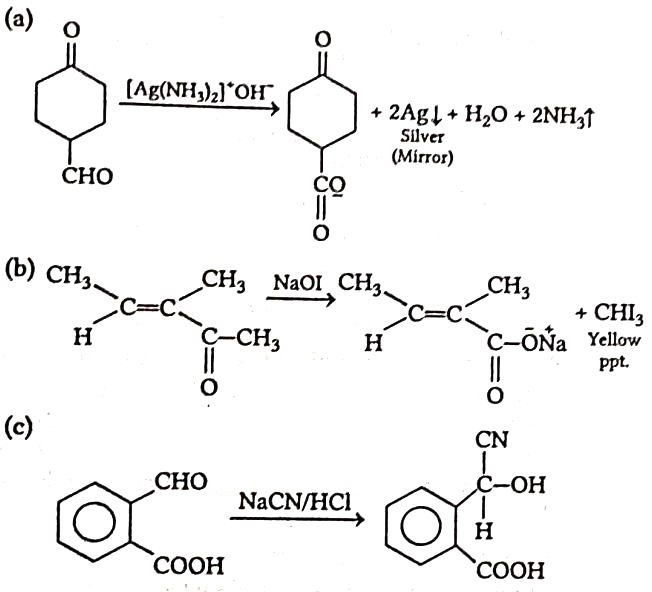
29.
IUPAC name
Chlorido bis-(ethylene diamine)
nitrito-O-cobalt (III) ion.
The complex is octahedral in shape as en' is a bidentatc ligand, so coordination number
= 2 x 2+1+1 = 6
30.
(i) \({ C }_{ 6 }{ H }_{ 5 }-{ CONH }_{ 2 }\overset { { Br }_{ 2 }/KOH }{ \longrightarrow } { C }_{ 6 }{ H }_{ 5 }{ NH }_{ 2 }\)
\([A]\overset { { NaNO }_{ 2 }+HCI }{ \longrightarrow } { C }_{ 6 }{ H }_{ 5 }{ N }_{ 2 }^{ + }{ CI }^{ - }[B]\overset { KI }{ \longrightarrow } { C }_{ 6 }{ H }_{ 5 }I[C]\)
(ii) \({ CH }_{ 3 }CI\overset { KCN }{ \longrightarrow } { CH }_{ 3 }CN[A]\overset { { LiAIH }_{ 4 } }{ \longrightarrow } { CH }_{ 3 }{ CH }_{ 2 }{ NH }_{ 2 }[B]\overset { { CHCI }_{ 3 }+KOH }{ \longrightarrow } { CH }_{ 3 }{ CH }_{ 2 }NC[C]\)
31.
(i) Formic acid gives silver mirror test with Tollen's reagent whereas acetic acid does not give this test.
\(\underset { Formic\quad acid }{ HCOOH } +\underset { Tollen's\quad reagent }{ 2[{ Ag({ NH }_{ 3 }) }_{ 2 }]OH } \longrightarrow \underset { Silver\quad mirror }{ 2Ag } +{ 2H }_{ 2 }O+{ CO }_{ 2 }+{ NH }_{ 3 }\)
(ii) Acetaldehyde gives silver mirror test with Tollen's reagent
\({ CH }_{ 3 }CHO+\underset { Tollen's\quad reagent }{ 2[{ Ag({ NH }_{ 3 }) }_{ 2 }]OH } \longrightarrow { CH }_{ 3 }CON{ H }_{ 4 }+2Ag+{ H }_{ 2 }O+{ 3NH }_{ 3 }\)
Acetic acid does not give silver mirror
(iii) Propanoic acid reacts with NaHCO3 to give effervescence due to the evolution of CO2
\({ CH }_{ 3 }{ CH }_{ 2 }COOH+NaHC{ O }_{ 3 }\longrightarrow { CH }_{ 3 }{ CH }_{ 2 }COONA+{ H }_{ 2 }O+{ CO }_{ 2 }\)
32.
(a) When a ligand is bonded through a two different atoms, it is said to be ambidendate ligand,
e.g. \(\mathrm{NO}_2^{-}\), SCN-, CN-.
(b) [Co(NH3)5Cl]SO4 and [Co(NH3)5SO4]Cl show ionisation isomerism.
This type of isomerism arises when compounds give different ions in the solution although they have same composition.
(c) Chelate effect signify the stabilisation of coordination compounds due to the formation of metal chelates. The chelating ligands form more stable complexes than the unidentate analoges because when chelation occurs, entropy decreases and the process becomes more favourable and form a ring complexes which is known as chelate ring.
Or
(c) In complex Na3[Cr(C2O4)3] the coordination number of Cr is 6 as oxalate is a bidentate ligand.
Let, the oxidation number of Cr be x.
\(\therefore\) 3 + x + 3(-2) = 0
x = + 3
Thus, oxidation state of Cr be +3.
33.
(i) (d): In alkyl halides, polarity of C - Br bond increases with increase in chain length.
(ii) (a): The order of reactivity of alkyl halides: iodide > bromide > chloride (nature of the halogen atom)
tertiary> secondary> primary (type of halogen atom).
(iii) (d) : Iso-butylene is obtained.
(iv) (b): The order of bond dissociation energy: R - F > R - CI > R - Br > R - I. During dehydrohalogenation C - I bond breaks more easily than C - F bond. So reactivity order of halides R - I > R - Br > R - CI > R - F
34.
(i) (a):Terbium (65), 4f8; Dysprosium (Dy), 4f9; Ytterbium (Yb), 4f13.
(ii) (a)
(iii) (a)
(iv) (b): The almost identical radii of Zr (160 pm) and Hf(159 pm), a consequence of lanthanoid contraction.

12th Standard CBSE Syllabus & Materials
12th Standard CBSE
CBSE 12th Computer Science Python Revision Tour I - New Previous year Question Papers Study Material - QB365 Set A
NEW12th Standard CBSE
CBSE 12th Business Studies Planning Important Questions And Answers Study Material - QB365 Set A
NEW12th Standard CBSE
CBSE 12th Business Studies Business Environment Important Questions And Answers Study Material - QB365 Set A
NEW12th Standard CBSE
CBSE 12th Business Studies Principles of Management Important Questions And Answers Study Material - QB365 Set A



NCERT Books

Syllabus

Exam Pattern

Sample Question Papers

Previous year Question Papers

Important Notes

MCQ Practice test

NCERT Exemplers

Case study Questions

Image Based Questions

Passage based Questions

HOT Questions

Value Based Questions

Model Questions Papers
NCERT ( Book Back ) Questions

Assertion and Reason
Important Questions And Answers

CBSE 12th Standard CBSE Subjects
CBSE Standards








