
 100% FREE ACCESS
12th Standard CBSE Syllabus & Materials
12th Standard CBSE
CBSE 12th Economics Government Budget and the Economy Previous year Question Papers Study Material - QB365 Set A
NEW12th Standard CBSE
CBSE 12th Computer Science Interface Python with MySQL - New Previous year Question Papers Study Material - QB365 Set A
NEW12th Standard CBSE
CBSE 12th Computer Science Database Concept - New Previous year Question Papers Study Material - QB365 Set A
NEW12th Standard CBSE
CBSE 12th Computer Science Data Communication - New Previous year Question Papers Study Material - QB365 Set A
NEW12th Standard CBSE
CBSE 12th Computer Science Data Structures - New Previous year Question Papers Study Material - QB365 Set A
NEW12th Standard CBSE
CBSE 12th Computer Science Functions - New Previous year Question Papers Study Material - QB365 Set A

Published on: 25/10/2025
Download CBSE Class 12th Standard CBSE Chemistry question papers, sample papers, important questions, and previous year solved papers in PDF format. Get free study materials, NCERT solutions, and exam preparation resources for Class 12th Standard CBSE Chemistry
Questions + Answers key
Take MCQ Chemistry Test
1.
Write the structure of 4-chloropentan-2-one.
2.
Discuss the role of Lewis acid in the preparation of aryl bromides and chlorides in the dark.
3.
The reaction A + B \(\longrightarrow\) C has zero order. What is the rate equation ?
4.
When phenol is treated with bromine water, white precipitate is obtained. Give the structure and the name of the compound formed.
5.
In some cases it is found that a large number of colliding molecules have energy more than threshold energy but yet the reaction is slow. Why?
6.
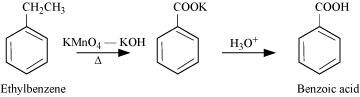
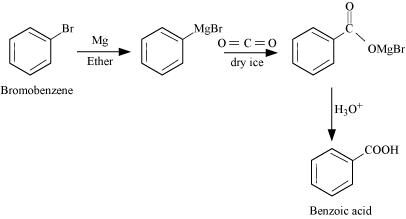
How can you convert each of the following compounds to benzoic acid?
1. Acetophenone
2. Ethylbenzene
3. Bromobenzene
7.
(i) How will you distinguish between the following pair by suitable chemical tests? butan-1-ol and butan-2-ol
(ii) Complete the following reaction:
\(\mathrm{HOCH}_{2}-\mathrm{CHOH}-\mathrm{CH}_{2} \mathrm{OH} \stackrel{\mathrm{HI}}{\longrightarrow}\)
8.
Among the following alcohols, which will yield the corresponding alkyl chloride on reaction with concentrated HCI at room temperature?
\(C{H}_{\mathit{3}}-C{H}_{\mathit{2}}\mathit{-}\underset{\overset{\mathit{|}}{C{H}_{3}}}{CH}\mathit{-}{CH}_{2}OH\)
\(C{H}_{\mathit{3}}C{H}_{\mathit{2}}\mathit{-}\underset{\overset{\mathit{|}}{C{H}_{3}}}{\overset{\underset{\mathit{|}}{C{H}_{\mathit{3}}}}{C}}\mathit{-}OH\)
\(C{H}_{\mathit{3}}-C{H}_{\mathit{2}}-C{H}_{\mathit{2}}\mathit{-}\underset{\overset{\mathit{|}}{C{H}_{3}}}{CH}\mathit{-}OH\)
9.
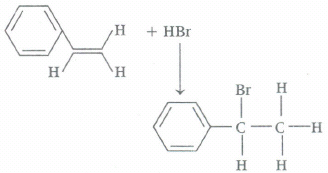
Complete the following reactions
.png)
.png)
\(CH_{ 3 }CH_{ 2 }CH=CH_{ 2 }+HBr\rightarrow \)
10.
The rate constant of a reaction is 3\(\times\)102h-1. What is the order of the reaction?
11.
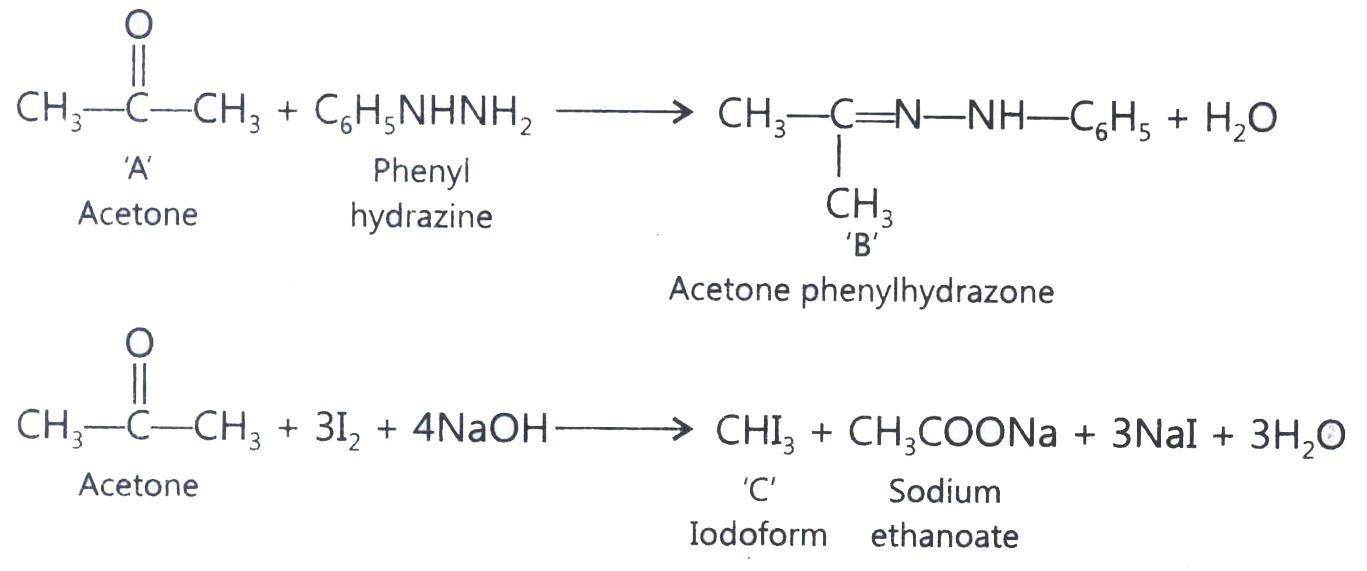
An aliphatic compound 'A' with a molecular formula of C3H6O reacts with phenylhydrazine to give compound 'B'. Reaction of 'A' with I2 in alkaline medium on warming, gives a yellow precipitate 'C'. Identify the compounds A, B and C.
12.
Explain the following observations:
(i) The boiling point of ethanol is higher than that of methoxymetane .
(ii) Phenol is more acidic than ethanol.
(iii)o-and p-nitrophenols are more acidic than phenol.
13.
The half-life for a zero order reaction equals
\(\frac{2 k}{R}\)
\(\frac{1}{2} \frac{k}{R^2}\)
\(\frac{R^2}{2 k}\)
\(\frac{R}{2 k}\)
14.
Which of the following undergoes nucleophilic substitution exclusively by SN1 mechanism?
Benzyl chloride
Ethyl chloride
Chlorobenzene
Isopropyl chloride
15.
The half life period of first order reaction is 1386 seconds. The specific rate constant ofthe reaction is
0.5 x 10- 2 s-1
0.5 x 10- 3 s-1
5.0 x 10- 2 s-1
5.0 x 10⁻³ S-1
16.
C6H514COOH on heating with Na2CO3 realeases
CO2
14CO2
CO
none of these
17.
Acetone on distillation with conc.H2SO4 forms
phorone
acrolein
mesitylene
mesityl oxide
18.
Among the following the one which reacts most readily with ethanol is
p-nitrobenzyl
p-chlorobenzyl
p-methoxybenzyl bromide
p-methylbenzyl bromide
19.
The correct order of acid strength of the following substituted phenol in water at 280C is
p-nitrophenol < p-fluorophenol < p-chlorophenol
p-chlorophenol < p-fluorophenol < p-nitrophenol
p-fluorophenoll < p-chlorophenol < p-nitrophenol
p-fluorophenoll < p-nitrophenol < p-chlorophenol
20.
HC \(\equiv\) CH \(\overset { HgSO_{ 4 } }{ \underset { H_{ 2 }{ SO }_{ 4 } }{ \longrightarrow } } \) \(\overset {(i)CH_3 MgBr }{ \underset { (ii)H_2O}{ \longrightarrow } } \) \(\overset {PBr_3} { \longrightarrow } \) gives
CH3CHBrCH3
CH3CH2CH2Br
CH2=CH-Br
BrCH=CH-CH3
21.
Acetic acid is treated with Ca(OH)2 and the product so obtained is subject to dry distillation. The final product is
propanal
ethanol
ethanal
propanone
22.
Alkyl halides are prepared from alcohols by treating with
HCl+ZnCl2
Red P+Br2
H2SO4+KI
All the above
23.
The arrangements of following compounds :
(i) bromomethane
(ii) bromoform
(iii) chloromethane
(iv) dibromomethane
in the increasing order of their voiling point is
(iv) < (iii) < (i) < (ii)
(i) < (ii) < (iii) < (iv)
(iii) < (i) < (iv) < (ii)
(ii) < (iii) < (i) < (iv)
24.
Kinetics of the reaction A (g) \(\longrightarrow\) 2 B (g) + C (g) is followed by measuring the total pressure at different times. It is given that
Initial pressure of A = 0.5 atm.
Total pressure of A after 2 hours = 0.7 atm
Rate constant of the reaction = 1 \(\times 10 ^{-3}s^{-1}\)
What is the rate of reaction \(-\frac {d[A]}{dt}\) when the total pressure is 0.7 atm?
2.0 \(\times 10^{-4}M s^{-1}\)
4.0\(\times 10^{-4}M s^{-1}\)
5.0\(\times 10^{-4}M s^{-1}\)
7.0\(\times 10^{-4}M s^{-1}\)
25.
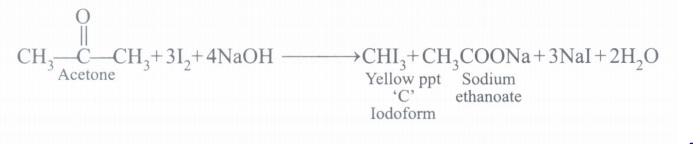
(a) An organic compound A, having the formula, C3H8O, on treatment with copper at 573 K, gives B. B does not reduce Fehling's solution but gives a yellow precipitate of the compound C with I2/NaOH. Deduce the structures of A, Band C.
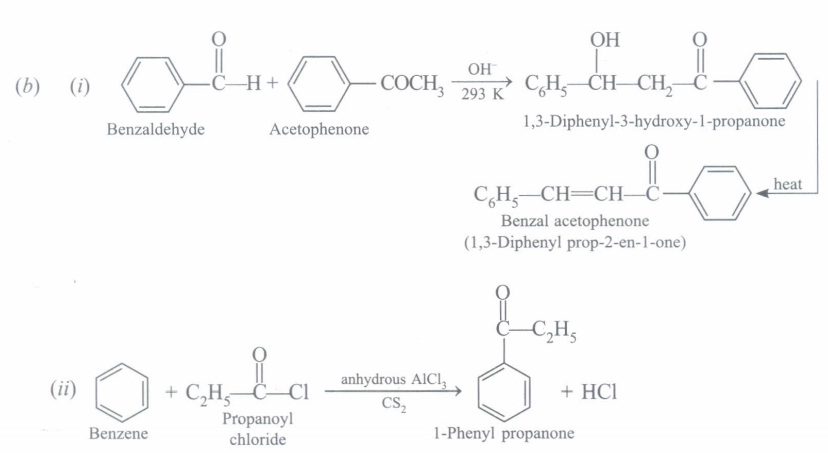
(b) Predict the products of the following reactions:
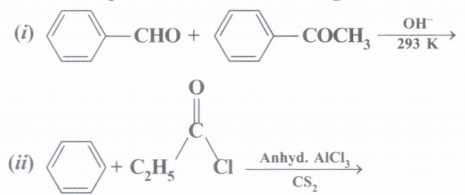
26.
(a) For a reaction A + B⟶P, the rate is given by Rate = k[A] [B]2
(i) How is the rate of reaction affected if the concentration of B is doubled?
(ii) What is the overall order of reaction if A is present in large excess?
(b) A first order reaction takes 30 minutes for 50% completion. Calculate the time required for 90% completion of this reactions. (log 2 = 0.3010)
27.
An organic compound (A) with molecular formula C6H6O gives a characteristic colour with aqueous FeCl3 solution. When (A) is treated with CO2 and NaOH at 410K under pressure, it gives compound (B) which upon acidification gives compound (C). Compound (C) reacts with acetyl chloride to give (D) which is a popular pain killer, Deduce the structures of (A), (B), (C) and (D) and explain all the reactions involved.
28.
Assertion: Boiling point of alkyl halides increases with increase in molecular weight.
Reason: Boiling point of alkyl halides is in the order RI > RBr > RCI >RF
Codes:
A) Assertion and reason both are correct statements and reason is correct explanation for assertion.
B) Assertion and reason both are correct statements but reason is not correct explanation for assertion.
C) Assertion is correct statement but reason is wrong statement.
D) Assertion is wrong statement but reason is correct statement.
29.
Assertion: Benzaldehyde is more reactive than ethanol towards nucleophilic attack.
Reason: The overall effect of –I and +R effect of phenyl group decrease the electron density on the carbon atom of > C = O group in benzaldehyde.
Codes:
(a) If both assertion and reason are true and the reason is the correct explanation of the assertion.
(b) If both assertion and reason are true but the reason is not the correct explanation of the assertion.
(c) If the assertion is true but the reason is false.
(d) If the assertion is false but the reason is true.
(e) If the assertion and reason both are false
30.
Assertion (A) : Order and molecularity of a reaction are always same.
Reason (R) : Complex reactions involve a sequence of elementary reactions and the slowest step is rate determining.
(a) Both Assertion and Reason are correct, Reason is the correct explanation of Assertion.
(b) Both Assertion and Reason are correct, Reason is not the correct explanation of Assertion.
(c) Assertion is correct; Reason is incorrect.
(d) Assertion is incorrect; Reason is correct.
31.
In the following questions. an Assertion (A) is followed by a corresponding Reason (R) Use the following keys to choose the appropriate answer.
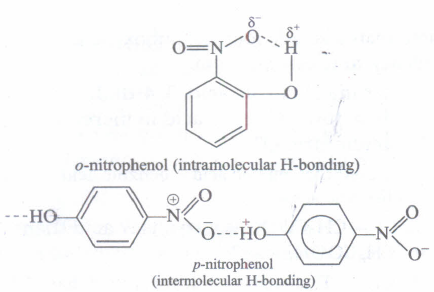
Assertion (A) o-nitrophenol is less volatile than p-nitrophenol.
Reason (R) There is intramolecular hydrogen bonding in o-nitrophenol and intermolecular hydrogen bonding in p-nitrophenol.
Codes:
(a) Both (A) and (R) are correct, (R) is the correct explanation of (A).
(b) Both (A) and (R) are correct, (R) is not the correct explanation of (A).
(c) (A) is correct; (R) is incorrect.
(d) (A) is incorrect; (R) is correct.
32.
Read the passage given below and answer the following questions:
Haloarenes are less reactive than haloalkanes. The low reactivity of haloarenes can be attributed to
(i) resonance effect
(ii) Sp2 hybridisation of C - X bond
(iii) polarity of C - X bond
(iv) instability of phenyl cation (formed by self-ionisation ofhaloarene)
(v) repulsion between the electron rich attacking nucleophiles and electron rich arenes.
Reactivity of haloarenes can be increased or decreased by the presence of certain groups at certain positions for example, nitro (-NO2) group at olp positions increases the reactivity of haloarenes towards nucleophilc substitution reactions.
The following questions are multiple choice questions. Choose the most appropriate answer:
(i) Aryl halides are less reactive towards nucleophilic substitution reaction as compared to alkyl halides due to
| (a) the formation ofless stable carbonium ion | (b) resonance stabilisation |
| (c) larger carbon-halogen bond | (d) inductive effect. |
(ii) Which of the following aryl halides is the most reactive towards nucleophilic substitution?
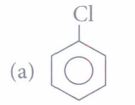 |
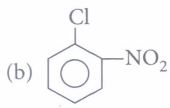 |
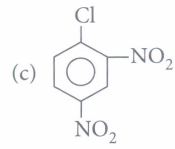 |
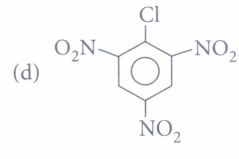 |
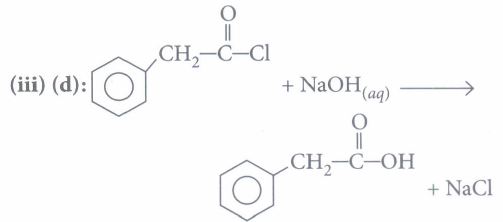
(iii) Which one of the following will react fastest with aqueous NaOH?
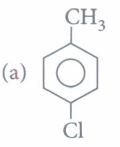 |
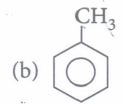 |
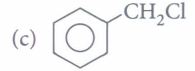 |
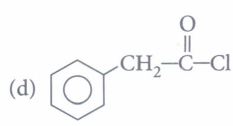 |
The reactivity of the compounds (i) MeBr, (ii) PhCH2Br, (iii) MeCI, (iv) p- MeOC6H4Br decreases as
| (a) (i) > (ii) >(iii) > (iv) | (b) (iv) > (ii) >(i) > (iii) |
| (c) (iv) > (iii) >(i) > (ii) | (d) (ii) > (i) > (iii) > (iv) |
33.
Read the passage given below and answer the following questions :
The half-life of a reaction is the time required for the concentration of reactant to decrease by half, i.e.,
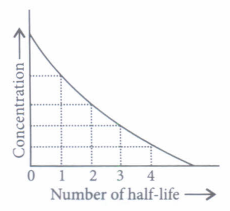
\([A]_{t}=\frac{1}{2}[A]\)
For first order reaction,
\(t_{1 / 2}=\frac{0.693}{k}\) this means t1/2 is independent of initial concentration. Figure shows that typical variation of concentration of reactant exhibiting first order kinetics. It may be noted that though the major portion of the first order kinetics may be over in a finite time, but the reaction will never cease as the concentration of reactant will be zero only at infinite time
The following questions are multiple choice questions. Choose the most appropriate answer:
(i) A first order reaction has a rate constant k = 3.01 x 10⁻³ is. How long it will take to decompose half of the reactant?
| (a) 2.303 s | (b) 23.03 s | (c) 230.3 s | (d) 2303 s |
(ii) The rate constant for a first order reaction is 7.0x 10⁻⁴ s-1. If initial concentration of reactant is 0.080 M, what is the half life of reaction?
| (a) 990 s | (b) 79.2 s | (c) 12375 s | (d) 10.10 x 10⁻⁴ s |
(iii) For the half-life period of a first order reaction, which one of the following statements is generally false?
| (a) It is independent of initial concentration. | (b) It is independent of temperature. |
| (c) It decreases with the introduction of a catalyst | (d) None of these |
(iv) The rate of a first order reaction is 0.04 mol L-1 s-1 at 10 minutes and 0.03 mol L-1 s-1 at 20 minutes after initiation. The half-life of the reaction is
| (a) 4.408 min | (b) 44.086 min | (c) 24.086 min | (d) 2.408 min |
1.

2.
The role of Lewis acids in the preparation of aryl chlorides and bromides is to generate the electrophiles, i.e., CI+and Br+ from the corresponding halogens
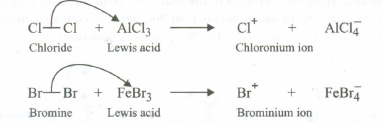
These electrophiles then react with arenes to form the corresponding aryl halides by electrophilic substitution mechanism.
3.
\(\text {Rate }=\left(\frac{d x}{d t}\right)=k[A]^0[B]^0=\mathrm{k} \text { (rate const.) }\)
4.

5.
It is because these molecules do not collide in a proper orientation that is why the reaction is slow.
6.
(i)
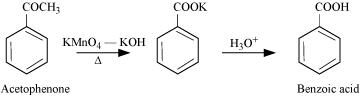
(ii)
(iii)
7.
Only 2-butanol gives positive iodoform test whereas 1-butanol does not give iodoform test.
\(\begin{equation} \mathrm{CH}_{3} \mathrm{CH}_{2} \mathrm{CHOHCH}_{3} \stackrel{\mathrm{I}_{2} / \mathrm{NaOH}}{\longrightarrow} \mathrm{CH}_{3} \mathrm{CH}_{2} \mathrm{COONa}+\mathrm{CH}_{3} \text { (Iodoform) } \end{equation}\)
8.
30 alcohols are very reactive and hence, their reactions with conc. HCI takes place even at room temperature.
9.
In case of non-symmetric unsaturated 1 compounds, addition of HI and HBr takes place according to Markownikoff's rule
10.
1st order
11.
12.
(i) Ethanol undergoes intermolecular hydrogen bonding due to the presence of a hydrogen attached to oxygen atom.
(ii) Phenol is stronger acid than ethanol because the phenoxide ion left after the release of proton is stabilized by resonance but ethoxide ion is not.
(iii) Due to –I effect or –R effect of –NO2 group, the resulting phenolate ion is more stable than phenoxide ion. Therefore o- and p--nitrophenols are more acidic than phenol
13.
(d)
\(\frac{R}{2 k}\)
14.
(a)
Benzyl chloride
15.
(b)
0.5 x 10- 3 s-1
16.
(a)
CO2
17.
(c)
mesitylene
18.
(c)
p-methoxybenzyl bromide
19.
(c)
p-fluorophenoll < p-chlorophenol < p-nitrophenol
20.
(a)
CH3CHBrCH3
21.
(d)
propanone
22.
(a)
HCl+ZnCl2
23.
(c)
(iii) < (i) < (iv) < (ii)
24.
(b)
4.0\(\times 10^{-4}M s^{-1}\)
25.
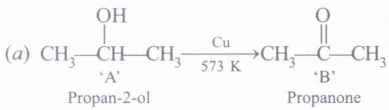
'B' does not reduce Fehling's solution because it is ketone.
26.
A + B⟶P
Rate = k[A] [B]2
(i) When concentration of B is doubled it means conc. of B becomes 2 times.
Thus: Rate = k[A]1 [B]2
= k[A] [4B2]
So, the rate becomes 4 times.
(ii) Order of reaction is the no. of molecules whose conc. alters after the reaction. If A is present in excess i.e., its conc. is un-effected.
So, rate is depending only on the conc. of B. As
= k[B]2
Thus the reaction is of second order.
(b) For the 1st order reaction
\(k=\frac{2.303}{t}\log \frac{a}{a-x}\)
\(t=30 \times 60=1800\ sec\)
\(k=\frac{2.303}{1800}\log \frac{100}{100-50}\)
\(=\frac{2.303}{1800}\log 2\)
\(=\frac{2.303}{1800}\times0.3010\)
\(t=\frac{2.303}{k}\log \frac{a}{a-x}\)
\(=\frac{2.303}{k}\log \frac{100}{100-90}\)
\(=\frac{2.303}{k}\log 10=\frac{2.303}{k}\)
By putting the value of k here, we get
\(\Rightarrow \ t=\frac{2.303\times 1800}{2.303\times0.3010}\)
\(=5.98\times 10^3 sec\)
27.
(i) Since compound (A) with M.F. C6H6O gives characteristic colour with FeCI3, therefore, (A) must be phenol.
(ii) Since compound (A), i.e., phenol reacts with CO2 and NaOR under pressure (i.e., Kolbe's reaction) to give compound (B) which on acidification gives compound (C), therefore, (B) must be sodium salicylate and (C) must be salicylic acid.
(iii) Since (C) reacts with acetyl chloride to form a popular pain killer (D), therefore, (D) must be aspirin.
28.
B) Assertion and reason both are correct statements but reason is not correct explanation for assertion.
Explanation:
Greater the molecular mass, stronger the van der Waals' forces of attraction and hence higher is the melting point/boiling point.
29.
(a) If both assertion and reason are true and the reason is the correct explanation of the assertion.
30.
(d) Assertion is incorrect; Reason is correct.
Order and molecularity differs in case of complex reactions.
A is incorrect, but R is correct.
31.
(d) o-nitrophenol is more volatile due to intramolecular hydrogen bonding, while p-nitrophenol is less volatile due to intermolecular hydrogen bonding which causes the association of molecules. Hence, (A) is incorrect but (R) is correct.
32.
(i) (b)
(ii) (d): When in aryl halides the electron withdrawing groups are attached at ortho and para positions to the chlorine atom then the removal of chlorine atom as CI- ion becomes easy, therefore, 2,4,6- trinitro chlorobenzene is the most reactive among given aryl halides.
(d) : The order of reactivity follows the sequence: benzyl halides> alkyl halides> aryl halides. Out of chlorides and bromides, bromides are more reactive. Therefore, the correct order of reactivity is PhCH2Br(ii) > MeBr(i) > MeCI(iii) >p-MeOC6H4Br (iv).
33.
(i) (c) : For a first order reaction :
\(t_{1 / 2}=\frac{0.693}{k}, k=3.01 \times 10^{-3} \mathrm{~s}^{-1}\)
\(\therefore \quad t_{1 / 2}=\frac{0.693}{3.01 \times 10^{-3}}=230.3 \mathrm{~s}\)
(ii) (a) : Half life (1/2) of a first order reaction is given as :
\(t_{1 / 2}=\frac{0.693}{k}=\frac{0.693}{7.0 \times 10^{-4}}=990 \mathrm{~s}\)
(iii) (b) : For a first order reaction \(t_{1 / 2}=\frac{0.693}{k}\) therefore t1/2 depends upon k and hence depends on temperature because rate constant k is a function of temperature.
(iv) (c) : Let the concentrations of the reactant after
10 min and 20 min be C1 and C2 respectively.
Rate after 10 min = k,C2
= 0.03 x 60 mol L-1 min-1
\(\therefore \frac{C_{1}}{C_{2}}=\frac{4}{3}\)
Let the reaction starts after 10 minutes.
\(k=\frac{2.303}{10} \log \frac{C_{1}}{C_{2}}=\frac{2.303}{10} \log \frac{4}{3}=0.02878\)
\(\therefore \quad t_{1 / 2}=\frac{0.6932}{k}=\frac{0.6932}{0.02878}=24.086 \mathrm{~min}\)

12th Standard CBSE Syllabus & Materials
12th Standard CBSE
CBSE 12th Computer Science Python Revision Tour I - New Previous year Question Papers Study Material - QB365 Set A
NEW12th Standard CBSE
CBSE 12th Business Studies Planning Important Questions And Answers Study Material - QB365 Set A
NEW12th Standard CBSE
CBSE 12th Business Studies Business Environment Important Questions And Answers Study Material - QB365 Set A
NEW12th Standard CBSE
CBSE 12th Business Studies Principles of Management Important Questions And Answers Study Material - QB365 Set A



NCERT Books

Syllabus

Exam Pattern

Sample Question Papers

Previous year Question Papers

Important Notes

MCQ Practice test

NCERT Exemplers

Case study Questions

Image Based Questions

Passage based Questions

HOT Questions

Value Based Questions

Model Questions Papers
NCERT ( Book Back ) Questions

Assertion and Reason
Important Questions And Answers

CBSE 12th Standard CBSE Subjects
CBSE Standards








