
 100% FREE ACCESS
12th Standard CBSE Syllabus & Materials
12th Standard CBSE
CBSE 12th Economics Government Budget and the Economy Previous year Question Papers Study Material - QB365 Set A
NEW12th Standard CBSE
CBSE 12th Computer Science Interface Python with MySQL - New Previous year Question Papers Study Material - QB365 Set A
NEW12th Standard CBSE
CBSE 12th Computer Science Database Concept - New Previous year Question Papers Study Material - QB365 Set A
NEW12th Standard CBSE
CBSE 12th Computer Science Data Communication - New Previous year Question Papers Study Material - QB365 Set A
NEW12th Standard CBSE
CBSE 12th Computer Science Data Structures - New Previous year Question Papers Study Material - QB365 Set A
NEW12th Standard CBSE
CBSE 12th Computer Science Functions - New Previous year Question Papers Study Material - QB365 Set A

Published on: 25/10/2025
Download CBSE Class 12th Standard CBSE Chemistry question papers, sample papers, important questions, and previous year solved papers in PDF format. Get free study materials, NCERT solutions, and exam preparation resources for Class 12th Standard CBSE Chemistry
Questions + Answers key
Take MCQ Chemistry Test
1.
Give one chemical test each to distinguish between the following pairs of compounds:
(i) Phenol and Benzoic acid
(ii) 1-Propanol and 2-Propanol
2.
What happens when anisole is heated with HI?
3.
How will you convert the following?
(i) Propan-2-ol to propanone
(ii) Phenol to 2, 4, 6-tribromophenol
4.
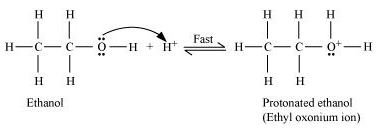
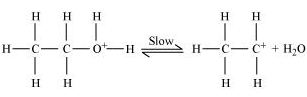
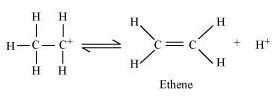
Write the mechanism of acid dehydration of ethanol to yield ethene.
5.
How do you convert the following?
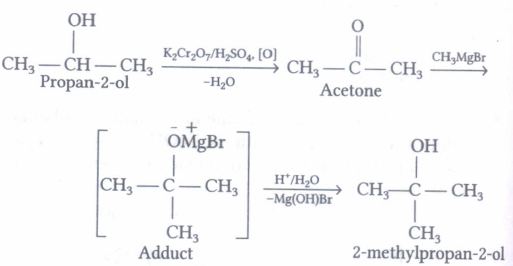
(i) Propan-2-ol to 2-methylpropan-2-ol
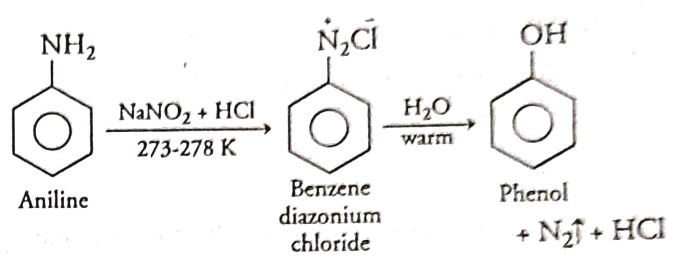
(ii) Aniline to phenol
6.
How will you convert
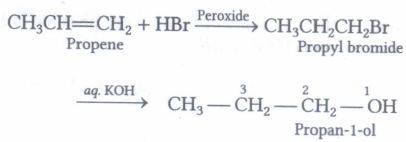
(i) propene to propan-1-ol?
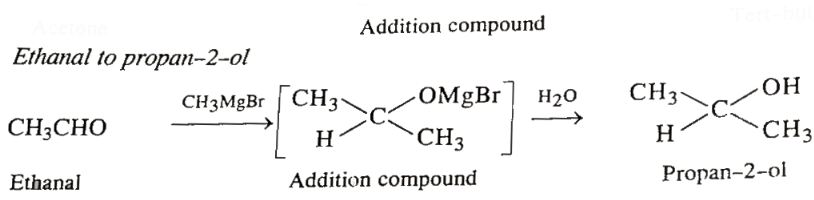
(ii) ethanal to propan-2-ol?
7.
Why do phenols not give the protonation reaction readily?
8.
How would you obtain phenol from benzene?
9.
Give a chemical test to distinguish between 2-Pentanol and 3-Pentanol
10.
Write steps to cary out the conversion of phenol to aspirin.
11.
Why is the reactivity of all ther three classes of alcoholes with conic.HCI and ZnCI2 (Lucas reagent) different?
12.
How can propan-2-one be converted into tert-butly alcohol?
13.
Give reason for the higher boiling point of ethanol in comparison to methoxy methane.
14.
Give two reactions that show the acidic nature of phenol. Compare its acidity with that of ethanol.
15.
While separating a mixture of ortho-and para-nitrophenols by steam distillation, name the isomer which will be steam volatile? Give reasons.
16.
What is meant by hydroboration-oxidation reaction? Illustrate with an example.
17.
Alcohols are comparatively more soluble in water than hydrocarbons of compounds of comparable molecular masses. Explain this fact.
18.
Write the equations involved in the
Reimenn-Tiemann reaction.
19.
Which is a stronger acid, phenol or cresol? Explain.
20.
Dipole moment of phenol is smaller than that of methanol. Why?
21.
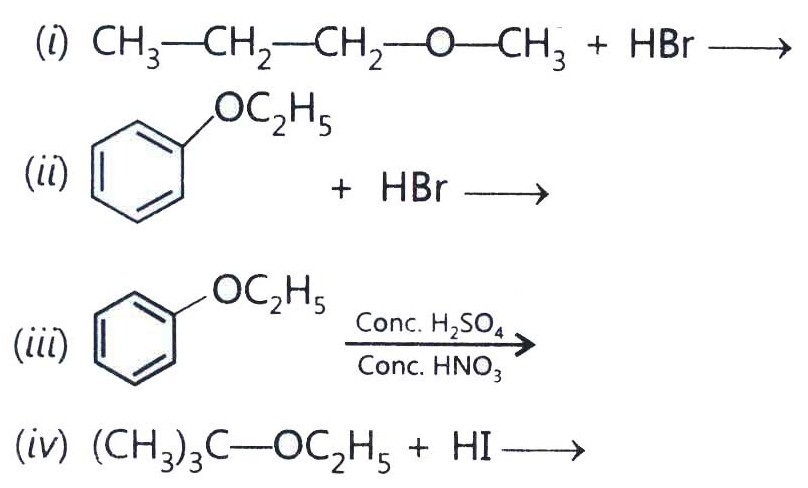
Predict the product of the reaction given below:
22.
The following is not an appropriate reaction for the preparation of t-butyl ethyl ether.
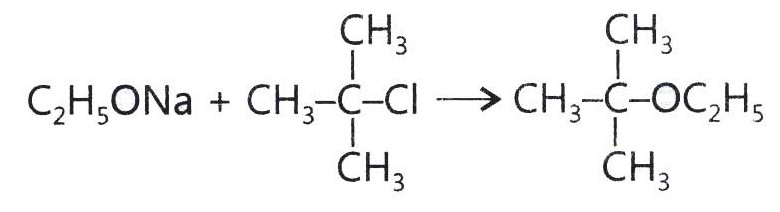
(i) What would be the major product of this reaction?
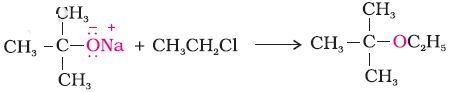
(ii) Write a suitable reaction for the preparation of i-butyl ethyl ether.
23.
Arrange the following sets of compounds in order of their increasing order of their acid strength:
Propan-1-ol, 2,4,6-trinitrophenol, 3-nitro-phenol, 3,5-dinitrophenol, phenol, 4-methyl-phenol.
24.
Arrange the following sets of compounds in order of their increasing boiling points,
(a) Pentan-1-ol, butan-1-ol, butan-2-ol, ethanol, propan-1-ol, methanol
(b) Pentan-1-ol, n-butane, pentanal, ethoxyethane.
25.
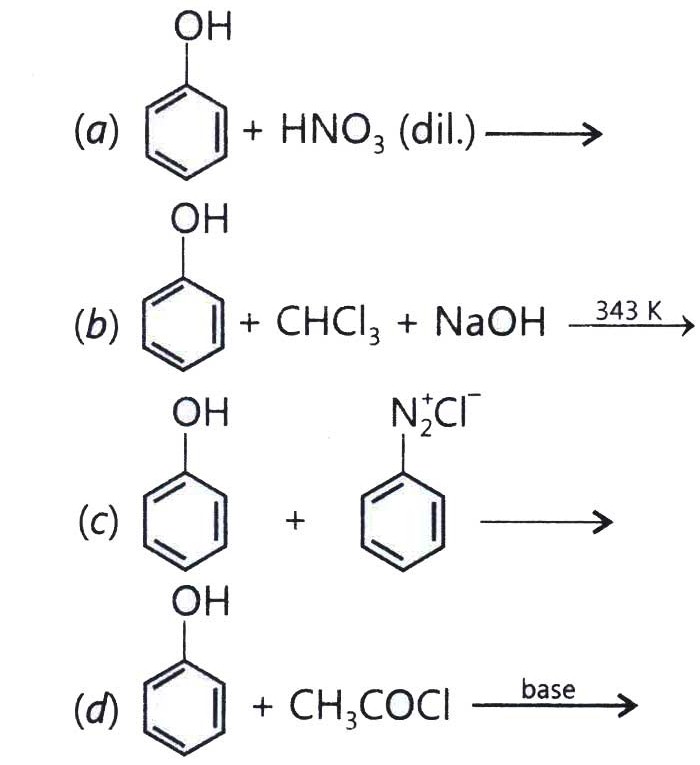
Complete the following:
26.
How will you distinguish between the following pairs by chemical reactions?
(i) CH3OH and C2H5OH
(ii) Phenol and methanol
(iii) 1-Propanol and 2-methyl-2-propanol
(iv) Ethanol and 1-Propanol?
27.
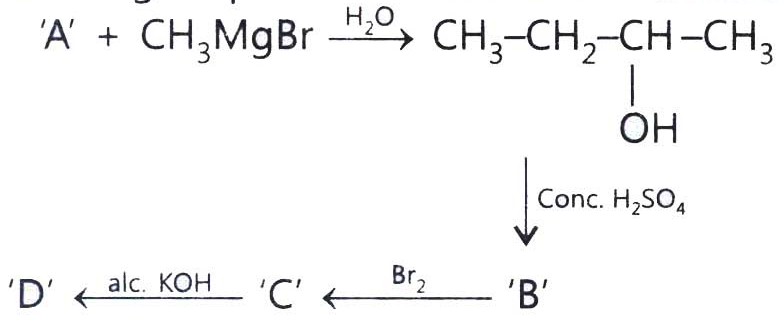
Write the structural formula of the organic compounds 'A', 'B', 'C' and 'D' in the following sequence of reactions:
28.
How are the following conversions carried out? (Write the reactions and conditions in each case):
(i) Ethanol to 2-propanol
(ii) Phenol to Acetophenone
29.
How are the following conversions carried out?
(i) Phenol to Toluene
(ii) Ethanol to 1,1-dichloroethane.
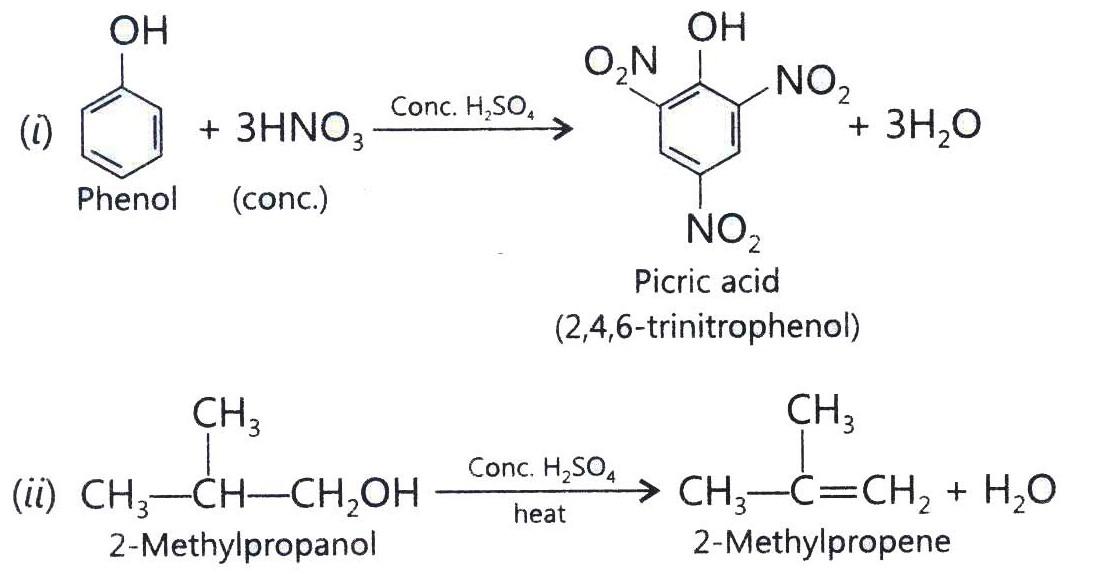
30.
How would you obtain
(i) Picric acid (2,4,6-trinitrophenol) from phenol,
(ii) 2-Methylpropene from 2-methylpropanol?
31.
How would you convert ethanol to ethene?
32.
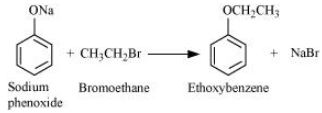
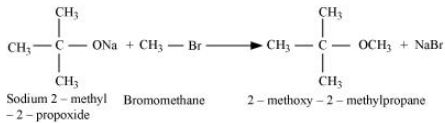
Write the names of reagents and equations for the preparation of the following ethers by Williamson synthesis:
(i) 1-Propoxypropane
(ii) Ethoxybenzene
(iii) 2-Methyl-2-methoxypropane
(iv) 1-Methoxyethane
33.
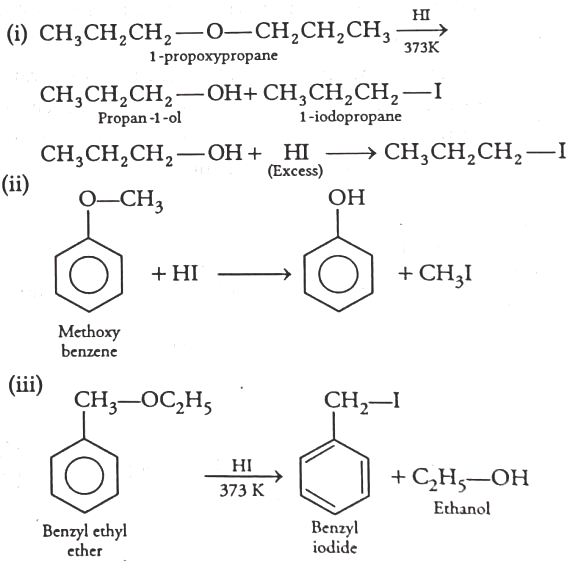
Write the equation of the reaction of hydrogen iodide with
(i) 1-Propoxy propane
(ii) methoxy benzene and
(iii) benzyl ethyl ether.
34.
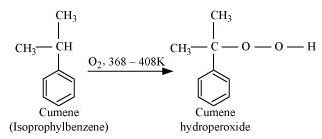
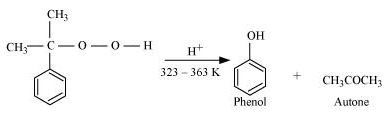
Give the equations of reaction for the preparation of phenol from cumene.
35.
How are the following conversions carried out?
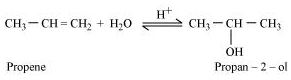
(i) Propene \(\longrightarrow \) Propan-2-ol
(ii) Ethyl magnesium chloride\(\longrightarrow \) Benzyl alcohol
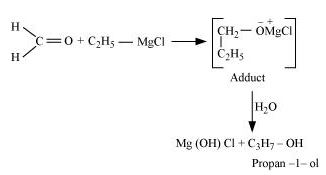
(iii) Ethyl magnesium chloride \(\longrightarrow \) Propan-1-ol.
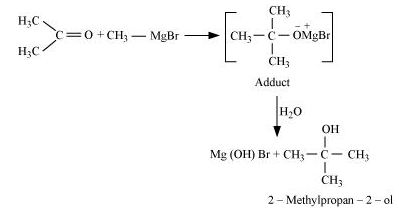
(iv) Methyl magnesium bromide\(\longrightarrow \) 2-Methylpropan-2-ol.
1.
(i) Add NaHCO3 to each. Phenol will not react, benzoic acid will give brisk effervescence due to CO2.
(ii) Add I2 and NaOH. 2-Propanol will give yellow ppt. of iodoform, whereas 1-propanol will not give yellow ppt.
2.
methyl iodide and phenol
3.
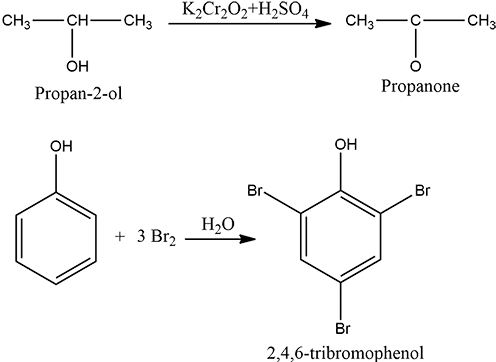
4.
The mechanism of acid dehydration of ethanol to yield ethene is shown above. First step is the protonation of oxygen atom of −OH group. Second step is the loss of a molecule of water to form carbonium ion. Last step is deprotonation to form carbon carbon double bond.
Step 1:
Protonation of ethanol to form ethyl oxonium ion:
Step 2:
Formation of carbocation (rate determining step):
Step 3:
Elimination of a proton to form ethene:
5.
(i)
(ii)
6.
(i) Propene to propan-1-ol
(ii) ethanal to propan-2-ol
7.
In phenols, the lone pairs of electrons on the oxygen atom are delocalised over the benzene ring due to resonance and hence, are not easily available for protonation to destabilise O-H bond thus, making protonation difficult.
8.
Benzene react with chlorine in the presenc of ferric chloride which form chlorobezene, which on further reaction with sodium hydroxide gives sodium phenoxide. Then sodium phenoxide acidified and form phenol.

9.
3-pentanol immediately gives turbidity with Lucas reagent but 2-pentanol gives turbidity in around five minutes.
10.
.png)
11.
The reaction of alcohols with conc.HCI and ZnCI2 (Lucas reagent) occurs through intermediate formation of carbocations. Obviously, more stable the carbocation, more reactive is the alcohol. Since the stability of carbocations. Obviusly, more stable the carbocation, more reactive is the alcohol. Since the stability of carbocations follows the order : \({ 3 }^{ \circ }>{ 2 }^{ \circ }>{ 1 }^{ \circ }\), therefore, reactivity of alcohols towards Lucas reagent follows the same order, i.e., \({ 3 }^{ \circ }>{ 2 }^{ \circ }>{ 1 }^{ \circ }\).
12.
\({ C }H_{ 3 }-\underset { \overset { \parallel }{ O } }{ C } -{ C }H_{ 3 }+{ C }H_{ 3 }MgBr\overset { Dry }{ \underset { ether }{ \longrightarrow } } \\ \quad \quad \quad \quad \quad \quad \quad \quad \quad \\ { C }H_{ 3 }-\overset { \underset { | }{ { C }H_{ 3 } } }{ \underset { \overset { | }{ { C }H_{ 3 } } }{ C } } \quad -OMgBr\overset { { H }^{ + }{ H }_{ 2 }O }{ \longrightarrow } \underset { tert-butyl\quad alcohol }{ \quad { C }H_{ 3 }-\overset { \underset { | }{ { C }H_{ 3 } } }{ \underset { \overset { | }{ { C }H_{ 3 } } }{ C } } \quad -OH } \)
13.
Boiling points of ethers are much lower than the boiling points of alcohols. The large difference in boiling points of alcohols and ethers is due to the presence of H-bonding in alcohols.
14.
The reactions showing acidic nature of phenol are:
(i) Reaction with sodium. Phenol reacts with active metals like sodium to liberate H2 gas.
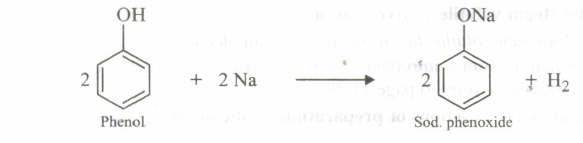
(ii) Reaction with NaOH. Phenol dissolves in NaOH to form sod. phenoxide and water.
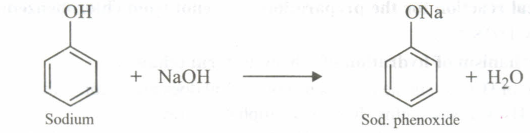
Comparison of acidic character of phenol and ethanol. Phenol is more acidic than ethanol. This is due to the reason that phenoxide ion left after the loss of a proton from phenol is stabilized by resonance (Refer to structures,VI to X on page 11/25) while ethoxide ion (left after loss of a proton from ethanol) is not.
15.
o-Nitrophenol is steam-volatile due to chelation (intramolecular H-bonding) and hence can be separated by steam distillation from p-nitrophenol which is not steam volatile because of intermolecular H-bonding.
16.
The addition of diborane to alkenes to form trialkylboranes followed by their oxidation with alkaline hydrogen peroxide to form alcohols is called hydroboration-oxidation reaction.

For example,
\(\underset { Propene }{ { CH }_{ 3 }CH={ CH }_{ 2 } } \overset { { BH }_{ 3 } }{ \underset { THF }{ \longrightarrow } } ({ CH }_{ 3 }{ CH }_{ 2 }{ CH }_{ 2 })\overset { { OH }^{ - },{ H }_{ 2 }{ O }_{ 2 } }{ \longrightarrow } \underset { Propene-1-ol }{ { 3CH }_{ 3 }CH{ CH }_{ 2 } } OH+B({ OH })_{ 3 }\)
17.
It is because alcohol can form H-bonds with H2O, whereas hydrocarbons cannot, that is why alcohols are soluble in water.
18.
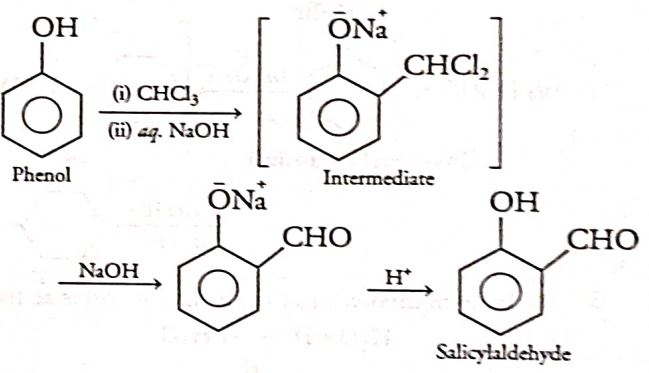
19.
Cresol is methylphenol. It has three positional isomers: o-cresol, m-cresol and p-cresol. Due to +l-effect of CH3 group, electron density in the O-H bond increases. Therefore, it becomes difficult to break the O-H bond as compared to that in phenol and hence all cresols are less acidic than phenol or phenol is a stronger acid than cresols.
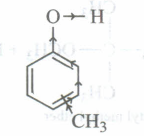
(Due to + l-effect of CH3 group, electron density in the O- H bond increases thereby making the cleavage of O - H bond difficult)
20.
It is due to C -O bond is less polar due to electron-withdrawing effect of benzene ring, whereas in methanol C--O bond is more polar due to electron releasing effect of methyl group.
21.
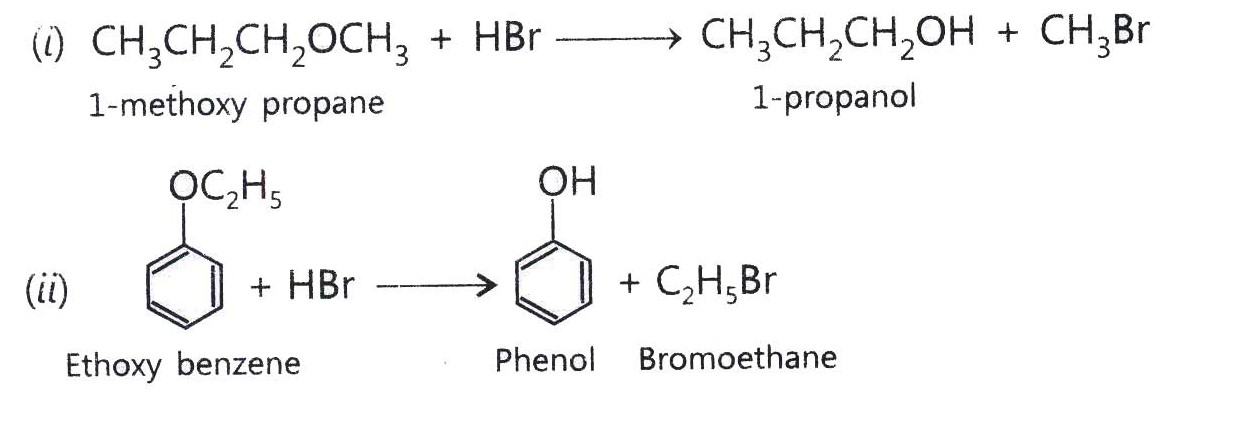
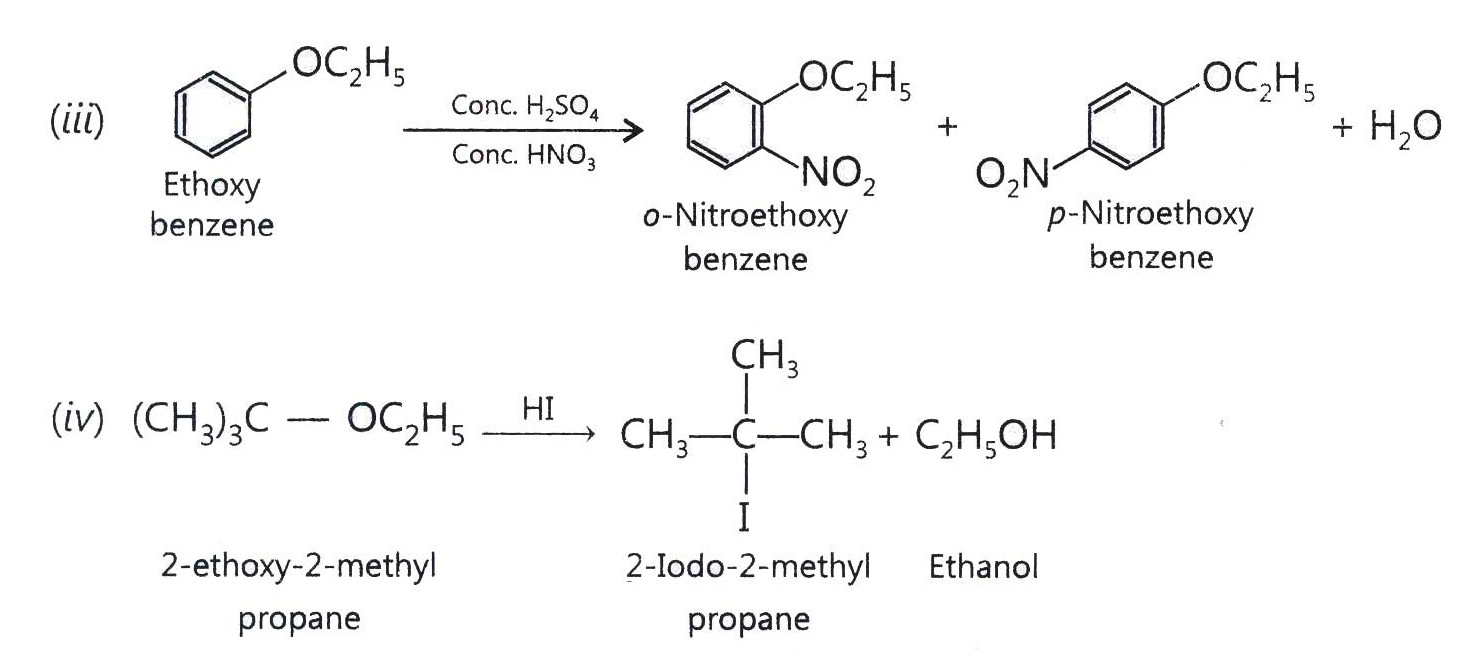
22.
(i) The major product of the given reaction is 2-methylprop-1-ene. It is because sodium ethoxide is a strong nucleophile as well as a strong base. Thus elimination reaction predominates over substitution.
(ii)
23.
Propan-1-ol, 4-methylphenol, phenol, 3-nitro-phenol, 3,5-dinitrophenol, 2,4,6-trinitrophenol is increasing order of acid strength.
24.
(a) Methanol < ethanol < propan-1-ol < butan-2-ol < butan-1-ol < pentan-1-ol
(b) n-Butane < ethoxyethane < pentanal < pentan-1-ol.
25.
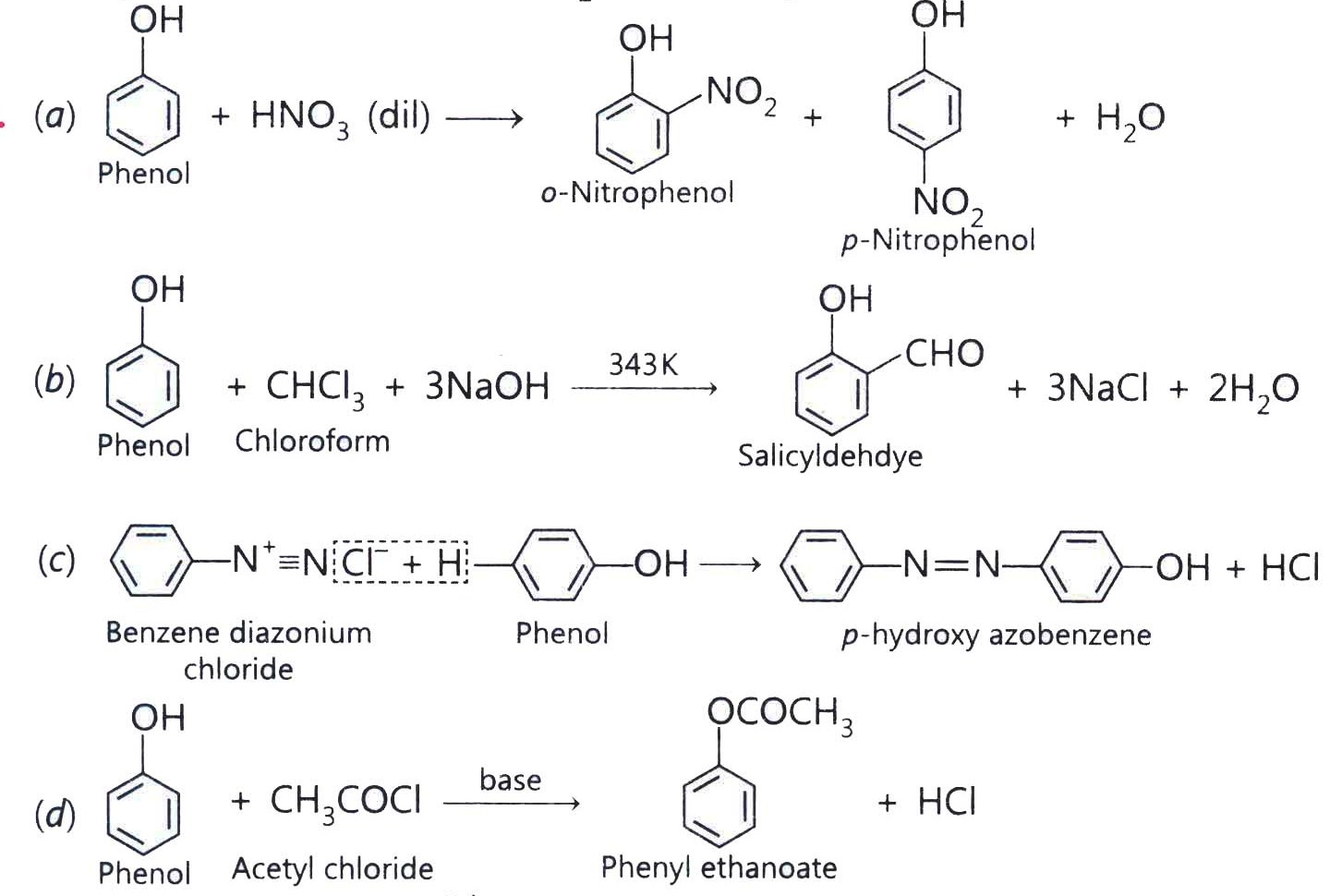
26.
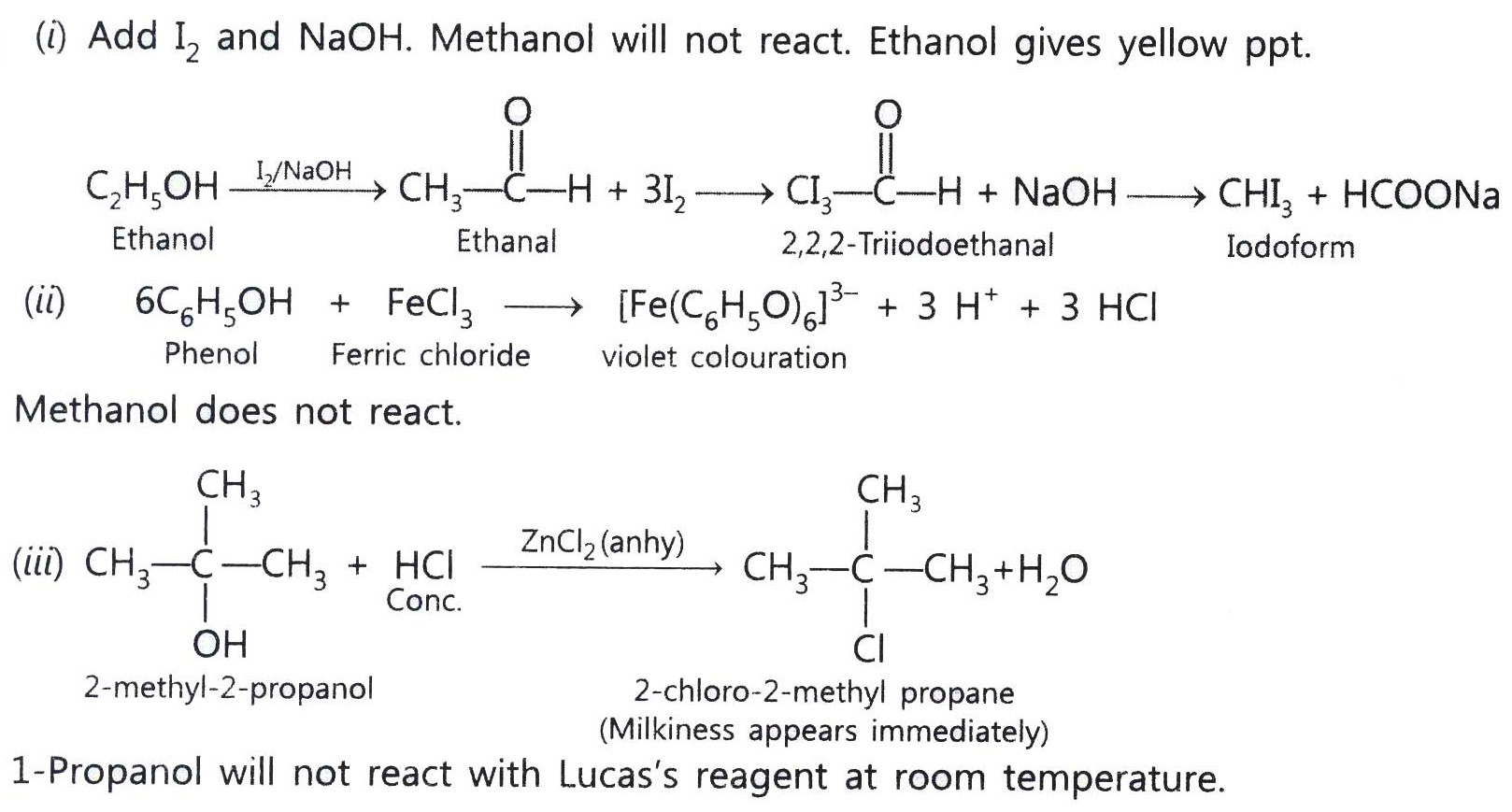

1-Propanol will not react with I2/NaOH to give iodoform.
27.
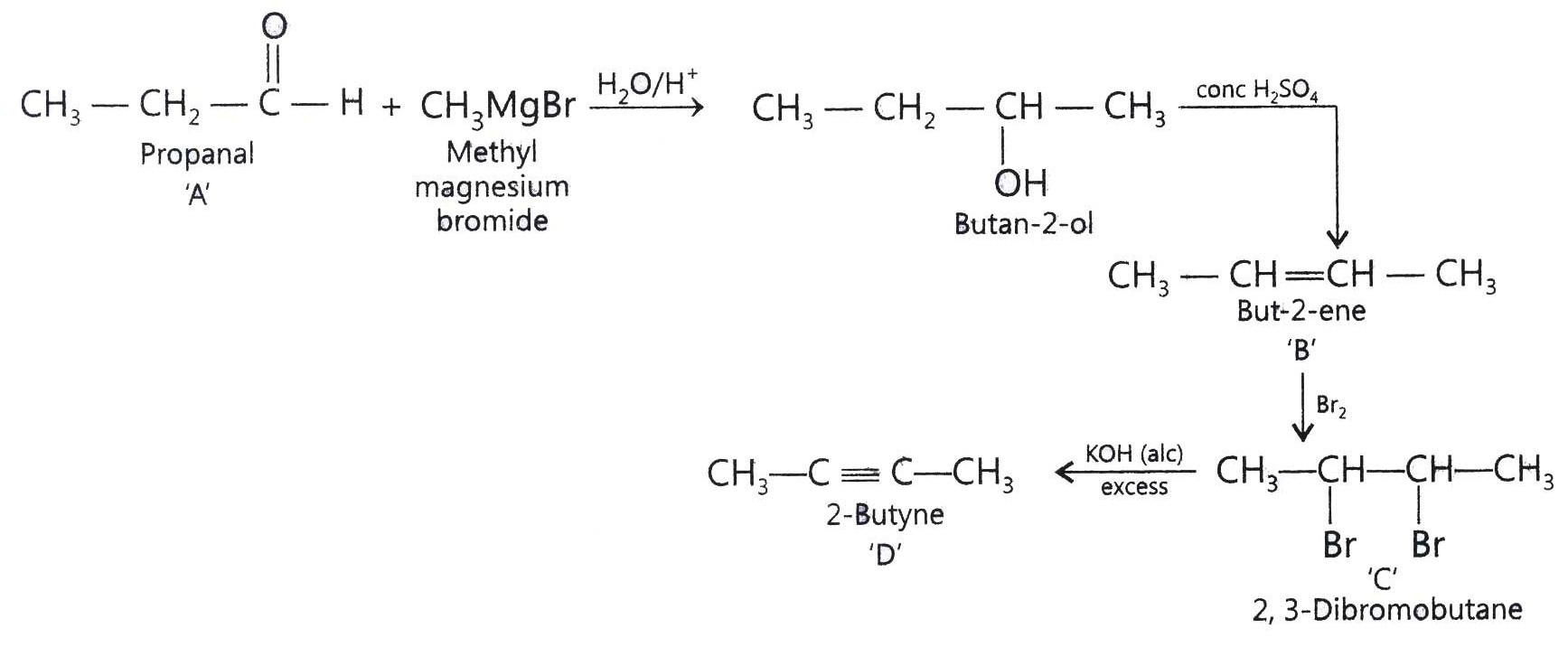
28.
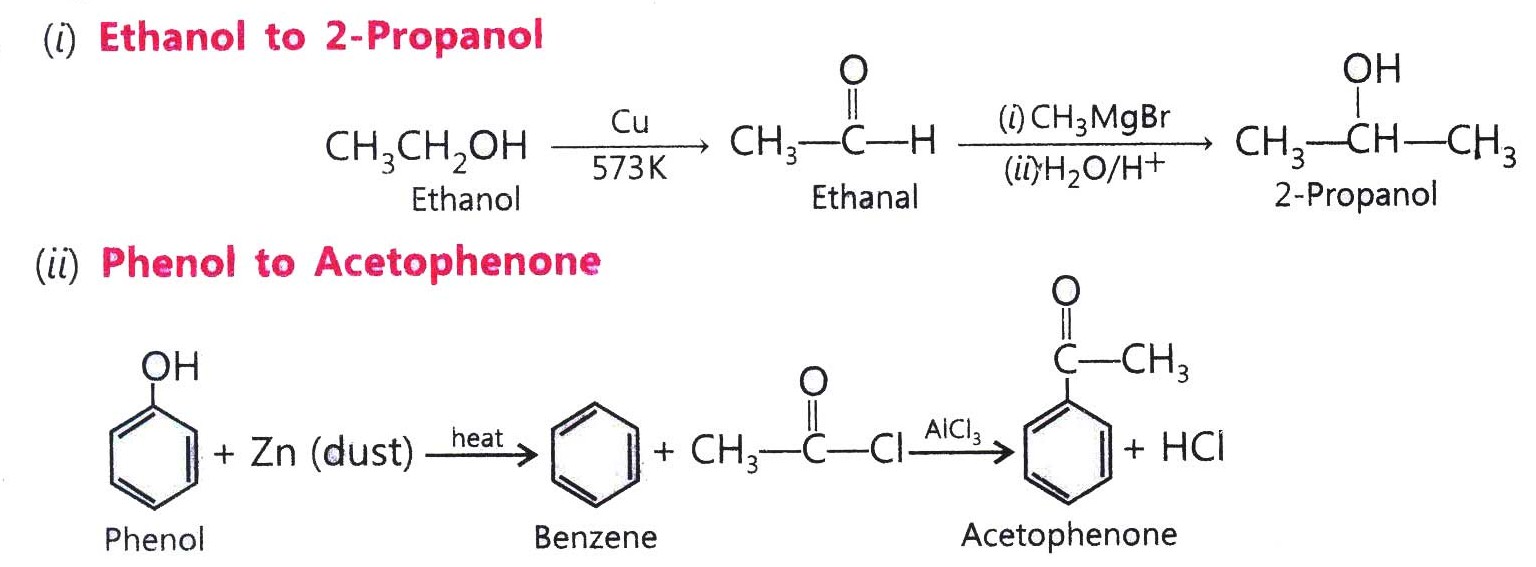
29.
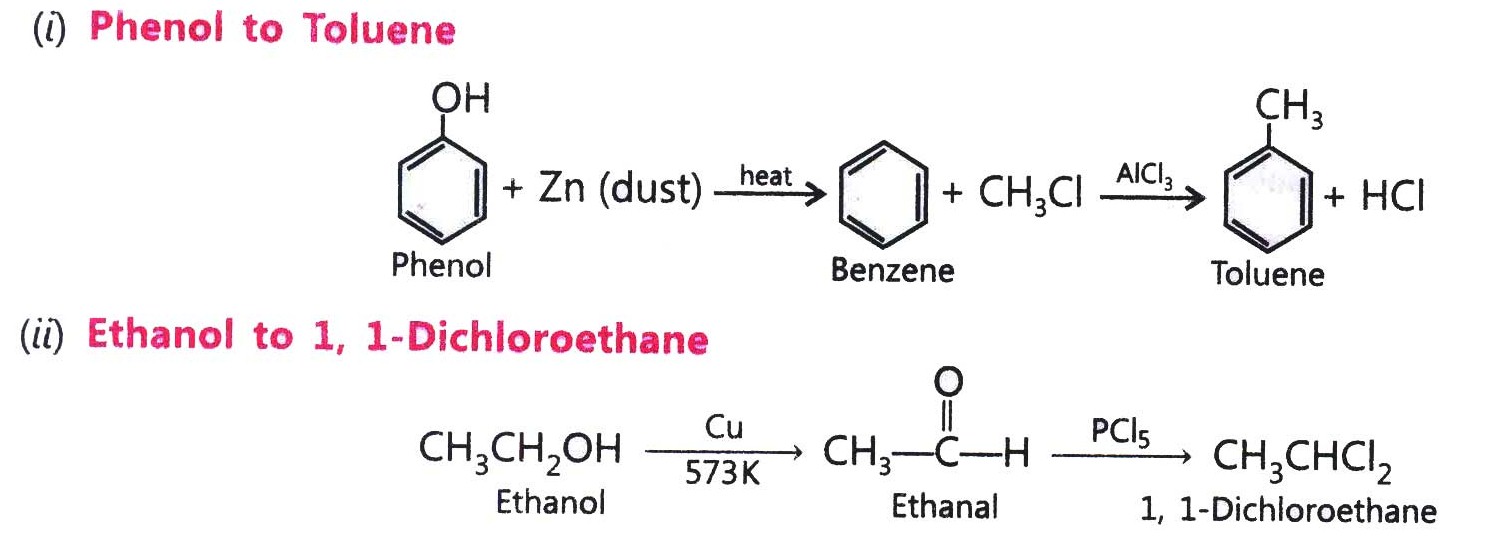
30.
31.

32.
(i)

(ii)
(iii)
(iv)

33.
34.
To prepare phenol, cumene is first oxidized in the presence of air of cumene hydro-peroxide.
Then, cumene hydroxide is treated with dilute acid to prepare phenol and acetone as by-products.
35.
(i) If propene is allowed to react with water in the presence of an acid as a catalyst, then propan-2-ol is obtained.
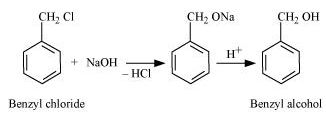
(ii) If benzyl chloride is treated with NaOH (followed by acidification) then benzyl alcohol is produced.
(iii) When ethyl magnesium chloride is treated with methanal, an adduct is the produced which gives propan-1-ol on hydrolysis.
(iv) When methyl magnesium bromide is treated with propane, an adduct is the product which gives 2-methylpropane-2-ol on hydrolysis.

12th Standard CBSE Syllabus & Materials
12th Standard CBSE
CBSE 12th Computer Science Python Revision Tour I - New Previous year Question Papers Study Material - QB365 Set A
NEW12th Standard CBSE
CBSE 12th Business Studies Planning Important Questions And Answers Study Material - QB365 Set A
NEW12th Standard CBSE
CBSE 12th Business Studies Business Environment Important Questions And Answers Study Material - QB365 Set A
NEW12th Standard CBSE
CBSE 12th Business Studies Principles of Management Important Questions And Answers Study Material - QB365 Set A



NCERT Books

Syllabus

Exam Pattern

Sample Question Papers

Previous year Question Papers

Important Notes

MCQ Practice test

NCERT Exemplers

Case study Questions

Image Based Questions

Passage based Questions

HOT Questions

Value Based Questions

Model Questions Papers
NCERT ( Book Back ) Questions

Assertion and Reason
Important Questions And Answers

CBSE 12th Standard CBSE Subjects
CBSE Standards








