
 100% FREE ACCESS
12th Standard CBSE Syllabus & Materials
12th Standard CBSE
CBSE 12th Economics Government Budget and the Economy Previous year Question Papers Study Material - QB365 Set A
NEW12th Standard CBSE
CBSE 12th Computer Science Interface Python with MySQL - New Previous year Question Papers Study Material - QB365 Set A
NEW12th Standard CBSE
CBSE 12th Computer Science Database Concept - New Previous year Question Papers Study Material - QB365 Set A
NEW12th Standard CBSE
CBSE 12th Computer Science Data Communication - New Previous year Question Papers Study Material - QB365 Set A
NEW12th Standard CBSE
CBSE 12th Computer Science Data Structures - New Previous year Question Papers Study Material - QB365 Set A
NEW12th Standard CBSE
CBSE 12th Computer Science Functions - New Previous year Question Papers Study Material - QB365 Set A

Published on: 25/10/2025
Download CBSE Class 12th Standard CBSE Chemistry question papers, sample papers, important questions, and previous year solved papers in PDF format. Get free study materials, NCERT solutions, and exam preparation resources for Class 12th Standard CBSE Chemistry
Questions + Answers key
Take MCQ Chemistry Test
1.
Explain the violet colour of the complex [Ti(H2O)6]3+ on the basis of crystal field theory.
2.
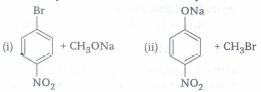
Which of the following is an appropriate set of reactants for the preparation of 1-methoxy-d nitrobenzene and why?
3.
Write the equations for the preparation of 1-iodobutane from
(1) 1-butanol
(2) 1-Chlorobutane
(3) but-1-ene
4.
Give chemical tests to distinguish between the following pairs of compounds:
(i) Propanal and propanone
(ii) Benzaldehyde and benzoic acid.
5.
The partial pressure of ethane over a saturated solution containing 6.56 \(\times\) 10-3 g of ethane is 1 bar. If the solution contains 5.00 \(\times\) 10-2 g of ethane then what shall be the partial pressure of the gas?
6.
Identify A, B, C, D, E, R and R' in the following:
(i)

(ii)

(iii)

7.
An organic compound (A) on treatment with ethyl alcohol gives a carboxylic acid (B) and compound (C). Hydrolysis of (C) under acidified conditions gives (B) and (D). Oxidation of (D) with KMnO4 also gives (B). (B) on heating with Ca(OH)2 gives (E) having moleuclar formula C3H6O. (E) does not give TOllens'test and does not reduce Fehiling's solution but forms 2, 4-dinitrophenyhydrazone. Identify (A),(B),(C),(D) and (E).
8.
Using valence bond theory, explain the following in relation to the complexes given below :
\([Mn(CN)_6]^{3-}, [Co(NH_3)_6]^{3+}, [Cr(H_2O)_6]^{3+}, [FeCl_6]^{4-}\)
(i) Type of hybridisation
(ii) Inner or outer orbital complex.
(iii) Magnetic behaviour.
(iv) Spin only magnetic moment value.
9.
Vapour pressure of chloroform (CHCI3) and dichloromethane (CH2CI2) at 298 K are 200 mm Hg and 415 mm Hg respectively.
(i) Calculate the vapour pressure of the solution prepared by mixing 25.5 g of CHCl3 and 40 g of CH2Cl2 at 298 K and
(ii) mole fractions of each component in vapour phase.
10.
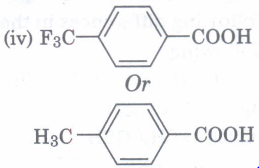
Which acid of each pair shown here would you expect to be stronger?
\((i) \mathrm{CH}_{3} \mathrm{CO_2 H} \ or \ \mathrm{CH}_{2} \mathrm{FCO_2H}\)
\(\\ (ii) \mathrm{CH}_{2} \mathrm{FCO_2H} \ or \ \mathrm{CH}_{2} \mathrm{ClCO_2H}\)
\(\\ (iii) \mathrm{CH}_{2} \mathrm{FCH}_{2} \mathrm{CH}_{2} \mathrm{CO_2H} \ or \ \mathrm{CH}_{3} \mathrm{CHFCH}_{2} \mathrm{CO_2H}\)
11.
What is meant by unidentate, didentate and ambidentate ligands? Give two examples for each.
12.
3.9 g of benzoic acid dissolved in 49 g of benzene shows a depression in freezing point of 1.62 K. Calculate the van't Hoff factor and predict the nature of solute (associated or dissociated). (Given : Molar mass of benzoic acid = 122 g mol-1 , Kf for benzene = 4.9 K kg mol-1)
13.
Name the reagents used in the following reactions:
(i) Oxidation of a primary alcohol to carboxylic acid.
(ii) Oxidation of a primary alcohol to an aldehyde.
(iii) Bromination of phenol to 2,4,6-tribromophenol.
(iv) Benzyl alcohol to benzoic acid.
(v) Dehydration of propan-2-ol to propene.
(vi) Butan-2-one to butan-2-ol.
14.
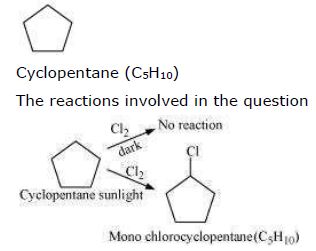
A hydrocarbon C5H10 does not react with chlorine in dark but gives a single monochloro compound C5H9Cl in bright sunlight. Identify the hydrocarbon.
15.
What is the correct IUPAC name of the given Compound?
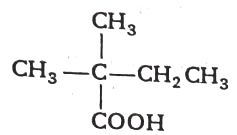
2, 2-dimethylbutanoic acid
2-carboxyl-2-methylbutane
2-ethyl-2-methylpropanoic acid
3-methylbutane carboxylic acid
16.
Which of the following compounds will react with sodium hydroxide solution in water?
C6H5OH
C6H5CH2OH
(CH3 )3 COH
C2H5OH
17.
Which of the following undergoes nucleophilic substitution exclusively by SN1 mechanism?
Benzyl chloride
Ethyl chloride
Chlorobenzene
Isopropyl chloride
18.
Propinic acid with Br2/P yields a dibromo product. Its structure would be
CHBr2 _ CH2COOH
CH2Br _ CH2COBr
CH3 _ CBr2 _ COOH
CH2Br _ CHBr _ COOH
19.
An organic compound 'X' having molecular formula C5H10O yields phenydrazone and gives negative response to the iodoform test and Tollens'test. It products n-pentane on reduction. 'X' could be
3-pentanone
n-amyl alcohol
pentanal
2-pentanone
20.
Which of the following complexes are heteroleptic ?
\([Cr(NH_3)_6]^{3+}\)
\([Co(NH_3)_4Cl_2]^+\)
\([Ni(CN)_4]^{2-}\)
\([Ni(NH_3)_4Cl_2]\)
21.
Products obtained when HI reacts with isopropyl methyl ether at 373 K are
isopropyl iodide and methyl alcihol
isopropyl alcohol and methyl iodide
isopropyl iodide and water
methyl iodide and water
22.
The magnitude of crystal field stabilization energy (CFSE of \({ \Delta }{ }_{ t }\)) in tetrahedral complexes is considerably less than in the octahedral field. Because
There are only four ligands instead of six so the ligand field is only 2/3 the size hence the \({ \Delta }{ }_{ t }\) is only 2/3 the size
The direction of the orbitals does not coincide with the direction of the ligands. This reduces the crystal field stabilization energy (\({ \Delta }{ }_{ t }\)) by further 2/3.
Both points (a) and (b) are correct.
Both points (a) and (b) are wrong
23.
Which one of the following forms propanenitrile as the major product?
Ethyl bromide ||+ alcoholic KCN
Propyl bromide+alcoholic KCN
Propyl bromide +alcoholic AgCN
Ethyl bromide+alcoholic AgCN
24.
The hybridisation of Fe in K4[Fe(CN)6] is
dsp2
sp3
d2sp3
sp3d2
25.
van't Hoff factors x,y and z for association, dissociation and no change of solute in the solution respectively are in the order :
x<y<z
x>z>y
x<z<y
x>y>z
26.
The unit of ebullioscopic constant is __________________.
K kg mol-1 or K (molality)-1
mol kg K-1 or K-1 (molality)
kg mol-1 K-1 or K-1 (molality)-1
K mol kg-1 or K (molality)
27.
Assertion : Exposure of ultraviolet rays to human causes the skin cancer, disorder and disrupt the immune system.
Reason : Carbon tetrachloride is released into air it rises to atmosphere and deplets the ozone layer.
Codes:
(a) If both Assertion and Reason are correct and the Reason is a correct explanation of the Assertion.
(b) If both Assertion and Reason are correct but Reason is not a correct explanation of the Assertion.
(c) If the Assertion is correct but Reason is incorrect.
(d) If both the Assertion and Reason are incorrect.
28.
Assertion: Reverse osmosis is used in the desalination of sea water.
Reason: When pressure more than osmotic pressure is applied, pure water is squeezed out 1 of the sea water through the membrane.
Codes:
A) Assertion and reason both are correct statements and reason is correct explanation for assertion.
B) Assertion and reason both are correct statements but reason is not correct explanation for assertion.
C) Assertion is correct statement but reason is wrong statement.
D) Assertion is wrong statement but reason is correct statement.
29.
Assertion: Boiling points of alcohols are lower than hydrocarbons.
Reason: Among isomeric alcohols, boiling point decreases in the order: 1°> 2° > 3°.
Codes:
(a) Assertion and reason both are correct statements and reason is correct explanation for assertion.
(b) Assertion and reason both are correct statements but reason is not correct explanation for assertion.
(c) Assertion is correct statement but reason is wrong statement.
(d) Assertion is wrong statement but reason is correct statement.
30.
In the following questions. an Assertion (A) is followed by a corresponding Reason (R) Use the following keys to choose the appropriate answer.
Assertion (A) Carboxylic acids are more acidic than phenols.
Reason (R) The carboxylate ion is less stabilised than phenoxide ion.
Codes:
(a) Both (A) and (R) are correct, (R) is the correct explanation of (A).
(b) Both (A) and (R) are correct, (R) is not the correct explanation of (A). .
(c) (A) is correct; (R) is incorrect.
(d) (A) is incorrect; (R) is correct.
31.
In the following questions. an Assertion (A) is followed by a corresponding Reason (R) Use the following keys to choose the appropriate answer.
Assertion (A) [Ni(CN)4]2- is square planar and dimagnetic.
Reason (R) It has no unpaired electrons due to presence of strong field ligand.
Codes:
(a) Both (A) and (R) are correct, (R) is the correct explanation of (A).
(b) Both (A) and (R) are correct, (R) is not the correct explanation of (A).
(c) (A) is correct; (R) is incorrect.
(d) (A) is incorrect; (R) is correct.
32.
Observe the graph between mole fraction of HCI gas dissolved in cyclohexane Vs equilibrium pressure of HCI(g) and answer the questions based on graph.
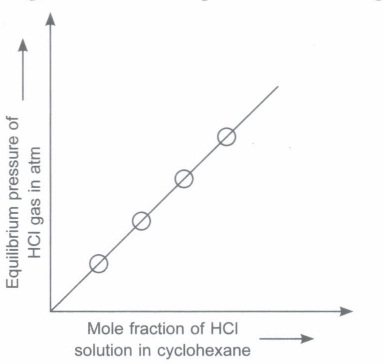
(a) Which law is depicted by this graph?
(b) What is mathematical expression for Henry's law?
(c) What does slope represent?
(d) What is effect of temperature and pressure on solubility of gas in liquid?
(e) Name two factors which affect the value of KH?
33.
Read the passage given below and answer the following questions :
When an aldehyde with no a-hydrogen reacts with concentrated aqueous NaOH, half the aldehyde is converted to carboxylic acid salt and other half is converted to an alcohol. In other words, half of the reactant is oxidized
and other half is reduced. This reaction is known as Cannizzaro reaction
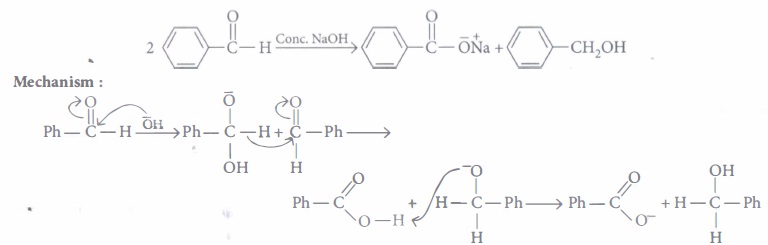
The following questions are multiple choice questions. Choose the most appropriate answer :
(i) A mixture of benzaldehyde and formaldehyde on heating with aqueous NaOH solution gives
| (a) benzyl alcohol and sodium formate | (b) sodium benzoate and methyl alcohol |
| (c) sodium benzoate and sodium formate | (d) benzyl alcohol and methyl alcohol. |
(ii) Which of the following compounds will undergo Cannizzaro reaction?
| (a) CH3CHO | (b) CH3COCH3 |
| (c) C6H5CHO | (d) C6H5CH2CHO |
(iii) Trichloroacetaldehyde is subjected to Cannizzaro's reaction by using NaOH. The mixture of the products contains sodium trichloroacetate ion and another compound. The other compounds is
| (a) 2, 2, 2-trichloroethanol | (b) trichloromethanol |
| (c) 2, 2, 2-trichloropropanol | (d) chloroform |
(iv) Which of the following reaction will not result in the formation of carbon-carbon bonds?
| (a) Cannizzaro reaction | (b) Wurtz reaction |
| (c) Reimer- Tiemann reaction | (d) Friedel-Crafts acylation |
1.
In ground state, Ti has 23 electrons with electronic configuration 3d34s2.
The oxidation state of Ti in the given compound is +3.
Hence it will now have the configuration 3d2. Since it has 2 unpaired electrons and has the ability to
undergo d-d transition, the given complex gives violet colour.
2.
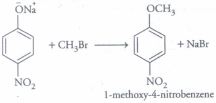
This reaction involves the preparation of ether by Williamson's synthesis. It takes place via SN2 attack of an alkoxide ion on primary alkyl halide because here the alkyl halide used is primary. Moreover in method (i) the C-Br bond has some double bond character.
3.
(i)

(ii)

(iii)

4.
(i) Add Tollen's reagent. Propanal will give silver mirror whereas propanone will not react.
(ii) Add NaHCO3 solution. Benzaldehyde will not react whereas benzoic acid will give brisk effervescence due to CO2.
5.
We know that, m = KH \(\times\) P
\(\therefore\) 6.56 \(\times\) 10-2g = KH \(\times\) 1 bar ...(i)
\(\therefore\) 0 5.00 \(\times\) 10-2 g = KH \(\times\) P.........(ii)
KH = 6.56 \(\times\) 10-2/1 bar (from i)
KH = 5.00 \(\times\) 10-2//p bar (from ii)
\(\therefore \quad \frac{6.56 \times 10^{-2}}{1}=\frac{5.00 \times 10^{-2}}{p}\)
\(\therefore \quad P=\frac{5 \cdot 00}{6 \cdot 56}=0.762 \text { bar. }\)
6.
(i) Haloalkanes react with Mg in dry ether to form Grignard reagents (RMgX), which react with water to form hydrocarbons.

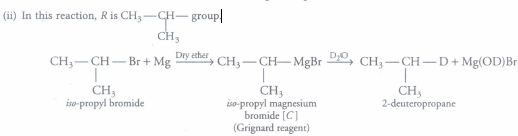
(iii) Haloalkanes react with Na in dry ether to give hydrocarbons containing double number of C-atoms.

7.
(i) Since compound (E) with molecular formula, C3H60 does not reduce Tollens' reagent and Fehling's solution but forms 2, 4-dinitrophenylhydrazone, it must be a ketone. But the only possible ketone having the molecular formula, C3H6O is acetone or propanone. Thus, compound (E) is acetone or (propanone) CH3COCH3·
(ii) Since acetone (E) is obtained by heating compound (8) with Ca(OH)2 therefore, (B) must be acetic acid (ethanoic acid), CH3COOH.
(iii) Since (D) on oxidation with KMn04 gives acetic acid (8), therefore, (D) must be ethyl alcohol (ethanol), CH3CH2OH.
(iv) Since acetic acid (8) and ethyl alcohol (D) are obtained by hydrolysis of (C) under acidic conditions, therefore, (C) must be ethyl acetate (ethyl ethanoate), CH3COOC2H5
(v) Since ethyl acetate (C) and acetic acid (8) are obtained by treatment of compound (A) with ethyl alcohol, therefore, compound (A) must be acetic anhydride (ethanoic anhydride), (CH3COO)2O.
(vi) All the reactions involved in this problem can now be explained as follows
8.
\([Mn(CN)_6]^{3-}\)
d2sp3, (ii) inner orbital complex, (iii) paramagnetic, (iv) 2.87 B.M.
(i) d2sp3 (ii) Inner orbital complex, (iii) diamagnetic, (iv) \(\mu=0\)
(i) d2sp3, (ii) Inner orbital complex, (iii) paramagnetic, (iv) 3.87 B.M.
(i) sp3d2, (ii) outer orbital complex (iii) paramagnetic (iv) 4.9 B.M.
9.
(i) Molar mass of CH2Cl2 = 12 × 1 + 1 × 2 + 35.5 × 2 = 85 g mol–1
Molar mass of CHCl3 = 12 × 1 + 1 × 1 + 35.5 × 3 = 119.5 g mol–1
\(\text {Moles of } \mathrm{CH}_{2} \mathrm{Cl}_{2} \quad=\frac{40 \mathrm{~g}}{85 \mathrm{~g} \mathrm{~mol}^{-1}}=0.47 \mathrm{~mol}\)
\(\text {Moles of } \mathrm{CHCl}_{3} \quad=\frac{25.5 \mathrm{~g}}{119.5 \mathrm{~g} \mathrm{~mol}^{-1}}=0.213 \mathrm{~mol}\)
\(x_{\mathrm{CH}_{2} \mathrm{Cl}_{2}}=\frac{0.47 \mathrm{~mol}}{0.683 \mathrm{~mol}}=0.688\)
xCHCl3 = 1.00 – 0.688 = 0.312
\(p_{\text {total }}=p_{1}^{0}+\left(p_{2}^{0}-p_{1}^{0}\right) x_{2}=200+(415-200) \times 0.688\)
= 200 + 147.9 = 347.9 mm Hg
(ii) y1 = p1/ptotal, we can calculate the mole fraction of the components in gas phase (y1).
\(p_{\mathrm{CH}_{2} \mathrm{Cl}_{2}}=0.688 \times 415 \mathrm{~mm} \mathrm{Hg}=285.5 \mathrm{~mm} \mathrm{Hg}\)
\(p_{\mathrm{CHCl}_{3}}=0.312 \times 200 \mathrm{~mm} \mathrm{Hg}=62.4 \mathrm{~mm} \mathrm{Hg}\)
\(y_{\mathrm{CH}_{2} \mathrm{Cl}_{2}}=285.5 \mathrm{~mm} \mathrm{Hg} / 347.9 \mathrm{~mm} \mathrm{Hg}=0.82\)
\(y_{\mathrm{CHCl}_{3}}=62.4 \mathrm{~mm} \mathrm{Hg} / 347.9 \mathrm{~mm} \mathrm{Hg}=0.18\)
10.
(i) CH2FCO2H is a stronger acid.
(ii) CH2FCO2H is a stronger acid.
(iii) CH3CHFCH2CO2H is a stronger acid.

11.
A molecule or an ion which has only one donor atom to form one coordinate bond with the central metal atom is called unidentate ligand, e.g.Cl- and NH3.
A molecule or an ion which contains two donor atoms and hence forms two coordinate bonds with the central metal atom is called a didentate ligand, e.g.,
\(\overset { { CH }_{ 2 }{ NH }_{ 2 } }{ \underset { { CH }_{ 2 }{ NH }_{ 2 } }{ | } } and\quad \overset { { COO }^{ - } }{ \underset { { COO }^{ - } }{ | } } \)
a molecule or an ion which contains two donor atoms but only one of them forms a coordinate bond at a time with the central metal atom is called ambidentate ligand, e.g. CN- or NC-and: NO-2 or ONO-
12.
Given, W2 = 3.9 s. WI = 49 g; \(\Delta T_f\)= 1.62 K
M2(benzoic acid) = 122 g mol-1
Kf(benzene) = 4.9 K kg mol-1
\(\Delta T_f=\frac{i\times K_f \times W_2 \times 1000}{M_2 \times W_1}\)
\(i=\frac{\Delta T_f\times M_2 \times W_1}{K_f \times W_2 \times 1000}\)
\(i=\frac{1.62 K \times 122 g mol^{-1}\times 49 g}{4.9 K kg mol^{-1}\times 3.9 g \times 1000}\)
i = 0.50
Since, i < I, therefore solute (benzoic acid) undergoes association.
13.
(i) Acidified K2Cr2O7 (followed by hydrolysis with dil, H2SO4)
(ii) Pyridinium chlorochromate (PCC)
(iii) Aqueous bromine
(iv) Acidified or alkaline KMnO4 (followed by hydrolysis with dil. H2SO4)
(v) 85% H3PO4 at 440 K
(vi) Ni/H2 or NaBH4 or LiAlH4
14.
A hydrocarbon with the molecular formula, C5H10 belongs to the group with a general molecular formula CnH2n. Therefore, it may either be an alkene or a cycloalkane. Since hydrocarbon does not react with chlorine in the dark, it cannot be an alkene. Thus, it should be a cycloalkane. Further, the hydrocarbon gives a single monochloro compound, C5H9Cl by reacting with chlorine in bright sunlight. Since a single monochloro compound is formed, the hydrocarbon must contain H−atoms that are all equivalent. Also, as all H−atoms of a cycloalkane are equivalent, the hydrocarbon must be a cycloalkane.
15.
(a)
2, 2-dimethylbutanoic acid
16.
(a)
C6H5OH
17.
(a)
Benzyl chloride
18.
(c)
CH3 _ CBr2 _ COOH
19.
(a)
3-pentanone
20.
(b)
\([Co(NH_3)_4Cl_2]^+\)
21.
(b)
isopropyl alcohol and methyl iodide
22.
(c)
Both points (a) and (b) are correct.
23.
(a)
Ethyl bromide ||+ alcoholic KCN
24.
(c)
d2sp3
25.
(c)
x<z<y
26.
(a)
K kg mol-1 or K (molality)-1
27.
(b) If both Assertion and Reason are correct but Reason is not a correct explanation of the Assertion.
Explanation:
Carbon tetrachloride rises to atmosphere and deplete the ozone layer. This depletion of ozone layer increases exposure of UV rays to human being which lead to increase of skin cancer, eye diseases and disorder with disruption of the immune system.
28.
A) Assertion and reason both are correct statements and reason is correct explanation for assertion.
Explanation:
If a pressure larger than the osmotic pressure is applied to the solution side, the pure solvent flows out of the solution to the solvent through semi-permeable membrane and this phenomenon is called reverse osmosis.
29.
(d): Alcohols undergo intermolecular H-bonding and hence, their boiling points are higher than those of hydrocarbons.
Among isomeric alcohols, boiling point decreases in the order: 1° > 2° > 3°.
30.
(c) Carboxylate ion is more stable than phenoxide ion due to two equivalent resonating structures in which negative charge is at the O-atom. In phenoxide ion, negative charge is at the less electronegative carbon atom. Therefore, corresponding acid of the carboxylate ion, i.e. carboxylic acid is more acidic than phenol. Hence, (A) is correct but (R) is incorrect.
31.
[Ni(CN)4]2- is square planar and dimagnetic.
\(\begin{equation} \begin{array}{l} \mathrm{Ni} \rightarrow 3 d^{8} 4 s^{2} \\ \mathrm{Ni}^{2+} \rightarrow 3 d^{8} 4 s^{0} \end{array} \end{equation}\)
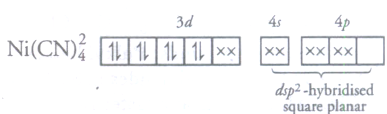
\(\therefore\)This complex has no unpaired electron.
Both (A) and (R) are correct and (R) is the correct explanation of (A).
32.
(a) Henry's law.
(b) Pgas = KH X gas
Where Pgas = Partial pressure of gas
Xgas = Mole fraction of gas
KH = Henry's law constant.
(c) Slope = KH, Henry's law constant.
(d) Solubility of gas in liquid increase with increase in pressure. Solubility of gas in liquid increase with decrease in temperature.
(e) (i) Nature of gas
(ii) Temperature
33.
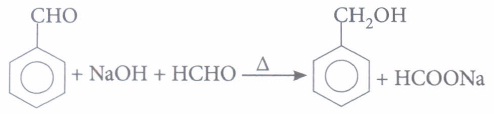
(i) (a): It is an example of cross Cannizzaro reaction where aromatic aldehyde gets reduced to alcohol and aliphatic aldehyde gets oxidised to its sodium salt (both aldehydes must not contain any \(\alpha\)-hydrogen).
(ii) (c)
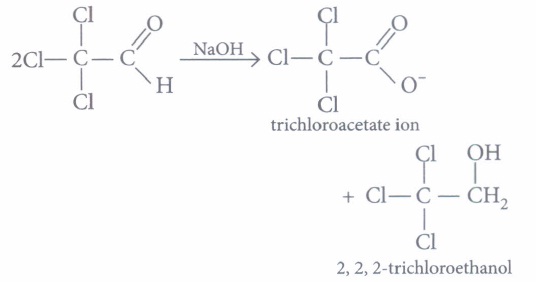
(iii) (a): The Cannizzaro product of given reaction yields 2, 2, 2-trichloroethanol.
(iv) (a): C-C bond is not formed in Cannizzaro reaction while other reactions result in the formation of C-C bond.

12th Standard CBSE Syllabus & Materials
12th Standard CBSE
CBSE 12th Computer Science Python Revision Tour I - New Previous year Question Papers Study Material - QB365 Set A
NEW12th Standard CBSE
CBSE 12th Business Studies Planning Important Questions And Answers Study Material - QB365 Set A
NEW12th Standard CBSE
CBSE 12th Business Studies Business Environment Important Questions And Answers Study Material - QB365 Set A
NEW12th Standard CBSE
CBSE 12th Business Studies Principles of Management Important Questions And Answers Study Material - QB365 Set A



NCERT Books

Syllabus

Exam Pattern

Sample Question Papers

Previous year Question Papers

Important Notes

MCQ Practice test

NCERT Exemplers

Case study Questions

Image Based Questions

Passage based Questions

HOT Questions

Value Based Questions

Model Questions Papers
NCERT ( Book Back ) Questions

Assertion and Reason
Important Questions And Answers

CBSE 12th Standard CBSE Subjects
CBSE Standards








