
 100% FREE ACCESS
12th Standard CBSE Syllabus & Materials
12th Standard CBSE
CBSE 12th Economics Government Budget and the Economy Previous year Question Papers Study Material - QB365 Set A
NEW12th Standard CBSE
CBSE 12th Computer Science Interface Python with MySQL - New Previous year Question Papers Study Material - QB365 Set A
NEW12th Standard CBSE
CBSE 12th Computer Science Database Concept - New Previous year Question Papers Study Material - QB365 Set A
NEW12th Standard CBSE
CBSE 12th Computer Science Data Communication - New Previous year Question Papers Study Material - QB365 Set A
NEW12th Standard CBSE
CBSE 12th Computer Science Data Structures - New Previous year Question Papers Study Material - QB365 Set A
NEW12th Standard CBSE
CBSE 12th Computer Science Functions - New Previous year Question Papers Study Material - QB365 Set A

Published on: 25/10/2025
Download CBSE Class 12th Standard CBSE Chemistry question papers, sample papers, important questions, and previous year solved papers in PDF format. Get free study materials, NCERT solutions, and exam preparation resources for Class 12th Standard CBSE Chemistry
Questions + Answers key
Take MCQ Chemistry Test
1.
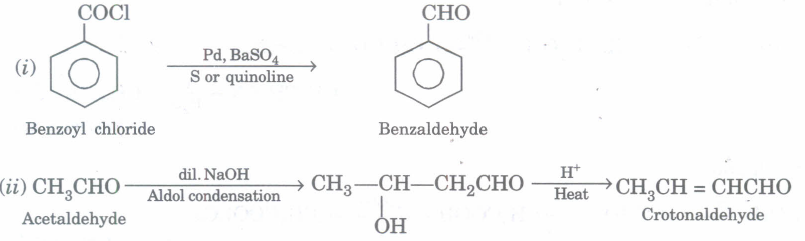
Write the reaction and conditions for the following conversions:
(i) Benzoyl chloride benzaldehyde
(ii) Acetaldehyde to crotonaldehyde
2.
Suggest the reagents to bring about the following conversion:
(i) Hexan -l- ol to hexanal
(ii) Cyclohexanol to cyclohexanone
(iii) 4-Fluorotoluene to 4-fluorobenzaldehyde
(iv) Ethanenitrile to ethanal
(v) Allyl alcohol to propenal
(vi) But-2-ene to ethanal
3.
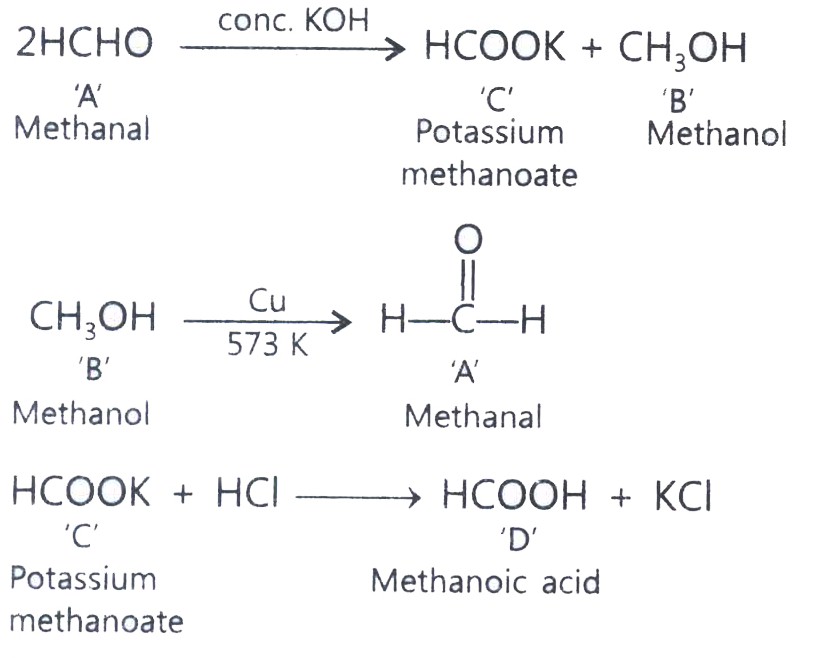
Two moles of organic compound 'A' one treatment with a strong base gives two compounds B and C. Compound 'B' on dehydrogenation with Cu gives 'A' while acidification of 'C' yields carboxylic acid 'D' having molecular formula of CH2O2. Identify the compounds A, B, C and D.
4.
(i) Write structures of A, B, C and D in the following reaction sequence:

(ii) Arrange the following compounds in the increasing order of their boiling points:
\(\begin{equation} \mathrm{CH}_{3} \mathrm{CHO}, \mathrm{CH}_{3} \mathrm{CH}_{2} \mathrm{OH}, \mathrm{CH}_{3} \mathrm{OCH}_{3}, \mathrm{CH}_{3} \mathrm{COOH} \end{equation}\)
5.
Write the products of the following reactions:
(i) \(2C_{ 6 }H_{ 3 }CHO+conc\quad NaOH\longrightarrow \)
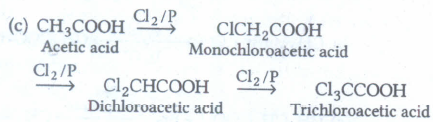
(ii) \(CH_{ 3 }COOH\underrightarrow { Cl_{ 2 }/p } \)
(b) Give, simple chemical tests to distinguish between the following pairs of compounds:
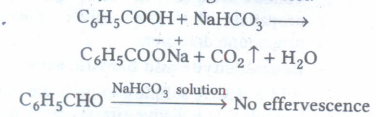
(i) Benzaldehyde and benzoic acid
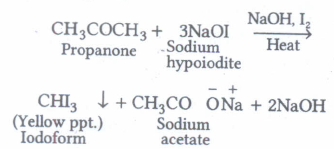
(il) Propanal and propanone.
6.
(a) Describe the following giving linked chemical equations:
(i) Cannizzaro reaction
(ii) Decarboxylation
(b) Complete the following chemical equations:
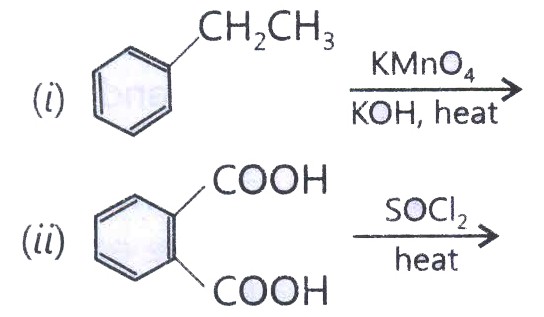
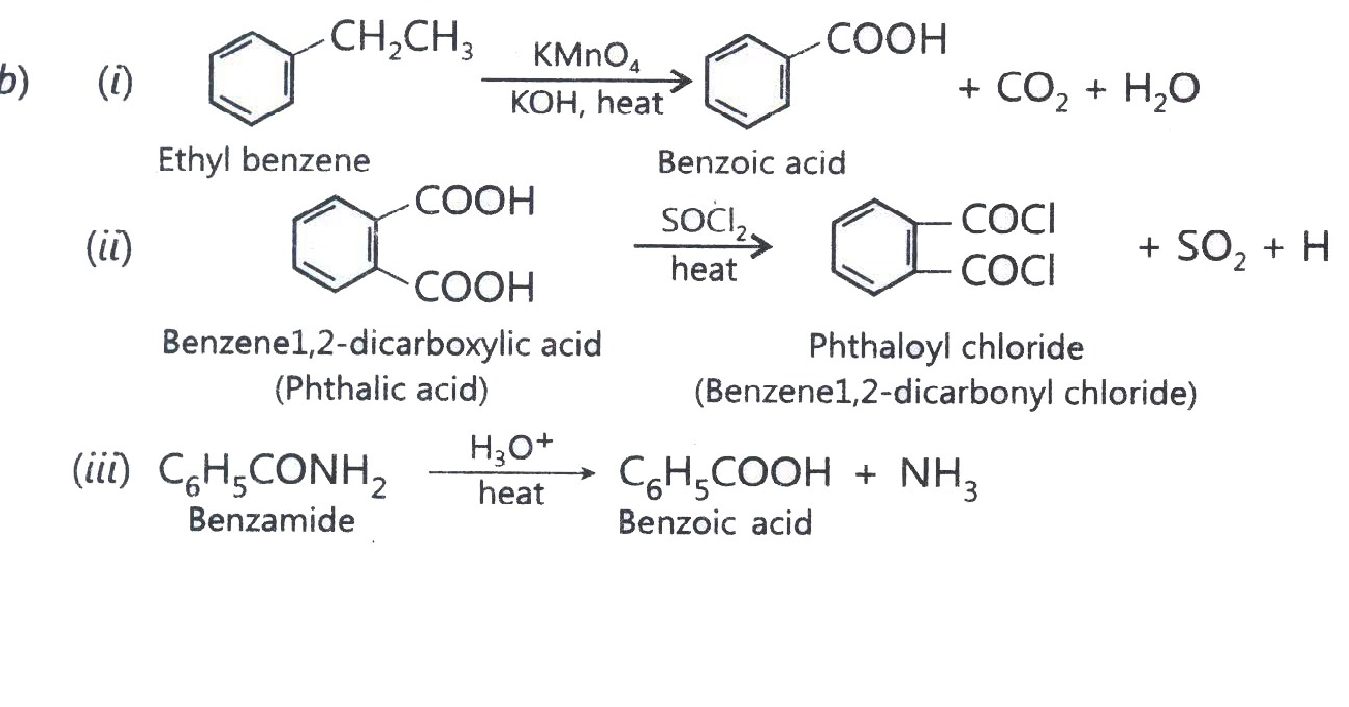
(iii) \(C_6H_5CONH_2 \xrightarrow [heat] {H_3O^+}\)
7.
Which of the following is most reactive in nucleophilic addition reactions?
HCHO
CH3CHO
CH3COCH3
CH3COC2H5
8.
Compounds A and C in the following reaction are

identical
positional isomers
functional isomers
optical isomers
9.
Acetophenone when reacted with base C2H5 -ONa, yields a stable product:
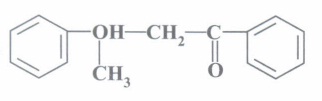
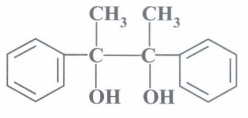
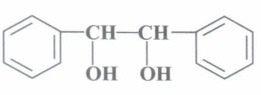
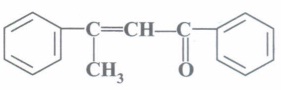
10.
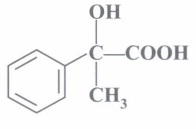
\(\mathrm{CH}_{3} \mathrm{COOH} \stackrel{\mathrm{SOCl}_{2}}{\longrightarrow} \ ^{\prime} \mathrm{A}^{\prime} \frac{\text { Benzene }}{\mathrm{Anhy} \mathrm{AlCl}_{3}}> ^{\prime} \mathrm{B}^{\prime} \stackrel{\mathrm{HCN}}{\longrightarrow} \ ^{\prime} \mathrm{C} ^{\prime} \stackrel{\mathrm{HOH}}{\longrightarrow} \ ^{\prime} \mathrm{D} ^{\prime}\)
The product 'D' is:
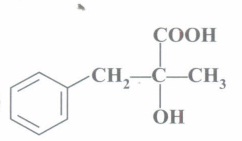
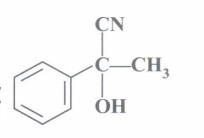
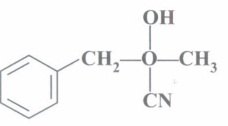
11.
Trichloroacetaldehyde was subjected to Cannizaro's reaction by using NaOH. The mixture and another products contains sodium trichloroacetate and other compound. The other compound is
trichloromethanol
2,2,2-trichloropropanol
chloroform
2,2,2-trichloromethanol
12.
A compound of molecular formula CH 100% (A) reacts with Tollens' reagent to give silver mirror but does not undergo aldol condensation. The compound A is
3-pentanone
2,2-dimethylpropanal
3-hydroxy-2-pentene
3-methyllbutanone
13.
For making distination between 2-pentanone and 3-pentanone, the reagent employed is
K2Cr2O7/H2SO4
Zn-Hg/HCI
SeO2
Iodine/NaOH
14.
CH3CHO and C6H5CH2 can be distinguished chemically by
Benedict's rect
Iodoform test
Tollens'reagent test
Fehling's solution test
15.
C3H5O did not give a silver mirror with Tollens' reagent, but give an oxmic with hydroxmine. reagent, but gave an oxmie with hydroxylamine. It can give possitive
iodoform test
Fehling's test
Schiff's test
Carbylamine test
16.
Acetic acid is treated with Ca(OH)2 and the product so obtained is subject to dry distillation. The final product is
propanal
ethanol
ethanal
propanone
17.
Give the simple chemical test to distinguish between ethanal and propanal.
18.
Draw the structure of p-methylbenzaldehyde molecule.
19.
Draw the molecular structure of the compound 4-methylpent-3-en-2-one.
20.
Assertion: Benzaldehyde resists nucleophilic addition in comparison with Ethanal
Reason: The Phenyl group in benzaldehyde is too bulky and therefore prevents the attack of Nucleophile.
Codes:
(a) If both assertion and reason are true and the reason is the correct explanation of the assertion.
(b) If both assertion and reason are true but the reason is not the correct explanation of the assertion.
(c) If the assertion is true but the reason is false.
(d) If the assertion is false but the reason is true.
(e) If the assertion and reason both are false
21.
Assertion: Acetaldehyde on treatment with alkaline gives aldol.
Reason: Acetaldehyde molecules contain a hydrogen atom.
Codes:
(a) If both assertion and reason are true and the reason is the correct explanation of the assertion.
(b) If both assertion and reason are true but the reason is not the correct explanation of the assertion.
(c) If the assertion is true but the reason is false.
(d) If the assertion is false but the reason is true.
(e) If the assertion and reason both are false
22.
Assertion: Ketones can be converted into acids by haloform reaction.
Reason: Addition of Grignard reagents to dry ice followed by hydrolysis gives ketones.
Codes:
(a) Assertion and reason both are correct statements and reason is correct explanation for assertion.
(b) Assertion and reason both are correct statements but reason is not correct explanation for assertion.
(c) Assertion is correct statement but reason is wrong statement.
(d) Assertion is wrong statement but reason is correct statement.
23.
Assertion: Fluoroacetic acid is stronger than chloroacetic acid.
Reason: Carboxylic acids are weak acids and turn blue litmus red.
Codes:
(a) Assertion and reason both are correct statements and reason is correct explanation for assertion.
(b) Assertion and reason both are correct statements but reason is not correct explanation for assertion.
(c) Assertion is correct statement but reason is wrong statement.
(d) Assertion is wrong statement but reason is correct statement.
24.
Study the table in whick pka of various is given. Answer the questions based on table and related studied concepts.
| Compounds | pka |
| Acetic acid | 4.76 |
| HCOOH | 3.75 |
| CH3CH2COOH | 4.38 |
| CICH2COOH | 2.87 |
| FCH2COOH | 2.59 |
| CH2 = CH-COOH | 4.30 |
| Benzoic acid | 4.19 |
| p- Toluic acid | 4.38 |
| Salicylic acid | 2.98 |
| p-nitro benzoic acid | 3.44 |
| p-methoxy benzoic acid | 4.88 |
| p-chloro benzoic acid | 3.99 |
| p-hydroxy benzoic acid | 4.58 |
(a) Why is HCOOH stronger than CH3 COOH?
(b) Why is p-hydroxy benzoic acid more acidic than p-methoxy benzoic acid?
(c) Why is salicylic acid stronger than benzoic acid?
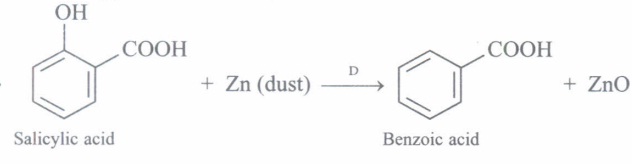
(d) What happens when salicylic acid is heated with zinc dust?
(e) Give one use of salicylic acid.
25.
Read the passage given below and answer the following questions:
Aldehydes and ketones undergo nucleophilic addition reactions .
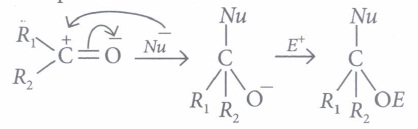
Carbonyl carbon is electron deficient hence acts as an electrophile. Nucleophile attacks on the electrophilic carbon atom of the carbonyl group from a direction perpendicular to the plane of the molecule.
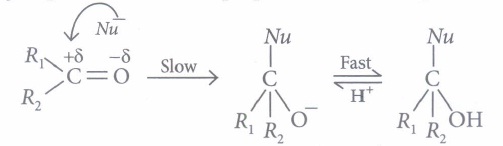
In this process, hybridisation of carbon atom changes from sp2 to sp3 and a tetrahedral alkoxide ion is formed as intermediate. This intermediate captures proton from the reaction medium to give the neutral product. Aldehydes are generally more reactive than ketones in nucleophilic addition reactions.
In these questions ( i - iv), a statement of assertion followed by a statement of reason is given. Choose the correct answer out of the following choices.
(a) Assertion and reason both are correct statements and reason is correct explanation for assertion.
(b) Assertion and reason both are correct statements but reason is not correct explanation for assertion.
(c) Assertion is correct statement but reason is wrong statement.
(d) Assertion is wrong statement but reason is correct statement.
(i) Assertion: Benzaldehyde is more reactive than ethanal towards nucleophilic attack.
Reason: The overall effect of -land +R effect of phenyl group decreases the electron density on the carbon atom of >C=O group in benzaldehyde
(ii) Assertion: (CH3)3CCOC(CH3)3 and acetone can be distinguished by the reaction with NaHSO3.
Reason: HSO3 is the nucleophile in bisulphite addition.
(iii) Assertion: Ease of nucleophilic addition of the compounds 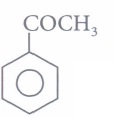 (I). CH3CHO(II) and CH3COCH3(III) is I > II > III.
Reason : Aldehydes and ketones undergo nucleophilic addition reactions.
(iv) Assertion: 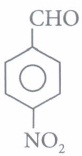 is more reactive towards nucleophilic addition reaction than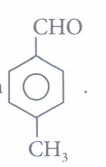
Reason : Reactivity of carbonyl group is due to electrophilic nature of carbonyl carbon.
1.
2.
\((i)\ { C }_{ 5 }{ H }_{ 5 }{ NH }^{ + }{ CrO }_{ 3 }{ Cl }^{ - }(pcc)\ in\ { CH }_{ 2 }{ Cl }_{ 2 }\)
\( (ii)\ { K }_{ 2 }{ Cr }_{ 2 }{ O }_{ 7 }\ in\ acidic\ medium\)
\((iii)\ Cr{ O }_{ 2 }\ in\ the\ presence\ of\ acetic\ anhydride\ (273-283K)\ or\ Cr{ O }_{ 2 }{ Cl }_{ 2 }, { H }_{ 2 }O\)
\((iv)\ DIBALH\:\ (Diisobutyl)\ aluminium\ hydride, 78°C,{ H }_{ 2 }O\)
\((v)\ PCC\ in\ { CH }_{ 2 }{ Cl }_{ 2 }\)
\((vi)\ { O }_{ 3 }/{ H }_{ 2 }O-Zn\ dust\)
3.
4.
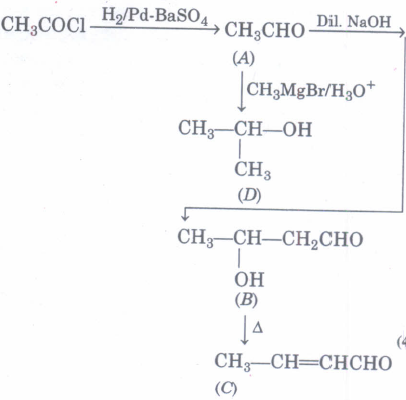
(ii) The correct increasing order of the boiling points is :
\(\begin{equation} \begin{array}{r} \mathrm{CH}_{3}-\mathrm{O}-\mathrm{CH}_{3}<\mathrm{CH}_{3} \mathrm{CHO}<\mathrm{CH}_{3} \mathrm{CH}_{2} \mathrm{OH} <\mathrm{CH}_{3} \mathrm{COOH} \end{array} \end{equation}\)
5.
(a) Benzaldehyde and benzoic acid NaHCO3 test Benzoic acid being an acid reacts with NaHCO3 solution, to produce brisk effervescence due to evolution of CO2 while benzaldehyde does not give this test.
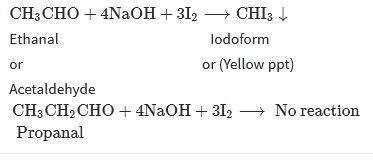
(b) Propanal and propanone Propanone responds to iodoform test whereas propanal (CH3CH2CHO) does not due to the absence of CH3CO- group.
6.
(a) (i) Cannizzaro's reaction:
When aldehydes which do not have \(\alpha\)-hydrogen gets oxidised as well as reduced in presence of conc. alkali, it is called Cannizzaro's reaction.
\(\underset { Methanal }{ 2HCHO } \overset { 50%NaOH }{ \longrightarrow } \underset { Sodium\quad Methanoate }{ HCOONa } +\underset { Methanol }{ CH_{ 3 }OH } \)
(ii) Decarboxylation : Sodium salts of acids when heated with soda lime, lower alkanes are formed
\(\underset { Sodium\quad acetate }{ CH_{ 3 }COONa } +\underset { Sodalime }{ NaOH } \longrightarrow \underset { Methane }{ CH_{ 4 } } +\underset { sodium\quad carbonate }{ Na_{ 2 }CO_{ 3 } } \)
7.
(a)
HCHO
8.
(b)
positional isomers
9.
(d)
10.
(d)
11.
(d)
2,2,2-trichloromethanol
12.
(b)
2,2-dimethylpropanal
13.
(d)
Iodine/NaOH
14.
(b)
Iodoform test
15.
(a)
iodoform test
16.
(d)
propanone
17.
Iodoform test Ethanal, because of the presence of CH3CO-skeleton gives iodoform test whereas propanal due to the absence of such a skeleton does not.
18.

19.

20.
(c) If the assertion is true but the reason is false.
21.
(a) If both assertion and reason are true and the reason is the correct explanation of the assertion.
22.
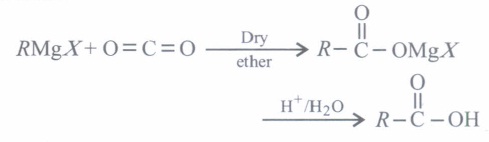
(c): Addition of Grignard reagents to dry ice followed by hydrolysis gives carboxylic acid not ketone.
23.
(b) : The -I effect of F is greater than inductive effect of Cl and thus fluoroacetate ion is more stabilized to show more tendency to lose proton by its acid.
24.
(a) It is because HCOO- is more stable than CH3COO-.
(b) It is because -OH has more -I effect than -OCH3 group.
(c) It is because salicylate is more stable than benzoate ion due to intra molecular H-bonding.
(d)
(e) It is used for preparation of Aspirin which is an important Analgesics, Antipyretic and prevents heart attack.
25.
(i) (a)
(ii) (b): \(\mathrm{HSO}_{3}^{-}\) is a bulky nucleophile, hence, cannot attack on sterically hindered ketones.
(iii) (d): Aromatic aldehydes and ketones are less reactive than the corresponding aliphatic analogues towards nucleophilic addition reactions due to the +R effect of benzene ring. Further, aldehydes are more reactive than ketones due to +I effect and steric effect of alkyl group. Therefore, the ease of nucleophilic addition will follow the order:

(iv) (b): Electron withdrawing group (-NO2) increases the reactivity towards nucleophilic addition reactions, whereas electron donating group (-CH3) decreases the reactivity towards nucleophilic addition reactions.

12th Standard CBSE Syllabus & Materials
12th Standard CBSE
CBSE 12th Computer Science Python Revision Tour I - New Previous year Question Papers Study Material - QB365 Set A
NEW12th Standard CBSE
CBSE 12th Business Studies Planning Important Questions And Answers Study Material - QB365 Set A
NEW12th Standard CBSE
CBSE 12th Business Studies Business Environment Important Questions And Answers Study Material - QB365 Set A
NEW12th Standard CBSE
CBSE 12th Business Studies Principles of Management Important Questions And Answers Study Material - QB365 Set A



NCERT Books

Syllabus

Exam Pattern

Sample Question Papers

Previous year Question Papers

Important Notes

MCQ Practice test

NCERT Exemplers

Case study Questions

Image Based Questions

Passage based Questions

HOT Questions

Value Based Questions

Model Questions Papers
NCERT ( Book Back ) Questions

Assertion and Reason
Important Questions And Answers

CBSE 12th Standard CBSE Subjects
CBSE Standards








