
 100% FREE ACCESS
12th Standard CBSE Syllabus & Materials
12th Standard CBSE
CBSE 12th Economics Government Budget and the Economy Previous year Question Papers Study Material - QB365 Set A
NEW12th Standard CBSE
CBSE 12th Computer Science Interface Python with MySQL - New Previous year Question Papers Study Material - QB365 Set A
NEW12th Standard CBSE
CBSE 12th Computer Science Database Concept - New Previous year Question Papers Study Material - QB365 Set A
NEW12th Standard CBSE
CBSE 12th Computer Science Data Communication - New Previous year Question Papers Study Material - QB365 Set A
NEW12th Standard CBSE
CBSE 12th Computer Science Data Structures - New Previous year Question Papers Study Material - QB365 Set A
NEW12th Standard CBSE
CBSE 12th Computer Science Functions - New Previous year Question Papers Study Material - QB365 Set A

Published on: 25/10/2025
Download CBSE Class 12th Standard CBSE Chemistry question papers, sample papers, important questions, and previous year solved papers in PDF format. Get free study materials, NCERT solutions, and exam preparation resources for Class 12th Standard CBSE Chemistry
Questions + Answers key
Take MCQ Chemistry Test
1.
(i) What is the basic structural difference between glucose and fructose?
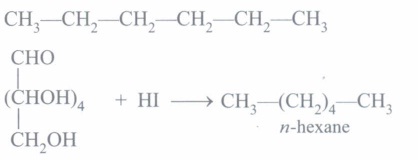
(ii) Write chemical reaction to show that open structure of D-glucose contains the straight chain.
(iii) What type of linkage is responsible for the formation of proteins?
2.
Why are aliphatic carboxylic acids stronger acids than phenols?
3.
What happens when:
(i) An aqueous solution of sodium acetate is electrolysed?
(ii) Calcium acetate is dry distilled?
(iii) Sodium benzoate is heated with soda lime?
4.
Define the following and give one example of each:
(a) Isoelectric point
(b) Mutarotation
(c) Enzymes
5.
Define the following, giving one example of each:
(i) Zwitter ion
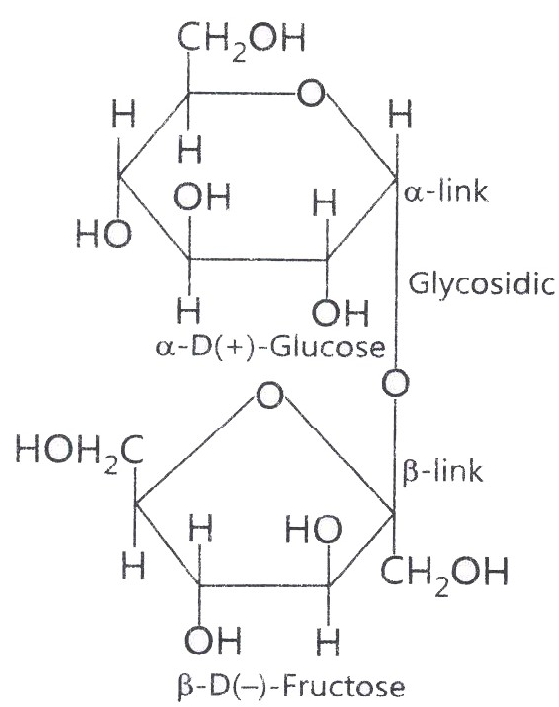
(ii) Glycosidic linkage
6.
What are the products of hydrolysis of sucrose?
7.
What is denaturation of proteins? What is the effect of denaturation on the structure of proteins? Give two examples of denatured proteins from your daily life.
8.
Benzaldehyde reduces Tollens' reagent but not the Fehling's or the Benedict's solution. Explain.
9.
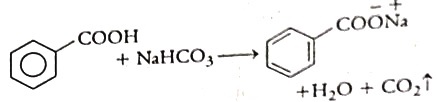
Give simple chemical tests to distinguish between the following pairs of compounds. Phenol and Benzoic acid
10.
Write the structure of the following compound: 3 - oxo pentanal.
11.
On the basis of which evidences D-glucose was assigned the following structure?
CHO
|
(CHOH)4
|
CH2OH
12.
Vitamins represents a group of organic compounds which are needed in small amounts for the healthy growth and maintenance of our body. These are not synthesised by the body and are supplied by the diet. The deficiency of vitamins can be supplemented with medicines.
(i) Which vitamins are water soluble ?
(ii) What are the chemical name of vitamin C and vitamin D ?
(iii) What is the source of vitmain K ?
(iv) How is vitamin K useful ?
13.
Give reason for the following :
(i) On electrolysis in acidic solution, aminoacids migrate towards cathode while in alkaline solution these migrate towards anode.
(ii) The mononamino monocarboxylic acids have two pK values.
14.
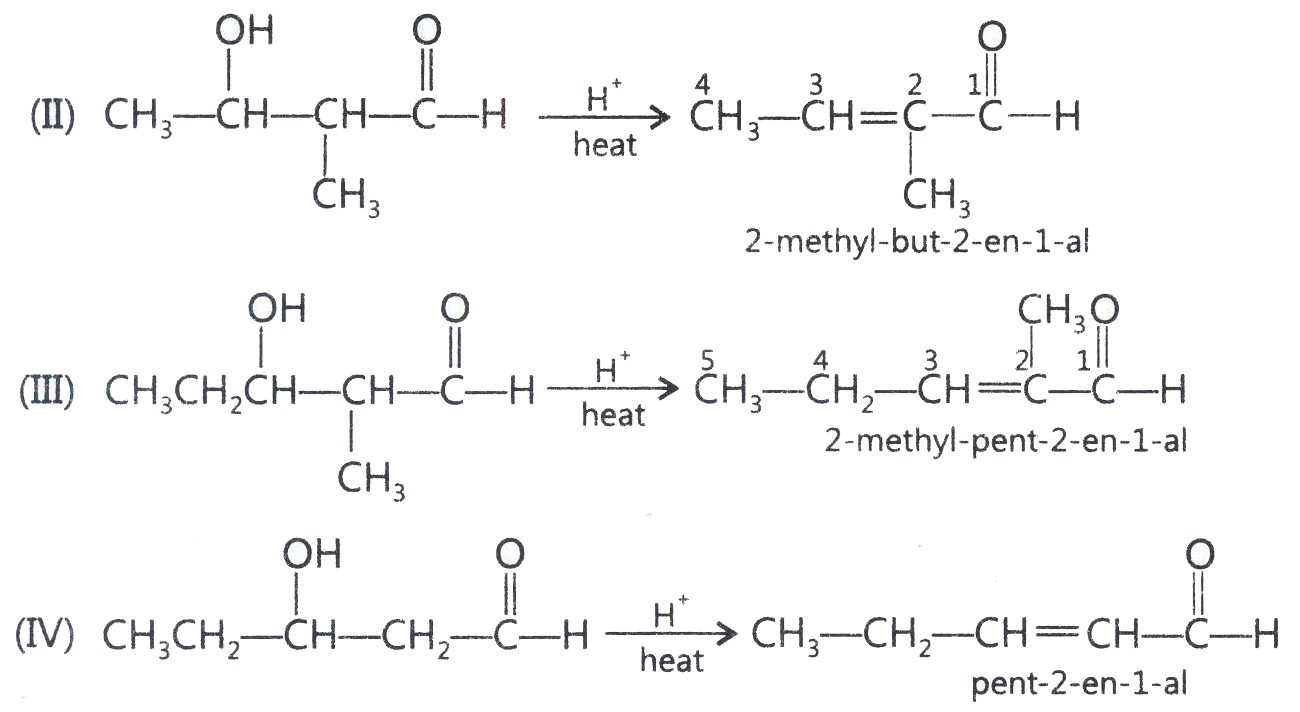
Describe the following reactions
(i) Cannizzaro's reactions.
(ii) Cross aldol condensation
15.
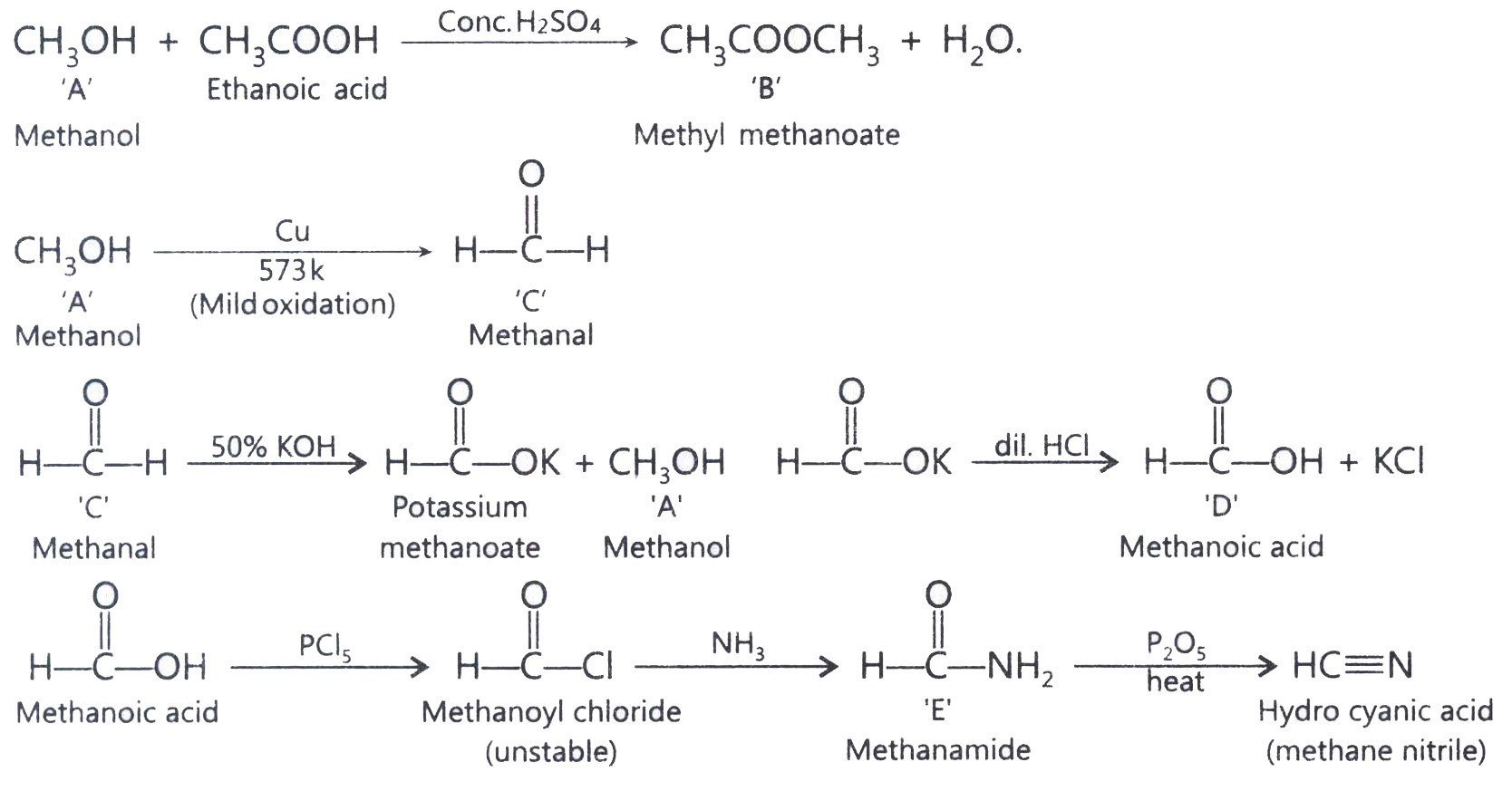
An organic compound (A) on treatment with acetic acid in the presence of sulphuric acid produces an ester (B). (A) on mild oxidation gives (C). (C) with 50% KOH followed by acidification with dilute HCl generates (A) and (D). (D) with PCl5 followed by reaction with ammonia gives (E). (E) on dehydration produces hydrocyanic acid. Identify the compounds A, B, C, D and E.
16.
(a) Given chemical tests to distinguish between the following:
(i) Benzoic acid and ethyl benzoate
(ii) Benzaldehyde and acetophenone
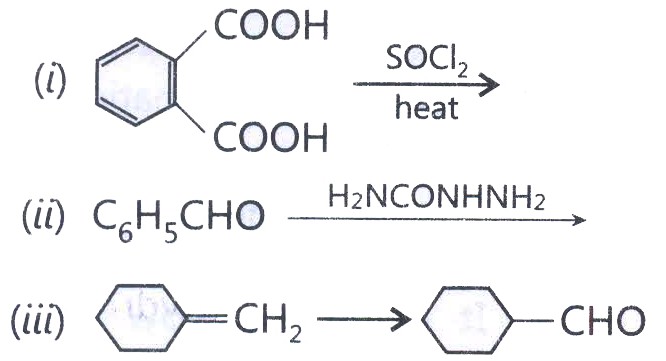
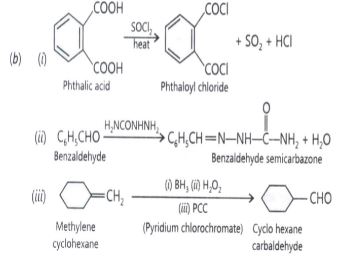
(b) Complete each synthesis by giving missing reagents or products in the following:
17.
Which of the following reactions will not result in the formation of carbon-carbon bonds ?
Fridel-Crafts acylation
Reimer-Tiemann reaction
Cannizzaro reaction
Wurtz reaction
18.
The helical structure of protein is stabilized by
dipeptide bonds
hydrogen bonds
ether bonds
peptide bonds
19.
Antibodies are
Carbohydrates
Proteins
Lipids
Enzymes.
20.
The compound that does not undergo Cannizzaro reaction is
formaldehyde
acetaldehyde
benzaldehyde
trimethylacetaldehyde
21.
The formation of cyanohydrin from acetone is which type of reaction ?
Electrophilic substitution
Electrophilic addition
Nucleophilic addition
Nucleophilic substitution
1.
(i) Glucose has aldehyde group whereas fructose has keto group.
(ii) n-hexane is formed,
(iii) Peptide linkage.
2.
The aliphatic carboxylic acids are stronger acids than phenols. The difference in the relative acidic strengths can be understood if we compare the resonance hybrids of carboxylate ion and phenoxide ion.
(i) The electron charge in the carboxylate ion is more dispersed in comparison to the phenoxide ion since 'there are two electronegative oxygen atoms in carboxylate ion as compared to only one oxygen atom in phenoxide ion.
(ii) Carboxylate ion is stabilised by two equivalent resonance structures in which negative charge is on more electronegative O atom. But phenoxide ion has non-equivalent resonance structures in which the negative charge is also on less electronegative carbon atom.
Therefore, the carboxylate ion is relatively more stable as compared to phenoxide ion. Thus, the release of H+ ion from carboxylic acid is comparatively easier or it behaves as a stronger acid than phenol.
3.
(i) \(2CH_{ 3 }COONa\overset { Electrolysis }{ \longrightarrow } 2CH_{ 3 }COO^{ - }+2Na^{ + }\)
At anode : \(2CH_{ 3 }COO^{ - }\longrightarrow \overset { CH_{ 3 } }{ \underset { CH_{ 3 } }{ | } } +2CO_{ 2 }+2e^{ - }\)
At Cathode : \(2H^++2e^-\rightarrow H_2(g)\)
(ii) \(_{ CH_{ 3 }COO }^{ CH_{ 3 }COO }{ _{ \diagup }^{ \diagdown }{ Ca } }\quad \overset { Dry }{ \underset { distillation }{ \longrightarrow } } \underset { Acetone }{ CH_{ 3 }COCH_{ 3 } } +CaCO_{ 3 }\)
(iii) \(\underset { Sodium\quad benzoate }{ C_{ 6 }H_{ 5 }COONa } +\underset { Soda\quad lime }{ NaOH(CaO) } \overset { \triangle }{ \longrightarrow } \underset { Benzene }{ C_{ 6 }H_{ 6 } } +\underset { sodium\\ carbonate }{ Na_{ 2 }CO_{ 3 } } \)
4.
(a) Isoelectric point: It is the pH at which +ve and -ve charges on zwitter ion are equal, e.g., amino acid exists as zwitter ion at pH =5.5 to 6.3.
(b) Mutarotation : It is a spontaneous change in optical rotaion when an optically active substance is dissolved in water, e.g., \(\alpha\)-glucose, when dissolved in water, its optical rotaion changes from 111o to 52.5o.
(c)Enzymes : They are biological catalysts which catalyse specific biochemical reactions, e.g.,
\(\underset { sucrose }{ C_{ 12 }H_{ 22 }O_{ 11 } } +H_{ 2 }O\quad \overset { invertase }{ \longrightarrow } \underset { Glucose }{ C_{ 6 }H_{ { 12 } }O_{ 6 } } +\underset { Fructose }{ C_{ 6 }H_{ 12 }O_{ 6 } } \)
Most of enzymes are globular proteins.
5.
(i)The ion whose one end is positively charged and other end is negatively charged is called Zwitter ion, e.g.,
\({ H }_{ 2 }N-CH_{ 2 }-COOH\rightleftharpoons { H }_{ 3 }^{ \oplus }N-CH_{ 2 }-COO^{ - }\)
(ii) Glycosidic Linkage: The oxide linkage between monosachharide units in oligo and polysachharide is called glycosidic linkage, e.g.
6.
The products obtained on hydrolysis of sucrose are D-(+)-glucose and D-(-)-fructose.
7.
Denaturation of proteins. Whenever proteins are subjected to changes in pH, action of heat, presence of electrolytes and radiations, they undergo structural changes leading to even the opening up of the folded structure. The changed state of proteins is called denaturation state. This causes a permanent loss of activity of proteins.
Effect of denaturation on the structure of proteins. During denaturation, the protein molecule uncoils from an ordered and specific conformation into a more random conformation. Denaturation does not change the primary structure of protein but results from a rearrangement of secondary and tertiary structures.
8.
The electron-donating resonance effect (+R-effect) of the benzene ring increases the electron density in the carbonyl group of benzaldehyde. This, in turn, increases the electron density in the C-H bond of the aldehyde group. As a result, the C-H bond becomes stronger and hence only stronger oxidising agents like Tollens' reagent, Ag(NH3)\(+\\ 2\) \(({ E° }_{ { Ag }^{ + }/Ag }=+0.18V)\) can oxidise C-H to C-OH to form carboxylic acids but weaker oxidising agents like Fehling's solution (Cu2+ + tartrate ion + base) .and Benedict's (Cu2+ + citrate ion + base) solution \(({ E° }_{ { Cu }^{ + }/Cu }=0.18V)\) fail to oxidise benzaldehyde to benzoic acid.
Thus, in general, all these three reagents oxidise aliphatic aldehydes but only Tollens' reagent oxidises aromatic aldehydes.
9.
Benzoic acid and phenol Benzoic acid reacts with sodium bicarbonate to produce effervescence of carbon dioxide. whereas phenol does not.
10.

11.
Evidences on the basis of which glucose was assigned the given structure are as follows
(i) Glucose on reaction with HI produces n-hexane which indicates presence of six carbon atoms linked in a straight chain.
\(\mathrm{C}_6 \mathrm{H}_{12} \mathrm{O}_6 \xrightarrow{\mathrm{HI}} n \text {-hexane }\)
(ii) Glucose on reaction with acetic anhydride produces glucose pentaacetate which indicates presence of five -OH groups.
\(\mathrm{C}_6 \mathrm{H}_{12} \mathrm{O}_6 \xrightarrow{\mathrm{Ac}_2 \mathrm{O}} \text { Glucose pentaacetate }\)
(iii) Glucose on oxidation with bromine water produces gluconic acid indicates presence of -CHO group.
\(\text { Glucose } \xrightarrow{\mathrm{Br}_2 / \mathrm{H}_2 \mathrm{O}} \text { Gluconic acid }\)
iv) Glucose on reaction with HNO3 produces saccharic acid, which indicates the presence of one primary -OH group.
12.
(i) Vitamin B-complex and vitamin C are water soluble vitamins.
(ii) Vitamin C is chemically ascorbic acid while vitamin D is ergocalciferol.
(iii) Green leafy vegetables like spinach, cabbage, carrot etc.
(iv) It is essentially needed for body. The deficiency of vitamin K leads to blood clotting and even harmorrhage
13.
(i) Amino acids have zwitterionic structure. Therefore. in presence of strong acids the} exist as cations' (I) and thus on electrolysis, these migrate towards cathode.
\(\overset { + }{ { NH }_{ 3 } } -CHR-{ COO }^{ - }+{ H }^{ + }\longrightarrow \quad \overset { + }{ { NH }_{ 3 } } -CHR-{ COO }H\\ \quad \quad Zwitterion\quad \quad \quad \quad \quad \quad \quad \quad \quad \quad \quad \quad Cation(I)\)
In contrast, in presence of alkalies, the amino acids exist as anions (II) and thus on electrolysis, these migrate towards anode.
\(\overset { + }{ { NH }_{ 3 } } -CHR-{ COO }^{ - }+{ OH }^{ - }\longrightarrow \quad \overset { + }{ { NH }_{ 3 } } -CHR-{ COO }H\\ \quad \quad Zwitterion\quad \quad \quad \quad \quad \quad \quad \quad \quad \quad \quad \quad Anion(II)\\ \)
(ii) A monoamino monocarboxylic acid such as glycine exists as a dipolar ion \((\overset { + }{ { NH }_{ 3 } } -{ CH }_{ 2 }-{ COO }^{ - })\) .In this structure, \(\overset { + }{ { NH }_{ 3 } } \) group acts as the acid and \({ COO }^{ - }\) group acts as the base. Thus, monoamino monocarboxylic acids can act both as an acid as well as a base. Therefore, these acids have two pK values one as an acid (when titrated with a base) and other as a base (when titrated with an acid).
14.
15.
16.
(a) (i) Add sodium bicarbonate to aqueous solution of benzoic acid and ethyl benzoate separately. Brisk effervescence due to CO2 will confirm benzoic acid. Ethly benzoate will not react.
(ii) Add I2 and NaOH. Benzaldehyde does not give yellow ppt. whereas acetophenone give yellow ppt. due to iodoform."
17.
(c)
Cannizzaro reaction
18.
(b)
hydrogen bonds
19.
(b)
Proteins
20.
acetaldehyde contains \(\alpha \)- hydrogens and hence does not undergo aldol condensation
21.
(c)
Nucleophilic addition

12th Standard CBSE Syllabus & Materials
12th Standard CBSE
CBSE 12th Computer Science Python Revision Tour I - New Previous year Question Papers Study Material - QB365 Set A
NEW12th Standard CBSE
CBSE 12th Business Studies Planning Important Questions And Answers Study Material - QB365 Set A
NEW12th Standard CBSE
CBSE 12th Business Studies Business Environment Important Questions And Answers Study Material - QB365 Set A
NEW12th Standard CBSE
CBSE 12th Business Studies Principles of Management Important Questions And Answers Study Material - QB365 Set A



NCERT Books

Syllabus

Exam Pattern

Sample Question Papers

Previous year Question Papers

Important Notes

MCQ Practice test

NCERT Exemplers

Case study Questions

Image Based Questions

Passage based Questions

HOT Questions

Value Based Questions

Model Questions Papers
NCERT ( Book Back ) Questions

Assertion and Reason
Important Questions And Answers

CBSE 12th Standard CBSE Subjects
CBSE Standards








