
 100% FREE ACCESS
12th Standard CBSE Syllabus & Materials
12th Standard CBSE
CBSE 12th Economics Government Budget and the Economy Previous year Question Papers Study Material - QB365 Set A
NEW12th Standard CBSE
CBSE 12th Computer Science Interface Python with MySQL - New Previous year Question Papers Study Material - QB365 Set A
NEW12th Standard CBSE
CBSE 12th Computer Science Database Concept - New Previous year Question Papers Study Material - QB365 Set A
NEW12th Standard CBSE
CBSE 12th Computer Science Data Communication - New Previous year Question Papers Study Material - QB365 Set A
NEW12th Standard CBSE
CBSE 12th Computer Science Data Structures - New Previous year Question Papers Study Material - QB365 Set A
NEW12th Standard CBSE
CBSE 12th Computer Science Functions - New Previous year Question Papers Study Material - QB365 Set A

Published on: 25/10/2025
Download CBSE Class 12th Standard CBSE Chemistry question papers, sample papers, important questions, and previous year solved papers in PDF format. Get free study materials, NCERT solutions, and exam preparation resources for Class 12th Standard CBSE Chemistry
Questions + Answers key
Take MCQ Chemistry Test
1.
Arrange the following compounds in increasing order of solubility in water:
C6H5NH2, (C2H5 )2NH, C2H5NH2
2.
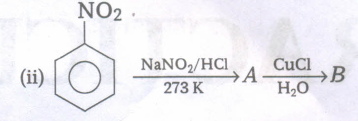
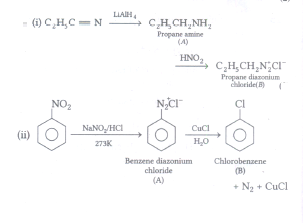
Identify A and B in the following reactions.
\(\begin{equation} \text { (i) } \mathrm{C}_{2} \mathrm{H}_{5} \mathrm{C} \equiv \mathrm{N} \stackrel{\mathrm{LiAlH}_{4}}{\longrightarrow} A \stackrel{\mathrm{HNO}_{2}}{\longrightarrow} B \end{equation}\)
3.
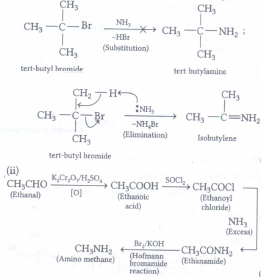
(i) Tert-butylamine cannot be prepared by the action of NH3 on tert-butylbromide. Give reason.
(ii) How is aminomethane obtained from ethanal?
4.
Give a chemical test to distinguish between a primary and a secondary amine.
5.
How will you carry out the following conversions?
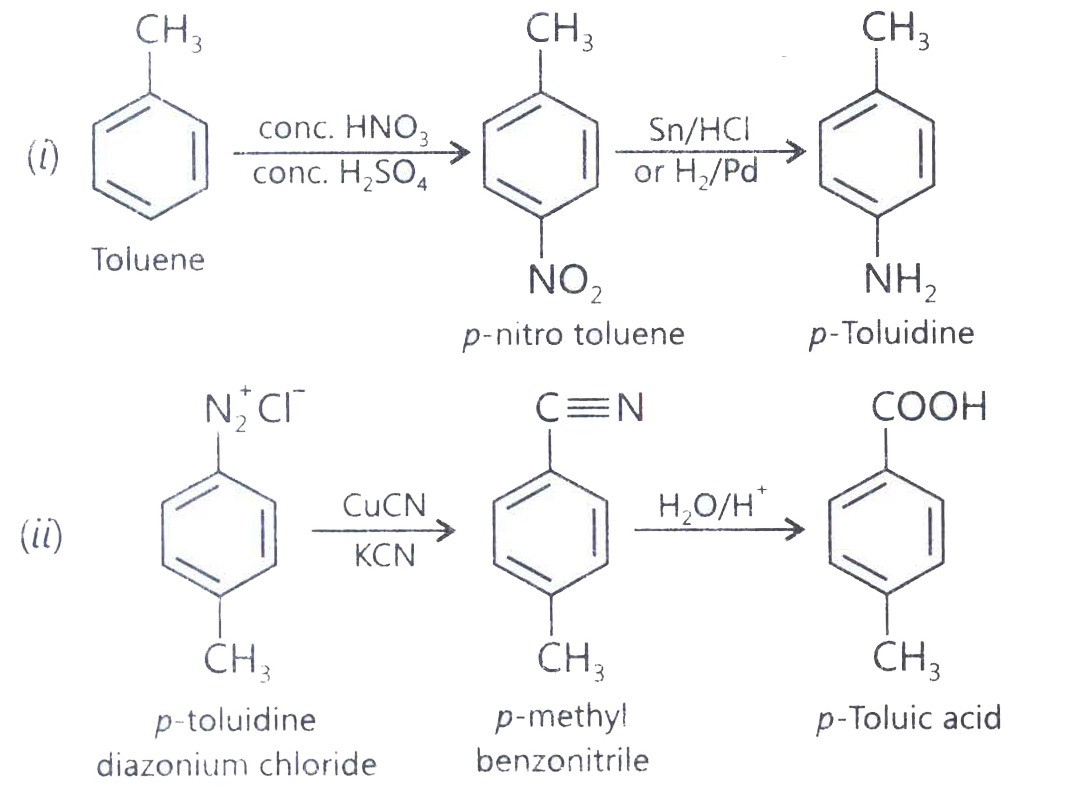
(i) toluene \(\longrightarrow \) p-toluidine
(ii) p-toluidine diazonium chloride \(\longrightarrow \) p-toluic acid
6.
(a) Account for the following:
(i) Aniline is weaker base than cyclohexylamine.
(ii) Silver chloride dissolves in CH3NH2 solution .
(b) Arrange the following compounds in increasing order of basic strength in aqueous solution:
NH3 , RNH2 , R2NH, R3N (R is CH3 )
7.
Write the chemical equations involved when C2H5NH2 is treated with the following reagents:
(i) CH3COCI/pyridine
(ii) C6H5SO2CI
(iii) CHCl3 + KOH
8.
Arrange the following in increasing order of this basic strength:
(a) C2H5NH2, C6H5NH2, NH3, C6H5CH2NH2 and (C2H5)2 NH
(b) C2H5NH2, (C2H)2NH, (C2H5)3N, C6H5NH2
(c) CH3NH2, (CH3)2NH, (CH3)3N, C6H5NH2, C6H5CH2NH2
9.
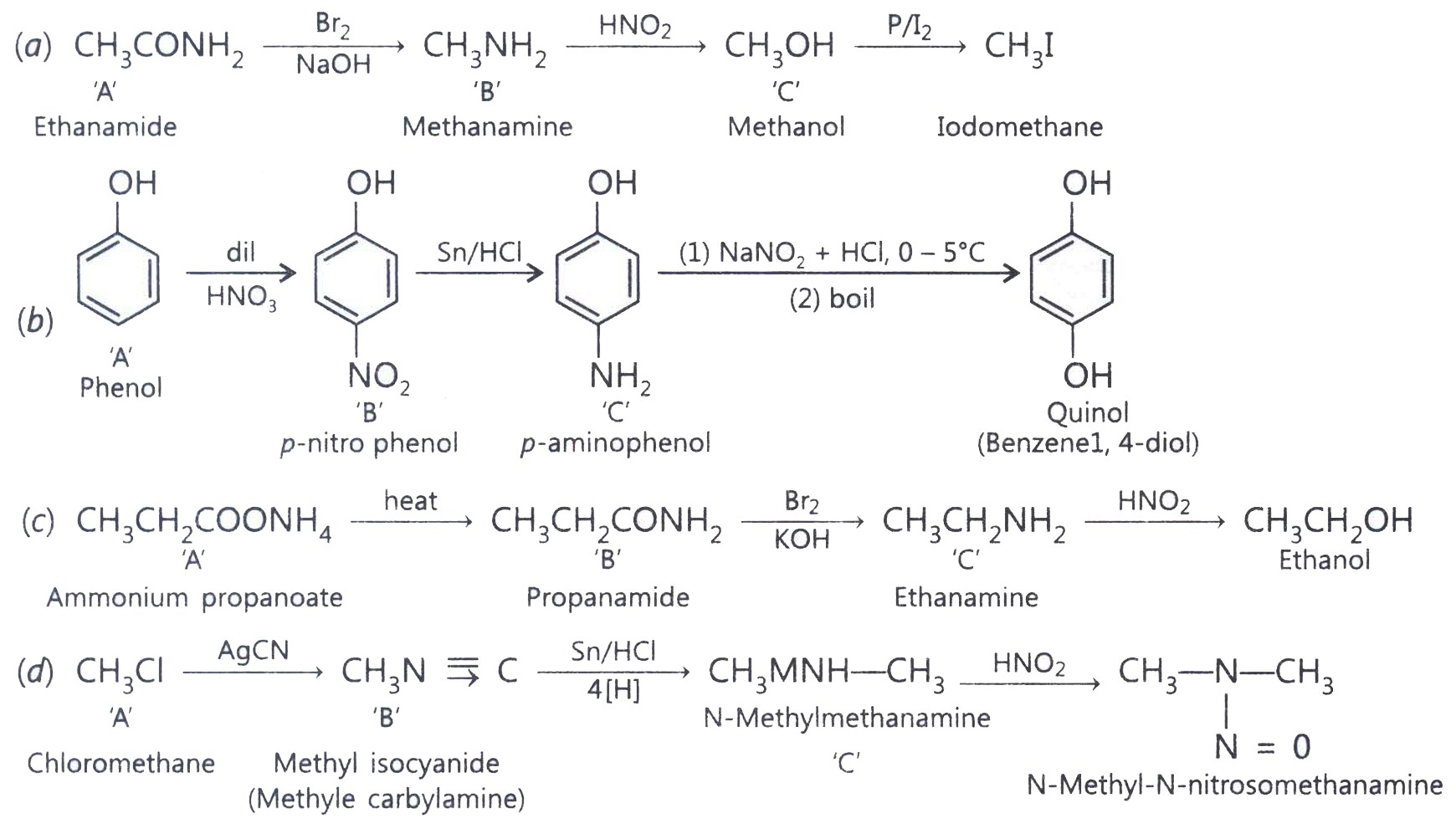
Identify the compounds A, B and C in the following reactions:
q.jpg)
q.jpg)
10.
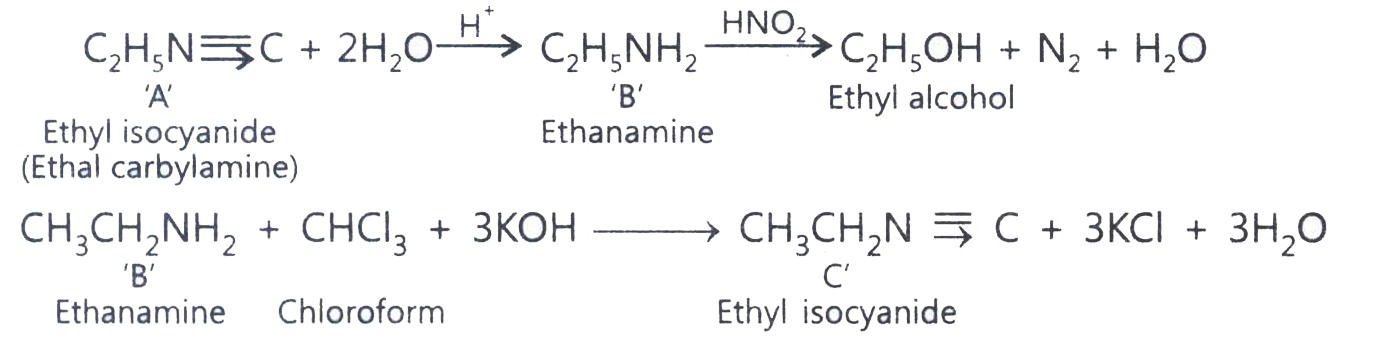
An organic compound 'A' having molecular formula C3H5N on hydrolysis gave another compound 'B' The compound 'B' on treatment with CHCI93 and alcoholic caustic potash gave an offensive smelling substance 'C' . Identify 'A' , 'B' and 'C'.
11.
Write short notes on the following.
(i) Hofmann bromamide reaction
(ii) Ammonolysis
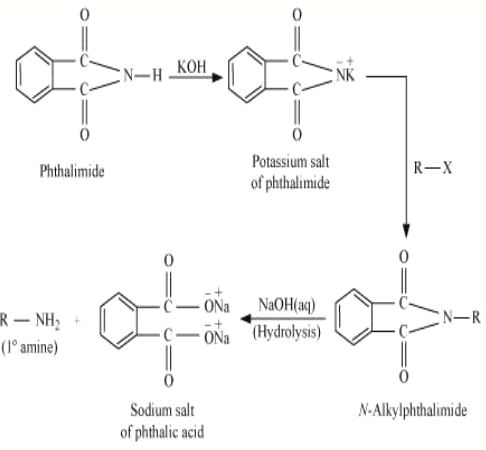
(iii) Gabriel phthalimide synthesis
12.
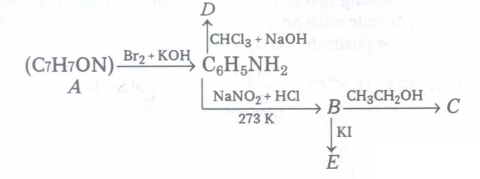
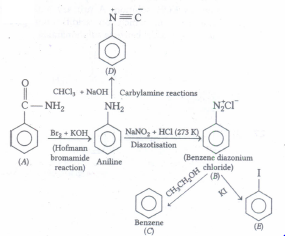
An aromatic compound 'A' of molecular formula C7H7ON undergoes a series of reactions as shown below. Write the structures of A, B, C, D and E in the following reactions.
13.
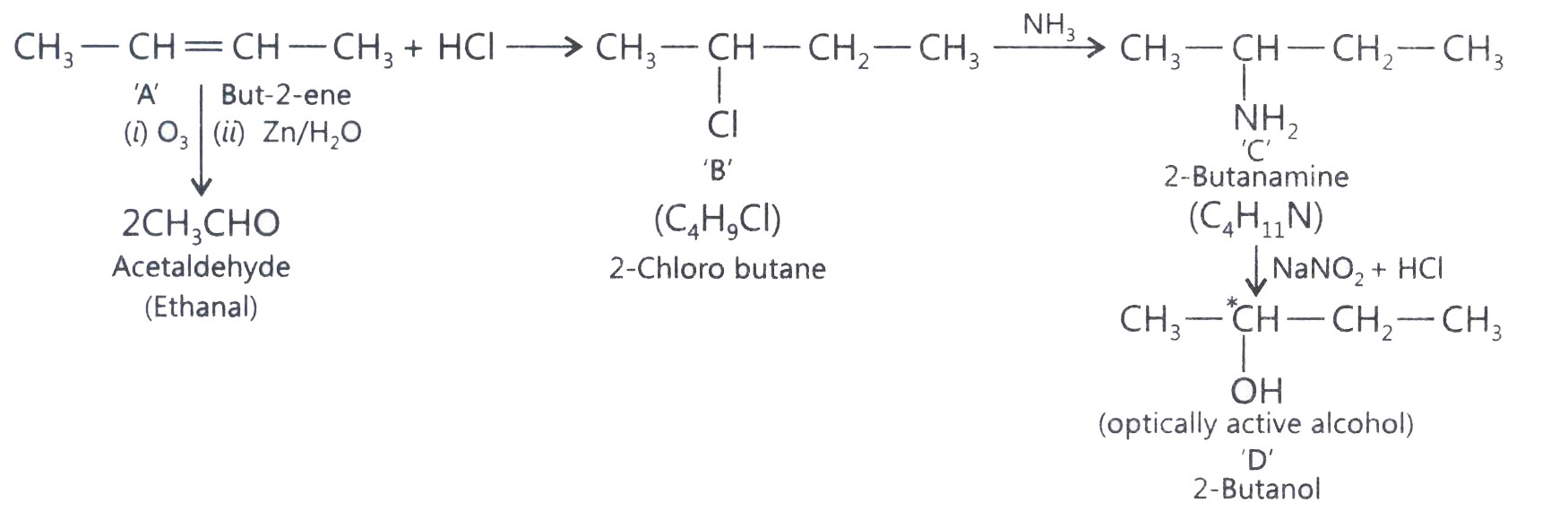
A hydrocarbon 'A' (C4H8) on reaction with HCI gives a compound 'B' , (C4H11N). On reacting with NaNO2 and HCI followed by treatment with water, compound 'C'. Ozonolysis of 'A' gives 2 moles of acetaldehyde. Identify compounds 'A' to 'D' . Explain the reactions involved.
14.
Which of the following cannot be prepared by Sandmeyer's reaction?
Chlorobenzene
Bromobenzene
lodobenzene
Fluorobenzene
15.
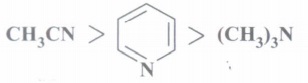
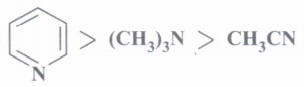
Among (CH3)3N  and CH3 CN, the electro negativity in the order
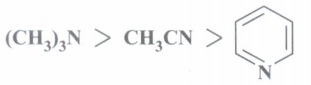
all have same
16.
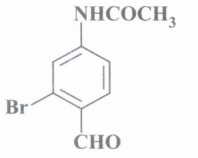
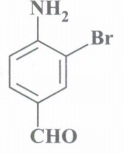
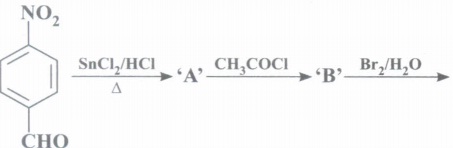 C', Product 'C' is
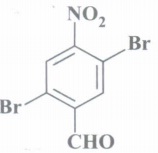
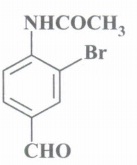
17.
Which of the following reagent is required for the following conversion?
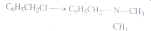
CH3NH2CH3CI
CH3CI,RNH2
NH3, CH3CI
CH3CH2NH2
18.
p-Chloroaniline and anilinium hydrochloride can be distinguished by
Sandmeyer reaction
NaHCO3 solution
AgNO3 solution
Carbylamine reaction
19.
Which of the following will be the most stable diazonium salt, \({ RN }_{ 2 }^{ + }{ X }^{ - }\) ?
\(CH_{ 3 }{ N }_{ 2 }^{ + }{ X }^{ - }\)
\({ C }_{ 6 }H_{ 5 }{ N }_{ 2 }^{ + }{ X }^{ - }\)
\(CH_{ 3 }{ CH }_{ 2 }{ N }_{ 2 }^{ + }{ X }^{ - }\)
\({ C }_{ 6 }H_{ 5 }{ CH }_{ 2 }{ N }_{ 2 }^{ + }{ X }^{ - }\)
20.
Which of the following compounds will dissolved in an alkali solution after it undergoes reaction with Hinsberg's reagent?
CH3NH2
(CH3)3N
(C2H5)2NH
C6H5NHC6H5
21.
Nitrobenzene on reaction with conc.HNO3/H2SO4 at 80-\({ 100 }^{ \circ }\)C forms which one of the following products?
1, 4-Dinitrobenzene
1, 2, 4-Trinitrobenzene
1,2-Dinitrobenzene
1, 3-Dinitrobenzene
22.
Methylamine reacts with NHO2 to form...................................... .
CH3-O-N=O
CH3-O-CH3
CH3OH
CH3CHO
23.
Ethylamine on heating with CS2 in presence of HgCl2 forms
\({ C }_{ 2 }{ H }_{ 5 }NCS\)
\(\left( { C }_{ 2 }{ H }_{ 5 } \right) _{ 2 }S\)
\(\left( { C }_{ 2 }{ H }_{ 5 } \right) _{ 2 }CS\)
\({ C }_{ 2 }{ H }_{ 5 }\left( CS \right) _{ 2 }\)
24.
The amine that reacts with NaNO2+ HCI to give yellow oily liquid is
ethylamine
diethylamine
isopropylamine
secondary but ylamine
25.
When a primary amine reacts with chloroform and ethanolic KOH, then the product formed is
isocyanide
aldehyde
cyanide
alcohol
26.
27.
28.
29.
Assertion : Aromatic 1°amines can be prepared by Gabriel phthalimide synthesis.
Reason : Aryl halides undergo nucleophilic substitution with anion formed by phthalimide.
Codes:
(a) If both Assertion and Reason are correct and the Reason is a correct explanation of the Assertion.
(b) If both Assertion and Reason are correct but Reason is not a correct explanation of the Assertion.
(c) If the Assertion is correct but Reason is incorrect.
(d) If both the Assertion and Reason are incorrect.
30.
Assertion: Ortho substituted anilines are usually weaker bases than anilines.
Reason: This is due to ortho effect.
Codes:
(a) Assertion and reason both are correct statements and reason is correct explanation for assertion.
(b) Assertion and reason both are correct statements but reason is not correct explanation for assertion.
(c) Assertion is correct statement but reason is wrong statement.
(d) Assertion is wrong statement but reason is correct statement.
31.
Assertion: Me3N reacts with BF3 whereas Ph3N does not.
Reason: The electron pair on nitrogen atom in Ph3N is delocalised in the benzene ring and is not available for boron in BF3.
Codes:
(a) Assertion and reason both are correct statements and reason is correct explanation for assertion.
(b) Assertion and reason both are correct statements but reason is not correct explanation for assertion.
(c) Assertion is correct statement but reason is wrong statement.
(d) Assertion is wrong statement but reason is correct statement.
32.
Assertion: Ammonia is more basic than water.
Reason: Nitrogen is less electronegative than oxygen.
Codes:
(a) Assertion and reason both are correct statements and reason is correct explanation for assertion.
(b) Assertion and reason both are correct statements but reason is not correct explanation for assertion.
(c) Assertion is correct statement but reason is wrong statement.
(d) Assertion is wrong statement but reason is correct statement.
33.
Assertion: Aniline is a weaker base than cyclohexylamine.
Reason: Aniline undergoes halogenation even in the absence of a catalyst.
Codes:
(a) Assertion and reason both are correct statements and reason is correct explanation for assertion.
(b) Assertion and reason both are correct statements but reason is not correct explanation for assertion.
(c) Assertion is correct statement but reason is wrong statement.
(d) Assertion is wrong statement but reason is correct statement.
34.
Assertion: In Hoffmann bromamide reaction, the amine formed has one carbon atom less than the parent 1°amide.
Reason: N-methyl acetamide undergoes Hoffmann bromamide reaction.
Codes:
(a) Assertion and reason both are correct statements and reason is correct explanation for assertion.
(b) Assertion and reason both are correct statements but reason is not correct explanation for assertion.
(c) Assertion is correct statement but reason is wrong statement.
(d) Assertion is wrong statement but reason is correct statement.
35.
In the following questions. an Assertion (A) is followed by a corresponding Reason (R) Use the following keys to choose the appropriate answer.
Assertion (A) Hofmann's bromamide reaction is given by primary amines.
Reason (R) Primary amines are less basic than secondary amines.
Codes:
(a) Both (A) and (R) are correct, (R) is the correct explanation of (A).
(b) Both (A) and (R) are correct, (R) is not the correct explanation of (A).
(c) (A) is correct; (R) is incorrect.
(d) (A) is incorrect; (R) is correct.
36.
Observe the histogram showing boiling points of pentane, iso pentane, 1°,2° and 3 ° amines. Answer the questions that follow based on table and related concepts.
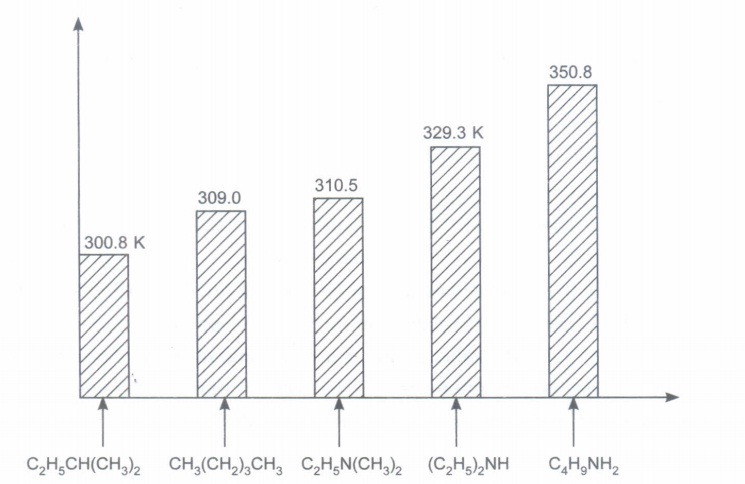
(a) Why does CH3CH2CH2CH2NH2 (1° amine) has higher boiling point than (C2H5)2NH and C2H5N(CH3 )2?
(b) Why does ethanol have higher boiling point than ethanamine?
(c) Why amines are more basic than alcohol?
(d) Why are Primary amines more soluble in water than 2° and 3° amines?
(e) Arrange the compounds shown in graph, increasing order of boiling points. Give reason.
37.
Read the passage given below and answer the following questions:
Amines are produced when an alcoholic solution of ammonia and an alkyl or a benzyl halide is heated in a sealed tube at 373 K. This reaction is called ammonolysis and usually gives a mixture of primary, secondary and tertiary amines along with some quarternary ammonium salts. This reaction is an example of nucleophilic substitution reaction in which ammonia acts as a nucleophile due to the presence of a lone pair of electrons on the nitrogen atom. However this method cannot be used for the preparation of aryl amines. One of the most convenient methods for the preparation of aryl amines is reduction of nitro compounds. Aryl amines can also be prepared by reduction of nitrites or Gabriel phthalimide synthesis.
In these questions (i-iv), a statement of assertion followed by a statement of reason is given. Choose the correct answer out of the following choices.
(a) Assertion and reason both are correct statements and reason is correct explanation for assertion.
(b) Assertion and reason both are correct statements but reason is not correct explanation for assertion.
(c) Assertion is correct statement but reason is wrong statement.
(d) Assertion is wrong statement but reason is correct statement. .
(i) Assertion: Ammonolysis of alkyl halides only produces 2o amines.
Reason: Ammonolysis of alkyl halides involves the reaction between alkyl halides and alcoholic ammonia.
(ii) Assertion: Ammonolysis method cannot be used for the preparation of aryl amines.
Reason: Aryl halides are much less reactive than alkyl halides towards nucleophilic substitution reaction.
(iii) Assertion: Ammonolysis can be used to prepare pure primary amines.
Reason: Ammonolysis of haloalkanes lead to multiple ammonium salts.
(iv) Assertion: Aromatic 1p amines can not be prepared by Gabriel phthalimide synthesis.
Reason: Aryl halides do not undergo nucleophilic substitution with anion formed by phthalimide.
1.
C6H5NH2 < (C2H5)2NH < C2H5NH2 is the increasing order of solubility in water.
2.
3.
i) Tert-butyl bromide, being a 3° alkyl halide, on treatment with a base (i.e. NH3) prefers to undergo elimination rather than substitution. Therefore, the product is isobutylene rather than tert-butylamine.
4.
Carbylamine reaction or Libermann nitroso reaction.
5.
6.
(a) (i) It is due to resonance in aniline, lone pair is delocalised but in cyclohexylamine, it is readily available.
(ii) It is due to the formation of soluble complex.
\(\mathrm{AgCl}+2 \mathrm{CH}_{3} \mathrm{NH}_{2} \longrightarrow\left[\mathrm{Ag}\left(\mathrm{CH}_{3} \mathrm{NH}_{2}\right)_{2}\right]^{+} \mathrm{Cl}^{-}\)
(b) NH3 < R3N < RNH2 < R2NH.
7.
\(\text { (i) } \mathrm{C}_{2} \mathrm{H}_{5} \mathrm{NH}_{2}+\mathrm{CH}_{3} \mathrm{COCl} \stackrel{\text { Pyridine }}{\longrightarrow} \mathrm{C}_{2} \mathrm{H}_{5} \mathrm{NHCOCH}_{3}+\mathrm{HCl}\)
\( \text { (ii) } \mathrm{C}_{2} \mathrm{H}_{5} \mathrm{NH}_{2}+\mathrm{C}_{6} \mathrm{H}_{5} \mathrm{SO}_{2} \mathrm{Cl} \longrightarrow \mathrm{C}_{6} \mathrm{H}_{5} \mathrm{SO}_{2} \mathrm{NHC}_{2} \mathrm{H}_{5}+\mathrm{HCl} \)
\(\text { (iii) } \mathrm{C}_{2} \mathrm{H}_{5} \mathrm{NH}_{2}+\mathrm{CHCl}_{3}+3 \mathrm{KOH} \longrightarrow \mathrm{C}_{2} \mathrm{H}_{5} \mathrm{~N} \equiv \mathrm{C}+3 \mathrm{KCl}+3 \mathrm{H}_{2} \mathrm{O} \)
8.

9.
10.
11.
(i) Hoffmann bromamide reaction
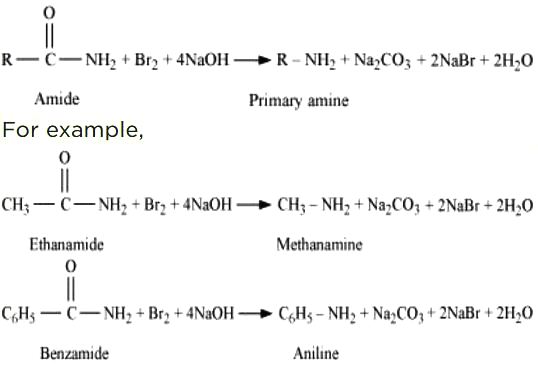
When an amide is treated with bromine in an aqueous or ethanolic solution of sodium hydroxide, a primary amine with one carbon atom less than the original amide is produced. This degradation reaction is known as Hoffmann bromamide reaction. This reaction involves the migration of an alkyl or aryl group from the carbonyl carbon atom of the amide to the nitrogen atom.
(ii) Ammonolysis
When an alkyl or benzyl halide is allowed to react with an ethanolic solution of ammonia, it undergoes nucleophilic substitution reaction in which the halogen atom is replaced by an amino (−NH2) group. This process of cleavage of the carbon-halogen bond is known as ammonolysis.
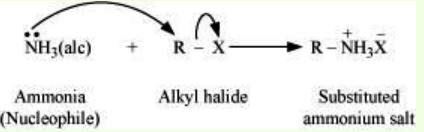
When this substituted ammonium salt is treated with a strong base such as sodium hydroxide, amine is obtained.
\(\mathrm{R}-\stackrel{+}{\mathrm{N}} \mathrm{H}_3 \stackrel{-}{\mathrm{X}}+\mathrm{NaOH} \longrightarrow \mathrm{R}-\mathrm{NH}_2+\mathrm{H}_2 \mathrm{O}+\mathrm{NaX}\)
Amine
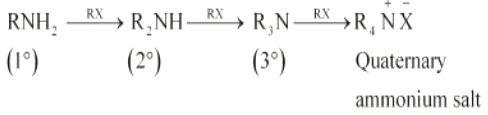
Though primary amine is produced as the major product, this process produces a mixture of primary, secondary and tertiary amines, and also a quaternary ammonium salt as shown.
(iii) Gabriel phthalimide synthesis
Gabriel phthalimide synthesis is a very useful method for the preparation of aliphatic primary amines. It involves the treatment of phthalimide with ethanolic potassium hydroxide to form potassium salt of phthalimide. This salt is further heated with alkyl halide, followed by alkaline hydrolysis to yield the corresponding primary amine.
12.
13.
14.
(c)
lodobenzene
15.
(a)
16.
(d)
17.
(a)
CH3NH2CH3CI
18.
Both p-chloroaniline and anilinium hydrochloride are \({ 1 }^{ \circ }\) amines and hence cannot be ditinguished by carbylamine reaction.
19.
Due to delocalization of the +ve charge on the benzene ring, aromatic diazonium salts are more satble, i.e., option (b) is correct.
20.
Amines form benzenesulphonamides which are soluble in alkali, i.e., option (a) is correct.
21.
-NO2 is a m-directing group and hance 1, 3-dinitrobenzene is formed.
22.
(c)
CH3OH
23.
(a)
\({ C }_{ 2 }{ H }_{ 5 }NCS\)
24.
amines, i.e., diethylamine reacts with NaNO2+HCI to give yellow oily nitrosoamine.
25.
Carbylamine reaction yields isocyanides.
26.
27.
28.
29.
(a) If both Assertion and Reason are correct and the Reason is a correct explanation of the Assertion.
30.
(a): Ortho effect is a consequence of steric and electronic factors.
31.
(a) Assertion and reason both are correct statements and reason is correct explanation for assertion.
32.
(a): Ammonia is more basic than water. It is because nitrogen being less electronegative than oxygen, has a greater tendency to donate electrons
33.
(b): Aniline exists as resonance hybrid. As a result of resonance, the lone pair of electrons on nitrogen gets delocalized over the benzene ring and thus, is less easily available for protonation than in case of cyclohexylamine where no such resonance takes place.
34.
(c): Only primary amines can be prepared from amides (RCONH2 ) by treating with Br2 and KOH. Thus, N-methyl acetamide i.e., CH3CONHCH3 does not undergo Hoffmann bromamide reaction.
35.
(d) Hofmann's bromamide reaction is given by amide which on reaction with NaOX produces amine having one carbon less than amide. Hence, (A) is not correct but (R) is correct statement.
36.
(a) It is because extent of H-bonding is more in CH3CH2CH2CH2NH2 than 2° and 3° amines.
(b) It is because H-bonds are stronger in alcohols than amines because 'O' is more electronegative than 'N'.
(c) It is because \(\stackrel{\oplus}{\mathrm{RNH}_{3}}\) is more stable than \(\underset{\mathrm{ROH2}}{\oplus}\) . +ve charge on oxygen is not stable.
(d) It is because primary amines can form H-bonds with water to more extent.
(e) C2H5CH(CH3)2 < CH3(CH2)3CH3 < C2H5N(CH3)2 < (C2H5)2NH < C4H9NH2.
Isopentane has lower boiling point that n-Pentane due to branching less surface area, less van der Waals' forces of attraction. 3° < 2° < 1° is order of boiling point in amines because extent of H-bonding increases.
37.
(i) (d): Reaction can be used to prepare 1°, 2°, 3° amines and finally quaternary ammonium salts.
(ii) (a)
(iii) (d): Ammonolysis cannot be used to prepare pure primary amines. This method usually gives a mixture of primary, secondary and tertiary amines along with some quaternary ammonium salts.
(iv) (a)

12th Standard CBSE Syllabus & Materials
12th Standard CBSE
CBSE 12th Computer Science Python Revision Tour I - New Previous year Question Papers Study Material - QB365 Set A
NEW12th Standard CBSE
CBSE 12th Business Studies Planning Important Questions And Answers Study Material - QB365 Set A
NEW12th Standard CBSE
CBSE 12th Business Studies Business Environment Important Questions And Answers Study Material - QB365 Set A
NEW12th Standard CBSE
CBSE 12th Business Studies Principles of Management Important Questions And Answers Study Material - QB365 Set A



NCERT Books

Syllabus

Exam Pattern

Sample Question Papers

Previous year Question Papers

Important Notes

MCQ Practice test

NCERT Exemplers

Case study Questions

Image Based Questions

Passage based Questions

HOT Questions

Value Based Questions

Model Questions Papers
NCERT ( Book Back ) Questions

Assertion and Reason
Important Questions And Answers

CBSE 12th Standard CBSE Subjects
CBSE Standards








