
 100% FREE ACCESS
12th Standard CBSE Syllabus & Materials
12th Standard CBSE
CBSE 12th Economics Government Budget and the Economy Previous year Question Papers Study Material - QB365 Set A
NEW12th Standard CBSE
CBSE 12th Computer Science Interface Python with MySQL - New Previous year Question Papers Study Material - QB365 Set A
NEW12th Standard CBSE
CBSE 12th Computer Science Database Concept - New Previous year Question Papers Study Material - QB365 Set A
NEW12th Standard CBSE
CBSE 12th Computer Science Data Communication - New Previous year Question Papers Study Material - QB365 Set A
NEW12th Standard CBSE
CBSE 12th Computer Science Data Structures - New Previous year Question Papers Study Material - QB365 Set A
NEW12th Standard CBSE
CBSE 12th Computer Science Functions - New Previous year Question Papers Study Material - QB365 Set A

Published on: 25/10/2025
Download CBSE Class 12th Standard CBSE Chemistry question papers, sample papers, important questions, and previous year solved papers in PDF format. Get free study materials, NCERT solutions, and exam preparation resources for Class 12th Standard CBSE Chemistry
Questions + Answers key
Take MCQ Chemistry Test
1.
Name the following complexes and draw the structure of one possible isomer of each:
(i) [Cr (C2O4)3]3-
(ii) [Pt (NH3)2CI2]
(iii) [Co (en)2Cl2]+
(where en = ethane-1,2-diamine or ethylene diamine)
2.
Give reasons for the following:
(i) Aniline does not undergo Friedel-Crafts reaction,
(ii) (CH3)2NH is more basic than (CH3)2N in an aqueous solution,
(iii) Primary amines have higher boiling point than tertiary amines.
3.
Which of two : cuprous chloride or cupric chloride is coloured and why?
4.
Identify the first row transition metal ions which have outer electronic configurations of 3d4 and 3d6 and describe their oxidation states.
5.
(a) (CH3)2NH is more basic than (CH3)2N is an aqueous solution, why?
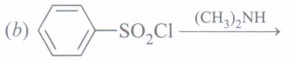
(c) Give a simple test to distinguish between Aniline and N, N-dimethyl anilne.
(d) An organic compound 'A' with molecular formula C6H7N is sparingly soluble in water. 'A', on treatment with HCl gives a soluble compound 'B'. 'A' also reacts with CHCl3 in presence of alkali to form an obnoxious smelling compound 'C'. 'A' reacts with benzene sulphonyl chloride to form alkali soluble compound 'D', 'A' reacts with NaN02 and HCl to form 'E' which on reaction with phenol forms 'F'. Elucidate the structure of organic compounds 'A' to 'F'.
6.
(i) Give name:
(a) the complex used as oxygen carrier in the blood.
(b) the coordination compound of magnesium, which is responsible for photosynthesis.
(ii) Discuss some applications of complex compounds.
7.
What is the relationship between observed colour of the complex and the wavelength of light absorbed by the complex ?
8.
(a) Given below are the electrode potential values, Eo for the some of the first row of transition elements:
| Element | EoM2+/M (V) |
|
V(23) Cr(24) Mn(25) Fe(26) Co(27) Ni(28) Cu(29) |
-1.18 -0.91 -1.18 -0.44 -0.28 -0.25 +0.34 |
Explain the irregularities in these values on the basis of electronic structures of atoms.
(b) Complete the following reaction equations:
(i) Cr2O72-+Sn2++H+\(\longrightarrow \)
(ii) MnO4-+Fe2++H+\(\longrightarrow \)
9.
Explain the coupling reaction.
10.
What type of isomerism is exhibited by the following complex [Co(NH3)5SO4]Cl?
11.
Why are \(Ni^{ 2+ }\)compounds thermodynamically more stable than \(Pt^{ 2+ }\) compounds while \(Pt^{ 4+ }\) compounds are relatively more stable than \(Ni^{ 4+ }\) compounds?
12.
Write a balanced equation for the reaction of chromite ore with sodium carbonate in the presence of air.
13.
What is the relationship between observaed colour of the complex and the wavelength of light absorbed by the complex?
14.
Among (CH3)3N  and CH3 CN, the electro negativity in the order
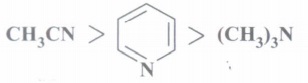
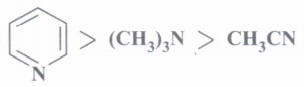
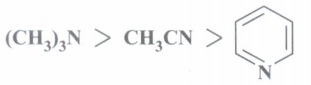
all have same
15.
Which of the following products is formed in the given reaction?
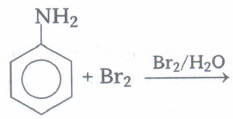
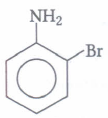
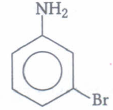
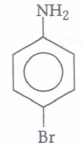
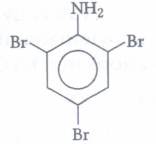
16.
The reciprocal of the formation constant is called
instability constant
dissociation constant
stability constant
Both (a) and (b)
17.
The correct order of basic strength of CH3NH2(I), (CH3)2NH(II), (CH3)3N(III), C6H5CH2NH2(IV) in gaseous phase is
IV < III < II < I
IV < III < I < II
I < II < III < IV
IV < I < II < III
18.
Nitrobenzene on reaction with conc.HNO3/H2SO4 at 80-\({ 100 }^{ \circ }\)C forms which one of the following products?
1, 4-Dinitrobenzene
1, 2, 4-Trinitrobenzene
1,2-Dinitrobenzene
1, 3-Dinitrobenzene
19.
Which element do you expect to have the smallest atomic radius ?
Sc
Zn
La
Hg
20.
Which of the following show oxidation state of +4 ?
Ce
Ac
Th
U
21.
The acidic, basic or amphoteric nature of Mn2O7 , V2O5 and CrO are respectively
acidic, acidic and basic
basic, amphoteric and acidic
acidic, amphoteric and basic
acidic, basic and amphoteric
acidic, basic and basic
22.
The formula, dichlorobis (urea) copper (II) is
[Cu{O = C(NH2)}2]Cl2
[CuCl2{O = C(NH2)2}]
[Cu{O = C(NH2)2}Cl]Cl
[CuCl2{O = C(NH2)2}2]
23.
The metal-carbon bond in metal carbonyls possesses
only \(\sigma \) character
only \(\pi \) character
both \(\sigma \) and \(\pi \) character
ionic character
24.
Assertion (A) : [Fe(CN)6]3- ion shows magnetic moment corresponding to two unpaired electrons.
Reason (R) : Because it has d²sp³ type hybridisation.
(a) Both (A) and (R) are correct but (R) is the correct explanation of (A).
(b) Both (A) and (R) are correct but (R) is not the correct explanation of (A).
(c) (A) is correct but (R) is incorrect.
(d) (A) is incorrect but (R) is correct.
25.
Assertion: [Pt(NH3)2Cl2] is square planar.
Reason: The oxidation state of platinum is +2.
Codes:
(a) Assertion and reason both are correct statements and reason is correct explanation for assertion.
(b) Assertion and reason both are correct statements but reason is not correct explanation for assertion.
(c) Assertion is correct statement but reason is wrong statement.
(d) Assertion is wrong statement but reason is correct statement
26.
In the following questions. an Assertion (A) is followed by a corresponding Reason (R) Use the
following keys to choose the appropriate answer.
Assertion (A) Acetanilide is less basic than aniline.
Reason (R) Acetylation of aniline results in decrease in decrease of electron density of nitrogen.
Codes:
(a) Both (A) and (R) are correct, (R) is the correct explanation of (A).
(b) Both (A) and (R) are correct, (R) is not the correct explanation of (A).
(c) (A) is correct; (R) is incorrect.
(d) (A) is incorrect; (R) is correct.
27.
In the following questions. an Assertion (A) is followed by a corresponding Reason (R) Use the following keys to choose the appropriate answer.
Assertion (A) Tertiary butyl amine can be prepared by the action of NH3 on tert-butyl bromide.
Reason (R) Tertiary butyl bromide being 3° alkylhalide prefers to undergo elimination on the treatment with a base.
Codes:
(a) Both (A) and (R) are correct, (R) is the correct explanation of (A).
(b) Both (A) and (R) are correct, (R) is not the correct explanation of (A).
(c) (A) is correct; (R) is incorrect.
(d) (A) is incorrect; (R) is correct.
28.
In the following questions an Assertion (A) is followed by a corresponding Reason (R) Use the following keys to choose the appropriate answer.
Assertion (A) Transition metals are good catalysts.
Reason (R) V2O5 or Pt is used in the preparation of H2SO4 by contact process.
Codes:
(a) Both (A) and (R) are correct, (R) is the correct explanation of (A).
(b) Both (A) and (R) are correct, (R) is not the correct explanation of (A).
(c) (A) is correct; (R) is incorrect.
(d) (A) is incorrect; (R) is correct.
29.
Amines are classified as primary, secondary and tertiary amines. Primary amines cannot be obtained by ammonolysis of alkyl halide because we will get mixture of 1°, 2 c and 3° amines. Cyanides, on reduction give primary amines where as isocyanides on reduction give secondary amines. Nitro compounds, on reduction also give primary amines. Primary amines react with CHCI3 and KOH to form foul smelling isocyanide. They react with HNO2 and liberate N2 gas. They react with Hinsberg's reagent to form salt soluble in KOH. Secondary amine form yellow oily compounds with HNO2 and salt formed with C6H5SO2CI, is insoluble in KOH. 3° amines form salt soluble in water with HNO2 but does not react with C6Hs SO2CI.
Diazonium salts are prepared by reaction of Aniline with NaNO2 and conc. HCI at 0 - 5 0c. Aromatic diazonium salts are more stable because phenyl diazonium ion is stabilized by resonance. Benzene diazonium chloride can be used to prepare halo benzene, phenol, nitro benzene, benzene, p-hydroxy azo benzene (azo dye) and large number of useful compounds.
(a) Write the isomer of C3H9N which does not react with Hinsberg reagent.
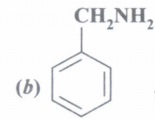 on heating with CHCI3 and KOH gives 'X'. Identify 'X'.
(c) Convert Aniline to phenol.
(d) Distinguish between Aniline and ethyl amine.
(e) Complete the following reaction
\(\mathrm{C}_{6} \mathrm{H}_{5} \mathrm{NO}_{2} \stackrel{\mathrm{Fe} / \mathrm{HCl}}{\longrightarrow} \mathrm{A} \frac{\mathrm{NaNO}_{2}+\mathrm{HCl}}{0-5^{\circ} \mathrm{C}} \mathrm{B}\) Identify' A' and 'B'.
(f) \(\mathrm{C}_{6} \mathrm{H}_{5} \mathrm{~N}_{2}^{+} \mathrm{Cl}^{\mathrm{CuCN}} \longrightarrow \mathrm{A} \stackrel{\mathrm{H}_{2} \mathrm{O} / \mathrm{H}^{+}}{\longrightarrow} \mathrm{B}\) Identify 'A' and 'B'.
(g) What is use of quarternary ammonium salts of long chain tertiary amines?
30.
Read the passage given below and answer the following questions:
Transition elements are elements that have partially filled d-orbitals. The configuration of these elements corresponds to (n - 1)d1-10 ns1-2. It is important to note that the elements mercury, cadmium and zinc (Ire not considered transition elements because of their electronic configurations, which corresponds to (n - 1)d1-10 ns2.
Some general properties of transition elements are :
These elements can form coloured compounds and ions due to d-d transition;
These elements exhibit many oxidation states;
A large variety of ligands can bind themselves to these elements, due to this, a wide variety of stable complexes formed by these ions. The boiling and melting point of these elements are high. These elements have a large ratio of charge to the radius.
In these questions (i-iv), a statement of assertion followed by a statement of reason is given. Choose the correct answer out of the following choices.
(a) Assertion and reason both are correct statements and reason is correct explanation for assertion.
(b) Assertion and reason both are correct statements but reason is not correct explanation for assertion.
(c) Assertion is correct statement but reason is wrong statement.
(d) Assertion is wrong statement but reason is correct statement.
(i) Assertion: Tungsten has very high melting point.
Reason: Tungsten is a covalent compound.
(ii) Assertion: Zn, Cd and Hg are normally not considered transition metals.
Reason: d-Orbitals in Zn, Cd and Hg elements are completely filled, hence these metals do not show the general characteristics properties of the transition elements.
(iii) Assertion: Copper metal gets readily corroded in acidic aqueous solution such as HCI and dil. H2SO4
Reason: Free energy change for this process is positive.
(iv) Assertion: Tailing of mercury occurs on passing ozone through it.
Reason: Due to oxidation of mercury.
1.
(i) [Cr(C2O4)3]3-
WPAC name Trioxalatochromate (III) ion Possible isomers Optical isomers (d and I)
Structure
s.png)
(ii) [Pt (NH3)P2]
IUPAC name
Diamminedichloridoplatinum (II)
Possible isomers Geometrical isomers
(cis and trans)
s.png)
(iii) [Co(en)2Cl2]+
IUPAC name Dichlorido bis - (ethane - 1 , 2, diamine) cobalt (III) ion Possible isomers Geometrical isomers (cis and trans)
Structure
s.png)
cis - [Co(en)2CI2]+ is optically active and exists in dextro (d) and laevo (I) forms.
s.png)
2.
(i) A Friedel Crafts reaction is carried out in the presence of AlCl3. But AlCl3 used as catalyst and is acidic in nature i.e., Lewis acid whereas aniline is a strong Lewis base. Thus, aniline reacts with AlCl3 to form a salt.
Due to the positive charge on the N-atom, electrophilic substitution in the benzene ring is deactivated. Hence, aniline does not undergo
Friedel-Crafts reaction.
(ii) (CH3)2NH is more basic than (CH3)3 in an aqueous solution. + I effect will increase in alkyl group that results in increasing the case of donation of lone pair electron. Amine accepts a proton and form cation which will be stabilised in water by solvation. Higher the solvation by hydrogen bonding, higher will be the basic strength.
Therefore, with increase in methyl group, hydrogen bonding and stabilisation by solvation decreases. This net effect results in decrease of basic strength from secondary to tertiary amine.
(iii) In tertiary amine, there are no H-atoms whereas, in primary amines, two H-atoms are present. Due to the presence of H-atoms, primary amines undergo extensive intermolecular H-bonding.
As a result, extra energy is required to separate the molecules of primary amine. Therefore, primary amines have higher boiling point than tertiary amine.
3.
In cuprous chloride (CuCI), Cu+ ion has fully filled 3d-subshell and therefore, it cannot absorb energy for the d-d transition. Therefore, it is colorless. In cupric chloride (CuCI2), Cu2+ has 3d9 configuration having one unpaired electron and therefore, it can absorb energy for the d-d transition. Hence, it is blue coloured.
4.
Cr2+ has electronic configuration 3d4 Chromium also shows +3 and +6 oxidation states. Fe2+ has electronic configuration 3d6. Iron has oxidation states +2 and +3.
5.
(a) It is due to stearic hindrance in (CH3)2N, lone pair is less available.

(c) Add CHCI3 and KOH. Aniline will give offensive smelling compound whereas N,N-Dimethyl aniline will not react.
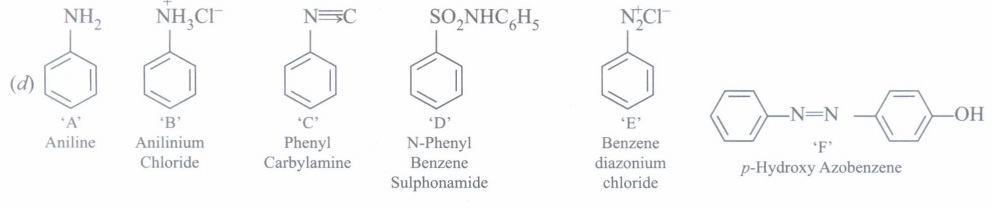
6.
(i) (a) Haemoglobin
(b) Chlorophyll
(ii) Applications of complex compounds.
(a) They are used in photography, Le. AgBr forms soluble complex with sodium thiosulphate rn photography.
(b) K[Ag(CN)2] is used for electroplating of silver, K[Au(CN)2] is used for gold plating.
(c) Some of ligands oxidise Co2+ to Co3+ ion.
(d) EDTA is used for estimation of Cla2+ and Mg2+ in hard water.
(e) Silver and gold are extracted by treating zinc with their cyanide complexes.
(f) Ni2+ is tested and estimated by DMG (dimethylglyoxime).
7.
When white light falls on the complex, some part of it is absorbed. Greater the CFSE, greater is the energy absorbed or shorter is the wavelength absorbed \((E={hc\over\lambda })\). The observed colour is the complementary colour of the colour absorbed.
8.
(a) It is due to irregular variations in sum of first and second ionisation energies and sublimation energies. It is also due to stability of electronic configuration.
(b) (i) Cr2O72- + 3Sn2+ + 14H+➝ 2Cr3+ + 3Sn4+ + 7H2O
(ii) MnO4- + 5Fe2+ + 8H+ ➝ SFe3+ + Mn2+ + 4H2O
9.
Coupling reaction is the reaction of benzene diazonium chloride with phenol in which phenol molecule at its para-position is coupled with diazonium salt.
10.
The complex, [Co(NH3)5SO4] Cl exhibits ionisation isomerism as it gives two different ions when dissolve in water.
Its another ionisation isomer is
[Co(NH3)5Cl]SO4
\( {\left[\mathrm{Co}\left(\mathrm{NH}_3\right)_5 \mathrm{SO}_4\right] \mathrm{Cl} \stackrel{\mathrm{H}_2 \mathrm{O}}{\rightleftharpoons}\left[\mathrm{CO}\left(\mathrm{NH}_3\right)_5 \mathrm{SO}_4\right]^{+}+\mathrm{Cl}^{-}} \\ {\left[\mathrm{Co}\left(\mathrm{NH}_3\right)_5 \mathrm{Cl}\right] \mathrm{SO}_4 \stackrel{\mathrm{H}_2 \mathrm{O}}{\rightleftharpoons}\left[\mathrm{CO}\left(\mathrm{NH}_3\right)_5 \mathrm{Cl}\right]^{2+}+\mathrm{SO}_4^{2-} .} \)
11.
The thermodynamic stability of transition metal compounds can be easily predicted from the values of ionization enthalpies. The first four ionization enthalpy values of nickel and platinum are given.
From these values, it is clear than Ni2+ compounds will be thermodynamically more stable than Pt2+ compounds whereas Ni4+ compounds are relatively less stable than Pt4+ compounds.
12.
\(4 \mathrm{FeCr}_2 \mathrm{O}_4+8 \mathrm{Na}_2 \mathrm{CO}_3+7 \mathrm{O}_2 \longrightarrow 8 \mathrm{Na}_2 \mathrm{CrO}_4+2 \mathrm{Fe}_2 \mathrm{O}_3+8 \mathrm{CO}_2\)
13.
When white light falls on the complex, some part of it is absorbed, Higher \({ \triangle }_{ o }\) (crystal field splitting energy) lower will be the wavelength absorbed by the complex. The colour of the complex is the colour from the wavelength left over (complementry colour).
14.
(a)
15.
(d)
16.
(d)
Both (a) and (b)
17.
In the gaseous phase, basicity increases as the + I-effect of the alkyl groups increases, i.e., CH3NH2(I) < (CH3)2 NH < (CH3)3 N (III). However, due to -I-effect of the CH- group, CHCHNH (IV) is even a weaker base than CHNH (I). Thus, the overall, basic character increases in the order : IV < I < II < III.
18.
-NO2 is a m-directing group and hance 1, 3-dinitrobenzene is formed.
19.
(b)
Zn
20.
(a)
Ce
21.
(c)
acidic, amphoteric and basic
22.
(b)
[CuCl2{O = C(NH2)2}]
23.
(c)
both \(\sigma \) and \(\pi \) character
24.
(d) (A) is incorrect but (R) is correct.
According to VBT, [Fe(CN)6]3-
Hybridisation d²sp³
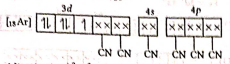
Number of unpaired electrons is 1 .
Thus, \(\left[\mathrm{Fe}(\mathrm{CN})_6\right]^{3-}\) ion shows magnetic moment corresponding to one unpaired clectron.
i.e. \(\mu =\sqrt{n(n+2)} =\sqrt{1(1+2)} \)
\( =\sqrt{3}=1.73 \mathrm{BM}
\)
25.
(b): The outer electronic configuration of platinum in ground state is 5d96s1. The Pt2+ ion formed by the loss of two electrons has outer electronic configuration of 5d8 In the presence of strong ligands (NH3 molecules) two unpaired electrons in the sd-subshell pair up. This is followed by dsp2 hybridisation resulting in the formation of four hybridised vacant orbitals which accommodate four pairs of electrons from four ligands (two from ammonia and two from Cl-). As such the resulting complex is square planar.
26.
(a) Both A and R are correct and R is the correct explanation of A.
27.
(d)Tertiary butyl amine cannot be prepared by the action of NH3 on tert-butyl bromide. Because tert-butyl bromide prefer to undergo elimination rather than substitution on treatment with a base. The product is iso-butylene rather than tert-butylamine. Hence, (A) is incorrect but (R) is correct.
28.
(b) Due to larger surface area and variable valenices, transition metals form intermediate adsorbed complex easily, hence they are used as good catalysts. Thus, both (A) and (R)are correct but (R) is not the correct explanation of (A).
29.
(a) (CH3)3N, N, N-dimethyl methanamine.
(b)
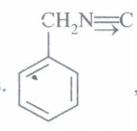 a foul smelling compound.
(c)
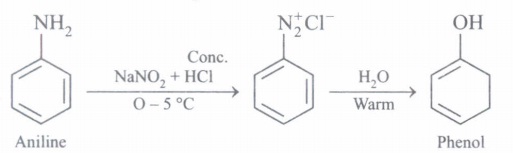
(d) Add NaNO2 and cone. HCI. Cool it to 0 to 5° C. Then add alkaline solution of phenol. Aniline gives orange dye where as ethyl amino does not.
(e) \(\begin{array}{ll}
\mathrm{A}^{\prime} \text { is } \mathrm{C}_{6} \mathrm{H}_{5} \mathrm{NH}_{2} & { }^{\prime} \mathrm{B}^{\prime} \text { is } \mathrm{C}_{6} \mathrm{H}_{5} \mathrm{~N}_{2}^{+} \mathrm{Cl}^{-}
\end{array}\)
(f) 'A' is C6H5CN, 'B' is C6H5COOH
(g) It is used as cationic detergents used in hair conditioners and shampoo.
30.
(i) (c) :Tungsten is a transition element and is very hard due to high metallic bonding.
(ii) (a)
(iii) (d): Non-oxidising acids (HCI and dil. H2SO4) do not have any effect on copper. However they dissolve the metal in presence of air. As it is a non-spontaneous process so, \(\Delta\)G cannot be -ve.
(iv) (a): When mercury is exposed to ozone it gets superficially oxidised and loses its meniscus and sticks to the glass.

12th Standard CBSE Syllabus & Materials
12th Standard CBSE
CBSE 12th Computer Science Python Revision Tour I - New Previous year Question Papers Study Material - QB365 Set A
NEW12th Standard CBSE
CBSE 12th Business Studies Planning Important Questions And Answers Study Material - QB365 Set A
NEW12th Standard CBSE
CBSE 12th Business Studies Business Environment Important Questions And Answers Study Material - QB365 Set A
NEW12th Standard CBSE
CBSE 12th Business Studies Principles of Management Important Questions And Answers Study Material - QB365 Set A



NCERT Books

Syllabus

Exam Pattern

Sample Question Papers

Previous year Question Papers

Important Notes

MCQ Practice test

NCERT Exemplers

Case study Questions

Image Based Questions

Passage based Questions

HOT Questions

Value Based Questions

Model Questions Papers
NCERT ( Book Back ) Questions

Assertion and Reason
Important Questions And Answers

CBSE 12th Standard CBSE Subjects
CBSE Standards








