
 100% FREE ACCESS
12th Standard CBSE Syllabus & Materials
12th Standard CBSE
CBSE 12th Economics Government Budget and the Economy Previous year Question Papers Study Material - QB365 Set A
NEW12th Standard CBSE
CBSE 12th Computer Science Interface Python with MySQL - New Previous year Question Papers Study Material - QB365 Set A
NEW12th Standard CBSE
CBSE 12th Computer Science Database Concept - New Previous year Question Papers Study Material - QB365 Set A
NEW12th Standard CBSE
CBSE 12th Computer Science Data Communication - New Previous year Question Papers Study Material - QB365 Set A
NEW12th Standard CBSE
CBSE 12th Computer Science Data Structures - New Previous year Question Papers Study Material - QB365 Set A
NEW12th Standard CBSE
CBSE 12th Computer Science Functions - New Previous year Question Papers Study Material - QB365 Set A

Published on: 25/10/2025
Download CBSE Class 12th Standard CBSE Chemistry question papers, sample papers, important questions, and previous year solved papers in PDF format. Get free study materials, NCERT solutions, and exam preparation resources for Class 12th Standard CBSE Chemistry
Questions + Answers key
Take MCQ Chemistry Test
1.
What are interstitial compounds? Why are such compounds well known for transition metals?
2.
Carboxylic acids contain carbonyl group but do not show the nucleophilic addition reaction like aldehydes or ketones. Why?
3.
Arrange the following in increasing order of acidic character:
HCOOH, CICH2COOH, CF3COOH, CCl3COOH
4.
How will you distinguish between C6H5CH2NH2 and C6H5NH2? Write the chemical equations for the reactions involved.
5.
Complete the following reaction equations:
\((i)\ C_6H_5NH_2+CHCl_3+KOH(alc)\rightarrow\)
(ii) \(C_6H_5N_2Cl+H_3PO_2+H_2O\rightarrow\)
6.
The \(E^{\ominus}\left(\mathrm{M}^{2+} / \mathrm{M}\right)\) value for copper is positive (+0.34 V). What is possibly the reason for this? (Hint: consider it's high \({ \Delta }_{ a }{ H }^{ o }\) and low \({ \Delta }_{ hyd }{ H }^{ o } \))
7.
Answer the following questions.
(i) [Ni(H2O)6]2+(aq) is green in colour, whereas [Ni(H2O)4 (en)]2+(aq) is blue in colour, give reason in support of your answer.
(ii) Write the formula and hybridisation of the following compound.
tris-(ethane-1,2-diamine) cobalt (III) sulphate
8.
(a) Give reasons for the following:
(i) \(\\ Mn^{ 3+ }\) is a good oxidising agent.
(ii) \(E°_{ M^{ 2+ }/M }\) values are not regular for first row transition metals (3d series).
(iii) Although F is more electronegative than O, the highest fluoride of Mn is MnF4 whereas the highest oxide is Mn2O7.
9.
How will you bring about the following conversions:
(i) Propanone to propane
(ii) Benzoyl chloride to benzaldehyde.
(iii) Ethanal to but-2-enal.
10.
Write the IUPAC name of the following:
(i) [Co(NH3)6]CI3
(ii) [NiCl4]2-
(iii) K3[Fe(CN6]
11.
Why are aliphatic carboxylic acids stronger acids than phenols?
12.
What is Gabriel phthalimide synthesis? For what purpose is it used? Give equation only to explain your answer.
13.
Complete the folowing reaction equations:
(i) C6H5N2CI+CH3COCI \(\longrightarrow \)
(ii)C2H5NH2+C6H5SO2CI \(\longrightarrow \)
(iii) C2H5NH2+HNO2 \(\longrightarrow \)
14.
Indicate the steps in the preparation of :
(a) K2Cr2O7 from chromite ore.
(b) KMnO4 from pyrolusite ore.
15.
Which of the following is a 3° amine?
1-methylcyclohexylarnine
Triethylamine
tert-butylarnine
N-methylaniline
16.
What reagent is used in Hinsberge test of amines?
(CH3CO)2O and pyridine
C6H5SO2CI in aq.NaOH
NaNO2 in aq.H2SO4
CH3I (excess) followed by AgOH
17.
In the chemical reaction, CH3CH2NH2+CHCI3+3 KOH \(\longrightarrow \) (A) + (B) + 3 H2O. The compopund (A) and (B) are respectively.
C2H5NC and 3 KCI
C2H5CN and 3 KCI
CH3CH2CONH2 and 3 KCI
C2H5NC and K2CO3
18.
A mixture of salts (Na2SO3+K2Cr2O7 ) in a test tube is treated with dil. H2SO4 and resulting gas is passed through lime water. Which of the following observations is correct about this test ?
Solution in test tube becomes green and lime water turns milky
Solution in test tube is colourless and lime water turns milky
Solution in test tube becomes green and lime water remains clear
Solution in test tube remains clear and lime water also remains clear.
19.
Which the following will react with water
CHCI3
CI3CCHO
CCI4
CICH2CH2CI
20.
In the following sequence of reactions :
Tolune \(\xrightarrow {KMnO_4}\) A \(\xrightarrow {SOCI_2}\) B \(\xrightarrow [ Ba{ so }_{ 4 } ]{ { H }_{ 2 }/Pd } \) C
The product A is
C6H5CH2OH
C6H5CHO
C6H5COCH3
C6H5CI
21.
Which of the following cannot reduce 'Tollens' reagent ?
HCOOH
HCHO
CH3CHO
CH3COCH3
22.
The hybridization involved in the complex [Ni(CN)4]2- is (At.No. of Ni=28)
d2sp2
d2sp3
dsp2
sp3
23.
Which one of the following is a homoleptic complex?
tris(ethane-1, 2-diamine) cobalt (III) chloride
triamminetriaquachromium (III) chloride
diamminechloridonitro-N-Platinum(II)
dichlorido bis(ethane-1, 2-diamine ) cobalt(III)
pentaamminecarbonato cobalt (III) chloride
24.
Zelse's salt is
[Fe(C5H5)2]
[Pb(C2H5)4]
K[PtCl3(C2H4)]
[Ni(CO)4]
25.
KMnO4, oxidation number of Mn is
+ 2
+ 4
+ 6
+ 7
26.
Which of the following ion is colourless in aqueous solution ?
Fe2+
Mn2+
Ti3+
Sc3+
27.
Attempt any five of the following.
(a) Ce(III) is easily oxidised to Ce(IV) Comment.
(b) E°(Mn2+ /Mn) is -1.18 V. Why is this value highly negative in comparison to neighbouring d-block elements?
(c) Which element of 3d-series has lowest enthalpy of atomisation and why?
(d) What happens when sodium chromate is acidified?
(e) Zn, Cd and Hg are soft metals. Why?
(f) Why is permanganate titration not carried out in the presence of HCI?
(g) The lower oxides of transition metals are basic whereas the highest are amphoteric/acidic. Given reason.
28.
(a) Write the structure of the main products when benzene diazonium chloride reacts with the following reagents.
(i) Kl
(ii) CH3CH2OH
(iii) Cu/HCl
(b) Arrange the following in the increasing order of their basic character in aqueous solution: CH3NH2 , (CH3 )2NH, (CH3 )3N
(c) Give a simple test to distinguish between the following pair of compounds:
C6H5NH2 and CH3NH2.
29.
(i) Define:
(a) Metal carbonyls
(b) Chelate
(ii) (a) Give one chemical test as an evidence to show that [Co(NH3)5CI]SO4 and [Co(NH3)5(SO4)] Cl are ionisation isomers.
(b) [NiCl4]2- is paramagnetic while [Ni(CO4] is diamagnetic though both are tetrahedral. Why? (Atomic no. of Ni = 28)
(c) Write the electronic configuration of Fe(III) on the basis of crystal field theory when it forms an octahedral complex in the presence of (i) strong field ligand, and (ii) weak field ligand. (Atomic no. of Fe = 26)
30.
Describe the following:
(i) Acetylation
(ii) Cannizzaro reaction
(iii) Cross aldol condensation
(iv) Decarboxylation
31.
Account for the following :
(a) Transition metals show variable oxidation states.
(b) Zn, Cd and Hg are soft metals
(c) Eo value for the Mn3+ /Mn2+ couple is highly positive (+ 1.57 V) as compared to Cr3+ /Cr2+.
(ii) Write one similarity and one difference between the chemistry of lanthanoid and actinoid elements.
32.
Using valence bond theory, explain the following in relation to the complexes given below :
\([Mn(CN)_6]^{3-}, [Co(NH_3)_6]^{3+}, [Cr(H_2O)_6]^{3+}, [FeCl_6]^{4-}\)
(i) Type of hybridisation
(ii) Inner or outer orbital complex.
(iii) Magnetic behaviour.
(iv) Spin only magnetic moment value.
33.
Assertion: Controlled nitration of aniline at low temperature mainly gives m-nitroaniline.
Reason: In acidic medium, -NH2 group gets converted into m-directing group.
Codes:
(a) Assertion and reason both are correct statements and reason is correct explanation for assertion.
(b) Assertion and reason both are correct statements but reason is not correct explanation for assertion.
(c) Assertion is correct statement but reason is wrong statement.
(d) Assertion is wrong statement but reason is correct statement.
34.
Assertion: Mn2+ is more stable than Mn3+.
Reason: Mn2+ has half-filled configuration.
Codes:
(a) Assertion and reason both are correct statements and reason is correct explanation for assertion.
(b) Assertion and reason both are correct statements but reason is not correct explanation for assertion.
(c) Assertion is correct statement but reason is wrong statement.
(d) Assertion is wrong statement but reason is correct statement.
35.
In the following questions. an Assertion (A) is followed by a corresponding Reason (R) Use the following keys to choose the appropriate answer.
Assertion (A) Carboxylic acids are more acidic than phenols.
Reason (R) The carboxylate ion is less stabilised than phenoxide ion.
Codes:
(a) Both (A) and (R) are correct, (R) is the correct explanation of (A).
(b) Both (A) and (R) are correct, (R) is not the correct explanation of (A). .
(c) (A) is correct; (R) is incorrect.
(d) (A) is incorrect; (R) is correct.
36.
In the following questions. an Assertion (A) is followed by a corresponding Reason (R) Use the following keys to choose the appropriate answer.
Assertion (A) [Ni(CN)4]2- is square planar and dimagnetic.
Reason (R) It has no unpaired electrons due to presence of strong field ligand.
Codes:
(a) Both (A) and (R) are correct, (R) is the correct explanation of (A).
(b) Both (A) and (R) are correct, (R) is not the correct explanation of (A).
(c) (A) is correct; (R) is incorrect.
(d) (A) is incorrect; (R) is correct.
37.
The f-block elements are those in which the differentiating electrons enters the (n-2)f orbitals. There are two series of f-Block elements corresponding to filling of 4f and 5f-orbitals. The series of 4f-orbitals is called lanthanides. Lanthanides show different oxidation states depending upon stability of f0, f7 and f14 configurations, though the most common oxidation states is +3. There is a regular decrease in the size of lanthanides ions with increase in atomic number which is known as lanthanides contraction.
The following questions are multiple choice question. Choose the most appropriate answer:
1.The atomic number of three lanthanides elements X, Y and Z are 65, 68 and 70 respectively, their Ln3+ electronic configuration is
(a) 4f8, 4f11, 4f13
(b) 4f11, 4f8, 4f13
(c) 4f0, 4f2, 4f11
(d) 4f3, 4f7, 4f9
2. lanthanide contraction is observed in
(a) Gd
(b) At
(c) Xe
(d) Te
3. Which of the following is not the configuration of lanthanide?
(a) [Xe]4f106s2
(b) [Xe]4f15d16s2
(c) [Xe]4d145d106s2
(d) [Xe]4f75d16s2
Or
Name a member of the lanthanide series which is well known to exhibit +4 oxidation state.
(a) Cerium (X=58)
(b) Europium (Z=63)
(c) Lanthanum (Z=57)
(d) Gadolinium (Z=64)
4. Identify the incorrect statement among the following.
(a) Lanthanide contraction is the accumulation of successive shrinkages.
(b) the different radii of Zr and Hf due to consequences of the lanthanide contraction.
(c) Shielding power of 4f electrons is quite weak.
(d) There is a decrease in the radii of the atoms or ions proceeds from La to Lu
38.
Amines are classified as primary, secondary and tertiary amines. Primary amines cannot be obtained by ammonolysis of alkyl halide because we will get mixture of 1°, 2 c and 3° amines. Cyanides, on reduction give primary amines where as isocyanides on reduction give secondary amines. Nitro compounds, on reduction also give primary amines. Primary amines react with CHCI3 and KOH to form foul smelling isocyanide. They react with HNO2 and liberate N2 gas. They react with Hinsberg's reagent to form salt soluble in KOH. Secondary amine form yellow oily compounds with HNO2 and salt formed with C6H5SO2CI, is insoluble in KOH. 3° amines form salt soluble in water with HNO2 but does not react with C6Hs SO2CI.
Diazonium salts are prepared by reaction of Aniline with NaNO2 and conc. HCI at 0 - 5 0c. Aromatic diazonium salts are more stable because phenyl diazonium ion is stabilized by resonance. Benzene diazonium chloride can be used to prepare halo benzene, phenol, nitro benzene, benzene, p-hydroxy azo benzene (azo dye) and large number of useful compounds.
(a) Write the isomer of C3H9N which does not react with Hinsberg reagent.
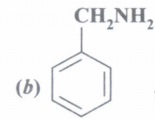 on heating with CHCI3 and KOH gives 'X'. Identify 'X'.
(c) Convert Aniline to phenol.
(d) Distinguish between Aniline and ethyl amine.
(e) Complete the following reaction
\(\mathrm{C}_{6} \mathrm{H}_{5} \mathrm{NO}_{2} \stackrel{\mathrm{Fe} / \mathrm{HCl}}{\longrightarrow} \mathrm{A} \frac{\mathrm{NaNO}_{2}+\mathrm{HCl}}{0-5^{\circ} \mathrm{C}} \mathrm{B}\) Identify' A' and 'B'.
(f) \(\mathrm{C}_{6} \mathrm{H}_{5} \mathrm{~N}_{2}^{+} \mathrm{Cl}^{\mathrm{CuCN}} \longrightarrow \mathrm{A} \stackrel{\mathrm{H}_{2} \mathrm{O} / \mathrm{H}^{+}}{\longrightarrow} \mathrm{B}\) Identify 'A' and 'B'.
(g) What is use of quarternary ammonium salts of long chain tertiary amines?
1.
The crystal lattices of transition metals have vacant interstitial sites into which small sized nonmetal atoms (H, C, N, B) can easily fit, resulting in the formation of compounds known as interstitial compounds. These are usually non-stoichiometric and are neither typically ionic nor covalent. For example, TiC, Mn4H, Fe3H, TiH1.7"etc. They have chemical properties similar to that of the parent metal but different physical properties such as hardness, electrical conductivity, etc.
2.
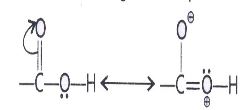
It is due to resonance as shown below the partial positive charge on carbonyl carbon atom is reduced therefore, these cannot undergo nulephilic addition reactions.
3.
HCOOH < CICH2COOH < CCl3COOH < CF3COOH.
4.
Add CHCI3 and alc. KOH,C6H5 - NH2 gives foul smell of isocyanide whereas C6H5 - NH - CH3 does not.
5.
(i) \(\underset { Aniline }{ C_{ 6 }H_{ 5 }NH_{ 2 } } +CHCl_{ 3 }+\underset { (alc) }{ 3KOH } \quad { \longrightarrow }\underset { Phenyl\quad carbylamine }{ C_{ 6 }H_{ { 5 } }N_{ \rightarrow }^{ = }C } +3KCl+3H_{ 2 }O\)
(ii) \(\underset { Benzene\\ diazonium\\ Chloride }{ C_{ 6 }H_{ 5 }N_{ 2 }Cl } +\underset { Hypo\\ phosphorus\quad \\ acid }{ H_{ 3 }PO_{ 2 } } +H_{ 2 }O\quad { \longrightarrow }\underset { Benzene }{ C_{ 6 }H_{ 6 } } +\underset { Phosphoric\\ acid }{ H_{ 3 }PO_{ 3 } } +N_{ 2 }+HCl\)
6.
It is because hydration energy and lattice energy of Cu2+ is more than that of Cu+.
7.
(i) Ligands play an important role in exhibiting the colour to the complex. \(\mathrm{H}_2 \mathrm{O}\) is a weak field ligand, which causes small d-d splitting and correspondingly complex give green colour, whereas, ethane-1, 2diamine (en) is a strong field ligand due to which d-d splitting is increased and correspondingly complex give blue colour.
(ii) Formula : \(\left[\mathrm{Co}\left(\mathrm{H}_2 \mathrm{NCH}_2 \mathrm{CH}_2 \mathrm{NH}_2\right)_3\right]_2\left(\mathrm{SO}_4\right)_3\) Hybridisation : \(d^2 s p^3\)
8.
(i) Mn3+ /Mn2+ has large positive Eo value. Hence, Mn3+ can be easily reduced to Mn2+ because Mn2+ has half-filled electronic configuration, so it is stable and Mn3+ is least stable. Therefore, it is a good oxidising agent.
(ii) There is decreasing negative electrode potentials of Mn2+/ M in the first transition series due to increasein the sum of IE1and IE2. It shows that in general, the stability of +2 oxidation state decreases from left to right. Exceptions are Mn and Zn in which the greater stability of +2 state for Mn is due to half-filled d-subshell(d5) in Mn2+ and that of Zn is due to completely filled d-subshell (d10) in Zn 2+.
(iii) It is because oxygen can form multiple bonds, whereas fluorine can only form single bonds with metals.
9.
(i) Conversion of Propanone to Propane:
.JPG)
(ii) Conversion of Benzoyl chloride to benzaldehyde:
.JPG)
(iii) On treatment with dilute alkali, ethanol produces 3-hydroxybutanal gives But-2-enal on hheating.
.JPG)
10.
(i) Hexaamminecobalt (Ill) chloride.
(ii) Tetrachloridro nickelate (II)ion.
(ill) Potassium hexacyanoferrate (Ill)
11.
The aliphatic carboxylic acids are stronger acids than phenols. The difference in the relative acidic strengths can be understood if we compare the resonance hybrids of carboxylate ion and phenoxide ion.
(i) The electron charge in the carboxylate ion is more dispersed in comparison to the phenoxide ion since 'there are two electronegative oxygen atoms in carboxylate ion as compared to only one oxygen atom in phenoxide ion.
(ii) Carboxylate ion is stabilised by two equivalent resonance structures in which negative charge is on more electronegative O atom. But phenoxide ion has non-equivalent resonance structures in which the negative charge is also on less electronegative carbon atom.
Therefore, the carboxylate ion is relatively more stable as compared to phenoxide ion. Thus, the release of H+ ion from carboxylic acid is comparatively easier or it behaves as a stronger acid than phenol.
12.
Gabriel phthalimide synthesis: It is the process in which pure aliphatic primary amines are prepared by reaction of potassium phthalimide with alkyl halide, followed by hydrolysis.
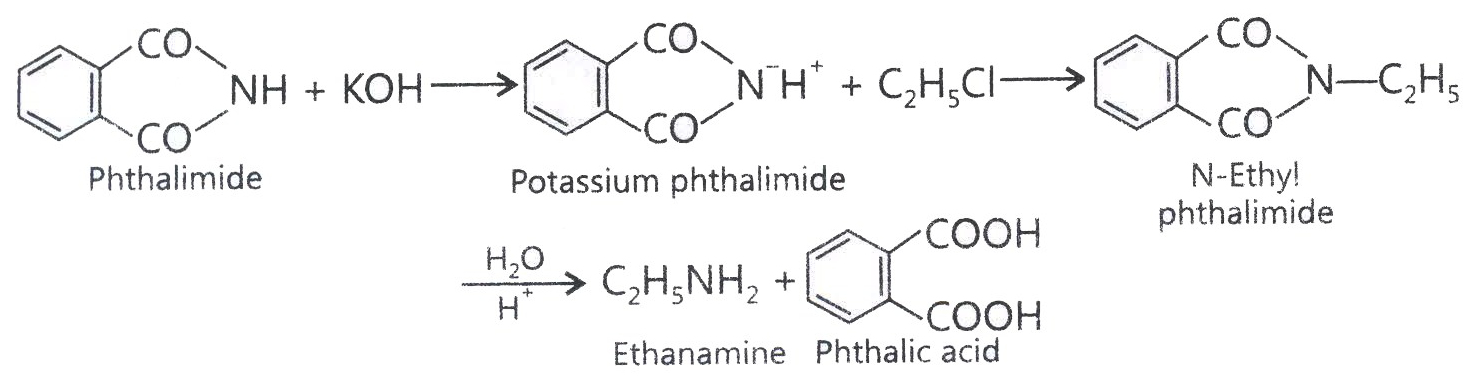
13.
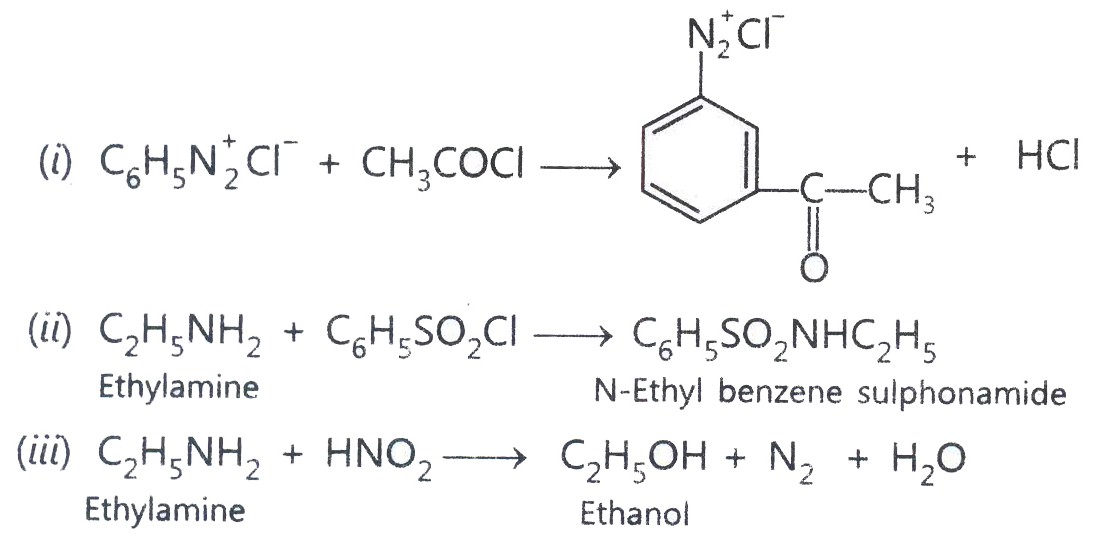
14.
(a)\(4FeCr_2O_4 + 8Na_2CO_3 + 7O_2 \longrightarrow 8Na_2CrO_4 + 2Fe_2O_3 + 8CO_2\)
\(2Na_2CrO_4 + 2H+ \longrightarrow Na_2Cr_2O_7 + 2Na^+ + H_2O\)
\(Na_2Cr_2O_7 + 2KCI \longrightarrow K_2Cr_2O_7 + 2NaCI\)
(b)\(2MnO_2 + 4KOH + O_2 \xrightarrow{\Delta} 2K_2MnO_4 + 2H_2\)
\(\underset{Magnate\ ion}{MnO_4^{2-}}\xrightarrow{electrolysis}\underset{Permagnate\ ion}{MnO_4^-}+e^-\)
15.
(b)
Triethylamine
16.
(b)
C6H5SO2CI in aq.NaOH
17.
(a)
C2H5NC and 3 KCI
18.
(c)
Solution in test tube becomes green and lime water remains clear
19.
(b)
CI3CCHO
20.
(b)
C6H5CHO
21.
(d)
CH3COCH3
22.
(c)
dsp2
23.
(a)
tris(ethane-1, 2-diamine) cobalt (III) chloride
24.
(c)
K[PtCl3(C2H4)]
25.
(d)
+ 7
26.
(d)
Sc3+
27.
(a) Ce(III) ion have the outer electronic configuration 4 f15d06s0 which can easily lose the electron from 4f orbital to acquire the stable configuration, i.e. 4f05d06s0 and form Ce(IV) ion.
(b) The E° (Mn2+/Mn) value is -1.18 V, which is highly negative as compared to other neighbouring d-block elements due to extra stability of half-filled orbitals of Mn2+ (i.e. 3d5).
(c) Greater is the number of unpaired electrons stronger is the resultant bonding hence greater is the enthalpy of atomisation.
In 3d series elements, Zn has the lowest enthalpy of atomisation, it is due to the absent of unpaired electrons in ns and (n - 1) d shells.
(d) When sodium chromate is acidified than orange colour solution of sodium dichromate is formed.
\(2 \mathrm{Na}_2 \mathrm{CrO}_4+2 \mathrm{H}^{+} \longrightarrow \underset{\substack{\text { Sodium dichromate } \\ \text { (Orange) }}}{\mathrm{Na}_2 \mathrm{Cr}_2 \mathrm{O}_7}+2 \mathrm{Na}^{+}+\mathrm{H}_2 \mathrm{O}\)
(e) Zn, Hg and Cd have completely filled d-orbitals in the ground state as well as in their common oxidation states. Thus, formation of strong metallic bond is not possible.
(f) Permanganate titration is not carried out in the presence of HCI because if HCl is used, the oxygen produced from the reaction of KMnO4 and HCl is partly utilised in oxidising HCl to Cl2, which itself acts as an oxidising agent and partially oxidises the reducing agent.
(g) In lower oxidation states, transition metals behave like metals and metal oxides are basic in nature. Thus, in lower oxidation states, transition metal oxides are basic.
As the oxidation state increases, its metallic character decreases due to decrease in size, thus, ít becomes less metallic or more non-metallic. Oxides of a non-metal may be acidic or neutral.
Thus, in higher oxidation states, transition metal oxids are amphoteric or acidic.
28.

(b) (CH3)2NH > CH3NH2 > (CH3)2N
(c) Add NaNO2 and conc. HCI. Cool it to 0-5o C. Add alkaline solution of phenol. C6H5NH2 gives orange azo dye, whereas CH3NH2 does not.
29.
(i) (a) Metal carbonyls: Metal carbonyls are the compounds in which carbon monoxide (CO) acts as the ligand. The metal-carbon bond in metal carbonyls possesses both \(\sigma\) and \(\pi\) characters, e.g. N(CO)4[nickeltetracarbonyl]. Its IUPAC name is tetra carbonyl nickel(0).
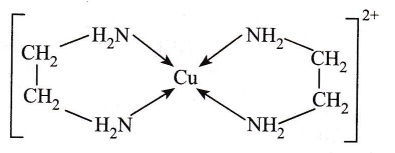
(b) Chelate: An inorganic metal complex in which there is a close ring of atoms caused by attachment of a ligand to a metal atom at two points. An example is the complex ion formed between ethylene diamine and cupric ion,[Cu(NH2CH2CH2NH2)2]2+.
(ii) (a) Add BaCl2 solution. [Co(NH3)]5Cl]SO4 will give white ppt. of BaSO4.
\(\left[\mathrm{Co}\left(\mathrm{NH}_{3}\right)_{5} \mathrm{Cl}\right] \mathrm{SO}_{4}+\mathrm{BaCl}_{2}(a q) \)\( \longrightarrow\left[\mathrm{Co}\left(\mathrm{NH}_{3}\right)_{5} \mathrm{Cl}\right] \mathrm{Cl}_{2}+\mathrm{BaSO}_{4} \downarrow \)
\(\text { (White ppt.) }\)
Add AgNO3(aq) solution [Co(NH3)5SO4] Cl will give white ppt. of AgCl.
\( {\left[\mathrm{Co}\left(\mathrm{NH}_{3}\right)_{5} \mathrm{SO}_{4}\right] \mathrm{Cl}+\mathrm{AgNO}_{3}(a q)} \) \(\longrightarrow \mathrm{AgCl}+\left[\mathrm{Co}\left(\mathrm{NH}_{3}\right)_{5} \mathrm{SO}_{4}\right] \mathrm{NO}_{3} \)
\(\text { (White ppt) }\)
(c) Fe3+ (4s03d5) In strong field \( \Delta_{0}>P t_{2 g}^{5} e g^{0} \)
In weak field \(\Delta_{0}
30.
(i) Acetylation
Acetyl group is introduced in an organic compound. Reagent is acetyl chloride or acetic anhydride.
Bases such as pyridine and dimethylaniline are used to neutralize acid (HCl or acetic acid).
(ii) Cannizzaro reaction
Aldehydes (not having alpha hydrogen atoms) undergo self oxidation-reduction (disproportionation) reaction. One molecule is oxidized to carboxylic acid and other molecule is reduced to alcohol. Concentrated alkali is the reagent.
(iii) Cross aldol condensation
Aldol condensation between different carbonyl compounds (aldehdyes and ketones). If both reactants contain alpha hydrogen atom, four different products can be obtained.
(iv) Decarboxylation
Loss of CO2 from carboxylic acids to form hydrocarbons. For this, sodium salts of carboxylic acids are heated with soda lime.
31.
(i) (a) Due to the comparatively smaller size of the metal ions, their high ionic charges and the availability of vacant d-orbitals for bond formation, transition metals form a large number of complex compounds.
(b) As oxidation number (or oxidation state) of an element increases ionic character decreases. In general, the oxides in lower oxidation states of metals are basic and in their higher oxidation state, the oxides are amphoteric.
In lower oxidation state of the metal, some of the valence electrons of the metal atom are not involved in bonding. Hence, it can donate electrons and behave as a base. In higher oxidation state, valence electrons are involved in bonding and hence, electrons are not available for donation. Instead, their effective nuclear charge is high and hence they behave as acids.
(c) Mn3+(3d4) is less stable than Mn2+(3d5) because Mn2+ has stable half-filled configuration. Cr3+ has stable 3d3(t32g) configuration, therefore, Cr3+ cannot be reduced to Cr2+. That's why, EO value for the Mn3+ / Mn2+ couple is much more positive than Cr3+ /Cr2+. In other words, Mn3+ is a strong oxidising agent.
(ii) Similarity Both lanthanoids and actinoids exhibit +3 oxidation state predominantly.Difference Lanthanoids have less tendency towards complex formation while actinoids have greater tendency towards complex formation.
32.
\([Mn(CN)_6]^{3-}\)
d2sp3, (ii) inner orbital complex, (iii) paramagnetic, (iv) 2.87 B.M.
(i) d2sp3 (ii) Inner orbital complex, (iii) diamagnetic, (iv) \(\mu=0\)
(i) d2sp3, (ii) Inner orbital complex, (iii) paramagnetic, (iv) 3.87 B.M.
(i) sp3d2, (ii) outer orbital complex (iii) paramagnetic (iv) 4.9 B.M.
33.
(a): Under acidic condition, aniline gets protonated to anilinium ion (-NH3+ group). This is deactivating and m-directing group. Thus, controlled nitration of aniline mainly gives m-nitroaniline.
34.
(a): A half-filled or fully-filled orbital is more stable than incompletely filled orbital.
35.
(c) Carboxylate ion is more stable than phenoxide ion due to two equivalent resonating structures in which negative charge is at the O-atom. In phenoxide ion, negative charge is at the less electronegative carbon atom. Therefore, corresponding acid of the carboxylate ion, i.e. carboxylic acid is more acidic than phenol. Hence, (A) is correct but (R) is incorrect.
36.
[Ni(CN)4]2- is square planar and dimagnetic.
\(\begin{equation} \begin{array}{l} \mathrm{Ni} \rightarrow 3 d^{8} 4 s^{2} \\ \mathrm{Ni}^{2+} \rightarrow 3 d^{8} 4 s^{0} \end{array} \end{equation}\)
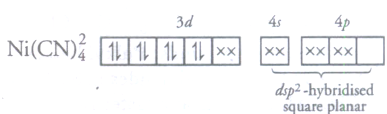
\(\therefore\)This complex has no unpaired electron.
Both (A) and (R) are correct and (R) is the correct explanation of (A).
37.
38.
(a) (CH3)3N, N, N-dimethyl methanamine.
(b)
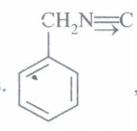 a foul smelling compound.
(c)
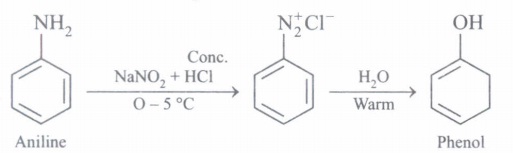
(d) Add NaNO2 and cone. HCI. Cool it to 0 to 5° C. Then add alkaline solution of phenol. Aniline gives orange dye where as ethyl amino does not.
(e) \(\begin{array}{ll}
\mathrm{A}^{\prime} \text { is } \mathrm{C}_{6} \mathrm{H}_{5} \mathrm{NH}_{2} & { }^{\prime} \mathrm{B}^{\prime} \text { is } \mathrm{C}_{6} \mathrm{H}_{5} \mathrm{~N}_{2}^{+} \mathrm{Cl}^{-}
\end{array}\)
(f) 'A' is C6H5CN, 'B' is C6H5COOH
(g) It is used as cationic detergents used in hair conditioners and shampoo.

12th Standard CBSE Syllabus & Materials
12th Standard CBSE
CBSE 12th Computer Science Python Revision Tour I - New Previous year Question Papers Study Material - QB365 Set A
NEW12th Standard CBSE
CBSE 12th Business Studies Planning Important Questions And Answers Study Material - QB365 Set A
NEW12th Standard CBSE
CBSE 12th Business Studies Business Environment Important Questions And Answers Study Material - QB365 Set A
NEW12th Standard CBSE
CBSE 12th Business Studies Principles of Management Important Questions And Answers Study Material - QB365 Set A



NCERT Books

Syllabus

Exam Pattern

Sample Question Papers

Previous year Question Papers

Important Notes

MCQ Practice test

NCERT Exemplers

Case study Questions

Image Based Questions

Passage based Questions

HOT Questions

Value Based Questions

Model Questions Papers
NCERT ( Book Back ) Questions

Assertion and Reason
Important Questions And Answers

CBSE 12th Standard CBSE Subjects
CBSE Standards








