
 100% FREE ACCESS
12th Standard CBSE Syllabus & Materials
12th Standard CBSE
CBSE 12th Economics Government Budget and the Economy Previous year Question Papers Study Material - QB365 Set A
NEW12th Standard CBSE
CBSE 12th Computer Science Interface Python with MySQL - New Previous year Question Papers Study Material - QB365 Set A
NEW12th Standard CBSE
CBSE 12th Computer Science Database Concept - New Previous year Question Papers Study Material - QB365 Set A
NEW12th Standard CBSE
CBSE 12th Computer Science Data Communication - New Previous year Question Papers Study Material - QB365 Set A
NEW12th Standard CBSE
CBSE 12th Computer Science Data Structures - New Previous year Question Papers Study Material - QB365 Set A
NEW12th Standard CBSE
CBSE 12th Computer Science Functions - New Previous year Question Papers Study Material - QB365 Set A

Published on: 25/10/2025
Download CBSE Class 12th Standard CBSE Chemistry question papers, sample papers, important questions, and previous year solved papers in PDF format. Get free study materials, NCERT solutions, and exam preparation resources for Class 12th Standard CBSE Chemistry
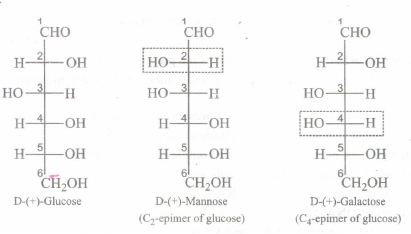
Questions + Answers key
Take MCQ Chemistry Test
1.
\(\alpha\)-D-glucose and \(\beta\)-D-glucose differ from each other with respect to the
number of -OH groups
configuration at the C-1 carbon
size of the hemiacetal ring
configuration at the C-5 carbon
2.
Which of the following is correct about H-bonding in DNA?
A - T, G - C
A - G, T - G
G - T, A - C
A - A, T - T
3.
Glucose on oxidation with Br2(aq) gives
Gluconic acid
Tartaric acid
Sachharic acid
Meso-oxalic acid
4.
The spatial arrangement of the two or more polypeptide chains with respect to each other is known as
primary structure
secondary structure
tertiary structure
quaternary structure
5.
The vitamin which is neither soluble in water nor in fat is
biotin
phylloquinone
thiamine
ergocalciferol
pyridoxine
6.
The number if disulphide linkages present in insulin are
4
3
2
1
7.
Which of the following is an essential amino acid ?
Methionine
Tyrosine
Proline
Glycine
Alanine
8.
Which of the following is not correct ?
D(-) Fructose exists in fructose structure
D(+) Glucose exists in the pyranose structure
In sucrose, the two monosaccharides are held together by peptide linkage
Maltose is a reducing sugar
Pentaacetate of glucose does not react with hydrolamine
9.
Carbohydrates are classified on the basis of their behaviour on hydrolysis and also as reducing or non-reducing sugar. Surcose is a ......... .
monosaccharide
disaccharide
reducing sugar
non-reducing sugar
10.
Hydrolysis products of lactose are
glucose and glucose
glucose and fructose
glucose and galactose
none of these
11.
Name the enzyme ehich converts glucose into alcholol ?
12.
Sucrose is dextrorotary but the mixture obtained after hydrolysis is laevorotatory. Explain
13.
What is the structural feature characterising reducing sugars ?
14.
Write the structure of alanine at pH = 2 and pH = 10.
15.
What forces are responsible for the stability of \(\alpha\) - helix ? Why is it named as 3.613 helix?
16.
How do expimers differ from anomers ?
17.
(i) Which one of the following is a polysaccharide? Starch, Maltose, Fructose, Glucose
(ii) What is the difference between native protein and denatured protein?
(iii) Write the name of vitamin responsible for coagulation of blood.
18.
(i) What is the basic structural difference between glucose and fructose?
(ii) Write chemical reaction to show that open structure of D-glucose contains the straight chain.
(iii) What type of linkage is responsible for the formation of proteins?
19.
Write the function of the following enzymes.
(i) Invertase
(ii) Urease
(iii) Maltase
20.
(i) Which one of the following is a disaccharide: Starch, Maltose, Fructose, Glucose?
(ii) What is the difference between fibrous protein and globular protein?
(iii) Write the name of vitamin whose deficiency causes bone deformities in children.
21.
(i) Deficiency of which vitamin causes night blindness?
(ii) Name the base that is found in nucleotide of RNA only.
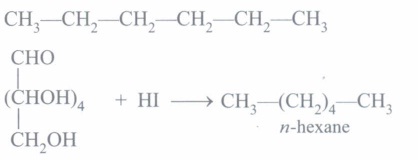
(iii) Glucose on reaction with HI gives n-hexane. What does it suggest about the structure of glucose?
22.
Certain organic compounds are required in small amounts in our diet but their deficiency causes specific disease. These compounds are called vitamins. Most of the vitamins cannot be synthesised in our body but plants can synthesise almost all of them. So, they are considered as essential food factors. However, the bacteria of the gut can produce some of the vitamins required by us. All the vitamins are generally available out diet. The term 'vitamin' was coined from the words vital + amine, since the earlier identified compounds had amino group.
Vitamins are classified into two groups depending upon their solubility in water or fat namely-fat soluble vitamins and water soluble vitamins.
Answer the following questions.
(a) What is the other name of vitamin B6?
(b) Name the vitamin whose deficiency causes increased blood clotting time.
(c) Xerophthalmia is caused by the deficiency of which vitamin? Give two sources of this vitamin.
Or
(c) Why can't vitamin C be stored in our body? Name the disease caused by the deficiency of this vitamin.
1.
(b)
configuration at the C-1 carbon
2.
(a)
A - T, G - C
3.
(a)
Gluconic acid
4.
(d)
quaternary structure
5.
(a)
biotin
6.
(b)
3
7.
(a)
Methionine
8.
(c)
In sucrose, the two monosaccharides are held together by peptide linkage
9.
(b)
disaccharide
10.
(c)
glucose and galactose
11.
\(\text { Zymase } ; \mathrm{C}_6 \mathrm{H}_{12} \mathrm{O}_6 \stackrel{\text { Zymase }}{\longrightarrow} 2 \mathrm{C}_2 \mathrm{H}_5 \mathrm{OH}+2 \mathrm{CO}_2 \text {. }\)
12.
Sucrose is dextrorotatory, with a specific rotation of \({ \left[ \alpha \right] }_{ D }\) = + 66·5° but on hydrolysis, it gives equimolar amounts of glucose which is dextrorotatory and fructose which is laevorotatory. Since the laevorotation of fructose (- 92.4°) is much more than dextrorotation of glucose (+ 52·5°), therefore, the resulting solution becomes laevorotatory.
13.
The main structural feature of reducing sugars is the presence of an aldehyde group (-CHO) such as in glucose , mannose, gatactose, etc or the \(\alpha\) - ketol grouping (-CO-CH2OH) as present in fructose.
14.
Alanine exists as a zwitterion (I) in aqueous solution. In presence of acid (pH = 2), the basic - COO- group accepts a proton to give cation (II) but in presence of a base (pH = 10), the acidic - \({ NH }_{ 3 }\) group donates a proton to the base and thus exists as an anion (III).
\(\quad \quad \quad { CH }_{ 3 }\quad \quad \quad \quad \quad \quad \quad \quad \quad \quad \quad \quad { CH }_{ 3 }\\ \quad \quad \quad \quad |\quad \quad \quad \quad \quad \quad \quad \quad \quad \quad \quad \quad \quad |\\ \overset { + }{ { NH }_{ 3 } } -CH-{ COO }^{ - }\quad \overset { { H }^{ + } }{ \longrightarrow } \overset { + }{ { NH }_{ 3 } } -CH-{ COO }H\\ \quad \quad Alanine\quad (I)\quad \quad \quad \quad \quad \quad \quad \quad II\)
\(\\ \quad \quad \quad { CH }_{ 3 }\quad \quad \quad \quad \quad \quad \quad \quad \quad \quad \quad \quad { CH }_{ 3 }\\ \quad \quad \quad \quad |\quad \quad \quad \quad \quad \quad \quad \quad \quad \quad \quad \quad \quad |\\ \overset { + }{ { NH }_{ 3 } } -CH-{ COO }^{ - }\quad \overset { { OH }^{ - } }{ \longrightarrow } \overset { + }{ { NH }_{ 3 } } -CH-{ { COO }^{ - } }\\ \quad \quad Alanine\quad (I)\quad \quad \quad \quad \quad \quad \quad \quad III\\ \)
15.
The stability of \(\alpha \) -helix structure is due to intramolecular H-bonding between -NH- and -CO- groups of the same polypeptide chain. The \(\alpha \) -helix is termed as \({ 3.6 }_{ 13 }\) helix since each turn of the helix has approximately 3·6 amino acids and the hydrogen bonding leads to the formation of a 13-membered ring.
16.
Carbohydrates which differ in configuration at the glycosidic carbon (i.e. \({ C }_{ 1 }\) in aldoses and \({ C }_{ 2 }\) in ketoses) are called anomers while those which differ in configuration at any carbon other than glycosidic carbon are called epimers. For example, \(\alpha \)-D-glucose and \(\beta \)-D-glucose are anomers since they differ in configuration at \({ C }_{ 1 }\) (glycosidic carbon) while glucose and mannose are called epimers since they differ in configuration at \({ C }_{ 2 }\)(other than the glycosidic carbon \({ C }_{ 1 }\) ). In other words, glucose and mannose are Cr epimers. Similarly, we can show that glucose and galactose are \({ C }_{ 4 }\) -epimers since they differ in configuration only at \({ C }_{ 4 }\).
17.
(i) Starch
(ii) Native protein has sequence of amino acid having peptide bonds. Denatured protein loses biological activity due to rupture of secondary and tertiary structure.
(iii) Vitamin K.
18.
(i) Glucose has aldehyde group whereas fructose has keto group.
(ii) n-hexane is formed,
(iii) Peptide linkage.
19.
(i) Write the function ofthe follow Hydrolysis of cane sugar.
(ii) Urease Decomposition of urea into NH3 and CO2.
(iii) Maltase Hydrolysis of maltose into glucose
20.
(i) Maltose is disaccharide.
(ii)
| Fibrous protein | Globular protein |
|---|---|
| It consist linear thread like molecules which tend to lie side by side to form fibres. Example: Keratin, collagen |
It consist compact form of molecules which are folded together. Example: enzymes, hormones. |
(iii) The deficiency of vitamin D causes bone deformities in children.
21.
(i) Vitamin A
(ii) Uracil
(iii) It suggests that six carbon atoms are in straight chain/CHO-(CHOH)4-CH2OH
22.
(a) Another name of vitamin B6 is pyridoxine.
(b) Vitamin K
(C) Deficiency of vitamin A cause xerophthalmia. The two sources of vitamin A are fish and carrots.
Or
(c) Vitamin C is a water soluble vitamin thus it can't be stored in our body.
Scurvy (bleeding gum) disease is caused by the deficiency of this vitamin.

12th Standard CBSE Syllabus & Materials
12th Standard CBSE
CBSE 12th Computer Science Python Revision Tour I - New Previous year Question Papers Study Material - QB365 Set A
NEW12th Standard CBSE
CBSE 12th Business Studies Planning Important Questions And Answers Study Material - QB365 Set A
NEW12th Standard CBSE
CBSE 12th Business Studies Business Environment Important Questions And Answers Study Material - QB365 Set A
NEW12th Standard CBSE
CBSE 12th Business Studies Principles of Management Important Questions And Answers Study Material - QB365 Set A



NCERT Books

Syllabus

Exam Pattern

Sample Question Papers

Previous year Question Papers

Important Notes

MCQ Practice test

NCERT Exemplers

Case study Questions

Image Based Questions

Passage based Questions

HOT Questions

Value Based Questions

Model Questions Papers
NCERT ( Book Back ) Questions

Assertion and Reason
Important Questions And Answers

CBSE 12th Standard CBSE Subjects
CBSE Standards








