
 100% FREE ACCESS
12th Standard CBSE Syllabus & Materials
12th Standard CBSE
CBSE 12th Economics Government Budget and the Economy Previous year Question Papers Study Material - QB365 Set A
NEW12th Standard CBSE
CBSE 12th Computer Science Interface Python with MySQL - New Previous year Question Papers Study Material - QB365 Set A
NEW12th Standard CBSE
CBSE 12th Computer Science Database Concept - New Previous year Question Papers Study Material - QB365 Set A
NEW12th Standard CBSE
CBSE 12th Computer Science Data Communication - New Previous year Question Papers Study Material - QB365 Set A
NEW12th Standard CBSE
CBSE 12th Computer Science Data Structures - New Previous year Question Papers Study Material - QB365 Set A
NEW12th Standard CBSE
CBSE 12th Computer Science Functions - New Previous year Question Papers Study Material - QB365 Set A

Published on: 25/10/2025
Download CBSE Class 12th Standard CBSE Chemistry question papers, sample papers, important questions, and previous year solved papers in PDF format. Get free study materials, NCERT solutions, and exam preparation resources for Class 12th Standard CBSE Chemistry
Questions + Answers key
Take MCQ Chemistry Test
1.
What are the different types of RNA molecules which perform different functions?
2.
Arrange the following compounds in increasing order of their acid strength:
Propan-1-ol, 2,4,6-trinitrophenol, 3-nitrophenol, 3,5-dinitrophenol,phenol, 4-methylphenol.
3.
Arrange the following compounds in the increasing order of their property as indicated: \(\mathrm{CH}_{3} \mathrm{COCH}_{3}, \mathrm{C}_{6} \mathrm{H}_{5} \mathrm{COCH}_{3}, \mathrm{CH}_{3} \mathrm{CHO}\) (reactivity towards nucleophilic addition reaction)
4.
In a pseudo first order hydrolysis of an ester in water, the following results were obtained :
| t/s | 0 | 30 | 60 | 90 |
|---|---|---|---|---|
| [Ester]/molL-1 | 0.55 | 0.31 | 0.17 | 0.085 |
(i) Calculate the average rate of reactions between the time interval 30 to 60 seconds.
5.
Amongst the following, the most stable complex is
(a) [Fe(H2O)6]3+
(b) [Fe(NH3)6]3-
(c) [Fe(C2O4)3]3-
(d) [FeCl6]3-
6.
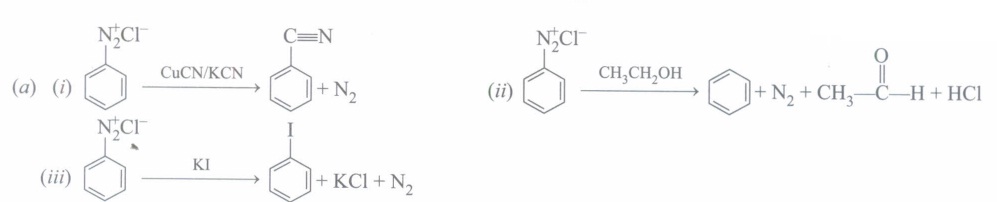
(a) Write the structures of the main products when benzene diazonium chloride C6H5N2+CI- reacts will the following reagents:
(i) CuCN/KCN
(ii) CH3CH2OH
(iii) KI
(b) Arrange the following:
(i) C2H5NH2, C2H5OH, (CH3)3N - in increasing order of the boiling point.
(ii) Aniline, p-nitro aniline, p-methyl aniline - in increasing order of their basic strength.
7.
In the button cells widely used in watches and other devices the following reaction takes place:
Zn(s) + Ag2O(s) + H2O(l) \(\rightarrow\) Zn2+(aq) + 2Ag(s) + 2OH–(aq)
Determine \(\Delta_{r} G^{\ominus} \text { and } E^{\ominus}\) for the reaction.
8.
Write the electronic configurations of the elements with the atomic numbers 61, 91, 101, and 109.
9.
Which of the following is correct about H-bonding in DNA?
A - T, G - C
A - G, T - G
G - T, A - C
A - A, T - T
10.
Which of the following statements are correct about the kinetics of this reaction?
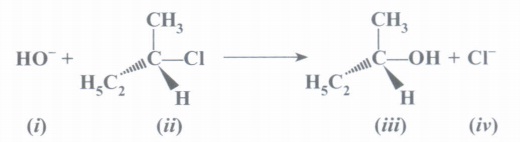
The rate of reaction depends on the concentration of only (ii).
The rate of reaction depends on concentration of both (i) and (ii).
Molecularity of reaction is one
Molecularity of reaction is two.
11.
The molecular formula of Wilkinson catalyst, used in hydrogenation of alkenes is
[Co(Co)6]
[(Ph3P)3Rh]Cl
[Pt(NH3)2Cl2]
K[Ag(CN)2]
12.
When freon is manufactured by tetrachloromethane, the reaction involved in this process is called
Sandmeyer reaction
Swarts reaction
Finkelstein reaction
All of these
13.
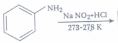
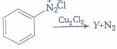
Identify the compound Y in the following reaction.


14.
After introducing the factor P, expression for the rate of a reaction, becomes
\(Rate =\frac{Z_{A B} e^{-E_{a} / R T}}{P}\)
\( Rate =P Z_{A B} e^{-E_{a}/RT}\)
\( Rate =\frac{Z_{A B}.P}{e^E_{a}/RT}\)
\(Rate=\frac{e^{E_{a} / R t}}{P Z_{AB}}\)
15.
Methylamine reacts with NHO2 to form...................................... .
CH3-O-N=O
CH3-O-CH3
CH3OH
CH3CHO
16.
Which of the following are purine bases ?
Guranine
Adenine
Thymine
Uracil
17.
Butan-2-one can be converted to propionic acid by which of the following :
NaOH. NaIH+
Fehling solution
NaOH,I2/H+
Tollens'reagent
18.
The smallest ketone and its next homologue are reacted with NH2OH to form oxime
two different oximes are formed
three different oximes are formed
two oximes are optically active
all oximes are optically active
19.
Consider the reaction :
RCHO + NH2NH2 \(\longrightarrow\) RCH = N __ NH2
What short of reaction is it?
Electrophilic addition - elimination reaction
Free radical addition - elimination reaction
Free radical addition - elimination reaction
Nucleophilic addition - elimination reaction
20.
Generally transition elements and their salts are coloured due to the presence of unpaired electrons in metal ions. Which of the following compounds are coloured ?
KMnO4
Ce(SO4)2
TiCI4
Cu2CI2
21.
Which of the following will produce only one product on reduction with LiAIH4?
CH3OCOCH2CH3
CH3CH2OCOCH2CH3
CH3CH2OCOCH3
CH3CH2OCOCH2CH2CH3
22.
Standard free energies of formation (in kJ/mol) at 298 K are - 237.2, - 394.4 and - 8.2 for H2O (l), CO2 (g) and pentane (g) respectively. The value of E0cell for the pentane-oxygen fuel cell is
1.968 V
2.0968 V
1.0968 V
0.0968 V
23.
Permanent magnets are generally made of alloys of
Fe
Co
Ni
Any one of these
24.
Which of the following statement is not correct for the catalyst ?
It catalyses the forward and backward reaction to the same extent
It alters \(\triangle G\) of the reaction
It is a substance that does not change the equilibrium constant of a reaction
It proivides an alternate machanism by reducing activation energy between energy between reactants and products.
25.
(i) Why is boiling of 1 M NaCl solution more than that of 1 M glucose solution?
(ii) A non-volatile solute ' X ' (molar mass =50 gmol−1 ) when dissolved in 78 g of benzene reduced its vapour pressure to 90%.
Calculate the mass of X dissolved in the solution.
(iii) Calculate the boiling point elevation for a solution prepared by adding 10 g of MgCl2 to 200 g of water assuming MgCl2 is completely dissociated.
( Kb for water =0.512Kkgmol−1, molar mass of MgCl2=95 g mol−1).
26.
Which one of the following has the highest dipole moment?
(i) CH2Cl2
(ii) CHCl3
(iii) CCl4
27.
A first order reaction takes 20 minutes for 25% decomposition. Calculate the time when 75% of the reaction will be completed.
Given: log 2 = 0.3010, log 3 = 0.4771, log 4 = 0.6021
28.
Write the equations involved in the following reactions:
(i) Reimer-Tiemann reaction
(ii) Williamson synthesis
29.
Addition of grignard reagents to dry ice followed by hydrolysis gives caeboxylic acids whereas that of organolithum compounds under similar conditions give ketones, Explain
30.
Resistance of a conductivity cell filled with 0.1 mol L-1 KCl solution is \(100 \ Ω\). If the resistance of the same cell, when filled with 0.02 mol L-1 solution, is, calculate \( 520 \ Ω \) the conductivity and molar conductivity of 0.02 mol L-1 solution. (The conductivity of 0.1 mol L-1 KCl solution is 1.29 S/m.
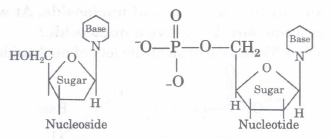
31.
What is the difference between a nucleoside and a nucleotide ?
32.
Solutions are homogeneous mixture of two or more substances. Ideal solution follow Raoult's law. The vapour pressure of each component is directly proportional to their mole fraction if both solute and solvent are volatile. The relative lowering of vapour pressure is equal to mole fraction of solute if only solvent is volatile.
Non-ideal solution form azeotropes which cannot be separated by 'tractional distillation. Henry's law is special case of Raoult's law applicable to gases dissolved in liquids.
Colligative properties depend upon number of particles of solute. Relative lowering of vapour pressure, elevation in boiling point, depression in freezing point and osmotic pressure are colligative properties which depend upon mole fraction of solute, molality and molarity of solutions. When solute undergoes either association or dissociation, molecular mass determined by colligative property will be abnormal.
van't Hofffactor is used in such cases which is ratio of normal molecular mass over observed molar mass.
(a) 50 ml of an aqueous solution of glucose (Molar mass 180 g/mol) contains 6.02 x 10²² molecules. What is molarity?
(b) Identify which liquid has lower vapour pressure at 90°C if boiling point of liquid 'A' and 'B' are 140°C and 180° respectively.
(c) What type of azeotropes are formed by nonideal solution showing negative deviation from Raoult's law?
(d) For a 5% solution of area (molar mass 60 g mol -1), calculate the osmotic pressure at 300 K (R = 0.0821 L atm k-1 )
(e) Predict the van't Hoff factor
(i) CH3 COOH dissolved in water,
(ii) dissolved in benzene.
(f) Why meat is preserved for longer time by salting?
(g) Why 0.1 M KCI has higher boiling point than 0.1 M glucose solution?
33.
Read the passage given below and answer the following questions:
Ligands are atoms or ions which can donate electrons to the central atoms. Ligands can be monodentate, bidentate or polydentate as well. Few ligands can coordinate with the central atom through more than one site, these are called ambidentate ligands. When a di- or polydentate ligand uses its two or more donor atoms to bind a single metal ion, it is said to be a chelating ligand.
In these questions (i-iv), a statement of assertion followed by a statement of reason is given. Choose the correct answer out of the following choices.
(a) Assertion and reason both are correct statements and reason is correct explanation for assertion.
(b) Assertion and reason both are correct statements but reason is not correct explanation for assertion.
(c) Assertion is correct statement but reason is wrong statement.
(d) Assertion is wrong statement but reason is correct statement.
(i) Assertion: Glycinate ion is an example of mono dentate ligand.
Reason: Glycinate contains Nand O as donor atoms
(ii) Assertion: Oxalate ion is a bidentate ligand.
Reason: Oxalate ion has two donor atoms
(iii) Assertion: A chelating ligand must possess two or more lone pairs at such a distance that it may form suitable strain free 5 and 6 membered rings with the metal ion.
Reason: H2N- NH2 is a chelating ligand.
(iv) Assertion: In Zeise's salt coordination number of Pt is five.
Reason: Ethene is a monodentate ligand.
1.
Three different types of RNA molecules are as follows
(i) Messenger-RNA (m-RNA)
(ii) Transfer-RNA (t-RNA)
(iii) Ribosomal-RNA (r-RNA)
2.
Propan-1-ol, 4-methylphenol, phenol, 3-nitrophenol, 3,5-dinitrophenol, 2,4, 6-trinitrophenol.
3.
\(\mathrm{C}_6 \mathrm{H}_5 \mathrm{COCH}_3<\mathrm{CH}_3 \mathrm{COCH}_3<\mathrm{CH}_3 \mathrm{CHO}\)
+I - effect of phenyl and +I- effect of two +I-effect of only one
methyl groups increases alkyl groups alkyl group and no
electron density on CO and steric sterically hindered
group and steric hindrance hindrance group, making it
caused by these two groups due to two more reactive
make nucleophilic attack bulky groups. towards nucleophilic
difficult. attack.
4.
(i) Average rate during the interval 30-60 sec.
\(=\frac { { C }_{ 2 }-{ C }_{ 1 } }{ { t }_{ 2 }-{ t }_{ 1 } } =\frac { 0.31-0.17 }{ 60-30 } =\frac { 0.14 }{ 30 } mol{ L }^{ -1 }{ s }^{ -1 }=4.67\times { 10 }^{ -3 }mol{ L }^{ -1 }{ s }^{ -1 }\)
\((ii)\ k\prime =\frac { 2.303 }{ t } \log { \frac { { \left[ A \right] }_{ 0 } }{ \left[ A \right] } } \) in which \({ \left[ A \right] }_{ 0 }=0.55M\)
\(t=30\quad sec,k\prime =\frac { 2.303 }{ 30\quad s } \log { \frac { 0.55 }{ 0.31 } } =1.91\times { 10 }^{ -2 }{ s }^{ -1 }\)
\(t=60\quad sec,k\prime =\frac { 2.303 }{ 60\quad s } \log { \frac { 0.55 }{ 0.17 } } =1.96\times { 10 }^{ -2 }{ s }^{ -1 }\)
\(t=90\quad sec,k\prime =\frac { 2.303 }{ 90\quad s } \log { \frac { 0.55 }{ 0.085 } } =2.07\times { 10 }^{ -2 }{ s }^{ -1 }\)
\(Average\ k\prime =\frac { 1.91+1.96+2.07 }{ 3 } \times { 10 }^{ -2 }=1.98\times { 10 }^{ -2 }{ s }^{ -1 }\)
5.
In each complex, Fe is in + 3 state , as C2O-4is didentate chelating ligand. which forms chelate rings and hence. it is the most stable complex.
6.
\(\text {(b) } \ (i)\left(\mathrm{CH}_{3}\right)_{3} \mathrm{~N}<\mathrm{C}_{2} \mathrm{H}_{5} \mathrm{NH}_{2}<\mathrm{C}_{2} \mathrm{H}_{5} \mathrm{OH}\)
(ii) p-nitroaniline < Aniline < p-methyl aniline.
7.
\( \mathrm{Zn}_{(s)} \longrightarrow \mathrm{Zn}^{2+}+2 \mathrm{e}^{-} ; E^{\ominus}=0.76 \mathrm{~V}\)
\(\mathrm{Ag}_{2} \mathrm{O}_{(s)}+\mathrm{H}_{2} \mathrm{O}_{(t)}+2 \mathrm{e}^{-} \longrightarrow 2 \mathrm{Ag}_{(s)}+2 \mathrm{OH}^{-} ; E^{\ominus}=0.344 \mathrm{~V} \)
__________________________________________________
\(\mathrm{Zn}_{(s)}+\mathrm{Ag}_{2} \mathrm{O}_{(s)}+\mathrm{H}_{2} \mathrm{O}_{(n)} \longrightarrow \mathrm{Zn}^{2+}+2 \mathrm{Ag}_{(s)}+2 \mathrm{OH}^{-} ; E^{\ominus}=1.104 \mathrm{~V}\)
Eø = 1.104 V
We know that,
ΔrGø = -nFEø
= - 2 x 96487 x 1.04
= - 213043.296 J
= - 213.04 kJ
8.
| Atomic number | Electronic configuration |
| 61 | \([X e]^{54} 4 f^{5} 5 d^{0} 6 s^{2}\) |
| 91 | \([R n]^{86} 5 f^{26} d^{17} s^{2}\) |
| 101 | \([R n]^{86} 5 f^{135} d^{07} s^{2}\) |
| 109 | \([R n]^{86} 5 f^{14} 6 d^{7} 7 s^{2}\) |
9.
(a)
A - T, G - C
10.
(a)
The rate of reaction depends on the concentration of only (ii).
11.
(b)
[(Ph3P)3Rh]Cl
12.
(d)
All of these
13.
(a)
14.
(b)
\( Rate =P Z_{A B} e^{-E_{a}/RT}\)
15.
(c)
CH3OH
16.
(b)
Adenine
17.
(c)
NaOH,I2/H+
18.
(b)
three different oximes are formed
19.
(d)
Nucleophilic addition - elimination reaction
20.
(a)
KMnO4
21.
(c), esters having the same number of carbon atoms in the alkyl and acyl group, i.e., CH3CH2 and COCH3 group in CH3CH2OCOCH3.
22.
(c)
1.0968 V
23.
(d)
Any one of these
24.
(b)
It alters \(\triangle G\) of the reaction
25.
(i) In case of 1 M NaCl solution the concentration of particles is higher as compared to 1 M glucose solution. Also the van't Hoff factor of NaCl is greater than 1 , while that of glucose is 1 .
(ii) Given, Molar mass of non volatile solute \(X=50 \mathrm{~g} \mathrm{~mol}^{-1}\)
Amount of benzene \(=78 \mathrm{~g}\)
Let $p$ be the vapour pressure of pure benzene
The vapour pressure of solution will be $=\frac{90}{100} p=0.9 p$
(iii) Given,\( \frac{p-p^{\prime}}{p}=\frac{W \times 78}{40 \times 78} \)
\(\frac{p-0.9 p}{p} =\frac{W}{40}\)
\(W =40 \frac{(0.1 p)}{p} \)
\( =40 \times 0.1=4 \mathrm{~g}\)
\(\text { Amount of } \mathrm{MgCl}_2=10 \mathrm{~g}\)
\(\text { Amount of water }=200 \mathrm{~g}\)
\(K_b \text { for water }=0.512 \mathrm{~K} \mathrm{~kg} \mathrm{~mol}^{-1} \)
\(\text { Molar mass of } \mathrm{MgCl}_2=95 \mathrm{~g} \mathrm{~mol}^{-1}\)
\(\Delta T=K_b \times m =0.512 \times m \)
\(=\frac{0.512}{200} \times \frac{100}{95} \times 1000 =0.269 \mathrm{~K} .\)
26.
Dichloromethane has highest dipole moment among CH2Cl2, CHCl3 and CCl4. The decreasing order of dipole moments is CH2Cl2>CHCl3>CCl4. These molecules have tetrahedral geometry due to sp3 hybridization of carbon atom.In CCl4, the individual C−Cl bond dipoles cancel each other which results in zero dipole moment.
Hence, CCl4 is non polar.
27.
For a first order reaction
K=\(\frac { 2.303 }{ t } log\frac { a }{ a-x } \)
where, k = Rate constant
a = initial concentration
(a - x) = concentration after time' t'.
When a first order reaction is 25% complete in 20 min.
a = 100, a - x = 100 - 25 = 75, 1= 20 min.
∴ \(k=\frac { 2.303 }{ t } log\frac { a }{ a-x } =\frac { 2.303 }{ 20 } log\frac { 100 }{ 75 } \)
=\(\frac { 2.303 }{ 20 } \)[log4-log3]=0.0143 min-1
For 75% completion of reaction
a = 100, a - x = 100 - 75 = 25, k = 0.0143 min-1
\(t=\frac { 2.303 }{ k } log\frac { a }{ a-x } =\frac { 2.303 }{ 0.0143 } log\frac { 100 }{ 25 } \)
=\(\frac { 2.303 }{ 0.0143 } \) log4 = 96.961 min.
28.
(i) Reimer-Tiemann reaction
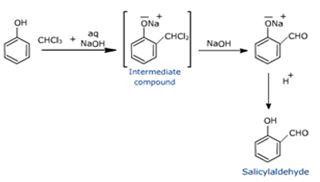
(ii) Williamson syntheses:
\(\underset { Alkyl halide\ Sodium\ alkoxide }{ R-X+\overset { + }{ Na } -\overset { - }{ O } -{ R }' } \longrightarrow R-O-{ R }'+NaX\)
\(\underset { Alkyl\ halide\ Sodium\ alkoxide }{ { CH }_{ 3 }-{ CH }_{ 2 }-Br } +\underset { sodium\ ethoxide }{ \overset { + }{ Na } -\overset { - }{ O } -{ CH }_{ 2 }-{ CH }_{ 3 } } \longrightarrow \underset { Diethyl\ ether }{ { CH }_{ 3 }-{ CH }_{ 2 }-O-{ CH }_{ 2 }-{ CH }_{ 3 } } +NaBr\)
29.
Since electronegativity of Li (E.N. = 1.0) is lower than that of Mg (E.N. = 1.2), therefore, organolithium compounds are more nucleophilic than Grignard reagents. As a result, organolithium compounds not only add to the more reactive CO2 but also to the less reactive resonance stabilized lithium salt of carboxylic acid thus formed to yield ketones.
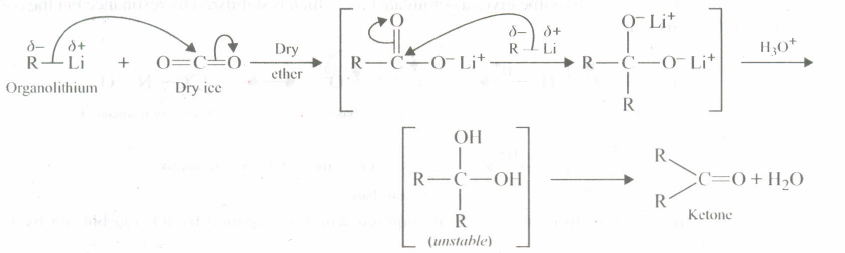
Grignard reagents, on the other hand, being less nucleophilic add only to the more reactive CO2 but not to the less reactive resonance stabilized magnesium salt of the carboxylic acid from which carboxylic acid can be generated by hydrolysis with mineral acids.

30.
The cell constant is given by the equation:
Cell constant = G* = conductivity × resistance
= 1.29 S/m × 100 \(\Omega\) = 129 m–1 = 1.29 cm–1
= \(\frac{G^{*}}{R}=\frac{129 \mathrm{~m}^{-1}}{520 \Omega}\) = 0.248 S m–1
Concentration = 0.02 mol L–1
= 1000 × 0.02 mol m–3 = 20 mol m–3
Molar conductivity = \(A_{m}=\frac{\kappa}{c}\)
= \(\frac{248 \times 10^{-3} \mathrm{Sm}^{-1}}{20 \mathrm{~mol} \mathrm{~m}^{-3}}\) = 124 × 10–4 S m2mol–1
Alternatively, \(\kappa=\frac{1.29 \mathrm{~cm}^{-1}}{520 \Omega}\) = 0.248 × 10⁻² S cm–1
and Λ m = κ × 1000 cm3 L–1 molarity–1
= \(\frac{0.248 \times 10^{-2} \mathrm{~S} \mathrm{~cm}^{-1} \times 1000 \mathrm{~cm}^{3} \mathrm{~L}^{-1}}{0.02 \mathrm{~mol} \mathrm{~L}^{-1}}\)
= 124 S cm2 mol–1
31.
A nucleoside contains only two basic components of nucleic acids namely a pentose sugar and a nitrogenous base.
A nucleotide contains all the three basic components of nucleic acids namely a phosphoric acid group, a pentose sugar and a nitrogenous base.
32.
(a) \(\mathrm{M}=\frac{\text { No. of moles }}{\text { Litres of solution }}=\frac{6.02 \times 10^{22}}{6.02 \times 10^{23}} \times \frac{1000}{50}\)
= 2M
(b) 'B' will have lower vapour pressure because its boiling point is higher.
(c) Maximum boiling azeotropes.
(d) \(\pi V=n R T \Rightarrow \pi \times 0.1 \mathrm{~L}=\frac{5}{60} \times 0.0821 \times 300\)
\(\Rightarrow \pi=\frac{24.63}{1.2}=20.52 \mathrm{~atm}[\because 100 \mathrm{~mL}=0.1 \mathrm{~L}]\)
(e) (i) i > 1, because dissociation takes place.
(ii) i < 1, because association takes place.
(f) Salt inhibits the growth of microorganisms by drawing out water from microbial cells through osmosis 20% salt is needed to kill most species of unwanted bacteria.
(g) It is because KCI dissociates into ions, it has double particles as compared to glucose.
Therefore, elevation in boiling point is double.
33.
(i) (d): Glycinate ion is an example of bidentate ligand. It contains Nand O as donor atoms.
(ii) (a)
(iii) (c) : H2N - NH2 does not act as chelating ligand.
The coordination by hydrazine leads to a three member highly unstable strained ring and thus it does not act as chelating agent.
(iv) (d): In Zeises salt, coordination no. of Pt is 4. Ethylene is a mono dentate ligand.

12th Standard CBSE Syllabus & Materials
12th Standard CBSE
CBSE 12th Computer Science Python Revision Tour I - New Previous year Question Papers Study Material - QB365 Set A
NEW12th Standard CBSE
CBSE 12th Business Studies Planning Important Questions And Answers Study Material - QB365 Set A
NEW12th Standard CBSE
CBSE 12th Business Studies Business Environment Important Questions And Answers Study Material - QB365 Set A
NEW12th Standard CBSE
CBSE 12th Business Studies Principles of Management Important Questions And Answers Study Material - QB365 Set A



NCERT Books

Syllabus

Exam Pattern

Sample Question Papers

Previous year Question Papers

Important Notes

MCQ Practice test

NCERT Exemplers

Case study Questions

Image Based Questions

Passage based Questions

HOT Questions

Value Based Questions

Model Questions Papers
NCERT ( Book Back ) Questions

Assertion and Reason
Important Questions And Answers

CBSE 12th Standard CBSE Subjects
CBSE Standards








