
 100% FREE ACCESS
12th Standard CBSE Syllabus & Materials
12th Standard CBSE
CBSE 12th Economics Government Budget and the Economy Previous year Question Papers Study Material - QB365 Set A
NEW12th Standard CBSE
CBSE 12th Computer Science Interface Python with MySQL - New Previous year Question Papers Study Material - QB365 Set A
NEW12th Standard CBSE
CBSE 12th Computer Science Database Concept - New Previous year Question Papers Study Material - QB365 Set A
NEW12th Standard CBSE
CBSE 12th Computer Science Data Communication - New Previous year Question Papers Study Material - QB365 Set A
NEW12th Standard CBSE
CBSE 12th Computer Science Data Structures - New Previous year Question Papers Study Material - QB365 Set A
NEW12th Standard CBSE
CBSE 12th Computer Science Functions - New Previous year Question Papers Study Material - QB365 Set A

Published on: 25/10/2025
Download CBSE Class 12th Standard CBSE Chemistry question papers, sample papers, important questions, and previous year solved papers in PDF format. Get free study materials, NCERT solutions, and exam preparation resources for Class 12th Standard CBSE Chemistry
Questions + Answers key
Take MCQ Chemistry Test
1.
Which one of the following has the highest dipole moment?
(i) CH2Cl2
(ii) CHCl3
(iii) CCl4
2.
The decomposition of A into product has value of k as 4.5 × 10³ s-1 at 10°C and energy of activation 60 kJ mol-1. At what temperature would k be 1.5 × 10⁴s-1?
3.
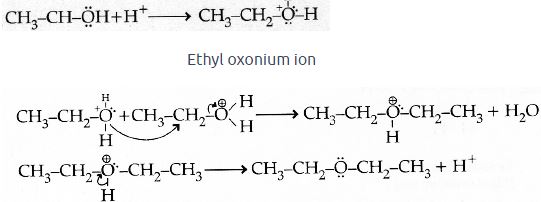
(i) Give mechanism of preparation of ethoxy ethane from ethanol.
(ii) How is toluene obtained from phenol?
4.
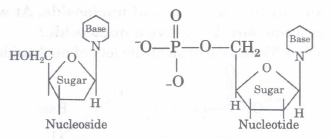
What is the difference between a nucleoside and a nucleotide ?
5.
Predict reaction of 1N sulphuric acid with : (i) Copper (ii) lead (iii) iron.
Given, \({ E }^{ 0 }_{ { Cu }^{ 2+ },/Cu }=-0.34\)volt, and \({ E }^{ 0 }_{ { Pb }^{ 2+ },/Pb }=-0.13\) volt, and \({ E }^{ 0 }_{ { Fe }^{ 2+ },/Fe }=-0.44\) volt
6.
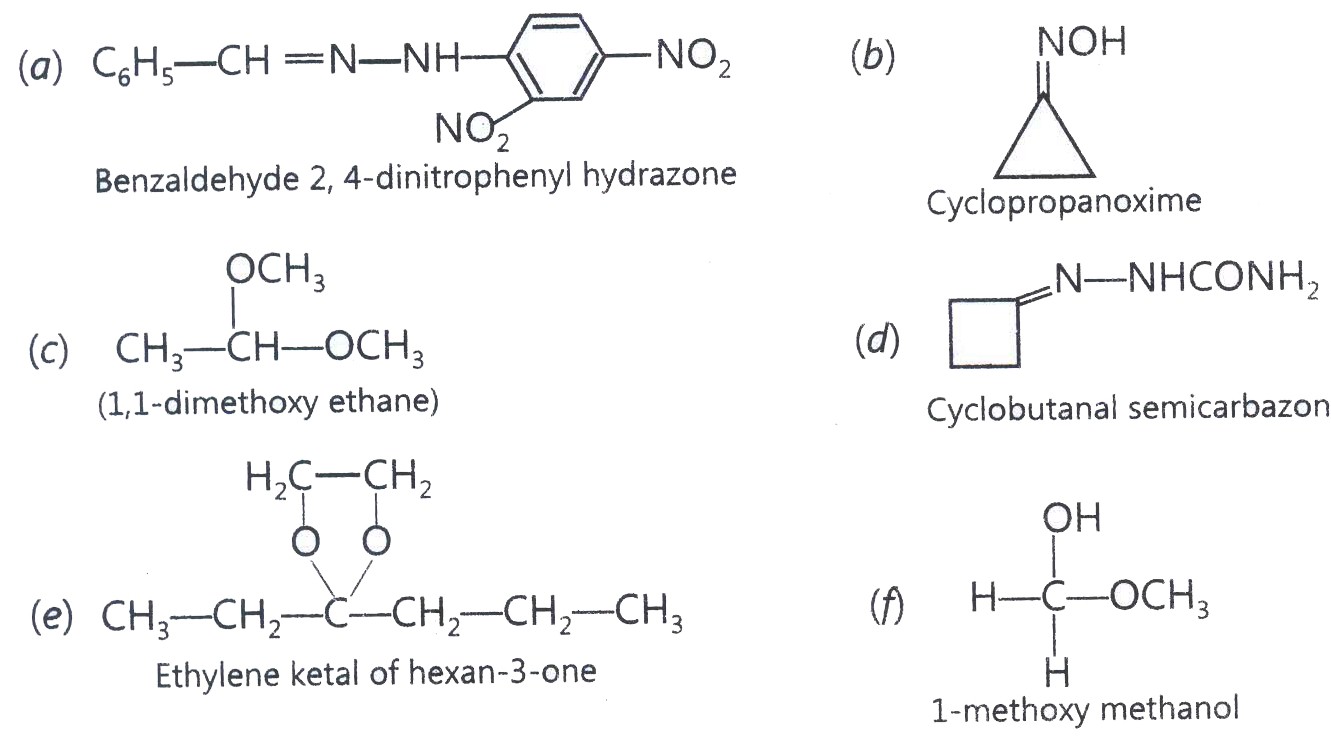
Draw structures of the following derivatives.
(a) The 2,4-dinitrophenylhydrazone of benzaldehyde
(b) Cyclopropanone oxime
(c) Acetaldehydedimethylacetal
(d) The semicarbazone of cyclobutanone
(e) The ethylene ketal of hexan-3-one
(f) The methyl hemiacetal of formaldehyde
7.
If N2 gas is bubbled through water at 293 K, how many millimoles of N2 gas would dissolve in 1 liter of water? Assume that N2 exerts a partial pressure of 0.987 bar. Given Henry's law constant for N2 at 293 K is 76.48 kbar.
8.
Write short notes on the following:
(i) Carbylamine reaction
(ii) Diazotisation
(iii) Hoffmann's bromamide reaction
(iv) Coupling reaction
(v) Ammonolysis
(vi) Acylation
(vii) Carbylamine reaction
9.
Using the standard electrode potentials, predict if the reaction between the following is feasible:
(i) Fe3+(aq) and I-(aq)
(ii) Ag+(aq) and Cu(s)
(iii) Fe3+(aq) and Br-(aq)
(iv) Ag(s) and Fe3+(aq)
(v) Br2(aq) and Fe2+(aq)
10.
(a) Given below are the electrode potential values, Eo for the some of the first row of transition elements:
| Element | EoM2+/M (V) |
|
V(23) Cr(24) Mn(25) Fe(26) Co(27) Ni(28) Cu(29) |
-1.18 -0.91 -1.18 -0.44 -0.28 -0.25 +0.34 |
Explain the irregularities in these values on the basis of electronic structures of atoms.
(b) Complete the following reaction equations:
(i) Cr2O72-+Sn2++H+\(\longrightarrow \)
(ii) MnO4-+Fe2++H+\(\longrightarrow \)
11.
Which of the following statements are correct about the reaction intermediate?
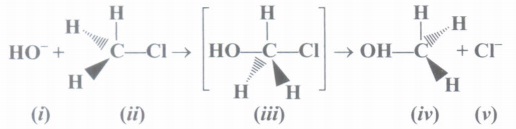
Intermediate (iii) is unstable because in this carbon is attached to 5 atoms
Intermediate (iii) is unstable because carbon atom is Sp2 hybridised.
Intermediate (iii) is stable because carbon atom is Sp2 hybridised.
Intermediate (iii) is less stable than the reactant (ii).
12.
Out of the following which one react with NaNO2 + HCl to form alcohol
C6H5NHCH3
(CH3)2NH
CH3NH2
C6H5NH
13.
Which of the following is the strongest acid?
CH3COOH
CICH2COOH
Cl2HCOOH
CI3C-COOH
14.
\(\alpha\) - Maltose consists of
one \(\alpha -D-\) glucopyranose unit and one \(\beta -D-\) glucopyranose unit by 1,2-glycosidic linkage
one \(\alpha -D-\) glucopyranose units with 1,2-glycosidic linkage
two \(\beta -D-\) glucopyranose units with 1, 4-glycosidic linkage
two \(\alpha -D-\)glucopyranose units with 1, 4-glycosidic linkage
15.
\(\alpha-D(+)-\)glucose and \(\beta-D(+)-\)glucose are
enatiomers
conformers
epimers
anomers
16.
Because of lanthanoid contraction, which of the following pairs of elements have nearly same atomic radii ? (Numbers in parenthesis are atomic numbers)
Zr (40) and Hf (72)
Zr (40) and Ta (73)
Ti (22) and Zr (40)
Zr (40) and Nb (41)
17.
Which of the following arrangements does not represent the correct order of the property stated against it ?
Sc<Ti<Cr<Mn : number of oxidation states
V2+<Cr2+<Mn2+<Fe2+ : paramagnetic behaviour.
Ni2+<Co2+<Fe2+<Mn2+ : ionic size
Co3+<Fe3+<Cr3+<Sc3+ : stability in aqueous solution
18.
CH3CHO and C6H5CH2 can be distinguished chemically by
Benedict's rect
Iodoform test
Tollens'reagent test
Fehling's solution test
19.
In a reaction, RCHO is reduced to RCH3 using amalgamated zinc and concentrated HCl and warming the solution. The reaction is known as
Meerwein-Ponndorf reaction
Clemmensen reduction
Wolff-Kishner reduction
Schiff's reaction
20.
Alkyl fluorides are synthesised by heating an alkyl chloride/bromide in presence of ............. or ..............
CaF2
CoF2
Hg2F2
NaF
21.
When EDTA solution is added to Mg2+ ion solution, then which of the following statements is not true?
Four coordinate sites of Mg2+ are occupied by EDTA and remaining two sites are occupied by water molecules
All six coordinate sites of Mg2+ are occupied
pH of the solution is decreased
Colourless [Mg-EDTA]2- chelate is formed.
22.
CH3OC2H5 and (CH3)3 COCH3 are treated with hydriodic acid. The fragments after reactions obtaind are:
CH3I+HOC2H5 ; (CH3)3C-I+HOCH3
CH3HO+C2H5I; (CH3)3C-I+HOCH3
CH3OH+C2H5I; (CH3)3C-OH+CH3I
CH3I+HOC2H5; CH3I+(CH3)3C-O H
23.
A hydrogen gas electrode is made by dipping platinum wire in a solution of HCl of pH = 10 and by passing hydrogen gas around the platinum wire at one atm pressure. The oxidation potential of the electrode would be
0.059 V
0.59 V
0.118 V
1.18 V
24.
The correct increasing order of reactivity of halides for SN2 reaction is
CH3CH2X < (CH3)2CHX < CH2 = CHCH2X < PhCH2X
(CH3)2CHX < CH3CH2X < CH2 =CHCH2X < PhCH2X
PhCH2X < (CH3)2CHX < CH3CH2X <CH2 = CHCH2X
CH2 = CHCH2X < PhCH2X < (CH3)2CHX < CH3CH2X
25.
The activation energy of a reaction can be determined from the slope of which of the following graph ?
In k vs \(\frac {1}{T}\)
\(\frac {T}{In k} vs \frac {1}{T}\)
In k vs T
\(\frac {In k} {T}\) vs T
26.
Time required for 100 percent completion of a zero order reaction is
\(\frac {2k}{a}\)
\(\frac {a}{2k}\)
\(\frac {a}{k}\)
a k
27.
Write two main functions of carbohydrates in plants.
28.
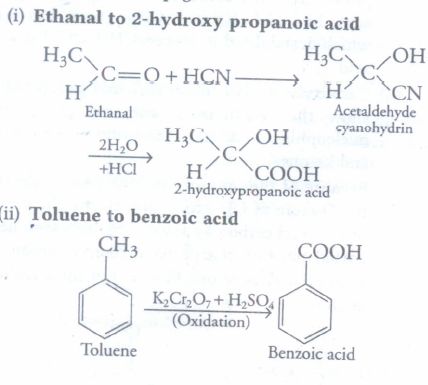
How will you convert the following?
(i) Ethanal to 2-hydroxy propanoic acid
(ii) Toluene to benzoic acid
29.
The spin only magnetic moment of [MnBr4]2- is 5.9 BM. Predict the geometry of the complex ion.
30.
While separating a mixture of ortho-and para-nitrophenols by steam distillation, name the isomer which will be steam volatile? Give reasons.
31.
Radioactive disntegration is a first order reaction. Explain why.
32.
Read the passage given below and answer the following questions:
The concentration of a solute is very important in studying chemical reactions because it determines how often molecules collide in solution and thus indirectly determine the rate of reactions and the conditions at equilibrium.
There are several ways to express the amount of solute present in a solution. The concentration of a solution is a measure of the amount of solute that has been dissolved in a given amount of solvent or solution. Concentration can be expressed in terms of molarity, molality, parts per million, mass percentage, volume percentage, etc.
The following questions are multiple choice questions. Choose the most appropriate answer:
(i) The molarity (in mol L-1) of the given solution will be
| (a) 1.56 | (b) 1.89 | (c) 0.263 | (d) 1.44 |
(ii) Which of the following is correct relationship between mole fraction and molality?
| \(\text { (a) } x_{2}=\frac{m M_{1}}{1+m M_{1}}\) | \(\text { (b) } x_{2}=\frac{m M_{1}}{1-m M_{1}}\) |
| \(\text { (c) } x_{2}=\frac{1+m M_{1}}{m M_{1}}\) | \(\text { (d) } x_{2}=\frac{1-m M_{1}}{m M_{1}}\) |
(iii) Which of the following is temperature dependent?
| (a) Molarity | (b) Molality |
| (c) Mole fraction | (d) Mass percentage |
(iv) Which of the following is true for an aqueous solution of the solute in terms of concentration?
| (a) 1 M = 1 m | (b) 1M > 1m |
| (c) 1M < 1 m | (d) Cannot be predicted |
33.
Read the passage given below and answer the following questions:
For understanding the structure and bonding in transition metal complexes, the magnetic properties are very helpful. Low spin complexes are generally diamagnetic because of pairing of electrons, whereas high spin complexes are usually paramagnetic because of presence of unpaired electrons. Larger the number of unpaired electrons, stronger will be the paramagnetism. However magnetic behaviour of a complex can be confirmed from magnetic moment measurement. Magnetic moment \(\mu=\sqrt{n(n+2)} \text { B.M. }\)where n = number of unpaired electrons. Greater the number of unpaired electrons, more will be the magnetic moment.
In these questions ( i-iv), a statement of assertion followed by a statement of reason is given. Choose the correct answer out of the following choices.
(a) Assertion and reason both are correct statements and reason is correct explanation for assertion.
(b) Assertion and reason both are correct statements but reason is not correct explanation for assertion.
(c) Assertion is correct statement but reason is wrong statement.
(d) Assertion is wrong statement but reason is correct statement.
(i) Assertion: Both [Cr(H2O)6]2+ and [FeH2O)6]2+ have same magnetic moment.
Reason: Number of unpaired electrons in Cr2+ and Fe2+ are same.
(ii) Assertion: [Fe(H2O)5NO]SO4 is paramagnetic.
Reason: The Fe in [Fe(H2O)5NO]SO4 has three unpaired electrons.
(iii) Assertion: [Co(en)3]3+ is paramagnetic.
Reason: It is an inner orbital complex.
(iv) Assertion: [Ni(CN)4]2- is diamagnetic complex.
Reason: It involves dsl hybridisation and there is no unpaired electron.
1.
Dichloromethane has highest dipole moment among CH2Cl2, CHCl3 and CCl4. The decreasing order of dipole moments is CH2Cl2>CHCl3>CCl4. These molecules have tetrahedral geometry due to sp3 hybridization of carbon atom.In CCl4, the individual C−Cl bond dipoles cancel each other which results in zero dipole moment.
Hence, CCl4 is non polar.
2.
From Arrhenius equation, we obtain
\(\log \frac{k_{2}}{k_{1}}=\frac{E_{a}}{2.303 R}\left(\frac{T_{2}-T_{1}}{T_{1} T_{2}}\right)\)
Also, k1 = 4.5 × 10³ s−1
T1 = 273 + 10 = 283 K
k2 = 1.5 × 10⁴ s−1
Ea = 60 kJ mol−1 = 6.0 × 10⁴ J mol−1
Then,
\(\log \frac{1.5 \times 10^{4}}{4.5 \times 10^{3}}=\frac{6.0 \times 10^{4} \mathrm{Jmol}^{-1}}{2.303 \times 8.314 \mathrm{JK}^{-1} \mathrm{~mol}^{-1}}\left(\frac{T_{2}-283}{283 T_{2}}\right)\)
\(\Rightarrow 0.5229=3133.627\left(\frac{T_{2}-283}{283 T_{2}}\right)\)
\(\Rightarrow 0.0427 T_{2}=T_{2}-283\)
\(\Rightarrow 0.9528 T_{2}=283\)
\(\Rightarrow T_{2}=297.019 K \text { (approximately) }\)
= 297K
= 24º C
Hence, k would be 1.5 × 10⁴ s−1 at 24°C.
3.
4.
A nucleoside contains only two basic components of nucleic acids namely a pentose sugar and a nitrogenous base.
A nucleotide contains all the three basic components of nucleic acids namely a phosphoric acid group, a pentose sugar and a nitrogenous base.
5.
(i) No (ii) Yes (iii)Yes
6.
7.
The solubility of gas is related to the mole fraction in aqueous solution. The mole fraction of the gas in the solution is calculated by applying Henry’s law. Thus:
\(x(\text { Nitrogen })=\frac{p \text { (nitrogen) }}{K_{\mathrm{H}}}=\frac{0.987 \mathrm{bar}}{76,480 \mathrm{bar}}=1.29 \times 10^{-5}\)
As 1 litre of water contains 55.5 mol of it, therefore if n represents number of moles of N2 in solution,
\(x(\text { Nitrogen })=\frac{n \text { mol }}{n \text { mol }+55.5 \text { mol }}=\frac{n}{55.5}=1.29 \times 10^{-5}\)
(n in denominator is neglected as it is < < 55.5)
Thus n = 1.29 × 10⁻⁵ \(\times\) 55.5 mol = 7.16\(\times\) 10–4 mol
\(=\frac{7.16 \times 10^{-4} \mathrm{~mol} \times 1000 \mathrm{ \ mmol}}{1 \mathrm{~mol}}=0.716 \mathrm{ \ mmol}\)
8.
(i) Carbylamine Reaction: When primary amne reacts with CHCl3 and KOH, it forms isocyanide which is an offensive smelling compund.
\(RN{ H }_{ 2 }+CHC{ l }_{ 3 }+3KOH\rightarrow RN\overset { = }{ \rightarrow } C+3KCl+3{ H }_{ 2 }O\)
(ii) Diazotisation: When aniline is reacted with NaNO2 and conc. HCl at 0-5o C, benzene diazonium chloride is formed.

(iii) Hoffman's Bromamide Reaction: When amide react with Br2 and KOH or NaOH to form lower amines, it is called Hoffman's Bromamide Reaction.

(iv) Coupling reaction: When benzene diazonium chloride reacts with phenol, the orange azo dye is formed.

(v) Ammonolysis: When alkyl halide with an excess of NH3 primary amines are formed.
C2H5Cl+NH3 \(\rightarrow\)C2H5NH2+HCl
(vi)Carbylamine reaction (i) Carbylamine reaction When aliphatic/ aromatic primary amines are heated with chloroform and alc KOH, foul-smelling alkyl isocyanides or carbylamines are obtained. Secondary or tertiary amines do not give this test.
(vii) \(\mathbf{P h}-\mathbf{N H}_{2}+\mathbf{C H C l}_{3}+3 \mathbf{K} \mathbf{O H} \stackrel{\Delta}{\longrightarrow} \mathbf{P h}-\mathbf{N C}+3 \mathbf{K} \mathbf{C l}+\mathbf{3 H}_{2} \mathbf{O}\)
2 ° and 3 ° (aromatic/aliphatic) do not give this reaction.
9.
(i) \(2Fe^{3+}+2I^-\longrightarrow2Fe^{2+}+I_2\)
\(E^0_{cell}=E^0_{I_2/ I^-}-E^0_{Fe^{3+}/Few^{2+}}=0.54 V - (0.77 V) = 0.54 V - 0.11 v = - 0.23 V\)
It is not feasible therefore E0cell is -ve ΔGo = +ve
(ii) 2Ag+(aq) + Cu(s) ⟶ Cu2+(aq) + Ag(s)
\(E^0_{cell} = E^0_{Ag^+/Ag} -E^0_{Cu^{2+}/Cu} = +0.80 V - 0.34 V = 0.46 V\)
It is feasible because E0cell is +ve
∴ ΔG0 = - ve
(iii) 2Fe3+(aq) + 2Br-(aq) ⟶ 2Fe2+(aq) + Br2'
\(E^0_{cell} = E^0_{Fe^{3+}/Fe^{2+}}- E^0_{Br_2/Br^-} = 0.77 V - 1.09 V = - 0.32 V\)
Since E0cell is -ve, ΔGo = +ve therefore, reaction is non spontaneous.
(iv) Ag(s) + Fe3+(aq) ⟶ Fe2+(aq) + Ag+(aq)
\(E^0_{cell} = E^0 _{Fe^{3+}/Fe^{2+}}-E^0_{Ag^+/Ag} = 0.77 V - 0.80 V = - 0.03 V\)
since E0cell is -ve, ΔGo is +ve therefore, reaction is non spontaneous.
(v) Br2 + 2Fe2+(aq) ⟶ 2Br-(aq) + 2Fe3+(aq)
\(E^0_{cell} = E^0_{Br^2/Br^-} E^0_{Fe^{3+}/Fe^{2+}}=1.09 V - 0.77 V = 0.32 V\)
Since E0cell is +ve, ΔGo = -ve, therefore, reaction will be spontaneous.
10.
(a) It is due to irregular variations in sum of first and second ionisation energies and sublimation energies. It is also due to stability of electronic configuration.
(b) (i) Cr2O72- + 3Sn2+ + 14H+➝ 2Cr3+ + 3Sn4+ + 7H2O
(ii) MnO4- + 5Fe2+ + 8H+ ➝ SFe3+ + Mn2+ + 4H2O
11.
(a)
Intermediate (iii) is unstable because in this carbon is attached to 5 atoms
12.
(c)
CH3NH2
13.
(d)
CI3C-COOH
14.
(d)
two \(\alpha -D-\)glucopyranose units with 1, 4-glycosidic linkage
15.
(d)
anomers
16.
(a)
Zr (40) and Hf (72)
17.
(b)
V2+<Cr2+<Mn2+<Fe2+ : paramagnetic behaviour.
18.
(b)
Iodoform test
19.
(b)
Clemmensen reduction
20.
(b)
CoF2
21.
(a)
Four coordinate sites of Mg2+ are occupied by EDTA and remaining two sites are occupied by water molecules
22.
(a) CH3OC2H5 undergoes cleavage by SN2 mechanism to give CH3I and C2H5OH while (CH3)3COCH3 undergoes cleavage by SN1 mechanism to give (CH3)3CI and CH3OH.
23.
(b)
0.59 V
24.
(d)
CH2 = CHCH2X < PhCH2X < (CH3)2CHX < CH3CH2X
25.
(a)
In k vs \(\frac {1}{T}\)
26.
(c)
\(\frac {a}{k}\)
27.
Carbohydrates are the source of energy in plants. Their two main functions are growth and metabolism.
28.
29.
Since the coordination number of Mn2+ ion in the complex ion is 4, it will be either tetrahedral (sp3 hybridisation) or square planar (dsp2 hybridisation). But the fact that the magnetic moment of the complex ion is 5.9 BM, it should be tetrahedral in shape rather than square planar because of the presence of five unpaired electrons in the d orbitals.
30.
o-Nitrophenol is steam-volatile due to chelation (intramolecular H-bonding) and hence can be separated by steam distillation from p-nitrophenol which is not steam volatile because of intermolecular H-bonding.
31.
The rate of disinetegration of a radioactive substance is directly proportional to amount of the substance present. Hence, it is a reaction of first order.
32.
(i) (d) : Density of solution = 1.202 g/mL
Volume of solution = \(\frac{100 \mathrm{~g}}{1.202 \mathrm{~g} / \mathrm{mL}}=83.2 \mathrm{~mL}\)
Molarity = \(\frac{n_{\mathrm{KI}}}{\text { Volume of solution in } \mathrm{L}}\)
\(=\frac{0.120 \mathrm{~mol}}{0.0832 \mathrm{~L}}=1.4423 \mathrm{~mol} \mathrm{~L}^{-1}\)
(ii) (a): \(x_{2}=\frac{n_{2}}{n_{1}+n_{2}} ; x_{1}=\frac{n_{1}}{n_{1}+n_{2}} ; \frac{x_{2}}{x_{1}}=\frac{n_{2}}{n_{1}}\)
\(\frac{x_{2}}{x_{1}}=\frac{m_{2} / M_{2}}{m_{1} / M_{1}}=\frac{m_{2}}{m_{1}} \times \frac{M_{1}}{M_{2}}\) ...(i)
Molality = \(\frac{n_{2}}{m_{1}}=\frac{m_{2}}{M_{2} \times m_{1}}\) ...(ii)
From(i) and (ii), m = \(\frac{x_{2}}{x_{1}} \times \frac{1}{M_{1}} ; x_{1}=1-x_{2}\)
Hence. x2 = \(\frac{m M_{1}}{1+m M_{1}}\)
(iii) (a) : Mass does not depend on temperature while volume does. Hence, molarity depends on temperature.
(iv) (b): 1M solution contains 1 mole of solute in less than 1000 g of the solvent whereas 1 m solution has 1 mole of the solute in 1000 g of the solvent.
33.
(i) (a): Spin only magnetic moment, \(\mu=\sqrt{n(n+2)} \text { B.M. }\) where n = number of unpaired electrons.
As the number of unpaired electrons in Cr2+ ([Ar ]3d4) and Fe2+([Ar]3d6) are same, hence [Cr(H2O)6]2+ and [Fe(H2O)6]2+ will have same magnetic moment.
(ii) (a): Fe+ : [Ar] 3d6 4s1
When the weak field ligand H2O and strong field ligand NO+ attack, the configuration changes as follows: Fe+ : [Ar] 3d7 4s°
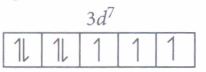
ஃ Fe+ has 3 unpaired electrons.

In presence of strong ethylenediamine ligand the electrons get paired.
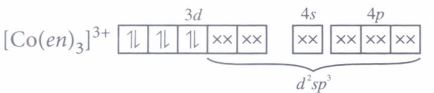
Thus inner orbital complex with no unpaired electrons.
(iv) (a)

12th Standard CBSE Syllabus & Materials
12th Standard CBSE
CBSE 12th Computer Science Python Revision Tour I - New Previous year Question Papers Study Material - QB365 Set A
NEW12th Standard CBSE
CBSE 12th Business Studies Planning Important Questions And Answers Study Material - QB365 Set A
NEW12th Standard CBSE
CBSE 12th Business Studies Business Environment Important Questions And Answers Study Material - QB365 Set A
NEW12th Standard CBSE
CBSE 12th Business Studies Principles of Management Important Questions And Answers Study Material - QB365 Set A



NCERT Books

Syllabus

Exam Pattern

Sample Question Papers

Previous year Question Papers

Important Notes

MCQ Practice test

NCERT Exemplers

Case study Questions

Image Based Questions

Passage based Questions

HOT Questions

Value Based Questions

Model Questions Papers
NCERT ( Book Back ) Questions

Assertion and Reason
Important Questions And Answers

CBSE 12th Standard CBSE Subjects
CBSE Standards








