
 100% FREE ACCESS
12th Standard CBSE Syllabus & Materials
12th Standard CBSE
CBSE 12th Economics Government Budget and the Economy Previous year Question Papers Study Material - QB365 Set A
NEW12th Standard CBSE
CBSE 12th Computer Science Interface Python with MySQL - New Previous year Question Papers Study Material - QB365 Set A
NEW12th Standard CBSE
CBSE 12th Computer Science Database Concept - New Previous year Question Papers Study Material - QB365 Set A
NEW12th Standard CBSE
CBSE 12th Computer Science Data Communication - New Previous year Question Papers Study Material - QB365 Set A
NEW12th Standard CBSE
CBSE 12th Computer Science Data Structures - New Previous year Question Papers Study Material - QB365 Set A
NEW12th Standard CBSE
CBSE 12th Computer Science Functions - New Previous year Question Papers Study Material - QB365 Set A

Published on: 25/10/2025
Download CBSE Class 12th Standard CBSE Chemistry question papers, sample papers, important questions, and previous year solved papers in PDF format. Get free study materials, NCERT solutions, and exam preparation resources for Class 12th Standard CBSE Chemistry
Questions + Answers key
Take MCQ Chemistry Test
1.
Give two applications of RNA
2.
Write an important factor on which the crystal field splitting depends.
3.
Which isomer of \([CoCl_2(en)_2]^+\) does not show optical isomersm ?
4.
How will you distinguish between the following pairs by chemical reactions?
(i) CH3OH and C2H5OH
(ii) Phenol and methanol
(iii) 1-Propanol and 2-methyl-2-propanol
(iv) Ethanol and 1-Propanol?
5.
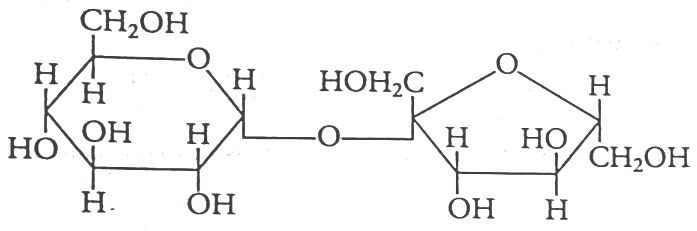
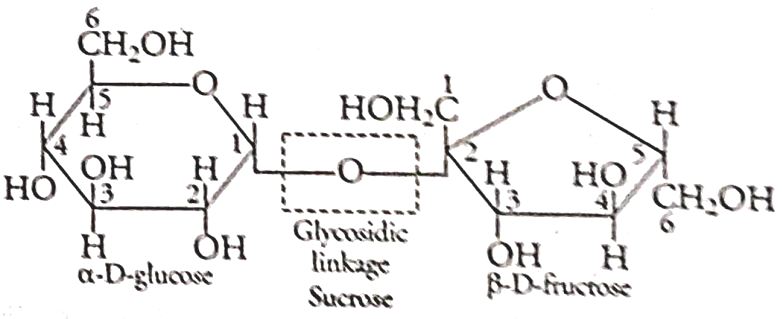
Label the glucose and fructose units in the following disaccharide and identify anomeric carbons atoms in these units. Is the sugar reducing in nature? Explain.
6.
Proteins found in a biological system with a unique three-dimensional structure and biological activity is called a native protein. When a protein in its native form, is subjected to a physical change like change in temperature or a chemical change like, change in pH, denaturation of protein takes place. Explain the cause.
7.
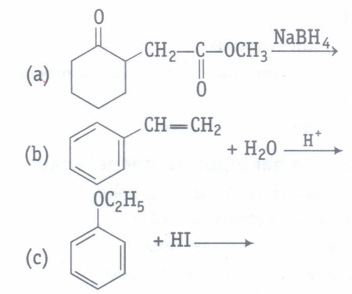
Write the structures of the main products in the following reactions:
8.
Answer the following queries about proteins:
(i) How are proteins related to amino acids?
(ii) How are oligopeptides different from polypeptides?
(iii) When is a protein said to be denaturated?
9.
Name the reagents used in the following reactions:
(i) Benzyl alcohol to benzoic acid.
(ii) Dehydration of propan-2-ol to propene.
(iii) Butan-2-one to butan-2-ol.
10.
\(\alpha\)-D-glucose and \(\beta\)-D-glucose differ from each other with respect to the
number of -OH groups
configuration at the C-1 carbon
size of the hemiacetal ring
configuration at the C-5 carbon
11.
Deficiency of vitamin B, causes the disease
convulsions
beri beri
cheilosis
sterility
12.
Chargaff's rule that in an organism.
Amount of adenine (A) is equal to that of thymine (T) and the amount of guanine (G) is equal to that of cytosine (C)
Amount of adenine (A) is equal to that of guanine (G) and the amount of thymine (T) is equal to that of cytosine (C)
Amount of adenine (A) is equal to that of cytosine (C) and the amount of thymine (T) is equal to that of guanine (G).
Amounts of all bases are equal.
13.
Subunits present in haemoglobin are:
2
3
4
5
14.
Which one of the following is not expected to undergo iodoform reaction?
Propan-2-ol
1-Phenylethanol
2-Butanol
Ethanol
Diphenylmethanol
15.
Consider the following reaction, ethanol \(\overset{PCl_5}\longrightarrow\) X \(\overset{alc.KOH}\longrightarrow\) Y \(\overset{H_2SO_4}{\underset {(ii)H_2O,room temperature}{\longrightarrow}}\) Z The product Z is:
CH3CH2 - O - CH2CH3
CH3CH2 - O-SO3H
CH3CH2OH
CH2 = CH2
16.
How many EDTA (ethylenediaminetetraacetic acid) molecules are required to make an octahedral complex with a Ca2+ ion?
One
Two
Six
Three
17.
CH3OC2H5 and (CH3)3 COCH3 are treated with hydriodic acid. The fragments after reactions obtaind are:
CH3I+HOC2H5 ; (CH3)3C-I+HOCH3
CH3HO+C2H5I; (CH3)3C-I+HOCH3
CH3OH+C2H5I; (CH3)3C-OH+CH3I
CH3I+HOC2H5; CH3I+(CH3)3C-O H
18.
Among the following complexes (K-P) K3[Fe(CN)6] (K), [Co(NH3)6]Cl3 (L), Na3[Co(oxalate)3](M), [Ni(H2O)6]Cl2 (N), K2[Pt(CN)4] (O) and [Zn(H2O)6] (NO3)2 (P) the diamagnetic complexes are
K, L, M, N
K, M, O, P
L, M, O, P
L, M, N, O
19.
Square planar complexes of the type MABXL (where A, B, X and L are unidentates) show
two cis and one trans isomer
two trans and one cis isomer
two cis and two trans isomers
one cis and one trans isomer
20.
A compound A (C6H12O6) is oxidised by bromine witer into monobasic acid. It also reduces Tollen's reagent and reacts with HCN to give a compound B which on hydrolysis gives a compound C. On treating C with HI/red P, n-heptanoic acid is obtained. Compound A on treatment with excess phenyl hydrazine gave D-glucoszone. Name the compound A and draw its cyclic from.
21.
Write equation of the following reactions.
(i) Friedel-Crafts reaction (alkylation in anisole)
(ii) Nitration of anisole
(iii) Bromination of anisole in ethanoic acid medium
(iv) Friedel-Crafts (acetylation of anisole)
22.
Just like human beings, plants also need various nutrients for their healthy growth. Iron is one of these. The deficiency of iron results in disorder known as iron chlorosis. It appears in the form of yellow leaves. It adversely affect the yield of fruits from citrus trees.
(i) In which oxidation state is iron generally present in the soil?
(ii) Why is iron hydroxide not assimilated in the soil?
(ill) Which complex of iron is readily absorbed by soil?
(iv) What can you suggest to stop the adverse effect of iron deficiency?
23.
Using valence bond theory, explain the following in relation to the complexes given below :
\([Mn(CN)_6]^{3-}, [Co(NH_3)_6]^{3+}, [Cr(H_2O)_6]^{3+}, [FeCl_6]^{4-}\)
(i) Type of hybridisation
(ii) Inner or outer orbital complex.
(iii) Magnetic behaviour.
(iv) Spin only magnetic moment value.
24.
Glucose is an aldohexose. It can occur freely as well as in combined form in the nature. It is present in sweet fruits and honey. It is also present in quantities in ripe grapes. As glucose is an aldohexose, it consists of six C-atoms and an aldehyde group. It is the most abundant organic compound on the earth and used as an immediate source of energy for all metabolic reactions in the animals.
It was found that glucose forms a six membered ring in which -OH at C-5 is involved in the ring formation.The cyclic six membered structure of glucose is known as pyranose structure. It is analogous to pyran which is a cyclic organic compound with one oxygen atom and five carbon atoms in the ring.
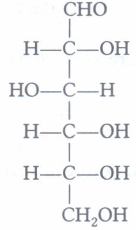
Write the structure of open-chain glucose.
25.
26.
Read the passage given below and answer the following questions:
For understanding the structure and bonding in transition metal complexes, the magnetic properties are very helpful. Low spin complexes are generally diamagnetic because of pairing of electrons, whereas high spin complexes are usually paramagnetic because of presence of unpaired electrons. Larger the number of unpaired electrons, stronger will be the paramagnetism. However magnetic behaviour of a complex can be confirmed from magnetic moment measurement. Magnetic moment \(\mu=\sqrt{n(n+2)} \text { B.M. }\)where n = number of unpaired electrons. Greater the number of unpaired electrons, more will be the magnetic moment.
In these questions ( i-iv), a statement of assertion followed by a statement of reason is given. Choose the correct answer out of the following choices.
(a) Assertion and reason both are correct statements and reason is correct explanation for assertion.
(b) Assertion and reason both are correct statements but reason is not correct explanation for assertion.
(c) Assertion is correct statement but reason is wrong statement.
(d) Assertion is wrong statement but reason is correct statement.
(i) Assertion: Both [Cr(H2O)6]2+ and [FeH2O)6]2+ have same magnetic moment.
Reason: Number of unpaired electrons in Cr2+ and Fe2+ are same.
(ii) Assertion: [Fe(H2O)5NO]SO4 is paramagnetic.
Reason: The Fe in [Fe(H2O)5NO]SO4 has three unpaired electrons.
(iii) Assertion: [Co(en)3]3+ is paramagnetic.
Reason: It is an inner orbital complex.
(iv) Assertion: [Ni(CN)4]2- is diamagnetic complex.
Reason: It involves dsl hybridisation and there is no unpaired electron.
27.
In the following question a statement of assertion followed by a statement of reasons is given. Choose the correct answer out of the following choices.
Assertion: [Cr(H2O)6]Cl2 and [Fe(H2O)6]Cl2 are reducing in nature.
Reasons: Unpaired electrons are present in their d-orbitals.
Codes:
(a) Assertion and reason both are true, reason is correct explanation of assertion.
(b) Assertion and reason both are true but reason is not the correct explanation of assertion.
(c) Assertion is true, reason is false.
(d) Assertion is false, reason is true.
28.
In the following questions a statement of ass6rtion followed by a statement of reason is given. Choose the correct answer out of the following choices.
Assertion: Toxic metal ions are removed by the chelating ligand.
Reason: Chelate complexes tend to be more stable
Codes:
(a) Assertion and reason both are true, reason is correct explanation of assertion.
(b) Assertion and reason both are true but reason is not the correct explanation of assertion.
(c) Assertion is true, reason is false.
1.
(i) It helps in biosynthesis of proteins.
(ii) It is associated with the process of learning and memory stage.
2.
Crystal field spliting depends upon the field produced by the ligand and charge on the metal ion.
3.
Trans isomer does not show optical isomerism.
4.
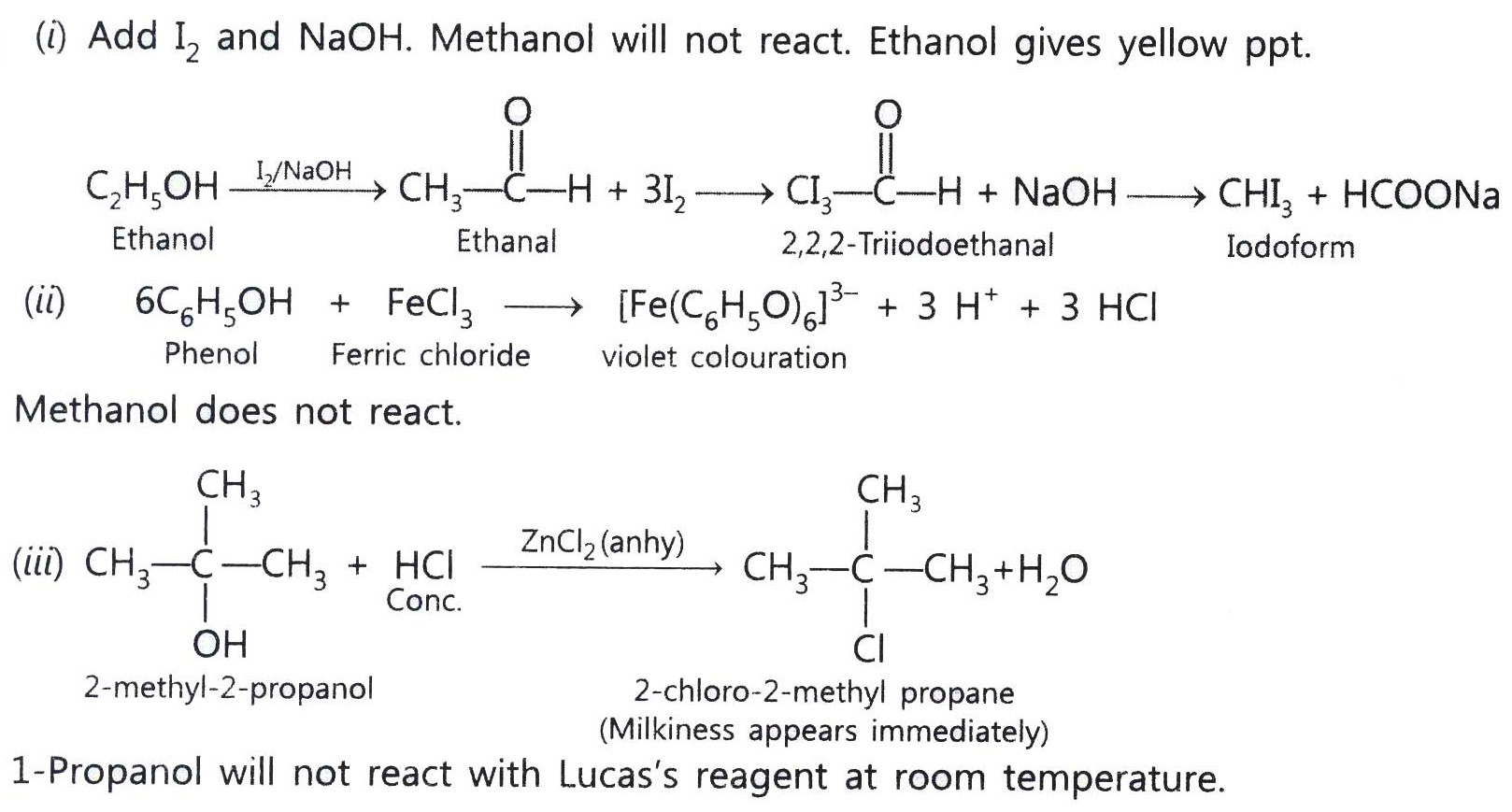

1-Propanol will not react with I2/NaOH to give iodoform.
5.
C-1 of glucose unit and C-2 of fructose unit are anomeric carbon atoms in the given disaccharide. The disaccharide is non-reducing sugar because -OH groups attached to anomeric carbon atoms are involved in the formation of glycosidic bond.
6.
Due to physical and chemical change, hydrogen bonds in proteins are disturbed. Due is this globules unfold and helix gets uncoiled and therefore, protein loses its biological activty. This is known as denaturation of proteins.
7.
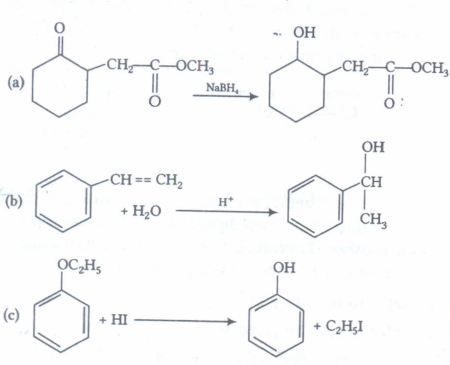
8.
(i) Proteins are biopolymers of amino acids which condense together forming peptide bonds.
(ii) Oligopeptides on hydrolysis give 3 to 12 \(\alpha \)-amino acids, where as polypeptides give large number of \(\alpha \)-amino acids on hydrolysis.
(iiI) When tertiary structure of protein is ruptured by,protein pH or on heating, protein is said to be denatured.It lose its biological activity.
9.
(i) KMnO4/dil.H2So4. (acidified KMnO4)
(ii) Conc. H2SO4 at 443 K
(iii) LiAlH4
10.
(b)
configuration at the C-1 carbon
11.
(b)
beri beri
12.
(a)
Amount of adenine (A) is equal to that of thymine (T) and the amount of guanine (G) is equal to that of cytosine (C)
13.
(c)
4
14.
(e)
Diphenylmethanol
15.
(c)
CH3CH2OH
16.
(a)
One
17.
(a) CH3OC2H5 undergoes cleavage by SN2 mechanism to give CH3I and C2H5OH while (CH3)3COCH3 undergoes cleavage by SN1 mechanism to give (CH3)3CI and CH3OH.
18.
(c)
L, M, O, P
19.
(a)
two cis and one trans isomer
20.
cyclic from of glucose (A)
21.
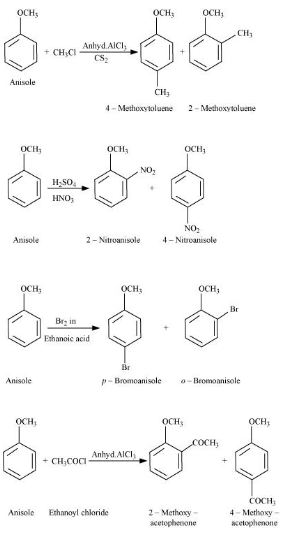
22.
(i) Iron is present in + 3 oxidation state as Fe (III).
(ii) Iron hydroxide i.e., Fe(OH)3 is insoluble in water and is therefore, not assimilated in the soil.
(iii) Fe(III)-EDTA complex is readily absorbed by the soil as it is water soluble.
(iv) The addition of this complex compound in proper amount makes plants healthy and the yield of fruits gets increased. But its deficiency also affect adversely so we will provide Fe-EDTA complex.
23.
\([Mn(CN)_6]^{3-}\)
d2sp3, (ii) inner orbital complex, (iii) paramagnetic, (iv) 2.87 B.M.
(i) d2sp3 (ii) Inner orbital complex, (iii) diamagnetic, (iv) \(\mu=0\)
(i) d2sp3, (ii) Inner orbital complex, (iii) paramagnetic, (iv) 3.87 B.M.
(i) sp3d2, (ii) outer orbital complex (iii) paramagnetic (iv) 4.9 B.M.
24.
Open chain strcuture of glucose is
25.
26.
(i) (a): Spin only magnetic moment, \(\mu=\sqrt{n(n+2)} \text { B.M. }\) where n = number of unpaired electrons.
As the number of unpaired electrons in Cr2+ ([Ar ]3d4) and Fe2+([Ar]3d6) are same, hence [Cr(H2O)6]2+ and [Fe(H2O)6]2+ will have same magnetic moment.
(ii) (a): Fe+ : [Ar] 3d6 4s1
When the weak field ligand H2O and strong field ligand NO+ attack, the configuration changes as follows: Fe+ : [Ar] 3d7 4s°
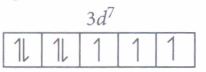
ஃ Fe+ has 3 unpaired electrons.

In presence of strong ethylenediamine ligand the electrons get paired.
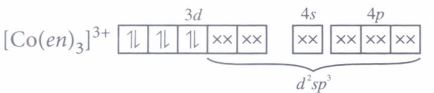
Thus inner orbital complex with no unpaired electrons.
(iv) (a)
27.
(b) Assertion and reason both are true but reason is not the correct explanation of assertion.
28.
(a) Assertion and reason both are true, reason is correct explanation of assertion.

12th Standard CBSE Syllabus & Materials
12th Standard CBSE
CBSE 12th Computer Science Python Revision Tour I - New Previous year Question Papers Study Material - QB365 Set A
NEW12th Standard CBSE
CBSE 12th Business Studies Planning Important Questions And Answers Study Material - QB365 Set A
NEW12th Standard CBSE
CBSE 12th Business Studies Business Environment Important Questions And Answers Study Material - QB365 Set A
NEW12th Standard CBSE
CBSE 12th Business Studies Principles of Management Important Questions And Answers Study Material - QB365 Set A



NCERT Books

Syllabus

Exam Pattern

Sample Question Papers

Previous year Question Papers

Important Notes

MCQ Practice test

NCERT Exemplers

Case study Questions

Image Based Questions

Passage based Questions

HOT Questions

Value Based Questions

Model Questions Papers
NCERT ( Book Back ) Questions

Assertion and Reason
Important Questions And Answers

CBSE 12th Standard CBSE Subjects
CBSE Standards








