
 100% FREE ACCESS
12th Standard CBSE Syllabus & Materials
12th Standard CBSE
CBSE 12th Economics Government Budget and the Economy Previous year Question Papers Study Material - QB365 Set A
NEW12th Standard CBSE
CBSE 12th Computer Science Interface Python with MySQL - New Previous year Question Papers Study Material - QB365 Set A
NEW12th Standard CBSE
CBSE 12th Computer Science Database Concept - New Previous year Question Papers Study Material - QB365 Set A
NEW12th Standard CBSE
CBSE 12th Computer Science Data Communication - New Previous year Question Papers Study Material - QB365 Set A
NEW12th Standard CBSE
CBSE 12th Computer Science Data Structures - New Previous year Question Papers Study Material - QB365 Set A
NEW12th Standard CBSE
CBSE 12th Computer Science Functions - New Previous year Question Papers Study Material - QB365 Set A

Published on: 25/10/2025
Download CBSE Class 12th Standard CBSE Chemistry question papers, sample papers, important questions, and previous year solved papers in PDF format. Get free study materials, NCERT solutions, and exam preparation resources for Class 12th Standard CBSE Chemistry
Questions + Answers key
Take MCQ Chemistry Test
1.
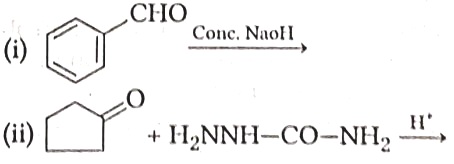
Write the products of the following reactions
2.
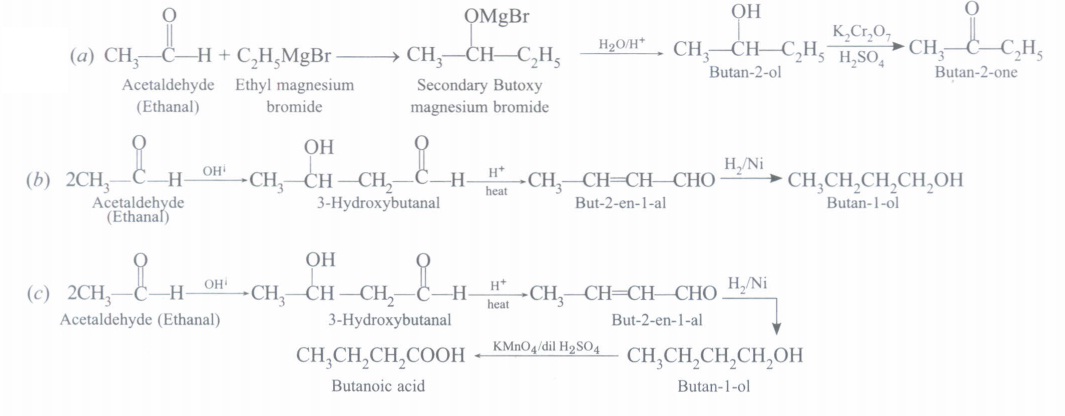
How will you convert ethanal into the following compounds?
(a) Butan-2-one
(b) Butan-J-ol
(c) Butanoic acid
3.
(a) For a reaction A + B⟶P, the rate is given by Rate = k[A] [B]2
(i) How is the rate of reaction affected if the concentration of 'B' is doubled?
(ii) What is the overall order of reaction if 'A' is present in large excess?
(b) A first order reaction takes 23.1 minutes for 50% completion. Calculate the time required for 75% completion of this reaction. log 2 = 0.301 log 3 = 0.4771, log 4 = 0.6021.
4.
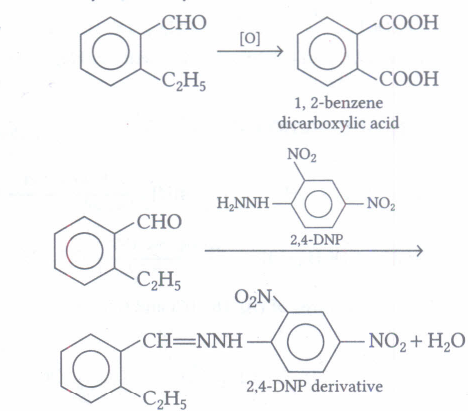
An organic compound with molecular formula C9H10O forms 2,4-DNP derivative, reduces Tollen's reagent and undergoes Cannizzaro's reaction.
On vigorous oxidation it gives 1,2-benzene dicarboxylic acid. Identify the compound.
5.
Express the rate of the following reaction in terms of different reactants and products:4NH3(g) + 5O2(g)\(\longrightarrow \)4NO(g) + 6H2O(g)
If the rate of formation of NO is 3.6\(\times\)10-3mol L-1s-1, Calculate
(i) the rate of disappearance of NH3
(ii) rate of formation of H2O.
6.
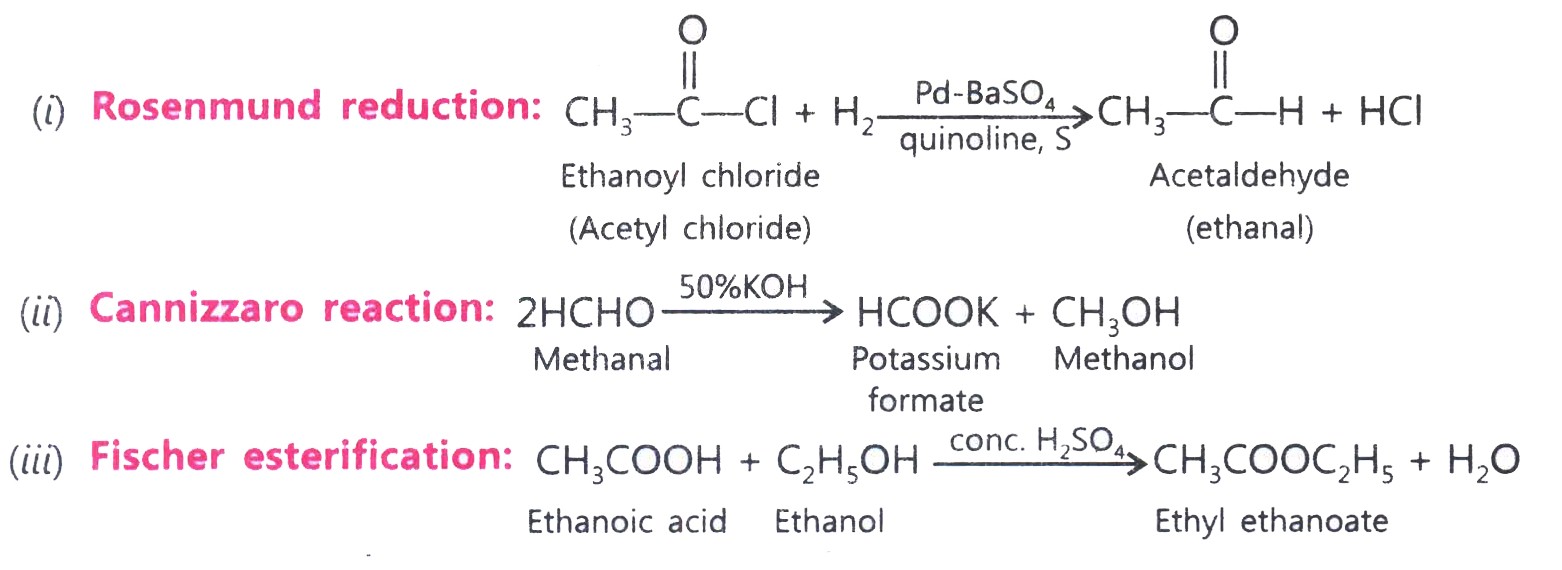
Write one chemical equation for each, to illustrate the following reactions:
(i) Rosenmund reduction
(ii) Cannizzaro reaction
(iii) Fischer esterification
7.
A first order reaction takes 100 minutes for completion of 60% of the reaction. Find the time when 90% of the reaction will be completed.
8.
For a first order reaction, show that time required for 99% completion is twice the time required for the completion of 90% of reaction
9.
For a general reaction A\(\rightarrow\) B, plot of concentration of A vs time is given in figure. Answer the following question on the basis of this graph.
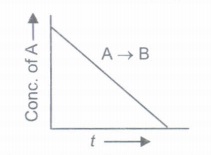
(i) What is the order of the reaction?
(ii) What is the slope of the curve?
(iii) What are the units of rate constant?
10.
Name the Regent you will use to convert allyl alcohol into propenal.
11.
What products will be formed on reaction of propanal with 2-methylpropanal in the presence of NaOH ?Write the name of reaction also.
12.
Write expression for rate of reactuion in terms of each reactant and product for the reaction
N2 + 3H2 \(\longrightarrow\) 2NH3.
13.
Arrange the following in increasing order of acidic character:
HCOOH, CICH2COOH, CF3COOH, CCl3COOH
14.
A reaction is of first order in reactant A and of second order in reactant B. How is the rate of this reaction affected when
(i) the concentration of B alone is increased to three times
(ii) the concentrations of A as well as B are doubled?
15.
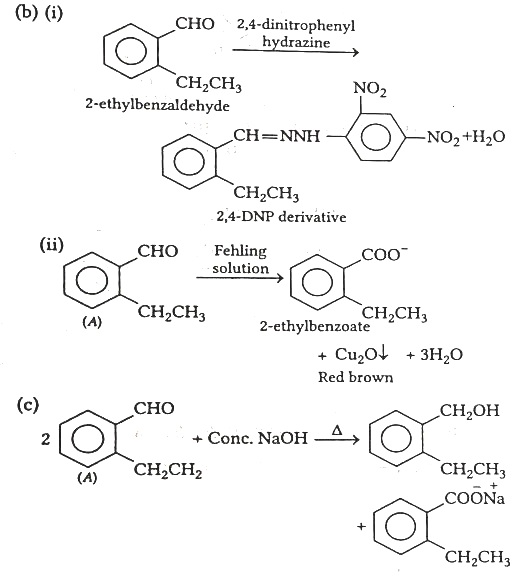
An organic compound (A) with the molecular formula C9H10O forms 2,4-DNP derivative, reduces Fehling solution and undergoes Cannizzaro reaction. On vigorous oxidation, it gives 1, 2-benzene dicarboxylic acid.
(a) Identify the compound (A) and write its IUPAC name
(b) Write the reaction of compound (A) with
(i) 2, 4-dinitrophenyl hydrazine and
(ii) Fehling solution
(c) Write the equation of compound (A) when it undergoes Cannizzaro reaction.
16.
(a) For the reaction 2N2O5(g) ⟶4NO2(g) +O2(g), the rate of formation of NO2(g) is 2.8 x 10- 3 Ms-1. Calculate the rate of disappearance of N2O5(g).
(b) The rate of a reaction increases four times when the temperature changes from 300 k to 320 K. Calculate the energy of activation of the reaction, assuming that it does not change with temperature.
17.
Give simple chemical tests to distinguish between the following pairs of compounds.
(i) Propanal and Propanone
(ii) Acetophenone and Benzophenone
(iii) Phenol and Benzoic acid
(iv) Benzoic acid and Ethyl benzoate
(v) Pentan-2-one and Pentan-3-one
(vi) Benzaldehyde and Acetophenone
(vii) Ethanal and Propanal
18.
Draw the structures of the following derivatives:
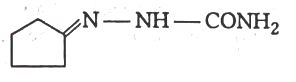
(i) Propanone oxime,
(ii) Semicarbazone of CH3HO.
(b) How will you convert ethanal into the following compounds? Give the chemical equations involved.
(i) \(CH_{ 3 }-CH_{ 2 }\)
(ii) \(CH_{ 3 }-CH\underset { \quad |\\ OH }{ CH } -{ CH }2_{ -CHO }\)
(iii) \(CH_{ 3 }CH_{ 2 }OH\)
19.
The half-life for decay of radioactive 14C is 5730 years. An archaeological artefact containing wood had only 80% of 14 C activity as found in a living tree. Calculate the age of the artefact
20.
(a) Explain the following terms:
(i) Order of a reaction
(ii) Molecularity of a reaction
(b) The rate of a reaction increases four times when the temperature changes from 300 k to 320 K. Calculate the energy of activation of the reaction, assuming that it does not change with temperature.
(R = 8.314 J K-1 mol-1)
21.
Consider Fig. and mark the correct option.
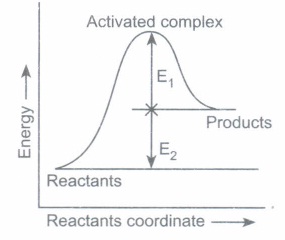
Activation energy of forward reaction is E1 + E2 and product is less stable than reactant.
Activation energy of forward reaction is E1 + E2 and product is more stable than reactant.
Activation energy of both forward and backward reaction is E1 + E2 and reactant is more stable than product.
Activation energy of backward reaction is E1 and product is more stable than reactant.
22.
In the first order reaction the concentration of reactant decreases from 0.6 M to 0.3 M in 30 minutes. The time taken for the concentration to change from 0.1 M to 0.025 M:
60 min
30 min
15 min
50 min
23.
Reagent(s) used for the reduction of aldehydes and ketones are
LiAlH4
NaBH4
Catalytic hydrogenation
All of these
24.
Ethyne + H2O  Product formed in the given reaction is
benzaldehyde
acetaldehyde
ethanoic acid
ethanoyl chloride
25.
Hydroxylamine reacts with
CH3COCI
CH3COCH3
CH3COOC2H5
CH3CONH2
26.
Methyl ketones are characterized through
Tollens' reagent
Iodoform test
Schiff's reagent
Fehling's solution
27.
The compound that does not undergo Cannizzaro reaction is
formaldehyde
acetaldehyde
benzaldehyde
trimethylacetaldehyde
28.
Which of the following organic compounds answers both iodoform test and Fehling's test?
Ethanal
Propanone
Ethanol
Methanol
29.
A catalyst
increases the average kinetic energy of the reacting molecules.
decreases the activation energy
alters the reaction mechanism
increaes the frequency of collision of the reacting species
30.
In a catalytic experiment involving Haber's process, N2 (g) + 3 H2 (g) \(\longrightarrow\) 2 NH2 (g), the rate of reaction was measured as : Rate = \(\frac { d[{ NH }_{ 3 }] }{ dt } \) = 2.0 \(\times 10 ^{-4} M s^{-1}\) . If there were no side reactions, what was the rate of reaction expressed in terms of N2 ?
1\(\times 10 ^{-4} s ^{-1}\)
4\(\times 10 ^{-4} s ^{-1}\)
5\(\times 10 ^{-4} s ^{-1}\)
1\(\times 10 ^{-4} s ^{-1}\)
31.
Which of the following statements are applicable to a balanced chemical equation of an elementary reaction ?
Order is same as molecularity
Order is less than the molecularity
Order is grater than the molecularity
Molecularity can never be zero.
32.
The unit of rate constant for a zero order reaction is
mol L-1 s-1
L mol-1 s-1
L2mol-1 s-1
s-1
33.
Assertion: Ketones are less reactive than aldehydes.
Reason: Ketones do not give Schiff’s test.
Codes:
(a) If both assertion and reason are true and the reason is the correct explanation of the assertion.
(b) If both assertion and reason are true but the reason is not the correct explanation of the assertion.
(c) If the assertion is true but the reason is false.
(d) If the assertion is false but the reason is true.
(e) If the assertion and reason both are false
34.
In the following questions a statement of assertion followed by a statement of reason is given.
Assertion: Rate constants determined from Arrhenius equation are fairly accurate for simple as well as complex molecules.
Reason: Reactant molecules undergo chemical change irrespective of their orientation during collision.
Codes:
(a) Both assertion and reason are correct and the reason is correct explanation of assertion.
(b) Both assertion and reason are correct but reason does not explain assertion.
(c) Assertion is correct but reason is incorrect,
(d) Both assertion and reason are incorrect.
(e) Assertion is incorrect but reason is correct.
35.
Assertion: Boiling point of aldehydes lie in between parent alkanes and corresponding alcohols.
Reason: Aldehydes cannot form intermolecular hydrogen bonds like alcohols.
Codes:
(a) Assertion and reason both are correct statements and reason is correct explanation for assertion.
(b) Assertion and reason both are correct statements but reason is not correct explanation for assertion.
(c) Assertion is correct statement but reason is wrong statement.
(d) Assertion is wrong statement but reason is correct statement.
36.
In the following questions. an Assertion (A) is followed by a corresponding Reason (R) Use the following keys to choose the appropriate answer.
Assertion (A) Some zero order reactions may have order in fractions.
Reason (R) Order cannot be determined from balanced chemical equation.
Codes:
(a) Both (A) and (R) are correct, (R) is the correct explanation of (A).
(b) Both (A) and (R) are correct, (R) is not the correct explanation of (A).
(c) (A) is correct; (R) is incorrect.
(d) (A) is incorrect; (R) is correct.
37.
Aldehydes, Ketones, Carboxylic acids and their derivatives are collectively called carboxyl compounds which are widely spread both in plants and animal kingdom. They play an important role in biological processes. They are responsible for fragrance and flavour of naturally occurring compounds e.g., Vanilline (from vanilla beans), salicylaldehyde (from meadowsweet), cinnamaldehyde (from cinnamon) and isoamyl acetate (from banana) have pleasant flavour.
Acetone and acetic acid are widely used as solvents. Various carboxylic acids are used to prepare drugs (Analgesics, antipyretics etc.).
(a) Convert benzaldehyde to Cinnamaldehyde?
(b) What is IUPAC name of 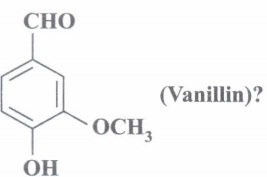
(c) Write the structural formula of Isoamyl acetate.
(d) What happens when 2 moles of acetone are condensed in presence of Ba(OH)2? Write chemical equation.
(e) What happens when acetic acid is heated with P2O5?
38.
Observe the following graphs and answer the questions based on these graphs.
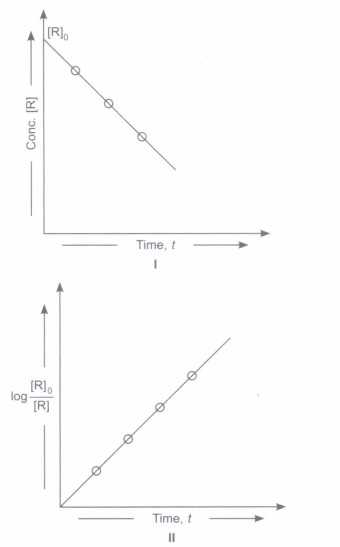
(a) What is order of reaction shown in graph I?
(b) What is slope in graph II?
(c) How does t1/2 varies with initial concentration in zero order reaction.
(d) If t1/2 of first order reaction is 40 minute, what will be t 99. 9 % for first order reaction?
(e) What is t1/2 of zero order reaction in terms of 'k'?
1.
(ii)
2.
3.
(i) The rate will become 4 times.
(ii) The overall order is equal to 2 if 'A' is in large excess.
(b) t1/2 = 23.1 min
\(k=\frac{2.303}{t_{1 / 2}} \log \frac{[R]_{0}}{[R]_{0} / 2}\)
\(\Rightarrow \ t_{1 / 2}=\frac{2.303}{k} \log 2\)
\(\Rightarrow \quad k=\frac{2.303}{23.1} \times 0.3010 \mathrm{~min}^{-1}\)
Also \(t_{75 \%}=\frac{2.303}{k} \log \frac{[R]_{0}}{[R]_{0} / 4}\)
\(=\frac{2.303 \times 23.1}{2.303 \times 0.3010} \log 4\)
\(\Rightarrow \ t_{75 \%}=\frac{23.1}{0.3010} \times 0.6021=46.2 \mathrm{~min}\)
4.
(i) As the given compound with molecular formula C9H10O, forms a 2,4-DNP derivative and reduces Tollen's reagent, thus it must be an aldehyde.
(ii) As it undergoes Cannizzaro reaction, hence -CHO group is directly attached to the benzene ring.
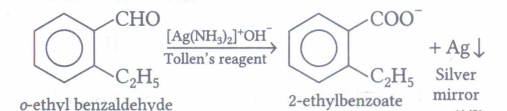
(iii) On vigorous oxidation, it gives 1,2-benzenedicarboxylic acid. Therefore, it must be an ortho-substituted benzaldehyde and the only o-substituted aromatic aldehyde which have C9H10O molecular formula is o-ethyl benzaldehyde.
Reactions involved
5.
5.4\(\times\)10-3mol L-1s-1
6.
7.
\(k={2.303\over t}log{[R]_0\over [R]}\)
\(={2.303\over 100}log{[R]_0\over {40\over 100}[R]_0}\)
[60% is complete, 40% is left]
\(k={2.303\over 100}(log5-log2)\)
\(k={2.303\over 100}(0.6990-0.3010)\)
\(k={2.303\over 100}\times0.3980\ min^{-1}\)
\(t_{90./.}={2.303\over k}log{[R]_0\over [R]}\)
[90% is complete, 10% is left]
\(t_{90./.}={2.303\over k}log{[R]_0\over {10\over 100}[R]_0}\)
\(={2.303\times100\over 2.303\times0.3980}log10\)
\(={100\over 0.3980}=251.26min\)
8.
For first order reaction, \(t=\frac { 2.303 }{ k } \log { \frac { a }{ a-x } } \)
99% completion means that x = 99% of a = 0.99 a
\({ t }_{ 99 }\%\)\(=\frac { 2.303 }{ k } \log { \frac { a }{ a-0.99a } } =\frac { 2.303 }{ k } \log { { 10 }^{ 2 } } =2\times \frac { 2.303 }{ k } \)
90% completion means that x = 90% of a = 0.90 a
\(\therefore \quad { t }_{ 90 }\%\)\(=\frac { 2.303 }{ k } \log { \frac { a }{ a-0.99a } } =\frac { 2.303 }{ k } \log { { 10 } } =2\times \frac { 2.303 }{ k } \)
\(\therefore \quad \frac { { t }_{ 99 } }{ { t }_{ 90 } } ={ \left( \frac { 2\times 2.303 }{ k } \right) }/{ \left( \frac { 2.303 }{ k } \right) }=2\quad \)\({ t }_{ 99 }\%\)\(=2\times { t }_{ 90 }\%\)
9.
(i) Order of reaction is zero
(ii) Slope = - k
(iii) mol L-1 s-1
10.
PCC(Pyridinium chlorochromate)
11.
Propanal and 2-methylpropanal both have a-hydrogens and hence can undergo cross aldol condensation in which each one of them can act either an electrophile or a nucleophile thereby giving two cross aldol products. Thus,
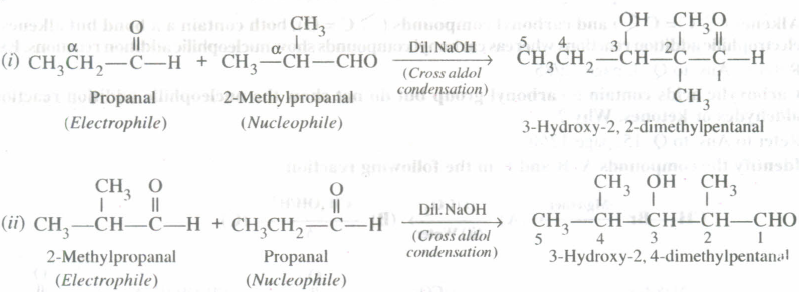
Besides, cross aldol condensation each aldehyde can also undergo selfot simple aldol condensation giving two self or simple aldol products.
.png)
12.
\(-\frac{d\left[N_2\right]}{d t}=\frac{1}{3} \frac{d\left[N_2\right]}{d t}=+\frac{1}{2} \frac{d\left[N H_3\right]}{d t}\)
13.
HCOOH < CICH2COOH < CCl3COOH < CF3COOH.
14.
\((i) \ Rate \ =k{ \left[ A \right] }^{ 1 }{ \left[ B \right] }^{ 2 }\)
\(Rate \ =k{ \left[ A \right] }{ \left[ 3B \right] }^{ 2 }\)
\(Rate \ =9k{ \left[ A \right] }{ \left[ B \right] }^{ 2 }\)
If concentration of 'B' alone increases three times, the rate will increase nine times.
(ii) If concentration of 'A' as well as 'B' is doubled, rate \(=k{ \left[ 2A \right] }^{ 1 }{ \left[ 2B \right] }^{ 2 }\), the rate will increase eight times.
So rate \(=k{ \left[ 2A \right] }^{ 1 }{ \left[ 2B \right] }^{ 2 }\).
15.
According to given information, the organic compound (A) with molecular formula C9H10O form 2-4 DNP derivative and also reduces Fehling solution. Hence, the compound (A) is an aldehyde.
Also, the compound (A) undergo Cannizzaro reaction hence, it does not contains an \(\alpha\)-H-atom. On vigorous oxidation, it gives 1,2-benzenedicarboxylic acid. That means, -CHO group is directly attached to benzene ring and the compound is ortho-disubstituted benzene.
(a) Therefore according to above information the compound (A) is 2-ethylbenzaldehyde.
16.
For the reaction \(2 \mathrm{~N}_{2} \mathrm{O}_{5}(\mathrm{~g}) \longrightarrow \mathrm{4NO}_{2}(\mathrm{~g})+\mathrm{O}_{2}(\mathrm{~g})\)
overall rate of reaction is
\( -\frac{1}{2} \frac{d\left[\mathrm{~N}_{2} \mathrm{O}_{5}\right]}{d t}=+\frac{1}{4} \frac{d\left[\mathrm{NO}_{2}\right]}{d t} \)
\(=+\frac{d\left[\mathrm{O}_{2}\right]}{d t} \)
Given,
\(\frac{d\left[\mathrm{NO}_{2}\right]}{d t}=2.8 \times 10^{-3} \mathrm{Ms}^{-1} \)
\(-\frac{d\left[\mathrm{~N}_{2} \mathrm{O}_{5}\right]}{d t}=? \)
\(-\frac{1}{2} \frac{d\left[\mathrm{~N}_{2} \mathrm{O}_{5}\right]}{d t}=\frac{1}{4} \frac{d\left[\mathrm{NO}_{2}\right]}{d t} \)
Putting the given values in the above equation. we get
\(\frac{-d\left[\mathrm{~N}_{2} \mathrm{O}_{5}\right]}{d t}=\frac{1}{4} \times 2 \times 2.8 \times 10^{-3} \mathrm{Ms}^{-1}\)
\(= 1.4 \times 10^{-3} \mathrm{Ms}^{-1} \)
(b)
\(\log { \frac { { k }_{ 2 } }{ { k }_{ 1 } } } =\frac { { E }_{ a } }{ 2.303R } \left( \frac { 1 }{ { T }_{ 1 } } -\frac { 1 }{ { T }_{ 2 } } \right)\)
\(\log { 4 } =\frac { { E }_{ a } }{ 2.303\times 8.314 } \left( \frac { 1 }{ 300 } -\frac { 1 }{ 320 } \right) \)
\({ E }_{ a }=\frac { 19.147\times 0.6021\times 300\times 320 }{ 20 }\)
\(\)= 55.336 KJ mol-1
17.
(i) Propanal and propanone :
Propanal gives silver mirror test with Tollen's reagent. Propanone does not gives this test.
Propanal gives red ppt with Fehlings solution but propanone does not give this test.
(ii) Acetophenone and Benzophenone :
Acetophenone gives yellow ppt of idoform with alkaline solution of iodine (iodoform test) and Benzophenone doe not give this test.
(iii) Phenol and Benzoic acid :
Phenol does not react with sodium hydrogen carbonate and benzoic acid gives effervescence of carbon dioxide gas upon reaction with sodium hydrogen carbonate.
Phenol gives violet colour with ferric chloride solution but benzoic acid does not give such colour.
(iv) Benzoic acid and Ethyl benzoate :
Ethyl benzoate does not react with sodium hydrogen carbonate and benzoic acid gives effervescence of carbon dioxide gas upon reaction with sodium hydrogen carbonate.
When ethyl benzoate is boiled with excess NaOH, it gives ethanol. Ethanol on heating with iodine gives yellow ppt of iodoform. This test is not given by benzoic acid.
(v) Pentan-2-one and Pentan-3-one :
Pentan-2-one gives iodoform test and Pentan-3-one does not gives iodoform test
Pentan-2-one gives white ppt with sodium bisulphite whereas pentan-3-one does not give ppt.
(vi) Benzaldehyde and Acetophenone :
Benzaldehyde forms silver mirror with ammoniacal silver nitrate solution (Tollen\s reagent) and Acetophenone does not give this test.
Acetophenone gives iodoform test. Benzaldehyde does not react.
(vii) Ethanal and Propanal :
Ethanal gives iodoform test but propanal does not give such test.
18.
(i)
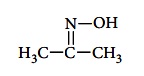
(ii) \((CH_{ 3 })_{ 2 }C=CHCOCH_{ 3 }\)
(b) (i) On adding sodium bicarbonate to benzoic acid, brisk effervescence of CO2 is evolved. Whereas ethylbenzoate does not. 1
(ii) Acetophenone having at least one group on heating with alkaline solution of iodine forms yellow colored precipitate of iodoform.

Whereas benzaldehyde does not 1
(iii) Benzoic acid reacts with NaHC03 giving CO2 gas with effervescence whereas phenol does not.
19.
\({ t }_{ { 1 }/{ 2 } }=5730 \ years\)
\({ t }_{ { 1 }/{ 2 } }=\frac { 0.693 }{ k } \)
\(k=\frac { 0.693 }{ 5730 } { years }^{ -1 }\)
\(k=\frac { 2.303 }{ t } \log { \frac { { \left[ N \right] }_{ 0 } }{ \left[ N \right] } }\)
\(t=\frac { 2.303 }{ k } \log { \frac { 100 }{ 80 } }\)
\(=\frac { 2.303 }{ 0.693 } \times 5730\left[ \log { 5 } -\log { 4 } \right] \)
\(=\frac { 5730 }{ 0.3010 } \times \left[ 0.6990-0.6021 \right] \)
\(=\frac { 5730 }{ 0.3010 } \times 0.0969=\frac { 55.237 }{ 0.3010 } \)
\(=1844.64 \ years\approx 1845 \ years\)
20.
(a) (i) Order of a reaction. The sum of the exponents (powers) of the concentration of reactants in the rate law is termed as order of the reaction. It can be in fraction. It can be zero also.
(ii) Molecularity: Total number of atoms, ions or molecules of the reactants involved in the reaction is termed as its molecularity. It is always in whole number. It is never more than three. It cannot be zero.
(b)
\(\log { \frac { { k }_{ 2 } }{ { k }_{ 1 } } } =\frac { { E }_{ a } }{ 2.303R } \left( \frac { 1 }{ { T }_{ 1 } } -\frac { 1 }{ { T }_{ 2 } } \right)\)
\(\log { 4 } =\frac { { E }_{ a } }{ 2.303\times 8.314 } \left( \frac { 1 }{ 300 } -\frac { 1 }{ 320 } \right) \)
\({ E }_{ a }=\frac { 19.147\times 0.6021\times 300\times 320 }{ 20 }\)
\(=55.336\quad kJ\ { mol }^{ -1 }\)
21.
(a)
Activation energy of forward reaction is E1 + E2 and product is less stable than reactant.
22.
(a)
60 min
23.
(d)
All of these
24.
(b)
acetaldehyde
25.
(b)
CH3COCH3
26.
Methyl ketones are characterized by iodoform test
27.
acetaldehyde contains \(\alpha \)- hydrogens and hence does not undergo aldol condensation
28.
(a)
Ethanal
29.
(c)
alters the reaction mechanism
30.
(a)
1\(\times 10 ^{-4} s ^{-1}\)
31.
(b)
Order is less than the molecularity
32.
(a) Rate = \(\frac {dx}{dt} = k[A_o]^{o} = k \) or \(k = \frac {dx}{dt} = \frac {conc}{Time} =\frac {mol L^{-1}}{s}\)mol L-1 s-1.
33.
(b) If both assertion and reason are true but the reason is not the correct explanation of the assertion.
34.
(c) Assertion is correct but reason is incorrect. For effective collision orientation during collision is irrespective.
35.
(b): Aldehydes have higher molecular weight than parent alkanes as well as polarity in aldehydes shows higher boiling point than parent alkanes. Aldehydes do not have any hydrogen atom attached directly to the oxygen so they cannot form hydrogen bond with each other.
36.
(d) Only reactions with zero order do not have the order in fractions. Thus, (A) is incorrect but (R) is correct.
37.
(a)

(b) 4-hydroxy- 3-methoxy benzaldehyde
(c)
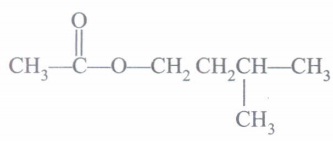
(d)
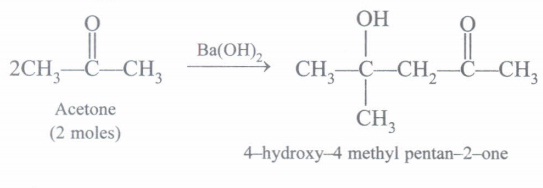
(e)
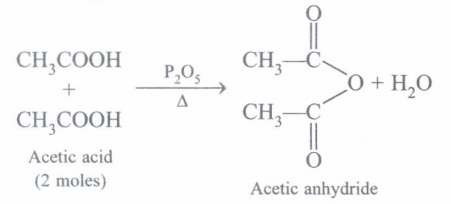
Acetic anhydride is formed.
38.
(a) Zero order reaction.
(b) \(\frac{k}{2.303}\) where 'k' is rate constant.
(c) t 1/2 is directly proportional to initial concentration.
(d) t 99. 9 %= 10 t 1/2 = 10 x 40 = 400 minutes
(e) \(t_{1 / 2}=\frac{[\mathrm{R}]_{0}}{2 k}\) for zero order reaction.

12th Standard CBSE Syllabus & Materials
12th Standard CBSE
CBSE 12th Computer Science Python Revision Tour I - New Previous year Question Papers Study Material - QB365 Set A
NEW12th Standard CBSE
CBSE 12th Business Studies Planning Important Questions And Answers Study Material - QB365 Set A
NEW12th Standard CBSE
CBSE 12th Business Studies Business Environment Important Questions And Answers Study Material - QB365 Set A
NEW12th Standard CBSE
CBSE 12th Business Studies Principles of Management Important Questions And Answers Study Material - QB365 Set A



NCERT Books

Syllabus

Exam Pattern

Sample Question Papers

Previous year Question Papers

Important Notes

MCQ Practice test

NCERT Exemplers

Case study Questions

Image Based Questions

Passage based Questions

HOT Questions

Value Based Questions

Model Questions Papers
NCERT ( Book Back ) Questions

Assertion and Reason
Important Questions And Answers

CBSE 12th Standard CBSE Subjects
CBSE Standards








