
 100% FREE ACCESS
12th Standard CBSE Syllabus & Materials
12th Standard CBSE
CBSE 12th Economics Government Budget and the Economy Previous year Question Papers Study Material - QB365 Set A
NEW12th Standard CBSE
CBSE 12th Computer Science Interface Python with MySQL - New Previous year Question Papers Study Material - QB365 Set A
NEW12th Standard CBSE
CBSE 12th Computer Science Database Concept - New Previous year Question Papers Study Material - QB365 Set A
NEW12th Standard CBSE
CBSE 12th Computer Science Data Communication - New Previous year Question Papers Study Material - QB365 Set A
NEW12th Standard CBSE
CBSE 12th Computer Science Data Structures - New Previous year Question Papers Study Material - QB365 Set A
NEW12th Standard CBSE
CBSE 12th Computer Science Functions - New Previous year Question Papers Study Material - QB365 Set A

Published on: 25/10/2025
Download CBSE Class 12th Standard CBSE Chemistry question papers, sample papers, important questions, and previous year solved papers in PDF format. Get free study materials, NCERT solutions, and exam preparation resources for Class 12th Standard CBSE Chemistry
Questions + Answers key
Take MCQ Chemistry Test
1.
For a general reaction A\(\rightarrow\) B, plot of concentration of A vs time is given in figure. Answer the following question on the basis of this graph.
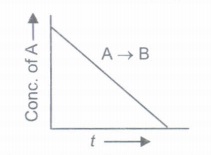
(i) What is the order of the reaction?
(ii) What is the slope of the curve?
(iii) What are the units of rate constant?
2.
Give reason.
The boiling points of alcohols decreases with increase in branching of the alkyl chain.
3.
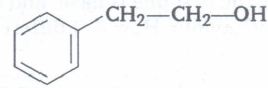
Write the IUPAC name of the given compound:
4.
Why does the hydrolysis of ethyl acetate being a bimolecular reaction is said to be a first order reaction?
5.
What happens when benzene diazonium chloride is heated with water?
6.
For the reaction A \(\to\) B, the rate of reaction becomes twenty-seven times when the concentration of A is increased three times. What is the order of the reaction?
7.
When diethyl ether is heated with excess of HI, it produces
ethanol
iodoform
methyl iodide
ethyl iodide
8.
Which of the following method is used for the preparation of symmetrical and unsymmetrical ether?
Williamson's synthesis
Riemer-Tiemann reaction
Kolbe's reaction
None of the above
9.
CH3CH2OH can be converted into CH3CHO by
catalytic hydrogenation
treatment with LiAIH4
treatment with pyridinium chlorochromate
treatment with KMnO4
10.
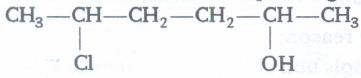
Give IUPAC name of the compound given below.
2-chloro-5-hydroxyhexane
2-hydroxy-5-chlorohexane
5-chlorohexan-2-ol
2-chlorohexan-5-ol
11.
tert-Butyl ether on heating with HI gives a mixture of
tert-butyl alcohol and methyl iodide
tert-butyl iodide and methanol
isobutylene and methyl iodide
isobutylene and methanol
12.
For a first order reaction, the time taken to reduce the initial concentration by a factor of \(\frac {1}{4}\) is 20 minutes. The time required to reduce initial concentration by a factor of 1/16 is
20 min
10 min
80 min
40 min
5 min
13.
Compounts 'A' and 'B' react according to the following chemical equation :
A (g) + 2 B (g) \(\longrightarrow\) 2 C (g)
Concntration of either 'A' or 'B' were changed keeping the concentration of the reactions constant and rates were measured as a function of initial concentration. Following results were obtained. Choose the correct option for the rate equations for this reaction.
| Exp. |
Initial |
Initial |
Initial rate of |
|---|---|---|---|
| 1. | 0.30 | 0.30 | 0.10 |
| 2. | 0.30 | 0.60 | 0.40 |
| 3. | 0.60 | 0.30 | 0.20 |
Rate = k[A]2[B]
Rate = k[A] [B] 2
Rate = k[A] [B]
Rate = k[A]2 [B] 0
14.
Which of the following statements is not correct about order of a reaction ?
The order of a reaction can be a fractional number
Order of a reaction is experimentally determined quantity.
The order of a reaction is always equal to the sum of the stoichiometric coeffecients of reactants in the balanced chemnical equation for reaction.
The order of a reaction is the sum of the powers of molar concentration of the reaction in the rate law expression.
15.
A chemical reaction was carried out at 300 K and 280 K the rate constants were found to be K1 and K2 respectively. Then
K2 = 4K1
K2 = 2K1
K2 = 0.25 K
K2 = 0.5 K1
16.
In the reaction BrO-3 (aq) + 5 Br - (aq) + 6 H+ \(\longrightarrow\) 3 Br2(I) + 3 H2O (l), the rate of apperance of bromine (BHr2) is related to the disapearance of bromide uions as follows :
\(\frac { d[{ Br }_{ 2 }] }{ dt } =-\frac { 5 }{ 3 } \frac { d[{ Br }^{ - }] }{ dt } \)
\(\frac { d[{ Br }_{ 2 }] }{ dt } =\frac { 5 }{ 3 } \frac { d[{ Br }^{ - }] }{ dt } \)
\(\frac { d[{ Br }_{ 2 }] }{ dt } =\frac {3 }{ 5} \frac { d[{ Br }^{ - }] }{ dt } \)
\(\frac { d[{ Br }_{ 2 }] }{ dt } =-\frac { 3 }{ 5 } \frac { d[{ Br }^{ - }] }{ dt } \)
17.
(a) How are following conversions done?
(i) 1-Propanol to 1-Bromopropane
(ii) 1-Chloropropane to 1-Propanol
(iii) 2-Methyl-l-pentene to 2-Methyl-2-pentanol
(iv) Phenol to Phenyl ethanoate.
(b) What happens when anisole is treated with the mixture of concentrated sui phuric acid and nitric acid? Write the chemical reaction involved.
18.
(a) Consider the reaction R \(\rightarrow\) P for which the change in concentration of R with time is shown by the following graph:
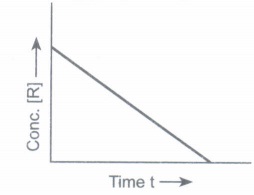
(i) Predict the order of the reaction.
(ii) What does the slope of the curve indicate?
(b) The rate of reaction quadruples when temperature changes from 293 K to 313 K. Calculate Ea assuming that it does not change with time. [R = 8.314 JK-1 mol-1)
19.
(i) For the reaction A➝B, the rate of reaction becomes twenty-seven times when the concentration of A is increased three times. What is the order of the reaction?
(ii) The activation energy of a reaction is 75.2 kJ mol-1 in the absence of a catalyst and it lowers to 50.14 kJ mol-1 with a catalyst. How many times will the rate of reaction grow in the presence of a catalyst if the reaction proceeds at 25°C?
20.
A compound A (C4H10O) is found to be soluble in concentrated sulphuric acid. (A) does not react with sodium metal or potassium permanganate. When (A) is heated with excess of HI, it gives a single alkyl halide. Deduce the structure of compound (A) and explain all the reactions involved.
21.
PCl5 reacts with ethanol to form chloromethane. However, with phenol, it does not give chlorobenzene but gives triphenylphosphate. Explain.
22.
When inversion of surcose is studied at pH = 5, the half-life period is always found to be 500 minutes irrespective of any initial concentration but when it is studied at pH = 6, the half-life period is found to be 50 minutes. Derive the rate law expression for the inversion of surcose.
23.
A compound 'X' with molecular formula C3H9N reacts with C6H5SO2Cl to give a solid, insoluble in alkali. Identify 'X' and give the IUPAC name of the product. Write the reaction involved.
24.
Predict the products of the following reaction:
\(\text { (i) } \mathrm{CH}_{3}-\mathrm{CH}=\mathrm{CH}_{2} \frac{\left(\text { i) } \mathrm{B}_{2} \mathrm{H}_{6}\right.}{\text { (ii) } 3 \mathrm{H}_{2} \mathrm{O}_{2} / \mathrm{OH}^{-}} \text {? }\)
\(\text { (ii) } \mathrm{C}_{6} \mathrm{H}_{5}-\mathrm{OH} \stackrel{\mathrm{Br}_{2}(a q)}{\longrightarrow} \text { ? }\)
\(\text { (iii) } \mathrm{CH}_{3} \mathrm{CH}_{2} \mathrm{OH} \stackrel{\mathrm{Cu} / 573 \mathrm{~K}}{\longrightarrow} \text { ? }\)
25.
(a) For a reaction A + B⟶P, the rate is given by Rate = k[A] [B]2
(i) How is the rate of reaction affected if the concentration of 'B' is doubled?
(ii) What is the overall order of reaction if 'A' is present in large excess?
(b) A first order reaction takes 23.1 minutes for 50% completion. Calculate the time required for 75% completion of this reaction. log 2 = 0.301 log 3 = 0.4771, log 4 = 0.6021.
26.
(a) Why pcc cannot oxidise methanol to methanoic acid and while KMnO4 can ?
(b) Why is reactions of alcohol/phenol and with acid chloride in the presence of pyridine?
27.
For a zero-order reaction, starting with initial concentration \({ C }_{ 0 }\) , how long will it take for the reaction to go to completion?
28.
The reaction, \(2{ N }_{ 2 }{ O }_{ 5 }\rightleftharpoons { 4No }_{ 2 }(g)+{ O }_{ 2 }(g)\) takes place in a closed container. It is found that the concentration of \({ 4NO }_{ 2 }\) increase by \(1.6\times { 10 }^{ -2 } \ mol \ { L }^{ -1 }\) in four seconds. calculate the rate of reaction and rate of change of concentration of \({ N }_{ 2 }{ O }_{ 5 }\)
1.
(i) Order of reaction is zero
(ii) Slope = - k
(iii) mol L-1 s-1
2.
In alcohols, the boiling point decreases with increase of branching in carbon chain because of decrease in van der Waal's forces with decrease in surface area.
3.
IUPAC Name 2-phenylethanol.
4.
\(\mathrm{CH}_3 \mathrm{COOC}_2 \mathrm{H}_8+\mathrm{H}_2 \mathrm{O} \longrightarrow \mathrm{CH}_3 \mathrm{COOH}+\mathrm{C}_2 \mathrm{H}_5 \mathrm{OH}\)
\(\text {Rate }=k\left[\mathrm{CH}_3 \mathrm{COOC}_2 \mathrm{H}_5\right]\left[\mathrm{H}_2 \mathrm{O}\right]^0\)
5.

6.
∵ rate = k [A]x
27 = k[3A]x
33 = 3x ⇒ x = 3
7.
(d)
ethyl iodide
8.
(b)
Riemer-Tiemann reaction
9.
(c)
treatment with pyridinium chlorochromate
10.
(c)
5-chlorohexan-2-ol
11.
(b)
tert-butyl iodide and methanol
12.
(d)
40 min
13.
(b)
Rate = k[A] [B] 2
14.
(c)
The order of a reaction is always equal to the sum of the stoichiometric coeffecients of reactants in the balanced chemnical equation for reaction.
15.
(c) : For every 10oC rise in temperature, rate constant is doubled, Hence, for 20oC rise in temperature, rate constant will become 4 times, i.e., K1 = 4 K2 or K2 = 0.25 K1
16.
(d) \(\frac{1}{3} \frac { d[{ Br }_{ 2 }] }{ dt } =-\frac { 1 }{ 5 } \frac { d[{ Br }^{ - }] }{ dt } \) or \(\frac { d[{ Br }_{ 2 }] }{ dt } =-\frac {3 }{ 5 } \frac { d[{ Br }^{ - }] }{ dt } \)
17.
(a) \(\text { (i) } \mathrm{CH}_{3} \mathrm{CH}_{2} \mathrm{CH}_{2} \mathrm{OH}: \mathrm{HBr} \stackrel{\text { reflux }}{\longrightarrow} \mathrm{CH}_{3} \mathrm{CH}_{2} \mathrm{CH}_{2} \mathrm{Br}+\mathrm{H}_{2} \mathrm{O}\)
1-Propanol 1-Bromopropane
\(\text { (ii) } \mathrm{CH}_{3}-\mathrm{CH}_{2}-\mathrm{CH}_{2} \mathrm{Cl}+\mathrm{KOH}(a q) \longrightarrow \mathrm{CH}_{3} \mathrm{CH}_{2} \mathrm{CH}_{2} \mathrm{OH}+\mathrm{KCl}\)
1-Chloropropane 1-Propanol
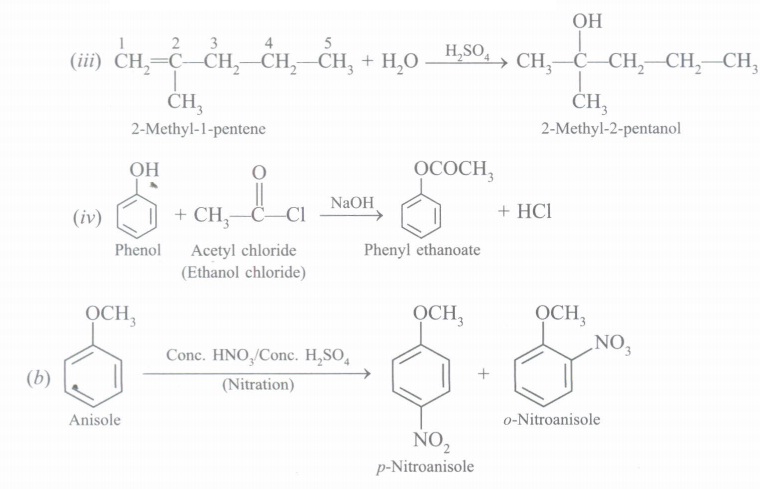
18.
(a) (i) It is zero order reaction
(ii) slope = - k
Negative of slope is equal to rate constant.
(b) Given if rate at 293 K is R thus 313 K rate becomes
\(4Rlog\frac{k_2}{k_1}=\frac{E_a}{2.303R}[\frac{T_2-T_1}{T_1\times T_2}]\)
\(\ log\frac{4R}{R}=\frac{E_a}{2.303\times 8.314}[\frac{313-293}{293\times313}]\)
\(\Rightarrow\ log\frac{4R}{R}=\frac{E_a}{19.1471}[\frac{20}{91709}]\)
\(\Rightarrow\ 0.6021=\frac{E_a}{19.1471}[\frac{20}{91706}]\)
\(\Rightarrow\ \ \ \ \frac{0.6021 \times 19.1471 \times 91709}{20}=E_a\)
\(\Rightarrow\ \ \ \ E_a=52863.2177\ J\ mol^{-1}\)
\(=52.863\ kJ\ mol^{-1}\)
19.
(i) \(r=k[R]^n\)
When concentration is increased three times, [R] = 3a
\(27r=k(3a)^n\)
\(\frac{27r}{r}=\frac{k(3a)^n}{ka^n}or27\)
\(=3^n \ or \ 3^3=3^n\)
\(\Rightarrow\ n=3\)
(ii) According to Arrhenius equation,
\(\log k=\log A-\frac{E_a}{2.303RT} \)
For uncatalysed reaction
\(\log k=\log A-\frac{E_a(2)}{2.303RT}\ \ \ \ \ \ .......(i) \)
For catalysed reaction
\(\log k_2=\log\ A \frac{E_a(2)}{2.303RT}\ \ \ \ \ ....(ii)\)
A is equal for both the reactions.
Subtracting equation (i) from equation (ii)
\(\log\frac{k_2}{k_1}=\frac{E_a(1)-E_a(2)}{2.303RT}\)
\(\Rightarrow\ \log\frac{k_2}{k_1}=\frac{(75.2-50.14)kJ\ mol^{-1}}{2.303\times8.314\ JK^{-1}\ mol^{-1}\times 298 K}\)
\(\Rightarrow\ \log\frac{k_2}{k_1}=4.39\)
\(\Rightarrow\ \frac{k_2}{k_1}=antilog(4.39)\)
\(=2.45\times 10^4\)
Rate of reaction increases by 2.45 x 10⁴ times.
20.
(i) Since compound A (C4H10O) does not react with Na metal or KMnO4, it cannot be an alcohol.
(ii) Since compound A dissolves in cone, H2SO4, it may be an ether.
(iii) Since ether A on heating with excess of HI gives a single alkyl halide, therefore, ether (A) must be symmetrical. Now the only symmetrical ether having M.F. C4HIOO is diethyl ether (CH3CH2OCH2CH3).
21.
To begin with both ethanol and phenol react with PCI5 to give the corresponding chlorophosphate esters.
Since in ethanol, C-O bond has only single bond character, therefore, nucleophilic attack by Cl- ion occurs easily on chlorophosphate ester (I) to give chloroethane. However, in case of phenol, C-O bond has some double bond character due to resonance and hence difficult to break. Instead nucleophilic attack by C6H5OH occurs twice on the chlorophosphate ester (II) to form intermediate (III). Further, nucleophilic attack by C6H5OH on III does not occur due to steric hindrance. Instead (III) undergoes hydrolysis by water to form triphenylphosphate.
22.
At pH = 5, as half-life period is found to be independent of initial concentration of sucrose, this means with respect to sucrose, it is a reaction of first order, i.e., Rate = k [Sucrose].
If n is the order with respect to H+ion, t1/2 ∝ [H+]I-n,
i.e., 500 ∝ (10-5)I-n [PH = 5 means [H+] = 10-5 M] .......(I)
and 50 ∝ (l0-6)I-n [pH = 6 means [H+] = 10-6 M] .......(ii)
Dividing (i) by (ii), 10 = (lo)l-n i.e. 1 - n = 1 or n = 0, i.e., order with respect to H+ion = O.Hence, overall rate law is Rate = k [Sucrose] [H+]o.
23.
As it is given that compound X on reacting with C6H5SO2Cl give a solid product which is insoluble in alkali, this shows that there is no hydrogen attached to N in the product.
Thus, the compound X is a secondary amine. The reaction involved is as follows
| \(\mathrm{CH}_3-\mathrm{N}-\mathrm{C}_2 \mathrm{H}_5+\mathrm{C}_6 \mathrm{H}_5 \mathrm{SO}_2 \mathrm{Cl} \longrightarrow\) | \(\mathrm{CH}_3-\mathrm{N}-\mathrm{SO}_2 \mathrm{C}_6 \mathrm{H}_5\) |
| | H (X) |
| C2H5 N-ethyl-N -methylbenzene sulphonamide |
24.
\(\text { (i) } \mathrm{CH}_{3}-\mathrm{CH}=\mathrm{CH}_{2} \frac{\left(\text { i) } \mathrm{B}_{2} \mathrm{H}_{6}\right.}{\text { (ii) } 3 \mathrm{H}_{2} \mathrm{O}_{2} / \mathrm{OH}^{-}}{\longrightarrow} \mathrm{CH}_{3}-\mathrm{CH}_{2}-\mathrm{CH}_{2} \mathrm{OH}\)
propene propane-1-ol
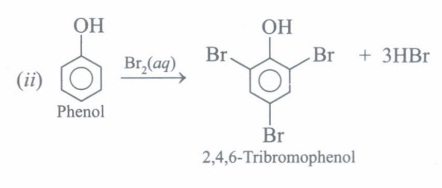
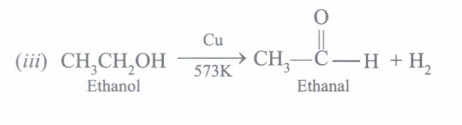
25.
(i) The rate will become 4 times.
(ii) The overall order is equal to 2 if 'A' is in large excess.
(b) t1/2 = 23.1 min
\(k=\frac{2.303}{t_{1 / 2}} \log \frac{[R]_{0}}{[R]_{0} / 2}\)
\(\Rightarrow \ t_{1 / 2}=\frac{2.303}{k} \log 2\)
\(\Rightarrow \quad k=\frac{2.303}{23.1} \times 0.3010 \mathrm{~min}^{-1}\)
Also \(t_{75 \%}=\frac{2.303}{k} \log \frac{[R]_{0}}{[R]_{0} / 4}\)
\(=\frac{2.303 \times 23.1}{2.303 \times 0.3010} \log 4\)
\(\Rightarrow \ t_{75 \%}=\frac{23.1}{0.3010} \times 0.6021=46.2 \mathrm{~min}\)
26.
(a) First convert phenol to benzene by heating with Zn dust.
(b) Nitration of benzene with conc. nitric acid in presence of conc. sulphuric acid.
27.
For a zero-order reaction:
\(k=\frac { 1 }{ t } \left[ { C }_{ 0 }-C \right] \quad or\quad t=\frac { 1 }{ k } \left[ { C }_{ 0 }-C \right] \)
Where C = concentration of the reactant at time t
For the reaction to go to completion C=0.
\(\therefore \ t=\frac { { C }_{ 0 } }{ k } \)
28.
\(Rate=\frac { 1 }{ 4 } \frac { d\left[ { NO }_{ 2 } \right] }{ dt } =\frac { 1 }{ 4 } \times \frac { 1.6\times { 10 }^{ -1 } }{ 4 }\)
\(=1.0\times { 10 }^{ -3 } \ mol \ { L }^{ -1 }{ Sec }^{ -1 }\)
\(-\frac { 1 }{ 2 } \frac { d\left[ { N }_{ 2 }{ O }_{ 5 } \right] }{ dt } =\frac { 1 }{ 4 } \frac { d\left[ { NO }_{ 2 } \right] }{ dt } \)
\(-\frac { d\left[ { N }_{ 2 }{ O }_{ 5 } \right] }{ dt } =\frac { 2 }{ 4 } \frac { d\left[ { NO }_{ 2 } \right] }{ dt } =\frac { 1 }{ 2 } \times \frac { 1.6\times { 10 }^{ -2 } }{ 4 } \)
\( =2.0\times { 10 }^{ -3 } \ mol \ { L }^{ -1 }{ Sec }^{ -1 }\)

12th Standard CBSE Syllabus & Materials
12th Standard CBSE
CBSE 12th Computer Science Python Revision Tour I - New Previous year Question Papers Study Material - QB365 Set A
NEW12th Standard CBSE
CBSE 12th Business Studies Planning Important Questions And Answers Study Material - QB365 Set A
NEW12th Standard CBSE
CBSE 12th Business Studies Business Environment Important Questions And Answers Study Material - QB365 Set A
NEW12th Standard CBSE
CBSE 12th Business Studies Principles of Management Important Questions And Answers Study Material - QB365 Set A



NCERT Books

Syllabus

Exam Pattern

Sample Question Papers

Previous year Question Papers

Important Notes

MCQ Practice test

NCERT Exemplers

Case study Questions

Image Based Questions

Passage based Questions

HOT Questions

Value Based Questions

Model Questions Papers
NCERT ( Book Back ) Questions

Assertion and Reason
Important Questions And Answers

CBSE 12th Standard CBSE Subjects
CBSE Standards








