
 100% FREE ACCESS
12th Standard CBSE Syllabus & Materials
12th Standard CBSE
CBSE 12th Economics Government Budget and the Economy Previous year Question Papers Study Material - QB365 Set A
NEW12th Standard CBSE
CBSE 12th Computer Science Interface Python with MySQL - New Previous year Question Papers Study Material - QB365 Set A
NEW12th Standard CBSE
CBSE 12th Computer Science Database Concept - New Previous year Question Papers Study Material - QB365 Set A
NEW12th Standard CBSE
CBSE 12th Computer Science Data Communication - New Previous year Question Papers Study Material - QB365 Set A
NEW12th Standard CBSE
CBSE 12th Computer Science Data Structures - New Previous year Question Papers Study Material - QB365 Set A
NEW12th Standard CBSE
CBSE 12th Computer Science Functions - New Previous year Question Papers Study Material - QB365 Set A

Published on: 25/10/2025
Download CBSE Class 12th Standard CBSE Chemistry question papers, sample papers, important questions, and previous year solved papers in PDF format. Get free study materials, NCERT solutions, and exam preparation resources for Class 12th Standard CBSE Chemistry
Questions + Answers key
Take MCQ Chemistry Test
1.
Distinguish between the terms molality and molarity. Under what conditions are the molarity and molality of a solution nearly the same?
2.
The reaction:
\({ SO }_{ 2 }{ Cl }_{ 2 }\longrightarrow { SO }_{ 2 }+{ Cl }_{ 2 }\) is a first order reaction. The half life period of this reaction is 60 minutes. calculate the rate constant of this reaction.
3.
Write an expression to relate molar conductivity of an electrolyte to its degree of dissociation.
4.
Predict which of the following will be coloured in aqueous solution. Ti3+, V3+, Cu+, Sc3+, Mn2+, Fe3+ and Co2+. Give reason for each.
5.
Reactivity of transition elements decreases almost regularly from Sc to Cu. Explain.
6.
In permanganate ion, all the bonds formed between Mn and O are covalent. Give reasons.
7.
(i) Give name:
(a) the complex used as oxygen carrier in the blood.
(b) the coordination compound of magnesium, which is responsible for photosynthesis.
(ii) Discuss some applications of complex compounds.
8.
(i) Two liquids A and B boil at 155°Cand 190°C, respectively. Which of them has a higher vapour pressure at 80°C?
(ii) Heptane and octane form ideal solution. At 373 K, the vapour pressures of the two liquid components are 105.2kPa and 46.8 kPa, respectively. What will be the vapour pressure of a mixture of 26.0 g of heptane and 35.0 g of octane?
(iii) The vapour pressure of water is 12.3 kPa at 300 K. Calculate the vapour pressure of one molal solution of non -volatile, non - ionic solute in water.
9.
Calculate the standard electrode potential of Ni2+ II Ni electrode if emf of the cell, Ni (s)1 Ni2+(0.01M) IICu2+(0.1 M) ICu(s) is 0.059 V. (Given \(E^{ 0 }_{ cu2+/cu }=+0.34V)\)
10.
(a) Out of Ag2SO4, CuF2, MgF2 and CuCI, which compound will be coloured and why?
(b) Explain :
(i) \({ CrO }_{ 4 }^{ 2- }\) is a strong oxidizing agent while \({ MnO }_{ 4 }^{ 2- }\) is not.
(ii) Zr and Hf have identical sizes.
(iii) The lowest oxidation state of manganese is basic while the highest is acidic.
(iv) Mn (II) shows maximum paramagnetic character amongst the divalent ions of the first transition series.
11.
(a) Define the following:
(i) Order of a reaction
(ii) Elementary step in a reaction
(b) A first order reaction has a rate constant value of 0.00510 min-1. If we begin with 0.10 M concentration of the reactant, how much of the reactant will remain after 3.0 hours?
12.
Transition metals and their compounds show catalytic activities.
13.
Zn, Cd and Hg are soft and have low melting points. Why?
14.
A 1st order reaction is 50% complete in 30minutes at 270 C and in 10 min at 470C. Calculate
(i) rate constant for the reaction at 270C and 470C
(ii) energy of activation for the reaction.
15.
The decomposition of N2O5 in carbon tetrachloride solution was stuied N2O5(solution)\(\longrightarrow\)2NO2(solution)+\(1\over2\)O2(g)
The reaction has been found to be first order and rate constant is found to be 4.2\(\times\)10-4s-1.Calculate the rate of reaction when
(a) [N2O2] = 1.25mol L-1 and
(b) [N2O5] = 0.25mol L-1
(c) What concentration of N2O5 would give a rate of 2.4\(\times\)10-3mol L-1 s-1?
16.
Calculate the equilibrium constant for the reaction, Zn + Cd2+\(\rightleftharpoons \) Zn2+ + Cd, if E0 Cd2+/Cd =-0.403 V and E0 Zn2+/Zn = 0.763 V.
17.
3.9 g of benzoic acid dissolved in 49 g of benzene shows a depression in freezing point of 1.62 K. Calculate the van't Hoff factor and predict the nature of solute (associated or dissociated). (Given : Molar mass of benzoic acid = 122 g mol-1 , Kf for benzene = 4.9 K kg mol-1)
18.
The molar conductivity of acetic acid at infinite dilution is 387\(\Omega\)-1 cm2 mol-1. At the same temperature, but at a concentration of acetic acid at this temperature.
19.
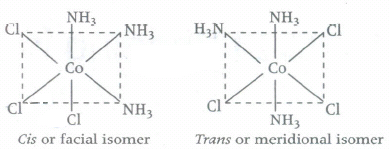
Name the following coordination entities and draw the structures of their entities and draw the structures of their streoisomers:
(i) [Co(en)2Cl2]+ (en = ethane-1, 2-diamine)
(ii) [Cr(C2O4)3]3-
(iii) [Co(NH3)3Cl3]
(Atomic numbers Cr = 24, Co = 27)
20.
Isotonic solutions have the same
density
refractive index
osmotic pressure
volume
21.
Choose the appropriate option about the misch metal.
It is an alloy which consists of a lanthanoid metal (-95%) and iron (-5%) and traces of S, C, Ca and AI
Used in Mg based alloy to produce bullets, shell and lighter flint.
It fmds application in making aeroplane body
Both (a) and (b)
22.
The factors affecting the rate of a reaction are
temperature
pressure
concentration of reactant or product
catalyst
23.
Which of the following reactions are disproportionation reactions?
\((i)\ { Cu }^{ + }\longrightarrow { Cu }^{ 2+ }+{ Cu }\)
\((ii)\ { 3MnO }_{ 4 }^{ - }+{ 4H }^{ + }\longrightarrow { 2MnO }_{ 4 }^{ - }+{ MnO }_{ 2 }+{ 2H }_{ 2 }O\)
\((iii)\ { 2KMnO }_{ 4 }\longrightarrow { K }_{ 2 }{ MnO }_{ 4 }+{ MnO }_{ 2 }+{ O }_{ 2 }\)
\((iv)\ { 2MnO }_{ 4 }^{ - }+{ 3Mn }^{ 2+ }+{ 2H }_{ 2 }O\longrightarrow { 5MnO }_{ 2 }+{ 4H }^{ + }\)
(i),(ii)
(i),(ii),(iii)
(ii),(iii),(iv)
(i),(iv)
24.
Which of the following shall from an octahedral complex?
d4(low spin)
d8(high spin)
d6(low spin)
all of these
25.
Given
\({ E }_{ { Cr }^{ 3+ }/{ Cr } }^{ 0 }=-0.74V,\\ { E }_{ { MnO }_{ 4 }^{ - }/{ Mn }^{ 2+ } }^{ 0 }=1.51V\)
\({ E }_{ { CrO }_{ 7 }^{ - }/{ Cr }^{ 3+ } }^{ 0 }=1.33V,{ E }_{ Cl/{ Cl }^{ - } }^{ 0 }=1.36V\)
Based on the data given above, strongest oxidizing agent will be
MnO4-
Cl-
Cr3+
Mn2+
26.
Which has maximum potential for the half cell reaction : \(2{ H }^{ + }+2{ e }^{ - }\longrightarrow { H }_{ 2 }\) ?
1.0 M HCl
1.0 M NaOH
Pure water
A solution with pH = 4
27.
Oxidation number and coordination number of silver in Tollen's reagent respectively are
1, 1
2, 1
2, 2
1, 2
28.
IUPAC name of [Pt(NH3)3Br(NO2)Cl]Cl is
Triamminechloridobromidonitroplatinum (IV) chloride
Triamminebromidonitrochloridoplatinum (IV) chloride
Triamminebromidochloridonitroplatinum (IV) chloride
Triamminenitrochloridobromidoplatinum (IV) chloride
29.
General electronic configuration of d - block elements is
(n - 1) d1-10ns1-2
ns2np1-6
(n - 2) f0-14(n - 1)1-2ns2
(n-1) d1-5ns1-2
30.
The van't Hoff factor for 0.1 M Ba(NO3)2 solution is 2.74. The degree of dissociation is
91.3%
87%
100%
74%
31.
A person is considered to be suffering from lead poisoning if its concentration in him is more than 15 micrograms of lead per decilitre of blood. Concentration in parts per billion parts is
1
10
100
1000
32.
In the reaction BrO-3 (aq) + 5 Br - (aq) + 6 H+ \(\longrightarrow\) 3 Br2(I) + 3 H2O (l), the rate of apperance of bromine (BHr2) is related to the disapearance of bromide uions as follows :
\(\frac { d[{ Br }_{ 2 }] }{ dt } =-\frac { 5 }{ 3 } \frac { d[{ Br }^{ - }] }{ dt } \)
\(\frac { d[{ Br }_{ 2 }] }{ dt } =\frac { 5 }{ 3 } \frac { d[{ Br }^{ - }] }{ dt } \)
\(\frac { d[{ Br }_{ 2 }] }{ dt } =\frac {3 }{ 5} \frac { d[{ Br }^{ - }] }{ dt } \)
\(\frac { d[{ Br }_{ 2 }] }{ dt } =-\frac { 3 }{ 5 } \frac { d[{ Br }^{ - }] }{ dt } \)
33.
KH value for Ar(g), CO2(g), HCHO (g) and CH4 (g) are 4.39,1.67,1.83 x 10-5 and 0.413 respectively. Arrange these gases in the order of their increasing solubility.
\( \mathrm{HCHO}<\mathrm{CH}_4<\mathrm{CO}_2<\mathrm{Ar}\)
\( \mathrm{HCHO}<\mathrm{CO}_2<\mathrm{CH}_4<\mathrm{Ar} \)
\( \mathrm{Ar}<\mathrm{CO}_2<\mathrm{CH}_4<\mathrm{HCHO} \)
\( \mathrm{Ar}<\mathrm{CH}_4<\mathrm{CO}_2<\mathrm{HCHO} \)
34.
Camphor is often used in molecular mass determination because
it is readily available
it has a very high cryoscopic constant
it is volatile
it is solvent for organic substances
35.
36.
Assertion (A) : Order and molecularity of a reaction are always same.
Reason (R) : Complex reactions involve a sequence of elementary reactions and the slowest step is rate determining.
(a) Both Assertion and Reason are correct, Reason is the correct explanation of Assertion.
(b) Both Assertion and Reason are correct, Reason is not the correct explanation of Assertion.
(c) Assertion is correct; Reason is incorrect.
(d) Assertion is incorrect; Reason is correct.
37.
Assertion : If \(\lambda^{0}{ }_{\mathrm{Na}^{+}}\) and \(\lambda^{0}{ }_{\mathrm{Cl}^{-}}\) are molar limiting conductivities of the sodium and chloride ions respectively, then the limiting molar conductivity for sodium chloride is given by the equation, \(\Lambda_{\mathrm{NaCl}}^{\circ}=\lambda_{\mathrm{Na}^{+}}^{\circ}+\lambda_{\mathrm{Cl}^{-}}^{\circ}\)
Reason : This is according to Kohlrausch law of independent migration of ions.
Codes :
(a) Assertion and reason both are correct statements and reason is correct explanation for assertion.
(b) Assertion and reason both are correct statements but reason is not correct explanation for assertion.
(c) Assertion is correct statement but reason is wrong statement.
(d) Assertion is wrong statement but reason is correct statement.
38.
In the following questions an Assertion (A) is followed by a corresponding Reason (R) Use the following keys to choose the appropriate answer.
Assertion (A) Transition metals form substitutional alloys.
Reason (R) Alloys are made to develop some useful properties which are absent in the constitutent elements.
Codes:
(a) Both (A) and (R) are correct, (R) is the correct explanation of (A).
(b) Both (A) and (R) are correct, (R) is not the correct explanation of (A).
(c) (A) is correct; (R) is incorrect.
(d) (A) is incorrect; (R) is correct.
39.
In the following questions. an Assertion (A) is followed by a corresponding Reason (R) Use the following keys to choose the appropriate answer.
Assertion (A) Ethanol and acetone show positive deviation from Raoult's law.
Reason (R) Pure ethanol molecule show hydrogen bond and on adding acetone hydrogen bond between ethanol molecules breaks
(a) Both (A) and (R) are correct, (R) is the correct explanation of (A).
(b) Both (A) and (R) are correct, (R) is not the correct explanation of (A).
(c) (A) is correct; (R) is incorrect.
(d) (A) is incorrect; (R) is correct.
40.
KMnO4 and K2Cr 2O7 are most important chemicals which are used as oxidising agents and disinfectants. K2MnO4 is prepared by fusing MnO2 with KOH in presence of O2.K2MnO 4 is electrolysed to get purple coloured KMnO4 . Na2CO4 is prepared by heating chromite ore with Na2CO3 in presence of O2. Na2CrO4 is converted into Na2Cr2 O7 by reacting with concentrated H2 SO4 , Na2Cr2 O7 is reacted with KCI to get K2Cr2O7 orange coloured solid, soluble in water, changes to yellow coloured \(\mathrm{CrO}_{4}^{2-}\) in basic medium, KMnO4 acts as oxidising agent in acidic, neutral as well tasic medium. In acidic medium, it converts Fe2+ to Fe3 +, Sn2+ to Sn4+,  to CO2. In asic medium it converts I- to \(\mathrm{IO}_{3}^{-} \cdot \mathrm{K}_{2} \mathrm{Cr}_{2} \mathrm{O}_{7}\) acts as oxidising agent only in acidic medium, converts H2S to S, SO2 to \(\mathrm{SO}_{4}^{2-}, \mathbf{I}^{-}\) to I2. Lanthanoids and actinoids belong to f-block elements with general electronic configuration \((n-2) f^{1 \text { to } 14}(n-1) d^{0-2} n s^{2}\) . All actinoids are radio active. Both show contraction in atomic and ionic radii but actinoid contraction is more than lanthanoid contraction. Lanthanoid show +3 oxidation state, few elements show +2 and +4 oxidation states also. Actinoids show +3, +4, +5, +6, +7 oxidation states.
(a) Which lanthanoid shows +4 oxidation state and why?
(b) Give two similarity between lanthanoids and actinoids.
(c) Complete the equation and balance:
\(\mathrm{Cr}_{2} \mathrm{O}_{7}^{2-}+\mathrm{Fe}^{2+}+\mathrm{H}^{+} \longrightarrow\)
(d) Convert sodium chromate to sodium dichromate. Give chemical equation.
(e) Complete the following:
\(\mathbf{3} \mathbf{M n} \mathbf{O}_{4}^{2-}+\mathbf{4} \mathbf{H}^{+} \longrightarrow\)
41.
Read the passage given below and answer the following questions:
Molar conductivity of ions are given as product of charge on ions to their ionic mobilities and Faraday's constant.
\(\lambda_{A^{n+}}=n \mu_{A^{n+}} F\) (here \(\mu\) is the ionic mobility of An+).
For electrolytes say AXBy, molar conductivity is given by
\(\lambda_{m\left(A_{x} B_{y}\right)}=x_{n} \mu_{A^{n+}} F+y_{m} \lambda_{A^{m}-F}\)
| Ions | Ionic mobility |
| K+ | 7.616 x 10- 4 |
| Ca2+ | 12.33 x 10⁻⁴ |
| Br- | 8.09 x 10- 4 |
| \(\mathrm{SO}_{4}^{2-}\) | 16.58 x 10- 4 |
The following questions are multiple choice questions. Choose the most appropriate answer
(i) At infinite dilution, the equivalent conductance of CaSO4 is
| (a) 256 x 10-4 | (b) 279 | (c) 23.7 | (d) 2.0 x 10- 8 |
(ii) If the degree of dissociation of CaSO4 solution is 10% then equivalent conductance of CaSO4 is
| (a) 3.59 | (b) 36.9 | (c) 27.9 | (d) 30.6 |
(iii) What is the unit of equivalent conductivity?
| (a) ohm-1 cm2 eq-1 | (b) ohm cm2eq-1 |
| (c) ohm-1 cm eq-1 | (d) ohm cm2 eq-1 |
(iv) If the molar conductance value of Ca2+ and Cl- at infinite dilution are 118.88 x 10⁻⁴ m2 mho mol-1 and 77.33 x 10⁻⁴ m 2 mho mol-1 respectively then the molar conductance of CaCl2 (in m2 mho mol-1) will be
| (a) 120.18 x 10- 4 | (b) 135 x 10-4 | (c) 273.54 x 10⁻⁴ | (d) 192.1 x 10⁻⁴ |
1.
| Molarity | Molality |
| The number of moles of solute present in per liter of solution | The number of moles of solute present in 1kg of solvent. |
| It depends on volume. | It depends on mass. |
| Volume changes with temperature, hence it is temperature dependent. | It depends on mass which is independent of temperature. |
2.
\({ t }_{ 1/2 }=\frac { 0.693 }{ k } for \ a \ first \ order \ reaction\)
\(\\ or \ k=\frac { 0.693 }{ { t }_{ 1/2 } } =\frac { 0.693 }{ 60\times 60 } =1.9\times { 10 }^{ -4 }{ s }^{ -1 }\)
3.
\(\alpha=\frac{\lambda_m^c}{\lambda_m^0} \text { where } \lambda_m^c=\) molar conductivity at given concentration, c and ∧0m = molar conductivity at infinite dilution.
4.
Ti3+, V3+, Mn2+, Fe3+ and Co2+ are coloured due to presence of unpaired electrons, they can undergo d-d transitions others Cu+, Sc3+ are colourless due to absence of unpaired electrons.
5.
It is due to increase in ionisation enthalpy, tendency to lose electron decreases, therefore, reactivity decreases.
6.
In MnO-4, Mn shows +7 oxidation state. Mn cannot lose 7 electrons because very high energy is required to remove 7 electrons, therefore it can form 7 covalent bonds.
7.
(i) (a) Haemoglobin
(b) Chlorophyll
(ii) Applications of complex compounds.
(a) They are used in photography, Le. AgBr forms soluble complex with sodium thiosulphate rn photography.
(b) K[Ag(CN)2] is used for electroplating of silver, K[Au(CN)2] is used for gold plating.
(c) Some of ligands oxidise Co2+ to Co3+ ion.
(d) EDTA is used for estimation of Cla2+ and Mg2+ in hard water.
(e) Silver and gold are extracted by treating zinc with their cyanide complexes.
(f) Ni2+ is tested and estimated by DMG (dimethylglyoxime).
8.
(i) A is more volatile, therefore has higher vapour pressure.
(ii) Given that, \(p_{\text {heptane }}^{\circ}=105.2 \mathrm{kPa},\)
\(p_{\text {octane }}^{\circ}=46.8 \mathrm{kPa}\)
Molar mass of heptane
\(\left(\mathrm{C}_{7} \mathrm{H}_{16}\right)=100 \mathrm{~g} \mathrm{~mol}^{-1}\\ (As \left.C_{7} H_{16}=7 \times 12+16=84+16=100\right)\)
Molar mass of octane \(\left(\mathrm{C}_{8} \mathrm{H}_{18}\right)=114 \mathrm{~g} \mathrm{~mol}^{-1}\)
\((As \left.C_{8} H_{18}=8 \times 12+18=96+18=114\right)\)
Number of moles of 26.0 g heptane
\(=\frac{26.0 \mathrm{~g}}{100 \mathrm{~g} \mathrm{~mol}^{-1}}=0.26 \mathrm{~mol} \)
Number of moles of 35.0 g heptane
\(=\frac{35.0 \mathrm{~g}}{114 \mathrm{~g} \mathrm{~mol}^{-1}}=0.31 \mathrm{~mol}\)
\(\chi_{\text {heptane }}=\frac{0.26 \mathrm{~g}}{0.26+0.31}=0.456\)
\(\chi_{\text {octane }}=1-0.456=0.544\)
\( p_{\text {heptane }}=0.456 \times 105.2 \mathrm{kPa}=47.97 \mathrm{kPa}\)
\(p_{\text {octane }} =0.544 \times 46.8 \mathrm{kPa}=25.46 \mathrm{kPa} \)
\(p_{\text {total }} =47.97+25.46=73.43 \mathrm{kPa}\)
(iii) As solution is 1 molal, it means that 1 mole of solute is dissolved in 1000 g of solvent (water).
No. of moles of solute = 1 mol, \(p_{\text {solvent }}^{\circ}=12.3 \mathrm{kPa}\)
No. of moles of water \(=\frac{1000}{18}=55.55 \)
Total moles = 56.55 mol
Mole fraction of water \(=\frac{\chi_{1} \text { (solvent) }}{\chi_{1}+\chi_{2} \text { (solution) }}=\frac{55.55}{56.55} \)
\(p_{\text {solution }}=\)\(p_{\text {solvent }}^{\circ}\)x \(\chi\)H2O
\(p_{\text {solution }}=12.3 \times \frac{55.55}{56.55}\)
= 12.08 kPa
9.
(i) First, find E0cell
(ii) Then find \(E^{ 0 }_{ anode }\) by using the formula
\(E^{ 0 }_{ cell }=E^{ 0 }-_{ cathode }E^{ 0 }_{ anode }\)
Given Ecell = 0.059V; E0cu2+/cu = +0.34V
[Ni2+] = 0.01M and [cu2+] = 0.1M
Ecell = E0cell - \(\frac { 0.059 }{ 2 } log\frac { \left[ Ni^{ 2+ }(aq) \right] }{ \left[ Cu^{ 2+ }(aq) \right] } \)
\(0.059=E^{ 0 }_{ cell }-\frac { 0.059 }{ 2 } log\frac { \left( 0.01 \right) }{ 0.1 } \left( \because n=2 \right) \)
\(0.059=E^{ 0 }_{ cell }-\frac { 0.059 }{ 2 } log\frac { 1 }{ 10 } \left[ \because log10^{ -1 }=-1 \right] \)
\(\because 0.059=E^{ 0 }_{ cell }+0.0295 \times 1\)
\(E^{ 0 }_{ cell }=0.059-0.0295\)
= 0.0295 V = 0.03 V
\(E^{ 0 }_{ cell }=E^{ 0 }_{ cathode }E^{ 0 }_{ anode }\)
0.03 = 0.34 - E0anode
or \(E^{ 0 }_{ anode }=E^{ 0 }_{ Ni2+/Ni }=0.34-0.03\)
= 0.31 V
10.
(i) (a) CuF2 (b) (i) Cr in crO24 - is in the highest oxidation state, i.e., +6 while Mn in MnO is in oxidation state +6 and its most stable oxidation state is +7
(ii) due to lanthanoid contraction
(iii) [Mn2+ has 3d 5 configuration]
11.
(a) (i) It is sum of powers to which cone. terms are raised in rate law or rate equation.
(ii) Each step of complex reaction (which takes place in more than one step) is called elementary, step in a reaction.
\((b) \ k=0.00510 \ { min }^{ -1 }\)
\(t=\frac { 2.303 }{ k } \log { \frac { { \left[ R \right] }_{ 0 } }{ \left[ R \right] } }\)
\(3\times 60\times 60=\frac { 2.303 }{ 0.00510 } \log { \frac { 0.1 }{ \left[ R \right] } }\)
\(\log { \frac { 0.1 }{ \left[ R \right] } } =\frac { 10800\times 0.00510 }{ 2.303 } \)
\(=23.94\)
\(\frac { 0.1 }{ \left[ R \right] } =Antilog \ 23.94\)
\(\frac { 0.1 }{ \left[ R \right] } =8.71\times { 10 }^{ 23 }\)
\(\left[ R \right] =\frac { 0.1 }{ 8.71\times { 10 }^{ 23 } }\)
\(\left[ R \right] =0.1148\times { 10 }^{ -24 }\)
\(\left[ R \right] =1.148\times { 10 }^{ -25 }M\)
12.
Transition metals and their compounds show catalytic activities because of Variable or multiple oxidation states, ability to form complexes, they provide large surface area for adsorption.
13.
Zn, Cd and Hg are generally soft and have low melting point because all the electrons in their d-orbital are paired.
Hence, the metallic bonds which are present in them are weak
14.
k270C = 2.31\(\times10^{-2}\) min-1,
k470C = 6.931\(\times10^{-2}\) min-1,
Ea = 43.85 kJ mol-1.
15.
(a) 7.75\(\times\)10-4mol L-1 s-1
(b) 1.55\(\times\)10-4mol L-1 s-1
(c) conc.= 3.87 mol L-1.
16.
1.52 \(\times\) 1012.
17.
Given, W2 = 3.9 s. WI = 49 g; \(\Delta T_f\)= 1.62 K
M2(benzoic acid) = 122 g mol-1
Kf(benzene) = 4.9 K kg mol-1
\(\Delta T_f=\frac{i\times K_f \times W_2 \times 1000}{M_2 \times W_1}\)
\(i=\frac{\Delta T_f\times M_2 \times W_1}{K_f \times W_2 \times 1000}\)
\(i=\frac{1.62 K \times 122 g mol^{-1}\times 49 g}{4.9 K kg mol^{-1}\times 3.9 g \times 1000}\)
i = 0.50
Since, i < I, therefore solute (benzoic acid) undergoes association.
18.
14.21 %
19.
(i) [Co(en)2Cl2]+ (en = ethane-1, 2-diamine)
(ii) [Cr(C2O4)3]3-
trioxalatochromate (III) ion
(iii) [Co(NH3)3Cl3]
Triamminetrichloridocobalt (Ill) ion. It will show geometrical isomerism.
20.
(c)
osmotic pressure
21.
(c)
It fmds application in making aeroplane body
22.
(d)
catalyst
23.
(a)
(i),(ii)
24.
(c)
d6(low spin)
25.
(a)
MnO4-
26.
(a)
1.0 M HCl
27.
(d)
1, 2
28.
(a)
Triamminechloridobromidonitroplatinum (IV) chloride
29.
(a)
(n - 1) d1-10ns1-2
30.
(b)
87%
31.
(c)
100
32.
(d) \(\frac{1}{3} \frac { d[{ Br }_{ 2 }] }{ dt } =-\frac { 1 }{ 5 } \frac { d[{ Br }^{ - }] }{ dt } \) or \(\frac { d[{ Br }_{ 2 }] }{ dt } =-\frac {3 }{ 5 } \frac { d[{ Br }^{ - }] }{ dt } \)
33.
(c)
\( \mathrm{Ar}<\mathrm{CO}_2<\mathrm{CH}_4<\mathrm{HCHO} \)
34.
Camphor has a very high cryoscopic constant (=39.7o). Hence, It gives a large depression in melting point when an organic solute is dissolved in it.
35.
36.
(d) Assertion is incorrect; Reason is correct.
Order and molecularity differs in case of complex reactions.
A is incorrect, but R is correct.
37.
(a) : According to Kohlrausch law, "limiting molar conductivity of an electrolyte can be represented as the sum of the individual contributions of the anion and cation of the electrolyte".
38.
(b) Transition metals form substitutional alloys, since they have nearly the same size, they can substitute one another in the crystal lattice. Thus, Both (A) and (R) are correct but (R) is not the correct explanation of (A).
39.
(a) Ethanol molecules show hydrogen bonding. On adding acetone, its molecules get in between the host molecule and break some of hydrogen bonds between them. Due to weakening of interaction, the mixture of ethanol and acetone shows the positive deviation from Raoult's law. Hence, both (A) and (R) are correct and (R) is the correct explanation of (A).
40.
(a) 'Ce' shows +4 oxidation state because if has stable electronic configuration.
(b) (i) Both show contraction, lanthanoid and actinoid contraction.
(ii) Both form coloured ions and undergo f· f transition
(c) \(\mathrm{Cr}_{2} \mathrm{O}_{7}^{2-}+6 \mathrm{Fe}^{2+}+14 \mathrm{H}^{+} \longrightarrow 2 \mathrm{Cr}^{3+}+7 \mathrm{H}_{2} \mathrm{O}+6 \mathrm{Fe}^{3+}\)
(d) \(2 \mathrm{Na}_{2} \mathrm{CrO}_{4}+\mathrm{H}_{2} \mathrm{SO}_{4}(\text { conc. }) \longrightarrow\) \(\mathrm{Na}_{2} \mathrm{Cr}_{2} \mathrm{O}_{7}+\mathrm{Na}_{2} \mathrm{SO}_{4}+\mathrm{H}_{2} \mathrm{O}\)
(e) \(3 \mathrm{MnO}_{4}^{2-}+4 \mathrm{H}^{+} \longrightarrow 2 \mathrm{MnO}_{4}^{-}+\mathrm{MnO}_{2}+2 \mathrm{H}_{2} \mathrm{O}\)
41.
(i) (b) : Equivalent conductance of CaSO4 :
\(\Lambda_{\mathrm{CaSO}_{4}}^{\infty}=\lambda_{\mathrm{Ca}^{2+}}^{\infty}+\lambda_{\mathrm{SO}_{4}^{2-}}^{\infty}\)
\(\lambda_{\mathrm{Ca}^{2+}}^{\infty}=\left(\mu_{\mathrm{Ca}^{2+}}\right) F ; \lambda_{\mathrm{SO}_{4}^{2-}}^{\infty}=\left(\mu_{\mathrm{SO}_{4}^{2-}}\right) F\)
\(\mu_{\mathrm{Ca}^{2+}}\) and \(\mu_{\mathrm{SO}_{4}^{2-}}\) - are ionic mobilities.
\(\Lambda_{\mathrm{CaSO}_{4}}^{\infty}=F(12.33+16.58) \times 10^{-4}\)
= 96500 x 10- 4 x 28.91 = 279
(ii) (c) : \(\alpha=\frac{\Lambda_{C}}{\Lambda^{\infty}} \Rightarrow 0.1=\frac{\Lambda_{C}}{279} \Rightarrow \Lambda_{C}=27.9\)
(iii) (a)
(iv) (c) : \(\Lambda_{m\left(\mathrm{CaCl}_{2}\right)}^{\circ}=\lambda_{\mathrm{Ca}^{2+}}^{\circ}+2 \lambda_{\mathrm{Cl}^{-}}^{\circ}\)
= (118.88 x 10- 4 ) + 2(77.33 x 10- 4 )
= 273.54 x 10⁻⁴ m2 mho mol-1

12th Standard CBSE Syllabus & Materials
12th Standard CBSE
CBSE 12th Computer Science Python Revision Tour I - New Previous year Question Papers Study Material - QB365 Set A
NEW12th Standard CBSE
CBSE 12th Business Studies Planning Important Questions And Answers Study Material - QB365 Set A
NEW12th Standard CBSE
CBSE 12th Business Studies Business Environment Important Questions And Answers Study Material - QB365 Set A
NEW12th Standard CBSE
CBSE 12th Business Studies Principles of Management Important Questions And Answers Study Material - QB365 Set A



NCERT Books

Syllabus

Exam Pattern

Sample Question Papers

Previous year Question Papers

Important Notes

MCQ Practice test

NCERT Exemplers

Case study Questions

Image Based Questions

Passage based Questions

HOT Questions

Value Based Questions

Model Questions Papers
NCERT ( Book Back ) Questions

Assertion and Reason
Important Questions And Answers

CBSE 12th Standard CBSE Subjects
CBSE Standards








