
 100% FREE ACCESS
12th Standard CBSE Syllabus & Materials
12th Standard CBSE
CBSE 12th Economics Government Budget and the Economy Previous year Question Papers Study Material - QB365 Set A
NEW12th Standard CBSE
CBSE 12th Computer Science Interface Python with MySQL - New Previous year Question Papers Study Material - QB365 Set A
NEW12th Standard CBSE
CBSE 12th Computer Science Database Concept - New Previous year Question Papers Study Material - QB365 Set A
NEW12th Standard CBSE
CBSE 12th Computer Science Data Communication - New Previous year Question Papers Study Material - QB365 Set A
NEW12th Standard CBSE
CBSE 12th Computer Science Data Structures - New Previous year Question Papers Study Material - QB365 Set A
NEW12th Standard CBSE
CBSE 12th Computer Science Functions - New Previous year Question Papers Study Material - QB365 Set A

Published on: 25/10/2025
Download CBSE Class 12th Standard CBSE Chemistry question papers, sample papers, important questions, and previous year solved papers in PDF format. Get free study materials, NCERT solutions, and exam preparation resources for Class 12th Standard CBSE Chemistry
Questions + Answers key
Take MCQ Chemistry Test
1.
Why aryl halides cannot be used for the formation of ethers?
2.
How will you convert
(i) propene to propan-1-ol?
(ii) ethanal to propan-2-ol?
3.
Arrange the following in order of increasing boiling point :
(i) CH3CH2CH2CH2Br
(ii) (CH3)3CBr
(iii) (CH3)2CHCH2Br.
4.
What are the units of molar conductivity?
5.
State Henry’s law and mention some important applications.
6.
Represent the galvanic cell in which the reactions is \(Zn(s)+{ Cu }^{ 2+ }(aq)\rightarrow { Zn }^{ 2+ }(aq)+Cu(s)\) takes place.
7.
Write the mechanism of the following reaction.

8.
(i) Why are alkyl halides insoluble in water?
(ii) Why is butan-1-ol optically inactive but butan-2-ol is optically active?
9.
An organic compound (A) (C6H6O) gives a characteristic colour with aq.FeCl3 solution. When CO2 gas is passed through an alkaline solution of A at 400 K under pressure, compound (B) is obtained. Compound B on acidification gives (C) which reacts with acetyl chloride to form (D) which is a popular painkiller. Deduce the structure of A, B, C and D.
10.
Differentiate between order and molecularity of a reaction.
11.
The possible mechnism for the reaction: 2H2+2NO\(\longrightarrow\)N2+2H2O is
(i) 2NO\(\rightleftharpoons \)N2O2
(ii) N2O2+H2\(\longrightarrow\)N2O+H2O(slow)
(iii) N2O+H2\(\longrightarrow\)N2+H2O(fast). What is
(a) the rate law for the reaction
(b) the order of the reaction?
12.
How would you differentiate between SN1 and SN2 mechanisms of substitution reactions? Give one example of each.
13.
What is a nickel-cadmium cell? State its one merit and one demerit over lead storage cell. Write the overall reaction that occurs during discharging of this cell.
14.
Henry's law constant for the molality of methane in benzene at 298 K is 4.27\(\times\)105 mm Hg. Calculate the solubility of methane in benzene at 298 K under 760 mm Hg.
15.
(a) How would you convert the following.
(i) Prop-1-ene to 1-fluoropropane
(ii) Chlorobenzene to 2-Chloro toluene
(iii) Ethanol to Propane nitrile
(b) Although chlorine is an electron withdrawing group, yet it is ortho-, para-directing in electrophilic aromatic substitution reactions. Explain why it is so?
16.
(a) Define:
(i) Temperature coefficient
(ii) Activated complex
(iii) Collision frequency
(b) Give reasons:
(i) Pulverised wood burns faster than log of wood.
(ii) Silver nitrate(s) does not react with sodium chloridets) whereas their aqueous solution react very fast.
17.
i) Account for the following:
(a) Allyl chloride is more reactive than the n-propyl chloride towards nucleophilic substitution reaction. Explain why?
(ii) What happens, when
(a) ethyl chloride is treated with aqueous KCN?
(b) chlorobenzene is subjected to hydrolysis?
18.
Define conductivity and molar conductivity for the solution of an electrolyte. Discuss their variation with concentration.
19.
Praveen went to a shop with his father to buy a battery for his mobile. The shopkeeper showed them two types of batteries, one a lead storage battery and the other nickel-cadmium storage battery. The second one was more expensive. He insisted to purchase Ni-Cd battery.
(i) What did Praveen insist for nickel-cadmium battery?
(ii) What type of battery is Ni-Cd battery?
(iii) What are the values associated with the above decision?
(iv) Give the chemical equation for the overall reaction.
20.
(a) State how the vapour pressure of a solvent is affected when a non-volatile solute is dissolved in it.
(b) A 5A% solution (by mass ) of cane sugar in water has a freezing point of 271 K. Calculate the freezing point of 5% (by mass) solution of glucose in water. The freezing point of pure water is 273.15 K.
(Molar mass of cane sugar = 342 g mol-1 and molar mass of glucose = 180 g mol-1)
21.
Phenol on being heated witlh concentrated H2SO4 and then with concentrated HNO3 gives
o -nitrophenol
2, 4, 6-trinitrophenol
p-nitrophenol
m-nitrophenol
22.
Which of the following is halogen exchange reaction?
RX + NaI ⟶ RI + NaX
\(C=C+HX\to \underset{\overset{|}{H}}{C-}\underset{\overset{|}{H}}{C}\)
\(R-\mathrm{OH}+\mathrm{HX} \stackrel{\mathrm{ZnCl}_{2}}{\longrightarrow} R-X+\mathrm{H}_{2} \mathrm{O}\)

23.
The unit of the rate constant of nth order is
mol1-n Ln-1s-1
mol n-1 Ln-1s-1
moln-1 Ln-1s
mol n L1-ns-1
24.
Same amount of electricity is passed through the solutions of HCI and CuSO4. If 6.35g of copper is deposited from CuSO4 solution, the amount of hydrogen liberated at STP will be
0.01
0.1
0.001
1
25.
Which of the following cannot be made by using Williamson synthesis?
Methoxybenzene
Benzyl p-nitrophenyl ether
tert-Butyl methyl ether
DI-tert-butyl ether
26.
An alkyl bromide produces a single alkene when it reacts with sodium ethoxide and ethanol. THis alkene on hydrogenation produces 2-methylbutane. What is the identity of the alkyl halide ?
1-Bromo-2,2-dimethylpropane
1-Bromobutane
1-Bromo-2-methylbutane
2-Bromo-2-methylbutane
2-Bromopentane
27.
For the half-cell reaction, \(2{ H }_{ 2 }O+{ 2e }^{ - }\longrightarrow { H }_{ 2 }+2{ OH }^{ - },{ E }^{ 0 }=-0.8277V\) at 298 K. Autoprotolysis constant of water calculated from this value will be
1 x 10⁻¹⁰
1 x 10-12
1 x 10-13
1 x 10-14
28.
In a fuel cell, methanol is used as fuel and oxygen gas is used as an oxidizer. The reaction is
\({ CH }_{ 3 }OH(l)+\frac { 3 }{ 2 } { O }_{ 2 }(g)\longrightarrow { CO }_{ 2 }(g)+2{ H }_{ 2 }O(l)\)
At 298 K, standard Gibbs energies of formation for CH3OH(l), H2O(l) and CO2 (g) are -166.2, - 237.2 and - 394.4 kJ mol-1 respectively. If standard enthalpy of combustion of methanol is - 726 kJ mol-1, efficiency of the fuel cell will be
80%
87%
90%
97%
29.
For first reaction A \(\longrightarrow\) P, the temperature (T) dependent rate constant (k) was found to follow the equation log k = -(2000)\(\frac {1}{T}\) +6.0.
The pre-exponential factor A and the activation energy Ea respectively, are
1.0 \(\times 10^{6}s^{-1}\) and 9.2 kJ mol -1
6.0 \(s^{-1}\) and 16.6 kJ mol -1
1.0 \(\times 10^{-1}s^{-1}\) and 16.6 kJ mol -1
1.0 \(\times 10^{6}s^{-1}\) and 38.3 kJ mol -1
30.
At high pressure, the following reaction is of zero order.
2NH3 \(\xrightarrow [ Platinum \ catalyst ]{ 1130K } \) (g) N2(g) + 3H2(g)
Which of the following options are correct for this reaction ?
Rate reaction = Rate constant
Rate of the reaction depends on concentration of amonia
Rate of decomposition of ammonia will remain constant until ammonia disappears completely
Further increase in pressure will change the rate of reaction
31.
An unripe mango placed in a concentrated salt solution to prepare pickle, shrivels because ________________.
it gains water due to osmosis
it loses water due to reverse osmosis
it gains water due to reverse osmosis
it loses water due to osmosis
32.
The osmotic pressure of 0.1 M aqueous solution of NaCl is ................ Osmotic pressure of 0.1 M aqueous solution of glucose
equal to
less than
half of
nearly double
33.
In the following questions a statement of assertion followed by a statement of reason is given. Choose the correct answer out of the following choices.
Assertion: Presence of a nitro group at ortho or para position increases the reactivity of haloarenes towards nucleophilic substitution.
Reason: Nitro group, being an electron withdrawing group decreases the electron density over the benzene ring.
Codes:
(a) Assertion and reason both are correct and reason is correct explanation of assertion.
(b) Assertion and reason both are wrong statements.
(c) Assertion is correct but reason is wrong statement.
(d) Assertion is wrong but reason is correct statement.
(e) Assertion and reason both are correct statements but reason is not correct explanation of assertion.
34.
Assertion: Ifblood cells are placed in pure water, they swell and burst.
Reason: Due to osmosis, the movement of water molecules into the cell, dilutes the salt content.
(a) Assertion and reason both are correct statements and reason is correct explanation for assertion.
(b) Assertion and reason both are correct statements but reason is not correct explanation for assertion .
(c) Assertion is correct statement but reason is wrong statement.
(d) Assertion is wrong statement but reason is correct statement.
35.
Assertion: Phenol is more acidic than ethanol.
Reason: Phenoxide ion is resonance stabilised.
Codes:
(a) Assertion and reason both are correct statements and reason is correct explanation for assertion.
(b) Assertion and reason both are correct statements but reason is not correct explanation for assertion.
(c) Assertion is correct statement but reason is wrong statement.
(d) Assertion is wrong statement but reason is correct statement.
36.
In the following questions.an Assertion (A) isfollowed by a corresponding Reason (R) Use the following keys to choose the appropriate answer.
Assertion (A) Solid NaCl does not conduct electricity.
Reason (R) Solid NaCl has no free ions.
Codes:
(a) Both (A) and (R) are correct, (R) is the correct explanation of (A).
(b) Both (A) and (R) are correct, (R) is not the correct explanation of (A).
(c) (A) is correct; (R) is incorrect.
(d) (A) is incorrect; (R) is correct.
37.
Haloalkanes are colourless (when pure), sweet smelling liquids. CH3Cl, CH3Br and C2H5CI and freons are gases. Boiling point increases with increase in molecular weight and increase in carbon chain and decreases with branching. They are insoluble in water due to inability to form H-bonds with water. Dipole moment increases with polarity, density increases with increase in molar mass. They are non-inflammable, therefore, CCl4 is used as fire extinguisher under the name pyrene. p-dichloro benzene has zero dipole moment, higher melting point than o-dichloro benzene due to symmetry, fits into crystal lattice readily. Haloalkanes undergo nucleophilic substitution reaction by SN2 mechanism, 1° > 2° > 3°, SN1 if carbocation formed is stable. They also undergo nucleophilic elimination reactions with alcoholic KOH. Haloarenes are less reactive than haloalkanes towards nucleophilic substitution due to resonance. Haloarenes undergo electrophilic substitution reaction like nitration, sulphonation, Friedel Crafts alkylation, acylation. Chloroform is used as solvent, Freon is used as refrigerant, dichloromethane is used as paint remover. Iodoform is used as antiseptic. DDT is insecticide but nonbiodegradable.
(a) Arrange R-F, R-Br, R-I, R-CI in increasing order of boiling point.
(b) A hydrocarbon' A' (C5H10) gives only one monochloro product on photo chlorination. Identity 'A'.
(c) Out of CH2 = CH-CH2CI and CH3CH2CH2Cl which one undergoes SN1 mechanism faster?
(d) Complete the following:
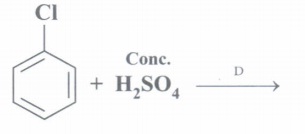
(e) Why is chloroform stored in dark coloured bottles?
(f) What is use of fully fluorinated organic compounds?
(g) Name the chlorine containing drug used in treatment of coronavirus and malaria.
38.
Read the passage given below and answer the following questions :
All chemical reactions involve interaction of atoms and molecules. A large number of atoms/molecules are present in a few gram of any chemical compound varying with their atomic/molecular masses. To handle such large number conveniently, the mole concept was introduced. All electrochemical cell reactions are also based on mole concept. For example, a 4.0 molar aqueous solution of NaCI is prepared and 500 mL of this solution is electrolysed. This leads to the evolution of chlorine gas at one of the electrode. The amount of products formed can be calculated by using mole concept.
The following questions are multiple choice questions. Choose the most appropriate answer :
(i) The total number of moles of chlorine gas evolved is
| (a) 0.5 | (b) 1.0 | (c) 1.5 | (d) 1.9 |
(ii) If cathode is a Hg electrode, then the maximum weight of amalgam formed from this solution is
| (a) 300 g | (b) 446 g | (c) 396 g | (d) 296 g |
(iii) In the electrolysis, the number of moles of electrons involved are
| (a) 2 | (b) 1 | (c) 3 | (d) 4 |
(iv) In electrolysis of aqueous NaCl solution when Pt electrode is taken, then which gas is liberated at cathode?
| (a) H2 gas | (b) C2 gas | (c) O2 gas | (d) None of these |
1.
Aryl halides can not be used for the formation of ethers because they are less reactive foward nucleophilic substitution reactions.
2.
(i) Propene to propan-1-ol
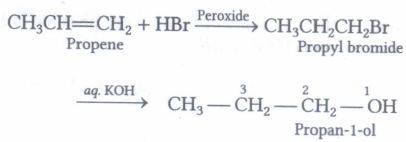
(ii) ethanal to propan-2-ol
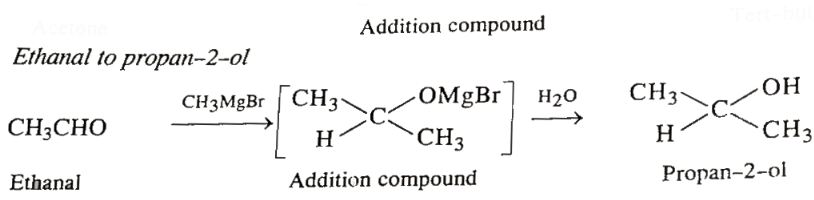
3.
The b.p increases as the branching decreases (or the surface area increases), i.e., (CH3)3CBr < (CH3) CHCH2Br < CH3CH2CH2CH2Br.
4.
Ohm-1 cm2 mol-1 or S cm2 mol-1
5.
Henry's Law: It states that the partial vapour pressure of gas in vapour phase(g) is directly proportional to the mole fraction of the gas in the solution.
Applications of Henry's Law:
(i) To minimise the painful effects accompanying the decompression of deep sea divers, oxygen diluted with less soluble helium gas is used as breathing gas.
(ii) To increase the solubility of CO2 in soft, drinks and soda water, the bottle is sealed under high pressure.
6.
The galvanic cell for the given reaction is
\(\underset{\text { Anode }}{\mathrm{Zn}} \mid \mathrm{Zn}^{2+} \underset{\substack{\text { salt: } \\ \text { bridge }}}{\| \mathrm{Cu}^{2+}} \underset{\text { Cathode }}{\mid \mathrm{Cu}}\)
7.
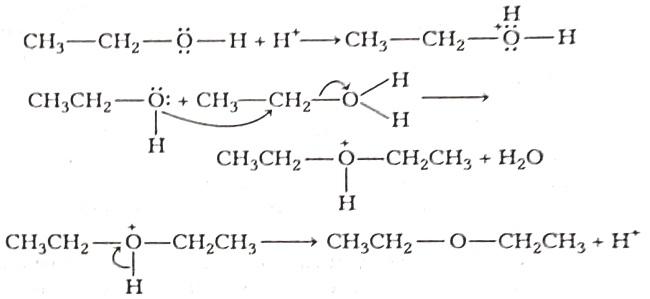
8.
Butan-1-ol is optically inactive compound due to the absence of asymmetric C-atom (or chiral C-atom) whereas butan-2-ol is optically active compound due to the presence of asymmetric C-atom (or chiral C-atom).
.png)
9.
The structure of A, B, C and D.
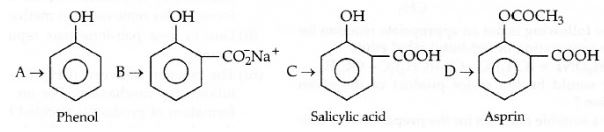
10.
Order and molecularity:The important differences between order and molecularity of a reaction are given below:
| S.NO | Order | Molecularity |
| 1 | Order is the sum of the powers of the concentration terms in the rate law of expression. | Molecularity is the number of reacting species undergoing simultaneous collisions in the elementary or simple reaction. |
| 2 | Order of a reaction is determined experimentally. | Molecularity is a theoretical concept. |
| 3 | Order of a reaction need not be a whole number, i.e., it can have fractional values also. | Molecularity has whole number values only, i.e., 1,2,3, etc. |
| 4 | Order of a reaction can be zero. | Molecularity of a reaction cannot be zero. |
11.
Rate = k[NO]2[H2],Order = 3
12.
SN1 Reactions: They are substitution nucleophilic unimolecular reactions in which the rate of the reaction depends on the concentration of only one reactant. Product formation takes place by the formation of carbo cation as reaction intermediate. For example:
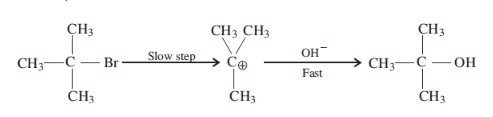
SN2 reactions they are substitution nucleophilic bimolecular reactions in which rate of the reaction depends on the concentration of two reactants. For example:
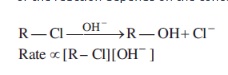
The product formation takes place by formation of transition state.
13.
Nickel-cadmium cell:
t is another type of secondary cell which has longer life than lead storage cell but more expensive to manufacture. The overall reaction during discharge is
\(Cd(s)+{ 2Ni(OH) }_{ 3 }(s)\rightarrow CdO(s)+{ 2Ni(OH) }_{ 2 }(s)+{ H }_{ 2 }O(l).\)
Merit:
It is easy to handle as it is less bulky than lead storage cell and has longer life than lead storage cell.
Demerit:
It is more expensive than lead storage cell.
14.
Given that Henry’s law constant
KH = 4.27× 10⁵ mmHg
p = 760mmHg
If X is the molar fraction then
According to Henry’s law,
p = KHX
760 = 4.27×10⁵×X
Divide by 4.27 × 10⁵ , we get
Molar fraction, X
\(=\frac{760}{4.27\times10_5}\)
= 178×10-5
So that, the molar fraction of methane in benzene = 1.78×10⁻³
15.
(a) \(\text { (i) } \mathrm{CH}_{3}-\mathrm{CH}=\mathrm{CH}_{2}+\mathrm{HBr} \stackrel{\text { Peroxide }}{\longrightarrow} \mathrm{CH}_{3} \mathrm{CH}_{2} \mathrm{CH}_{2} \mathrm{Br} \frac{\mathrm{Ag} \mathrm{F}}{\text { Swartz reaction }} \mathrm{CH}_{3} \mathrm{CH}_{2} \mathrm{CH}_{2} \mathrm{~F}\)
Prop-1-ene 1-Bromopropane 1-Fluoropropane
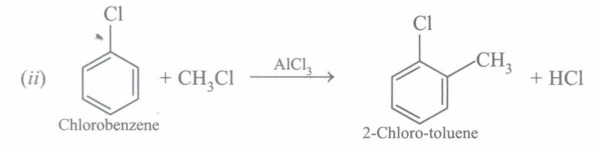
\(\mathrm{CH}_{3} \mathrm{CH}_{2} \mathrm{OH} \stackrel{\mathrm{PCl}_{5}}{\longrightarrow} \mathrm{CH}_{3} \mathrm{CH}_{2} \mathrm{Cl} \quad \stackrel{\mathrm{KCN}}{\longrightarrow} \quad \mathrm{CH}_{3} \mathrm{CH}_{2} \mathrm{CN}\)
Ethanol Chloroethane Propane nitrile
(b) Chlorobenzene is resonance hybrid of following structures:
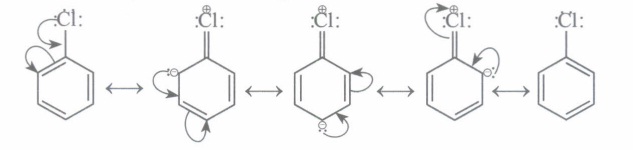
Since, electron density is maximum at o-and p-positions due to +R effect, therefore, electrophilic substitution will take place at o and p-positions.
16.
(a) (i) Temperature Coefficient: It is the ratio of rate constant at temperature 308 K to the rate constant at temperature 298 K.
Temperature coefficient
\(=\frac{\text { Rate constant ' } k \text { ' at } 308 \mathrm{~K}}{\text { Rate constant ' } k^{\prime} \text { at } 298 \mathrm{~K}}\)
Its value lies between 2 and 3.
(ii) Activated Complex: It is defined as unstable intermediate formed between reacting molecules. It is highly unstable and readily changes into product.
(iii) Collision Frequency (Z): The number of collisions that take place per second per unit volume of the reaction mixture is called collision frequency.
(b) (i) Pulvirised wood has greater surface area than log of wood, that is why it bums faster than log of wood.
Surface area \(\propto\) Rates of reaction
(ii) It is due the fact that rate of reaction depends upon nature of reactants, therefore, AgNO3 (s) does not react with NaCI(s) whereas their aqueous solution react very fast in (10- 12 s)
AgCI(s) + NaCI(s) \(\rightarrow\) No reaction
AgCl(aq) + NaCl(aq) \(\rightarrow\) AgCl(s) + NaNO3 (aq)
17.
a) Allyl chloride posses resonance structure therefore prefers to show nucleophilic substitution reaction as compared to n-propyl chloride as shown in figure below for allyl.
(ii) (a)(i) Methyl chloride is treated with alcoholic KCN.
(ii) Ethyl chloride is treated with alcoholic KOH.
(iii) Chloroform is heated with Ag powder.
(b) Phenol is formed. No reaction occurs under normal conditions. However. Hydrolysis takes place under specific conditions and phenol is formed as the product.
18.
Conductivity The inverse of resistivity is called conductivity. It is denoted by K (kappa). It is also known as specific conductance. k = 1/p SI unit of conductivity is Sm-1 or ohm-1 m-1
Molar conductivity It is defined as the conductance of the solution which contains one mole of the electrolyte such that entire solution is in between the two electrodes kept one centimeter apart, and large enough to contain all the electrolytes.
Molar conductivity, \(\Lambda _{ m }=\frac { K }{ C } \)
Variation of conductivity and molar conductivity with concentration.
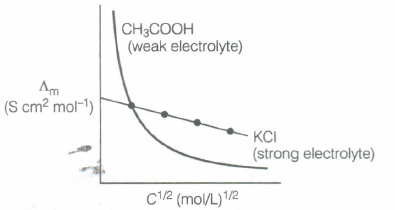
Conductivity and molar conductivity change with change in concentration of electrolyte ..Conductivity always decreases with decrease in concentration for both weak as well as strong electrolytes.
But molar conductivity increases with decrease in concentration. For strong electrolytes, \(\Lambda _{ m }\) increases slowly with dilution but for weak electrolyte, \(\Lambda _{ m}\) increases steeply on dilution, especially near lower concentrations.
19.
(i) Lead is toxic, it has harmful effects on health as well as environment. Therefore, Praveen insisted for nickel-cadmium battery.
(ii) Secondary battery.
(iii) Environmental concern and care for health.
(iv) Cd(s) + NiO2(s) + 2H2O(l) \(\rightarrow\)Cd(OH)2(s) + Ni(OH)3
20.
(a) When non-volatile solute is added, the escaping tendency of the solvent into vapour phase reduces because some of the solute molecules occupy the position of the solvent molecules on the liquid surface and thus lowers down the vapour pressure of the solvent.
(b) In the case of cane sugar,
WB = 5 g, WA = 95 g, MB = 342 g mol-1
∆Tf = 271 K, T, = 273.15 K
ΔTf=T0f, -Tf
= 273.15 - 271.00 = 2.15 K
Now\(\Delta T_f=K_f\times{W_B\over M_b}\times {1000\over W_A}\)
\(2.15=K_f\times{5\over 342}\times{1000\over 95}\)
Dividing (t) by (it), we have
\({2.15\over \Delta T_f}=K_f\times{5\over 342}\times{180\over 180}=4.085\)
Freezing point of 5% (by mass) solution of glucose in water
= 273.15 - 4.085
= 269.065 K
21.
(b)
2, 4, 6-trinitrophenol
22.
(a)
RX + NaI ⟶ RI + NaX
23.
(a)
mol1-n Ln-1s-1
24.
(b)
0.1
25.
(d)
DI-tert-butyl ether
26.
(c)
1-Bromo-2-methylbutane
27.
(d)
1 x 10-14
28.
(d)
97%
29.
(d)
1.0 \(\times 10^{6}s^{-1}\) and 38.3 kJ mol -1
30.
(c)
Rate of decomposition of ammonia will remain constant until ammonia disappears completely
31.
(d)
it loses water due to osmosis
32.
(d)
nearly double
33.
(a) Assertion and reason both are correct and reason is correct explanation of assertion.
34.
(b): Osmosis is a phenomenon in which the solvent flows from a solution of lower concentration to the solution of higher concentration. Here, movement of water molecules takes place in highly concentrated salt content of blood cell to such an extent that the cell membrane ruptures.
35.
(a) Assertion and reason both are correct statements and reason is correct explanation for assertion.
36.
(a)Solid NaCI does not conduct electricity due to the absence of free ions. Thus, both (A)and (R)are correct and (R) is the correct explanation of (A).
37.
(a) R-F < R-Cl < R-Br < R-I
(b)
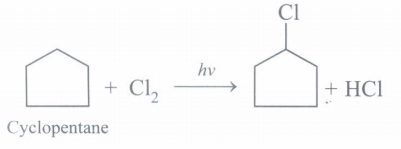
(c) CH2 =CH-CH2Cl because \(\mathrm{CH}_{2}-\mathrm{CH}-\mathrm{CH}_{2}^{\oplus}\) is more stable due to resonance.
(d)
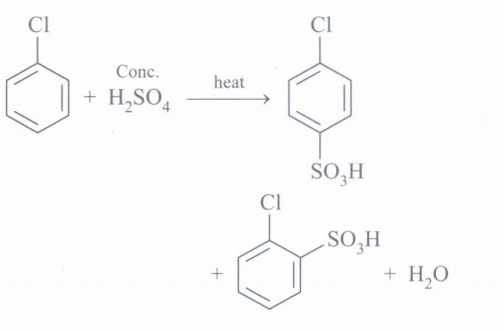
(e) It is done so as to prevent formation of COCl2 which is poisonous.
\(\mathrm{CHCl}_{3}+\frac{1}{2} \mathrm{O}_{2} \stackrel{\text { Sunlight }}{\longrightarrow} \mathrm{COCl}_{2}+\mathrm{HCl}\)
(f) They are used as blood substitute in surgery.
(g) Hydroxychloroquine
38.
(i) (b) : \(n_{\mathrm{NaCl}}=\frac{4 \times 500}{1000}=2 \mathrm{~mol}\)
\(\therefore\) \(n_{\mathrm{Cl}_{2}}=1 \mathrm{~mol}\)
(ii) (b) : nNa deposited = 2 mol
\(\therefore\) nNa _ Hg formed = 2 mol
\(\therefore\) Mass of amalgam formed = 2 x 223 = 446 g
(iii) (a)
(iv) (a)

12th Standard CBSE Syllabus & Materials
12th Standard CBSE
CBSE 12th Computer Science Python Revision Tour I - New Previous year Question Papers Study Material - QB365 Set A
NEW12th Standard CBSE
CBSE 12th Business Studies Planning Important Questions And Answers Study Material - QB365 Set A
NEW12th Standard CBSE
CBSE 12th Business Studies Business Environment Important Questions And Answers Study Material - QB365 Set A
NEW12th Standard CBSE
CBSE 12th Business Studies Principles of Management Important Questions And Answers Study Material - QB365 Set A



NCERT Books

Syllabus

Exam Pattern

Sample Question Papers

Previous year Question Papers

Important Notes

MCQ Practice test

NCERT Exemplers

Case study Questions

Image Based Questions

Passage based Questions

HOT Questions

Value Based Questions

Model Questions Papers
NCERT ( Book Back ) Questions

Assertion and Reason
Important Questions And Answers

CBSE 12th Standard CBSE Subjects
CBSE Standards








