
 100% FREE ACCESS
12th Standard CBSE Syllabus & Materials
12th Standard CBSE
CBSE 12th Economics Government Budget and the Economy Previous year Question Papers Study Material - QB365 Set A
NEW12th Standard CBSE
CBSE 12th Computer Science Interface Python with MySQL - New Previous year Question Papers Study Material - QB365 Set A
NEW12th Standard CBSE
CBSE 12th Computer Science Database Concept - New Previous year Question Papers Study Material - QB365 Set A
NEW12th Standard CBSE
CBSE 12th Computer Science Data Communication - New Previous year Question Papers Study Material - QB365 Set A
NEW12th Standard CBSE
CBSE 12th Computer Science Data Structures - New Previous year Question Papers Study Material - QB365 Set A
NEW12th Standard CBSE
CBSE 12th Computer Science Functions - New Previous year Question Papers Study Material - QB365 Set A

Published on: 25/10/2025
Download CBSE Class 12th Standard CBSE Chemistry question papers, sample papers, important questions, and previous year solved papers in PDF format. Get free study materials, NCERT solutions, and exam preparation resources for Class 12th Standard CBSE Chemistry
Questions + Answers key
Take MCQ Chemistry Test
1.
For the reaction A + 2B \(\rightarrow\) C + D. The order of the reaction is
1 with respect to A
2 with respect to B
can't be predicted as order is determined experimentally.
3
2.
The rate of a reaction increases sixteen times when the concentration of the reactant increases four times.The order of the reaction is
2.5
2.0
1.5
0.5
3.
The non-stoichiometric reaction:
2A + B \(\rightarrow\) C+D
| Initial conc A | Initial conc of B | Initial rate (Mol L-1 ) |
| 0.1 M | 0.1 M | 1.2 x 10- 3 |
| 0.1 M | 0.2M | 1.2 x 10- 3 |
| 0.2 M | 0.1 M | 2.4 x 10- 3 |
The rate law for formation of c is
\(\frac{\mathrm{dc}}{\mathrm{dt}}=k[\mathrm{~A}]\)
\(\frac{\mathrm{dc}}{\mathrm{dt}}=k[\mathrm{~A}][\mathrm{B}]\)
\(\frac{\mathrm{dc}}{\mathrm{dt}}=k[\mathrm{~A}]^{2}[\mathrm{~B}]^{1}\)
\(\frac{\mathrm{dc}}{\mathrm{dt}}=k[\mathrm{~A}][\mathrm{B}]^{2}\)
4.
In Arrhenius plot of Ink Vs \(\frac{1}{\mathrm{~T}}\) is a linear plot obtained with slope of -2 x 10⁴ k. Ea of reaction in kJ mol -1.
83
166
249
332 kJ mol -1
5.
The rate of chemical reaction double for every 10° rise of temperature. If the temperature is raised by 50°, the rate of reaction will increase by
10 times
24 times
32 times
64 times
6.
In the first order reaction the concentration of reactant decreases from 0.6 M to 0.3 M in 30 minutes. The time taken for the concentration to change from 0.1 M to 0.025 M:
60 min
30 min
15 min
50 min
7.
For a reaction taking place in three steps, the overall rate constant k \(=\frac{k_{1} k_{2}}{k_{3}}\) If Ea1, Ea2 and Ea3 are the 40, 50 and 60 kJ mol-1, the overall Ea is
30
40
60
50
8.
If the initial concentration of reactant is doubled, t1/2 is also doubled, the order of reaction is
zero
1
2
3
9.
The rate of first order reaction is 0.04 mol L-1 s-1 at 10 sec. and 0.03 mol L-1 at 20 seconds after initiation of the reaction. t1/2 of reaction is
44.1 s
54.1 s
24.1 s
34.1 s
10.
A first order reaction has specific reaction rate 10- 2 s-1 . How much time it will take for 20g of reactant to reduce to 5g?
138.6 s
346.5 s
693.0 s
238.6 s
11.
Which of the following is affected by catalyst?
\(\triangle\)H
\(\triangle\)S
\(\triangle\)G
Ea
12.
The half life period of first order reaction is 1386 seconds. The specific rate constant ofthe reaction is
0.5 x 10- 2 s-1
0.5 x 10- 3 s-1
5.0 x 10- 2 s-1
5.0 x 10⁻³ S-1
13.
Consider the following plot between In k and 1/T,
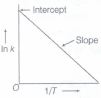
In this plot, the intercept and slope respectively are
\(-\frac{E_{a}}{R} ; \ln A\)
\( \ln A ;-\frac{E_{\alpha}}{R}\)
\(\frac{E_{a}}{R} ;-\ln A\)
\( \frac{E_{a}}{R} ; A\)
14.
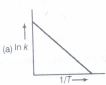
According to Arrhenius equation rate constant k is equal to A e.-Ea/RT Which of the following options represents the graph of In k vs 1/T


15.
Arrhenius equation may not be represented as
\( \ln \frac{A}{k}=\frac{E_{a}}{R T}\)
\(K=Ae^-Ea/RT\)
\(\log A=\log k+\frac{E_{\alpha}}{2303 R T}\)
\(\log k-\left(\frac{E_{a}}{R T}\right)=A\)
16.
When one reactant is present in large excess in a chemical reaction between two substances, then the reaction is known as
first order reaction
second order reaction
zero order reaction
pseudo first order reaction
17.
Expression for the half-life of zero order reaction is given as
\( t_{1 / 2}=\frac{[R]}{2 k}\)
\(t_{1 / 2}=\frac{[R]_{0}}{2 k}\)
\(t_{1 / 2}=\frac{0.693}{k}\)
\(t_{1 / 2}=\frac{0.301}{k}\)
18.
For the reaction,
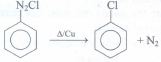
half-life does not depend on the concentration of the reactant. After 10 min, volume of N2 gas is 20 L and after the completion of reaction, it is 100 L. Hence, rate constant is
\(\frac{2.303}{10}\) log 5 min-1
\(\frac{2.303}{10}\) log 10 min-1
\(\frac{2.303}{10}\) log 10 min-1
\(\frac{2.303}{10}\) log 20 min-1
19.
Equation for rate constant of a first order reaction is
\( k=\frac{2.303}{t} \log _{10} \frac{a}{(a-x)}\)
\(k=\frac{4 \cdot 306}{t} \log _{10} \frac{a}{(a-x)}\)
\( k=\frac{2.303}{t^{2}} \log _{10} \frac{a}{(a-x)}\)
\( k=\frac{10}{t} \log _{10} \frac{a}{(a-x)}\)
20.
Four reactions are given below. Which one of them is of zero order?
\(\mathrm{PCL}_{5} \longrightarrow \mathrm{PCl}_{3}+\mathrm{Cl}_{2}\\ \)
\( 2 \mathrm{FeCl}_{\mathrm{s}}+\mathrm{SnCl}_{2} \longrightarrow 2 \mathrm{FeCl}_{2}+\mathrm{SnCl}_{4}\\ \)
\( \mathrm{H}_{2}+\mathrm{Cl}_{2} \longrightarrow 2 \mathrm{HCl}\\ \)
\( \mathrm{N}_{2} \mathrm{O}_{5} \longrightarrow 2 \mathrm{NO}_{2}+\frac{1}{2} \mathrm{O}_{2}\\\)
21.
For the given rate expression = k[A]3/2[B]-1, the overall-order of a reaction is
zero
half
one
two
22.
Consider the data given below for a hypothetical reactions, M ⟶ N
| Time(s) | Rate of reaction (mol L-1 s-1) |
| 0 | 4.20 x 10⁻⁴ |
| 10 | 4.20 x 10⁻⁴ |
| 20 | 4.20 x 10⁻⁴ |
| 30 | 4.20 x 10⁻⁴ |
| 40 | 4.18 x 10⁻⁴ |
For the above data, the order of reaction is
one
two
three
zero
23.
For which of the following, the units of rate constant and rate of the reaction are same?
Zero order reaction
First order reaction
Second order reaction
Third order reaction
24.
Find the order of the reaction whose rate constant is 2.5 x 10⁻² min-1
zero
three
two
one
25.
During a chemical reaction with increase in temperature, rate of a reaction
decreases
increases
remains constant
show irregular trends
26.
In a reaction, 2x ⟶ y, the concentration of x decreases from 3.0 M to 1.5 Min 4 min. The rate of the reaction is
0.187 M min-1
1.87 M min-1
3.75 x 10⁻¹M min-1
0.75 M min-1
27.
Rate of which of the following reactions can be determined easily?
Rusting of iron in the presence of air and moisture
Hydrolysis of starch
Reaction of silver nitrate with sodium chloride
All of the above
28.
For the first order reaction
2 N2O5 (g) \(\longrightarrow\) 4 NO2 (g) + O2 (g)
the concentration of the reactant decreases exponentially with time
the half-life of the reaction decreses with increases temperature
the half-life of the reaction depends on the initial concentration of the reactant
the reaction proceeds to 99/6% completion in eight half-duration
29.
A catalyst
increases the average kinetic energy of the reacting molecules.
decreases the activation energy
alters the reaction mechanism
increaes the frequency of collision of the reacting species
30.
The initial rate hydrolysis of methyl acetate (1 M) by a week acid (HA, 1 M) is 1/100th of that of a strong acid (HX, 1 M) at 25oC. The ka of HA is
1 \(\times 10 ^{-4}\)
1\(\times 10 ^{-5}\)
1\(\times 10 ^{-6}\)
1\(\times 10 ^{-3}\)
31.
The oxidation of a certain metal is found to obey the equation A2 = \(\alpha t + \beta\) , where A is the thickness of the oxide film at time t , \(\alpha\) and \(\beta\) are constants. The order of this reaction is
0
1
-1
2
32.
Consider the following statements :
(i) increase in concentration of reactant increses the rate of zero order reaction
(ii) rate constant k is equal to collision frequency A is Ea = 0
(iii) rate constant k is equal to collision frequency A if Ea = \(\infty \).
(iv) In k vs T is a straight line
(v) in k vs 1/T is a straight line.
correct statement are :
(i) and (iv)
(ii) and (v)
(iii) and (iv)
(ii) and (iii)
33.
One mole of N2O4 gas at 300 K is kept in a closed container at 1 atm. It is heated to 600 K when 20% by mass of N2O4 decomposes to NO2(g). The resultant pressure in the container would be
1.2 atm
2.4 atm
2.0 atm
1.0 atm
34.
Which one of the following is not correct ?
Every biomolecular collision does not result into a chemical reaction.
collosion theory is not applicable to unimolecular reaction
according to collision frequency, k = PZ AB e-E/RT where Z AB is collision frequency and P is steric factor
Collision theory assumes molecules to be hard speres
35.
The rate constants k1 and k2 for two different reactions are 1016. e-2000/T and 1015. e-1000/T respectively. The temperature at which k1 = k2 is
1000 K
\(\frac {2000}{2.303}K\)
2000 K
\(\frac {1000}{2.303}K\)
36.
For a reaction taking place in three steps, the rate constants are k1,k2 and k3. The overall rate constant is \(k = \frac {k_1k_2}{k_3}\). The overall energy of activation in kJ mol-1 is
30
150
50
60
37.
For an endothermic reaction, where \(\triangle H\) represents the enthalpy of the reaction in kJ/mol. The minimum value for the energy of activation will be
less than \(\triangle H\)
zero
more than \(\triangle H\)
equal to \(\triangle H\)
38.
H2O2 is formed in the upper atmosphere through the following mechanism
H2O + (O) \(\longrightarrow\) 2OH \(\longrightarrow\) H2O2
The overall enthalpy change and activation energy for the forward reaction are 72 kJ mol-1 and 77 kJ mol-1 respectively. The activation energy for the decomposition of H2O2 to give back H2O and (O) will be
5 kJ mol-1
-5 kJ mol-1
149 kJ mol-1
-149 kJ mol-1
39.
In the presence of a catalyst, the activation energy of a reaction is lowered by 2kcal at 27oC. The rate of reaction will increase by
2 times
14 times
28 times
20 times
40.
The rate of a reaction doubles when its temperature changes from 300 K to 310 K activation energy of such a reaction will be
60.5 kJ mol-1
53.6 kJ mol-1
48.6 kJ mol-1
58.5 kJ mol-1
41.
The activation energy of a reaction can be determined from the slope of which of the following graph ?
In k vs \(\frac {1}{T}\)
\(\frac {T}{In k} vs \frac {1}{T}\)
In k vs T
\(\frac {In k} {T}\) vs T
42.
Number of natural life times (tav) required for a first reaction to complete 99.9% is
6.93
2.31
9.2
infinite
43.
In the study of inversion of surcose in presence of readings at times r0 , r1 and \({ r }_{ \infty }\) represent the polarimetric readings at times 0, t and \( \infty \) respectively, then at the 50% inversion, which of the following relationship will hold good ?
\({ r }_{t }={ r }_{0 }+{ r }_{ \infty }\)
\({ r }_{t }\frac {1}{2}({ r }_{0 }+{ r }_{ \infty })\)
\({ r }_{t }={ r }_{0 }-{ r }_{ \infty }\)
\({ r }_{t }\frac {1}{2}({ r }_{0 }-{ r }_{ \infty })\)
44.
For the elementary reaction M \(\longrightarrow\) N, the rate of disappearance of M increses by a factor of 8 upon doubling the concentration of M. The order of reaction with respect to M is
4
3
2
1
45.
Under the same reaction conditions, initial concentration of 1.386 mol dm-3 of a substance becomes half in 40 seconds and 20 seconds through first order and zero kinetices respectively. Ratio (k1/k0) of the rate constants for first order (k1) and zero order (k0) of the reactions is
0.5 mol-1 dm3
1.0 mol-1 dm-3
1.5 mol-1 dm-3
2.0 mol-1 dm3
46.
For a second order reaction, 2 A \(\longrightarrow\) Products, a plot of log t 1/2 vs log a (where a is the initial concentration) will give an intercept equal to which of the following ?
1/k
log (1/2 k)
log (1/k)
log k
47.
Te half-life of a reaction is halved as the initial concentration of the reactant is doubled. The order of reaction is
0.5
1
2
0
48.
For a first order reaction, the time required for 99.9% of the reaction to take place is nearly
10 times that required for half of the reaction
100 times that required for two - thirds of the reaction
10 times that required forone - fourth of the reaction
20 times that required for half of the reaction
49.
t1/4 can be taken as the time taken for the concentration of a reactant to drop to \(\frac {3}{4}\) of its initial value. If the rate constant for a first order reaction is K, then t1/4 can be written as
0.10/K
0.29/K
0.69/K
0.75/K
50.
At 500 K, the half-life period of a gaseous reaction at the initial pressure of 80 kPa is 350 sec. When the pressure is 40 kPa, the half-life period is 175 sec. The order of reaction is
second
more than zero but less than first
zero
first
51.
For the reaction A + 2 B \(\longrightarrow\) C, the reaction rate is doubled if the increased by four times when concentration of both A and B are increased by four times. The order of reaction is
3
0
1
2
52.
Rate constant of a reaction is 0.0693 min-1. Starting with 10 mol L-1, rate of reaction after 10 minutes will be
0.0693 M min -1
0.0693\(\times 2.5\) M min -1
0.0693 \(\times 5\) M min -1
0.0693 \(\times 10\) M min -1
53.
The rate constant of a second order reaction, 2A\(\longrightarrow\) Products, is 10-4 lit mol-1 min-1. The initial concentration of the reactant is 10-2 mol lit-1. What is the half-life (in min) ?
10
1000
100
106
54.
For a first order reaction, the time taken to reduce the initial concentration by a factor of \(\frac {1}{4}\) is 20 minutes. The time required to reduce initial concentration by a factor of 1/16 is
20 min
10 min
80 min
40 min
5 min
55.
A first order reaction is carried out staring with 10 mol L-1 of the reactant. It is 40 % complete in one hour. If the same reaction is carried out with an initial concentration of 5 mol L-1, the percentage of the reaction that is completed in one hour will be
40 %
80 %
20 %
60 %
56.
For the reaction A + B \(\longrightarrow\) C + D, doubling the concentration of both the reactants increases the reaction rate by 8 times and doubling the concentration of only B simply doubles the reaction rate. The rate law is given as
r = k[A]1/2 [B]1/2
r = k[A] [B]2
r = k[A]2[B]
r = k[A] [B}
57.
For the reaction, Ag+ + 2 NH3 \(\rightleftharpoons \) [Ag(NH3)2]+ Then which of the following statement/s is are correct ?
Rate constant for forward reaction = \(2 \times 10 ^{7}\)
Rate constant for backward reaction = \(1 \times 10 ^{-2}\)
Equilibrium constant of the reaction = \(2 \times 10 ^{9}\)
All the above
58.
The rate law for a reaction between the substances A and B is given by Rate = k[A]n [B] m On doubling the concentration of B, the ratio of the new rate to the earlier rate of the reaction will be
m+n
(n-m)
2(n-m)
\(\frac {1}{2^{(m+n)}}\)
59.
In the synthesis of ammonia from nitrogen and hydrogen gases, if 6\(\times 10 ^{-2 }\) mole of hydrogen disappears in 10 minutes, the number of moles of ammonia formed in 0.3 minutes is
1.8\(\times 10 ^{-2 }\)
1.2\(\times 10 ^{-2 }\)
4\(\times 10 ^{-2 }\)
3.6\(\times 10 ^{-2 }\)
60.
In a catalytic experiment involving Haber's process, N2 (g) + 3 H2 (g) \(\longrightarrow\) 2 NH2 (g), the rate of reaction was measured as : Rate = \(\frac { d[{ NH }_{ 3 }] }{ dt } \) = 2.0 \(\times 10 ^{-4} M s^{-1}\) . If there were no side reactions, what was the rate of reaction expressed in terms of N2 ?
1\(\times 10 ^{-4} s ^{-1}\)
4\(\times 10 ^{-4} s ^{-1}\)
5\(\times 10 ^{-4} s ^{-1}\)
1\(\times 10 ^{-4} s ^{-1}\)
61.
Which of the following statements are in accordance with the Arhenius equation ?
Rate of a reaction increases with decrease in temperature
Rate of a reaction increases with decrease in activation energy
Rate constant decreases exponentially with increase in temperature
Rate of reaction decreases with decrease in activation energy
62.
In the graph showing Maxwell Boltzman distribution of energy, ....... .
area under the curve must not change with increase in temperature
area under the curve increases with increase in temperature
area under the curve decreases with increase in temperature
with increase in temperature curve broadens and shifts to the right hand side.
63.
According to Maxwell Boltzmann distribution of energy, ....... .
the fraction of molecules with most probable kinetic energy decreases at higher temperatures
the fraction of molecules with most probable kinetic energy increases at higher temperatures
most probable kinetic energyincreases at higher temperatures
most probable kinetic energy decreasesat higher temperatures.
64.
At high pressure, the following reaction is of zero order.
2NH3 \(\xrightarrow [ Platinum \ catalyst ]{ 1130K } \) (g) N2(g) + 3H2(g)
Which of the following options are correct for this reaction ?
Rate reaction = Rate constant
Rate of the reaction depends on concentration of amonia
Rate of decomposition of ammonia will remain constant until ammonia disappears completely
Further increase in pressure will change the rate of reaction
65.
For a complex reaction ............. .
order of overall reaction is same as molecularity of the slowest step
order of overall reaction is less than the molecularity of the lowest step
order of overall reaction is grater than molecularity of the slowest step
molecularity of the slowest step is never zero or non integer.
66.
In any unimolecular reaction ........... .
only one reacting species is involved in the rate determining step
the order and the molecularity of slowest step are equal to one
the molecularity of the reaction is one and order is zero
both molecularity and order of the reaction are one.
67.
Rate law cannot be determined from balanced chemical equation if ........ .
reverse reaction is involved
it is an elementary reaction
it is a sequence of elementary reactions
any of the reactants is in excess.
68.
The value of rate constant of a pseudo first order reaction ............... .
depends on the concentration of reactants present in small amount
depends on the concentration of reactants present in excess
is independent of the concentration of reactants
depends only on temperature.
69.
Compounts 'A' and 'B' react according to the following chemical equation :
A (g) + 2 B (g) \(\longrightarrow\) 2 C (g)
Concntration of either 'A' or 'B' were changed keeping the concentration of the reactions constant and rates were measured as a function of initial concentration. Following results were obtained. Choose the correct option for the rate equations for this reaction.
| Exp. |
Initial |
Initial |
Initial rate of |
|---|---|---|---|
| 1. | 0.30 | 0.30 | 0.10 |
| 2. | 0.30 | 0.60 | 0.40 |
| 3. | 0.60 | 0.30 | 0.20 |
Rate = k[A]2[B]
Rate = k[A] [B] 2
Rate = k[A] [B]
Rate = k[A]2 [B] 0
70.
A first order reaction is 50% completed in 1.26\(\times 10^{15} s\) . How much time would it take for 100% completion ?
1.26 \(\times 10^{15} s\)
2.52 \(\times 10^{14} s\)
2.52 \(\times 10^{28} s\)
infinite
71.
Which of the following statement is incorrect about the collision theory of chemical reaction ?
If considers reactions molecules or atmos to be hard spheres and ignores their structural features
Number of effective collisions determines the rate of reaction
Collision at atoms or molecules possessing sufficient threshold energy results into the product information
Molecules should collide with sufficient threshold energy and proper orientation for the collision to be effective.
72.
Which of the following statements is not correct about order of a reaction ?
The order of a reaction can be a fractional number
Order of a reaction is experimentally determined quantity.
The order of a reaction is always equal to the sum of the stoichiometric coeffecients of reactants in the balanced chemnical equation for reaction.
The order of a reaction is the sum of the powers of molar concentration of the reaction in the rate law expression.
73.
Consider the Arrhenius equation given below and mark the correct option. k = Ae-Ea/RT
Rate constant increases exponentially with increasing activation energy and decreasing temperature
Rate constant decreases exponentially with increasing activation energy and decreasing temperature
Rate constant increases exponentially with decreasing activation energy and decreasing temperature
Rate constant increases exponentially with decreasing activation energy and increasing temperature
74.
In the presence of a catalyst, the heat evolved or absorbed during the reaction ............ .
increases
decreases
remains unchanged
may increase or decrease
75.
The role of a catalyst is to change .............. .
Gibbs energy of reaction
enthalpy of reaction
activation energy of reaction
equilibrium constant
76.
If the activatiopn energy for the forward reaction is 150 kJ mol-1 and that of the reserve reaction is 260 kJ mol-1, what is the enthalpy change for the reaction ?
410 kJ mol-1
-110 kJ mol-1
110 kJ mol-1
-410 kJ mol-1
77.
The half-life period of a radioactive element is 20 days. What will be the remaining mass of 100 g of it after 60 days?
25 g
50 g
12.5 g
20 g
78.
10 g of a radioactive isotope is reduced to 1.25 g in 12 years, therefore half-life period of the isotope is
24 years
4 years
3 years
8 years
79.
If a graph is plotted between In k ad 1/T for the first order reaction. the slope of the straight line so obtained is given by
-\(\frac {E_a}{R}\)
-\(-\frac {E_a}{2.303 R}\)
\(-\frac {2.303} {E_aR}\)
\(-\frac {E_a}{2.303 }\)
80.
75% of the first order reaction was completed in 32 min. 50% of the reaction was completed in
24 min
8 min
16 min
4 min
81.
The reaction A \(\longrightarrow\) B follows first order kinetics. The time taken for 0.8 mole of A to produce 0.6 mole of B is 1 hour. What is the time taken for conversion of 9.9 mole of A to produce 0.675 mole of B ?
1 hour
0.5 hour
0.25 hour
2 hours
82.
For the reaction R \(\longrightarrow\) P, a graph of [R] against time is found to be a straight line with negative slope. What is the order of reaction ?
Second order
Third order
First order
Zero order
83.
The molecularity and order of the reaction 2 NO (g) + O2 (g) \(\rightarrow\)2NO2 (g) are respectively
one and one
two and two
three and three
two and three
84.
Rate constant of a reaction (k) is 175 litre2 mol-2 sec-1. What is the order of reaction?
first
second
third
zero
85.
A first order reaction has a half-life period of 34.65 seconds. Its rate constant is
2 \(\times 10\) -2 sec-1
4 \(\times 10\) -4 sec-1
20 sec-1
2 \(\times 10\) -4 sec-1
86.
The rate of the reaction 2 NO + CI2 \(\rightarrow\) 2NOCI is given by the rate equation : rate = k [NO]2 [CI2]. The value of the rate constant can be increased by
increasing the temperature
increasing the concentration of NO
increasing the concentration of CI2
doing all of these
87.
In a reaction \(\longrightarrow\) B, the rate of reaction increases two times on increasing the concentration of the reactant four times, then order of reaction is
0
2
1/2
4
88.
The rate of a gaseous reaction is given by the expression k [A][B]. If the volume of the reaction vessel is suddenly reduced to 1/4 th of the initial volume, the reaction rate relating to original rate will be
1/10
1/8
8
16
89.
Time required for 100 percent completion of a zero order reaction is
\(\frac {2k}{a}\)
\(\frac {a}{2k}\)
\(\frac {a}{k}\)
a k
90.
In the reaction BrO-3 (aq) + 5 Br - (aq) + 6 H+ \(\longrightarrow\) 3 Br2(I) + 3 H2O (l), the rate of apperance of bromine (BHr2) is related to the disapearance of bromide uions as follows :
\(\frac { d[{ Br }_{ 2 }] }{ dt } =-\frac { 5 }{ 3 } \frac { d[{ Br }^{ - }] }{ dt } \)
\(\frac { d[{ Br }_{ 2 }] }{ dt } =\frac { 5 }{ 3 } \frac { d[{ Br }^{ - }] }{ dt } \)
\(\frac { d[{ Br }_{ 2 }] }{ dt } =\frac {3 }{ 5} \frac { d[{ Br }^{ - }] }{ dt } \)
\(\frac { d[{ Br }_{ 2 }] }{ dt } =-\frac { 3 }{ 5 } \frac { d[{ Br }^{ - }] }{ dt } \)
1.
(c)
can't be predicted as order is determined experimentally.
2.
(b)
2.0
3.
(a)
\(\frac{\mathrm{dc}}{\mathrm{dt}}=k[\mathrm{~A}]\)
4.
(b)
166
5.
(c)
32 times
6.
(a)
60 min
7.
(a)
30
8.
(a)
zero
9.
(c)
24.1 s
10.
(a)
138.6 s
11.
(d)
Ea
12.
(b)
0.5 x 10- 3 s-1
13.
(b)
\( \ln A ;-\frac{E_{\alpha}}{R}\)
14.
(a)
15.
(d)
\(\log k-\left(\frac{E_{a}}{R T}\right)=A\)
16.
(d)
pseudo first order reaction
17.
(b)
\(t_{1 / 2}=\frac{[R]_{0}}{2 k}\)
18.
(a)
\(\frac{2.303}{10}\) log 5 min-1
19.
(a)
\( k=\frac{2.303}{t} \log _{10} \frac{a}{(a-x)}\)
20.
(c)
\( \mathrm{H}_{2}+\mathrm{Cl}_{2} \longrightarrow 2 \mathrm{HCl}\\ \)
21.
(b)
half
22.
(d)
zero
23.
(a)
Zero order reaction
24.
(d)
one
25.
(b)
increases
26.
(a)
0.187 M min-1
27.
(b)
Hydrolysis of starch
28.
(d)
the reaction proceeds to 99/6% completion in eight half-duration
29.
(c)
alters the reaction mechanism
30.
(a)
1 \(\times 10 ^{-4}\)
31.
(c)
-1
32.
(b)
(ii) and (v)
33.
(b)
2.4 atm
34.
(b)
collosion theory is not applicable to unimolecular reaction
35.
(d)
\(\frac {1000}{2.303}K\)
36.
(c)
50
37.
(a)
less than \(\triangle H\)
38.
(a)
5 kJ mol-1
39.
(c)
28 times
40.
(a)
60.5 kJ mol-1
41.
(a)
In k vs \(\frac {1}{T}\)
42.
(c)
9.2
43.
(b)
\({ r }_{t }\frac {1}{2}({ r }_{0 }+{ r }_{ \infty })\)
44.
(b)
3
45.
(a)
0.5 mol-1 dm3
46.
(d)
log k
47.
(c)
2
48.
(a)
10 times that required for half of the reaction
49.
(b)
0.29/K
50.
(d)
first
51.
(c)
1
52.
(c)
0.0693 \(\times 5\) M min -1
53.
(d)
106
54.
(d)
40 min
55.
(a)
40 %
56.
(c)
r = k[A]2[B]
57.
(d)
All the above
58.
(c)
2(n-m)
59.
(b)
1.2\(\times 10 ^{-2 }\)
60.
(a)
1\(\times 10 ^{-4} s ^{-1}\)
61.
(b)
Rate of a reaction increases with decrease in activation energy
62.
Area under the curve must remain the same because sum of all fractions must be equal to i.e., total probability is one. Hence, (a) is incorrect. Also (d) is correct and (b),(c) are wrong.
63.
(a)
the fraction of molecules with most probable kinetic energy decreases at higher temperatures
64.
(c)
Rate of decomposition of ammonia will remain constant until ammonia disappears completely
65.
(d)
molecularity of the slowest step is never zero or non integer.
66.
(a)
only one reacting species is involved in the rate determining step
67.
(a)
reverse reaction is involved
68.
The value of rate constant of a pseudo first order reaction depends not only on temperaturebut also on concentration of reactant present in excess (See Solved Problem 2, page 4/42). Hence, (b) is correct
69.
(b)
Rate = k[A] [B] 2
70.
Whole of the substance never reacts because in every half life, 50% of the substance reacts. Hence, time taken for 100% completion of a reaction is infinite.
71.
(c) is incorrect because formation of product depends not only on energy but also on proper orientation at the time of colllision.
72.
(c)
The order of a reaction is always equal to the sum of the stoichiometric coeffecients of reactants in the balanced chemnical equation for reaction.
73.
(d)
Rate constant increases exponentially with decreasing activation energy and increasing temperature
74.
(c)
remains unchanged
75.
In the presence of catalyst , activation energy barrier is lowerd.
76.
(b)
-110 kJ mol-1
77.
(c) : 60 days = 3 half-lives, i.e., n = 3 ; [A] = \(\frac { [A]_{ 0 } }{ { 2 }^{ n } } =\frac { 100 }{ { 2 }^{ 3 } } =\frac { 100 }{ 8 } =12.5g\)
78.
(b)
4 years
79.
(b)
-\(-\frac {E_a}{2.303 R}\)
80.
(c) : 75% of reaction is completed in two half-lived i.e., 2 \(\times\) t 12 = 32 min or t 1/2 = 16 min
81.
(a) : The fraction of a reacted in each case is same (0.2/0.8 = 1/4), (0.9 - 0.675)/0.90 = 0.225/0.90 = 1/4). Hence, time taken is same.
82.
(d) : For zero order reaction, k = \(\frac {1}{t}\)\(\left[ { \left[ A \right] }_{ 0 }-\left[ A \right] \right] \) or \( { \left[ A \right] }-\left[ A \right] _{ 0 } - kt\)
83.
(c)
three and three
84.
(c) : On the basis of given units of k, the reactions of 3 rd order.
85.
(a) : \(k = \frac {0.693}{t/2}= \frac {0.693}{34.65}s^{-1} = 2 \times 10^{-2}\)s-1
86.
(a) : The rate of constant of a reaction depends only on temperature and does not depend upon concentrations of the reactants.
87.
(c) : (i) r = k \(a ^ { \alpha}\) (ii) 2 r = k (4 a) \(\alpha\) dividing (ii) by (i), 4 \(\alpha\)= 2 or 2 \(\alpha\)= 1/2
88.
(d) : Rate = k ab. When volume is reduced to 1/4 th, Concentrations will become = 4 times
New rate = k (4 a) (4 b) = 16 k ab = 16 times.
89.
(c)
\(\frac {a}{k}\)
90.
(d) \(\frac{1}{3} \frac { d[{ Br }_{ 2 }] }{ dt } =-\frac { 1 }{ 5 } \frac { d[{ Br }^{ - }] }{ dt } \) or \(\frac { d[{ Br }_{ 2 }] }{ dt } =-\frac {3 }{ 5 } \frac { d[{ Br }^{ - }] }{ dt } \)

12th Standard CBSE Syllabus & Materials
12th Standard CBSE
CBSE 12th Computer Science Python Revision Tour I - New Previous year Question Papers Study Material - QB365 Set A
NEW12th Standard CBSE
CBSE 12th Business Studies Planning Important Questions And Answers Study Material - QB365 Set A
NEW12th Standard CBSE
CBSE 12th Business Studies Business Environment Important Questions And Answers Study Material - QB365 Set A
NEW12th Standard CBSE
CBSE 12th Business Studies Principles of Management Important Questions And Answers Study Material - QB365 Set A



NCERT Books

Syllabus

Exam Pattern

Sample Question Papers

Previous year Question Papers

Important Notes

MCQ Practice test

NCERT Exemplers

Case study Questions

Image Based Questions

Passage based Questions

HOT Questions

Value Based Questions

Model Questions Papers
NCERT ( Book Back ) Questions

Assertion and Reason
Important Questions And Answers

CBSE 12th Standard CBSE Subjects
CBSE Standards








