
 100% FREE ACCESS
12th Standard CBSE Syllabus & Materials
12th Standard CBSE
CBSE 12th Economics Government Budget and the Economy Previous year Question Papers Study Material - QB365 Set A
NEW12th Standard CBSE
CBSE 12th Computer Science Interface Python with MySQL - New Previous year Question Papers Study Material - QB365 Set A
NEW12th Standard CBSE
CBSE 12th Computer Science Database Concept - New Previous year Question Papers Study Material - QB365 Set A
NEW12th Standard CBSE
CBSE 12th Computer Science Data Communication - New Previous year Question Papers Study Material - QB365 Set A
NEW12th Standard CBSE
CBSE 12th Computer Science Data Structures - New Previous year Question Papers Study Material - QB365 Set A
NEW12th Standard CBSE
CBSE 12th Computer Science Functions - New Previous year Question Papers Study Material - QB365 Set A

Published on: 25/10/2025
Download CBSE Class 12th Standard CBSE Chemistry question papers, sample papers, important questions, and previous year solved papers in PDF format. Get free study materials, NCERT solutions, and exam preparation resources for Class 12th Standard CBSE Chemistry
Questions + Answers key
Take MCQ Chemistry Test
1.
What will be the effect of temperature on rate constant ?
2.
Explain the following observations:
(i) Transition elements generally form colored compounds.
(ii) Zinc is not regarded as a transition element.
3.
Out of Cu2Cl2 and CuCl2, which is more stable and why?
4.
(i) Give reasons for the following:
(a) Compounds of transition elements are generally coloured.
(b) MnO is basic while Mn2O7 is acidic.
(ii) Calculate the magnetic moment of a divalent ion in aqueous medium if its atomic number is 26.
5.
Which is stronger reducing agent \({ Cr }^{ 2+ }\) or \({ Fe }^{ 2+ }\) and why?
6.
The rate of formation of a dimer in a second order dimerisation reaction is 9.5\(\times\)10-5 mol L-1 s-1 at 0.01 mol L-1 monomer concentration. Calculate the rate constant.
7.
A first order reaction takes 100 minutes for completion of 60% of the reaction. Find the time when 90% of the reaction will be completed.
8.
Describe briefly the dependence of reaction rate of a chemical reaction on temperature. Explain the effect of temperature on the rate constant of a reaction.
9.
(a) Answer the following questions:
(i) Which element of the first transition series has highest second ionisation enthalpy?
(ii) Which element of the first transition series has highest third ionisation enthalpy?
(iii) Which element of the first transition series has lowest enthalpy of atomisation?
(b) Identify the metal and justify your answer.
(i) Carbonyl M(CO)5
(ii) MO3F
10.
When acidified K2Cr2O7 solution is added to Sn2+ salts, then Sn2+ changes to
Sn
Sn3+
Sn4+
Sn+
11.
The rate constant is numerically the same for three reactions of first, second and third order respectively. Which one of the following is true for the rate of these three reactions if concentration of the reactant is same and grater than 1 M ?
\({ r}_{ 1 }={ r}_{ 2 }={ r }_{ 3 }\)
\({ r}_{ 1 }>{ r}_{ 2 }>{ r }_ { 3 }\)
\({ r}_{ 1 }<{ r}_{ 2 }<{ r }_{ 3 }\)
There can be no definite order
12.
A chemical reaction was carried out at 300 K and 280 K the rate constants were found to be K1 and K2 respectively. Then
K2 = 4K1
K2 = 2K1
K2 = 0.25 K
K2 = 0.5 K1
13.
The difference between the energy of the activated complex and the average energy of the rectants is called .....................
14.
In the following questions a statement of assertion followed by a statement of reason is given.
Assertion: All collision of reactant molecules lead to product formation.
Reason: Only those collisions in which molecules have correct orientation and sufficient kinetic energy lead to compound formation .
Codes:
(a) Both assertion and reason are correct and the reason is correct explanation of assertion.
(b) Both assertion and reason are correct but reason does not explain assertion.
(c) Assertion is correct but reason is incorrect,
(d) Both assertion and reason are incorrect.
(e) Assertion is incorrect but reason is correct.
15.
Assertion: Europium (II) is more stable than cerium (II).
Reason: Cerium salts are used as a catalyst in petroleum cracking.
Codes:
(a) Assertion and reason both are correct statements and reason is correct explanation for assertion.
(b) Assertion and reason both are correct statements but reason is not correct explanation for assertion.
(c) Assertion is correct statement but reason is wrong statement.
(d) Assertion is wrong statement but reason is correct statement.
16.
17.
Read the passage given below and answer the following questions:
A reaction in which rate of reaction is independent of concentration of the reactants is called zero order reaction. Photochemical combination of hydrogen and chlorine to give hydrogen chloride is an example of zero order reaction. The rate constant of a zero order reaction is equal to the rate of reaction. The half life period of a zero order reaction is directly proportional to initial concentration of the reactant. For a zero order reaction, \(k=\frac{1}{t}\left\{[A]_{0}-[A]\right\}\)
In these questions (i-iv), a statement of assertion followed by a statement of reason is given. Choose the correct answer out of the following choices.
| (a) Assertion and reason both are correct statements and reason is correct explanation for assertion |
| (b) Assertion and reason both are correct statements but reason is not correct explanation for assertion. |
| (c) Assertion is correct statement but reason is wrong statement. |
| (d) Assertion is wrong statement but reason is correct statement |
(i) Assertion : For a zero order reaction, plot of rate vs concentration will be a straight line parallel to concentration axis.
Reason : For a zero order reaction, rate is independent of concentration.
(ii) Assertion : Photochemical combination of hydrogen and chlorine to give hydrogen chloride is an example of zero order reaction.
Reason : The rate of reaction depends on the concentration of hydrogen and independent of concentration of chlorine.
(iii) Assertion : If in a zero order reaction, the concentration of the reactant is doubled, the half-life period is also doubled.
Reason : For a zero order reaction, the rate of reaction is independent of initial concentration
(iv) Assertion : In a reaction A -7 products, the concentration of the reactant is reduced to zero after a finite time.
Reason : The order of reaction is zero.
18.
Read the passage given below and answer the following questions:
The transition elements have incompletely filled d-subshells in their ground state or in any of their oxidation states. The transition elements occupy position in between s- and p-blocks in groups 3-12 of the Periodic table. Starting from fourth period, transition elements consists of four complete series : Sc to Zn, Y to Cd and La, Hf to Hg and Ac, Rf to Cn. In general, the electronic configuration of outer orbitals of these elements is (n - 1) d1-10 ns1-2. The electronic configurations of outer orbitals of Zn, Cd, Hg and Cn are represented by the general formula (n - 1)d10 n2. All the transition elements have typical metallic properties such as high tensile strength, ductility, malleability. Except mercury, which is liquid at room temperature, other transition elements have typical metallic structures. The transition metals and their compounds also exhibit catalytic property and paramagnetic behaviour. Transition metal also forms alloys. An alloy is a blend of metals prepared by mixing the components. Alloys may be homogeneous solid solutions in which the atoms of one metal are distributed randomly among the atoms of the other.
The following questions are multiple choice questions. Choose the most appropriate answer :
(i) Which of the following characteristics of transition metals is associated with higher catalytic activity?
| (a) High enthalpy of atomisation | (b) Variable oxidation states |
| (c) Paramagnetic behaviour | (d) Colour of hydrated ions |
(ii) Transition elements form alloys easily because they have
| (a) same atomic number | (b) same electronic configuration |
| (c) nearly same atomic size | (d) same oxidation states. |
(iii) The electronic configuration of tantalum (Ta) is
| (a) \([\mathrm{Xe}] 4 f^{0} 5 d^{1} 6 s^{2}\) | (b) \([\mathrm{Xe}) 4 f^{14} 5 d^{2} 6 s^{2}\) |
| (c) \([\mathrm{Xe}] 4 f^{14} 5 d^{3} 6 s^{2}\) | (d) \(\left[\mathrm{Xe}\left]4 f^{14} 5 d^{4} 6 s^{2}\right.\right.\) |
(iv) Which one of the following outer orbital configurations may exhibit the largest number of oxidation states?
| (a) 3d54s1 | (b) 3d54s2 | (c) 3d24s2 | (d) 3d34s2 |
19.
\(\mathrm{MnO}_{4}^{-} \text {and } \mathrm{MnO}_{4}^{2-}\) have tetrahedral structure.
1.
The rate constant of a reaction increases with increase in temperature. In general, the rate constant becomes almost double with rise in temperature by 10°.
2.
(i) It is due to presence of unpaired electrons in d-orbitals therefore, they undergo d-d transitions by absorbing light from visible region and rediate complementary colour.
(ii) It is because neither Zn nor Zn2+ ion has incompletely filled d-orbital.
3.
CuCl2 is more stable due to more hydration energy.
4.
(i) Compounds of transition elements are coloured due to the presence of incomplete d-subshell, i.e., unpaired electrons. These unpaired electrons gain energy and get excited to higher energy level and when they one come back, they radiate energy in vidible rang due to that from coloured compounds.
(ii) MnO is basic while Mn2O7 is acidic bacause the oxides in lower oxidation states of metals are basic and in their higher oxidation states, they are acidic.
\(M n O^{+2} M n_{2}^{+7} O_{7}\\ \underset{\text { (lower oxidation) }}{\operatorname{MnO}} and \underset{\text { (higher oxidation) }}{\operatorname{Mn}_{2} \mathrm{O}_{7}} idi\)
\(\\ (b) Magnetic moment (\mu)=\sqrt{n(n+2)} B . M\)
\(m(26)=1 s^{2} 2 s^{2} 2 p^{6} 3 s^{2} 3 p^{6} 4 s^{2} 3 d^{6}\)
\(\\ M^{2+}=3 d^{6} (ion)\)
| ΛV | Λ | Λ | Λ | Λ |
Unpaid e−s = 4, i.e., n = 4
μ = \( \sqrt{4(4+2)} \)
μ = \(\sqrt{24}\) = 4.90B.M
5.
\({ Cr }^{ 2+ }\) is a stronger reducing agent than \({ Fe }^{ 2+ }\). This is because the configuration of \({ Cr }^{ 2+ }\) changes from \({ d }^{ 4 }\) to \({ d }^{ 3 }\) configuration is stable \(({ t }_{ 2g }^{ 3 })\) being half-filled \({ t }_{ 2g }\) level.
6.
0.94 L mol-1s-1.
7.
\(k={2.303\over t}log{[R]_0\over [R]}\)
\(={2.303\over 100}log{[R]_0\over {40\over 100}[R]_0}\)
[60% is complete, 40% is left]
\(k={2.303\over 100}(log5-log2)\)
\(k={2.303\over 100}(0.6990-0.3010)\)
\(k={2.303\over 100}\times0.3980\ min^{-1}\)
\(t_{90./.}={2.303\over k}log{[R]_0\over [R]}\)
[90% is complete, 10% is left]
\(t_{90./.}={2.303\over k}log{[R]_0\over {10\over 100}[R]_0}\)
\(={2.303\times100\over 2.303\times0.3980}log10\)
\(={100\over 0.3980}=251.26min\)
8.
Temperature has a great effect on reaction rates or reaction rate constants. In general, an increase in temperature increases the rates of almost all reactions. For homogeneous chemical reactions, the rate of the reaction or rate constant (k) becomes almost double for every 10° rises in temperature.According to collision theory, the rate of reaction depends upon,
(i) the collision frequency of the reacting molecules.
(ii) the fraction of effective collisions.
The frequency of collisions between reacting molecules depends upon the average velocity of the molecules. With the increase in temperature, the average velocity of the molecules increases which results into increase in collision frequency. However, an increase of 10° rise of temperature increases the number of collisions by only 1.016 times. Further, we know that all the collisions are not effective. For molecules to undergo effective collisions, they must possess a certain minimum amount of energy called threshold energy. The molecules which possess energy equal to or greater than threshold energy will result in the formation of products. However, the fraction of such molecules capable of effective collisions is very small. As the temperature has increased the fraction of molecules possessing energies greater than threshold energy increases and so the rate of the reaction increases.
Let us consider the effect of increase of temperature on the number of effective collisions (having energies greater than threshold energy). The energy. distribution, of molecules at two temperatures \({ T }_{ 1 }\) and \({ T }_{ 2 }\) (where \({ T }_{ 2 }={ T }_{ 1 }+10°\)) is shown in figure. It is clear from the figure that the curve at higher temperature gets shifted towards the right indicating that at higher temperature, the molecules have higher energies. Further, the curve at higher temperature is flatter than that at lower temperature which also indicates that the number of molecules with higher energy content have increased.
The minimum energy required for the effective collisions also shown in the diagram and the number of molecules possessing energies equal to or greater than E, is proportional to area abed at temperature \({ T }_{ 1 }\) and area above at temperature \({ T }_{ 2 }\). In the figure, the area abef is roughly twice as large as abcd. Since the rate of reaction depends upon the number of molecules which possess energies larger than activation energy (for effective collisions), it may be interpreted that the fraction of molecules possessing activation energy has increased approximately two times and thereby, increases the rate of reaction by two times for a rise of 10 degrees.
Thus, we may conclude that increase in the rate of reaction with the rise in temperature is mainly due to the increase in number of effective collisions.
9.
(i) Cu. This is because the electronic configuration of Cu is 3d10 4s1. After the loss of a 1st electron, it acquires stable configuration of 3dlO. Hence, removal of the 2nd electron is very difficult.
(ii) Zn. This is because Zn = 3dlO 4; and Zn2+ = 3d10 which is again fully filled and hence is very stable. Removal of 3rd electron requires very high energy.
(iii) Zn. This is because it has completely filled 3d subshell and no unpaired electron is available for metallic bonding.
(b) (i) Following EAN rule (page 9/102), M(CO)s is Fe(CO)s x -2
(ii) M03 p-l, X - 6 - 1 = 0, x = + 7, i.e., M is in oxidation state + 7. Mn shows an oxidation state of + 7. Hence, the compound is Mn03F.
10.
(c)
Sn4+
11.
(c)
\({ r}_{ 1 }<{ r}_{ 2 }<{ r }_{ 3 }\)
12.
(c) : For every 10oC rise in temperature, rate constant is doubled, Hence, for 20oC rise in temperature, rate constant will become 4 times, i.e., K1 = 4 K2 or K2 = 0.25 K1
13.
()
activation energy
14.
(e) Assertion is incorrect but reason is correct. All collisions are never effective.
15.
(b): The electronic configurations of europium (II) and cerium (II) are Eu2+ : [Xe] 4f7 and Ce2+ :
[Xe] 4f15d1
In Eu2+,f - subshell is half-filled thus, it is more stable.
16.
17.
(i) (a) :
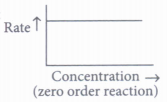
(ii) (c) : The reaction proceeds with a constant rate which is independent of concentration of hydrogen and chlorine. That is why, this reaction is a zero order reaction.
(iii) (b) : For a zero order reaction t1/2 = [a]/2k. .
(iv) (a) :
18.
(i) (b): The transition metals and their compounds are known for their catalytic activity. This activity is ascribed to their ability to adopt multiple oxidation states to form complexes.
(ii) (c) : Because of similar radii and other characteristics of transition metals, alloys are readily formed by these metals.
(iii) (c)
(iv) (b): Greater the number of valence electrons, more will be the number of oxidation states exhibited by the element.
19.
(a)

12th Standard CBSE Syllabus & Materials
12th Standard CBSE
CBSE 12th Computer Science Python Revision Tour I - New Previous year Question Papers Study Material - QB365 Set A
NEW12th Standard CBSE
CBSE 12th Business Studies Planning Important Questions And Answers Study Material - QB365 Set A
NEW12th Standard CBSE
CBSE 12th Business Studies Business Environment Important Questions And Answers Study Material - QB365 Set A
NEW12th Standard CBSE
CBSE 12th Business Studies Principles of Management Important Questions And Answers Study Material - QB365 Set A



NCERT Books

Syllabus

Exam Pattern

Sample Question Papers

Previous year Question Papers

Important Notes

MCQ Practice test

NCERT Exemplers

Case study Questions

Image Based Questions

Passage based Questions

HOT Questions

Value Based Questions

Model Questions Papers
NCERT ( Book Back ) Questions

Assertion and Reason
Important Questions And Answers

CBSE 12th Standard CBSE Subjects
CBSE Standards








