
 100% FREE ACCESS
12th Standard CBSE Syllabus & Materials
12th Standard CBSE
CBSE 12th Economics Government Budget and the Economy Previous year Question Papers Study Material - QB365 Set A
NEW12th Standard CBSE
CBSE 12th Computer Science Interface Python with MySQL - New Previous year Question Papers Study Material - QB365 Set A
NEW12th Standard CBSE
CBSE 12th Computer Science Database Concept - New Previous year Question Papers Study Material - QB365 Set A
NEW12th Standard CBSE
CBSE 12th Computer Science Data Communication - New Previous year Question Papers Study Material - QB365 Set A
NEW12th Standard CBSE
CBSE 12th Computer Science Data Structures - New Previous year Question Papers Study Material - QB365 Set A
NEW12th Standard CBSE
CBSE 12th Computer Science Functions - New Previous year Question Papers Study Material - QB365 Set A

Published on: 25/10/2025
Download CBSE Class 12th Standard CBSE Chemistry question papers, sample papers, important questions, and previous year solved papers in PDF format. Get free study materials, NCERT solutions, and exam preparation resources for Class 12th Standard CBSE Chemistry
Questions + Answers key
Take MCQ Chemistry Test
1.
For a reaction, P⟶Q, the rate becomes 8 times when concentration of P is doubled. What is the order of the reaction?
2.
(a) What type of isomerism is shown by the complex [Co(en)3]CI3?
(b) Write the hybridisation and magnetic character of [Co(C2O4)3]3-. (Atomic number of Co = 27)
(c) Write IUPAC name of the following complex [Cr(NH3)3CI3].
3.
Explain the following observations:
(i) With the same d-orbital configuration (d4), Cr2+ ion is a reducing agent while Mn3+ ion is an oxidising agent.
(ii) Cu+ ion is not stable in aqueous solutions.
(iii) Among the 3d series of transition elements, the largest number of oxidation states are exhibited by manganese.
4.
Nitric oxide,NO reacts with oxygen to nitrogen dioxide:2NO(g) + O2(g)\(\longrightarrow\)2NO2(g) What is the predicted rate law, if the mechnism is:NO + O2\(\overset { k }{ \rightleftharpoons } \)NO3(fast)NO + NO3\(\overset { { k }_{ 1 } }{ \longrightarrow } \)NO2 + NO2(slow).
5.
Explain the following:
(i) The transition elements have great tendency for complex formation.
(ii) There is a gradual decrease in the atomic sizes of transition elements in a series with increasing atomic numbers.
(iii) Lanthanum and Lutetium do not show colouration in solutions.
(At. No : La = 57, Lu = 71)
6.
Which of the following statements related to lanthanoids is incorrect?
Eu shows + 2 oxidation state
Pr(OH)3 to Lu(OH)3, basicity decreases
All lanthanoids more reactive than Al
Ce4+ is used as oxidising agent
7.
If conc. of reactant' A' is increased 10 times and rate of reaction becomes 100 times. What is order with respect to 'A'?
1
2
3
4
8.
The variability of oxidation state
is a characteristic of transition elements
arises out of incomplete filling of d-orbitals in such a way that their oxidation states differ from each other by unity
differs from the variability of oxidation states of non-transition elements, where the oxidation states normally differ by two unit.
All of the above are true
9.
KMnO4 acts as an oxidising agent in alkaline medium. When alkaline KMnO4 is treated with KI, iodide ion is oxidised to ............ .
I2
IO-
\({ IO }_{ 3 }^{ - }\)
\({ IO }_{ 4 }^{ - }\)
10.
A, B and C are three complexes of chromium (III) with the empirical formula H12O6Cl3Cr. All the three complexes have water and chloride ions as ligands. Complex A does not react with conc. H2SO4 whereas complexes B and C lose 6.75% and 13.5% of their original weight respectively, on treatment with concentrated H2SO4.
The complex A is
[Cr(H2O)4(H)4(O)2]Cl3
[Cr(H2O5)5(H)2(O)]Cl3
[Cr(H2O)6]Cl3
[Cr(H2O)5Cl]Cl2.H2O
11.
The CFSE for octahedral [CoCl6]4- is 18,000 cm-1. The CFSE for tetrahedral [CoCl4]2- will be
18,000 cm-1
16,000 cm-1
8,000 cm-1
20,000 cm-1
12.
Prussian blue is obtained by mixing together aqueous solution of Fe3+ salt with
Ferricyanide
Ferocyanide
Hydrogen cyanide
Sodium cyanide
13.
Which one of the following is a tridentate ligand?
NO-2
oxalate ion
glycinate ion
dien
14.
For the reaction A + 2 B \(\longrightarrow\) C, the reaction rate is doubled if the increased by four times when concentration of both A and B are increased by four times. The order of reaction is
3
0
1
2
15.
For the reaction A + B \(\longrightarrow\) C + D, doubling the concentration of both the reactants increases the reaction rate by 8 times and doubling the concentration of only B simply doubles the reaction rate. The rate law is given as
r = k[A]1/2 [B]1/2
r = k[A] [B]2
r = k[A]2[B]
r = k[A] [B}
16.
(a) Consider the reaction R \(\rightarrow\) P for which the change in concentration of R with time is shown by the following graph:
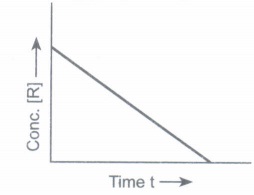
(i) Predict the order of the reaction.
(ii) What does the slope of the curve indicate?
(b) The rate of reaction quadruples when temperature changes from 293 K to 313 K. Calculate Ea assuming that it does not change with time. [R = 8.314 JK-1 mol-1)
17.
Co-ordination compounds have an important role in the field of medicines. Out of these, the compound cis-platin is quite effective against cancer. It inhibits the growth of tumors leading to cancer.
(i) What is the chemical formula and name of the complex?
(ii) How does it behave as an anti cancer agent?
(iii) Why is trans-isomer not effective?
(iv) What is the value associated with the use of cis platin?
18.
Lokesh is a social worker. A milkman in the village has been complaining that a factory in his nearby area dumps chemical waste in his field which has become a major cause of decreasing productivity. Lokesh visited that place and found after analysis that the major waste was potassium permanganate which is being absorbed by the soil. He advised the factory people that they should treat potassium permanganate solution before dumping it into the drain.
Comment in brief:
(i) About the environmental values displayed by Lokesh.
(ii) Write balanced chemical equations for the two reactions showing oxidizing nature of potassium permanganate.
19.
Using crystal field theory, draw energy level diagram, write electronic configuration of the central metal atom/ion and determine the magnetic moment value in the following :
(i) \([CoF_6]^{3-}, [Co(H_2O)_6]^{2+},[Co(CN)_6]^{3-}\)
(ii) \([FeF_6]^{3-}, \ [Fe(H_2O)_6]^{2+}, [Fe(CN)_6]^{4-}\).
20.
Give the examples of two coordination complexes where central metal atom has coordination number (i) 4 (ii) 6
21.
Complete the following chemical equations:
\((i)Cr_2O_7^-(aq)+C_2O_4^{2-}(aq)+H^+(aq)⟶\)
\((ii)MnO_4^-(aq)+Fe^{2+}(aq)+H^+(aq)⟶\)
22.
Why is europium (II) more stable than cerium (II)?
23.
Why does \({ NH }_{ 3 }\)readily form complexes but \({ { NH }_{ 4 } }^{ + }\)does not? Explain.
24.
For a reaction A \(\longrightarrow \) B, the rate of reaction becomes twenty seven times when the concentration of A is increased three ttimes. what is the order of the reaction?
25.
26.
Assertion: Zinc is used in the galvanisation of iron.
Reason: Its coating on iron articles increases their life by protecting them from rusting.
Codes:
(a) Assertion and reason both are correct statements and reason is correct explanation for assertion.
(b) Assertion and reason both are correct statements but reason is not correct explanation for assertion.
(c) Assertion is correct statement but reason is wrong statement.
(d) Assertion is wrong statement but reason is correct statement.
27.

28.
Read the passage given below and answer the following questions:
Arrangement of ligands in order of their ability to cause splitting Δ is called spectrochemical series. Ligands which cause large splitting (large Δ ) are called strong field ligands while those which cause small splitting (small Δ) are called weak field ligands. When strong field ligands approach metal atomlion, the value of Δo is large, so that electrons are forced to get paired up in lower energy t2g orbitals. Hence, a low-spin complex is resulted from strong field ligand. When weak field ligands approach metal atom/ion, the value of Δo is small, so that electrons enter high energy eg orbitals rather than pairing in low energy t2g orbitals. Hence, a high-spin complex is resulted from weak field ligands. Strong field ligands have tendency to form inner orbital complexes by forcing the electrons to pair up. Whereas weak field ligands have tendency to form outer orbital complex because inner electrons generally do not pair up.
In these questions (i-iv), a statement of assertion followed by a statement of reason is given. Choose the correct answer out of the following choices.
(a) Assertion and reason both are correct statements and reason is correct explanation for assertion.
(b) Assertion and reason both are correct statements but reason is not correct explanation for assertion.
(c) Assertion is correct statement but reason is wrong statement.
(d) Assertion is wrong statement but reason is correct statement.
(i) Assertion: In tetrahedral coordination entity formation, the d orbital splitting is inverted and is smaller as compared to the octahedral field splitting.
Reason: Spectrochemical series is based on the absorption of light by complexes with different ligands.
(ii) Assertion: F- ion is a weak field ligand and forms outer orbital complex.
Reason: F- ion cannot force the electrons of dz2 and dx2- y2 orbitals of the inner shell to occupy dxy, dyz and dzx orbitals of the same shell.
(iii) Assertion: The crystal field model is successful in explaining the formation, structures, colour and magnetic properties of coordination compounds.
Reason: In spectrochemical series, ligands are arranged in a series of increasing field strength.
(iv) Assertion: NF3 is a weaker ligand than N(CH3)3.
Reason: NF3 ionizes to give F- ions in aqueous solution.
1.
\(Let Rate, r=k[P]^{n} ---(i)\)
\( 8 r=k[2 P]^{n}---(ii)\\ On \ dividing \ Eq. (ii) \)
\(by \ Eq. (i), we get\)
\(\frac{8 r}{r}=\frac{k[2 P]^{n}}{k[P]^{n}}\)
\(or \ [2]^{3}=[2]^{n} \text { or } n=3\)
Therefore, order of the reaction is 3
2.
(a) Optical isomerism is shown by the complex
[Co(en)3]Cl3
s.png)
(b) In [Co(C2O4)3]3-, cobalt is in +3 oxidation state
Co = [Ar]3d74s2
Co3+ = 3d6
s.png)
Magnetic character = Diamagnetic
(all electrons are paired)
(c) IUPAC name of the complex [Cr(NH3)3CI3]
Triamminetrichlorochromium (III).
3.
(iii) Manganese exhibits all the oxidation states from + 2 to + 7. It shows largest number of oxidation states as it has the maximum number of unpaired electrons.
4.
Rate = k[NO]2[O2].
5.
(i) It is due to the presence of vacant d-orbitals of suitable energy, the smaller size of cautions and higher charge.
(ii) It is due to increase in effective nuclear charge gradually because unpaired electrons increase in the beginning and then decreases. There is repulsion between paired electrons.
(iii) It is due to absence of unpaired electrons, they do not absorb light from visible region and do not radiate color.
6.
(c)
All lanthanoids more reactive than Al
7.
(b)
2
8.
(d)
All of the above are true
9.
(c)
\({ IO }_{ 3 }^{ - }\)
10.
(c)
[Cr(H2O)6]Cl3
11.
(c)
8,000 cm-1
12.
(b)
Ferocyanide
13.
(d)
dien
14.
(c)
1
15.
(c)
r = k[A]2[B]
16.
(a) (i) It is zero order reaction
(ii) slope = - k
Negative of slope is equal to rate constant.
(b) Given if rate at 293 K is R thus 313 K rate becomes
\(4Rlog\frac{k_2}{k_1}=\frac{E_a}{2.303R}[\frac{T_2-T_1}{T_1\times T_2}]\)
\(\ log\frac{4R}{R}=\frac{E_a}{2.303\times 8.314}[\frac{313-293}{293\times313}]\)
\(\Rightarrow\ log\frac{4R}{R}=\frac{E_a}{19.1471}[\frac{20}{91709}]\)
\(\Rightarrow\ 0.6021=\frac{E_a}{19.1471}[\frac{20}{91706}]\)
\(\Rightarrow\ \ \ \ \frac{0.6021 \times 19.1471 \times 91709}{20}=E_a\)
\(\Rightarrow\ \ \ \ E_a=52863.2177\ J\ mol^{-1}\)
\(=52.863\ kJ\ mol^{-1}\)
17.
(i)The chemical formula of the compound is shown. Its name is cis-diammine dichlorido platinum (II).
(ii) It behaves as an anti cancer agent by taking part in the chelate formation or chelation.
(iii) In the trans isomer the similar groups are on opposite sides and chelate formation does not take place.
(iv) Cis-platin saves many valueable lives by forming co-ordinate complex. So it is life saving.
18.
(i) Lokesh knows about the soil pollution caused by chemical industrial waste. His responsibility towards society and environment and social awareness are displayed here.
(ii) 10FeSO4 + 2KMn04 + 8H2SO4 \(\longrightarrow \)K2SO4 + 2MnSO4 + 5 Fe2(SO4)3 + 8H2O
5H2C2O4 + 2KMnO4 + 3H2SO4 \(\longrightarrow \)+ K2SO4 + 2MnSO4 + 8H2O + 10CO2
19.
(i) \([CoF_6]^{3-}\)
\( [Co(H_2O)_6]^{2+}\)
\([Co(CN)_6]^{3-}\)
(ii) \([FeF_6]^{3-}\)
\(\ [Fe(H_2O)_6]^{2+}\)
\([Fe(CN)_6]^{4-}\)
It is diamagnetic due to the absence of unpaired electrons.
20.
Coordination number 4 = [Pt(NH3)2 Cl2]
Coordination number 6 = [CO(NH3)4 Cl2]+
21.
\((i)Cr_2O_7^-(aq)+C_2O_4^{2-}(aq)+H^+(aq)⟶2Cr^{3+}+7H_2O+6CO_2\)
\((ii)MnO_4^-(aq)+Fe^{2+}(aq)+H^+(aq)⟶Mn^{2+}+4H_2O+5Fe^{3+}\)
22.
Europium (II) has electronic configuration [Xe] 4f 5do while cerium (II) has electronic configuration [Xe] 4f 5d1. In Eu2+, 4f - subshell is half filled and 5d-subshell is empty. Since half filled and completely filled electronic configurations are more stable, the Eu2+ ion is more stable than Ce2+in which neither 4f subshell nor 5d-subshell is half filled or completely filled.
23.
NH3 contains a lone pair of electrons which coordinate with the metal ion to form the complex compound. However, in NH4+ ion, the lone pair is bound to H+ and therefore, is not available for bonding to metal ion. Therefore, NH4+ does not form complexes readily.
24.
3
25.
26.
(a): Zinc has no action of air or water on it and thus, its coating on iron articles increase their life by protecting them from rusting.
27.
28.
(i) (b)
(ii) (a)
(iii) (b)
(iv) (c): Due to high electronegativity of F- atoms, the lone pair of N-atom in NF3 molecule cannot be ligated easily. Whereas in N(CH3)3' CH3 group is a electron releasing group, thus lone pair of N-atom in N(CH3)3 molecule can be ligated easily.
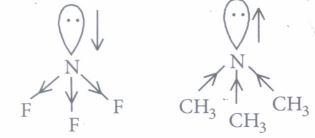
Except, nitrogen fluoride, all other halides hydrolyse in water.

12th Standard CBSE Syllabus & Materials
12th Standard CBSE
CBSE 12th Computer Science Python Revision Tour I - New Previous year Question Papers Study Material - QB365 Set A
NEW12th Standard CBSE
CBSE 12th Business Studies Planning Important Questions And Answers Study Material - QB365 Set A
NEW12th Standard CBSE
CBSE 12th Business Studies Business Environment Important Questions And Answers Study Material - QB365 Set A
NEW12th Standard CBSE
CBSE 12th Business Studies Principles of Management Important Questions And Answers Study Material - QB365 Set A



NCERT Books

Syllabus

Exam Pattern

Sample Question Papers

Previous year Question Papers

Important Notes

MCQ Practice test

NCERT Exemplers

Case study Questions

Image Based Questions

Passage based Questions

HOT Questions

Value Based Questions

Model Questions Papers
NCERT ( Book Back ) Questions

Assertion and Reason
Important Questions And Answers

CBSE 12th Standard CBSE Subjects
CBSE Standards








