
 100% FREE ACCESS
12th Standard CBSE Syllabus & Materials
12th Standard CBSE
CBSE 12th Economics Government Budget and the Economy Previous year Question Papers Study Material - QB365 Set A
NEW12th Standard CBSE
CBSE 12th Computer Science Interface Python with MySQL - New Previous year Question Papers Study Material - QB365 Set A
NEW12th Standard CBSE
CBSE 12th Computer Science Database Concept - New Previous year Question Papers Study Material - QB365 Set A
NEW12th Standard CBSE
CBSE 12th Computer Science Data Communication - New Previous year Question Papers Study Material - QB365 Set A
NEW12th Standard CBSE
CBSE 12th Computer Science Data Structures - New Previous year Question Papers Study Material - QB365 Set A
NEW12th Standard CBSE
CBSE 12th Computer Science Functions - New Previous year Question Papers Study Material - QB365 Set A

Published on: 25/10/2025
Download CBSE Class 12th Standard CBSE Chemistry question papers, sample papers, important questions, and previous year solved papers in PDF format. Get free study materials, NCERT solutions, and exam preparation resources for Class 12th Standard CBSE Chemistry
Questions + Answers key
Take MCQ Chemistry Test
1.
What are reducing sugars?
2.
Why are vitamin A and vitamin C essential to us ? Give their important sources ?
3.
How will you convert
(i) Benzene into aniline
(ii) Benzene into N, N-dimethylaniline
(iii) Cl-(CH2)4-CI into hexane-1, 6-diamine?
4.
[Fe(CN)6]4- and [Fe(H2O)6]2+ are of different colours in dilute solutions. Why?
5.
Write chemical equations for the following conversions:
(i) CH3-CH2-Cl into CH3-CH2-CH2-NH2
(ii) C6H5-CH2-Cl into C6H5-CH2-CH2-NH2
6.
Discuss briefly giving an example in each case the role of coordination compounds in:
(a) biological systems,
(b) analytical chemistry,
(c) medicinal chemistry and
(d) extraction/metallurgy of metals.
7.
Write the major product(s) in the following reactions.
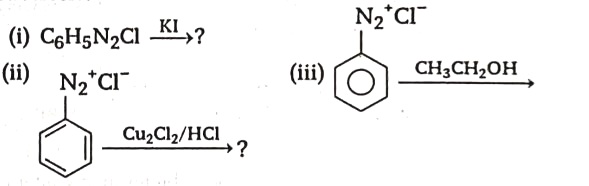
8.
Write the IUPAC names of the following coordination compounds.
(a) [Co(NH3)4CI(NO2))CI
(b) [Ni(NH3)6]Cl2
(c) K3[Cr(C2O4)3]
(d) [Co(en)2Br2]+
9.
Write the function of the following enzymes.
(i) Invertase
(ii) Urease
(iii) Maltase
10.
(i) Write the name of two monosaccharides obtained on hydrolysis of lactose sugar.
(ii) Why vitamin C cannot be stored in our body?
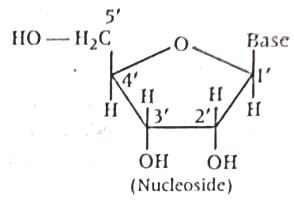
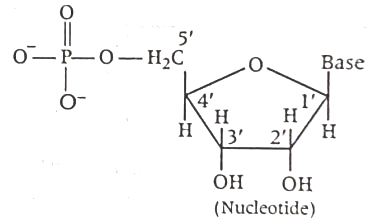
(iii) What is the difference between a nucleoside and nucleotide?
11.
Explain [Co(NH3)6]3+ is an inner orbital complex whereas [Ni(NH3)6]2+ is an outer orbital complex.
12.
A compound 'X' having molecular formula C3H7NO, reacts with Br2 in presence of KOH to give another compound 'Y'. The compound Y reacts with NHO2 to form ethanol and N2 gas. Identify the compounds X and Y and write the reactions involved.
13.
The two strands in DNA are not identical but are complementary. Explain.
14.
Describe for any two of the following comples ions, the type of hybridization, shape and magnetic property:
(i) [Fe(H2O)6]2+
(ii) [Co(NH3)6]3+
(iii) [NiCl4]2-
(At. Nos.Fe = 26, Co = 27, Ni = 28)
15.
Carbohydrates are optically active polyhydroxy aldehydes and ketones. They are also called saccharides. All those carbohydrates which reduce Fehling solution and Tollen's reagent are referred to as reducing sugars. Glucose, the most important sources of energy for mammals, is obtained by the hydrolysis of starch. Vitamins are accessory food factors required in the diet. Proteins are the polymers of \(\alpha\)-amino acids and perform various structural and dynamic functions in the organisms. Deficiency of vitamins leads to many diseases.
Answer the following
(a) The penta-acetate of glucose does not react with hydroxylamine. What does it indicate?
(b) Why cannot vitamin C be stored in our body?
(c) Define the following as related to proteins:
(i) Peptide linkage
(ii) Denaturation
Or
(c) Define the following as related to carbohydrates:
(i) Anomers
(ii) Glycosidic linkage
16.
(i) Define:
(a) Metal carbonyls
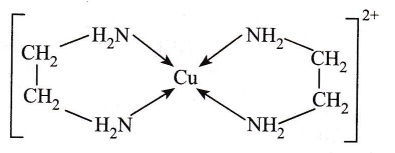
(b) Chelate
(ii) (a) Give one chemical test as an evidence to show that [Co(NH3)5CI]SO4 and [Co(NH3)5(SO4)] Cl are ionisation isomers.
(b) [NiCl4]2- is paramagnetic while [Ni(CO4] is diamagnetic though both are tetrahedral. Why? (Atomic no. of Ni = 28)
(c) Write the electronic configuration of Fe(III) on the basis of crystal field theory when it forms an octahedral complex in the presence of (i) strong field ligand, and (ii) weak field ligand. (Atomic no. of Fe = 26)
17.
List various types of isomeris possible for coordination compounds, give an example of each.
18.
A compound A (C6H12O6) is oxidised by bromine witer into monobasic acid. It also reduces Tollen's reagent and reacts with HCN to give a compound B which on hydrolysis gives a compound C. On treating C with HI/red P, n-heptanoic acid is obtained. Compound A on treatment with excess phenyl hydrazine gave D-glucoszone. Name the compound A and draw its cyclic from.
19.
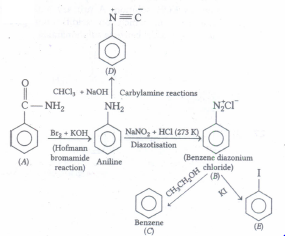
An aromatic compound 'A' of molecular formula C7H7ON undergoes a series of reactions as shown below. Write the structures of A, B, C, D and E in the following reactions.
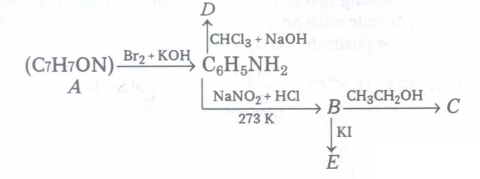
20.
Write short notes on the following:
(i) Carbylamine reaction
(ii) Diazotisation
(iii) Hoffmann's bromamide reaction
(iv) Coupling reaction
(v) Ammonolysis
(vi) Acylation
(vii) Carbylamine reaction
21.
An organic compound C7H9N forms clear solution when dissolved in KOH after reacting with C6H5 SO2Cl, 'A' on diazotisation at OQC and then reaction with \(\beta\)-naphthol gives orangish red dye. 'A' on electrophilic substitution gives single product. 'A' is
4-Methyl aniline
2-Methyl aniline
3-Methyl aniline
N-Methyl aniline
22.
The name of complex [Fe(CN)6]3- is
Tricyanido ferrate (III) ion
Hexacyanido ferrate (III) ion
Hexacyanido iron (Ill)
Hexacyanido ferrate (II) ion
23.
Which of the following disease is caused by the deficiency of vitamin E?
Beri-beri
Rickets
Scurvy
Muscular weakness
24.
Which of the following statements are correct ?
\(\alpha \)-and \(\beta \)-D-glucopyranose are anomers
-D-glucopyranose is more stable than -D-glucopyranose
galactose is a C4-epimer of glucose
invert sugar is laevorotatory
25.
The deficiency of vitamin C causes
scurvy
rickets
pyorrhea
pernicious anaemia
26.
The final product in the following reaction sequence \(p-Chloroaniline\overset { { NaNO }_{ 2 }\ /\ HCI }{ \underset { 0-5^{ \circ }C }{ \longrightarrow } } \ ?\ \overset { KCN }{ \longrightarrow } \quad ?\quad \overset { LiAIH_{ 4 } }{ \longrightarrow } ?\)
p-chlorobenzamide
p-chlorophenol
p-chlorobenzylamine
p-chlorobenzyl alcohol
27.
The compound which gives an oily nitrosoamine on reaction with nitrous acid at low temperature is
CH3NH2
(CH3)2CHNH2
CH3-NH-CH3
(CH3)3N
28.
Glycogen is a branched chain polymer of \(\alpha\)-D-glucose units nin which chain is formed by C1 - C4 glycosidic linkage whereas branching occures by the formation of C1-C6 glycosidic linkage. Structure of clycogen is similar to ......... .
Amylose
Amylopectin
Cellulose
Glucose
29.
In the following reaction, X is \(X\overset { Bromination }{ \longrightarrow } Y\overset { NaNO_{ 2 }\quad /HCI }{ \longrightarrow } Z\overset { Boiling }{ \underset { { C }_{ 2 }{ H }_{ 5 }OH }{ \longrightarrow } } Tribromobenzene\)
Benzoic acid
Salicylic acid
Phenol
Aniline
30.
The compound Na2[Fe(CN)5NO] is called
sodium nitroprusside
sodium pentacyanonitrosonium ferrate (II)
sodium pentacyanonitrosylferrate (III)
sodium nitrosoferrocyanide
31.
For the given complex [CoCl2 (en) (NH3)2]+, the number of geometrical isomers, the number of optical isomers and total number of isomers of all type possible respectively are
2, 2 and 4
2, 2 and 3
2, 0 and 2
0, 2 and 2
32.
The dark blue colour of the solution formed when excess of ammonia is added to a solution of copper (II) sulphate is due to the presence of the ion
[Cu(OH)4 (H2O)2]2-
[Cu(H2O)6]2+
[Cu(NH3)2 (H2O)4]2+
[Cu(NH3)4 (H2O)2]2+
33.
Assertion : Glucose and fructose give the same osazone.
Reason : During osazone formation stereochemistry at C1 and C2 is destroyed.
Codes:
A) Assertion and reason both are correct statements and reason is correct explanation for assertion.
B) Assertion and reason both are correct statements but reason is not correct explanation for assertion.
C) Assertion is correct statement but reason is wrong statement.
D) Assertion is wrong statement but reason is correct statement.
34.
Assertion: Glycine exists as zwitter ion but o - and p-aminobenzoic acids do not.
Reason: Due to the presence of -NH2 and -COOH group within the same molecule, they neutralise each other and hence, \(\alpha \) -amino acids exist as dipolar ions or zwitter ions.
Codes:
(a) Assertion and reason both are correct statements and reason is correct explanation for assertion.
(b) Assertion and reason both are correct statements but reason is not correct explanation for assertion.
(c) Assertion is correct statement but reason is wrong statement.
(d) Assertion is wrong statement but reason is correct statement.
35.
Assertion: Boiling point of amines are lower than those of alcohols and carboxylic acids.
Reason: Amines are much more soluble in water than less polar solvents like alcohol, ether, etc.
Codes:
(a) Assertion and reason both are correct statements and reason is correct explanation for assertion.
(b) Assertion and reason both are correct statements but reason is not correct explanation for assertion.
(c) Assertion is correct statement but reason is wrong statement.
(d) Assertion is wrong statement but reason is correct statement.
36.
Assertion: Cu(OH)2 is soluble in NH4OH but not in NaOH.
Reason: Cu(OH)2 forms a soluble complex with NH3.
Codes:
(a) Assertion and reason both are correct statements and reason is correct explanation for assertion.
(b) Assertion and reason both are correct statements but reason is not correct explanation for assertion.
(c) Assertion is correct statement but reason is wrong statement.
(d) Assertion is wrong statement but reason is correct statement.
37.
Carbohydrates are polyhydroxy aldehydes or ketones and are also called saccharides, Glucose is an example of monosaccharides. GIucose (C6H12O6) is an aldohexose and its open chain structure was assigned on the basis of many reactions as evidences like presence of carbonyl group, presence of straight chain, presence of five -OH groups etc.
Glucose is correctly named as D-(+)-glucose. Glucose is found to exist in two different crystalline forms which are named as \(\alpha\) and \(\beta\). Despite having the aldehyde group, glucose does not give 2, 4-DNP test.
(i) What is the correct structure of D-(+)-glucose?
(ii) Glucose on oxidation with HNO3 gives a dicarboxylic acid called saccharic acid. What does this result indicate?
(iii) The pentaacetate of glucose does not react with H2N-OH What does this result indicate?
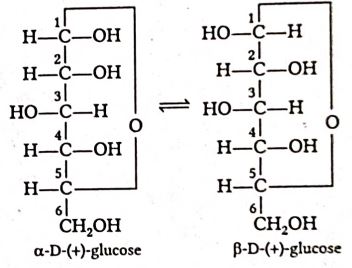
(iv) What is the difference between \(\alpha\)-D-glucose and \(\beta\)-D-glucose?
Or
Give the possible explanation for the following:
Glucose doesn't give 2,4-DNP test.
38.
The oxidation number of the central atom in a complex is defined as the charge it would carry if all the ligands are removed along with the electron pairs that are shared with the central atom. Similarly the charge on the complex is the sum of the charges of the constituent parts, i.e. the sum of the charges on the central metal ion and its surrounding ligands.
Based on this, the complex is called neutral if the sum of the charges of the constituents is equal to zero. However, for an anion or cationic complex, the sum of the charges of the constituents is equal to the charge on the coordination sphere.
Based on the above information, answer the following questions.
(a) Define ambidentate ligand with an example.
(b) What type of isomerism is shown by [Co(NH3)5Cl]SO4 and [Co(NH3)5SO4]Cl?
(c) Define chelate effect. How it affects the stability of complex?
Or
(c) Find the coordination number and oxidation state of chromium in Na3[Cr(C2O4)3].
1.
All those carbohydrates which contain a free aldehyde or Ketonic group and reduce Fehling's solution and Tollen's reagent are referred as a reducing Sugar. Examples of reducing sugar is galactose, glucose, glyceraldehyde, fructose, ribose, and xylose.
2.
Vitamin A is essential to us because its deficiency causes xerophthalmia (hardening of cornea of eye) and night blindness.
Sources: Fish liver oil, carrots, butter, and milk.
Vitamin C. Vitamin C is essential to us because its deficiency causes scurvy (bleeding gums) and pyorrhea (loosening and bleeding of teeth).
Sources: Citrous fruits; arnIa, green leafy vegetables.
3.
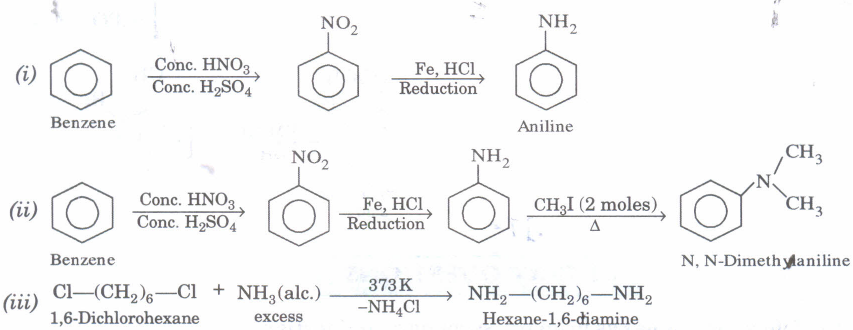
4.
In both the complexes, Fe is in +2 state with the configuration 3d6, i.e., it has four unpaired electrons. As the ligands H2O and CN- possess different crystal field splitting energy, they absorb different components of the visible light (VIBGYOR) for d - d transition. Hence, the transmitted colours are different.
5.

6.
(a) Biological processes: Chlorophyll contains Mg, which is used in photosynthesis. Haemoglobin contains Fe, which acts as oxygen carrier. Vitamin-B12 contain cobalt which is used to preven anaemia.
(b) Analytical chemistry:
(i) Ni2+ is detected by using DMG (dimethylglyoxime)
(ii) EDTA is used for sofening of hard water.
(c) Medicinal chemistry: cis-Platin is used as anticancer agent.
(d) Metallurgical operation: Cyanide complexes are used in extraction of Ag and Au.
7.
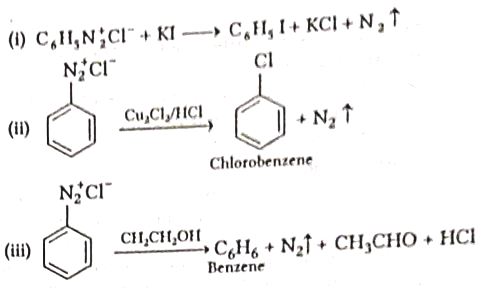
8.
(a) [Co(NH3)4CI(NO2))CI = Tetraaminechloridoinitro cobalt(III) chloride
(b) [Ni(NH3)6]Cl2 = Hexaaminenickel(II) chloride
(c) K3[Cr(C2O4)3] = Potassiumtrioxalatochromate (III)
(d) [Co(en)2Br2]+ = Dibromido bis (ethylenediamine)cobalt (III)ion
9.
(i) Write the function ofthe follow Hydrolysis of cane sugar.
(ii) Urease Decomposition of urea into NH3 and CO2.
(iii) Maltase Hydrolysis of maltose into glucose
10.
(i) D-glucose and D-galactose.
(ii) Since, vitamin C is a water soluble vitamin, it is excreted out through urine, hence cannot be stored.
(iii) Nucleoside A unit formed by the attachment of a base to 1' position of sugar is known as nucleoside.
Nucleotide When nucleoside is linked to phosphoric acid at 5' position of sugar moiety, a nucleotide is obtained. They are joined together by phosphodiester linkage between 5' and 3' carbon atoms of the pentose sugar.
11.
In [Co(NH 3)6]3+, Co is in +3 state with the configuration 3d6. In the presence of NH 3, 3d electrons pair up leaving two d-orbitals empty. Hence, the hybridisation is d2sp forming an inner orbital complex. In [Ni(NH 3 forming an inner orbital complex. In [Ni(NH 3)6]2+, Ni is in +2 state with the configuration 3d.8. In presence of NH3, the 3d electrons do not pair up. The hybridization involved is sp3d2 forming an outer orbital complex.
12.

13.
Each strand consist of 4 bases which are Adenine, Guanine, Thymine and Cytosine.
These complementary bases are the following:
Adenine (A) ⇔ Thymine (T)
Cytosine (C) ⇔ Guanine (G)
⇔ This symbol represents that both the left and right hand side bases are complementary to each other.
The two strands are internally connected by hydrogen bonding between complementary bases. The two strands of DNA are not identical because their sequence of bases has to be complementary to each other. Ex- If one sequence is ATCG the other has to be TAGC.
14.
(i) [Fe(H2O)6]2+; Fe(26): [Ar]4s23d6
Fe2+: [Ar]4s0 3d6
H2O is weak field ligand, does not cause pairing of electrons.
It has sp3d2 hybridisation, octahedral shape and paramagnetic.
(ii) [Co(NH3)6]3+; Co(27): [Ar] 4s23d7; Co3+(27):[Ar]4s0 3d6
NH3 is strong field ligand will cause pairing of electrons.
It has d2sp3 hybridisation, octahedral shape and diamagnetic in nature.
(iii) [NiCl4]2-; Ni(28) : [Ar] 4S23d8
Ni2+: [Ar] 4s03d8, Cl- is weak field ligand, does not cause pairing of electrons.
It has sp3 hybridisation, therefore, has tetrahedral structure. It is paramagnetic.
15.
(a) The penta-acetate of glucose does not react with hydroxylamine. It indicates that the carbonyl group of glucose is not free as it is present in cyclic form.
(b) Vitamin C is water soluble, that's why it cannot stored in our body.
(c) (i) Peptide linkage Proteins are connected to each other by –CO–NH– bond which is called the peptide linkage.
(ii) Denaturation When a native protein is subjected to physical change or chemical change, the hydrogen bonds are disturbed. As a result, globules unfold and helix gets uncoiled and protein loses its biological activity. This is known as denaturation of proteins.
Or
(c) (i) Anomers In carbohydrates, a pairs of anomers, is a near-identical stereoisomers that differ at only the anomeric carbon.
(ii) Glycosidic linkage The two monosaccharide units are joinied together through an oxide linkage, known as glycosidic linkage.
16.
(i) (a) Metal carbonyls: Metal carbonyls are the compounds in which carbon monoxide (CO) acts as the ligand. The metal-carbon bond in metal carbonyls possesses both \(\sigma\) and \(\pi\) characters, e.g. N(CO)4[nickeltetracarbonyl]. Its IUPAC name is tetra carbonyl nickel(0).
(b) Chelate: An inorganic metal complex in which there is a close ring of atoms caused by attachment of a ligand to a metal atom at two points. An example is the complex ion formed between ethylene diamine and cupric ion,[Cu(NH2CH2CH2NH2)2]2+.
(ii) (a) Add BaCl2 solution. [Co(NH3)]5Cl]SO4 will give white ppt. of BaSO4.
\(\left[\mathrm{Co}\left(\mathrm{NH}_{3}\right)_{5} \mathrm{Cl}\right] \mathrm{SO}_{4}+\mathrm{BaCl}_{2}(a q) \)\( \longrightarrow\left[\mathrm{Co}\left(\mathrm{NH}_{3}\right)_{5} \mathrm{Cl}\right] \mathrm{Cl}_{2}+\mathrm{BaSO}_{4} \downarrow \)
\(\text { (White ppt.) }\)
Add AgNO3(aq) solution [Co(NH3)5SO4] Cl will give white ppt. of AgCl.
\( {\left[\mathrm{Co}\left(\mathrm{NH}_{3}\right)_{5} \mathrm{SO}_{4}\right] \mathrm{Cl}+\mathrm{AgNO}_{3}(a q)} \) \(\longrightarrow \mathrm{AgCl}+\left[\mathrm{Co}\left(\mathrm{NH}_{3}\right)_{5} \mathrm{SO}_{4}\right] \mathrm{NO}_{3} \)
\(\text { (White ppt) }\)
(c) Fe3+ (4s03d5) In strong field \( \Delta_{0}>P t_{2 g}^{5} e g^{0} \)
In weak field \(\Delta_{0}
17.
(i) Ionisation isomerism:
Those isomers which produce different ions in aqueous solution are called ionization isomers. In ionization isomers counter ions are ligands which can replace ligands,
e.g. [Co(NH3)5SO4Br and [Co(NH3)5Br]SO4
(ii) Linkage isomers:
Those isomers which have ambidentate ligands can show linkage isomerism. They differ in donor atom forming coordinate bond,
e.g. [Co(NH3) 5 NO2]2+ and [Co(NH3) 5ONO]2+.
(iii) Coordination isomerism:
It arises from the interchange of ligands between cationic and anionic entities of different metal ions present in a complex,
e.g. [Co(NH3)6 ]6Cr(CN)6] and [Cr(NH3)6][Co(CN)6]
(iv) Solvate isomerism:
They differ in number of solvent molecules forming coordinate bond with central metal ion,
e.g. [Cr(H2O)5]CI3 is violet; whereas [Cr(H2 O)5CI]CI2.H2 O is greyish green.
18.
cyclic from of glucose (A)
19.
20.
(i) Carbylamine Reaction: When primary amne reacts with CHCl3 and KOH, it forms isocyanide which is an offensive smelling compund.
\(RN{ H }_{ 2 }+CHC{ l }_{ 3 }+3KOH\rightarrow RN\overset { = }{ \rightarrow } C+3KCl+3{ H }_{ 2 }O\)
(ii) Diazotisation: When aniline is reacted with NaNO2 and conc. HCl at 0-5o C, benzene diazonium chloride is formed.

(iii) Hoffman's Bromamide Reaction: When amide react with Br2 and KOH or NaOH to form lower amines, it is called Hoffman's Bromamide Reaction.

(iv) Coupling reaction: When benzene diazonium chloride reacts with phenol, the orange azo dye is formed.

(v) Ammonolysis: When alkyl halide with an excess of NH3 primary amines are formed.
C2H5Cl+NH3 \(\rightarrow\)C2H5NH2+HCl
(vi)Carbylamine reaction (i) Carbylamine reaction When aliphatic/ aromatic primary amines are heated with chloroform and alc KOH, foul-smelling alkyl isocyanides or carbylamines are obtained. Secondary or tertiary amines do not give this test.
(vii) \(\mathbf{P h}-\mathbf{N H}_{2}+\mathbf{C H C l}_{3}+3 \mathbf{K} \mathbf{O H} \stackrel{\Delta}{\longrightarrow} \mathbf{P h}-\mathbf{N C}+3 \mathbf{K} \mathbf{C l}+\mathbf{3 H}_{2} \mathbf{O}\)
2 ° and 3 ° (aromatic/aliphatic) do not give this reaction.
21.
(a)
4-Methyl aniline
22.
(b)
Hexacyanido ferrate (III) ion
23.
(d)
Muscular weakness
24.
(a)
\(\alpha \)-and \(\beta \)-D-glucopyranose are anomers
25.
(a)
scurvy
26.
(c)
p-chlorobenzylamine
27.
\({ 2 }^{ \circ }\) Amines, i.e., (CH3)2NH, on treatment with HNO2 give oily nitrosamines.
28.
(b)
Amylopectin
29.
(d)
Aniline
30.
(a)
sodium nitroprusside
31.
(b)
2, 2 and 3
32.
(d)
[Cu(NH3)4 (H2O)2]2+
33.
A) Assertion and reason both are correct statements and reason is correct explanation for assertion.
Explanation:
Glucose and fructose differ from each other only at C1 and C2 positions.
34.
(b): In o- or p-aminobenzoic acids, the lone pair of electrons on the -NH2 group is donated towards the benzene ring. As a result, the basic character of -NH2 group and acidic character of -COOH group decreases. Therefore, the weakly acidic -COOH group cannot transfer H+ ion to the weakly basic -NH2 group therefore, o and p-aminobenzoic acids do not exist as zwitter ion.
35.
(b): It is because hydrogen bonding is less pronounced in primary and secondary amines than that in alcohols or carboxylic acids and nitrogen is less electronegative than oxygen
36.
(a) Assertion and reason both are correct statements and reason is correct explanation for assertion.
37.
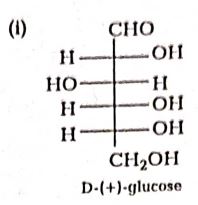
(ii) Glucose on oxidation with HNO3 gives saccharic acid. This indicates the presence of a one primary alcoholic (-OH) group in glucose.
(iii) The pentaacetate of glucose does not react with hydroxylamine which shows the absence of free aldehydic (-CHO) group.
(iv) In \(\alpha\)-D-glucose, the -OH group at C1 is towards right, whereas in \(\beta\)-D-glucose, the -OH group at C1 is towards left. Such a pair of stereoisomers which differ in the configuration only at C1 are called anomers.
Or
Actually, glucose exists in the cyclic hemiacetal form (hence the aldehyde group is not free) with only a small amount (<0.05%) of the open chain form.
Since, the concentration of the open chain form is low and its reaction with 2,4-DNP is reversible, therefore, formation of 2,4-DNP derivative cannot disturb the equilibrium to regenerate more open chain form from the cyclic hemiacetal form and hence, does not give this test.
38.
(a) When a ligand is bonded through a two different atoms, it is said to be ambidendate ligand,
e.g. \(\mathrm{NO}_2^{-}\), SCN-, CN-.
(b) [Co(NH3)5Cl]SO4 and [Co(NH3)5SO4]Cl show ionisation isomerism.
This type of isomerism arises when compounds give different ions in the solution although they have same composition.
(c) Chelate effect signify the stabilisation of coordination compounds due to the formation of metal chelates. The chelating ligands form more stable complexes than the unidentate analoges because when chelation occurs, entropy decreases and the process becomes more favourable and form a ring complexes which is known as chelate ring.
Or
(c) In complex Na3[Cr(C2O4)3] the coordination number of Cr is 6 as oxalate is a bidentate ligand.
Let, the oxidation number of Cr be x.
\(\therefore\) 3 + x + 3(-2) = 0
x = + 3
Thus, oxidation state of Cr be +3.

12th Standard CBSE Syllabus & Materials
12th Standard CBSE
CBSE 12th Computer Science Python Revision Tour I - New Previous year Question Papers Study Material - QB365 Set A
NEW12th Standard CBSE
CBSE 12th Business Studies Planning Important Questions And Answers Study Material - QB365 Set A
NEW12th Standard CBSE
CBSE 12th Business Studies Business Environment Important Questions And Answers Study Material - QB365 Set A
NEW12th Standard CBSE
CBSE 12th Business Studies Principles of Management Important Questions And Answers Study Material - QB365 Set A



NCERT Books

Syllabus

Exam Pattern

Sample Question Papers

Previous year Question Papers

Important Notes

MCQ Practice test

NCERT Exemplers

Case study Questions

Image Based Questions

Passage based Questions

HOT Questions

Value Based Questions

Model Questions Papers
NCERT ( Book Back ) Questions

Assertion and Reason
Important Questions And Answers

CBSE 12th Standard CBSE Subjects
CBSE Standards








