
 100% FREE ACCESS
12th Standard CBSE Syllabus & Materials
12th Standard CBSE
CBSE 12th Economics Government Budget and the Economy Previous year Question Papers Study Material - QB365 Set A
NEW12th Standard CBSE
CBSE 12th Computer Science Interface Python with MySQL - New Previous year Question Papers Study Material - QB365 Set A
NEW12th Standard CBSE
CBSE 12th Computer Science Database Concept - New Previous year Question Papers Study Material - QB365 Set A
NEW12th Standard CBSE
CBSE 12th Computer Science Data Communication - New Previous year Question Papers Study Material - QB365 Set A
NEW12th Standard CBSE
CBSE 12th Computer Science Data Structures - New Previous year Question Papers Study Material - QB365 Set A
NEW12th Standard CBSE
CBSE 12th Computer Science Functions - New Previous year Question Papers Study Material - QB365 Set A

Published on: 25/10/2025
Download CBSE Class 12th Standard CBSE Chemistry question papers, sample papers, important questions, and previous year solved papers in PDF format. Get free study materials, NCERT solutions, and exam preparation resources for Class 12th Standard CBSE Chemistry
Questions + Answers key
Take MCQ Chemistry Test
1.
Consider the Figure and answer the following questions.
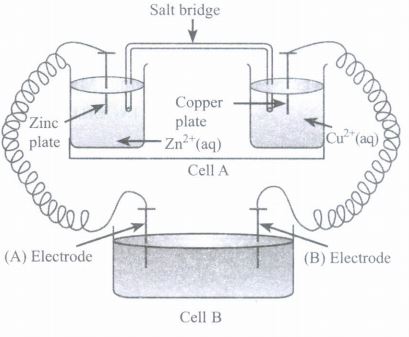
(i) Cell' A' has ECell = 2V and Cell 'B' has ECell = 1.1 V. Which of the two cells 'A' or 'B' will act as an electrolytic cell? Which electrode reactions will occur in this cell?
(ii) If cell 'A' has ECell = 0.5 V and Cell 'B' has ECell = 1.1 V then what wi II be the reactions at anode and cathode?
2.
Define effective collisions.
3.
Identify the reaction order of K = 3 x 10- 4 s-1
4.
Some square planar complexes of Ni(II) are diamagnetic while some are paramagnetic, Justify.
5.
Give the IUPAC name of K3[Co(NO3)6].
6.
The molar conductivity of 1.5 M solution of an electrolyte is found to be 138.9 S cm2 mol-1 . Calculete the conductivity of this solution.
7.
(i) The conversion of molecule A to B followed second order kinetics. If concentration of A increased to three times, how will it affect the rate of formation of B?
(ii) Define Pseudo first order reaction with an example.
8.
The following results have been obtained during kinetic studies of the reaction,
2A + B\(\longrightarrow\)C + D
| Experiment | [A]/mol | [B]/mol | Initial rate of fornmation of D/mol L-1 min-1 |
| I | 0.1 | 0.1 | 6.0\(\times\)10-3 |
| II | 0.3 | 0.2 | 7.2\(\times\)10-2 |
| III | 0.3 | 0.4 | 2.88\(\times\)10-1 |
| IV | 0.4 | 0.1 | 2.4\(\times\)10-2 |
Determine rate law and the rate constant for the reaction.
9.
Write down the IUPACnames of the following coordination compounds.
(i) [Co(NH3)5 Cl]Cl2
(ii) K2[PdC14]
10.
Write the structures and names of all the stereo isomers of the following compounds
(i) [Co(en)2] Cl2]+
(ii) [Pt (NH3)2CI2]
(iii) [Fe(NH3)4CI2]CI
11.
Calculate the equilibrium constant for the reaction at 298 K :
NiO2 + 2 CI- + 4 H+ \(\rightarrow\) Cl2+ Ni2+ + 2 H2O if E0 cell = 0.320 V.
12.
Specific the conductivity of a 0.12 normal solution of an electrolyte is 0.024 ohm-1 cm-1. Determine its eqivalent conductivity
13.
[Co(NH3)5 NO3] SO4 and [Co(NH3)5SO4] NO3 exhibit
Linkage isomerism
Ionisation isomerism
Optical isomerism
Coordination isomerism
14.
The complex ion having minimum magnitude of \(\triangle\)o(CFSE) is
[CO(NH3)6]3+
[Cr(H2O)6]3+
[Cr(CN)6]3-
[CoCl6]3-
15.
X(s) + 2Y+ (aq) \(\rightleftharpoons\) X2+ (aq) + 2Y(s); \(\left(\mathbf{E}_{\text {cell }}^{\circ}=\mathbf{0 . 0 5 9} \mathbf{V}\right)\)
What is the value of 'K' for above reaction?
1 x 10⁸
1 x 10²
4 x 10³
3 x 10⁴
16.
Consider Fig. and mark the correct option.
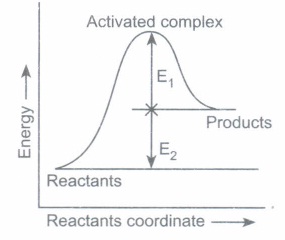
Activation energy of forward reaction is E1 + E2 and product is less stable than reactant.
Activation energy of forward reaction is E1 + E2 and product is more stable than reactant.
Activation energy of both forward and backward reaction is E1 + E2 and reactant is more stable than product.
Activation energy of backward reaction is E1 and product is more stable than reactant.
17.
Mechanism of a hypothetical reaction X2 + Y2 \(\rightarrow\)2 x Y is given below
\(\mathrm{a}_{2} \rightleftharpoons x+x(\text { fast })\)
X + Y2 \(\rightarrow\) XY + Y (slow)
X + Y\(\rightarrow\) XY (fast)
The overall order of reaction is
2
0
1.5
1
18.
The total number of metal-metal bond present in [Co2(CO)8] is
0
3
2
1
19.
E1 , E2 and E3 are the emf values of the three galvanic cells respectively
(i) Zn | Zn2+ (1 M) || Cu2+ (0.1 M) | Cu
(ii) Zn | Zn2+ (1 M) || Cu2+ (1 M) | Cu
(iii) Zn | Zn2+ (0.1 M) || Cu2+ (1 M) | Cu
Which one of the following is true ?
E2 > E3 > E1
E3 > E2 > E1
E1 > E2 > E3
E1 > E3 > E2
20.
Equivalent conductivity at infinite dilution for sodium potassium oxalate, (COO-)2 Na+ K+ , will be (given, molar conductivities of oxalate, K+ and Na+ ions at infinite dilution are 148.2, 50.1, 73.5 S cm2 mol-1 respectively)
271.8 S cm2 eq-1
67.95 S cm2 eq-1
543.6 S cm2 eq-1
135.9 S cm2 eq-1
21.
For a reaction A + B \(\longrightarrow\) product, rate law is \(-\frac { d[A] }{ dt } =k[{ A }]_{ 0 }\) The concentration of X changes from 0.1 M to 0.025 M, then the rate of reaction when concentration of X is 0.01 M is
1.73 \(\times 10 ^ {-4} M/min\)
3.47\(\times 10 ^ {-5} M/min\)
3.47\(\times 10 ^ {-4} M/min\)
1.73\(\times 10 ^ {-5} M/min\)
22.
75% of the first order reaction was completed in 32 min. 50% of the reaction was completed in
24 min
8 min
16 min
4 min
23.
(i) Define:
(a) Metal carbonyls
(b) Chelate
(ii) (a) Give one chemical test as an evidence to show that [Co(NH3)5CI]SO4 and [Co(NH3)5(SO4)] Cl are ionisation isomers.
(b) [NiCl4]2- is paramagnetic while [Ni(CO4] is diamagnetic though both are tetrahedral. Why? (Atomic no. of Ni = 28)
(c) Write the electronic configuration of Fe(III) on the basis of crystal field theory when it forms an octahedral complex in the presence of (i) strong field ligand, and (ii) weak field ligand. (Atomic no. of Fe = 26)
24.
(a) Define the following terms:
(i) Limiting molar conductivity
(ii) Fuel cell
(b) Resistance of a conductivity cell filled with 0.1 mol L-1 KCI solution is \(\mathbf{1 0 0} \Omega\). If the resistance of the same cell when filled with 0.02 mol L-1 KCI solution is \(\mathbf{520} \Omega\), calculate the conductivity and molar conductivity of 0.02 mol L-1 KCI solution. The conductivity of 0.1 mol L-1 KCI solution is 1.29 x \(10^{-2} \Omega^{-1}\) cm-1.
25.
For the cell reaction
Ni(s) I Ni2+ (aq) II Ag+ (aq) I Ag(s)
Calculate the equilibrium constant at 25°C. How much maximum work would be obtained by operation of this cell ?
26.
Describe briefly the dependence of reaction rate of a chemical reaction on temperature. Explain the effect of temperature on the rate constant of a reaction.
27.
Why are different colours observed in octahedral and tetrahedral complexes for the same metal and same ligands ?
28.
The energy change accompanying the equilibrium reaction A \(\rightleftharpoons \) B is -33.0 kJ mol-1. Calculate
(i) Equilibrium constant Kc for the reaction at 300 K
(ii) Energy of activation forward and backward reaction (Ef and Eb) at 300 K. Given that Ef and Assume that pre-exponential factor is same for forward and backward reaction.
1.
(i) Cell 'B' will act as electrolytic cell as it has lower emf.
\(\therefore\) The electrode reactions will be
Zn2+ + Ze- \(\longrightarrow\) Zn(s) at cathode.
Cu \(\longrightarrow\) Cu2+ + Ze- at anode.
(ii) Cell 'B' will act as galvanic cell as it has higher emf and will supply electrons into cell 'A'.
The electrode reaction will be
At anode: Zn \(\longrightarrow\) Zn2+ + 2e-
At cathode: Cu2+ 2e- \(\longrightarrow\) Cu(s)
2.
Those collisions which lead to the formation of product molecules are called effective collisions.
Rate of reaction = f x Z
where 'Z' = collision frequency, f = fraction of collisions (effective).
3.
First order reaction
4.
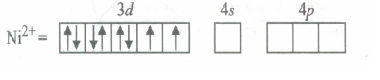
In some complexes, the two unpaired 3d electrons pair up and the hybridization is dsp2 . Thus, no unpaired electron is left. In some other complexes, one unpaired 3d electron is excited to 4p. Hybridization is again dSp2 but there are two unpaired electrons present.
5.
potassium hexanitratocobaltate.
6.
\(A_m={1000\times k\over M}\)
138.9 S cm2 mol-1=\(1000\times k\over 1.5\)
\(k={138.9\times 1.5\over 1000}={208.05\over 1000}={2.0805}\times 10^{-1}\ S\ cm^{-1}\)
7.
(i) For the reaction \(A \rightarrow B\),
Rate of reaction \((r)=k[A]^2\)
If the concentration of reactant increased to three times.
Rate of reaction \(\left(r^{\prime}\right)=k[3 A]^2\)
Thus, on dividing equations (1) and (2)
\( \frac{r}{r^{\prime}}=\frac{k[A]^2}{k[3 A]^2} =\frac{1}{9}\)
Therefore, rate of formation of B increases to nine times.
(ii) Pseudo first order reaction: The reaction which is bimolecular but order is one is called pseudo first order reaction. This happens when one of the reactants is in large excess. E.g., acidic hydrolysis of ester (ethyl acetate).
8.
Let the rate law in terms of rate of formation of $D$ be
\(\frac{d[D]}{d t}=k[A]^4 \quad B^b\)
1. \(6.0 \times 10^{-3}=k(0.1)^a(0.1)^b\) ....(i)
2. \(7.2 \times 10^{-3}=k(0.3)^a(0.2)^b\) ...(ii)
3. \(2.88 \times 10^{-2}=k(0.3)^a(0.4)^b\) ...(iii)
4. \(2.40 \times 10^{-2}=k(0.4)^a(0.1)^b\) ...(iv)
Divide Eq. (iv) by Eq. (i), we get
\(4=(4)^a\)
Therefore a = 1
Divide Eq. (iii) by Eq. (ii), we get
\(4 =(2)^b\)
\(2^2 =(2)^b\)
b=2
Order with respect to A=1
Order with respect to B=2
\(\text { Rate law }=\frac{d[D]}{d t}=k[A][B]^2\)
On putting the values of ' A ' and ' B ' in any equation, say (i)
\( 6.0 \times 10^{-3} \mathrm{M}_{\min ^{-1}}=k(0.1 \mathrm{M})(0.1 \mathrm{M})^2\)
\( \therefore \quad k=6 \mathrm{M}^{-2} \mathrm{~min}^{-1}\)
9.
\((i) \left[\mathrm{Co}\left(\mathrm{NH}_{3}\right)_{5} \mathrm{Cl}\right] \mathrm{Cl}_{2} \\ x+(0) \times 5+(-1) \times 1+(-1) \times 2=0 \\ x+0-3=0 \\ x=+3 \)
So. the name of the complex is pentaarnminechloridocobalt (Ill) chloride.
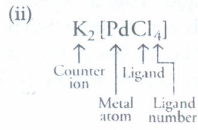
Let the oxidation state of Pd is x.
(+1)2 +x+(-1)4 = 0
2+x-4 = 0
⇒ x = +2
So, the name of the complex is potassiumtetrchloridopalladate (Il).
10.
(i) [Co(en)3] Cl3
IUPAC name:
Tris - (ethane - l,2- diamine) cobalt (III) chloride.
s.png)
(ii) Pt(NH3)2CI2
(ill) [Fe(NH3)4CI2]Cl
IUPACname
Tetraamminedichloridoiron (II) chloride
Isomers Geometrical isomers (cis and trans)
s.png)
11.
6.747 x 10¹⁰
12.
200 ohm-1 cm2 eq-1
13.
(b)
Ionisation isomerism
14.
(d)
[CoCl6]3-
15.
(b)
1 x 10²
16.
(a)
Activation energy of forward reaction is E1 + E2 and product is less stable than reactant.
17.
(c)
1.5
18.
(d)
1
19.
(b)
E3 > E2 > E1
20.
(d)
135.9 S cm2 eq-1
21.
(c)
3.47\(\times 10 ^ {-4} M/min\)
22.
(c) : 75% of reaction is completed in two half-lived i.e., 2 \(\times\) t 12 = 32 min or t 1/2 = 16 min
23.
(i) (a) Metal carbonyls: Metal carbonyls are the compounds in which carbon monoxide (CO) acts as the ligand. The metal-carbon bond in metal carbonyls possesses both \(\sigma\) and \(\pi\) characters, e.g. N(CO)4[nickeltetracarbonyl]. Its IUPAC name is tetra carbonyl nickel(0).
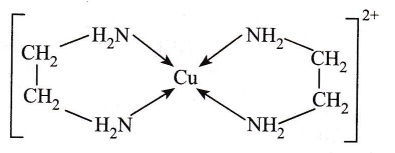
(b) Chelate: An inorganic metal complex in which there is a close ring of atoms caused by attachment of a ligand to a metal atom at two points. An example is the complex ion formed between ethylene diamine and cupric ion,[Cu(NH2CH2CH2NH2)2]2+.
(ii) (a) Add BaCl2 solution. [Co(NH3)]5Cl]SO4 will give white ppt. of BaSO4.
\(\left[\mathrm{Co}\left(\mathrm{NH}_{3}\right)_{5} \mathrm{Cl}\right] \mathrm{SO}_{4}+\mathrm{BaCl}_{2}(a q) \)\( \longrightarrow\left[\mathrm{Co}\left(\mathrm{NH}_{3}\right)_{5} \mathrm{Cl}\right] \mathrm{Cl}_{2}+\mathrm{BaSO}_{4} \downarrow \)
\(\text { (White ppt.) }\)
Add AgNO3(aq) solution [Co(NH3)5SO4] Cl will give white ppt. of AgCl.
\( {\left[\mathrm{Co}\left(\mathrm{NH}_{3}\right)_{5} \mathrm{SO}_{4}\right] \mathrm{Cl}+\mathrm{AgNO}_{3}(a q)} \) \(\longrightarrow \mathrm{AgCl}+\left[\mathrm{Co}\left(\mathrm{NH}_{3}\right)_{5} \mathrm{SO}_{4}\right] \mathrm{NO}_{3} \)
\(\text { (White ppt) }\)
(c) Fe3+ (4s03d5) In strong field \( \Delta_{0}>P t_{2 g}^{5} e g^{0} \)
In weak field \(\Delta_{0}
24.
(a) (i) Limiting molar conductivity \(\left(\Lambda_{m}^{\circ}\right)\) : It is defined as the maximum molar conductance of an electrolyte when solution is infinitely dilute, i.e. concentration approaches zero when electrolyte solution is kept in cell, unit distance apart having large area of cross-section to hold enough electrolyte.
(ii) Fuel cell is a cell in which chemical energy of a fuel is converted into electrical energy.
(b) R = 100 ohms, M = 0.1 mol L-1 of KCI
\(\kappa=\frac{1}{R} \times \frac{l}{A}\)
\(\Rightarrow 1.29 \times 10^{-2} \mathrm{ohm}^{-1} \mathrm{~cm}^{-1}=\frac{1}{100 \mathrm{ohm}} \times \frac{l}{A}\)
\(\Rightarrow \ \frac{l}{A}=1.29 \mathrm{~cm}^{-1}\)
Again, \(\kappa=\frac{1}{R} \times \frac{l}{A}=\frac{1}{520} \times 1.29\)
= \(\frac{1.29}{5.20} \times 10^{-2}\)
= 2.48 x 10- 3 ohm-1 cm-1
Now, M = 0.02 mol L-1
\(\Lambda_{m}=\frac{1000 \kappa}{\mathrm{M}}=\frac{1000 \times 2.48 \times 10^{-3}}{0.02}\)
= 124 S cm2 mol-1
25.
Degree of dissociation is the ratio of molar conductivity at a specific concentration to the molar conductivity at infinite solution.
Degree of dissociation = \(\frac { { \Lambda }_{ m }^{ c } }{ { \Lambda }_{ m }^{ 0 } } \)
(b) \({ E }_{ cell }^{ ° }={ E }^{ ° }{ Ag }^{ + }/Ag-{ E }^{ ° }{ Ni }^{ 2+ }/Ni\)
= 0.80V - 0.25V
= 0.55V
\({ log }_{ { K }_{ c } }=\left( \frac { n{ E }^{ ° }cell }{ 0.059 } \right) \)
\(=\frac { 2\times 0.55 }{ 0.059 } \)
\({ log }_{ { K }_{ c } }=18.644\)
\({ K }_{ c }=Antilog\quad 18.644{ K }_{ c }=4\times { 10 }^{ 18 }\)
\({ \Delta }_{ G }^{ ° }=nFE°cell\)
\(=-2\times 96500C{ mol }^{ -1 }\times 0.55V\)
\(=-106,150J{ mol }^{ -1 }\)
Max.work = +106150 J mol-1
26.
Temperature has a great effect on reaction rates or reaction rate constants. In general, an increase in temperature increases the rates of almost all reactions. For homogeneous chemical reactions, the rate of the reaction or rate constant (k) becomes almost double for every 10° rises in temperature.According to collision theory, the rate of reaction depends upon,
(i) the collision frequency of the reacting molecules.
(ii) the fraction of effective collisions.
The frequency of collisions between reacting molecules depends upon the average velocity of the molecules. With the increase in temperature, the average velocity of the molecules increases which results into increase in collision frequency. However, an increase of 10° rise of temperature increases the number of collisions by only 1.016 times. Further, we know that all the collisions are not effective. For molecules to undergo effective collisions, they must possess a certain minimum amount of energy called threshold energy. The molecules which possess energy equal to or greater than threshold energy will result in the formation of products. However, the fraction of such molecules capable of effective collisions is very small. As the temperature has increased the fraction of molecules possessing energies greater than threshold energy increases and so the rate of the reaction increases.
Let us consider the effect of increase of temperature on the number of effective collisions (having energies greater than threshold energy). The energy. distribution, of molecules at two temperatures \({ T }_{ 1 }\) and \({ T }_{ 2 }\) (where \({ T }_{ 2 }={ T }_{ 1 }+10°\)) is shown in figure. It is clear from the figure that the curve at higher temperature gets shifted towards the right indicating that at higher temperature, the molecules have higher energies. Further, the curve at higher temperature is flatter than that at lower temperature which also indicates that the number of molecules with higher energy content have increased.
The minimum energy required for the effective collisions also shown in the diagram and the number of molecules possessing energies equal to or greater than E, is proportional to area abed at temperature \({ T }_{ 1 }\) and area above at temperature \({ T }_{ 2 }\). In the figure, the area abef is roughly twice as large as abcd. Since the rate of reaction depends upon the number of molecules which possess energies larger than activation energy (for effective collisions), it may be interpreted that the fraction of molecules possessing activation energy has increased approximately two times and thereby, increases the rate of reaction by two times for a rise of 10 degrees.
Thus, we may conclude that increase in the rate of reaction with the rise in temperature is mainly due to the increase in number of effective collisions.
27.
\({ \triangle }_{ t }=\left( \frac { 4 }{ 9 } \right) { \triangle }_{ 0 }\). Thus, \({ \triangle }_{ t }\) is smaller than \({ \triangle }_{ 0 }\). Hence, less energy (higher wavelength) is absorbed by tetrahedral complexes than by octahedral complexes of the same metal and ligands. Therefore, the observed colour are different.
28.
As.ΔH = - 33 kJ mol-1, the reaction is exothermic. The activation energy diagram will be as shown in fig.
ΔH = Ef - Eb= - 33 kJ
kf = Ae-Ef/RT
kb = Ae-Eb/RT
\(K_c={k_f\over k_b}=e^{(E_b-E_f)/RT}\)
In \(K_c={E_b-E_f\over RT}\ or\ log\ K_c={E_b-E_f\over 2.303RT}={30000\ J\ mol^{-1}\over 2.303(8.314JK^{-1}mol^{-1})300K}=5.2227\)
Kc = Antilog 5·2227 = 1·67 x 105
Substituting \(E_b={31\over 20}E_f,\)We get
\(E_f-{31\over 20}E_f=-33\ or\ {-{11\over 20}}E_f=-33\ or\ E_f={33\times20\over 11}=60kJ\ mol^{-1}\)
Eb = Ef + 33 = 60 + 33 = 93 kJ mol-1

12th Standard CBSE Syllabus & Materials
12th Standard CBSE
CBSE 12th Computer Science Python Revision Tour I - New Previous year Question Papers Study Material - QB365 Set A
NEW12th Standard CBSE
CBSE 12th Business Studies Planning Important Questions And Answers Study Material - QB365 Set A
NEW12th Standard CBSE
CBSE 12th Business Studies Business Environment Important Questions And Answers Study Material - QB365 Set A
NEW12th Standard CBSE
CBSE 12th Business Studies Principles of Management Important Questions And Answers Study Material - QB365 Set A



NCERT Books

Syllabus

Exam Pattern

Sample Question Papers

Previous year Question Papers

Important Notes

MCQ Practice test

NCERT Exemplers

Case study Questions

Image Based Questions

Passage based Questions

HOT Questions

Value Based Questions

Model Questions Papers
NCERT ( Book Back ) Questions

Assertion and Reason
Important Questions And Answers

CBSE 12th Standard CBSE Subjects
CBSE Standards








