
 100% FREE ACCESS
12th Standard CBSE Syllabus & Materials
12th Standard CBSE
CBSE 12th Economics Government Budget and the Economy Previous year Question Papers Study Material - QB365 Set A
NEW12th Standard CBSE
CBSE 12th Computer Science Interface Python with MySQL - New Previous year Question Papers Study Material - QB365 Set A
NEW12th Standard CBSE
CBSE 12th Computer Science Database Concept - New Previous year Question Papers Study Material - QB365 Set A
NEW12th Standard CBSE
CBSE 12th Computer Science Data Communication - New Previous year Question Papers Study Material - QB365 Set A
NEW12th Standard CBSE
CBSE 12th Computer Science Data Structures - New Previous year Question Papers Study Material - QB365 Set A
NEW12th Standard CBSE
CBSE 12th Computer Science Functions - New Previous year Question Papers Study Material - QB365 Set A

Published on: 25/10/2025
Download CBSE Class 12th Standard CBSE Chemistry question papers, sample papers, important questions, and previous year solved papers in PDF format. Get free study materials, NCERT solutions, and exam preparation resources for Class 12th Standard CBSE Chemistry
Questions + Answers key
Take MCQ Chemistry Test
1.
Explain the following terms giving a suitable example in each case:
(i) Ambident ligand
(ii) Denticity of a ligand
2.
For the complex [Fe(en)2Cl2]Cl, identify the following:
(i) Oxidation number of iron.
(ii) Hybrid orbitals and shape of the complex.
(iii) Magnetic behavior of the complex.
(iv) Number of its geometrical isomers.
(v) Whether there may be optical isomer also.
(vi) Name of the complex.
3.
Compare the following complexes with respect to their molecular shape and mahnetic behaviour:
(i) [Cr(NH3)6]3+
(ii) [Fe(CN)6]4-
(iii) [NiCl4]2-
(At. No:Cr = 24, Fe = 26, Ni = 28)
4.
What do you understand by stepwise stability constant and overall stability constant of a coordination compound? How are these two constants related?
5.
What type of isomerism is exhibited by [CO(NH3)4CI2]+ Br- ? Write the structures of the possible isomers and the state of hybridisation of the central metal atom.
6.
2 : 4 Dinitrophenyl hydrazine is an example for
Tridentate ligend
Monodentate ligand
Polydentate ligand
Didentate ligand
7.
Which of the following is not considered as an organometallic compound?
cis-platin
ferrocene
Zeise's salt
Grignard reagent
8.
The non-existent metal carbonyl among the following is
Cr(CO)6
Mn(CO)5
Ni(CO)4
Fe(CO)5
9.
The correct structure of Fe(CO)5 is
octahedral
terahedral
square pyramidal
trigonal bipyramidal
10.
Zelse's salt is
[Fe(C5H5)2]
[Pb(C2H5)4]
K[PtCl3(C2H4)]
[Ni(CO)4]
11.
Prussian blue is obtained by mixing together aqueous solution of Fe3+ salt with
Ferricyanide
Ferocyanide
Hydrogen cyanide
Sodium cyanide
12.
The dark blue colour of the solution formed when excess of ammonia is added to a solution of copper (II) sulphate is due to the presence of the ion
[Cu(OH)4 (H2O)2]2-
[Cu(H2O)6]2+
[Cu(NH3)2 (H2O)4]2+
[Cu(NH3)4 (H2O)2]2+
13.
The most stable complex among the following is
K3[Al(C2O4)3]
[Pt(en)2] Cl2
[Ag(NH3)2] Cl
K2[Ni(EDTA)]
14.
Which of the following configuration of ions has zero CFSE in both strong and weak ligand fields?
d10
d8
d6
d4
15.
Which of the following compound has tetrahedral geometry?
[Ni(CN)4]2-
[Pd(CN)4]2-
[PdCl4]2-
[NiCl4]2-
16.
Account fpr different magnetic behaviour of hexacyanoferrate (III) and hexafluoroferrate (III).
17.
Arrange the following complexes in order of increasing electrical conductivity:
[Co(NH3)3Cl3], [Co(NH3)5Cl]Cl2, [Co(NH3)6] Cl3, [Co(NH3)4Cl2]Cl
18.
On the basis of valence bond theory, explain geometry, nature of hybridisation, magnetic property and optical isomerism of [Co(ox)3]3- and [CoF6]3-.
19.
A coordination compound has the formula, CoCl3.4NH3. It doesnot liberate ammonia but precipitates chloride ions as silver chloride. Give the IUPAC name of the complex and write its structural formula.
20.
Write the names and draw the structures of each of the following complex compounds:
(i) [Co(NH3)4(H2O)2]Cl3
(ii) [Pt(NH3)4] [NiCl4]
21.
Write the correct formulae for the following coordination compounds ;
(a) CrCl3.6H2O (violet, with 3 chloride ions/ unit formula)
(b) CrCl3.6H2O (light green colour with 2 chloride ions/ unit formula)
(c) CrCl3.6H2O (dark green colour with 1 chloride ion/ unit formula)
22.
Why only transition metals are known to form \(\pi \) complexes?
23.
Which of the following is more stable complex and why?
[Co(NH3)6]3+ and [Co(en)3]3+
24.
\(Fe^{ 2+ }\overset { SCN^{ - } }{ \underset { { excess } }{ \rightarrow } } (A)\overset { { F }^{ - } }{ \underset { excess }{ \rightarrow } } (B)\)
What are (A) and (B)? Give IUPAC name of (A). Find the spin only magnetic moment of (B).
25.
Dimethyl glyoxime is added to alcoholic solution of NiCl2. When ammonium hydroxide is slowly added to it, a rosy red precipitate of a complex appears
(i) Give the structure of the complex showing hydrogen bonds.
(ii) Give oxidation state and hybridisation of central metal ion.
(iii) Identify whether it is paramagnetic or diamagnetic.
26.
CoSO4Cl.5 NH3 exists in two isomeric forms 'A' and 'B' gives white precipitate with BaCl2 but does not react with AgNO3. Answer the following questions.
(i) Identify 'A' and 'B' and write their structure formulas.
(ii) Name the type of isomerism involved
(iii) Give the IUPAC name of 'A' and 'B'.
27.
Using valence bond theory, explain the following in relation to the complexes given below :
\([Mn(CN)_6]^{3-}, [Co(NH_3)_6]^{3+}, [Cr(H_2O)_6]^{3+}, [FeCl_6]^{4-}\)
(i) Type of hybridisation
(ii) Inner or outer orbital complex.
(iii) Magnetic behaviour.
(iv) Spin only magnetic moment value.
28.
Using crystal field theory, draw energy level diagram, write electronic configuration of the central metal atom/ion and determine the magnetic moment value in the following :
(i) \([CoF_6]^{3-}, [Co(H_2O)_6]^{2+},[Co(CN)_6]^{3-}\)
(ii) \([FeF_6]^{3-}, \ [Fe(H_2O)_6]^{2+}, [Fe(CN)_6]^{4-}\).
1.
(i) Ambidentate ligand: Ligands which can ligate (link) through two different atoms present in it are called ambidentate ligands, e.g.\({ { NO }_{ 2 } }^{ - },{ SCN }^{ - },{ CNO }^{ - },{ CN }^{ - },{ { NO }_{ 2 } }^{ - }\) can link through 'N' as well as oxygen while SCN- can link through'S' as well as 'N' atom.
(ii) Denticity: The number of ligating (linking) atoms present in ligand is called denticity of a ligand, e.g.
CN- has 1,\(\overset { { COO }^{ - } }{ \underset { { COO }^{ - } }{ | } } \) has 2,
H2N-CH2-CH2-NH-CH2-CH2-NH2 has 3.
H2NCH2CH2NHCH2CH2NHCH2CH2NH2 has 4.
[EDTA]3- has 5, [EDTA]4- has 6 denticity.
2.
(i) +3 (III)
(ii) dsp, octahedral
(iii) paramagnetic
(iv) Two geometrical isomers
(v) Yes, there may be optical isomer also due to presence of polydentate ligand.
(vi) Dichlorido bis-(ethane 1, 2-diamine) Iron (III)
3.
(i) In [Cr(NH3)6]3+
Cr(24): [Ar]4s13d5
Cr3+: [Ar]4s03d3
(ii)
s.png)
[CN- being strong field ligand, paired up the d-electrons of the metal].
s.png)
Shape Octahedral
Magnetic property Diamagnetic.
4.
Complexes are formed from aqueous solution and the reaction involves the replacement of water molecules by the ligands in various steps, each step having its formation constant, e.g.
[CU(H2O)4]SO4 + 4NH3 \(\overset { K }{ \rightleftharpoons } \) [Cu(NH3)4]SO4 + 4H2O
1st step: [CU(H2O)4]SO4 + NH3 \(\overset { { K }_{ 1 } }{ \rightleftharpoons } \) [CU(H2O)3NH3] SO4 + H2O
2nd step: [Cu(H2O)3NH3]SO4 + NH3 \(\overset { { K }_{ 2 } }{ \rightleftharpoons } \) [CU(H2O)2(NH3)2] + H2O
3rd step: [CU(H2O)2(NH3)2]SO4 + NH3 \(\overset { { K }_{ 3 } }{ \rightleftharpoons } \) [Cu(H2O)(NH3)3] + H2O
4th step: [Cu(H2O)(NH3)3]SO4 + NH3 \(\overset { { K }_{ 4 } }{ \rightleftharpoons } \) [Cu(NH3)4]SO4 + H2O
K= k1 x k2 x k3 x k4
5.
Ionisation isomerism and Geometrical isomerism are exhibited by [CO(NH3)4CI2] Br.
The ionisation isomers are [CO(NH3)4CI2] Br and [CO(NH3)4(CI)(Br)CI.
The geometrical isomers are
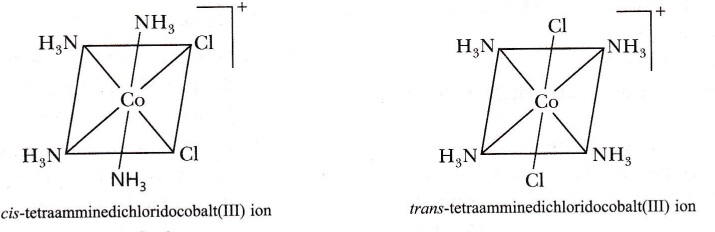
The central atom has d2sp3 hybridisation.
6.
(b)
Monodentate ligand
7.
(b)
ferrocene
8.
(b)
Mn(CO)5
9.
(c)
square pyramidal
10.
(c)
K[PtCl3(C2H4)]
11.
(b)
Ferocyanide
12.
(d)
[Cu(NH3)4 (H2O)2]2+
13.
(d)
K2[Ni(EDTA)]
14.
(a)
d10
15.
(d)
[NiCl4]2-
16.
In [Fe(CN )6]3- , CN- is a strong ligand. Hence, electrons in the d-subshell pair up and there is only one unpaired electron left.In [FeF6]3- ,is a weak ligand. Hence, electrons in the 3 d subshell do not pair up. There are five unpaired electrons in the 3d-subshell. (The hybridization involved is sp3d2 _ outer orbital complex is formed). Hence, [FeF6 ]3- has greater magnetic moment than [Fe(CN ]3- .
17.
[Co(NH3)3Cl3] < [Co(NH3)4Cl2]Cl < [Co(NH3)5Cl]Cl2 < [Co(NH3)6] Cl3. This is because number of ions produced from these complexes are 0,2,3 and 4 respectively.
18.
[Co(ox)3]3- : Geometry = octahedral, Hybridisation = sp3d2, Magnetic properties = paramagnetic. Two optical isomers.
[CoF6]3- : Geometry = octahedral, Hybridisation = sp3d2, Magnetic properties = paramagnetic. No optical isomers.
19.
Remembering that coordination number of Co is 6, the formula of the complex will be [Co(NH3)4Cl2] Cl. The name will be tetraamminedichloridocobalt (III) chloride.
20.
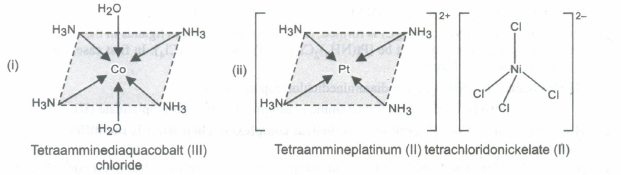
21.
(a) [Cr(H2O)6Cl3 (b) [Cr(H2O)5Cl]Cl2.H2O (c) [Cr(H2O)4Cl2]Cl.2H2O
Note that coordination number of Cr is 6 in each case.
22.
Transition metals/ions have empty d-orbitals into which the electron-pairs can be donated by ligands containing \(\pi \) electrons, i.e., CH2 = CH2, C5H5, C6H6, etc.
23.
[Co(en)3]3+ is more stable due to chelate effect of the bidentate ligand, en, as it forms rings.
24.
(A) = Fe(SCN)3, (B) = [FeF6]3- .
IUPAC name of A = trithiocyanatoiron (Ill)
E.C. of Fe (III) = d5. Unpaired electrons = 5
Spin only magnetic moment = \(\sqrt { 5(5+2) } \) = 5·916 BM.
25.
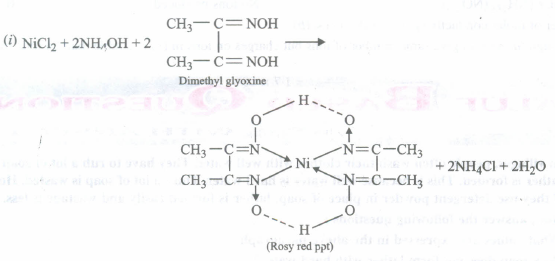
(ii) Oxidation state of Ni in the complex = + 2
Hybridisation = dsp2 (because it is a planar molecule)
(iii) It is diamagnetic (because there is no unpaired electron present)
26.
(i) As isomer A reacts with AgNO3 to give a white precipitate, CI must be present in the ionization sphere. As it does not react with BaCI2, SO42- must be present in coordination sphere.
Formula of A = [Co(NH3)5SO4] CI (coordination no. of Co = 6) As reactions are reverse for isomer B, formula of B = [Co(NH3)5CI]S04
(ii) Ionization isomerism.
(iii) A = Pentaarnminesulphatocobalt (III) chloride ; B = Pentaamminechloridocobalt (ill) sulphate
27.
\([Mn(CN)_6]^{3-}\)
d2sp3, (ii) inner orbital complex, (iii) paramagnetic, (iv) 2.87 B.M.
(i) d2sp3 (ii) Inner orbital complex, (iii) diamagnetic, (iv) \(\mu=0\)
(i) d2sp3, (ii) Inner orbital complex, (iii) paramagnetic, (iv) 3.87 B.M.
(i) sp3d2, (ii) outer orbital complex (iii) paramagnetic (iv) 4.9 B.M.
28.
(i) \([CoF_6]^{3-}\)
\( [Co(H_2O)_6]^{2+}\)
\([Co(CN)_6]^{3-}\)
(ii) \([FeF_6]^{3-}\)
\(\ [Fe(H_2O)_6]^{2+}\)
\([Fe(CN)_6]^{4-}\)
It is diamagnetic due to the absence of unpaired electrons.

12th Standard CBSE Syllabus & Materials
12th Standard CBSE
CBSE 12th Computer Science Python Revision Tour I - New Previous year Question Papers Study Material - QB365 Set A
NEW12th Standard CBSE
CBSE 12th Business Studies Planning Important Questions And Answers Study Material - QB365 Set A
NEW12th Standard CBSE
CBSE 12th Business Studies Business Environment Important Questions And Answers Study Material - QB365 Set A
NEW12th Standard CBSE
CBSE 12th Business Studies Principles of Management Important Questions And Answers Study Material - QB365 Set A



NCERT Books

Syllabus

Exam Pattern

Sample Question Papers

Previous year Question Papers

Important Notes

MCQ Practice test

NCERT Exemplers

Case study Questions

Image Based Questions

Passage based Questions

HOT Questions

Value Based Questions

Model Questions Papers
NCERT ( Book Back ) Questions

Assertion and Reason
Important Questions And Answers

CBSE 12th Standard CBSE Subjects
CBSE Standards








