
 100% FREE ACCESS
12th Standard CBSE Syllabus & Materials
12th Standard CBSE
CBSE 12th Economics Government Budget and the Economy Previous year Question Papers Study Material - QB365 Set A
NEW12th Standard CBSE
CBSE 12th Computer Science Interface Python with MySQL - New Previous year Question Papers Study Material - QB365 Set A
NEW12th Standard CBSE
CBSE 12th Computer Science Database Concept - New Previous year Question Papers Study Material - QB365 Set A
NEW12th Standard CBSE
CBSE 12th Computer Science Data Communication - New Previous year Question Papers Study Material - QB365 Set A
NEW12th Standard CBSE
CBSE 12th Computer Science Data Structures - New Previous year Question Papers Study Material - QB365 Set A
NEW12th Standard CBSE
CBSE 12th Computer Science Functions - New Previous year Question Papers Study Material - QB365 Set A

Published on: 25/10/2025
Download CBSE Class 12th Standard CBSE Chemistry question papers, sample papers, important questions, and previous year solved papers in PDF format. Get free study materials, NCERT solutions, and exam preparation resources for Class 12th Standard CBSE Chemistry
Questions + Answers key
Take MCQ Chemistry Test
1.
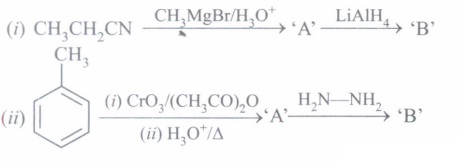
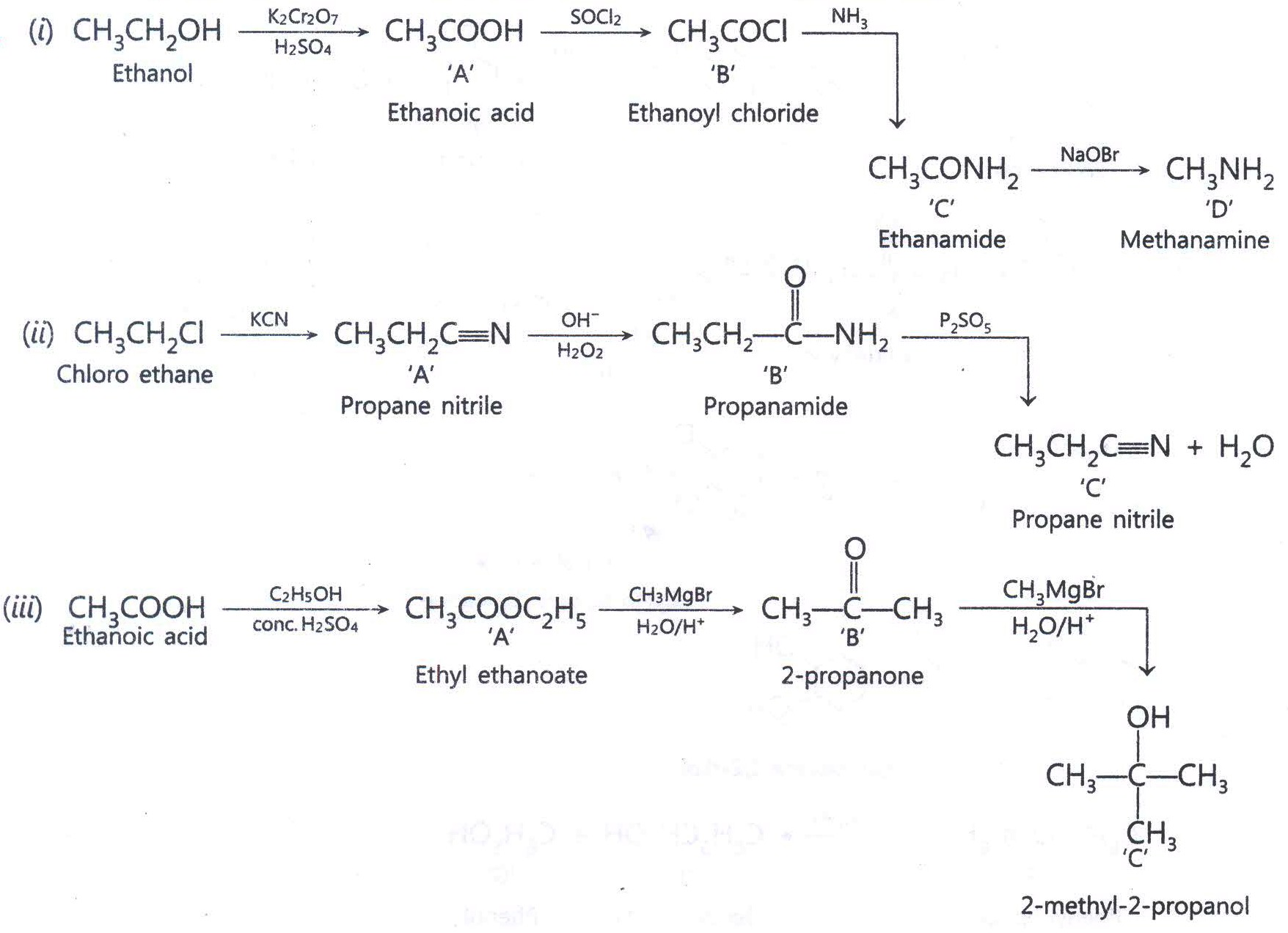
Write structures of main compounds 'A' and 'B' in each of the following reactions:
2.
Write chemical equations when:
(i) chlorobenzene is treated with CH3 COCI in presence of anhydrous AICI3 .
(ii) ethyl chloride is treated with aqueous KOH
3.
Write the reactions involved in the following reactions:
(i) Clemmensen reduction
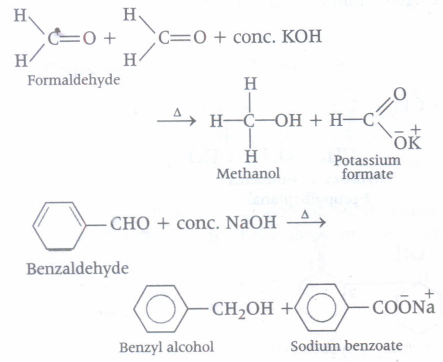
(ii) Cannizzaro reaction
4.
Give simple chemical test to distinguish between the following pairs of compounds.
(i) Ethanal and prop anal
(ii) Benzoic acid and phenol.
5.
Write I.U.P.A.C name of
(i) [Co(NH3)5Cl] Cl2
(ii) [Co (en)2Cl (ONO)]+
6.
Henry's law constant for CO2 in water is 1.67 \(\times\)108 Pa at 298 K. Calculate the quality of CO2 in 500 ml of soda water when packed under 2.5 atm CO2 pressure at 298 K.
7.
Give reasons:
(i) p-nitro phenol is more acidic than p-methyl phenol.
(ii) Bond length of C-O bond in phenol is shorter than that in CH3OH.
(iii) (CH3)3CBr on reaction with CH3 O-Na+ gives alkene as major product and not an ether.
8.
What is meant by positive and negative deviations from Raoult's law and how is the sign of \(\triangle_{mix}\)H related to positive and negative deviations from Raoult's law?
9.
Convert the following:
(a) Bromobenzene to 1-phenylethanol
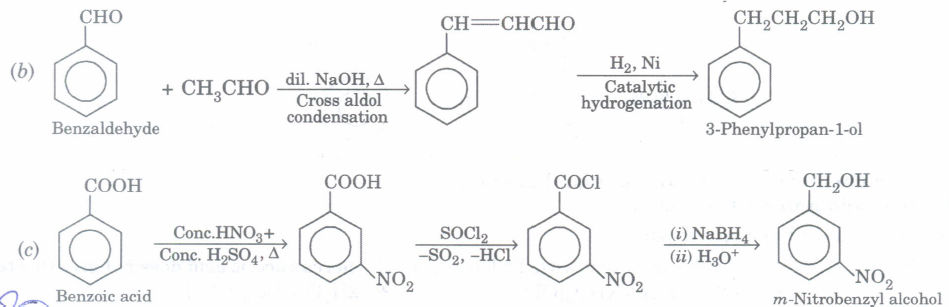
(b) Benzaldehyde to 3-phenylpropan-1-ol
(c) Benzoic acid to m-Nitrobenzyl alcohol
10.
Accomplish the following conversions:
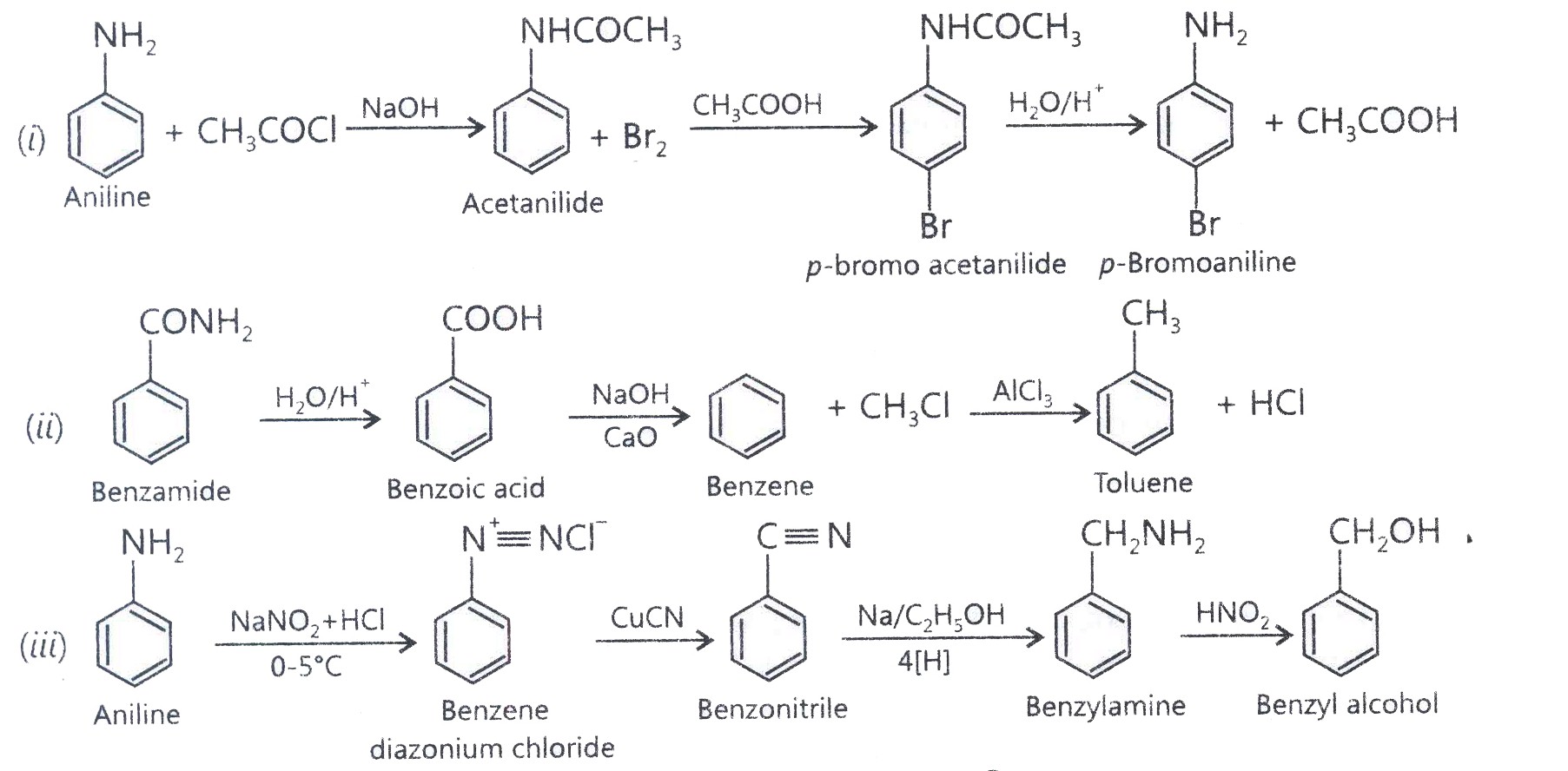
(i) Aniline to p-bromoaniline
(ii) Benzamide to toluene
(iii) Aniline to benzyle alcohol
11.
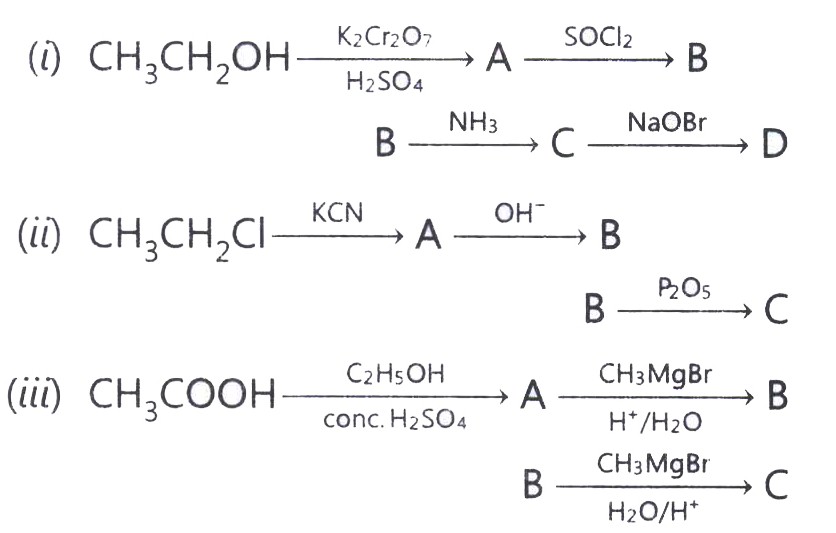
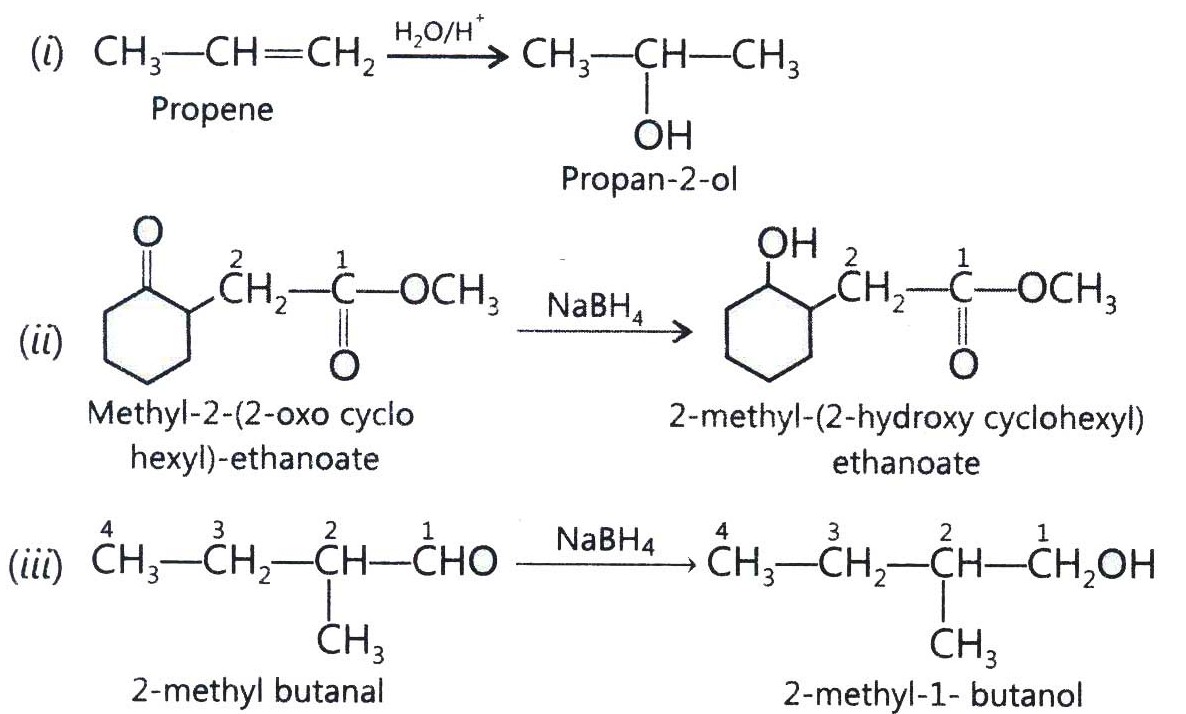
Predict the products:
12.
Write structures of the products of the following reactions:
(i)

(ii)
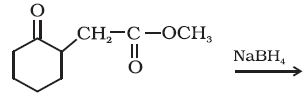
(iii)
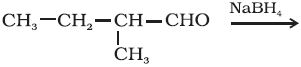
13.
Explain the following giving an example in each case:
(i) Linkage isomerism
(ii) An outer orbital complex
(iii) A bidentate ligand
14.
An aqueous solution freezes at 272.4, while pure water at 273 K, determine the
(i) molality of the solution,
(ii) boiling point of solution,
(iii) lowering of vapour pressure of water at 298 K.
Given K f = 1.86 K kg mol-1, K b = 0.512 K kg mol-1 and vapour pressure of pure water is 23.757 mm Hg)
15.
Compounds A and C in the following reaction are

identical
positional isomers
functional isomers
optical isomers
16.
\(^{\prime} \mathrm{A}^{\prime}\stackrel{\text { Reduction }}{\longrightarrow}{ }^{\prime} \mathrm{B}^{\prime} \stackrel{\mathrm{HNO}_{2}}{\longrightarrow} \mathrm{CH}_{3} \mathrm{CH}_{2} \mathrm{OH}\)
The compound' A' is
propane nitrile
ethane nitrile
nitro methane
methyl isocyanate
17.
 D', 'D' is
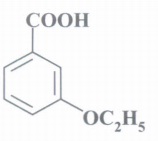
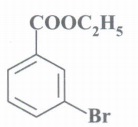
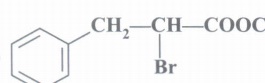
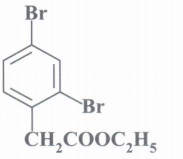
18.

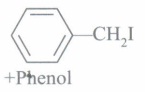
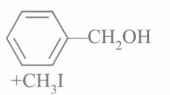
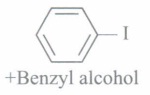
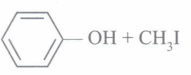
19.
Arrange the following in decreasing order of acidic character:
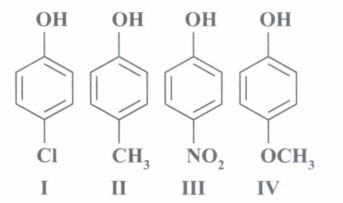
IV > III> I > II
II > IV > I > III
I> II> III > IV
III > I > II > IV
20.
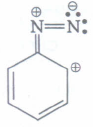
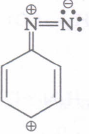
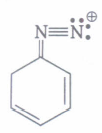
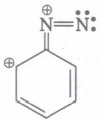
The stability of arenediazonium ion is explained on the basis of resonance. Which of the following resonating structure is incorrect?
21.
The reaction,
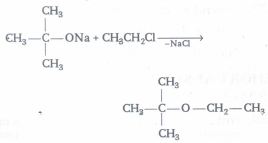 is called
Williamson synthesis
Williamson continuous etherification process
Etard reaction
Gattermann-Koch reaction
22.
Consider the following figure.
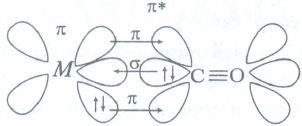
Which type of bond formed between metal and ligand?
synergic bond
σ-bond
ㅠ-bond
None of these
23.
Which of the following statements is/are true for the diagram?
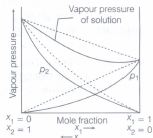
The escaping tendency of molecule decreases for each component
Vapour pressure of the solution decreases
Solution shows negative deviation from Raoult's law
All of the above
24.
The formation of cyanohydrin from acetone is which type of reaction ?
Electrophilic substitution
Electrophilic addition
Nucleophilic addition
Nucleophilic substitution
25.
The hybridization involved in the complex [Ni(CN)4]2- is (At.No. of Ni=28)
d2sp2
d2sp3
dsp2
sp3
26.
Which one of the following gases has the lowest value of the Henry's law constant ?
N2
He
H2
CO2
27.
(a) lllustrate the following reactions giving suitable example in each case:
(i) Hoffmann's Bromamide degradation reaction,
(ii) Diazotization
(iii) Gabriel phthalimide synthesis.
(b) Distinguish between the following pairs of compounds:
(i) Aniline and N-methyl aniline
(ii) (CH3 )2 NH and (CH3)3N.
28.
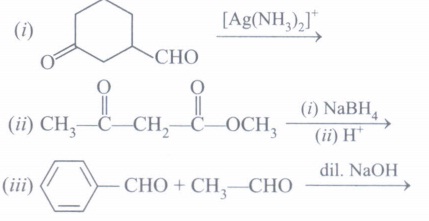
(a) Predict the main product of the following reactions:
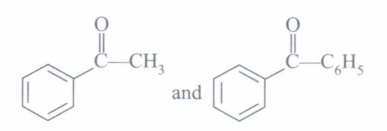
(b) Give a simple chemical test to distinguish bewtween
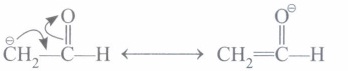
(c) Why is alpha (\(\alpha\)) hydrogen of carbonyl compounds acidic in nature?
29.
(a) Give reasons for the following:
(i) Ethanal is more reactive than acetone towards nucleophilic addition reaction.
(ii) (CH3)3C-CHO does not undergo aldol condensation
(iii) Carboxylic acids are higher boiling liquids than alcohols.
(b) Give a simple chemical test to distinguish between:
(i) Acetophenone and Benzophenone
(ii) Benzaldehyde and Ethanal
30.
(a) Give reason for the following:
(i) t-butyl chloride on heating with sodium methoxide gives 2-methylpropene instead of t-butylmethylether.
(ii) C-O bond in phenol is much shorter than ethanol.
(b) Give chemical test to distinguish between the following pair of compounds:
(i) Ethanol and phenol
(ii) Methanol and propan-2-ol
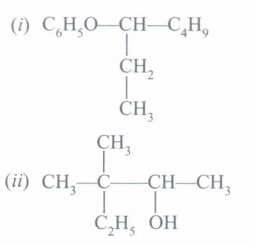
(c) Write IUPAC name of the following:
31.
(i) Define:
(a) Metal carbonyls
(b) Chelate
(ii) (a) Give one chemical test as an evidence to show that [Co(NH3)5CI]SO4 and [Co(NH3)5(SO4)] Cl are ionisation isomers.
(b) [NiCl4]2- is paramagnetic while [Ni(CO4] is diamagnetic though both are tetrahedral. Why? (Atomic no. of Ni = 28)
(c) Write the electronic configuration of Fe(III) on the basis of crystal field theory when it forms an octahedral complex in the presence of (i) strong field ligand, and (ii) weak field ligand. (Atomic no. of Fe = 26)
32.
(i) What type of deviation is shown by a mixture of ethanol and acetone? Give reason.
(ii) A solution of glucose (molar mass = 180 g mol-1) in water is labelled as 10 % (by mass). What would be the molality and molarity of the solution?
(Density of solution = 1.2 g mL-1)
33.
Assertion: Ketones are less reactive than aldehydes.
Reason: Ketones do not give Schiff’s test.
Codes:
(a) If both assertion and reason are true and the reason is the correct explanation of the assertion.
(b) If both assertion and reason are true but the reason is not the correct explanation of the assertion.
(c) If the assertion is true but the reason is false.
(d) If the assertion is false but the reason is true.
(e) If the assertion and reason both are false
34.
Assertion: Solubility of alcohols decreases with increase in size of alkyl/aryl groups.
Reason: Alcohols form H-bonding with water to show soluble nature.
Codes:
(a) Assertion and reason both are correct statements and reason is correct explanation for assertion.
(b) Assertion and reason both are correct statements but reason is not correct explanation for assertion.
(c) Assertion is correct statement but reason is wrong statement.
(d) Assertion is wrong statement but reason is correct statement.
35.
Assertion: [Al(NH3)6]3+ does npt exist in aqueous solution.
Reason: NH3 is a neutral ligand.
Codes:
(a) Assertion and reason both are correct statements and reason is correct explanation for assertion.
(b) Assertion and reason both are correct statements but reason is not correct explanation for assertion.
(c) Assertion is correct statement but reason is wrong statement.
(d) Assertion is wrong statement but reason is correct statement.
36.
In the following questions. an Assertion (A) is followed by a corresponding Reason (R) Use the following keys to choose the appropriate answer.
Assertion (A) When scuba divers come towards surface, their capillaries get blocked which is painful and dangerous to life.
Reason (R) There occurred release of dissolved gases as the pressure decreases and leads to the formation of bubbles of nitrogen in the blood.
(a) Both (A) and (R) are correct, (R) is the correct explanation of (A).
(b) Both (A) and (R) are correct, (R) is not the correct explanation of (A).
(c) (A) is correct; (R) is incorrect.
(d) (A) is incorrect; (R) is correct.
37.
Organic compounds containing amine as functional group are present in wide variety of compounds namely amino acids, hormones, neurotransmitters, DNA, alkaloids, dyes etc. Drugs including nicotine, morphine, codein, heroin etc. which have physiological effects on human also contain -NH2 group in one form or another. Amines are basic in nature due to presence of lone pair of electron on nitrogen. Adrenaline hormone and ephedrine drug, both contain second amino group are used for increasing blood pressure. Novacain, a synthetic compound contains both primary ana tertiary amino group, is used as anaesthetic in dentistry. Benadryl, a widely used antihistamine drug contains tertiary amino group, Quarternary ammonium salts of long chain, tertiary amines are used as cationic detergents. Diazonium salts are used for synthesis of azodyes and useful aromatic compounds.
(a) Write the formula of tertiary amine with molecular formula C3H9N, which does not react with Hinsberg reagent?
(b) Convert Aniline to p-hydroxy azo benzene.
(c) Give one example of cationic detergent.
(d) What is formula of paracetamol, (crosin), a well known antipyretic?
(e) How will you distinguish between Aniline and Benzyl amine?
38.
Read the passage given below and answer the following questions:
Metal carbonyl is an example of coordination compounds in which carbon monoxide (CO) acts as ligand. These are also called homoleptic carbonyls. These compounds contain both \(\sigma\) and \(\pi\) character. Some carbonyls have metal-metal bonds. The reactivity of metal carbonyls is due to (i) the metal centre and (ii) the CO ligands. CO is capable of accepting an appreciable amount of electron density from the metal atom into their empty \(\pi\) or \(\pi\)* orbitals. These types ofligands are called \(\pi\)-accepter or \(\pi\)-acid ligands. These interactions increases the Δo value.
The following questions are multiple choice questions. Choose the most appropriate answer:
(i) What is the oxidation state of metal in [ Mn2(CO)10] ?
| (a) +1 | (b) -1 | (c) +2 | (d) 0 |
(ii) Among the following metal carbonyls, the C - O bond order is lowest in
| (a) \(\left[\mathrm{Mn}(\mathrm{CO})_{6}\right]^{+}\) | (b) \(\left[\mathrm{Fe}(\mathrm{CO})_{5}\right]\) | (c) \(\left[\mathrm{Cr}(\mathrm{CO})_{6}\right]\) | (d) \(\left[\mathrm{V}(\mathrm{CO})_{6}\right]^{-}\) |
(iii) The oxidation state of cobalt in K [CO(CO)4] is
| (a) +1 | (b) +3 | (c) -1 | (d) 0 |
(iv) Structure of decacarbonyl manganese is
| (a) trigonal bipyramidial | (b) octahedral | (c) tetrahedral | (d) square pyramidal. |
1.

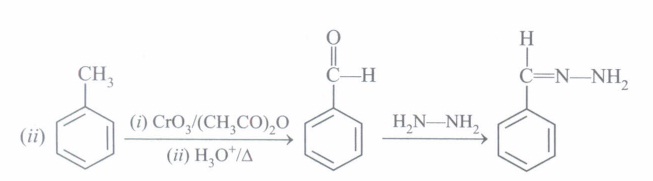
2.
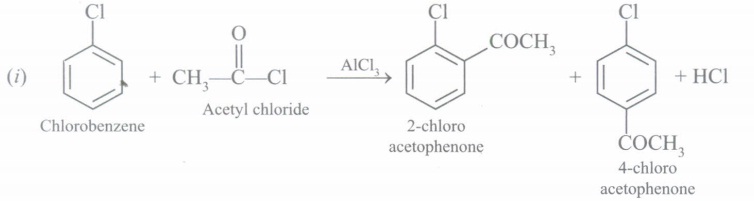
\(\text { (ii) } \mathrm{C}_{2} \mathrm{H}_{5} \mathrm{Cl}+\mathrm{KOH}(a q) \longrightarrow \mathrm{C}_{2} \mathrm{H}_{5} \mathrm{OH}+\mathrm{KCl}\)
Ethyl chloride Ethyl alcohol
3.
(i) Clemmensen reduction It involves reduction of carbonyl group of an aldehyde or ketone to methylene group to form a hydrocarbon. Clemmensen reduction is carried out in presence of Zn amalgam and conc. HCl.
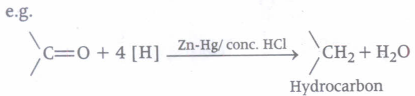
It is widely used for the reduction of aldehydes and ketones which are sensitive to alkalies.
(ii) Cannizzaro reaction Aldehydes which do not have ∝-H atoms undergo Cannizzaro reaction on treatment with cone. alkali. In this reaction, one molecule of aldehyde is reduced to alcohol while another molecule is oxidised to salt of carboxylic acid.
4.
i) Iodoform test: Ethanal gives this test due to the presence of CH3CO :
CH3HO + 4NaOH + 3I2 \(\longrightarrow \) CHI3 + HCOONa + 3Nal + 3H20
Ethanal (yellow ppt)
loadform
CH3CH2CHO + 4NaOH + 3I2 \(\longrightarrow \) No reaction
(ii) Sodium bicarbonate test: Benzoic acid gives brisk effervescence of CO2 when react with NaHCO3 while phenol does not give it, as it is a weak acid.
5.
(i) pentaamminechloridocobalt (III) chloride
(ii) chloridobis (ethane-1, 2-diamine) nitritocobalt (III) ion.
6.
Here, \({ K }_{ H }=4.27\times { 10 }^{ 5 }mm,\ p=760 \ mm\)
Applying Henry's law, \(p={ K }_{ H }x, we \ have \ x=\frac { p }{ { K }_{ H } } =\frac { 760 \ mm }{ 4.27 \times{ 10 }^{ 5 }mm } =1.78 \times{ 10 }^{ -3 }\)
i.e., mole fraction of methane in benzene = 1.78 x 10⁻³
7.
(i) It is due to -1 and -R effect of -NO2 group and +I and +R effect of CH3 group, p-nitrophenoxide ion is more stable than \(\rho\)-methyl phenoxide ion.
(ii) It is due to double bond character in phenol due to resonance but not in CH3 OH.
(iii) 3° halides undergo \(\beta\)-elimination with strong nucleophile (CH3O-).
8.
Positive deviation from Raoult's law occurs when the total vapour pressure of the solution is more than corresponding vapour pressure in case of ideal solution.
\(P={P}_{{A}}+{P}_{{B}}>{P}_{{A}}^{\circ} {X}_{{A}}+{P}_{{B}}^{\circ} {X}_{{B}}\)
Negative deviation from Raoult's law occurs when the total vapour pressure of the solution is less than corresponding vapour pressure in case of the ideal solution.
\({P}={P}_{{A}}+{P}_{{B}}<{P}_{{A}}^{\circ} {X}_{{A}}+{P}_{{B}}^{\circ} {X}_{{B}}\)
For positive deviation from Raoult's law, Δ mix ,H has a positive sign.
For negative deviation from Raoult's law, Δ mix .H has a negative sign.
9.

10.
11.
12.
13.
(i) Linkage isomerism: The isomerism in which a ligand can- form linkage with metal through different atoms, e.g. nitro group (-NO2) can link to metal either through nitrogen atom or through oxygen atom, e.g. [Co(NH3)5ONO]CI2 (Pentaamminenitrito-O-cobalt(III) chloride) and [Co(NH3)5NO2]CI2 (Pentaamminenitrito-N cobalt(llI) chloride) are linkage isomers.
(ii) When 4s, 4p and 4d orbitals take part in hybridization, it is called outer orbital complex. or
An element which involves ns, np and nd orbitals for bonding is called outer orbital complex.
e.g. [CoF6 ]3-
Co(27) : [Ar] 4S23d7
C03+ : [Ar] 4s03d6

It has sp3d2 hybridisation, therefore, it is an outer orbital complex.
(iii) A ligand which can form two c bonds with central metal ion is called bidentate ligand. It has two donor atoms. e.g:-
COO-
I
COO-
14.
(i) ΔTf = 273 K - 272.4 K = 0.6 K.
Also, ΔTf = Kf x m
⇒ 0.6 K = 1.86 x m
⇒ m = 0.322 mol/kg
(ii) ∆Tb = m x Kb = 0.322 x 0.512
= 0.165 K
Tb = 373 K + 0.165 K = 373.165 K
(iii)\({p_A^0-p_A\over p_A^0}=X_B={m\over m+{1000\over 18}}={0.322\over 0.322+55.55}\)
\(⇒ 1-{p_A\over p_A^0}={0.322\over 55.87}\)
\(⇒ {p_A\over 23.757}=1-{0.322\over 55.87}={55.585\over 55.87}\)
\(⇒ p_A={23.757\times55.55\over 55.87}\)
= 23.62 mm of Hg
15.
(b)
positional isomers
16.
(b)
ethane nitrile
17.
(b)
18.
(a)
19.
(d)
III > I > II > IV
20.
(c)
21.
(a)
Williamson synthesis
22.
(a)
synergic bond
23.
(d)
All of the above
24.
(c)
Nucleophilic addition
25.
(c)
dsp2
26.
Higher the solubility, lower is KH. As CO2 has maximum solubility, its KH is lowest.
27.
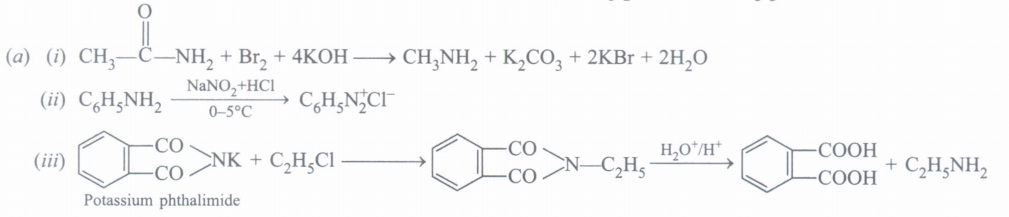
(b) (i) Add CHCl3 and KOH. Aniline will form offensive smelling compound where as N-methyl aniline will not react.
(ii) Add HNO2 (CH3)2NH will form yellow oily compound where as (CH3)3N will form salt soluble in water.
28.
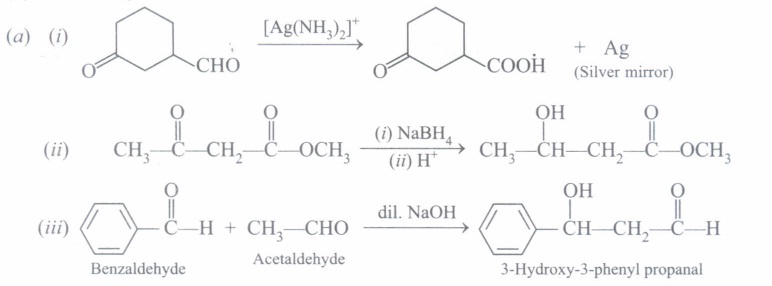
(b) Add I2 and NaOH. Acetophenone will give yellow ppt of iodoform whereas benzophenone will not react.
(c) It is because carbanion formed by losing H+ from \(\alpha\)-carbon is stabilised by resonance.
29.
(a) (i) It is because ethanal is more polar than acetone due to only one methyl group, whereas in acetone, there are two methyl groups which are electron releasing and reduce positive charge on carbonyl carbon.
(ii) It is because it does not have alpha (a) hydrogen.
(iii) It is due to greater intermolecular H-bonding in carboxylic acids than alcohols and they exist as dimers.
(b) (i) Add I2 and NaOH. Acetophenone will give yellow ppt. of iodoform, whereas Benzophenone will not react.
(ii) Add I2 and NaOH. Ethanal will give yellow ppt. of iodoform, whereas benzaldehyde will not react.
Alternathe Method: Add Fehling's solution A and B to each of these and heat. Ethanal will give brick red ppt., whereas benzaldehyde will not react.
30.
(a) (i) It is because \(\mathrm{CH}_{3} \mathrm{O}^{\Theta} \) is strong nucleophile, 3° halide undergo elimination more readily than nucleophilic substitution reaction.
(ii) It is due to double bond character in phenol due to resonance but not in ethanol.
(b) (i) Add neutral FeCI3 . Ethanol does not react. Phenol gives violet colour.
(ii) Add l2 and NaOH. Methanol will not react. Propan-2-ol will give yellow ppt. of Iodoform.
(c) (i) 3-Phenoxy heptane.
(ii) 3,3-Dimethyl pentan-2-ol.
31.
(i) (a) Metal carbonyls: Metal carbonyls are the compounds in which carbon monoxide (CO) acts as the ligand. The metal-carbon bond in metal carbonyls possesses both \(\sigma\) and \(\pi\) characters, e.g. N(CO)4[nickeltetracarbonyl]. Its IUPAC name is tetra carbonyl nickel(0).
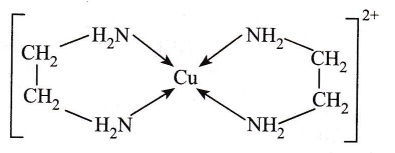
(b) Chelate: An inorganic metal complex in which there is a close ring of atoms caused by attachment of a ligand to a metal atom at two points. An example is the complex ion formed between ethylene diamine and cupric ion,[Cu(NH2CH2CH2NH2)2]2+.
(ii) (a) Add BaCl2 solution. [Co(NH3)]5Cl]SO4 will give white ppt. of BaSO4.
\(\left[\mathrm{Co}\left(\mathrm{NH}_{3}\right)_{5} \mathrm{Cl}\right] \mathrm{SO}_{4}+\mathrm{BaCl}_{2}(a q) \)\( \longrightarrow\left[\mathrm{Co}\left(\mathrm{NH}_{3}\right)_{5} \mathrm{Cl}\right] \mathrm{Cl}_{2}+\mathrm{BaSO}_{4} \downarrow \)
\(\text { (White ppt.) }\)
Add AgNO3(aq) solution [Co(NH3)5SO4] Cl will give white ppt. of AgCl.
\( {\left[\mathrm{Co}\left(\mathrm{NH}_{3}\right)_{5} \mathrm{SO}_{4}\right] \mathrm{Cl}+\mathrm{AgNO}_{3}(a q)} \) \(\longrightarrow \mathrm{AgCl}+\left[\mathrm{Co}\left(\mathrm{NH}_{3}\right)_{5} \mathrm{SO}_{4}\right] \mathrm{NO}_{3} \)
\(\text { (White ppt) }\)
(c) Fe3+ (4s03d5) In strong field \( \Delta_{0}>P t_{2 g}^{5} e g^{0} \)
In weak field \(\Delta_{0}
32.
(i) It shows positive deviation.
It is due to weaker interaction between acetone and ethanol than ethanol-ethanol interactions.
(ii) Given : WB = 10g, Ws = 100 g, WA = 90 g, MB = 180 g.mol and d = 1.2 g/mL
\(M=\frac { Wt%\times density\times 10 }{ Mol.wt } \)
\(M=\frac { 10\times 1.2\times 10 }{ 180 } \)
= 0.66 M or 0.66 mol/L
\(m=\frac { { W }_{ B }\times 1000 }{ { M }_{ B }\times { W }_{ A }(in\quad g) } \)
\(m=\frac { 10\times 1000 }{ 180\times 90 } \)
= 0.61 m or 0.61 mol/kg
(or any other suitable method)
33.
(b) If both assertion and reason are true but the reason is not the correct explanation of the assertion.
34.
(b): The tendency to show H-bonding decreases with increasing hydrophobic character of carbon chain.
35.
(b): The complex ion[Al(NH3)6]3+ undergoes the change into new complex ion [Al(H2O)6]3+ in aqueous medium due to higher heat of hydration of aluminium ion on account of its small size.
\(\left[\mathrm{Al}\left(\mathrm{NH}_{3}\right)_{6}\right]^{3+}+6 \mathrm{H}_{2} \mathrm{O} \rightarrow\left[\mathrm{Al}\left(\mathrm{H}_{2} \mathrm{O}\right)_{6}\right]^{3+}+6 \mathrm{NH}_{3}\)
36.
(a) When the divers come towards the surface, pressure gradually decreases. This releases the dissolved gases and leads to the formation of bubbles of nitrogen in the blood. Hence, both (A) and (R) are correct and (R) is the correct explanation of (A).
37.
(a) (CH3)3N does not react with Hinsberg reagent.
(b)

(c)
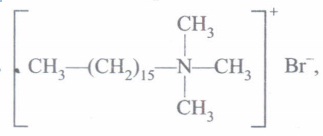 cetyltrimethyl ammonium bromide.
(d)
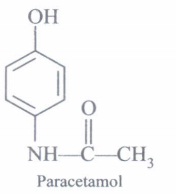
(e) Add NaNO2 and cone, HCI. Cool it to 0 - 5°C. Then add alkaline solution of phenol. Aniline will give orange, azo dye, whereas Benzyl amine does not.
38.
(i) (d): Oxidation state of Mn in [Mn2(CO)10] is zero.
(ii) (d): In \(\left[\mathrm{V}(\mathrm{CO})_{6}\right]^{-}\), the anionic carbonyl complex can delocalise more electron density to antibonding \(\pi\)-orbital (d\(\pi\)-p\(\pi\) back bonding) of CO and thus lowers the bond order.
(iii) (c): K[CO(CO)4]
+ 1 + (x) + 4(0) = 0 or x = -1
(iv) (d): Mn2(CO)10 is made up of two square pyramidal Mn(CO)5 units joined by Mn - Mn bond.

12th Standard CBSE Syllabus & Materials
12th Standard CBSE
CBSE 12th Computer Science Python Revision Tour I - New Previous year Question Papers Study Material - QB365 Set A
NEW12th Standard CBSE
CBSE 12th Business Studies Planning Important Questions And Answers Study Material - QB365 Set A
NEW12th Standard CBSE
CBSE 12th Business Studies Business Environment Important Questions And Answers Study Material - QB365 Set A
NEW12th Standard CBSE
CBSE 12th Business Studies Principles of Management Important Questions And Answers Study Material - QB365 Set A



NCERT Books

Syllabus

Exam Pattern

Sample Question Papers

Previous year Question Papers

Important Notes

MCQ Practice test

NCERT Exemplers

Case study Questions

Image Based Questions

Passage based Questions

HOT Questions

Value Based Questions

Model Questions Papers
NCERT ( Book Back ) Questions

Assertion and Reason
Important Questions And Answers

CBSE 12th Standard CBSE Subjects
CBSE Standards








