
 100% FREE ACCESS
12th Standard CBSE Syllabus & Materials
12th Standard CBSE
CBSE 12th Economics Government Budget and the Economy Previous year Question Papers Study Material - QB365 Set A
NEW12th Standard CBSE
CBSE 12th Computer Science Interface Python with MySQL - New Previous year Question Papers Study Material - QB365 Set A
NEW12th Standard CBSE
CBSE 12th Computer Science Database Concept - New Previous year Question Papers Study Material - QB365 Set A
NEW12th Standard CBSE
CBSE 12th Computer Science Data Communication - New Previous year Question Papers Study Material - QB365 Set A
NEW12th Standard CBSE
CBSE 12th Computer Science Data Structures - New Previous year Question Papers Study Material - QB365 Set A
NEW12th Standard CBSE
CBSE 12th Computer Science Functions - New Previous year Question Papers Study Material - QB365 Set A

Published on: 25/10/2025
Download CBSE Class 12th Standard CBSE Chemistry question papers, sample papers, important questions, and previous year solved papers in PDF format. Get free study materials, NCERT solutions, and exam preparation resources for Class 12th Standard CBSE Chemistry
Questions + Answers key
Take MCQ Chemistry Test
1.
Define the following terms:
(a) Vitamins
(b) Invert sugar
(c) Nucleoside
2.
An aromatic compound 'A' on heating with Br2 and KOH forms a compound 'B' of molecular formula C6H7N which on reacting with CHCI3 and alcoholic KOH produces a foul smelling compound 'C'. Write the structures and IUPAC names of compounds A, B and C.
3.
What are enzymes? Describe their functions. Name two diseases which are caused due to deficiency of enzymes.
4.
Why aryl halides are less reactive towards nucleophilic substitution reactions than alkyl halides?
5.
What is menat by unidentate, didentate and ambidentate ligands? Give twoo examples for each.
6.
Which of the following statements are correct about the mechanism of this reaction?
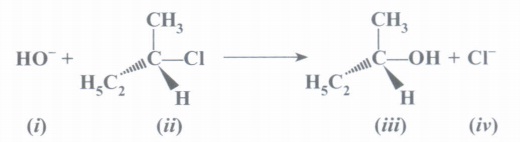
A carbocation will be formed as an intermediate in the reaction.
OH- will attach the substrate (ii) from one side and CI- will leave it simultaneously from other side.
An unstable intermediate will be formed in which OH- and Cl- will be attached by weak bonds.
(d) Reaction proceeds through SN1 mechanism
7.
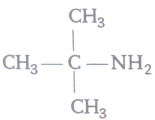 is a
is a
primary amine
secondary amine
tertiary amine
None of these
8.
The M - Cㅠ - bond is formed by the
donation of a pair of electrons
sharing of a pair of electrons
receiving a pair of electrons
None of the above
9.
Which of the following is not the correct reaction of aryldiazonium salts?
\({ C }_{ 6 }H_{ 5 }{ N }_{ 2 }^{ + }{ CI }^{ - }+{ Cu }_{ 2 }{ Cl }_{ 2 }\longrightarrow { C }_{ 6 }H_{ 5 }CI\)
\({ C }_{ 6 }H_{ 5 }{ N }_{ 2 }^{ + }{ CI }^{ - }+HB{ F }_{ 4 }\overset { Heat }{ \longrightarrow } { C }_{ 6 }H_{ 5 }F\)
\({ C }_{ 6 }H_{ 5 }{ N }_{ 2 }^{ + }{ CI }^{ - }+{ H }_{ 3 }{ PO }_{ 2 }\longrightarrow { C }_{ 6 }H_{ 5 }{ PO }_{ 4 }\)
\({ C }_{ 6 }H_{ 5 }{ N }_{ 2 }^{ + }{ CI }^{ - }+SnCI_{ 2 }/HCI\longrightarrow { C }_{ 6 }H_{ 5 }{ NHNH }_{ 2 }\)
10.
Number of structural isomers possible from the molecular formula C3H9N is
5
2
3
4
11.
Starch is a mixture of two components, a water soluble component amtlose (15-20%) and a water insoluble component amylopectin (80-85%). The aqueous solution of amylose gives a blue colour with iodine solution due to the formation of
amylose iodide
amylose iodate
inclusion complex
amylose teriodide complex
12.
Which of the following statements is not true regarding (+)-lactose ?
(+)-Lactose, C12H22O11 contains * OH groups
On hydrolysis, (+)-lactose gives equal amounts of D-(+)-glucose and D-(+)-galactose
(+)-Lactose is a \(\beta\) -glycoside formed by the union of a molecule of D (+)-glucose and a molecule of D-(+)-galactose
(+)-Lactose is a reducing sugar and does not exhibit mutarotation
13.
For the following : (a) I- (b) CI- (c) Br- the increasing order of nucleophilicity would be
Br- < CI- < I-
I- < Br- < CI-
CI- < Br- < I-
I- < CI- < Br-
14.
Which of the following possesses highest melting point?
Chlorobenzene
o-Dichlorobenzene
m-Dichlorobenzene
p-Dichlorobenzene
15.
The correct structure of Fe(CO)5 is
octahedral
terahedral
square pyramidal
trigonal bipyramidal
16.
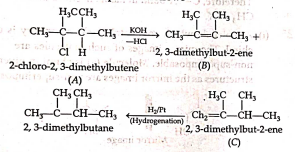
An alkyl halide (A) of molecular formula, C6H13Cl on treatment with alcoholic KOH gives two isomeric alkenes (B) and (C) of molecular formula, C6H12- Both alkenes on hydrogenation gives 2, 3-dimethylbutane. Write the structures of (A), (B) and (C).
17.
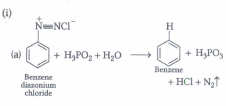
(a) Write the structures of main products when products when benzene diazonium chloride reacts with the following reagents:
(i) H3PO2+H2O
(ii) CuCN/KCN
(iii) H2O
(b) Arrange the following in the increasing order of their basic character in an aqueous solution:
C2H5NH2 , (C2H5)2NH, (C2H5)3N
(c) Give a simple chemical test to distinguish between the following pair of compounds:
C6H5-NH2 and C6H5-NH-CH3
18.
What forces are responsible for the stability of \(\alpha\) - helix ? Why is it named as 3.613 helix?
19.
Using crystal field theory, draw energy level diagram, write electronic configuration of the central metal atom/ion and determine the magnetic moment value in the following :
(i) \([CoF_6]^{3-}, [Co(H_2O)_6]^{2+},[Co(CN)_6]^{3-}\)
(ii) \([FeF_6]^{3-}, \ [Fe(H_2O)_6]^{2+}, [Fe(CN)_6]^{4-}\).
20.
Complete the following chemical equation:
(i) CH3CI + KNO2 \(\longrightarrow\)
(ii) \(\mathrm{C}_{2} \mathrm{H}_{5} \mathrm{Cl}+\mathrm{NaI} \stackrel{\text { Acetone }}{\longrightarrow}\)
21.
Why do proteins form an indispensable part of our food?
22.
Benzene diazonium salts are more stable than alkyl diazonium salts. Give reason.
23.
Write the IUPAC name of [PtCI6]2-
24.
25.
Assertion (A) : Nucleophilic substitution of iodoethane is easier than chloroethane.
Reason (R) : Bond enthalpy of C-1 bond is less than that of C-Cl bond
(a) Both (A) and (R) are correct, (R) is the correct explanation of (A).
(b) Both (A) and (R) are correct, (R) is not the correct explanation of (A).
(c) (A) is correct but (R) is incorrect.
(d) (A) is incorrect but (R) is correct
26.
Assertion: Carbylamine reaction involves the reaction between 1o amine and chloroform in basic medium.
Reason: In carbylamine reaction, -NH2 group is converted into - NC group.
Codes:
(a) Assertion and reason both are correct statements and reason is correct explanation for assertion.
(b) Assertion and reason both are correct statements but reason is not correct explanation for assertion.
(c) Assertion is correct statement but reason is wrong statement.
(d) Assertion is wrong statement but reason is correct statement.
27.
In the following questions. an Assertion (A) is followed by a corresponding Reason (R) Use the following keys to choose the appropriate answer.
Assertion (A) Fresh tomatoes are better source of vitamin C than those which have been stored for sometime.
Reason (R) On prolonged exposure to air, vitamin C is destroyed due to aerial oxidation.
Codes:
(a) Both (A) and (R) are correct, (R) is the correct explanation of (A).
(b) Both (A) and (R) are correct, (R) is not the correct explanation of (A).
(c) (A) is correct; (R) is incorrect.
(d) (A) is incorrect; (R) is correct.
28.
Observe the histogram showing boiling points of pentane, iso pentane, 1°,2° and 3 ° amines. Answer the questions that follow based on table and related concepts.
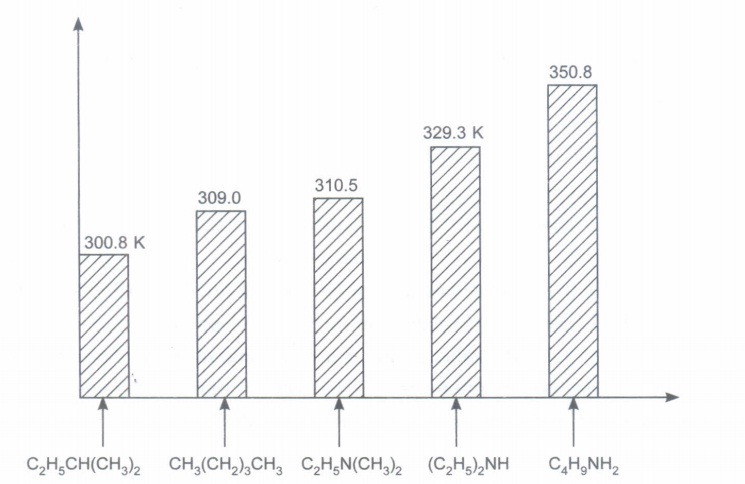
(a) Why does CH3CH2CH2CH2NH2 (1° amine) has higher boiling point than (C2H5)2NH and C2H5N(CH3 )2?
(b) Why does ethanol have higher boiling point than ethanamine?
(c) Why amines are more basic than alcohol?
(d) Why are Primary amines more soluble in water than 2° and 3° amines?
(e) Arrange the compounds shown in graph, increasing order of boiling points. Give reason.
29.
Read the passage given below and answer the following questions:
Carbohydrates are polyhydroxy aldehydes and ketones and those compounds which on hydrolysis give such compounds are also carbohydrates. The carbohydrates which are not hydrolysed are called monosaccharides. Monosaccharides with aldehydic group are called aldose and those which free ketonic groups are called ketose. Carbohydrates are optically active. Number of optical isomers = 2n
Where n = number of asymmetric carbons. Carbohydrates are mainly synthesised by plants during photosynthesis.
The monosaccharides give the characteristic reactions of alcohols and carbonyl group (aldehydes and ketones). It has been found that these monosaccharides exist in the form of cyclic structures. In cyclization, the -OH groups (generally C5 or C4 in aldohexoses and C5 or C6 in ketohexoses) combine with the aldehyde or keto group. As a result, cyclic structures of five or six membered rings containing one oxygen atom are formed, e.g., glucose forms a ring structure. Glucose contains one aldehyde group, one 1o alcoholic group and four 2o alcoholic groups in its open chain structure.
The following questions are multiple choice questions. Choose the most appropriate answer:
(i) First member of ketos sugar is
| (a) ketotriose | (b) ketotetrose | (c) ketopentose | (d) ketohexose |
(ii) In CH2OHCHOHCHOHCHOHCHOHCHO, the number of optical isomers will be
| (a) 16 | (b) 8 | (c) 32 | (d) 4 |
(iii) Some statements are given below:
1. Glucose is aldohexose.
2. Naturally occurring glucose is dextrorotatory.
3. Glucose contains three, chiral centres.
4. Glucose contains one 1o alcoholic group and four 2o alcoholic groups.
Among the above, correct statements are
| (a) 1 and 2 only | (b) 3 and 4 only |
| (c) 1,2 and 4 only | (d) 1,2,3 and 4 |
(iv) Which of the following reactions of glucose can be explained only by its cyclic structure?
| (a) Glucose forms cyanohydrin with HCN |
| (b) Glucose reacts with hydroxylamine to form an oxime |
| (c) Pentaacetate of glucose does not react with hydroxylamine |
| (d) Glucose is oxidised by nitric acid to gluconic acid . |
1.
(a) Vitamins: Vitamins are the group of organic compounds which are required in very small amounts for the healthy growth and functioning of animal organism. They cannot be made by organism and so have to be part of our diet. The deficiency of a vitamin can cause a specific disease. Vitamins A, D, E and K are fat-soluble substances, whereas vitamin B complex and vitamin C are water-soluble.
(b) Invert sugar: It is a mixture containing equal amount of glucose and fructose.
(c) Nucleosides: A base joined to a sugar molecule is called nucleoside, e.g. adenosine contains adenine and ribose, guanosine contains ribose and guanine, cytidine contains ribose and cytosine.
2.
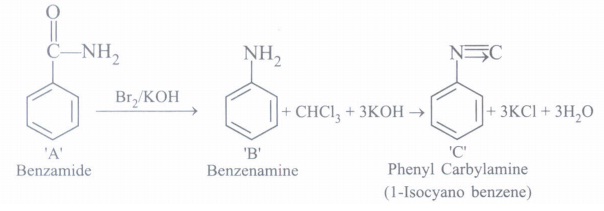
'A' is Benzamide, 'B' is Benzenamine, 'C' is isocyanobenzene.
3.
Enzymes are biological catalyst, they are composed of proteins. Enzymes are highly specific in nature. The two
main functions are as follows :
(i) They lower the requirement of activation energy.
(ii) They speed up the rate of reaction.
e.g. Enzyme maltase catalyses maltose to glucose.
\(\begin{equation} \mathrm{C}_{12} \mathrm{H}_{22} \mathrm{O}_{11}+\mathrm{H}_{2} \mathrm{O} \stackrel{\text { Maltase }}{\longrightarrow} 2 \mathrm{C}_{6} \mathrm{H}_{12} \mathrm{O}_{6} \end{equation}\)
(iii) Two diseases which are caused due to deficiency of enzymes are
(a) Phenyl ketone urea (PKU) (b) Albinism
4.
Haloarenes are much less reactive than haloalkanes towards nucleophilic substitution reactions because of the following reasons:
1. Resonance effect: In haloarenes, there is delocalisation of electrons due to resonance. For example, chlorobenzene is considered to be a resonance hybrid of the following structures:
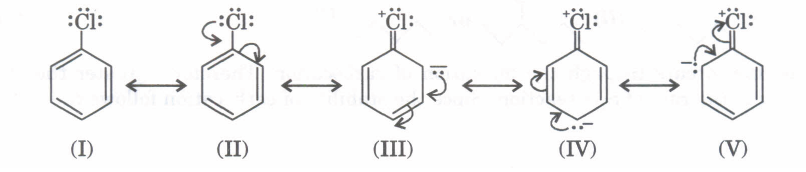
It is evident that, the contribution of structures III, IV and V imparts a partial double bond character to the carbon-chlorine bond. This is confirmed by X-ray analysis which shows that the C - CI bond length in chlorobenzene is 1.69A while the C-CI bond length in ethyl chloride molecule is 1.82A. The shortening of bond length imparts stability to aryl halides and the bond cleavage becomes rather difficult. The aryl halides are, therefore, less reactive than alkyl halides.
2. Different hybridisation states of carbon atom: In haloalkanes the carbon atom of the C - X bond is sp3 hybridised while in haloarene halides, the carbon atom is sp2 hybridised. The Sp2 hybridised carbon atom with a greater s-character is more electronegative. It can hold the electron pair of the bond more tightly than the Sp3 hybridised carbon atom in alkyl halides. Therefore, it has less tendency to release electrons to the halogen. As a result, the bond cleavage in aryl halides is some what more difficult than in alkyl halides.
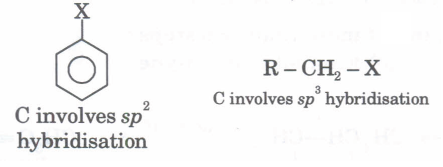
Thus haloarenes are less reactive towards the substitution reactions than haloalkanes.
5.
Unidentate Ligands: Those ligands which can form only one coordinate bond are called unidentate ligands, e.g. NH3 , CN- Didentate Ligands: Those ligands which can form two coordinate bonds are called bidentate ligands,\(\overset { { COO }^{ - } }{ \underset { { COO }^{ - } }{ | } } \) (ox), H2NCH2CH2NH2(en). Ambidentate Ligands: Those ligands which can form bond through either of the two donor atoms are called ambidentate ligands, e.g. CN- , NO2- etc.
6.
(a)
A carbocation will be formed as an intermediate in the reaction.
7.
(a)
primary amine
8.
(a)
donation of a pair of electrons
9.
H3PO4 brings about substitution of diazo group by H. Therefore, reaction (c) is not correct.
10.
(d)
4
11.
(c)
inclusion complex
12.
(d)
(+)-Lactose is a reducing sugar and does not exhibit mutarotation
13.
(c)
CI- < Br- < I-
14.
(d)
p-Dichlorobenzene
15.
(c)
square pyramidal
16.
The reaction takes place as follows
17.
(b) C2H5NH2 < (C2H5)3N < (C2H5)2NH
(c) Add CHCl3 and alc. KOH, C6H5-NH2 gives foul smell of isocyanide whereas C6H5-NH-CH3 does not (or any other correct test).
18.
The stability of \(\alpha \) -helix structure is due to intramolecular H-bonding between -NH- and -CO- groups of the same polypeptide chain. The \(\alpha \) -helix is termed as \({ 3.6 }_{ 13 }\) helix since each turn of the helix has approximately 3·6 amino acids and the hydrogen bonding leads to the formation of a 13-membered ring.
19.
(i) \([CoF_6]^{3-}\)
\( [Co(H_2O)_6]^{2+}\)
\([Co(CN)_6]^{3-}\)
(ii) \([FeF_6]^{3-}\)
\(\ [Fe(H_2O)_6]^{2+}\)
\([Fe(CN)_6]^{4-}\)
It is diamagnetic due to the absence of unpaired electrons.
20.
(i) \(\mathrm{CH}_{3} \mathrm{Cl}+\mathrm{KNO}_{2} \longrightarrow \mathrm{CH}_{3}-\mathrm{O}-\mathrm{N}=\mathrm{O}+\mathrm{KCl}\)
(ii) \(\mathrm{C}_{2} \mathrm{H}_{5} \mathrm{Cl}+\mathrm{NaI} \stackrel{\text { Acetone }}{\longrightarrow} \mathrm{C}_{2} \mathrm{H}_{5} \mathrm{I}+\mathrm{NaCl}\)
21.
Providing strength to the cells and tissues.
22.
Due to the dispersal of positive charge over benzene ring.
23.
Hexochloroplatinate (IV)
24.
25.
(a) Both (A) and (R) are correct, (R) is the correct explanation of (A).
Nucleophilic substitution of iodoethane is easier than chloroethane because bond energy or enthalpy of C-I bond is less than that of C-Cl bond. Thus, both (A) and (R) are correct and (R) is the correct explanation of (A).
26.
(a) \( R \mathrm{NH}_{2}+\mathrm{CHCl}_{3}+3 \mathrm{KOH}(\mathrm{alc}) \longrightarrow\) \(R-\mathrm{N} =^\rightarrow \mathrm{C}+3 \mathrm{KCl}+3 \mathrm{H}_{2} \mathrm{O}\)
27.
(a) Both (A) and (R) are correct and (R) is correct explanation of (A).
28.
(a) It is because extent of H-bonding is more in CH3CH2CH2CH2NH2 than 2° and 3° amines.
(b) It is because H-bonds are stronger in alcohols than amines because 'O' is more electronegative than 'N'.
(c) It is because \(\stackrel{\oplus}{\mathrm{RNH}_{3}}\) is more stable than \(\underset{\mathrm{ROH2}}{\oplus}\) . +ve charge on oxygen is not stable.
(d) It is because primary amines can form H-bonds with water to more extent.
(e) C2H5CH(CH3)2 < CH3(CH2)3CH3 < C2H5N(CH3)2 < (C2H5)2NH < C4H9NH2.
Isopentane has lower boiling point that n-Pentane due to branching less surface area, less van der Waals' forces of attraction. 3° < 2° < 1° is order of boiling point in amines because extent of H-bonding increases.
29.
(i) (a)
(ii) (a)
(iii) (c) : Glucose contains four chiral centres.
(iv) (c) : Pentacetate of glucose does not react with hydroxylamine showing absence of free -CHO group. This cannot be explained by open structure of glucose.

12th Standard CBSE Syllabus & Materials
12th Standard CBSE
CBSE 12th Computer Science Python Revision Tour I - New Previous year Question Papers Study Material - QB365 Set A
NEW12th Standard CBSE
CBSE 12th Business Studies Planning Important Questions And Answers Study Material - QB365 Set A
NEW12th Standard CBSE
CBSE 12th Business Studies Business Environment Important Questions And Answers Study Material - QB365 Set A
NEW12th Standard CBSE
CBSE 12th Business Studies Principles of Management Important Questions And Answers Study Material - QB365 Set A



NCERT Books

Syllabus

Exam Pattern

Sample Question Papers

Previous year Question Papers

Important Notes

MCQ Practice test

NCERT Exemplers

Case study Questions

Image Based Questions

Passage based Questions

HOT Questions

Value Based Questions

Model Questions Papers
NCERT ( Book Back ) Questions

Assertion and Reason
Important Questions And Answers

CBSE 12th Standard CBSE Subjects
CBSE Standards








