
 100% FREE ACCESS
12th Standard CBSE Syllabus & Materials
12th Standard CBSE
CBSE 12th Economics Government Budget and the Economy Previous year Question Papers Study Material - QB365 Set A
NEW12th Standard CBSE
CBSE 12th Computer Science Interface Python with MySQL - New Previous year Question Papers Study Material - QB365 Set A
NEW12th Standard CBSE
CBSE 12th Computer Science Database Concept - New Previous year Question Papers Study Material - QB365 Set A
NEW12th Standard CBSE
CBSE 12th Computer Science Data Communication - New Previous year Question Papers Study Material - QB365 Set A
NEW12th Standard CBSE
CBSE 12th Computer Science Data Structures - New Previous year Question Papers Study Material - QB365 Set A
NEW12th Standard CBSE
CBSE 12th Computer Science Functions - New Previous year Question Papers Study Material - QB365 Set A

Published on: 25/10/2025
Download CBSE Class 12th Standard CBSE Chemistry question papers, sample papers, important questions, and previous year solved papers in PDF format. Get free study materials, NCERT solutions, and exam preparation resources for Class 12th Standard CBSE Chemistry
Questions + Answers key
Take MCQ Chemistry Test
1.
Propanamine and N, N-dimethylmethanamine contain the same number of carbon atoms, even though Propanamine has higher boiling point than N, N-dimethylmethanamine. Why?
2.
Though both Cr2+ and Mn3+ have d4 configuration, yet Cr2+ is reducing and Mn3+ is oxidizing. Explain Why?
3.
Arrange the following in increasing order of their boiling point:
C4H9-NH2, (C2H5)2NH, C2H5N(CH3)2.
4.
Name the ionization isomer of \([Cr(H_O)_5Br]\ SO_4\).
5.
What is spectrochemical series? Explain the difference between a weak field ligand and a strong field ligand.
6.
Silver atom has completely filled d orbitals (4d10) in its ground state. How can you say that it is a trasition element?
7.
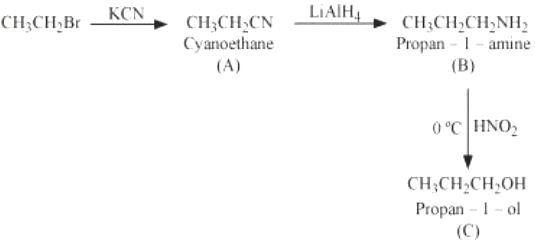
Give the structures of A, B and C in the following by reactions.
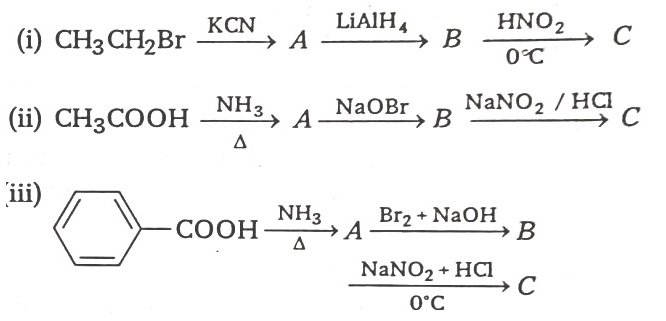
8.
Give reasons:
(i) Aniline does not undergo Friedel-Crafts Reaction.
(ii) p-methyl aniline is more basic thanp-nitroaniline.
(iii) Acetylation of -NH2 group is done in aniline before preparing its o and p compounds.
9.
Calculate the ‘spin only’ magnetic moment of M2+(aq) ion (Z = 27).
10.
How would you account for the following?
(i) Copper (I) is diamagnetic, whereas copper (II) is paramagnetic.
(ii) What is the common oxidation state of Cu, Ag, Au?
(iii) The d1-configuration is very unstable in ions.
11.
Why do the transition elements exhibit higher enthalpies of atomisation?
12.
Give one chemical test each to distinguish between the compounds in the following pairs:
(i) Methyleamine and dimethylamine
(ii) Aniline and benzylamine
(iii) Ethylamine and aniline
13.
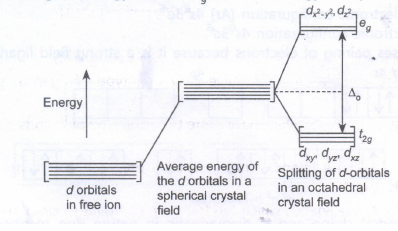
Draw figure to show splitting of d orbitals in an octahedral crystal field.
14.
What type of isomerism is exhibited by [CO(NH3)4CI2]+ Br- ? Write the structures of the possible isomers and the state of hybridisation of the central metal atom.
15.
Write the IUPAC names of the following coordination compounds
(i) [Co(NH3)6]Cl3
(ii) [Co(NH3)5Cl]Cl2
(iii) K3[Fe(CN)6]
(iv) K3[Fe(C2O4)3] (v) K2[PdCl4]
(v) [Pt(NH3)2Cl(NH2CH3)]Cl
16.
Write the reactions involved in the following:
(i) Hofmann bromamide degradation reaction
(ii) Diazotisation
(iii) Gabriel phthalimide synthesis
17.
(i) Distinguish the structure of chromate ion from that of dichromate ion.
(ii) Between the dichromates of sodium and potassium, which one is preferred for oxidising organic compound and why?
(iii) Give two equations that explains the nature of K2Cr2O7 as reducing agent.
18.
Account for the following :
(a) Transition metals show variable oxidation states.
(b) Zn, Cd and Hg are soft metals
(c) Eo value for the Mn3+ /Mn2+ couple is highly positive (+ 1.57 V) as compared to Cr3+ /Cr2+.
(ii) Write one similarity and one difference between the chemistry of lanthanoid and actinoid elements.
19.
Amines may be regarded as alkyl or aryl derivatives of ammonia. They may be primary, secondary or tertiary. Quaternary salts are also quite common. They occur in nature among proteins, vitamins,alkaloids and hormones. Several polymer, dyestuffs and drugs are amines.
(i) Name two drugs which contain secondary amino groups and are used to increase blood pressure.
(ii) Which amino drug is used as an anaesthetic in dentistry?
(iii) Benadryl is an antihistamine drug and is commonly used in cough syrups, what type of amino group does it contain?
(iv) Name a quaternary salt which is used both as detergent and as a germicide.
20.
Compare the general characteristics of the first series of the transition metals with those of the second and third columns. Give special emphasis on the following points:
(i) electronic configurations,
(ii) oxidation states,
(iii) ionisation enthalpies and
(iv) atomic sizes.
21.
Which of the following is the weakest Bronsted base?
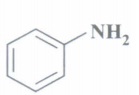
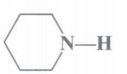
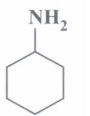
CH3NH2
22.
Which of the following statements about primary amines is 'False' ?
Alkylamines are stronger base than ammonia.
Alkylamines are stronger bases than arylamines
Alkylamines react with nitrous acid to produce alcohols
Arylamines react with nitrous acid to produce pheols
23.
m-Bromoaniline can be prepared by
\({ C }_{ 6 }{ H }_{ 6 }\quad \overset { { HNO }_{ 3 } }{ \underset { { H }_{ 2 }{ SO }_{ 4 } }{ \longrightarrow } } \quad \overset { 1.Sn-HCI }{ \underset { { 2.NaOH,H }_{ 2 }O }{ \longrightarrow } } \quad \overset { { Br }_{ 2 } }{ \underset { H_{ 2 }O }{ \longrightarrow } } \)
\({ C }_{ 6 }{ H }_{ 6 }\ \overset { { Br }_{ 2 } }{ \underset { { FeBr }_{ 3 } }{ \longrightarrow } } \quad \overset { { HNO }_{ 3 } }{ \underset { H_{ 2 }{ SO }_{ 4 } }{ \longrightarrow } } \quad \overset { { H }_{ 2 } }{ \underset { Pt }{ \longrightarrow } } \)
\(m-Br{ C }_{ 6 }{ H }_{ 4 }COOH\ \overset{ SOCI_{ 2 } }{ \longrightarrow } \quad \overset { NH_{ 3 } }{ \longrightarrow } \quad \overset { Br_{ 2 },NaOH }{ \longrightarrow } \)
\({ C }_{ 6 }{ H }_{ 5 }{ NH }_{ 2 }\quad \overset { { NaNO }_{ 2 },HCI }{ \underset { { Cu }_{ 2 }Br_{ 2 } }{ \longrightarrow } } \overset { SOCI_{ 2 } }{ \longrightarrow } \quad \overset { NaNH_{ 2 } }{ \longrightarrow } \)
24.
The colour of the transition metal ions is due to
d - d transition
charge transfer
change in the geometry
none
25.
KMnO4 can be prepared from K2MnO4 as per the reaction :
\({ 3MnO }_{ 4 }^{ 2- }+{ 2H }_{ 2 }O\rightleftharpoons { 2MnO }_{ 4 }^{ - }+{ MnO }_{ 2 }+{ 4OH }^{ - }\)
The reaction can go to completion by removing OH- ions by adding
HCI
KOH
CO2
SO2
26.
In the form of dichromate, Cr (VI) is a strong oxidising agent in acidic medium but Mo (VI) in MoO3 and W (VI) in WO3 are not because _______________.
Cr (VI) is more stable than Mo (VI) and W (VI).
Mo (VI) are more stable than Cr (VI).
Higher oxidation states of heavier members of group - 6 of transition series are more stable
Lower oxidation states of heavier members of group - 6 of transition series are more stable
27.
Indicate the complex ion which shows geometrical isomerism.
[Cr(H2O)4Cl2]+
[Pt(NH3)3Cl]
[Co(NH3)6]3+
[Co(CN)5(NC)]3-
28.
Which of the following reactions are kinetically favourable?
I. [Cu(H2O)4]2+ + 4NH3 \(\rightarrow \) [Cu(NH3)4]2+ + 4H2O
II. [Cu(H2O)4]2+ +4Cl- \(\rightarrow \) [CuCl4]2+ + 4H2O
III. [Co(H2O)6]3+ +6Cl- \(\rightarrow \) [CoCl6]3- + 6H2O
I and II
II and III
I and III
I, II and III
29.
The hybridization involved in the complex [Ni(CN)4]2- is (At.No. of Ni=28)
d2sp2
d2sp3
dsp2
sp3
30.
The primary and secondary valencies of chromium in the complex ion, dichlorodioxalatochromium (III) are respectively
3,4
4,3
3,6
6,3
31.
KMnO4 on heating to red hot gives
K2MnO4 + MnO2 + O2
K2MnO3 + MnO2 + O2
K2O + MnO2 + O2
None of these
32.
Which metal has highest density ?
Pt
Os
W
Hg
33.
34.
Assertion: Ammonolysis of alkyl halides involves the reaction between alkyl halides and alcoholic ammonia.
Reason: Reaction can be used to prepare 1°, 2°, 3° amines and finally quaternary ammonium salts.
Codes:
(a) Assertion and reason both are correct statements and reason is correct explanation for assertion.
(b) Assertion and reason both are correct statements but reason is not correct explanation for assertion.
(c) Assertion is correct statement but reason is wrong statement.
(d) Assertion is wrong statement but reason is correct statement.
35.
Assertion: [CrCl2(H2O)4]NO3 is dichlorotetraaquachromium(III) nitrate.
Reason : In writing the name of the.complex cation is written first followed by the anion.
Codes:
(a) Assertion and reason both are correct statements and reason is correct explanation for assertion.
(b) Assertion and reason both are correct statements but reason is not correct explanation for assertion.
(c) Assertion is correct statement but reason is wrong statement.
(d) Assertion is wrong statement but reason is correct statement.
36.
In the following questions. an Assertion (A) is followed by a corresponding Reason (R) Use the following keys to choose the appropriate answer.
Assertion (A) Tertiary butyl amine can be prepared by the action of NH3 on tert-butyl bromide.
Reason (R) Tertiary butyl bromide being 3° alkylhalide prefers to undergo elimination on the treatment with a base.
Codes:
(a) Both (A) and (R) are correct, (R) is the correct explanation of (A).
(b) Both (A) and (R) are correct, (R) is not the correct explanation of (A).
(c) (A) is correct; (R) is incorrect.
(d) (A) is incorrect; (R) is correct.
37.
Read the passage given below and answer the following questions:
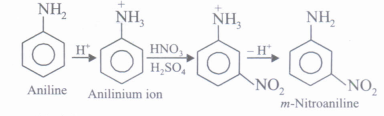
Amines are alkyl or aryl derivatives of ammonia formed by replacement of one or more hydrogen atoms. Alkyl derivatives are called aliphatic amines and aryl derivatives are known as aromatic amines. The presence of aromatic amines can be identified by performing dye test. Aniline is the simplest example of aromatic amine. It undergoes electrophilic substitution reactions in which - NH2 group strongly activates the aromatic ring through delocalisation oflone pair of electrons of N-atom. Aniline undergoes electrophilic substitution reactions. Ortho and para positions to the -NH2 group become centres of high electrons density. Thus, -NH2 group is ortho and para-directing and powerful activating group. The following questions are multiple choice questions.
Choose the most appropriate answer:
(i) Cyclohexylamine and aniline can be distinguished by
| (a) Hinsberg test | (b) carbylamine test | (c) Lassaigne test | (d) azo dye test |
(ii) Which of the following compounds gives-dye test?
| (a) Aniline | (b) Methyl amine | (c) Diphenyl amine | (d) Ethyl amine |
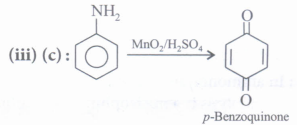
(iii) Oxidation of aniline with manganese dioxide and sulphuric acid produces
| (a) phenylhydroxylamine | (b) nitrobenzene | (c) p-benzoquinone | (d) phenol. |
(iv) Aniline when treated with conc, HNO3 and H2SO4 gives
| (a) phenylhydroxylamine | (b) m-nitroaniline | (c) p-benzoquinone | (d) nitrobenzene. |
38.
Read the passage given below and answer the following questions:
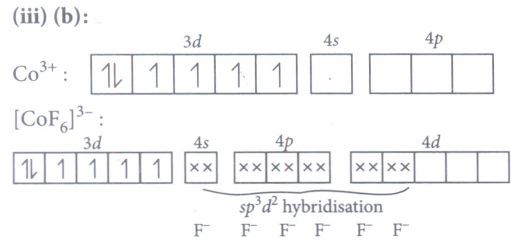
To explain bonding in coordination compounds various theories were proposed. One of the important theory was valence bond theory. According to that, the central metal ion in the complex makes available a number of empty orbitals for the formation ofcoordination bonds with suitable ligands. The appropriate atomic orbitals of the metal hybridise to give a set of equivalent orbitals of definite geometry. The d-orbitals involved in the hybridisation may be either inner d-orbitals i.e., (n - 1) d or outer d-orbitals i.e., nd. For example, CO3+ forms both inner orbital and outer orbital complexes, with ammonia it forms [Co(NH3)6]3+ and with fluorine it forms [CoF6]3- complex ion.
The following questions are multiple choice questions. Choose the most appropriate answer:
(i) Which of the following is not true for [CoF6]3- ?
| (a) It is paramagnetic. | (b) It has coordination number of 6. |
| (c) It is outer orbital complex. | (d) It involves d2sp3 hybridisation. |
Which of the following is true for [Co(NH3)6]3+ ?
| (a) It is an octahedral, dimagnetic and outer orbital complex. |
| (b) It is an octahedral, paramagnetic and outer orbital complex. |
| (c) It is an octahedral, paramagnetic and inner orbital complex. |
| (d) It is an octahedral, dimagnetic and inner orbital complex. |
(iii) The paramagnetism of [CoF6]3- is due to
| (a) 3 electrons | (b) 4 electrons | (c) 2 electrons | (d) 2 electrons |
(iv) Which of the following is an inner orbital or low spin complex?
| (a) \(\left[\mathrm{Ni}\left(\mathrm{H}_{2} \mathrm{O}\right)_{6}\right]^{3+}\) | (b)\(\left[\mathrm{FeF}_{6}\right]^{3-}\) | (c) \(\left[\mathrm{Co}(\mathrm{CN})_{6}\right]^{3-}\) | (d) \(\left[\mathrm{NiCl}_{4}\right]^{2-}\) |
1.
Propanamine has higher boiling point than N, N-Dimethylmethanamine because it is associated with intermolecular H-bonding whereas N, N-Dimethylmethanamine does not have H-bonds.
2.
Because of the stable half filled configuration of t2g sets Cr3+.
3.
Boiling points depend upon the extent of H-bonding which, in turn, depends upon the number of H-atoms present on the N-atom. Since C2H9NH2 has two, (C2H5)2NH has one and C2H5N(CH3)2 has no hydrogen linked to nitrogen, therefore, boiling points decrease as the extent H-bonding decreases, i.e., boiling points decrease in the order :
C4H9NH2 > (C2H5)2NH > C2H5N(CH3)2.
4.
[Cr(H2O)5SO4] Br, i.e., penta aqua sulphato chromium (III) bromide.
5.
Ligands have different field strength and as a result the crystal field splitting, \({ \Delta }_{ 0 }or{ \Delta }_{ t }\)depends upon the field produced by the ligand and charge on metal ions. Some ligands are strong and able to produce strong field; whereas others are weak and able to produce weak field. The series of ligands in which ligands are arranged in increasing order of field strength is called spectrochemical series, e.g.
\(({ I }^{ - }<{ Br }^{ - }<{ Cl }^{ - }<{ { SCN }^{ - } }<{ F }^{ - }<{ OH }^{ - }<{ { C }_{ 2 }{ O }_{ 4 } }^{ - }<{ H }_{ 2 }O<{ NCS }^{ - }<{ EDTA }^{ 4- }<{ NH }_{ 3 }\)
Weak field ligand cannot cause pairing of electrons and will form high spin complex/whereas stron$ field ligand can cause pairing of electrons and will form low spin complex.
6.
Silver in its + 1 oxidation state, exhibits 4d10 5so configuration. But in some compounds, it also shows +2 oxidation state, so the configuration becomes 4d10 5so. Here, d-orbital is not completely fllled, Therefore, silver is a transition element.
7.
(i)
(ii)
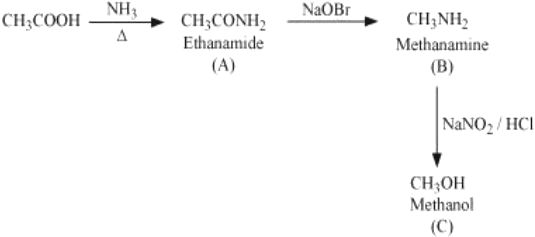
8.
(i) Aniline is a base, reacts with AlCl3 (Lewis acid) to form salt (adduct).
(ii) It is due to +1 effect of -CH3 group in p-methyl aniline and -I effect of -NO2 group in p-nitroaniline.
(iii) It is done to reduce activating effect of -NH2 .
9.
Z = 27
\(\Rightarrow[\mathrm{Ar}] 3 \mathrm{~d}^{7} 4 \mathrm{~s}^{2}\)
\(\therefore \mathrm{M}^{2+}=[\mathrm{Ar}] 3 \mathrm{~d}^{7}\)
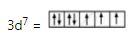
i.e., 3 unpaired electrons
\(\therefore n=3\)
\(\Rightarrow \sqrt{n(n+2)}=\mu\)
\(\Rightarrow \sqrt{3(3+2)}=\mu\)
\(\Rightarrow \sqrt{15}=\mu\)
\(\mu \approx 4 \mathrm{BM}\)
10.
Cu + = 3d10 and Cu 2+ = 3d9
(ii) Common oxidation state of Cu, Ag and Au is + 1.
(iii) As after loosing 1more electron it will become stable. All elements with dl configuration are either reducing agent or undergo disproportionation.
11.
Because of large number of unpaired electrons in their atoms they have stronger interatomic interaction and hence stronger bonding between atoms resulting in higher enthalpies of atomisation.
12.
(i) Methylamine and dimethylamine can be distinguished by the carbylamine test. Carbylamine test: Aliphatic and aromatic primary amines on heating with chloroform and ethanolic potassium hydroxide form foul-smelling isocyanides or carbylamines. Methylamine (being aliphatic primary amine) gives a positive carbylamine test, but dimethylamine does not.
(ii) Secondary and tertiary amines can be distinguished by allowing them to react with Hinsbergs reagent (benzenesulphonyl chloride, C6H5SO2Cl). Secondary amines react with Hinsberg’s reagent to form a product that is insoluble in an alkali. For example, N, N−diethylamine reacts with Hinsberg’s reagent to form N, N−diethylbenzenesulphonamide, which is insoluble in an alkali. Tertiary amines, however, do not react with Hinsberg’s reagent amines, however, do not react with Hinsberg’s reagent.
(iii) Aniline and benzylamine can be distinguished by their reactions with the help of nitrous acid, which is prepared in situ from a mineral acid and sodium nitrite. Benzylamine reacts with nitrous acid to form unstable diazonium salt, which in turn gives alcohol with the evolution of nitrogen gas.
13.
Let us assume that the six ligands are positioned symmetrically along the cartesian axes, with metal atom at the origin. As the ligands approach, first there is an increase in energy of d-orbitals relative to that of the free ion just as would be the case in a spherical field The orbitals lying along the axes (\({ d }_{ { z }^{ 2 } }\)nd \({ d }_{ { x }^{ 2 }-{ y }^{ 2 } }\))get repelled more strongly than dx1 d and dyz and dzx orbitals which have lobes directed between the axes. The \({ d }_{ { z }^{ 2 } }\)and orbitals get raised in energy and dxy dyz d xz orbitals are lowered in energy relative to the average energy in the spherical crystal field. Thus, the degenerate set of d-orbitals get split into two sets : the lower energy orbitals set and the higher energy orbitals eg set. The energy is separated by t2g and the higher energy orbitals eg set. The energy is separated by \({ \Delta }_{ 0 }\)
14.
Ionisation isomerism and Geometrical isomerism are exhibited by [CO(NH3)4CI2] Br.
The ionisation isomers are [CO(NH3)4CI2] Br and [CO(NH3)4(CI)(Br)CI.
The geometrical isomers are
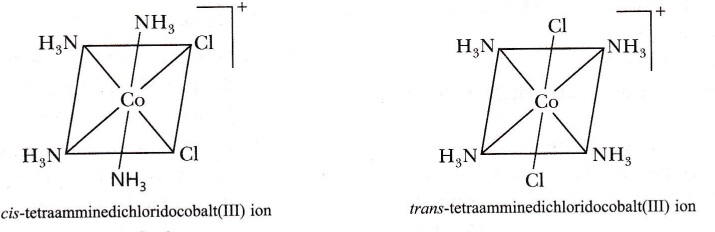
The central atom has d2sp3 hybridisation.
15.
(i) Pentaamminechloridocobalt(III) chloride.
(ii) Pentaamminechloridocobalt(III) chloride.
(iii) Potassium hexacyanoferrate(III).
(iv) Potassium tetrachloridopalladate(II).
(v) Diamminechlorido(methylamine)platinum(II) chloride.
16.
(a) (i) Hofmann Bromamide Degradation Reaction This reaction is used for preparing amine contaning one carbon less than the starting amide. This method was developed for the preparation of primary amines by reacting an amide with Br2/ Cl2 in NaOH/KOH.
In this reaction, migration of an alkyl or aryl group takes place from carbonyl carbon of the amide to the N-atom.
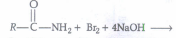
\(\begin{equation} R-\mathrm{NH}_{2}+\mathrm{Na}_{2} \mathrm{CO}_{3}+2 \mathrm{NaBr}+2 \mathrm{H}_{2} \mathrm{O} \end{equation}\)
\(\begin{equation} \text { e.g. } \mathrm{CH}_{3} \mathrm{CH}_{2} \mathrm{CONH}_{2}+\mathrm{Br}_{2}+4 \mathrm{NaOH}\\ \text { Amide } \end{equation}\)⟶\(\begin{equation} \begin{aligned} &3 \mathrm{CH}_{3} \mathrm{CH}_{2} \mathrm{NH}_{2}+\mathrm{Na}_{2} \mathrm{CO}_{3}+2 \mathrm{NaBr}+2 \mathrm{H}_{2} \mathrm{O}\\ &\text { Amine } \end{aligned} \end{equation}\)
(ii) Diazotisation The conversion of primary aromatic amines into their diazonium salts is called diazotisation. Benzene diazonium chloride is prepared by the reaction of aniline with nitrous acid (which is produced by the reaction of NaNO2 and HCI) at 273-278K or 0-5oC as shown below:
\(\begin{array}{r} \mathrm{C}_{6} \mathrm{H}_{5} \mathrm{NH}_{2}+\mathrm{NaNO}_{2}+2 \mathrm{HCl} \stackrel{273-278 \mathrm{~K}}{\longrightarrow} \mathrm{C}_{6} \mathrm{H}_{5} \mathrm{~N^+}_{2}{\mathrm{Cl^-}}+ \mathrm{NaCl}+2 \mathrm{H}_{2} \mathrm{O} \end{array}\)
Due to its unstability, the diazonium salt is not generally stored and is used immediately after its preparation.
(iii) Gabriel Phthalimide Synthesis When a phthalimide is treated with ethanolic KOH, it forms potassium salt of phthalimide which on heating with alkyl halide followed by alkaline hydrolysis forms corresponding primary amines as shown below.
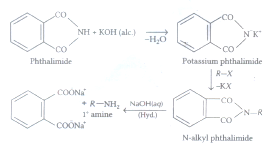
Primary amines are produce through this method without the traces of secondary or tertiary amines. So, this method is preferred for the synthesis of primary amines.
17.
(ii) Potassium
18.
(i) (a) Due to the comparatively smaller size of the metal ions, their high ionic charges and the availability of vacant d-orbitals for bond formation, transition metals form a large number of complex compounds.
(b) As oxidation number (or oxidation state) of an element increases ionic character decreases. In general, the oxides in lower oxidation states of metals are basic and in their higher oxidation state, the oxides are amphoteric.
In lower oxidation state of the metal, some of the valence electrons of the metal atom are not involved in bonding. Hence, it can donate electrons and behave as a base. In higher oxidation state, valence electrons are involved in bonding and hence, electrons are not available for donation. Instead, their effective nuclear charge is high and hence they behave as acids.
(c) Mn3+(3d4) is less stable than Mn2+(3d5) because Mn2+ has stable half-filled configuration. Cr3+ has stable 3d3(t32g) configuration, therefore, Cr3+ cannot be reduced to Cr2+. That's why, EO value for the Mn3+ / Mn2+ couple is much more positive than Cr3+ /Cr2+. In other words, Mn3+ is a strong oxidising agent.
(ii) Similarity Both lanthanoids and actinoids exhibit +3 oxidation state predominantly.Difference Lanthanoids have less tendency towards complex formation while actinoids have greater tendency towards complex formation.
19.
(i) Adrenaline and ephedrine are used are to increase blood pressure, contain secondary amino group. 1
(ii) Novacain is used as an anaesthetic in dentistry.
(iii) Benadryl contains a tertiary amino group.
(iv) Cetyltrimethylammonium chloride is used as a cationic detergent as well as germicide.
20.
(i) Electronic configurations: In 1st transition series, 3d orbitals are progressively filled, whereas, in 2nd transition series, 4d orbitals are progressively filled and in 3rd transition series, 5d-orbitals are progressively filled.
(ii) Oxidation states: Elements show variable oxidation states in both the. series. The highest oxidation state is equal to a total number of electrons in '5' as well as 'd' orbitals. The number of oxidation states shown is less in 5d transition series than 4d series. In 3d series +2, +3 oxidation states are common and they form stable complexes in these oxidation states. In other series, SO4 and PtF6 are formed which are quite stable in higher oxidation state.
(iii) ionization enthalpies: The ionization enthalpy of 5d series is higher than 3d and 4d series due to lanthanide contraction, the effective nuclear charge is more.
(iv) Atomic sizes: The atomic sizes of 4d and 5d series do not differ appreciably due to lanthanoid contraction. The atomic radii of second and third series are larger than 3d series.
21.
(a)
22.
Arylamines react with NHO2 to form diazonium salts.
23.
(c)
\(m-Br{ C }_{ 6 }{ H }_{ 4 }COOH\ \overset{ SOCI_{ 2 } }{ \longrightarrow } \quad \overset { NH_{ 3 } }{ \longrightarrow } \quad \overset { Br_{ 2 },NaOH }{ \longrightarrow } \)
24.
(a)
d - d transition
25.
(c)
CO2
26.
(c)
Higher oxidation states of heavier members of group - 6 of transition series are more stable
27.
(a)
[Cr(H2O)4Cl2]+
28.
(a)
I and II
29.
(c)
dsp2
30.
(c)
3,6
31.
(b)
K2MnO3 + MnO2 + O2
32.
(b)
Os
33.
34.
(b) Assertion and reason both are correct statements but reason is not correct explanation for assertion.
35.
(d): Correct IUPAC name is tetraaquadichloridochromium (III) nitrate.
36.
(d)Tertiary butyl amine cannot be prepared by the action of NH3 on tert-butyl bromide. Because tert-butyl bromide prefer to undergo elimination rather than substitution on treatment with a base. The product is iso-butylene rather than tert-butylamine. Hence, (A) is incorrect but (R) is correct.
37.
(i) (d)
(ii) (a): Aromatic primary amines give dye test.
(iv) (b): In acidic medium aniline gets protonated to anilinium ion which is meta-directing.
38.
(i) (d): It involves sp3 d2 hybridisation and not d2sp3.
(ii) (d) : [Co(NH3)6]3+ is d2sp3 hybridised with all electrons paired hence, it is diamagnetic and inner
orbital complex.
(iv) (c): Inner orbital complexes are formed with strong ligands as they force electrons to pair up and hence the complex will be either diamagnetic or will have less number of unpaired electrons.

12th Standard CBSE Syllabus & Materials
12th Standard CBSE
CBSE 12th Computer Science Python Revision Tour I - New Previous year Question Papers Study Material - QB365 Set A
NEW12th Standard CBSE
CBSE 12th Business Studies Planning Important Questions And Answers Study Material - QB365 Set A
NEW12th Standard CBSE
CBSE 12th Business Studies Business Environment Important Questions And Answers Study Material - QB365 Set A
NEW12th Standard CBSE
CBSE 12th Business Studies Principles of Management Important Questions And Answers Study Material - QB365 Set A



NCERT Books

Syllabus

Exam Pattern

Sample Question Papers

Previous year Question Papers

Important Notes

MCQ Practice test

NCERT Exemplers

Case study Questions

Image Based Questions

Passage based Questions

HOT Questions

Value Based Questions

Model Questions Papers
NCERT ( Book Back ) Questions

Assertion and Reason
Important Questions And Answers

CBSE 12th Standard CBSE Subjects
CBSE Standards








