
 100% FREE ACCESS
12th Standard CBSE Syllabus & Materials
12th Standard CBSE
CBSE 12th Economics Government Budget and the Economy Previous year Question Papers Study Material - QB365 Set A
NEW12th Standard CBSE
CBSE 12th Computer Science Interface Python with MySQL - New Previous year Question Papers Study Material - QB365 Set A
NEW12th Standard CBSE
CBSE 12th Computer Science Database Concept - New Previous year Question Papers Study Material - QB365 Set A
NEW12th Standard CBSE
CBSE 12th Computer Science Data Communication - New Previous year Question Papers Study Material - QB365 Set A
NEW12th Standard CBSE
CBSE 12th Computer Science Data Structures - New Previous year Question Papers Study Material - QB365 Set A
NEW12th Standard CBSE
CBSE 12th Computer Science Functions - New Previous year Question Papers Study Material - QB365 Set A

Published on: 25/10/2025
Download CBSE Class 12th Standard CBSE Chemistry question papers, sample papers, important questions, and previous year solved papers in PDF format. Get free study materials, NCERT solutions, and exam preparation resources for Class 12th Standard CBSE Chemistry
Questions + Answers key
Take MCQ Chemistry Test
1.
[Fe(H2O)6]3+ is strongly paramagnetic where as [Fe(CN)6]3- is weakely paramagnetic. Explain.
2.
Out of Cu2Cl2 and CuCl2, which is more stable and why?
3.
Why is KMnO4 kept in dark bottles?
4.
Why is CO a stromger lig and than CI-?
5.
Lanthanoids form primarily +3 ions, while the actinoids usually have higher oxidation states in their compounds, +4 or even +6 being typical. Give reason.
6.
(i) How is double salt different from a complex?
(ii) Write IUPAC name of the following:
(a) K3 [Fe (C2O4)3]
(b) [Pt (NH3)6]CI4
(iii) Draw the structure of cis-isomer of
[Co(NH3)4CI2]+
7.
Explain why a green solution of potassium manganate turns purple and a brown solid is precipitated when CO2 gas is bubbled into the solution?
8.
Why are low spin tetrahedral complexes not formed ?
9.
Write the formulae for the following coordination compounds:
(i) Tetraammineaquachloridocobalt (III) chloride
(ii) Potassium tetrahydroxozincate (II)
(iii) Potassium trioxalatoaluminate (III)
(iv) Dichloridobis (ethane-1, 2 diamine) - cobalt (III)
(v) Tetracarbonylnickel (0)
10.
Identify the first row transition metal ions which have outer electronic configurations of 3d4 and 3d6 and describe their oxidation states.
11.
The electronic configuration of Cu (II) is 3d9 whereas that of Cu (I) is 3d10 . Which of the following is correct ?
Cu (II) is more stable
Cu (II) is less stable
Cu (I) and Cu (II) are equally stable
Stability of Cu (I) and Cu (II) depends on nature of copper salts
12.
The oxidation state of Fe in the brown ring complex [Fe(H2O)5NO]SO4 is
+ 1
+ 2
+ 3
+ 4
13.
Zelse's salt is
[Fe(C5H5)2]
[Pb(C2H5)4]
K[PtCl3(C2H4)]
[Ni(CO)4]
14.
The hybridisation of Fe in K4[Fe(CN)6] is
dsp2
sp3
d2sp3
sp3d2
15.
Which of the following is not a transition element ?
Zn
Ru
Ag
Pb
16.
(i) Give name:
(a) the complex used as oxygen carrier in the blood.
(b) the coordination compound of magnesium, which is responsible for photosynthesis.
(ii) Discuss some applications of complex compounds.
17.
(i) Distinguish the structure of chromate ion from that of dichromate ion.
(ii) Between the dichromates of sodium and potassium, which one is preferred for oxidising organic compound and why?
(iii) Give two equations that explains the nature of K2Cr2O7 as reducing agent.
18.
(i) Name a compound of
(a) transition metal which is used in the manufacture of sulphuric acid.
(b) transition metal that is used in Haber's process for the manufacture of ammonia.
(c) transition metal that have light sensitive properties and act as valuable source in photographic industry.
(ii) Write the equations which are involved in the oxidation of hydrogen sulphide to sulphur by potassium permanganate solution.
19.
(a) Give the preparation of potassium dichromate from chromate ore:
(b) Explain the following:
(i) Transition metals have good tendency to form complexes.
(ii) Transition metals exhibit variable oxidation states.
(c) Write the general electronic configuration of lanthanoids.
20.
Why are different colours observed in octahedral and tetrahedral complexes for the same metal and same ligands ?
21.
CoSO4Cl.5 NH3 exists in two isomeric forms 'A' and 'B' gives white precipitate with BaCl2 but does not react with AgNO3. Answer the following questions.
(i) Identify 'A' and 'B' and write their structure formulas.
(ii) Name the type of isomerism involved
(iii) Give the IUPAC name of 'A' and 'B'.
1.
In both the complexes, Fe is in +3 oxidation state with the configuration 3d5. CN- is a strong ligand. In its presence, 3d electrons pair up leaving only one unpaired electron. The hybridization is d 2sp3forming inner orbital complex. H20 is a weak ligand. In its presence, 3d electrons do not pair up. The hybridization is sp3 d2 forming an outer orbital complex containing five unpaired electrons. Hence, it is strongly paramagnetic.
2.
CuCl2 is more stable due to more hydration energy.
3.
KMnO4 is kept in dark bottles because KMnO4 gets decomposed to K2MnO4 in presence of sunlight.
4.
It is because CO can form σ (sigma) as well as π -bond, therefore, it is stronger ligand than CI-.
5.
In Actinoids 5f, 6d and 7s orbitals have comparable energies and electrons from these orbitals can take part to show higher oxidation states.
6.
Double salts dissociate completely into their constituent simple ions when dissolve in water, i.e they lose their identity in aqueous solution
e.g KCl.MgCl2.6H2O ⟶ K++Ma2++3Cl-+6H2O
While coordination compounds do not dissociate into simple ions, i.e. they retain their identity both in solid state and in aqueous solutions.
(ii) The IUPAC name of the following given complexes are:
(a) K3[Fe(C2O4)3]
Potassiumtrioxalatoferrate (III)
(b) [Pt(NH3)6]Cl4: Hexaammineplatinum (IV) chloride
(iii) The structure of cis-isomer of [Co(NH3))4Cl2]+ ion is.
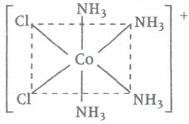
7.
In aqueous solution, CO2 reacts as follows:
\({ CO }_{ 2 }+{ H }_{ 2 }O\rightleftharpoons { H }_{ 2 }{ CO }_{ 3 }\rightleftharpoons { H }^{ + }+HCO_{ 3 }^{ - }\)
In the presence of H+ ion, \(MnO^{ 2- }\) ion undergoes disproportionation to form \(MnO^{ - }_{ 4 }\) ion (purple in colour) and MnO2 (brown solid).
8.
It is because in tetrahedral complexes, the orbital splitting energies are not very large, therefore, forced pairing does not take place, unpaired electrons are sufficiently large forced pairing of electrons, therefore, low spin complexes are not formed.
9.
(i) [Co(NH3)4(H2O)Cl]Cl2
(ii) K2[Zn(OH)4]
(iii) K3[Al(C2O4)3]
(iv) [CoCl2(en)2]+
(v) [Ni(CO)4]
10.
Cr2+ has electronic configuration 3d4 Chromium also shows +3 and +6 oxidation states. Fe2+ has electronic configuration 3d6. Iron has oxidation states +2 and +3.
11.
(a)
Cu (II) is more stable
12.
(a)
+ 1
13.
(c)
K[PtCl3(C2H4)]
14.
(c)
d2sp3
15.
(d)
Pb
16.
(i) (a) Haemoglobin
(b) Chlorophyll
(ii) Applications of complex compounds.
(a) They are used in photography, Le. AgBr forms soluble complex with sodium thiosulphate rn photography.
(b) K[Ag(CN)2] is used for electroplating of silver, K[Au(CN)2] is used for gold plating.
(c) Some of ligands oxidise Co2+ to Co3+ ion.
(d) EDTA is used for estimation of Cla2+ and Mg2+ in hard water.
(e) Silver and gold are extracted by treating zinc with their cyanide complexes.
(f) Ni2+ is tested and estimated by DMG (dimethylglyoxime).
17.
(ii) Potassium
18.
(i) (a) Vanadium
(b) Iron
(c) Silver
(ii) \(\begin{equation} 2 \mathrm{MnO}_{4}^{-}+5 \mathrm{H}_{2} \mathrm{~S}+16 \mathrm{H}^{+} \longrightarrow 2 \mathrm{Mn}^{2+}+5 \mathrm{~S}+8 \mathrm{H}_{2} \mathrm{O} \end{equation}\)
19.
(i) The transition elements exhibit variable oxidation states. The variable oxidation states of transition metals are due to the participation of ns and (n - 1) d-electrons. This is because of the very small difference between the energies of (n - 1) d and ns orbitals. For the first five elements, the minimum oxidation state is equal to the number of electrons ---in the 4s orbitals and the other oxidation states are equal to the sum of 4s and some of the 3d-electrons. The highest oxidation state is equal to the sum of 4s and 3d electrons. For the remaining elements, the minimum oxidation state is equal to electrons in 4s-orbitals and the maximum oxidation state is not equal to the sum of 4s and 3d electrons. In general, the oxidation state increases up to the middle and then decreases.
20.
\({ \triangle }_{ t }=\left( \frac { 4 }{ 9 } \right) { \triangle }_{ 0 }\). Thus, \({ \triangle }_{ t }\) is smaller than \({ \triangle }_{ 0 }\). Hence, less energy (higher wavelength) is absorbed by tetrahedral complexes than by octahedral complexes of the same metal and ligands. Therefore, the observed colour are different.
21.
(i) As isomer A reacts with AgNO3 to give a white precipitate, CI must be present in the ionization sphere. As it does not react with BaCI2, SO42- must be present in coordination sphere.
Formula of A = [Co(NH3)5SO4] CI (coordination no. of Co = 6) As reactions are reverse for isomer B, formula of B = [Co(NH3)5CI]S04
(ii) Ionization isomerism.
(iii) A = Pentaarnminesulphatocobalt (III) chloride ; B = Pentaamminechloridocobalt (ill) sulphate

12th Standard CBSE Syllabus & Materials
12th Standard CBSE
CBSE 12th Computer Science Python Revision Tour I - New Previous year Question Papers Study Material - QB365 Set A
NEW12th Standard CBSE
CBSE 12th Business Studies Planning Important Questions And Answers Study Material - QB365 Set A
NEW12th Standard CBSE
CBSE 12th Business Studies Business Environment Important Questions And Answers Study Material - QB365 Set A
NEW12th Standard CBSE
CBSE 12th Business Studies Principles of Management Important Questions And Answers Study Material - QB365 Set A



NCERT Books

Syllabus

Exam Pattern

Sample Question Papers

Previous year Question Papers

Important Notes

MCQ Practice test

NCERT Exemplers

Case study Questions

Image Based Questions

Passage based Questions

HOT Questions

Value Based Questions

Model Questions Papers
NCERT ( Book Back ) Questions

Assertion and Reason
Important Questions And Answers

CBSE 12th Standard CBSE Subjects
CBSE Standards








