
 100% FREE ACCESS
12th Standard CBSE Syllabus & Materials
12th Standard CBSE
CBSE 12th Economics Government Budget and the Economy Previous year Question Papers Study Material - QB365 Set A
NEW12th Standard CBSE
CBSE 12th Computer Science Interface Python with MySQL - New Previous year Question Papers Study Material - QB365 Set A
NEW12th Standard CBSE
CBSE 12th Computer Science Database Concept - New Previous year Question Papers Study Material - QB365 Set A
NEW12th Standard CBSE
CBSE 12th Computer Science Data Communication - New Previous year Question Papers Study Material - QB365 Set A
NEW12th Standard CBSE
CBSE 12th Computer Science Data Structures - New Previous year Question Papers Study Material - QB365 Set A
NEW12th Standard CBSE
CBSE 12th Computer Science Functions - New Previous year Question Papers Study Material - QB365 Set A

Published on: 25/10/2025
Download CBSE Class 12th Standard CBSE Chemistry question papers, sample papers, important questions, and previous year solved papers in PDF format. Get free study materials, NCERT solutions, and exam preparation resources for Class 12th Standard CBSE Chemistry
Questions + Answers key
Take MCQ Chemistry Test
1.
What is the name of the simplest aromatic aldehyde?
2.
Write the IUPAC name of the following:
\(\left( CH_{ 3 } \right) _{ 2 }CH-CH_{ 2 }-\underset { \underset { O }{ || } }{ C- } CH(CH_{ 3 })_{ 2 }\)
3.
Describe the trends in the following properties of the first series of the transition elements:
(i) Oxidation states
(ii) Atomic sizes
(iii) Magnetic behaviour of dispositive gaseous ions \((M^{ 2+ })\).
4.
Why are benzenediazonium salts soluble in water?
5.
What is misch metal? Mention its two important uses.
6.
Which of the following compounds do not undergo aldol condensation?
CH3-CHO
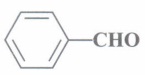
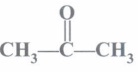
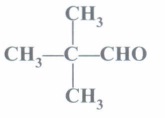
7.
The stability of Mn2+, Fe2+,Cr2+, Co2+ is in order of (At o. of Mn = 25, Fe = 26, Cr = 24, Co = 27)
Mn2+ > Fe2+ > Cr2+ > CO2+
Fe2+ > Mn2+ > Co2+ > Cr2+
Co2+ > Mn2+ > Fe2+ > Cr2+
Cr2+ > Mn2+ > Co2+ > Fe2+
8.
Amines on treatment with acids yield salt because they are
basic in nature
acidic in nature
amphoteric in nature
None of these
9.
Which of the following is the correct decreasing order of basicity os amines in gaseous phase?
(CH3)2NH > CH3NH2 > (CH3)3N > NH3
(CH3)3N > (CH3)2NH > CH3NH2 > NH3
(CH3)2NH > (CH3)3N > CH3NH2 > NH3
(CH3)3N > CH3NH2 > (CH3)2NH > NH3
10.
The correct order of basic strength of CH3NH2(I), (CH3)2NH(II), (CH3)3N(III), C6H5CH2NH2(IV) in gaseous phase is
IV < III < II < I
IV < III < I < II
I < II < III < IV
IV < I < II < III
11.
The purple colour of KMnO4 is due to
incomplete d - subshell
ionic nature of KMnO 4
charge transfer
resonance in \({ MnO }_{ 4 }^{ - }\) ion
12.
Phenol and benzoic acid may be distinguished by their reaction with
aqueous NaOH
aqueous COCH3
neutral FeCI3
Br2 - H2O
13.
When CH2 = CH _ COOH is reduced with LiAIH4 the compound obtained will be
CH3 _ CH2 _ CHO
CH3 _ CH2 _ COOH
CH2 = CH _ CH2OH
CH3 _ CH2 _ COOH
14.
Amoung the following compounds. most acidic is
p-nitrophenol
p-hydroxybenzoic acid
o-hydroxybenzoic acid
p-toluic acid
15.
Formation of interstitial compounds makes the transition metal
more soft
more ductile
more metalic
more hard and brittle
16.
Arrange the following in increasing order of property specified:
(i) Aniline, ethanamine, 3-ethylethanamine (solubility in water)
(ii) Ethanoic acid, ethanamine, ethanol (boiling point)
(iii) Methanamine, N, N- dimethylmethanamine and N-methylmethanamine (basic strength in aqueous phase).
17.
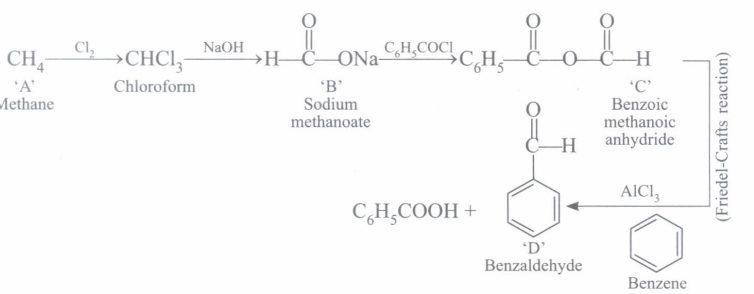
Identify A, B, C, D and E in the following sequence of reactions:
\(\mathrm{A} \stackrel{\mathrm{Cl}_{2}}{\longrightarrow} \mathrm{CHCl}_{3} \stackrel{\mathrm{NaOH}}{\longrightarrow} \mathrm{B} \stackrel{\mathrm{C}_{6} \mathrm{H}_{5} \mathrm{COCl}}{\longrightarrow} \mathrm{C} \stackrel{\mathrm{C}_{6} \mathrm{H}_{6} / \mathrm{AlCl}_{3}}{\longrightarrow} \mathbf{E}+\mathrm{D}\)
18.
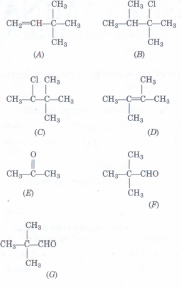
\((A) \mathrm{C}_{6} \mathrm{H}_{12} \stackrel{\mathrm{HCl}}{\longrightarrow}(B) \mathrm{C}_{6} \mathrm{H}_{13} \mathrm{Cl}+(\mathrm{C}), \mathrm{C}_{6} \mathrm{H}_{13} \mathrm{Cl}\)
\(\\ (B) \stackrel{\text { Alcoholic KOH }}{\longrightarrow}(E),\)
(positive iodoform and negative Fehling's solution test)
\((D) \stackrel{\text { Ozonolysis }}{\longrightarrow}(E), (positive \ iodoform \ and \ negative \ Fehling's \ solution \ test) \)
\(\\ (A) \stackrel{\text { Ozonolysis }}{\longrightarrow}(F)+(G), (positive \ Tollen's \ test \ for \ both)\)
\( (F)+(G) \stackrel{\text { Conc. } \mathrm{NaOH}}{\longrightarrow} \mathrm{HCOONa}+\text { A primary alcohol }\)
\(\\ Identify\ the \ compounds (A) to (G)\)
19.
Account for the following :
(a) Transition metals show variable oxidation states.
(b) Zn, Cd and Hg are soft metals
(c) Eo value for the Mn3+ /Mn2+ couple is highly positive (+ 1.57 V) as compared to Cr3+ /Cr2+.
(ii) Write one similarity and one difference between the chemistry of lanthanoid and actinoid elements.
20.
Explain why Cu(I) ion is not stable in aqueous solution ?
21.
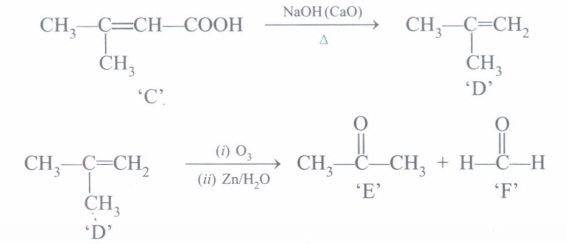
An organic acid 'A' C5H10O2 reacts with Br2 in presence of phosphorus to give 'B'. Compound 'B' contains an asymmetric carbon atom and yields 'C' on dehydrobromination. Compound 'C' does not show geometrical isomerism and on decarboxylation gives an alkene 'D' which on ozonolysis gives 'E' and 'F'. Give structures of A, B, C, D, E and F.
22.
Write the major product(s) in the following reactions.
\(\begin{equation} \text { (i) } \mathrm{C}_{6} \mathrm{H}_{5}-\mathrm{NO}_{2} \stackrel{\mathrm{Sn} / \mathrm{HCl}}{\longrightarrow} ? \end{equation}\)
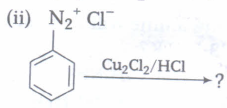
\(\begin{equation} \text { (iii) } \mathrm{CH}_{3} \mathrm{CONH}_{2} \stackrel{\mathrm{Br}_{2} / \mathrm{KOH}(\mathrm{aq} .)}{\longrightarrow} ? \end{equation}\)
23.
(i) Nb4 is paramagnetic while NbX4 (X = : Cl, Br, I) are diamagnetic, why?
(ii) Out of La(OH)3 and Lu(OH)3, which is more basic and why?
24.
25.
26.
27.
Assertion: Ketones are more reactive than aldehydes towards nucleophilic addition.
Reason: The alkyl groups in ketone increase the electron density on the carbonyl carbon through the +I effect.
Codes:
(a) If both assertion and reason are true and the reason is the correct explanation of the assertion.
(b) If both assertion and reason are true but the reason is not the correct explanation of the assertion.
(c) If the assertion is true but the reason is false.
(d) If the assertion is false but the reason is true.
(e) If the assertion and reason both are false
28.
Assertion: Europium (II) is more stable than cerium (II).
Reason: Cerium salts are used as a catalyst in petroleum cracking.
Codes:
(a) Assertion and reason both are correct statements and reason is correct explanation for assertion.
(b) Assertion and reason both are correct statements but reason is not correct explanation for assertion.
(c) Assertion is correct statement but reason is wrong statement.
(d) Assertion is wrong statement but reason is correct statement.
29.
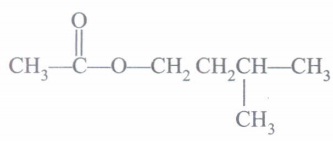
Aldehydes, Ketones, Carboxylic acids and their derivatives are collectively called carboxyl compounds which are widely spread both in plants and animal kingdom. They play an important role in biological processes. They are responsible for fragrance and flavour of naturally occurring compounds e.g., Vanilline (from vanilla beans), salicylaldehyde (from meadowsweet), cinnamaldehyde (from cinnamon) and isoamyl acetate (from banana) have pleasant flavour.
Acetone and acetic acid are widely used as solvents. Various carboxylic acids are used to prepare drugs (Analgesics, antipyretics etc.).
(a) Convert benzaldehyde to Cinnamaldehyde?
(b) What is IUPAC name of 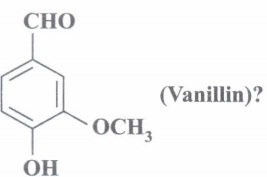
(c) Write the structural formula of Isoamyl acetate.
(d) What happens when 2 moles of acetone are condensed in presence of Ba(OH)2? Write chemical equation.
(e) What happens when acetic acid is heated with P2O5?
30.
Observe the graph of transition metal and their melting points and answer the questions based on the graph and related concepts.
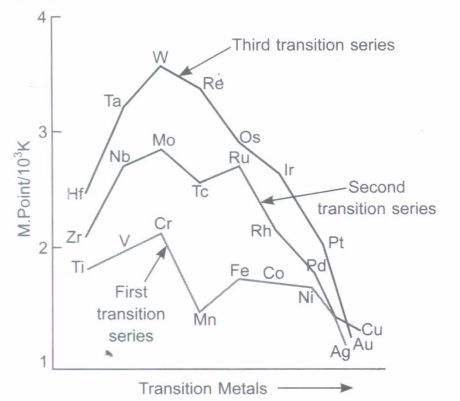
(a) Why does W (tungsten) has highest melting point?
(b) Which element in 3d series has lowest enthalpy of atomisation and why?
(c) Why is mercury liquid?
(d) Why are transition metals less electropositive than 's'-block elements?
(e) How does density vary from left to right in 3d series and why?
1.
Benzaldehyde
2.

3.
(i) The transition elements exhibit variable oxidation states. The variable oxidations states of transition metals are due to the participation of ns and (n - 1) d-electrons. This is because of the very small difference between the energies of (n - 1) d and ns orbitals. For the first five elements, the minimum oxidation state is equal to the number of electrons in the 4s orbitals and the other oxidation states are equal to the sum of 4s and some of all 3d-electrons. The highest oxidation state is equal to the sum of 4s and 3d electrons. For the remaining elements, the minimum oxidation state is equal to electrons in 4s-orbitals and the maximum oxidation state is not equal to the sum of 4s and 3d electrons. In general, the oxidation state increases up to the middle and then decreases.
(ii) As we move in the series, the atomic radius decreases with increases in atomic number. However, this decrease in atomic radius becomes small after midway. This is due to the fact that in the beginning, the atomic radius decreases because, with an increase in atomic number, there is an increase in the nuclear charge. However, the added d-electrons enter the penultimate shell and screen the outermost s-electrons. As the number or d-electrons increases, the screening effect increases. Thineutralizeses the effect of increased nuclear charge and consequently atomic radii remain almost the same after chromium.
(iii) The paramagnetic character is due to the presence of unpaired electrons. In the dispositive gaseous ions (M2+) first transition series, the paramagnetic character increases up to the middle (Mn2+)and then decreases.
4.
Being ionic, they are soluble in water.
5.
Misch metal consists of lanthanoids (95%), iron, traces of S, C, Ca and Al.
Uses:
(i) It is used to produce bullets.
(ii) It is used in shells and lighter flints.
6.
(b)
7.
(a)
Mn2+ > Fe2+ > Cr2+ > CO2+
8.
(a)
basic in nature
9.
In the gaseous phase, basicity increases as the +I effect of the alkyl groups increases. Thus, option (b) is correct.
10.
In the gaseous phase, basicity increases as the + I-effect of the alkyl groups increases, i.e., CH3NH2(I) < (CH3)2 NH < (CH3)3 N (III). However, due to -I-effect of the CH- group, CHCHNH (IV) is even a weaker base than CHNH (I). Thus, the overall, basic character increases in the order : IV < I < II < III.
11.
(c)
charge transfer
12.
(d)
Br2 - H2O
13.
(c)
CH2 = CH _ CH2OH
14.
(c)
o-hydroxybenzoic acid
15.
(d)
more hard and brittle
16.
(i) The correct increasing order of solubility in water is aniline < 3 - ethylethanamine < ethanamine.
Solubility of amines decreases with increase in mnolar mass due to increase in the hydrophobic part which retard the formation of H- bonds,
(ii) The correct increasing order of boiling point is ethanamine < ethanol < ethanoic acid. Carboxylicacids have higher boiling points because they have high extent of hydrogen bonding withwater, due to which they exists as associated molecules.
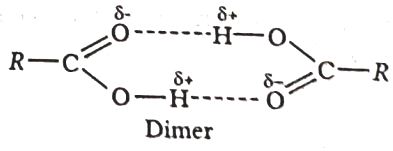
In vapour state or in aprotic solvent.
(iii) The correct increasing order of basic strength in aquaous phase is
N, N - dimethylmethanamine, methanamine, N-methylmethanamine
17.
18.
19.
(i) (a) Due to the comparatively smaller size of the metal ions, their high ionic charges and the availability of vacant d-orbitals for bond formation, transition metals form a large number of complex compounds.
(b) As oxidation number (or oxidation state) of an element increases ionic character decreases. In general, the oxides in lower oxidation states of metals are basic and in their higher oxidation state, the oxides are amphoteric.
In lower oxidation state of the metal, some of the valence electrons of the metal atom are not involved in bonding. Hence, it can donate electrons and behave as a base. In higher oxidation state, valence electrons are involved in bonding and hence, electrons are not available for donation. Instead, their effective nuclear charge is high and hence they behave as acids.
(c) Mn3+(3d4) is less stable than Mn2+(3d5) because Mn2+ has stable half-filled configuration. Cr3+ has stable 3d3(t32g) configuration, therefore, Cr3+ cannot be reduced to Cr2+. That's why, EO value for the Mn3+ / Mn2+ couple is much more positive than Cr3+ /Cr2+. In other words, Mn3+ is a strong oxidising agent.
(ii) Similarity Both lanthanoids and actinoids exhibit +3 oxidation state predominantly.Difference Lanthanoids have less tendency towards complex formation while actinoids have greater tendency towards complex formation.
20.
In aqueous solution, copper (1) undergoes disproportionation reaction.
2Cu (aq) ⟶ Ca³+Co(s)
The highest stability of Cu ion in aqueous solution is due to negative enthalpy of hydration.
Hence, Cu is not known (or unstable) in aqueous solution
21.

B has asymmetric carbon. 'C' does not show geometrical isomerism because 'C' attached to double bond has two methyl groups i.e. same groups.
22.
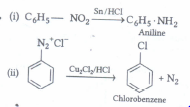
\(\begin{equation} \begin{array}{l} \text { (iii) } \mathrm{CH}_{3} \mathrm{CONH}_{2} \stackrel{\left.\mathrm{Br}_{2} / \mathrm{KOH} / \mathrm{a} \mathrm{q}\right)}{\rightarrow} \mathrm{CH}_{3} \mathrm{NH}_{2}+\mathrm{K}_{2} \mathrm{CO}_{3} +2 \mathrm{KBr}+2 \mathrm{H}_{2} \mathrm{O} \end{array} \end{equation}\)
23.
(i) Using Fajan's rule
(ii) Size of lanthanoid ions decreases from La3+ to Lu3+.
24.
25.
26.
27.
(d) If the assertion is false but the reason is true.
28.
(b): The electronic configurations of europium (II) and cerium (II) are Eu2+ : [Xe] 4f7 and Ce2+ :
[Xe] 4f15d1
In Eu2+,f - subshell is half-filled thus, it is more stable.
29.
(a)

(b) 4-hydroxy- 3-methoxy benzaldehyde
(c)
(d)
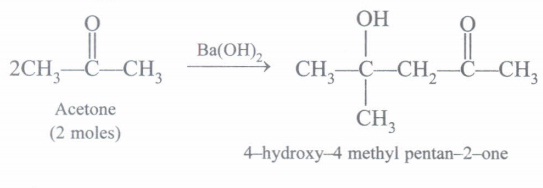
(e)
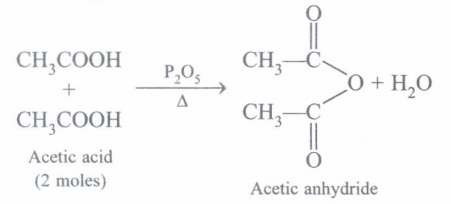
Acetic anhydride is formed.
30.
(a) It is due to presence of unpaired electrons and there is more frequent metal-metal bonding in 5d series than 3d and 4d series.
(b) Zinc has lowest enthalpy of atomisation due to weak metallic bond which is due to absence of unpaired electrons.
(c) It is due to larger size, absence of unpaired electron and weak interatomic attraction and weaker metallic bond.
(d) It is due to smaller atomic size and higher ionisation enthalpies.
(e) Density goes on increasing from Sc to Cu because atomic mass increase more than atomic volume .

12th Standard CBSE Syllabus & Materials
12th Standard CBSE
CBSE 12th Computer Science Python Revision Tour I - New Previous year Question Papers Study Material - QB365 Set A
NEW12th Standard CBSE
CBSE 12th Business Studies Planning Important Questions And Answers Study Material - QB365 Set A
NEW12th Standard CBSE
CBSE 12th Business Studies Business Environment Important Questions And Answers Study Material - QB365 Set A
NEW12th Standard CBSE
CBSE 12th Business Studies Principles of Management Important Questions And Answers Study Material - QB365 Set A



NCERT Books

Syllabus

Exam Pattern

Sample Question Papers

Previous year Question Papers

Important Notes

MCQ Practice test

NCERT Exemplers

Case study Questions

Image Based Questions

Passage based Questions

HOT Questions

Value Based Questions

Model Questions Papers
NCERT ( Book Back ) Questions

Assertion and Reason
Important Questions And Answers

CBSE 12th Standard CBSE Subjects
CBSE Standards








