
 100% FREE ACCESS
12th Standard CBSE Syllabus & Materials
12th Standard CBSE
CBSE 12th Economics Government Budget and the Economy Previous year Question Papers Study Material - QB365 Set A
NEW12th Standard CBSE
CBSE 12th Computer Science Interface Python with MySQL - New Previous year Question Papers Study Material - QB365 Set A
NEW12th Standard CBSE
CBSE 12th Computer Science Database Concept - New Previous year Question Papers Study Material - QB365 Set A
NEW12th Standard CBSE
CBSE 12th Computer Science Data Communication - New Previous year Question Papers Study Material - QB365 Set A
NEW12th Standard CBSE
CBSE 12th Computer Science Data Structures - New Previous year Question Papers Study Material - QB365 Set A
NEW12th Standard CBSE
CBSE 12th Computer Science Functions - New Previous year Question Papers Study Material - QB365 Set A

Published on: 25/10/2025
Download CBSE Class 12th Standard CBSE Chemistry question papers, sample papers, important questions, and previous year solved papers in PDF format. Get free study materials, NCERT solutions, and exam preparation resources for Class 12th Standard CBSE Chemistry
Questions + Answers key
Take MCQ Chemistry Test
1.
Calculate the ‘spin only’ magnetic moment of M2+(aq) ion (Z = 27).
2.
First ionisation energy of copper is higher than those of alkali metals, while second and third ionisation energies are lower. Explain.
3.
Although fluorine is more electronegative than oxygen, but the ability of oxygen to stabilise higher oxidation states exceeds that of fluorine. Why?
4.
Which is stronger reducing agent \({ Cr }^{ 2+ }\) or \({ Fe }^{ 2+ }\) and why?
5.
In the series (Z = 21) to Zn (Z = 30), the enthalpy of zinc is the lowest 126 kJ mol-1 Why?
6.
Explain as to why the \(E^{ \ominus }\) value for the \(Mn^{ 3+ }/Mn^{ 2+ }\) couple is much more positive than that for \(Cr^{ 3+ }/Cr^{ 2+ }\) or \(Fe^{ 3+ }/Fe^{ 2+ }\) .
7.
Why do the transition elements exhibit higher enthalpies of atomisation?
8.
When an oxide of manganese (A) is fused with KOH in the presence of an oxidising agent and dissolved in water, it gives a Compound (B) disproportionates in neutral or acidic solution to give purple compound (C). An alkaline solution of compound (C) oxidises potassium iodide solution to a compound (D) and compound (A) is also formed. Identify compound A to D and also explain the reactions involved.
9.
Indicate the steps in the preparation of :
(a) K2Cr2O7 from chromite ore.
(b) KMnO4 from pyrolusite ore.
10.
Complete the following reactions:
(a) Cr2O72-+14H++6e-\(\longrightarrow \).......... +7H2O
(b) CrO42-+..........\(\rightleftharpoons \)........\(\rightleftharpoons \).......+H2O
(c) MnO4-+2H2O+3e- \(\overrightarrow { medium } \)........ +4OH-
11.
Identify the first row transition metal ions which have outer electronic configurations of 3d4 and 3d6 and describe their oxidation states.
12.
(a) Comlete the following chemical equations for reactions in aqueous media:
(i) Cr2O72-+H++Fe2+ \(\longrightarrow \)
(ii) MnO4-+I-+H+\(\longrightarrow \)
(b) How many unpaired electrons are present in Mn2+ ion (At. no. of Mn =25)? How does it influence magnetic behaviour of Mn2+ ions?
13.
How would you account for the following?
(I) The Eo value for the Mn3+ /Mn2+ couple is much more positive than that for the Cr3+/Cr2+ couple or Fe 3+/Fe 2+ couple.
(ii) The highest oxidation state of a metal is exhibited in its oxide or fluoride.
(iii) The atomic radii ofthe metals ofthe third (Sd) series of transition elements are virtually the same as those of the corresponding members of the second (4d) series.
14.
Which is the last element in the series of the actinoids? Write the electronic configuration of this element. Comment on the possible oxidation state of this element.
15.
Describe the preparation of potassium dichromate from iron chromite ore. What is the effect of increasing pH on a solution of potassium dichromate?
16.
Write the electronic configurations of the elements with the atomic numbers 61, 91, 101, and 109.
17.
What can be inferred from the magnetic moment values of the following complex species
| Example | Magnetic Moment (BM) |
| K4[Mn(CN)6) | 2.2 |
| [Fe(H2O)6]2+ | 5.3 |
| K2[MnCl4] | 5.9 |
18.
Explain giving reason:
(a) The enthalpies of atomisation of the transition metals are high.
(b) Transition metals and many of their compounds show paramagnetic behaviour.
(c) The transition metals generally form coloured compounds.
(d) transition metals and their many compounds act as good catalyst.
1.
Z = 27
\(\Rightarrow[\mathrm{Ar}] 3 \mathrm{~d}^{7} 4 \mathrm{~s}^{2}\)
\(\therefore \mathrm{M}^{2+}=[\mathrm{Ar}] 3 \mathrm{~d}^{7}\)
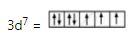
i.e., 3 unpaired electrons
\(\therefore n=3\)
\(\Rightarrow \sqrt{n(n+2)}=\mu\)
\(\Rightarrow \sqrt{3(3+2)}=\mu\)
\(\Rightarrow \sqrt{15}=\mu\)
\(\mu \approx 4 \mathrm{BM}\)
2.
Copper has small size compared to alkali metals in their period. Its electronic configuration
is [Ar] 3d104s1. As filled 3d-subshell is less effective in shielding the outer s-electrons than a s- and p-subshell, so s-electron in copper is more tightly held by the nucleus than in alkali metals. Hence, its first ionization energy is higher than for alkali metals. However, second and third ionization energy values of copper are lower as compared to those of alkali metals due to the removal of electrons from diffused d-orbitals.
3.
This is because of ability to form multiple bonds.
4.
\({ Cr }^{ 2+ }\) is a stronger reducing agent than \({ Fe }^{ 2+ }\). This is because the configuration of \({ Cr }^{ 2+ }\) changes from \({ d }^{ 4 }\) to \({ d }^{ 3 }\) configuration is stable \(({ t }_{ 2g }^{ 3 })\) being half-filled \({ t }_{ 2g }\) level.
5.
The high enthalpies of atomization of transition elements are due to the participation of electrons (n-1) d-orbitals in addition to ns electrons in the interatomic metallic bonding. In the case of zinc, no electrons from 3d-orbitals are involved in the formation of metallic bonds. On the other hand, in all other metals of 3d series electrons from d-orbitals are S involved in the formation of metallic bonds.
6.
(i) Zinc (Z= 30, 1822822p6 3823p6 3d10 482)does not have partially filled d-subshell in its elementary state or in its commonly occurring oxidation state (Zn2+: 3dlO). Therefore, it is not regarded as a transition element.
(ii) Transition elements or the d-block elements from a large number of coordination complexes. The transition metal ions bind to a number of anions or neutral molecules in these complexes. The common examples are [Ni(NHJJ2+, [Co(NHJJ3-, [Fe(CN)J3+,
[Fe(CN)J4-, [Cu(NH3)4]2+e,etc. The high tendency of transition metal ions to form complexes is due to
(a) small size of the atoms and ions of transition metals
(b) high nuclear charge
(c) availability of vacant d-orbitals of suitable energy to accept lone pairs of electrons donated by other groups (called ligands).
(iii) Mn2+ has 3d5 electronic configuration. It is stable because of the half-filled configuration of d-subshell. Therefore, Mn has very high third ionization enthalpy for the change from d5 to d4 and it is responsible for much more positive EOvalue for Mn3+/Mn2+couple in comparison to Cr3+/Cr2+couple.
7.
Because of large number of unpaired electrons in their atoms they have stronger interatomic interaction and hence stronger bonding between atoms resulting in higher enthalpies of atomisation.
8.
\({ MnO }_{ 2 }+4KOH+{ O }_{ 2 }\rightarrow 2{ K }_{ 2 }{ MnO }_{ 4 }+2{ H }_{ 2 }O\)
\(\\ { 3MnO }_{ 4 }^{ 2- }+4{ H }^{ + }\rightarrow { 3MnO }_{ 4 }^{ - }+{ MnO }_{ 2 }+2{ H }_{ 2 }O\)
\(\\ { 2MnO }_{ 4 }^{ - }+{ H }_{ 2 }O+KI\rightarrow 2{ MnO }_{ 2 }+2{ OH }^{ - }+{ KIO }_{ 3 }\)
9.
(a)\(4FeCr_2O_4 + 8Na_2CO_3 + 7O_2 \longrightarrow 8Na_2CrO_4 + 2Fe_2O_3 + 8CO_2\)
\(2Na_2CrO_4 + 2H+ \longrightarrow Na_2Cr_2O_7 + 2Na^+ + H_2O\)
\(Na_2Cr_2O_7 + 2KCI \longrightarrow K_2Cr_2O_7 + 2NaCI\)
(b)\(2MnO_2 + 4KOH + O_2 \xrightarrow{\Delta} 2K_2MnO_4 + 2H_2\)
\(\underset{Magnate\ ion}{MnO_4^{2-}}\xrightarrow{electrolysis}\underset{Permagnate\ ion}{MnO_4^-}+e^-\)
10.
(a) Cr2O72-+14H++6e-\(\longrightarrow \)2Cr3+ +7H2O
(b) CrO42-+2H+\(\rightleftharpoons \)2HCrO4-\(\rightleftharpoons \)Cr2O72-+H2O
(c) MnO4-+2H2O+3e- \(\overrightarrow { medium } \)MnO2 +4OH-
11.
Cr2+ has electronic configuration 3d4 Chromium also shows +3 and +6 oxidation states. Fe2+ has electronic configuration 3d6. Iron has oxidation states +2 and +3.
12.
(a)\((i) Cr_2O_7^{2-} + 14 H^+ + 6Fe^{2+}\longrightarrow\ 2Cr^{3+} + 6Fe^{3+} + 7H_2O\)
\((ii) 2 MnO_4^- + 10 I^- + 16 H^+\longrightarrow 2Mn^{2+} + 8H_2O + 5I_2\)
(b) Mn2+: 3d54s0 has S unpaired electrons.It is highly paramagnetic and it is attracted by magnet.
13.
(i) It is because Mn2+ is more stable than Mn3+ due to stable half filled 3d5 configuration, whereas Cr3+(t2g 3) and Fe3 (3d5) are more stable than Cr2+ sg and Fe2+ respectively.
(ii) It is because oxygen and fluorine are strong oxidising agents, highly electronegative, small size and can provide energy for formation of transition metal ion in higher oxidation state.
(iii) It is due to lanthanoid contraction which is due to poor shielding effect off-electrons.
14.
Lawrencium (103) is the last elementin series of actinoids.
Its electronic configuration is [Rn] 5f146d17s2.
The possible oxidation state of Lr is +3.
15.
\(4FeCr_2O_4 + 8Na_2CO_3 + 7O_2\longrightarrow 8Na_2CrO_4 + 2Fe_2O_3 + 8CO_2\)
\(2Na_2CrO_4 + 2H^+\longrightarrow Na_2Cr_2O_7 + 2Na^+ + H_2O\)
\(Na_2Cr_2O_7 + 2KCI \longrightarrow K_2Cr_2O_7 + 2NaCI\)
\(\underset{dihromate\ ion\ medium}{\underset{(orange)}{Cr_2O_7^{2-} }+\underset{Basic} {2OH^-} }\longrightarrow \underset{chromate\ ion\\ yellow}{2CrO_4^{2-}} + H_2O\)
16.
| Atomic number | Electronic configuration |
| 61 | \([X e]^{54} 4 f^{5} 5 d^{0} 6 s^{2}\) |
| 91 | \([R n]^{86} 5 f^{26} d^{17} s^{2}\) |
| 101 | \([R n]^{86} 5 f^{135} d^{07} s^{2}\) |
| 109 | \([R n]^{86} 5 f^{14} 6 d^{7} 7 s^{2}\) |
17.
K4[Mn(CN)6]
Mn2+: 3d5, magnetic moment of 2.2 indicates that it has one unpaired electron and hence forms inner orbital or low spin complex.
[Fe(H2O)6]2+
Fe2+: 3d6, the magnetic moment value is close to 4 unpaired electrons. So it forms an outer orbital complex having 4 unpaired electrons.
K2[MnCl4]
Mn2+: 3d5, the magnetic moment corresponds to 5 unpaired electrons. The d-orbitals are not disturbed.So it forms a tetrahedral complex.
18.
(a) The high enthalpies of atomization are due to a large number of unpaired electrons in their atoms. Therefore, they have stronger interatomic interactions and hence, stronger bonding between atoms. Thus, they have high enthalpies of atomization.
(b) Most of the compounds of transition elements contain unpaired electrons in their (n-1) d-subshells. Therefore, they are paramagnetic in nature and are attracted by the magnetic field. The magnetic character is expressed in terms of magnetic moment. The larger the number of unpaired electrons in a substance, the greater is the paramagnetic character and larger is the magnetic moment. The magnetic moment is expressed in Bohr magneton abbreviated as B.M. For example, Ti2+ has 2 unpaired electrons and has less magnetic moment than Mn2+which has 3 unpaired electrons. Mn2+has 5 unpaired electrons and has maximum magnetic moment among the divalent transition metal ions because d-subshell can have a maximum of 5 unpaired electrons.
(c) Most of the transition metal ions are colored both in the solid state and in aqueous solutions.The color of these ions is attributed to the presence of incomplete (n - 1) d subshell. The electrons in these metal ions can be easily promoted from one energy level to another in the same d-subshell. The amount of energy required to excite the electrons to higher energy states within the same d-subshell corresponds to the energy of certain colors of visible light. Therefore, when white light falls on a transition metal compound, some of its energy corresponding to a certain color, is absorbed causing promotion of d-electrons. This is known as d-d transitions. The remaining colors of white light are transmitted and the compound appears colored. For example, hydrated cupric compounds absorb radiations corresponding to red light and the transmitted color is greenish blue (which is complementary color to red color). Thus, cupric compounds have greenish-blue color
(d) Some transition metals and their compounds act too good catalysts for various reactions. This is due to their ability to show multiple oxidation states. The common examples are Fe, Co, Ni, V, Cr, Mn, Pt, etc.The transition metals form reaction intermediates with the substrate by using empty d-orbitals. These intermediates give reaction paths of lower activation energy and therefore, increase the rate of reaction.

12th Standard CBSE Syllabus & Materials
12th Standard CBSE
CBSE 12th Computer Science Python Revision Tour I - New Previous year Question Papers Study Material - QB365 Set A
NEW12th Standard CBSE
CBSE 12th Business Studies Planning Important Questions And Answers Study Material - QB365 Set A
NEW12th Standard CBSE
CBSE 12th Business Studies Business Environment Important Questions And Answers Study Material - QB365 Set A
NEW12th Standard CBSE
CBSE 12th Business Studies Principles of Management Important Questions And Answers Study Material - QB365 Set A



NCERT Books

Syllabus

Exam Pattern

Sample Question Papers

Previous year Question Papers

Important Notes

MCQ Practice test

NCERT Exemplers

Case study Questions

Image Based Questions

Passage based Questions

HOT Questions

Value Based Questions

Model Questions Papers
NCERT ( Book Back ) Questions

Assertion and Reason
Important Questions And Answers

CBSE 12th Standard CBSE Subjects
CBSE Standards








