
 100% FREE ACCESS
12th Standard CBSE Syllabus & Materials
12th Standard CBSE
CBSE 12th Economics Government Budget and the Economy Previous year Question Papers Study Material - QB365 Set A
NEW12th Standard CBSE
CBSE 12th Computer Science Interface Python with MySQL - New Previous year Question Papers Study Material - QB365 Set A
NEW12th Standard CBSE
CBSE 12th Computer Science Database Concept - New Previous year Question Papers Study Material - QB365 Set A
NEW12th Standard CBSE
CBSE 12th Computer Science Data Communication - New Previous year Question Papers Study Material - QB365 Set A
NEW12th Standard CBSE
CBSE 12th Computer Science Data Structures - New Previous year Question Papers Study Material - QB365 Set A
NEW12th Standard CBSE
CBSE 12th Computer Science Functions - New Previous year Question Papers Study Material - QB365 Set A

Published on: 25/10/2025
Download CBSE Class 12th Standard CBSE Chemistry question papers, sample papers, important questions, and previous year solved papers in PDF format. Get free study materials, NCERT solutions, and exam preparation resources for Class 12th Standard CBSE Chemistry
Questions + Answers key
Take MCQ Chemistry Test
1.
Resistance of a conductivity cell filled with 0.2 mol L-1 KCI solution is 200 \(\Omega\). If the resistance of the same cell when filled with 0.05 mol L-1 KCI solution is 620 \(\Omega\), calculate the conductivity and molar conductivity of 0.05 mol L-1 KCI solution. The conductivity of 0.2 mol L-1 KCI solution is 0.0248 S cm-1.
2.
Name the reagent used to convert butan-2-one into butan-2-ol.
3.
In a galvanic cell, what is the polarity of anode?
4.
While separating a mixture of ortho-and para-nitrophenols by steam distillation, name the isomer which will be steam volatile? Give reasons.
5.
Arrange the following metals in the order in which they displace each other from the solution of their salts : Al, Cu, Fe, Mg and Zn
6.
How are the following conversions carried out?
(i) Phenol to Toluene
(ii) Ethanol to 1,1-dichloroethane.
7.
Synthesise the following.
(i) 1-chloropropane to propan-1-ol
8.
Write the final product(s) in each of the following reactions:
(i) \({ CH }_{ 3 }-\overset { \underset { | }{ { CH }_{ 3 } } }{ \underset { \overset { | }{ { CH }_{ 3 } } }{ C } } -O-{ CH }_{ 3 }+HI\longrightarrow ,\)
(ii) \({ CH }_{ 3 }-{ CH }_{ 2 }-\underset { \overset { | }{ OH } }{ CH } -{ CH }_{ 3 }\overset { Cu/573k }{ \longrightarrow } ,\)
(iii) \({ C }_{ 2 }{ H }_{ 6 }-OH\overset { (i)CH{ C1 }_{ 3 }+aq.NaOH }{ \underset { (ii){ H }^{ + } }{ \longrightarrow } } \)
9.
Calculate the equilibrium constant for the reaction at 298 K :
NiO2 + 2 CI- + 4 H+ \(\rightarrow\) Cl2+ Ni2+ + 2 H2O if E0 cell = 0.320 V.
10.
Calculate the emf of the cell, Cd | Cd2+ (0.001 M) || Fe2+ (0.6 M) | Fe at 25oC
The standard reduction potential of Cd/Cd2+ and Fe/Fe2+ electrodes are - 0.403 and - 0.441 volt respectively.
11.
Calculate \(\Lambda_{m}^{0}\) for CaCl2 and MgSO4 from the data given in Table
| Ion | \(\lambda^0\)/(S cm2mol–1) | Ion | \(\lambda^0\)/(S cm2mol–1) |
| H+ | 349.6 | OH– | 199.1 |
| Na+ | 50.1 | Cl– | 76.3 |
| K+ | 73.5 | Br– | 78.1 |
| Ca2+ | 119.0 | CH3COO | -40.9 |
| Mg2+ | 106.0 | \(\mathrm{SO}_{4}^{2-}\) | 160.0 |
12.
Write the equation of the reaction of hydrogen iodide with
(i) 1-Propoxy propane
(ii) methoxy benzene and
(iii) benzyl ethyl ether.
13.
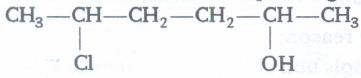
Give IUPAC name of the compound given below.
2-chloro-5-hydroxyhexane
2-hydroxy-5-chlorohexane
5-chlorohexan-2-ol
2-chlorohexan-5-ol
14.
Among the following, the non-spontaneous reaction is
ROH + R'MgX \(\longrightarrow\) R'H + Mg c (or) X
RONa + NH3 \(\longrightarrow\) NaNH2 + ROH
RONa+H2O \(\longrightarrow\) NaOH+ROH
ROH + HC \(\equiv\) CNa \(\longrightarrow\) RONa+HC \(\equiv\) CH
15.
In the following sequence of reactions, \(Z \overset { { PCl }_{ 5 } }{ \longrightarrow } X\overset { Alc.KOH }{ \longrightarrow } Y\overset { (i)conc.H_{ 2 }{ SO }_{ 4 } }{ \underset { (ii)H_{ 2 }O,boil }{ \longrightarrow } } Z \) Z is
CH3CH2CH2OH
CH3CHOHCH3
CH3CH2CH2CH2OH
(CH3)3CCH2OH
16.
Given at 25°C, \(\left[ Ag\left( { NH }_{ 3 } \right) _{ 2 } \right] ^{ + }+{ e }^{ - }\longrightarrow Ag+2{ NH }_{ 3 },{ E }^{ 0 }=0.02V\) \({ Ag }^{ + }+{ e }^{ - }\longrightarrow Ag,{ E }^{ 0 }=0.80V\). The order of magnitude of the equilibrium constant of the reaction \(\left[ Ag\left( { NH }_{ 3 } \right) _{ 2 } \right] ^{ + }\longrightarrow { Ag }^{ + }+2{ NH }_{ 3 }\) will be
10-8
10-10
10-12
10-14
17.
Electrolysis of dilute aqueous NaCl solution was carried out by passing 10 milli ampere current. The time required to liberate 0.01 mol of H2 gas at the cathode is (1 Faraday = 96500 C mol-1)
9.65 x 10⁴ sec
19.3 x 10⁴ sec
28.95 x 10⁴ sec
38.6 x 10⁴ sec
18.
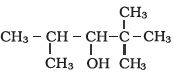
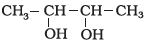
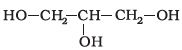
Write IUPAC names of the following compounds:
(i)
(ii)

(iii)
(iv)
(v)

(vi)
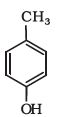
(vii)
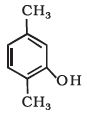
(viii)

(ix)
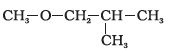
(x)
\(\mathrm{C}_{6} \mathrm{H}_{5}-\mathrm{O}-\mathrm{C}_{2} \mathrm{H}_{5}\)
(xi)
\(\mathrm{C}_{6} \mathrm{H}_{5}-\mathrm{O}-\mathrm{C}_{7} \mathrm{H}_{15}(\mathrm{n}-)\)
(xii)
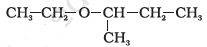
19.
Write equation of the following reactions.
(i) Friedel-Crafts reaction (alkylation in anisole)
(ii) Nitration of anisole
(iii) Bromination of anisole in ethanoic acid medium
(iv) Friedel-Crafts (acetylation of anisole)
20.
Define conductivity and molar conductivity for the solution of an electrolyte. Discuss their variation with concentration.
21.
Calculate the emf and /lG for the following cell
Mg(s) I Mg2+11Cu2 + (0.0001M) ICu(s)
\(E^{ 0 }_{ \left( Mg2+/Mg \right) }=-2.37V,E^{ 0 }_{ (cu^{ 2+ }/cu) }=0.34V\)
22.
Read the passage given below and answer the following questions:
Lucas test is a test to differentiate between primary, secondary and tertiary alcohols. This test consists of treating an alcohol with Lucas reagent, and turbidity, due to the formation of insoluble alkyl chloride, is observed. Lucas test is based on the difference in reacting of three classes of alcohols with hydrogen chloride via SN1 reaction. The different reactivity reflects the differing ease of formation of the corresponding carbocations.
In these questions (i-iv), a statement of assertion followed by a statement of reason is given. Choose the correct answer out of the following choices.
(a) Assertion and reason both are correct statements and reason is correct explanation for assertion.
(b) Assertion and reason both are correct statements but reason is not correct explanation for assertion.
(c) Assertion is correct statement but reason is wrong statement.
(d) Assertion is wrong statement but reason is correct statement.
(i) Assertion: Equimolar mixture of conc. HCI and anhydrous ZnCl2 is called Lucas' reagent.
Reason : Lucas' reagent can be used to distinguish between methanol and ethanol.
(ii) Assertion: 2-Methyl-2-butanol gives no turbidity with Lucas' reagent at room temperature.
Reason: It is a 3° alcohol
(iii) Assertion: Amongst the compounds, H2C =CHCH2OH (I), C6H5OH (II), CH3CH2CH2OH (III) and (CH3)3COH (IV), only (IV) reacts with Lucas' reagent at room temperature.
Reason : Tertiary alcohol gives turbidity immediately with Lucas' reagent.
(iv) Assertion: Lucas test can be used to distinguish between 1-propanol and 2-propanol.
Reason : Lucas test is based upon the difference in reactivity of primary, secondary and tertiary alcohols with conc. HCI and anhyd. ZnCI2.
23.
Assertion: For measuring resistance of an ionic solution an AC source is used.
Reason: Concentration of ionic solution will change if DC source is used.
codes :
(a) Assertion and reason both are correct statements and reason is correct explanation for assertion.
(b) Assertion and reason both are correct statements but reason is not correct explanation for assertion.
(c) Assertion is correct statement but reason is wrong statement.
(d) Assertion is wrong statement but reason is correct statement.
1.
Given, for 0.2 mol L-1 KCl solution,
Conductivity, \(\kappa\) = 0.0248 S cm-1
Resistance, R = 200 \(\Omega\)
Cell constant = Conductivity \(\times\) Resistance
= 0.0248 \(\times\) 200 = 4.96 cm-1
For 0.05 mol L-1 KCI solution,
Resistance = 620 \(\Omega\),
Cell constant = 4.96 cm-1
\(\text { Conductivity }=\frac{\text { Cell constant }}{\text { Resistance }}=\frac{4.96}{620}=0.008 \Omega^{-1} \mathrm{~cm}^{-1}\)
\(\begin{aligned} \text { Molar conductivity } & =\frac{\text { Conductivity } \times 1000}{\text { Molarity }} \end{aligned}\)
\(\begin{aligned} =\frac{0.008 \Omega^{-1} \times 1000 \mathrm{~cm}^3 \mathrm{~L}^{-1}}{0.05 \mathrm{~mol} \mathrm{~L}^{-1}} \end{aligned}\)
\(=160 \Omega^{-1} \mathrm{~cm}^2 \mathrm{~mol}^{-1}\)
2.
NaBH4/Ni/H2
3.
Negative
4.
o-Nitrophenol is steam-volatile due to chelation (intramolecular H-bonding) and hence can be separated by steam distillation from p-nitrophenol which is not steam volatile because of intermolecular H-bonding.
5.
Mg, Al, Zn, Fe, Cu, Ag
6.
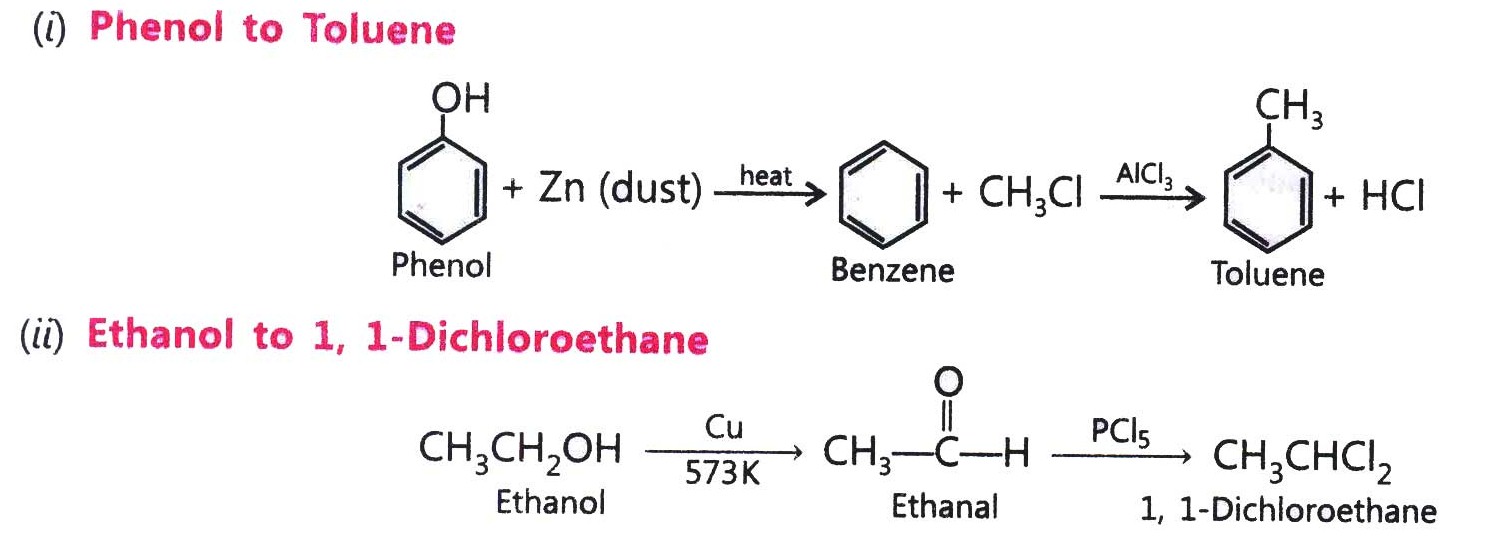
7.
(i) \(\mathrm{CH}_{3} \mathrm{CH}_{2} \mathrm{CH}_{2} \mathrm{Cl} \stackrel{\text { aq. } \mathrm{NaOH}}{\longrightarrow} \mathrm{CH}_{3} \mathrm{CH}_{2} \mathrm{CH}_{2} \mathrm{OH}\)
8.
(i) \({ CH }_{ 3 }-\overset { \underset { | }{ { CH }_{ 3 } } }{ \underset { \overset { | }{ { CH }_{ 3 } } }{ C } } -O-{ CH }_{ 3 }+2HI\longrightarrow { CH }_{ 3 }-\overset { \underset { | }{ { CH }_{ 3 } } }{ \underset { \overset { | }{ { CH }_{ 3 } } }{ C } } -O-I+{ CH }_{ 3 }I+{ H }_{ 2 }O\)
(ii) \({ CH }_{ 3 }-{ CH }_{ 2 }-\underset { \overset { | }{ OH } }{ CH } -{ CH }_{ 3 }\overset { Cu/573k }{ \longrightarrow } \underset { Butanone }{ { CH }_{ 3 }-{ CH }_{ 2 }-\underset { \overset { || }{ O } }{ C } -{ CH }_{ 3 }+{ H }_{ 2 } } \)
9.
6.747 x 10¹⁰
10.
0.0441 volt
11.
We know from Kohlrausch law that
\(A_{m\left(\mathrm{CaCl}_{2}\right)}^{\mathrm{o}}=\lambda_{\mathrm{Ca}^{2+}}^{0}+2 \lambda_{\mathrm{Cl}^{-}}^{0}=119.0 \mathrm{~S} \mathrm{~cm}^{2} \mathrm{~mol}^{-1}+2(76.3) \mathrm{S} \mathrm{cm}^{2} \mathrm{~mol}^{-1}\)
= (119.0 + 152.6) S cm2 mol–1
= 271.6 S cm2 mol–1
\(A_{n\left(\mathrm{MgSO}_{4}\right)}^{\mathrm{o}}=\lambda_{\mathrm{Mg}^{2+}}^{0}+\lambda_{\mathrm{so}_{4}^{2}}^{0}=106.0 \mathrm{~S} \mathrm{~cm}^{2} \mathrm{~mol}^{-1}+160.0 \mathrm{~S} \mathrm{~cm}^{2} \mathrm{~mol}^{-1}\)
= 266 S cm2 mol–1
12.
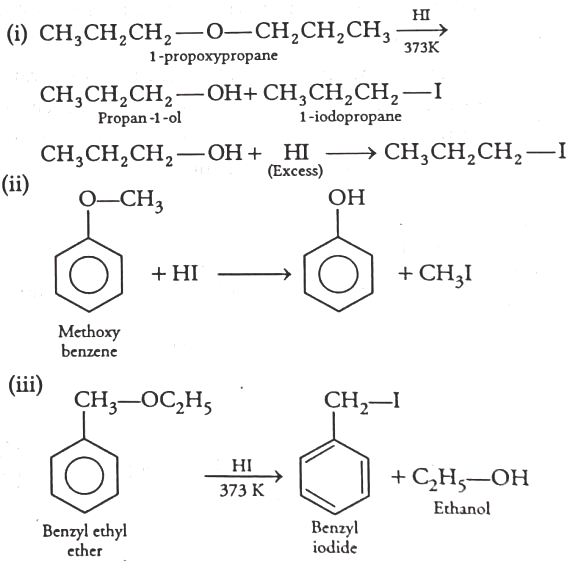
13.
(c)
5-chlorohexan-2-ol
14.
(b)
RONa + NH3 \(\longrightarrow\) NaNH2 + ROH
15.
(b)
CH3CHOHCH3
16.
(d)
10-14
17.
(b)
19.3 x 10⁴ sec
18.
(i) 2, 2, 4-Trimethylpentan-3-ol
(ii) 5-Ethylheptane-2, 4-diol
(iii) Butane-2, 3-diol
(iv) Propane-1, 2, 3-triol
(v) 2-Methylphenol
(vi) 2,5-DimethylphenoI
(vii) 4-Methylphenol
(viii) 2,6-Dimethylphenol
(ix) 1-Methoxy-2-methylpropane
(x) Ethoxybenzene
(xi) 1-Phenoxyheptane
(xii) 2-Ethoxybutane
19.
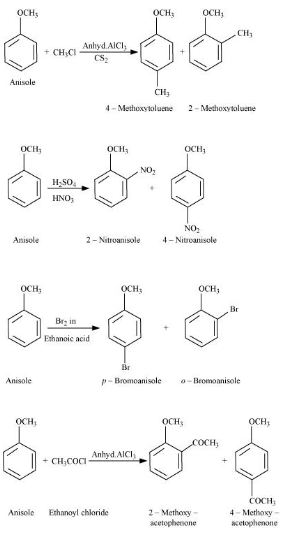
20.
Conductivity The inverse of resistivity is called conductivity. It is denoted by K (kappa). It is also known as specific conductance. k = 1/p SI unit of conductivity is Sm-1 or ohm-1 m-1
Molar conductivity It is defined as the conductance of the solution which contains one mole of the electrolyte such that entire solution is in between the two electrodes kept one centimeter apart, and large enough to contain all the electrolytes.
Molar conductivity, \(\Lambda _{ m }=\frac { K }{ C } \)
Variation of conductivity and molar conductivity with concentration.
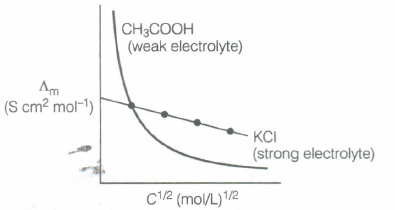
Conductivity and molar conductivity change with change in concentration of electrolyte ..Conductivity always decreases with decrease in concentration for both weak as well as strong electrolytes.
But molar conductivity increases with decrease in concentration. For strong electrolytes, \(\Lambda _{ m }\) increases slowly with dilution but for weak electrolyte, \(\Lambda _{ m}\) increases steeply on dilution, especially near lower concentrations.
21.
At anode -\(Mg(s)\longrightarrow Mg^{ 2+ }(aq)+2e^{ - }\)
At cathode -Cu2+(aq)+2e- \(\longrightarrow \) Cu(s)
Overall reation
\(Mg(s)+Cu^{ 2 }(aq)\longrightarrow Mg^{ 2 }(aq)+Cu(s)\)
\(E^{ 0 }_{ cell }\) = 0.34-(-237) = +271V
(i) \(\because n=2\)
\(\because E_{ xell }=E^{ 0 }_{ cell }\frac { -0.059 }{ 2 } log\frac { 0.001 }{ 0.0001 } \)
Ecell = 2.71 - 0.0295 log 10
Ecell = 2.71 - 0.0295 x 1
Ecell = 2.68V
(ii) \(\triangle G=-nFE_{ cell }\)
\(\triangle G=\) =-2 x 96500 x 2.68 (If = 96500C)
\(\triangle G=\) 517.24 KJ mol-1
22.
(i) (c): Both methanol and ethanol are 1° alcohols and hence, cannot be distinguished by Lucas' reagent.
(ii) (d): Tertiary alcohols immediately react with Lucas' reagent.
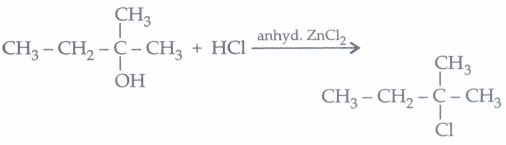
(iii) (d): The order of reactivity of alcohols towards Lucas' reagent is 3° alcohol > 2° alcohol > 1° alcohol. 1° alcohols do not react with Lucas' reagent at room temperature. It requires high temperature. The benzyl and allyl alcohols react as rapidly as 3° alcohols with Lucas' reagent because their cations are resonance stabilised.
(iv) (b) : When Lucas' reagent (conc. HCl + ZnCI2) is added to 2-propanol (2° alcohol) turibitity appears within five minutes whereas with 1-propanol no turbidity appears and solution remains dear at room temperature.
23.
(a) Assertion and reason both are correct statements and reason is correct explanation for assertion.

12th Standard CBSE Syllabus & Materials
12th Standard CBSE
CBSE 12th Computer Science Python Revision Tour I - New Previous year Question Papers Study Material - QB365 Set A
NEW12th Standard CBSE
CBSE 12th Business Studies Planning Important Questions And Answers Study Material - QB365 Set A
NEW12th Standard CBSE
CBSE 12th Business Studies Business Environment Important Questions And Answers Study Material - QB365 Set A
NEW12th Standard CBSE
CBSE 12th Business Studies Principles of Management Important Questions And Answers Study Material - QB365 Set A



NCERT Books

Syllabus

Exam Pattern

Sample Question Papers

Previous year Question Papers

Important Notes

MCQ Practice test

NCERT Exemplers

Case study Questions

Image Based Questions

Passage based Questions

HOT Questions

Value Based Questions

Model Questions Papers
NCERT ( Book Back ) Questions

Assertion and Reason
Important Questions And Answers

CBSE 12th Standard CBSE Subjects
CBSE Standards








