
 100% FREE ACCESS
12th Standard CBSE Syllabus & Materials
12th Standard CBSE
CBSE 12th Economics Government Budget and the Economy Previous year Question Papers Study Material - QB365 Set A
NEW12th Standard CBSE
CBSE 12th Computer Science Interface Python with MySQL - New Previous year Question Papers Study Material - QB365 Set A
NEW12th Standard CBSE
CBSE 12th Computer Science Database Concept - New Previous year Question Papers Study Material - QB365 Set A
NEW12th Standard CBSE
CBSE 12th Computer Science Data Communication - New Previous year Question Papers Study Material - QB365 Set A
NEW12th Standard CBSE
CBSE 12th Computer Science Data Structures - New Previous year Question Papers Study Material - QB365 Set A
NEW12th Standard CBSE
CBSE 12th Computer Science Functions - New Previous year Question Papers Study Material - QB365 Set A

Published on: 25/10/2025
Download CBSE Class 12th Standard CBSE Chemistry question papers, sample papers, important questions, and previous year solved papers in PDF format. Get free study materials, NCERT solutions, and exam preparation resources for Class 12th Standard CBSE Chemistry
Questions + Answers key
Take MCQ Chemistry Test
1.
State
(a) Kohlrausch law of independent migration of ions.
(b) Faraday's first law of electrolysis.
2.
Ni(II) compounds are thermodynamically more stable than Pt(II) compounds. Why?
3.
What do you mean by limiting molar conductivity?
4.
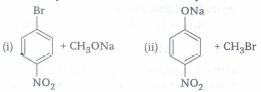
Which of the following is an appropriate set of reactants for the preparation of 1-methoxy-d nitrobenzene and why?
5.
How do you convert phenol to anisole?
6.
Name the products obtain when anisole is treated with HI?
7.
Complete the following chemical equations:
(i) MnO4-(aq)+C2O42-(aq)+H+(aq) \(\rightarrow \)
(ii) Cr2O72-(aq) + Fe2+(aq) +H+(aq) \(\rightarrow \)
8.
(a) State Kohlrausch law of independent migration of ions. Write an expression for the molar conductivity of acetic acid at infinite dilution according to Kohlrausch law.
Calculate \(\Delta_{m}^{\circ}\) for acetic acid.
Given that \(\Delta_{m}^{\circ}\) (HCl) = 426 S cm2 mol-1
\(\Delta_{m}^{\circ}\) (NaCI) = 126 S cm2 mol-1
\(\Delta_{m}^{\circ}\) (CH3 COONa) = 91 S cm2 mol-1
9.
Define conductivity and molar conductivity for the solution of an electrolyte. Discuss their variation with concentration.
10.
(a) Complete the following chemical equations :
\((i)\ { Cr }_{ 2 }{ O }_{ 7 }^{ 2- }(aq)+{ H }_{ 2 }S(g)+{ H }^{ + }(aq)\longrightarrow \)
\((ii)\ { Cu }^{ 2+ }(aq)+{ I }^{ - }(aq)\longrightarrow\)
(b) How would you account for the following ?
(i) The oxidizing power of oxoanions is the order : \({ VO }_{ 2 }^{ + }<{ Cr }_{ 2 }{ O }_{ 7 }^{ 2- }<{ MnO }_{ 4 }^{ - }\)
(ii) The third ionization enthalpy of manganese (Z = 25) is exceptionally high.
(iii) Cr2+ is stronger reducing agent than Fe2+
11.
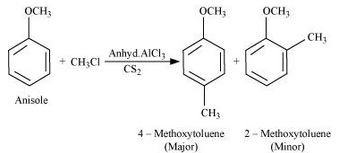
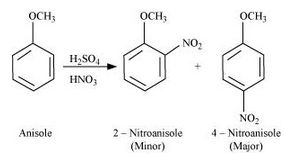
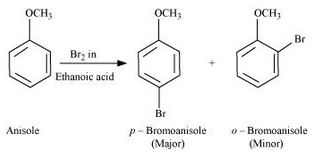
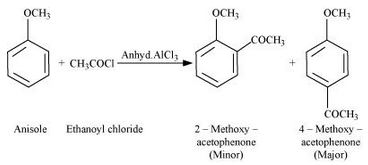
Write equations of the following reactions:
(i) Friedel-Crafts reaction - alkylation in anisole,
(ii) Nitration of anisole
(iii) Bromination of anisole in ethanoic acid medium,
(iv) Friedel- Crafts acetylation of anisole.
12.
Define fuel cell with an example. What advantages do the fuel cells have over primary and secondary batteries?
13.
Calculate the ‘spin only’ magnetic moment of M2+(aq) ion (Z = 27).
14.
Explain the following with an example.
(i) Kolbes reaction.
(ii) Reimer-Tiemann reaction.
(iii) Williamson ether synthesis.
(iv) Unsymmetrical ether.
15.
Explain the following:
(i) The paramagnetic character in 3d transition series increases upto Cr and then decreases.
(ii) Transition metals are very good catalyst.
(iii) Transition metals form a large number of interstitial compounds.
16.
From the given data of E0 values, answer the following questions:
| \(E_{(M^{2+}/Mn)}^0\) | Cr | Mn | Fe | Co | Ni | Cu |
| -0.91 | -1.18 | -0.44 | -0.28 | -0.25 | +0.34 |
|---|
(i) Why is \(E_{(Cu^{2+}/Cu)}^0\) value exceptionally positive?
(ii) Why is \(E_{(M^{2+}/Mn)}^0\) value highly negative as compared to other elements?
(iii) Which is a stronger reducing agent Cr2+ or Fe2+? Give reason.
17.
Which is stronger reducing agent \({ Cr }^{ 2+ }\) or \({ Fe }^{ 2+ }\) and why?
18.
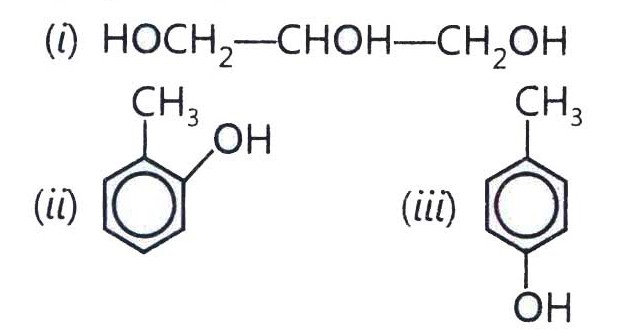
Write IUPAC names of the following compounds:
19.
Vishal took 4 test-tubes namely A, B, C and D containing CH3CH = CH2, CH3CH2CH = CH2, CH3CH = CH - CH3 and (CH3)2C = CH2 respectively and tried to convert them into tert-butyl alcohol. He carried out acid catalysed hydration reaction on every alkene. Out of the four test-tubes, the one which will give desired result is
A
B
C
D
20.
Monochlorination of toluene in sunlight followed by hydrolysis with aq. NaOH yields ___________
o-Cresol
m-Cresol
2, 4-Dihydroxytoluene
benzyl alcohol
21.
Galvanisation is
zinc plating on aluminium sheet
zinc plating on iron sheet
iron plating on zinc sheet
aluminium plating on zinc sheet
22.
Anode in the Leclanche cell is
zinc container
graphite electrode
carbon
MnO2 + C
23.
Unit of specific conductance is
cm-2ohm-1
cm-2ohm-1equivalent -1
cm-1ohm-1
cm-2ohm
24.
Zn(s) + Cu2+(aq)⇾ Zn2+(aq) +Cu(s)
The above redox reaction is used in
Galvanic cell
Daniell cell
Voltaic cell
All of these
25.
The colour of the transition metal ions is due to
d - d transition
charge transfer
change in the geometry
none
26.
The number of unpaired electrons in gaseous species of Mn3+. Cr3+ and V3+ respectively are ........ and most stable species is ......... .
4,3 and 2 and V3+ is most stable
3,3 and 2 and Cr3+ is most stable
4,3 and 2 and Cr3+ is most stable
3,3 and 3 and Mn3+ is most stable.
27.
The most suitable reagent for the conversion of R-CH2OH \(\longrightarrow\) R-CHO is
PCC(Pyridinium chlorochromate)
KMnO4
CrO3
K2Cr2O7
28.
In the following sequence of reactions, \(Z \overset { { PCl }_{ 5 } }{ \longrightarrow } X\overset { Alc.KOH }{ \longrightarrow } Y\overset { (i)conc.H_{ 2 }{ SO }_{ 4 } }{ \underset { (ii)H_{ 2 }O,boil }{ \longrightarrow } } Z \) Z is
CH3CH2CH2OH
CH3CHOHCH3
CH3CH2CH2CH2OH
(CH3)3CCH2OH
29.
Electronic configuration of a transition element X in +3 oxidation state is [Ar] 3d5. What is its atomic number ?
25
26
27
24
30.
Products obtained when HI reacts with isopropyl methyl ether at 373 K are
isopropyl iodide and methyl alcihol
isopropyl alcohol and methyl iodide
isopropyl iodide and water
methyl iodide and water
31.
Phenol reacts with bromine in CS2 to give
o-bromophenol
m-bromophenol
o-and p-bromophenol
2, 4, 6-tribromophenol
32.
Two faradays of electricity are passed through a solution of CuSO4. The mass of copper deposited at the cathode (at mass of Cu = 63.5 amu)
2 g
127 g
0 g
63.5 g
33.
KMnO4 on heating to red hot gives
K2MnO4 + MnO2 + O2
K2MnO3 + MnO2 + O2
K2O + MnO2 + O2
None of these
34.
In first transition series which of the following has lowest enthalpy of atomisation ?
Sc
Cu
Yi
Zn
35.
Read the passage given below and answer the following questions:
An organic compound (A) having molecular formula C6H6O gives a characteristic colour with aqueous FeCl3 solution. (A) on treatment with CO2 and NaOH at 400 K under pressure gives (B), which on acidification gives a compound (C). The compound (C) reacts with acetyl chloride to give (D) which is a popular pain killer.
The following questions are multiple choice questions. Choose the most appropriate answer:
(i) Compound (A) is
| (a) 2-hexanol | (b) dimethyl ether | (c) phenol | (d) 2-methyl pentanol. |
(ii) Number of carbon atoms in compound (D) is
| (a) 7 | (b) 6 | (c) 8 | (d) 9 |
(iii) The conversion of compound (A) to (C) is known as
| (a) Reimer- Tiemann reaction | (b) Kolbe's reaction | (c) Schimdt reaction | (d) Swarts reaction |
(iv) Compound (A) on heating with compound (C) in presence of POCl3 gives a compound (D) which is used
| (a) in perfumery as a flavouring agent | (b) as an antipyretic | (c) as an analgesic | (d) as an intestinal antiseptic. |
36.
Read the passage given below and answer the following questions:
Molar conductivity of ions are given as product of charge on ions to their ionic mobilities and Faraday's constant.
\(\lambda_{A^{n+}}=n \mu_{A^{n+}} F\) (here \(\mu\) is the ionic mobility of An+).
For electrolytes say AXBy, molar conductivity is given by
\(\lambda_{m\left(A_{x} B_{y}\right)}=x_{n} \mu_{A^{n+}} F+y_{m} \lambda_{A^{m}-F}\)
| Ions | Ionic mobility |
| K+ | 7.616 x 10- 4 |
| Ca2+ | 12.33 x 10⁻⁴ |
| Br- | 8.09 x 10- 4 |
| \(\mathrm{SO}_{4}^{2-}\) | 16.58 x 10- 4 |
The following questions are multiple choice questions. Choose the most appropriate answer
(i) At infinite dilution, the equivalent conductance of CaSO4 is
| (a) 256 x 10-4 | (b) 279 | (c) 23.7 | (d) 2.0 x 10- 8 |
(ii) If the degree of dissociation of CaSO4 solution is 10% then equivalent conductance of CaSO4 is
| (a) 3.59 | (b) 36.9 | (c) 27.9 | (d) 30.6 |
(iii) What is the unit of equivalent conductivity?
| (a) ohm-1 cm2 eq-1 | (b) ohm cm2eq-1 |
| (c) ohm-1 cm eq-1 | (d) ohm cm2 eq-1 |
(iv) If the molar conductance value of Ca2+ and Cl- at infinite dilution are 118.88 x 10⁻⁴ m2 mho mol-1 and 77.33 x 10⁻⁴ m 2 mho mol-1 respectively then the molar conductance of CaCl2 (in m2 mho mol-1) will be
| (a) 120.18 x 10- 4 | (b) 135 x 10-4 | (c) 273.54 x 10⁻⁴ | (d) 192.1 x 10⁻⁴ |
1.
(a) The Kohlrausch law of independent migration of ions state that "limiting molar conductivity of an electrode is the sum of the individual contribution of the cation and the anion of the electrolyte."
(b) The Faraday's first law states that "the amount of chemical reaction occuring at any electrode by passing current is directly proportional to the quantity of electricity passed through the electrolyte.
2.
This is because that sum of ionisation energies (E1 + E2) is less in case of Ni than Pt.
3.
When the concentration of electrolyte approaches zero, the molar conductivity is known as limiting molar conductivity \(\left(\Lambda_m^{\circ}\right)\)
\(\Lambda_m^{\circ}=\left(\Lambda_m\right) \text { when } \mathrm{C} \rightarrow 0\)
4.
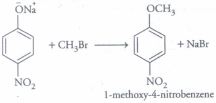
This reaction involves the preparation of ether by Williamson's synthesis. It takes place via SN2 attack of an alkoxide ion on primary alkyl halide because here the alkyl halide used is primary. Moreover in method (i) the C-Br bond has some double bond character.
5.

6.
Phenol and methyl iodide
7.
(i) 8MnO4-(aq)+3S2O32-(aq)+H2O(l) \(\rightarrow \)8MnO2+6SO42-+2OH-
(ii) Cr2O72-(aq) + 6Fe2+(aq) +14H+(aq) \(\rightarrow \) 2Cr3++6Fe3++7H2O
8.
(a) Kohlrausch's law of independent migration of ions: According to this law, molar conductivity of an electrolyte, at infinite dilution, can be expressed as the sum of the contributions from its individual ions. If the molar conductivity of the cations is denoted by \(\lambda_{+}^{\infty}\) and that of the anions by \(\lambda_{-}^{\infty},\) then the law of independent migration of ions is
\(\Lambda_{m}^{\infty}=v_{+} \lambda_{+}^{\infty}+v_{-} \lambda_{-}^{\infty}\)
or \(\Lambda^{\circ}=v_{+} \lambda_{+}^{\circ}+v_{-} \lambda^{\circ}\)
where v+ and v_ are the number of cations and anions per formula of electrolyte
\(\Lambda_{m}^{\circ} \mathrm{CH}_{3} \mathrm{COOH}=\lambda_{m}^{\circ} \mathrm{CH}_{3} \mathrm{COO}^{-}+\lambda_{m}^{\circ} \mathrm{H}^{+}\)
The degree of dissociation a can be calculated by the formula \(\alpha=\frac{\left(\Lambda_{m}\right)_{C}}{\left(\Lambda_{m}\right)_{\infty}}\) where (Am)c is molar conductivity of a particular cone. an \(\left(\Lambda_{m}\right)_{\infty}\) is the maximum molar conductivity of infinite dilution. It is also denoted by \(\Lambda_{m}^{\circ}\)called limiting molar conductivity.
(b) \(\Lambda_{m}^{\circ}(\mathrm{NaCl})=\lambda^{\circ}\left(\mathrm{Na}^{+}\right)+\lambda^{\circ}(\mathrm{Cl^-})\)
= 126 S cm2 mol-1 ... (i)
\(\Lambda_{m}^{\circ}(\mathrm{HCl})=\lambda^{\circ}\left(\mathrm{H}^{+}\right)+\lambda^{\circ}\left(\mathrm{Cl}^{-}\right)\)
= 426 S cm2 mol-1 ... (ii)
\(\Lambda_{m}^{\circ}\left(\mathrm{CH}_{3} \mathrm{COONa}\right)=\lambda^{\circ}\left(\mathrm{Na}^{+}\right)+\lambda^{\circ}\left(\mathrm{CH}_{3} \mathrm{COO}^{-}\right)\)
= 91 S cm2 mol-1 ...(iii)
Adding (ii) and (iii) and subtracting (i), we get
\(\Lambda_{m}^{\circ}\left(\mathrm{CH}_{3} \mathrm{COOH}\right)=\lambda^{\circ}\left(\mathrm{H}^{+}\right)+\lambda^{\circ}\left(\mathrm{CH}_{3} \mathrm{COO}^{-}\right)\)
= \(\Lambda_{m}^{\circ}(\mathrm{HCl})+\Lambda_{m}^{\circ}\left(\mathrm{CH}_{3} \mathrm{COONa}\right) - \Lambda_{m}^{\circ}(\mathrm{NaCl})\)
= (426 + 91 - 126) = 391 S cm2 mol-1
9.
Conductivity The inverse of resistivity is called conductivity. It is denoted by K (kappa). It is also known as specific conductance. k = 1/p SI unit of conductivity is Sm-1 or ohm-1 m-1
Molar conductivity It is defined as the conductance of the solution which contains one mole of the electrolyte such that entire solution is in between the two electrodes kept one centimeter apart, and large enough to contain all the electrolytes.
Molar conductivity, \(\Lambda _{ m }=\frac { K }{ C } \)
Variation of conductivity and molar conductivity with concentration.
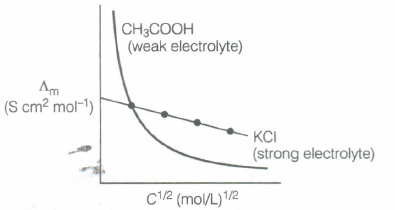
Conductivity and molar conductivity change with change in concentration of electrolyte ..Conductivity always decreases with decrease in concentration for both weak as well as strong electrolytes.
But molar conductivity increases with decrease in concentration. For strong electrolytes, \(\Lambda _{ m }\) increases slowly with dilution but for weak electrolyte, \(\Lambda _{ m}\) increases steeply on dilution, especially near lower concentrations.
10.
(a) (i) \( \mathrm{Cr}_{2} \mathrm{O}_{7}^{2-}(a q)+3 \mathrm{H}_{2} \mathrm{~S}(g)+8 \mathrm{H}^{+}(a q) \) \(\longrightarrow 2 \mathrm{Cr}^{3+}+3 \mathrm{~S}+7 \mathrm{H}_{2} \mathrm{O}\)
(ii) \( 2 \mathrm{Cu}^{2+}(a q)+2 \mathrm{I}^{-}(a q) \longrightarrow 2 \mathrm{Cu}^{+}(a q)+\mathrm{I}_{2}(s)\)
(b) (i) It is because V in lower oxidation the state is less stable than Cr which is less stable than Mn. That is why MnO4 is a best oxidizing agent and VO2+ is least.
(ii) M n (2 5) has electronic configuration [Ar]4s23ds, electronic configuration of Mn2+ is [Ar]4so3ds. After losing 2 electrons, it has half filled d-orbital, which is more stable that is why Mn2+ has exceptionally high third ionization energy, i.e. the energy required to remove
the third electron is very high.
(iii) It is because in Cr3+, d3 (half filled t2g orbitals) is more stable in aqueous solution than Fe3+ i.e. Cr3+ is more stable than Fe3+.
11.
(i)
(ii)
(iii)
(iv)
12.
Fuel cell is a galvanic cell, in which chemical energy from combustion of fuels like hydrogen, methane, methanol, etc. is converted into electrical energy. One of the most successful fuel cells uses the reaction of hydrogen with oxygen to form water.
Advantages of Fuel cell
1. It is highly efficient (70%) as compared to thermal power plants (40%).
2. It does not causes pollution as no harmful products are formed.
3. This cells runs as long as the reactants are supplied.
4. The cell being light weight have been used as automobiles on an experimental basis.
13.
Z = 27
\(\Rightarrow[\mathrm{Ar}] 3 \mathrm{~d}^{7} 4 \mathrm{~s}^{2}\)
\(\therefore \mathrm{M}^{2+}=[\mathrm{Ar}] 3 \mathrm{~d}^{7}\)
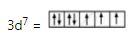
i.e., 3 unpaired electrons
\(\therefore n=3\)
\(\Rightarrow \sqrt{n(n+2)}=\mu\)
\(\Rightarrow \sqrt{3(3+2)}=\mu\)
\(\Rightarrow \sqrt{15}=\mu\)
\(\mu \approx 4 \mathrm{BM}\)
14.
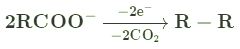
(i) Kolbes reaction.
It is a decarboxylative dimerisation of two carboxylic acids (or carboxylate ions) to form carbon carbon bond of alkane.
(ii) Reimer-Tiemann reaction.
It involves the ortho-formylation of phenols. Phenol is converted to salicylaldehyde.

(iii) Williamson ether synthesis.
Sodium alkoxide reacts with alkyl halide to form an ether.
\(\mathbf{C}_{2} \mathrm{H}_{5} \mathrm{ONa}+\mathrm{C}_{2} \mathrm{H}_{5} \mathrm{Cl} \rightarrow \mathrm{C}_{2} \mathrm{H}_{5}-\mathrm{O}-\mathrm{C}_{2} \mathrm{H}_{5}+\mathrm{NaCl}\)
(iv) Unsymmetrical ether.
Two different alkyl groups are attached to O atom. The general formula is R−O−R′. An example is ethyl methyl ether
\(\mathrm{CH}_{3}-\mathrm{CH}_{2}-\mathrm{O}-\mathrm{CH}_{3}\)
15.
(i)From the electronic configuration of the 3d transition series, we can see that, as we go from left to right, the number of unpaired electrons increases from Sc to Cr and decreases thereafter. So the paramagnetic nature of the 3d transition series increaes till Cr and then decreases regularly.
(ii)Transition metals have vacant d-orbitals and because of this their valency is variable so they can be used as oxidising agent as well as reducing agent. also they have large surface area so they can act as a good catalyst.
(iii)The transition metals form interstitial compounds because there are vacant spaces in the lattice of transition metals which can be filled by small atoms like H,C,N etc.
16.
(i) Sum of enthalphy of atomisation and ionisation is greater than enthalphy of hydration. Thus, \(E_{(M^{2+}/Mn)}^0\) is positive for copper.
(ii) Ionisation enthalpy is lower than hydration enthalphy due to stable 3d5 configuration. Thus, \(E_{(M^{2+}/Mn)}^0\) is more negative.
(iii) Cr2+ is a stronger reducing agent because it can lose electron to form Cr3+ which has stable 3d3 configuration (half-filled t2g3). Further is more negative than Fe2+
17.
\({ Cr }^{ 2+ }\) is a stronger reducing agent than \({ Fe }^{ 2+ }\). This is because the configuration of \({ Cr }^{ 2+ }\) changes from \({ d }^{ 4 }\) to \({ d }^{ 3 }\) configuration is stable \(({ t }_{ 2g }^{ 3 })\) being half-filled \({ t }_{ 2g }\) level.
18.
(i) Propane-1, 2, 3-triol
(ii) 2-Methylphenol
(iii) 4-Methylphenol.
19.
(d)
D
20.
(d)
benzyl alcohol
21.
(b)
zinc plating on iron sheet
22.
(a)
zinc container
23.
(c)
cm-1ohm-1
24.
(d)
All of these
25.
(a)
d - d transition
26.
(c)
4,3 and 2 and Cr3+ is most stable
27.
(a)
PCC(Pyridinium chlorochromate)
28.
(b)
CH3CHOHCH3
29.
(b)
26
30.
(b)
isopropyl alcohol and methyl iodide
31.
(c)
o-and p-bromophenol
32.
(c)
0 g
33.
(b)
K2MnO3 + MnO2 + O2
34.
(d)
Zn
35.
(i) (c):
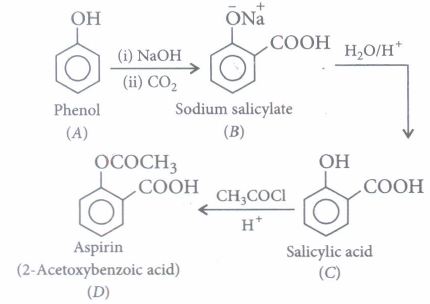
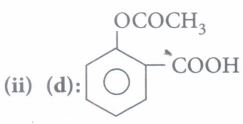
It has 9 C-atoms.
(iii) (b): Sodium phenoxide when heated with CO2 at 400 K under a pressure of 4-7 atm followed by acidification gives 2-hydroxybenzoic acid (salicylic acid) as the main product along with a small amount of 4-hydroxybenzoic acid. This reaction is called Kolbe's reaction.
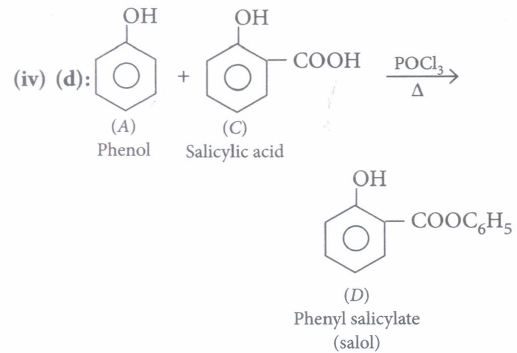
Salol is used as an intestinal antiseptic.
36.
(i) (b) : Equivalent conductance of CaSO4 :
\(\Lambda_{\mathrm{CaSO}_{4}}^{\infty}=\lambda_{\mathrm{Ca}^{2+}}^{\infty}+\lambda_{\mathrm{SO}_{4}^{2-}}^{\infty}\)
\(\lambda_{\mathrm{Ca}^{2+}}^{\infty}=\left(\mu_{\mathrm{Ca}^{2+}}\right) F ; \lambda_{\mathrm{SO}_{4}^{2-}}^{\infty}=\left(\mu_{\mathrm{SO}_{4}^{2-}}\right) F\)
\(\mu_{\mathrm{Ca}^{2+}}\) and \(\mu_{\mathrm{SO}_{4}^{2-}}\) - are ionic mobilities.
\(\Lambda_{\mathrm{CaSO}_{4}}^{\infty}=F(12.33+16.58) \times 10^{-4}\)
= 96500 x 10- 4 x 28.91 = 279
(ii) (c) : \(\alpha=\frac{\Lambda_{C}}{\Lambda^{\infty}} \Rightarrow 0.1=\frac{\Lambda_{C}}{279} \Rightarrow \Lambda_{C}=27.9\)
(iii) (a)
(iv) (c) : \(\Lambda_{m\left(\mathrm{CaCl}_{2}\right)}^{\circ}=\lambda_{\mathrm{Ca}^{2+}}^{\circ}+2 \lambda_{\mathrm{Cl}^{-}}^{\circ}\)
= (118.88 x 10- 4 ) + 2(77.33 x 10- 4 )
= 273.54 x 10⁻⁴ m2 mho mol-1

12th Standard CBSE Syllabus & Materials
12th Standard CBSE
CBSE 12th Computer Science Python Revision Tour I - New Previous year Question Papers Study Material - QB365 Set A
NEW12th Standard CBSE
CBSE 12th Business Studies Planning Important Questions And Answers Study Material - QB365 Set A
NEW12th Standard CBSE
CBSE 12th Business Studies Business Environment Important Questions And Answers Study Material - QB365 Set A
NEW12th Standard CBSE
CBSE 12th Business Studies Principles of Management Important Questions And Answers Study Material - QB365 Set A



NCERT Books

Syllabus

Exam Pattern

Sample Question Papers

Previous year Question Papers

Important Notes

MCQ Practice test

NCERT Exemplers

Case study Questions

Image Based Questions

Passage based Questions

HOT Questions

Value Based Questions

Model Questions Papers
NCERT ( Book Back ) Questions

Assertion and Reason
Important Questions And Answers

CBSE 12th Standard CBSE Subjects
CBSE Standards








