
 100% FREE ACCESS
12th Standard CBSE Syllabus & Materials
12th Standard CBSE
CBSE 12th Economics Government Budget and the Economy Previous year Question Papers Study Material - QB365 Set A
NEW12th Standard CBSE
CBSE 12th Computer Science Interface Python with MySQL - New Previous year Question Papers Study Material - QB365 Set A
NEW12th Standard CBSE
CBSE 12th Computer Science Database Concept - New Previous year Question Papers Study Material - QB365 Set A
NEW12th Standard CBSE
CBSE 12th Computer Science Data Communication - New Previous year Question Papers Study Material - QB365 Set A
NEW12th Standard CBSE
CBSE 12th Computer Science Data Structures - New Previous year Question Papers Study Material - QB365 Set A
NEW12th Standard CBSE
CBSE 12th Computer Science Functions - New Previous year Question Papers Study Material - QB365 Set A

Published on: 25/10/2025
Download CBSE Class 12th Standard CBSE Chemistry question papers, sample papers, important questions, and previous year solved papers in PDF format. Get free study materials, NCERT solutions, and exam preparation resources for Class 12th Standard CBSE Chemistry
Questions + Answers key
Take MCQ Chemistry Test
1.
An organic compound (A) having molecular formula C6H6O gives a characteristic color with an aqueous FeCl3 solution. (A) on treatment with CO2 and NaOH at 400 K under pressure gives (B), which on acidification gives a compound (C). The compound (C) reacts with acetyl chloride to give (D) which is a popular pain killer.
(i) Compound (A) is
(a) 2-hexanol
(b) dimethyl ether
(c) phenol
(d) 2-methyl pentanol.
ii) Number of carbon atoms in compound (D) is
(a) 7
(b) 6
(c) 8
(d) 9
iii) The conversion of compound (A) to (C) is known as
(a) Reimer- Tiemann reaction
(b) Kolbe’s reaction
(c) Schmidt reaction
(d) Swarts reaction
(iv) Compound (A) on heating with compound (C) in presence of POCl3 gives a compound (D) which is used
(a) in perfumery as a flavoring agent
(b) as an antipyretic
(c) as an analgesic
(d) as an intestinal antiseptic.
2.
3.
Table given below has compounds and their pKa values. Study the table and answer the questions based on table and related studied concepts.
| Compound | pKa |
| Ethanol | 15.9 |
| Phenol | 9.98 |
| o-cresol | 10.28 |
| p-cresol | 10.14 |
| m-cresol | 10.08 |
| o-nitro phenol | 7.23 |
| p-nitro phenol | 7.15 |
| m-nitro phenol | 8.40 |
| 2, 4-dinitro phenol | 4.0 |
| Picric acid | 0.71 |
| m-methoxy phenol | 9.65 |
| o-methoxy phenol | 9.96 |
| p-methoxy phenol | 10.21 |
| m-amino phenol | 9.87 |
(a) Which phenolic compound is most acidic?
(b) What is relationship between pKa and acidic character?
(c) Why are cresols weaker acids than phenol?
(d) Which has more electron withdrawing effect (-I)-I effect -OCH3 or -NH2? Why?
(e) Why is o-fluoro phenol weakest acid than pand m-fluoro phenol?
4.
Observe the following table showing boiling points of alcohol, molar mass. Study the table and answer the questions based on table and related studied concept.
| Alcohol | Boiling Point | Molar Mass |
| CH3OH | 64°C | 32 g mol-1 |
| C2H5OH | 78°C | 46 g mol-1 |
| C3H7OH (n-propyl alcohol) | 97°C | 60 g mol-1 |
| Isopropyl alcohol | 82.5oC | 60 g mol-1 |
| n-butanol | 118°C | 74 g mol-1 |
| Isobutyl alcohol | 108°C | 74 g mol-1 |
| Butan-2-ol | 100°C | 74 g mol-1 |
| Tert. butyl alcohol | 83°C | 74 g mol-1 |
(a) Why do alcohols have higher boiling points than haloalkanes, ethers, aldehydes and ketones?
(b) Why does tertiary butyl alcohol have lower boiling point than n-butyl alcohol?
(c) How does boiling point vary with increase in carbon chain?
(d) How is solubility of alcohol vary with increase in molar mass?
(e) Which alcohol is most acidic and why?
5.
Alcohols play very important role in our daily life. Ordinary sprit used as an antiseptic contains methanol. Ethanol is present in cough syrups, tonics, wine, beer and whisky, Sugar, starch, cellulose are carbohydrates which also contain large number -OH groups. Phenol is also an antiseptic in low concentration (0.2%) where as 2% solution of phenol is used as disinfectant. The fragrance of rose is due to citronellol (unsaturated alcohol). Phenol is used for preparation of many useful compounds like aspirin, methyl salicylate (Iodex) and phenyl salicylate (salol) used as intestinal antiseptic.
(a) How is phenol prepared from cumene? What is advantage of this method?
(b) How is phenol converted into salicylic acid?
(c) Convert phenol to picric acid
(d) Distinguish between phenol and benzyl alcohol?
(e) Why does phenol turn pink after long standing?
6.
Observe the table given below belonging to 3d series, their first, second, third ionisation enthalpy and \(\mathbf{E}_{\mathbf{M}^{2+} / \mathbf{M}}^{\circ}\) and \(\mathbf{E}_{\mathbf{M}^{3+} / \mathbf{M}^{2+}}^{\circ}\) and answer the questions that follow based on table and related concepts.
| Element | Sc | Ti | V | Cr | Mn | Fe | Co | Ni | Cu | Zn |
| 1 st ionisation enthalpy | 631 | 656 | 650 | 652 | 717 | 762 | 758 | 736 | 745 | 905 kJ ml -1 |
| IInd ionisation enthalpy | 1245 | 1320 | 1376 | 1635 | 1513 | 1564 | 1648 | 1757 | 1962 | 1736 |
| IIIrd ionisation enthalpy | 2451 | 2721 | 2874 | 2995 | 3258 | 2964 | 3238 | 3401 | 3561 | 3839 |
| \(\mathbf{E}_{\mathbf{M}^{2+} / \mathbf{M}}^{\circ}\) in volts | - | -1.63V | -1.18V | -0.91V | -1.18V | -0.44V | -0.28V | -0.25V | +0.34V | -0.76V |
| \(\mathbf{E}_{\mathbf{M}^{3+} / \mathbf{M}^{2+}}^{\circ}\)in volts | - | -0.37V | -0.26V | -0.41V | +1.57V | +0.77V | +1.97V | - | - | - |
(a) Why does zinc have highest first ionisation enthalpy?
(b) Why is 3 rd ionisation enthalpy of Mn high?
(c) Why is Cr3 + more stable than Cr2+?
(d) Why is \(\mathbf{E}_{\mathbf{M n}^{2+} / \mathbf{M n}}^{\circ}-\mathbf{1 . 1 8 V} ?\)
(e) Why is \(\mathbf{E}_{\mathbf{C n}^{2+} / \mathrm{Cn}}^{\circ}+\mathbf{0 . 3 4 V} ?\)
(f) Why is Fe3+ more stable than Fe2+?
(g) Why is Mn 3 + good oxidising agent and \(\mathbf{E}_{\mathbf{M n}^{3+} / \mathrm{Mn}^{2+}}^{\circ}=\mathbf{1 . 5 7 V} ?\)
7.
Observe the graph shown in figure between Am (molar conductivity) Vs \(\sqrt{\mathrm{C}}\) (Molar concentration) and answer the questions based on graph.
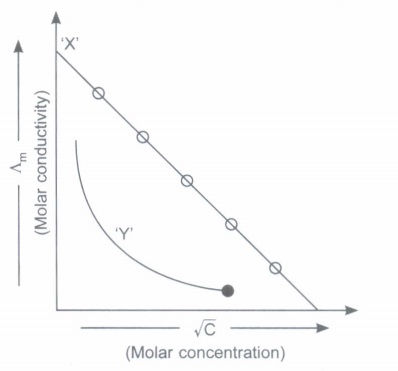
(a) The curve 'V' is for KCI or CH3 COOH?
(b) What is intercept on \(\Lambda\)m axis for 'X' equal to?
(c) Give mathematical equation representing straight line.
(d) What is slope equal to?
(e) What happens to molar conductivity on dilution in case of weak electrolyte and why?
8.
Read the passage given below and answer the following questions:
The concentration of potassium ions inside a biological cell is at least twenty times higher than the outside. The resulting potential difference across the cell is important in several processes such as transmission of nerve impulses and maintaining the ion balance. A simple model for such a concentration cell involving a metal M is M(s) | M+(aq.; 0.05 molar) || M+(aq; 1 molar) |M(s).
The following questions are multiple choice questions. Choose the most appropriate answer:
(i) For the above cell,
| (a) \(E_{\text {cell }}<0 ; \Delta G>0\) | (b) \(E_{\text {cell }}>0 ; \Delta G<0\) | (c) \(E_{\text {cell }}<0 ; \Delta G^{\circ}>0\) | (d) \(E_{\text {cell }}>0 ; \Delta G^{\circ}<0\) |
(ii) The value of equilibrium constant for a feasible cell reaction is
| (a) < 1 | (b) = 1 | (c) > 1 | (d) zero |
(iii) What is the emf ofthe cell when the cell reaction attains equilibrium?
| (a) 1 | (b) 0 | (c) > 1 | (d) < 1 |
(iv) The potential of an electrode change with change in
| (a) concentration of ions in solution | (b) position of electrodes |
| (c) voltage of the cell | (d) all of these |
9.
Read the passage given below and answer the following questions :
All chemical reactions involve interaction of atoms and molecules. A large number of atoms/molecules are present in a few gram of any chemical compound varying with their atomic/molecular masses. To handle such large number conveniently, the mole concept was introduced. All electrochemical cell reactions are also based on mole concept. For example, a 4.0 molar aqueous solution of NaCI is prepared and 500 mL of this solution is electrolysed. This leads to the evolution of chlorine gas at one of the electrode. The amount of products formed can be calculated by using mole concept.
The following questions are multiple choice questions. Choose the most appropriate answer :
(i) The total number of moles of chlorine gas evolved is
| (a) 0.5 | (b) 1.0 | (c) 1.5 | (d) 1.9 |
(ii) If cathode is a Hg electrode, then the maximum weight of amalgam formed from this solution is
| (a) 300 g | (b) 446 g | (c) 396 g | (d) 296 g |
(iii) In the electrolysis, the number of moles of electrons involved are
| (a) 2 | (b) 1 | (c) 3 | (d) 4 |
(iv) In electrolysis of aqueous NaCl solution when Pt electrode is taken, then which gas is liberated at cathode?
| (a) H2 gas | (b) C2 gas | (c) O2 gas | (d) None of these |
10.
Read the passage given below and answer the following questions:
Standard electrode potentials are used for various processes:
(i) It is used to measure relative strengths of various oxidants and reductants.
(ii) It is used to calculate standard cell potential.
(iii) It is used to predict possible reactions.
A set of half-reactions (in acidic medium) along with their standard reduction potential, Eo (in volt) values are given below
\(\mathrm{I}_{2}+2 e^{-} \rightarrow 2 \mathrm{I}^{-} ; \quad E^{\circ}=0.54 \mathrm{~V}\)
\(\mathrm{Cl}_{2}+2 e^{-} \rightarrow 2 \mathrm{Cl}^{-} ; \quad E^{\circ}=1.36 \mathrm{~V}\)
\(\mathrm{Mn}^{3+}+e^{-} \rightarrow \mathrm{Mn}^{2+} ; \quad E^{\circ}=1.50 \mathrm{~V}\)
\(\mathrm{Fe}^{3+}+e^{-} \longrightarrow \mathrm{Fe}^{2+} ; \quad E^{\circ}=0.77 \mathrm{~V}\)
\(\mathrm{O}_{2}+4 \mathrm{H}^{+}+4 e^{-} \longrightarrow 2 \mathrm{H}_{2} \mathrm{O} ; E^{\circ}=1.23 \mathrm{~V}\)
The following questions are multiple choice questions. Choose the most appropriate answer:
(i) Which of the following statements is correct?
| (a) CI- is oxidised by O2 | (b) Fe2+ is oxidised by iodine |
| (c) I- is oxidised by chlorine. | (d) Mn2+ is oxidised by chlorine |
(ii) Mn3+ is not stable in acidic medium, while Fe3+is stable because
| (a) O2 oxidises Mn2+ to Mn3+ |
| (b) O2 oxidises both Mn2+ to Mn3+ and Fe2+ to Fe3+ |
| (c) Fe3-oxidises H2O to O2 |
| (d) Mn3+ oxidises H2O to O2 |
(iii) The strongest reducing agent in the aqueous solution is
| (a) I- | (b) Cl- | (c) Mn2+ | (d) Fe2+ |
(iv) The emf for the following reaction is
\(\mathrm{I}_{2}+\mathrm{KCl} \rightleftharpoons 2 \mathrm{KI}+\mathrm{Cl}_{2}\)
| (a) -0.82 V | (b) +0.82 V | (c) -0.73 V | (d) +0.73 V |
11.
Read the passage given below and answer the following questions:
Transition metal oxides are compounds formed by the reaction of metals with oxygen at high temperature. The highest oxidation number in the oxides coincides with the group number. In vanadium, there is a gradual change from the basic V2O3 to less basic V2O4 and to amphoteric V2O5・V2O4 dissolves in acids to give VO2+ salts. Transition metal oxides are commonly utilized for their catalytic activity and semiconductive properties. Transition metal oxides are also frequently used as pigments in paints and plastic. Most notably titatnium dioxide. One of the earliest application of transition metal oxides to chemical industry involved the use of vanadium oxide for catalytic oxidation of sulfur dioxide to sulphuric acid. Since then, many other applications have emerged, which include benzene oxidation to maleic anhydride on vandium oxides; cyclohexane oxidation to adipic acid on cobalt oxides. An important property of the catalyst material used in these processes is the ability of transition metals to change their oxidation state under a given chemical potential of reductants and oxidants.
The following questions are multiple choice questions. Choose the most appropriate answer:
(i) Which oxide of vanadium is most likely to be basic and ionic ?
| (a) VO | (b) V2O3 | (c) VO2 | (d) V2O5 |
(ii) Vanadyl ion is
| (a) VO2+ | (b) VO2+ | (c) V2O+ | (d) VO43- |
(iii) The oxidation state of vanadium in V2O5 is
| (a) +5/2 | (b) +7 | (c) +5 | (d) +6 |
(iv) Identify the oxidising agent in the following reaction.
| (a) V2O5 | (b)Ca | (c) V | (d) None of these |
12.
Read the passage given below and answer the following questions:
Molar conductivity of ions are given as product of charge on ions to their ionic mobilities and Faraday's constant.
\(\lambda_{A^{n+}}=n \mu_{A^{n+}} F\) (here \(\mu\) is the ionic mobility of An+).
For electrolytes say AXBy, molar conductivity is given by
\(\lambda_{m\left(A_{x} B_{y}\right)}=x_{n} \mu_{A^{n+}} F+y_{m} \lambda_{A^{m}-F}\)
| Ions | Ionic mobility |
| K+ | 7.616 x 10- 4 |
| Ca2+ | 12.33 x 10⁻⁴ |
| Br- | 8.09 x 10- 4 |
| \(\mathrm{SO}_{4}^{2-}\) | 16.58 x 10- 4 |
The following questions are multiple choice questions. Choose the most appropriate answer
(i) At infinite dilution, the equivalent conductance of CaSO4 is
| (a) 256 x 10-4 | (b) 279 | (c) 23.7 | (d) 2.0 x 10- 8 |
(ii) If the degree of dissociation of CaSO4 solution is 10% then equivalent conductance of CaSO4 is
| (a) 3.59 | (b) 36.9 | (c) 27.9 | (d) 30.6 |
(iii) What is the unit of equivalent conductivity?
| (a) ohm-1 cm2 eq-1 | (b) ohm cm2eq-1 |
| (c) ohm-1 cm eq-1 | (d) ohm cm2 eq-1 |
(iv) If the molar conductance value of Ca2+ and Cl- at infinite dilution are 118.88 x 10⁻⁴ m2 mho mol-1 and 77.33 x 10⁻⁴ m 2 mho mol-1 respectively then the molar conductance of CaCl2 (in m2 mho mol-1) will be
| (a) 120.18 x 10- 4 | (b) 135 x 10-4 | (c) 273.54 x 10⁻⁴ | (d) 192.1 x 10⁻⁴ |
13.
Read the passage given below and answer the following questions:
The unique behaviour of Cu, having a positive Eo accounts for its inability to liberate H2 from acids. Only oxidising acids (nitric and hot concentrated sulphuric acid) react with Cu, the acids being reduced. The stability of the half-filled (d5) subshell in Mn2+ and the completely filled (d10 ) configuration in Zn2+ are related to their Eo (M3+ /M2+) values. The low value for Sc reflects the stability of Sc3+ which has a noble gas configuration. The comparatively high value for Mn shows that Mn2+(d5) is particularly stable, whereas a comparatively low value for Fe shows the extra stability of Fe3+ (d5). The comparatively low value for V is related to the stability of V2+ (half-filled t2g level).
The following questions are multiple choice questions.Choose the most appropriate answer :
(i) Standard reduction electrode potential of Zn2+ /Zn is - 0.76 V. This means
| (a) ZnO cannot be reduced to Zn by H2 under standard conditions |
| (b) Zn cannot liberate H2 with concentrated acids |
| (c) Zn is generally the anode in an electrochemical cell |
| (d) Zn is generally the cathode in an electrochemical cell. |
(ii) Eo values for the couples Cr3+/Cr2+ and Mn3+ /Mn2+ are -0.41 and +1.51 volts respectively. These values suggest that
| (a) Cr2+ acts as a reducing agent whereas Mn3+ acts as an oxidizing agent |
| (b) Cr2+ is more stable than Cr3+ state |
| (c) Mn3+ is more stable than Mn2+ |
| (d) Cr2+ acts as an oxidizing agent whereas Mn3+ acts as a reducing agent |
(iii) The reduction potential values of M, Nand O are +2.46, -1.13 and -3.13 Y respectively. Which of the following order is correct regarding their reducing property?
| (a) O>N>M | (b) O>M>N | (c) M>N>O | (d) M>O>N |
(iv) Which of the following statements are true?
(i) Mn2+ compounds are more stable than Fe2+ towards oxidation to +3 state.
(ii) Titanium and copper both in the first series of transition metals exhibits +1 oxidation state most frequently.
(iii) Cu+ ion is stable in aqueous solutions.
(iv) The E0 value for the Mn3+ /Mn2+ couple is much more positive than that for Cr3+/Cr2+ or Fe3+/Fe2+.
| (a) (ii) and (iii) | (b) (i) and (iv) | (c) (i) and (iii) | (d) (ii) and (iv) |
14.
Read the passage given below and answer the following questions:
The transition elements have incompletely filled d-subshells in their ground state or in any of their oxidation states. The transition elements occupy position in between s- and p-blocks in groups 3-12 of the Periodic table. Starting from fourth period, transition elements consists of four complete series : Sc to Zn, Y to Cd and La, Hf to Hg and Ac, Rf to Cn. In general, the electronic configuration of outer orbitals of these elements is (n - 1) d1-10 ns1-2. The electronic configurations of outer orbitals of Zn, Cd, Hg and Cn are represented by the general formula (n - 1)d10 n2. All the transition elements have typical metallic properties such as high tensile strength, ductility, malleability. Except mercury, which is liquid at room temperature, other transition elements have typical metallic structures. The transition metals and their compounds also exhibit catalytic property and paramagnetic behaviour. Transition metal also forms alloys. An alloy is a blend of metals prepared by mixing the components. Alloys may be homogeneous solid solutions in which the atoms of one metal are distributed randomly among the atoms of the other.
The following questions are multiple choice questions. Choose the most appropriate answer :
(i) Which of the following characteristics of transition metals is associated with higher catalytic activity?
| (a) High enthalpy of atomisation | (b) Variable oxidation states |
| (c) Paramagnetic behaviour | (d) Colour of hydrated ions |
(ii) Transition elements form alloys easily because they have
| (a) same atomic number | (b) same electronic configuration |
| (c) nearly same atomic size | (d) same oxidation states. |
(iii) The electronic configuration of tantalum (Ta) is
| (a) \([\mathrm{Xe}] 4 f^{0} 5 d^{1} 6 s^{2}\) | (b) \([\mathrm{Xe}) 4 f^{14} 5 d^{2} 6 s^{2}\) |
| (c) \([\mathrm{Xe}] 4 f^{14} 5 d^{3} 6 s^{2}\) | (d) \(\left[\mathrm{Xe}\left]4 f^{14} 5 d^{4} 6 s^{2}\right.\right.\) |
(iv) Which one of the following outer orbital configurations may exhibit the largest number of oxidation states?
| (a) 3d54s1 | (b) 3d54s2 | (c) 3d24s2 | (d) 3d34s2 |
15.
Read the passage given below and answer the following questions:
The f-block elements are those in which the differentiating electron enters the (n -2) forbital. There are two series of f-block elements corresponding to filling of 4f and 5f-orbitals. The series of 4f- orbitals is called lanthanides. Lanthanides show different oxidation states depending upon stability of f0, f7 and f14 configurations, though the most common oxidation states is +3. There is a regular decrease in size of lanthanides ions with increase in atomic number which is known as lanthanide contraction.
The following questions are multiple choice questions. Choose the most appropriate answer:
(i) The atomic numbers of three lanthanide elements X, Y and 2 are 65, 68 and 70 respectively, their Ln3+ electronic configuration is
| (a) 4f8, 4f11, 4f13 | (b) 4f11, 4f8 , 4f13 | (c) 4fo, 4f2, 4f11 | (d) 4f3, 4f7, 4f9 |
(ii) Lanthanide contraction is observed in
| (a) Gd | (b) At | (c) Xe | (d) Te |
(iii) Name a member of the lanthanoid series which is well known to exhibit +4 oxidation state.
| (a) Cerium (Z = 58) | (b) Europium (Z = 63) | (c) Lanthanum (Z = 57) | (d) Gadolinium (Z = 64) |
(iv) Identify the incorrect statement among the following.
| (a) Lanthanojd contraction is the accumulation of successive shrinkages. |
| (b) The different radii of Zr and Hf due to consequence of the lanthanoid contraction. |
| (c) Shielding power of 4f electrons is quite weak. |
| (d) There is a decrease in the radii of the atoms or ions as one proceeds from La to Lu. |
1.
i. (c) phenol
ii. (d) 9
iii.(b) Kolbe’s reaction
iv.(d) as an intestinal antiseptic.
2.
3.
(a) Picric acid
(b) Lower the pKa, more will be acidic character.
(c) It is because -CH3 groups are electron releasing, destabilise phenoxide ion.
(d) -OCH3 has more -I effect than -NH2 because oxygen is more electronegative than nitrogen.
(e) It is because in a-fluoro phenol, there is strong intramolecular H-bonding.
4.
(a) It is due to inter molecular H-bonding.
(b) It is because it has spherical shape, least surface area, less van der Waals' forces of attraction, hence lower boiling point than n-butyl alcohol.
(c) Boiling point increases with increase in carbon chain
(d) Solubility of alcohol decreases with increase in molar mass.
(e) CH3OH is most acidic because \(\mathrm{CH}_{3} \mathrm{O}^{\ominus}\) is most stable among \(\mathrm{RO}^{\ominus}\) .
5.
(a)
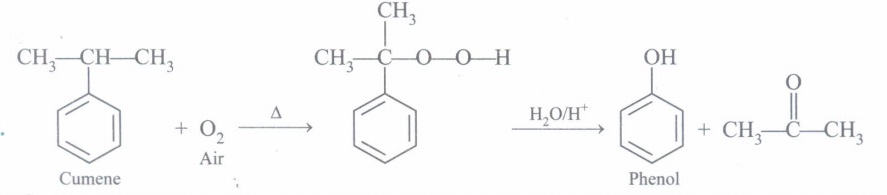
Acetone is obtained which is useful by product.
(b)

(c)
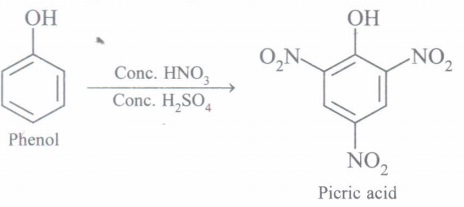
(d) Add neutral FeCI 3 . Phenol gives violet colour where as benzyl alcohol does not.
(e) It is due to oxidation.
6.
(a) It is because Zn has completely filled '4s' orbital which is stable.
(b) It is because after losing 2 electrons, it becomes 3d5 which is more stable.
(c) It is because \(\mathrm{Cr}^{3+}\left(t_{2 g}^{3}\right)\) half filled t2g orbitals are more stable than Cr2+(3d4).
(d) It is due to low enthalpy of atomisation, sublimation enthalpy, ionisation enthalpy.
(e) It is due to high ionisation enthalpy and low hydration enthalpy.
(f) Fe3+(3d5) is half filled which is more stable than Fe2+(3d6).
(g) It is because it can gain one electron easily to from Mn2+(3d5) which is more stable that is why\(\mathrm{E}_{\mathrm{Mn}^{3+} / \mathrm{Mn}}^{\circ}=1.57 \mathrm{~V}\)
7.
(a) It is for CH3COOH.
(b) It is equal \(\Lambda\)° (limiting molar conductivity).
(c) \(\Lambda_{\mathrm{m}}=\Lambda_{\mathrm{m}}^{\circ}-\mathrm{A} \sqrt{\mathrm{C}}\)
(d) Slope = -A
(e) \(\Lambda\)m for weak electrolyte increases sharply on dilution because both number of ions as well as mobility of ions increases.
8.
(i) (b) : \(\begin{array}{l} M \longrightarrow M^{+}+e^{-} \\ (1 \cdot M)(0.05 M) \end{array}\)
For concentration cell, \(E_{\text {cell }}=-\frac{0.059}{1} \log \frac{0.05}{1}\)
\(E_{\text {cell }}=-\frac{0.059}{1} \log \left(5 \times 10^{-2}\right)\)
\(E_{\text {cell }}=-\frac{0.059}{1}[(-2)+\log 5]-0.059(-2+0.698)\)
= -0.059(-1.302) = 0.0768
\(\Delta G=-n F E_{\text {cell }}\)
If Ecell is positive, \(\Delta G\) is negative.
(ii) (c) : \(K=\operatorname{antilog}\left(\frac{n E^{\circ}}{0.0591}\right)\)
For feasible cell, Eo is positive, hence from the above equation K > 1 for a feasible cell reaction.
(iii) (b)
(iv) (a)
9.
(i) (b) : \(n_{\mathrm{NaCl}}=\frac{4 \times 500}{1000}=2 \mathrm{~mol}\)
\(\therefore\) \(n_{\mathrm{Cl}_{2}}=1 \mathrm{~mol}\)
(ii) (b) : nNa deposited = 2 mol
\(\therefore\) nNa _ Hg formed = 2 mol
\(\therefore\) Mass of amalgam formed = 2 x 223 = 446 g
(iii) (a)
(iv) (a)
10.
(i) (c) : The half cell having the higher reduction potential will undergo reduction process.
(ii) (d) : Electrode potential of Mn3+ is higher than O2.
(iii) (a) : Due to least electrode potential value.
(iv) (a) : Half reactions :
| \(\mathrm{I}_{2}+2 e^{-} \rightarrow 2 \mathrm{I}^{-}\) | Reduction Eo = 0.54 V |
| \(2 \mathrm{Cl}^{-} \longrightarrow \mathrm{Cl}_{2}+2 e^{-}\) | Oxidation Eo = -1.36 V |
| ------------------------------- | |
| e.m.f = -0.82 V |
11.
(i) (a): Oxide of V in lowest oxidation state, i.e., VO is basic and ionic in character.
(ii) (a): Vanadyl ion is VO2+ where V is in +4 oxidation state.
(iii) (c)
(iv) (a)
12.
(i) (b) : Equivalent conductance of CaSO4 :
\(\Lambda_{\mathrm{CaSO}_{4}}^{\infty}=\lambda_{\mathrm{Ca}^{2+}}^{\infty}+\lambda_{\mathrm{SO}_{4}^{2-}}^{\infty}\)
\(\lambda_{\mathrm{Ca}^{2+}}^{\infty}=\left(\mu_{\mathrm{Ca}^{2+}}\right) F ; \lambda_{\mathrm{SO}_{4}^{2-}}^{\infty}=\left(\mu_{\mathrm{SO}_{4}^{2-}}\right) F\)
\(\mu_{\mathrm{Ca}^{2+}}\) and \(\mu_{\mathrm{SO}_{4}^{2-}}\) - are ionic mobilities.
\(\Lambda_{\mathrm{CaSO}_{4}}^{\infty}=F(12.33+16.58) \times 10^{-4}\)
= 96500 x 10- 4 x 28.91 = 279
(ii) (c) : \(\alpha=\frac{\Lambda_{C}}{\Lambda^{\infty}} \Rightarrow 0.1=\frac{\Lambda_{C}}{279} \Rightarrow \Lambda_{C}=27.9\)
(iii) (a)
(iv) (c) : \(\Lambda_{m\left(\mathrm{CaCl}_{2}\right)}^{\circ}=\lambda_{\mathrm{Ca}^{2+}}^{\circ}+2 \lambda_{\mathrm{Cl}^{-}}^{\circ}\)
= (118.88 x 10- 4 ) + 2(77.33 x 10- 4 )
= 273.54 x 10⁻⁴ m2 mho mol-1
13.
(i) (a)
(ii) (a): Lesser and negative reduction potential indicates that Cr2+ is a reducing agent. Higher and positive reduction potential indicates that Mn3+ is a stronger oxidizing agent.
(iii) (a) : The electrode which has more reduction potential is a good oxidizing agent and has least reducing power.
(iv) (b): (i) It is because Mn2+ has 3d5 electronic configuration which has extra stability.
(ii) Not titanium but copper, because with + 1 oxidation state an extra stable configuration, 3d10 results.
(iii) It is not stable as it undergoes disproportionation;
2Cu+(aq) ➝Cu2+(aq) + Cu(s). The Eo value for this is favourable.
(iv) Much larger third ionisation energy ofMn (where the required change is d5 to d4) is mainly responsible for this.
14.
(i) (b): The transition metals and their compounds are known for their catalytic activity. This activity is ascribed to their ability to adopt multiple oxidation states to form complexes.
(ii) (c) : Because of similar radii and other characteristics of transition metals, alloys are readily formed by these metals.
(iii) (c)
(iv) (b): Greater the number of valence electrons, more will be the number of oxidation states exhibited by the element.
15.
(i) (a):Terbium (65), 4f8; Dysprosium (Dy), 4f9; Ytterbium (Yb), 4f13.
(ii) (a)
(iii) (a)
(iv) (b): The almost identical radii of Zr (160 pm) and Hf(159 pm), a consequence of lanthanoid contraction.

12th Standard CBSE Syllabus & Materials
12th Standard CBSE
CBSE 12th Computer Science Python Revision Tour I - New Previous year Question Papers Study Material - QB365 Set A
NEW12th Standard CBSE
CBSE 12th Business Studies Planning Important Questions And Answers Study Material - QB365 Set A
NEW12th Standard CBSE
CBSE 12th Business Studies Business Environment Important Questions And Answers Study Material - QB365 Set A
NEW12th Standard CBSE
CBSE 12th Business Studies Principles of Management Important Questions And Answers Study Material - QB365 Set A



NCERT Books

Syllabus

Exam Pattern

Sample Question Papers

Previous year Question Papers

Important Notes

MCQ Practice test

NCERT Exemplers

Case study Questions

Image Based Questions

Passage based Questions

HOT Questions

Value Based Questions

Model Questions Papers
NCERT ( Book Back ) Questions

Assertion and Reason
Important Questions And Answers

CBSE 12th Standard CBSE Subjects
CBSE Standards








