
 100% FREE ACCESS
12th Standard CBSE Syllabus & Materials
12th Standard CBSE
CBSE 12th Economics Government Budget and the Economy Previous year Question Papers Study Material - QB365 Set A
NEW12th Standard CBSE
CBSE 12th Computer Science Interface Python with MySQL - New Previous year Question Papers Study Material - QB365 Set A
NEW12th Standard CBSE
CBSE 12th Computer Science Database Concept - New Previous year Question Papers Study Material - QB365 Set A
NEW12th Standard CBSE
CBSE 12th Computer Science Data Communication - New Previous year Question Papers Study Material - QB365 Set A
NEW12th Standard CBSE
CBSE 12th Computer Science Data Structures - New Previous year Question Papers Study Material - QB365 Set A
NEW12th Standard CBSE
CBSE 12th Computer Science Functions - New Previous year Question Papers Study Material - QB365 Set A

Published on: 25/10/2025
Download CBSE Class 12th Standard CBSE Chemistry question papers, sample papers, important questions, and previous year solved papers in PDF format. Get free study materials, NCERT solutions, and exam preparation resources for Class 12th Standard CBSE Chemistry
Questions + Answers key
Take MCQ Chemistry Test
1.
Calculate the volume of oxygen liberated at anode at STP in the electrolysis of CuSO4 solution when 1-ampere current is passed for 16 minutes.
2H2O \(\longrightarrow\) 4H+ + O2 + 4e- (IF = 96500 C).
2.
Transition metals form alloys with other transition metals. Explain.
3.
Alcohols react with active metals, e.g., Na, K, ect. to give corresponding alkoxides. Write down the decreasing order of reactivity of sodium metal towards primary, secondary and tertiary alcohols.
4.
What is a primary cell? Give an example.
5.
When phenol is treated with bromine water, white precipitate is obtained. Give the structure and the name of the compound formed.
6.
Why are Cr2+ reducing and Mn3+ oxidising when both have d4 configuration?
7.
Given reasons:
(i) Mercury cell delivers a constant potential during its life time.
(ii) In the experimental determination of electrolytic conductance, Direct Current (DC) is not used.
8.
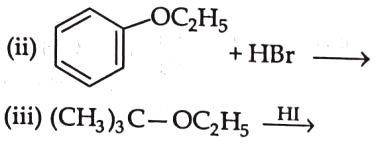
Predict the products of the following reactions
(i) CH3CH2CH2OCH3 + HBr \(\rightarrow\)
9.
Give reasons for the following:
(i) Why phenol undergoes electrophilic substitution more easily than benzene?
(ii) The C-O-H bond angle in alcohols is slightly less than the tetrahedral angle (109°28').
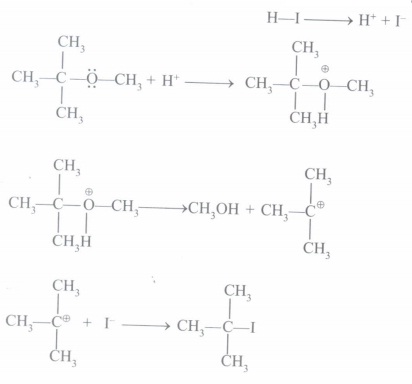
(iii) (CH3)3C-O-CH3 on reaction' with HI gives (CH3)3C-I and CH3 -OH as the main products and not (CH3)3C-OH and CH3 -I.
10.
(a) What are the different oxidation states exhibited by the lanthanoids?
(b) Write two characteristics of the transition elements.
(c) Which of the 3d-block elements may not be regarded as the transition elements and why?
11.
From the given data of E0 values, answer the following questions:
| \(E_{(M^{2+}/Mn)}^0\) | Cr | Mn | Fe | Co | Ni | Cu |
| -0.91 | -1.18 | -0.44 | -0.28 | -0.25 | +0.34 |
|---|
(i) Why is \(E_{(Cu^{2+}/Cu)}^0\) value exceptionally positive?
(ii) Why is \(E_{(M^{2+}/Mn)}^0\) value highly negative as compared to other elements?
(iii) Which is a stronger reducing agent Cr2+ or Fe2+? Give reason.
12.
Calculate the emf of the following cell at \(25°C\):
\(Ag\left( s \right) |{ Ag }^{ + }({ 10 }^{ -3 }M)||{ Cu }^{ 2+ }({ 10 }^{ -1 }M)|Cu(s)\)
Give \({ E° }_{ cell }=+0.46V\) and \(\log { { 10 }^{ n } } =n\)
13.
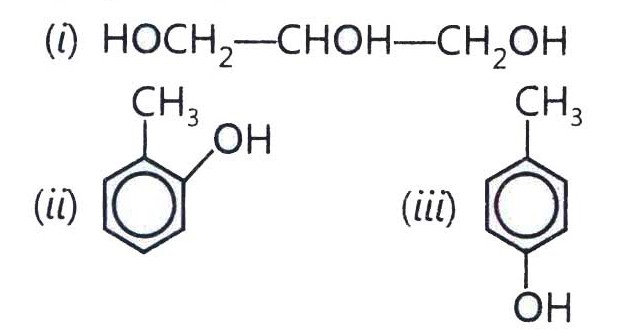
Write IUPAC names of the following compounds:
14.
Calculate the equilibrium constant, K for the reaction at 298 K,
\(Zn(s)+{ Cu }^{ 2+ }(aq)\rightleftharpoons { Zn }^{ 2+ }(aq)+Cu(s)\)
Given \({ E }_{ { Zn }^{ 2+ }/Zn }^{ o }=-0.76V\)
\({ E }_{ { Cu }^{ 2+ }/Cu }^{ o }=+0.34V\)
15.
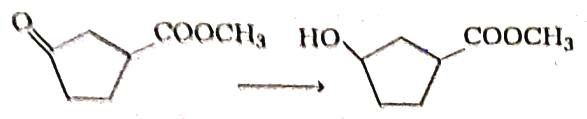
Which of the following reagents should be used to carry out the above conversion?
LiAlH4
NaBH4
Zn-Hg/HCl
KMnO4
16.
The oxidation state of Cr in final product formed by reaction of KI and acidified dichromate solution is
+4
+6
+2
+3
17.
Out of Mn2O7, V2O3, V2OS, CrO, Cr2O3, the basic oxides are
Mn2O7, V2O3
V2O3, V2O5
V2O5,CrO
V2O3 and CrO
18.
On the basis of following Eo values, the strongest oxidising agent is
[Fe(CN)4)4- \(\longrightarrow\) [Fe(CN)6]3- + e- Eo = - 0.35 V
Fe2+ \(\longrightarrow\) Fe3+ + e- Eo = - 0.77 V
Fe2+
Fe3+
[Fe(CN)6]3-
[Fe(CN)6]4-
19.
The reaction,
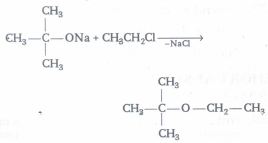 is called
Williamson synthesis
Williamson continuous etherification process
Etard reaction
Gattermann-Koch reaction
20.
Monochlorinaton of toluene in sunlight followied by hydrolysis with aq.NaOH yields.
o-Cresol
m-Cresol
2, 4-Dihydroxytoluene
Benzyl alcohol
21.
Products obtained when HI reacts with isopropyl methyl ether at 373 K are
isopropyl iodide and methyl alcihol
isopropyl alcohol and methyl iodide
isopropyl iodide and water
methyl iodide and water
22.
Name a member of lanthanide series which is well known to exhibit + 4 oxidation state :
Ce
La
Lu
Pr
23.
Which is the strongest base among the following ?
La(OH)3
Lu(OH)3
Ce(OH)3
Yb(OH)3
24.
What will happen during the electrolysis of aqueous solution of CuSO4 by using platinum electrodes?
Copper will deposit at cathode
Copper will deposit at anode
Oxygen will be released at anode
Copper will dissolve at anode
25.
Which cell will measure standard electrode potential of copper electrode?
Pt (s) | H2 (g, 0.1 bar) | H+ (aq., 1 M) || Cu2+ (aq., 1 M) | Cu
Pt (s) | H2 (g, 1 bar) | H+ (aq., 1 M) || Cu2+ (aq., 2 M) | Cu
Pt (s) | H2 (g, 1 bar) | H+ (aq., 1 M) || Cu2+ (aq., 1 M) | Cu
Pt (s) | H2 (g, 1 bar) | H+ (aq., 0.1 M) || Cu2+ (aq., 1 M) | Cu
26.
In the electrolytic cell, flow of electrons is from
cathode to anode in the solution
cathode to anode through external supply
cathode to anode through internal supply
anode to cathode through internal supply
27.
(a) How are following conversions done?
(i) 1-Propanol to 1-Bromopropane
(ii) 1-Chloropropane to 1-Propanol
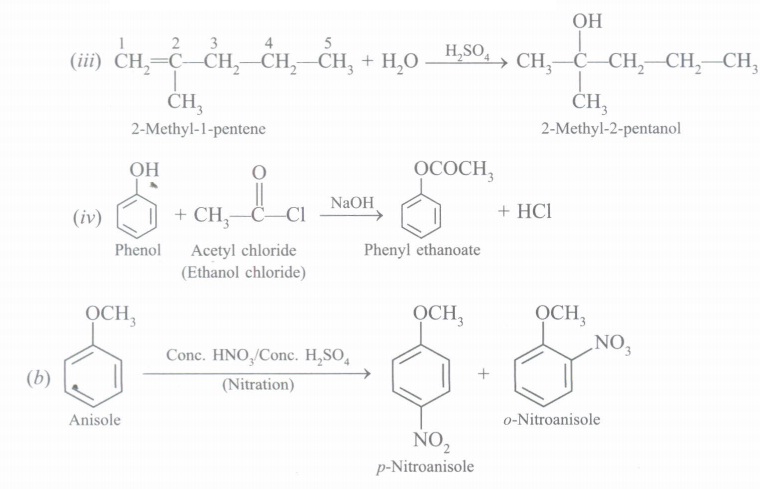
(iii) 2-Methyl-l-pentene to 2-Methyl-2-pentanol
(iv) Phenol to Phenyl ethanoate.
(b) What happens when anisole is treated with the mixture of concentrated sui phuric acid and nitric acid? Write the chemical reaction involved.
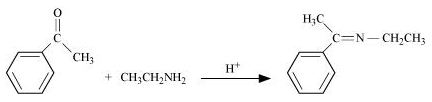
28.
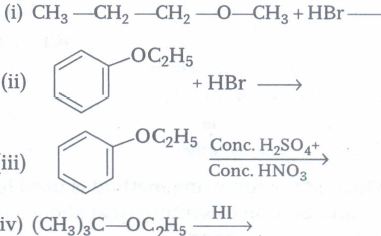
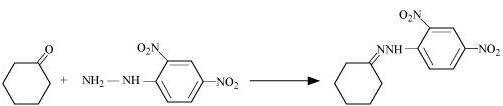
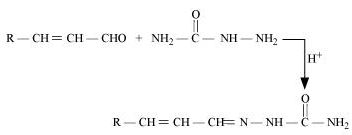
Predict the products of the following reactions:
29.
(a)When a bright silver object is placed in the solution of gold chloride, it acquires a golden tinge but nothing happens when it is placed in a solution of copper chloride. Explain this behaviour of silver.
[Given: Ecu2+/cu = + 0.34; EoAg+ /Ag = + 0.80 V,
EAu2+/Au = + 1.40 V]
(b)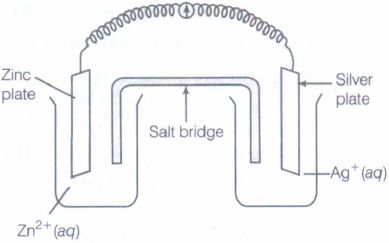
Consider the figure given above and answer the following questions:
(i) What is the direction of flow of electrons?
(ii) Which one is anode and which one is cathode?
(iii) What will happen if the salt bridge is removed?
(iv) How will concentration of Zn2+ and Ag + ions be affected when the cell functions?
(v) How will concentration of these ions be affected when the cell becomes dead?
30.
(a) Define the following terms:
(i) Molar conductivity
(ii) Secondary batteries
(iii) Fuel cell
(b) State the following laws
(i) Faraday first law of electrolysis
(ii) Kohlrausch's law of independent migration of ions
31.
(a) Give the preparation of potassium dichromate from chromate ore:
(b) Explain the following:
(i) Transition metals have good tendency to form complexes.
(ii) Transition metals exhibit variable oxidation states.
(c) Write the general electronic configuration of lanthanoids.
32.
Write the chemistry of recharging the lead storage battery, highlighting all the materials that are involved during recharging.
33.
Assertion (A) : Copper is a non-transition element.
Reason (R) : Copper has completely filled d-otrbitals in its ground state.
(a) Both (A) and (R) are correct, (R) is the correct explanation of (A).
(b) Both (A) and (R) are correct, (R) is not the correct explanation of (A).
(c) (A) is correct; (R) is incorrect.
(d) (A) is incorrect; (R) is correct
34.
Assertion: Solubility of alcohols decreases with increase in size of alkyl/aryl groups.
Reason: Alcohols form H-bonding with water to show soluble nature.
Codes:
(a) Assertion and reason both are correct statements and reason is correct explanation for assertion.
(b) Assertion and reason both are correct statements but reason is not correct explanation for assertion.
(c) Assertion is correct statement but reason is wrong statement.
(d) Assertion is wrong statement but reason is correct statement.
35.
In the following questions. an Assertion (A) is followed by a corresponding Reason (R) Use the following keys to choose the appropriate answer.
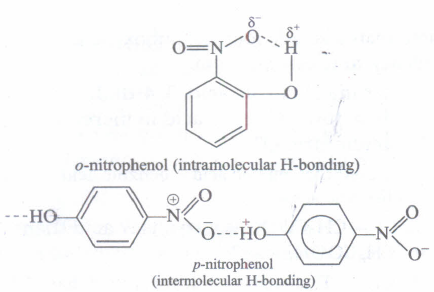
Assertion (A) o-nitrophenol is less volatile than p-nitrophenol.
Reason (R) There is intramolecular hydrogen bonding in o-nitrophenol and intermolecular hydrogen bonding in p-nitrophenol.
Codes:
(a) Both (A) and (R) are correct, (R) is the correct explanation of (A).
(b) Both (A) and (R) are correct, (R) is not the correct explanation of (A).
(c) (A) is correct; (R) is incorrect.
(d) (A) is incorrect; (R) is correct.
36.
In the following questions.an Assertion (A) isfollowed by a corresponding Reason (R) Use the following keys to choose the appropriate answer.
Assertion (A) Solid NaCl does not conduct electricity.
Reason (R) Solid NaCl has no free ions.
Codes:
(a) Both (A) and (R) are correct, (R) is the correct explanation of (A).
(b) Both (A) and (R) are correct, (R) is not the correct explanation of (A).
(c) (A) is correct; (R) is incorrect.
(d) (A) is incorrect; (R) is correct.
37.
The d-block of the periodic table contains the elements of the groups 3 to 12 and are known as transition elements. In general, the electronic configuration of these elements is \((n-1) d^{1-10} n s^{1-2}\). The d-orbitals of the penultimate energy level in their atoms receive electrons giving rise to the three rows of the transition metals i.e. 3d, 4d and 5d series. However Zn, Cd and Hg are not regarded as transition elements. Transition elements exhibit certain characteristic properties like variable oxidation stables, complex formation, formation of coloured ions, alloys, catalytic activity etc. Transition metals are hard (except Zn, Cd and Hg) and have a high melting point.
(a) Why are Zn, Cd and Hg non-transition elements?
(b) Which transition metal of 3d series does not show variable oxidation state?
(c) Why do transition metals and their compounds show catalytic activity?
(d) Why are melting points of transition metals high?
(e) Why is Cu2+ ion coloured while Zn2+ ion is colourless in aqueous solution?
38.
Observe the graph shown in figure between Am (molar conductivity) Vs \(\sqrt{\mathrm{C}}\) (Molar concentration) and answer the questions based on graph.
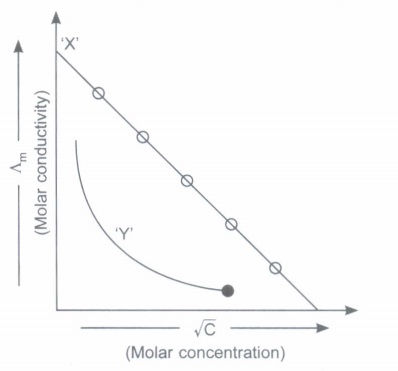
(a) The curve 'V' is for KCI or CH3 COOH?
(b) What is intercept on \(\Lambda\)m axis for 'X' equal to?
(c) Give mathematical equation representing straight line.
(d) What is slope equal to?
(e) What happens to molar conductivity on dilution in case of weak electrolyte and why?
1.
Given: l = I amp, t = 16 minute, V =?, 1F = 96500 c mol-1
m = Z x I x t
mO2 = \(\frac{16}{2 \times 96500} \times 1 \times 16 \times 60=\frac{15360}{193000}\)
= 0.08 g
Volume at STP = \(\frac{\text { Mass of } \mathrm{O}_{2}}{\text { Molar macs }} \times 22400\)
= \(\frac{0.08}{32} \times 22400=\frac{1792}{32}\) = 56 mL.
2.
Transition metals form a large variety of alloys. This is due to the fact that transition metals have almost similar sizes and therefore, the atoms of one metal can easily substitute the atoms of other metals in their lattices. When we cool the mixture solution of two or more transition metals, solid alloys are generally formed. For example, Mn dissolves in molten iron to form manganese steel. The alloys formed are hard, having high melting points. These are also resistant to corrosion in comparison to the parent metals. Tungsten is also used for preparing stainless steel.
3.
1° > 2° > 3° is order reactivity towards Na and K because 1° alcohols are most acidic; whereas 3° alcohols are least acidic.
4.
A primary cell is the cell which the redox reaction occurs only once and the cell becomes dead after some time. It cannot used again.
5.

6.
Cr2+ is reducing as its configuration changes from d4 to d3, the latter having a half-filled t2g level. On the other hand, the change from Mn3+ to Mn2+ results in the half-filled (d5) configuration which has extra stability.
7.
(i) The potential of a mercury cell is approximately 1.35 V. It remains constant as in the overall cell reaction no ions are involved in solution whose concentration can change during the life span of the cell. Thus, it lasts longer.
(ii) When DC current is used, it cause the polarization of electrodes and electrolyte which leads to error in measurement. In AC there is no polarization due to non-continuous flow. Therefore, direct current is not used in determination of electrolytic conductance.
8.
(i) CH3CH2CH2OCH3 + HBr \(\rightarrow\) CH3Br + CH3CH2CH2OH
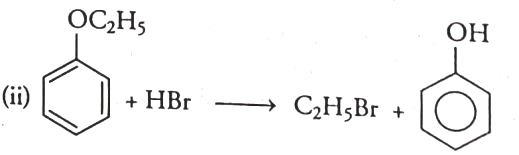
(iii) (CH3)3C - OC2H5 + HI \(\rightarrow\) (CH3)3C - I + C2H5OH
9.
(i) It is because -OH group is electron releasing, activating, therefore, it undergoes electrophilic substitution more readily than benzene.
(ii) It is due to repulsion between lone pair of electrons with bonded pair of electrons.
(iii) It is because tert. carbocation is more stable which combines with 1- to form Tert. butyl iodide and methanol.
10.
(a) Lanthanoids, mostly show +3 oxidation state but some of them show +2 and +4 oxidation states also due to the stability of electronic configuration (4f0, 4f 7 and 4f14 ).
(b) (i) They show variable oxidation states.
(ii) They form coloured ions.
(c) Zn may not be regarded as transition metal because neither Zn nor Zn2+ have incompletely filled d-orbital.
11.
(i) Sum of enthalphy of atomisation and ionisation is greater than enthalphy of hydration. Thus, \(E_{(M^{2+}/Mn)}^0\) is positive for copper.
(ii) Ionisation enthalpy is lower than hydration enthalphy due to stable 3d5 configuration. Thus, \(E_{(M^{2+}/Mn)}^0\) is more negative.
(iii) Cr2+ is a stronger reducing agent because it can lose electron to form Cr3+ which has stable 3d3 configuration (half-filled t2g3). Further is more negative than Fe2+
12.
\(Ag\left( s \right) |{ Ag }^{ + }({ 10 }^{ -3 }M)||{ Cu }^{ 2+ }({ 10 }^{ -1 }M)|Cu(s)\)
The cell reaction is:
\(Cu(s)+{ 2Ag }^{ + }(aq)\longrightarrow { Cu }^{ 2+ }(aq)+2Ag(s)\)
\(\ e={ { E }^{ ° } }_{ cell }-\frac { 0.059 }{ 2 } log\frac { \left[ { Cu }^{ 2+ } \right] }{ { \left[ Ag \right] }^{ 2 } } \)
\({ E }^{ ° }=0.46V\)
\(E=0.46-\frac { 0.059 }{ 2 } log\frac { \left( { 10 }^{ -1 } \right) }{ { \left( { 10 }^{ -3 } \right) }^{ 2 } } \)
\(=0.46-\frac { 0.059 }{ 2 } log{ 10 }^{ 5 }\)
\(=0.46-\frac { 0.059 }{ 2 } \times 5\)
\( =0.46-0.1475\)
\(=0.3125V\)
13.
(i) Propane-1, 2, 3-triol
(ii) 2-Methylphenol
(iii) 4-Methylphenol.
14.
\(Zn(s)+{ Cu }^{ 2+ }(aq)\rightleftharpoons { Zn }^{ 2+ }(aq)+Cu(s)\)
\(At \ anode \ Zn\longrightarrow { Zn }^{ 2+ }+{ 2e }^{ - }\)
\({ At \ cathode \ Cu }^{ 2+ }+{ 2e }^{ - }\longrightarrow Cu(s)\)
\( { { E }^{ ° } }_{ cell }=\left( { { E }^{ ° } }_{ { Cu }^{ 2+ }/Cu }-{ { E }^{ ° } }_{ { Zn }^{ 2+ }/Zn } \right) =+0.34V-(\_ 0.76V)=1.10V\)
\( { { E }^{ ° } }_{ cell }=\frac { 0.0591 }{ 2 } \ logK\)
\( logK=\frac { 2\times { { E }^{ ° } }_{ cell } }{ 0.0591 } =\frac { 2\times 1.10V }{ 0.0591 } =37.2250\)
\( K=Antilog \ 37.2250\)
\(K=1.679\times { 10 }^{ 37 }\)
15.
(b)
NaBH4
16.
(d)
+3
17.
(d)
V2O3 and CrO
18.
(b)
Fe3+
19.
(a)
Williamson synthesis
20.
(d)
Benzyl alcohol
21.
(b)
isopropyl alcohol and methyl iodide
22.
(a)
Ce
23.
(a)
La(OH)3
24.
(a)
Copper will deposit at cathode
25.
(c)
Pt (s) | H2 (g, 1 bar) | H+ (aq., 1 M) || Cu2+ (aq., 1 M) | Cu
26.
In an electrolytic cell, electrons enter the cathode and leave at the anode. Thus, in the external supply, electrons flow from cathode to anode. In the solution, only ions flow and not the electrons.
27.
(a) \(\text { (i) } \mathrm{CH}_{3} \mathrm{CH}_{2} \mathrm{CH}_{2} \mathrm{OH}: \mathrm{HBr} \stackrel{\text { reflux }}{\longrightarrow} \mathrm{CH}_{3} \mathrm{CH}_{2} \mathrm{CH}_{2} \mathrm{Br}+\mathrm{H}_{2} \mathrm{O}\)
1-Propanol 1-Bromopropane
\(\text { (ii) } \mathrm{CH}_{3}-\mathrm{CH}_{2}-\mathrm{CH}_{2} \mathrm{Cl}+\mathrm{KOH}(a q) \longrightarrow \mathrm{CH}_{3} \mathrm{CH}_{2} \mathrm{CH}_{2} \mathrm{OH}+\mathrm{KCl}\)
1-Chloropropane 1-Propanol
28.
(i)

(ii)
(iii)
(iv)
29.
(a) Eo value of silver (EoAg+ /Ag = +0.80V) is lower than Ag lAg that of gold, hence silver displaces gold
( EoAu3+ /Au= + 1.40V), which gets deposited on the silver Object
Eo value of copper (E°cu2+/cu = +0.34) is lower than that of silver, hence silver cannot displace copper from its solution.
(b) (i) Electrons flow from Zn to Ag plate.
(ii) Zn acts as anode and Ag acts as cathode
(iii) Cell will stop functioning
(iv) Concentration of Zn2+ions will increase and that of Ag+ ions will decrease.
(v) No change
30.
(a) (i) Molar conductivity of a solution at a given concentration is the conducting power of all the ions produced by 1 mol of an electrolyte.
(ii) Secondary battery can be recharged by passing current through it in opposite direction so that it can be used again.
(iii) Galvanic cells that are designed to convert the energy of combustion of fuels like hydrogen, methane, methanol, etc. directly into electrical energy are called fuel cells.
(b) (i) Faraday's first law of electrolysis states that the amount of chemical reaction which occurs at any electrode during electrolysis by current is proportional to the quantity of electricity passed through the electrolyte (solution or melt).
(ii) According to Kohlrausch law of independent migration of ions limiting molar conductivity of an electrolyte can be represented as the sum of the individual contributions of the anion and cation of the electrolyte
31.
(i) The transition elements exhibit variable oxidation states. The variable oxidation states of transition metals are due to the participation of ns and (n - 1) d-electrons. This is because of the very small difference between the energies of (n - 1) d and ns orbitals. For the first five elements, the minimum oxidation state is equal to the number of electrons ---in the 4s orbitals and the other oxidation states are equal to the sum of 4s and some of the 3d-electrons. The highest oxidation state is equal to the sum of 4s and 3d electrons. For the remaining elements, the minimum oxidation state is equal to electrons in 4s-orbitals and the maximum oxidation state is not equal to the sum of 4s and 3d electrons. In general, the oxidation state increases up to the middle and then decreases.
32.
A lead storage battery consists of anode of lead, cathode of a grid of lead packed with lead dioxide (PbO2 ) and 38% solution of sulphuric acid as electrolyte. When the battery is in use, the following reactions take place
At anode:
\(Pb(s)+{ { So }_{ 4 } }^{ 2- }(aq)\longrightarrow { PbSO }_{ 4 }(s)+2{ e }^{ - }\)
At cathode
\({ PbO }_{ 2 }(s)+{ { So }_{ 4 } }^{ 2- }(aq)+{ 4H }^{ + }(aq)+2{ e }^{ - }\longrightarrow { PbSO }_{ 4 }(s)+2{ H }_{ 2 }O(l)\)
Overall reaction
\(Pb(s)+{ PbO }_{ 2 }(s)+2{ H }_{ 2 }{ SO }_{ 4 }(aq)\longrightarrow 2{ PbSO }_{ 4 }(s)+2{ H }_{ 2 }O(l)\)
On charging the battery, the reverse reaction takes place, i.e., PbSO4 deposited on the electrodes is converted back into Pb and PbO2 and H2SO4 is regenerated.
Reverse of reaction (i) will be reduction and hence will take place at cathode. Reverse of reaction (ii) c will be oxidation and hence will take place at anode.
33.
(a) Both (A) and (R) are correct, (R) is the correct explanation of (A).
34.
(b): The tendency to show H-bonding decreases with increasing hydrophobic character of carbon chain.
35.
(d) o-nitrophenol is more volatile due to intramolecular hydrogen bonding, while p-nitrophenol is less volatile due to intermolecular hydrogen bonding which causes the association of molecules. Hence, (A) is incorrect but (R) is correct.
36.
(a)Solid NaCI does not conduct electricity due to the absence of free ions. Thus, both (A)and (R)are correct and (R) is the correct explanation of (A).
37.
(a) It is because neither they nor their ions have incompletely filled d-orbitals.
(b) Scandium (Sc) and Zinc (Zn).
(c) It is because they show variable oxidation state, can form intermediate complexes and have large surface area for adsorption of gases.
(d) It is due to strong interatomic forces of attraction due to presence of unpaired electrons.
(e) It is because Cu2 + has one unpaired electron and undergoes d-d transition by absorbing light from visible region and radiate blue colour, where as Zn2 + is colourless due to absence of unpaired electron.
38.
(a) It is for CH3COOH.
(b) It is equal \(\Lambda\)° (limiting molar conductivity).
(c) \(\Lambda_{\mathrm{m}}=\Lambda_{\mathrm{m}}^{\circ}-\mathrm{A} \sqrt{\mathrm{C}}\)
(d) Slope = -A
(e) \(\Lambda\)m for weak electrolyte increases sharply on dilution because both number of ions as well as mobility of ions increases.

12th Standard CBSE Syllabus & Materials
12th Standard CBSE
CBSE 12th Computer Science Python Revision Tour I - New Previous year Question Papers Study Material - QB365 Set A
NEW12th Standard CBSE
CBSE 12th Business Studies Planning Important Questions And Answers Study Material - QB365 Set A
NEW12th Standard CBSE
CBSE 12th Business Studies Business Environment Important Questions And Answers Study Material - QB365 Set A
NEW12th Standard CBSE
CBSE 12th Business Studies Principles of Management Important Questions And Answers Study Material - QB365 Set A



NCERT Books

Syllabus

Exam Pattern

Sample Question Papers

Previous year Question Papers

Important Notes

MCQ Practice test

NCERT Exemplers

Case study Questions

Image Based Questions

Passage based Questions

HOT Questions

Value Based Questions

Model Questions Papers
NCERT ( Book Back ) Questions

Assertion and Reason
Important Questions And Answers

CBSE 12th Standard CBSE Subjects
CBSE Standards








