
 100% FREE ACCESS
12th Standard CBSE Syllabus & Materials
12th Standard CBSE
CBSE 12th Economics Government Budget and the Economy Previous year Question Papers Study Material - QB365 Set A
NEW12th Standard CBSE
CBSE 12th Computer Science Interface Python with MySQL - New Previous year Question Papers Study Material - QB365 Set A
NEW12th Standard CBSE
CBSE 12th Computer Science Database Concept - New Previous year Question Papers Study Material - QB365 Set A
NEW12th Standard CBSE
CBSE 12th Computer Science Data Communication - New Previous year Question Papers Study Material - QB365 Set A
NEW12th Standard CBSE
CBSE 12th Computer Science Data Structures - New Previous year Question Papers Study Material - QB365 Set A
NEW12th Standard CBSE
CBSE 12th Computer Science Functions - New Previous year Question Papers Study Material - QB365 Set A

Published on: 25/10/2025
Download CBSE Class 12th Standard CBSE Chemistry question papers, sample papers, important questions, and previous year solved papers in PDF format. Get free study materials, NCERT solutions, and exam preparation resources for Class 12th Standard CBSE Chemistry
Questions + Answers key
Take MCQ Chemistry Test
1.
Williamson's synthesis of preparing dimethyl ether is a/an
SN1 reaction
elimination reaction
SN2 reaction
nucleophilic addition reaction
2.
The ions of metals of Group 12 (Zn, Cd and Hg] have completely filled d-orbitals and so they
behave like semiconductors
are very high melting points
do not behave like transition metals
behave like superconductors
3.
Which of the following cell is used in hearing aids?
Mercury cell
H2-O2 fuel cell
Dry cell
Ni-Cd cell
4.
van't Hoff factor for KCl solution assuming the complete dissociation is
1
2
0.5
1.5
5.
Identify 'C' in the following:

Water
Ethanol
Propanone
Cumene hydroperoxide
6.
A conductivity cell containing electrodes made up of
Gold
Silver
Platinised platinum
Copper
7.
As the atomic number of lanthanides increases, there atomic radius decreases, but exception is
Ga and Eu
Eu and Yb
Nd and Ho
Dy and Ho
8.
Catalyst used in the oxidsation of SO2 in the manufacture of H2SO4 is
CuCl2
V2O5
MnO2
None of these
9.
For the reaction, Mn+(aq) + ne- ⇾ M(s), select the best suitable representation of Nernst equation, when the solid M is taken.
\(\begin{array}{l} E_{M^{n+} / M}=E_{M^{n+} / M}^{0}-\frac{R T}{n F} \ln \frac{[M]}{\left[M^{n+}\right]} \\ \end{array}\)
\(E_{M^{n+} / M}=E_{M^{n+} / M}^{\circ}-\frac{R T}{n F} \ln \frac{1}{\left[M^{n+}\right]} \\ \)
\(E_{M^{n+} / M}=E_{M^{n+} / M}^{0}-\frac{R T}{n F} \ln \frac{\left[M^{n+}\right]}{[M]} \\ \)
\(E_{M^{n+} / M}=E_{M^{n+} / M}^{\circ}-\frac{R T}{n F} \ln \left[M^{n+1}\right]\)
10.
Prussian blue is
\({ K }_{ 3 }[{ Fe(CN) }_{ 6 }]\)
\({ K }_{ 4 }[{ Fe(CN) }_{ 6 }]\)
\({ K\quad Fe[Fe(CN) }_{ 6 }]\)
\({ Fe }_{ 4 }[{ Fe(CN) }_{ 6 }]\)
11.
Which of the following exhibits only +3 oxidation state ?
Ac
Pa
U
Th
12.
In acidic medium, H2O2 changes \({ Cr }_{ 2 }{ O }_{ 7 }^{ 2- }\) to CrO5 which has two (-O-O-) bonds. Oxidation state of Cr in CrO5 is
+ 5
+ 3
+ 6
- 10
13.
Identify Z in the sequence of reactions: CH3CH2CH = CH2\(\overset{HBr/H_2O_2}\longrightarrow\) Y \(\overset{C_2H_5ONa}\longrightarrow\) Z.
CH3-(CH2)3-O-CH2CH3
(CH3)2CH-O-CH2CH3
CH3-(CH2)4-O-CH3
CH3CH2-CH(CH3)-O-CH2CH3
14.
Isopropyl benzene is oxidised in the presence of air to compound 'A'. When compound 'A' is treated with dilute mineral acid,the aromatic product formed is
phenol
benzene
benzaldehyde
acetophenone
toluene
15.
Cyclohexene is best prepared from cyclohexanol by which of the following reagents:
Conc.H3PO4
Conc.HCl/ZnCl2
Conc.HCl
Conc.HBr
16.
Acid-catalysed hydration of alkenes except ethane leads to the formation of
primary alcohol
secondary or tertiary alcohol
mixture of primary and secondary alcohols
mixture of secondary and tertiary alcohols
17.
Aluminium displaces hydrogen from dilute HCl whereas silver does not. The e.m.f. of a cell prepared by combining Al/Al3+ and Ag/Ag+ is 2.46 V. The reduction potential of silver electrode is + 0.80 V. The reduction potential of aluminium electrode is
+ 1.66 V
- 3.26 V
3.26 V
- 1.66 V
18.
\({ E }_{ cell }^{ \circleddash }=1.1V\) for Daniell cell. Which of the following expressions are correct description of state of equilibrium in this cell?
1.1 = Kc
\(\frac { 2.303RT }{ 2F } \log { { K }_{ c } } =1.1\)
\(\log { { K }_{ c } } =\frac { 2.2 }{ 0.059 } \)
\(\log { { K }_{ c } } =1.1\)
19.
Standard electrode potential of three metals X, Y and Z are -1.2 V, + 0.5 v and - 3.0 V respectively. The reducing power of these metals will be
X > Y > Z
Y > Z > X
Y > X > Z
Z > X > Y
20.
In the electrolytic cell, flow of electrons is from
cathode to anode in the solution
cathode to anode through external supply
cathode to anode through internal supply
anode to cathode through internal supply
21.
22.
23.
Assertion: Boiling points of alcohols are higher than ethers.
Reason: They can form intennolecular hydrogen bonding.
Codes:
A) Assertion and reason both are correct and reason is correct explanation of assertion.
B) Both assertion and reason are correct statements but reason is not correct explanation of assertion.
C) Assertion is correct statement but reason is wrong statement.
D) Assertion is wrong statement but reason is correct statement.
24.
25.
Assertion: In cell, current stops flowing when Ecell = 0.
Reason: Equilibrium of the cell reaction is attained.
Codes:
(a) If both assertion and reason are true and reason is the correct explanation of assertion.
(b) If both assertion and reason are true, but reason is not the correct explanation of assertion.
(c) If assertion is true, but reason is false.
(d) If both assertion and reason are false
26.
Assertion: Molar conductivity increases with decrease in concentration of solution.
Reason: Conductivity always decreases with decrease in concentration of solution.
Codes:
(a) If both assertion and reason are true and reason is the correct explanation of assertion.
(b) If both assertion and reason are true, but reason is not the correct explanation of assertion.
(c) If assertion is true, but reason is false.
(d) If both assertion and reason are false
27.
Assertion (A) IUPAC name of the compound

Reason (R) In IUPAC nomenclature, ether is regarded as hydrocarbon derivative in which a hydrogen atom is replaced by -OR or -OAr group [where, R = alkyl group and Ar = aryl group].
(a) Both (A) and (R) are correct, (R) is the correct explanation of (A).
(b) Both (A) and (R) are correct, (R) is not the correct explanation of (A).
(c) (A) is correct; (R) is incorrect.
(d) (A) is incorrect; (R) is correct.
28.
In the following questions a statement of assertion followed by a statement of reason is given. Choose the correct answer out of the following choices
Assertion: Cu2+ iodide is not known.
Reason: Cu2+ oxidises 1- to iodine.
Codes:
(a) Both assertion and reason are true, and reason is the correct explanation of the assertion.
(b) Both assertion and reason are true but reason is not the correct explanation of assertion.
(c) Assertion is not true but reason is true.
(d) Both assertion and reason are false.
29.
Assertion: For measuring resistance of an ionic solution an AC source is used.
Reason: Concentration of ionic solution will change if DC source is used.
codes :
(a) Assertion and reason both are correct statements and reason is correct explanation for assertion.
(b) Assertion and reason both are correct statements but reason is not correct explanation for assertion.
(c) Assertion is correct statement but reason is wrong statement.
(d) Assertion is wrong statement but reason is correct statement.
30.
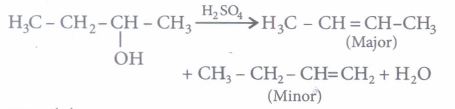
Assertion: 2-Butanol on heating with H2SO4 gives 1-butene and 2-butene.
Reason: Dehydration of 2-butanol follows Saytzeffs rule.
Codes:
(a) Assertion and reason both are correct statements and reason is correct explanation for assertion.
(b) Assertion and reason both are correct statements but reason is not correct explanation for assertion.
(c) Assertion is correct statement but reason is wrong statement.
(d) Assertion is wrong statement but reason is correct statement.
31.
Assertion : Auric chloride (AuCI3 ) solution cannot be stored in a vessel made of copper, iron, nickel, chromium, zinc or tin. Reason: Gold is a very precious metal.
Reason : Gold is a very precious metal.
Codes :
(a) Assertion and reason both are correct statements and reason is correct explanation for assertion.
(b) Assertion and reason both are correct statements but reason is not correct explanation for assertion.
(c) Assertion is correct statement but reason is wrong statement.
(d) Assertion is wrong statement but reason is correct statement.
32.
Assertion : KCI, NaCl and NH4CI cannot be used in the salt bridge of a cell containing silver.
Reason : A salt bridge contains concentrated solution of an inert electrolyte like KCl, KNO3 , K2 SO4 or solidified solution of such an electrolyte in agar-agar and gelatine.
Codes :
(a) Assertion and reason both are correct statements and reason is correct explanation for assertion.
(b) Assertion and reason both are correct statements but reason is not correct explanation for assertion.
(c) Assertion is correct statement but reason is wrong statement.
(d) Assertion is wrong statement but reason is correct statement.
33.
Assertion : If \(\lambda^{0}{ }_{\mathrm{Na}^{+}}\) and \(\lambda^{0}{ }_{\mathrm{Cl}^{-}}\) are molar limiting conductivities of the sodium and chloride ions respectively, then the limiting molar conductivity for sodium chloride is given by the equation, \(\Lambda_{\mathrm{NaCl}}^{\circ}=\lambda_{\mathrm{Na}^{+}}^{\circ}+\lambda_{\mathrm{Cl}^{-}}^{\circ}\)
Reason : This is according to Kohlrausch law of independent migration of ions.
Codes :
(a) Assertion and reason both are correct statements and reason is correct explanation for assertion.
(b) Assertion and reason both are correct statements but reason is not correct explanation for assertion.
(c) Assertion is correct statement but reason is wrong statement.
(d) Assertion is wrong statement but reason is correct statement.
34.
Assertion : Electrolysis of an aqueous solution of KI gives I2 at the anode but that of KF gives O2 at the anode not F2 .
Reason : I- ions have much higher oxidation potential than water while F- ions have much lower oxidation potential than water.
Codes :
(a) Assertion and reason both are correct statements and reason is correct explanation for assertion.
(b) Assertion and reason both are correct statements but reason is not correct explanation for assertion.
(c) Assertion is correct statement but reason is wrong statement.
(d) Assertion is wrong statement but reason is correct statement.
35.
Assertion: Chromium is hard but mercury is soft.
Reason: Chromium is a 3d transition element.
Codes:
(a) Assertion and reason both are correct statements and reason is correct explanation for assertion.
(b) Assertion and reason both are correct statements but reason is not correct explanation for assertion.
(c) Assertion is correct statement but reason is wrong statement.
(d) Assertion is wrong statement but reason is correct statement
36.
Assertion: Mn2+ is more stable than Mn3+.
Reason: Mn2+ has half-filled configuration.
Codes:
(a) Assertion and reason both are correct statements and reason is correct explanation for assertion.
(b) Assertion and reason both are correct statements but reason is not correct explanation for assertion.
(c) Assertion is correct statement but reason is wrong statement.
(d) Assertion is wrong statement but reason is correct statement.
37.
In the following questions. an Assertion (A) is followed by a corresponding Reason (R) Use the following keys to choose the appropriate answer.
Assertion (A) Bromination of phenol takes place even in the absence of Lewis acid.
Reason (R) In phenol, OH group attached to benzene ring has highly deactivating effect.
Codes:
(a) Both (A) and (R) are correct, (R) is the correct explanation of (A).
(b) Both (A) and (R) are correct, (R) is not the correct explanation of (A).
(c) (A) is correct; (R) is incorrect.
(d) (A) is incorrect; (R) is correct.
38.
In the following questions. an Assertion (A) is followed by a corresponding Reason (R) Use the following keys to choose the appropriate answer.
Assertion (A) Alcohols and phenols are soluble in water.
Reason (R) There occurs a dipole-dipole interaction of OH group of alcohol and phenol with water molecules which is responsible for their solubility in water.
Codes:
(a) Both (A) and (R) are correct, (R) is the correct explanation of (A).
(b) Both (A) and (R) are correct, (R) is not the correct explanation of (A).
(c) (A) is correct; (R) is incorrect.
(d) (A) is incorrect; (R) is correct.
39.
40.
In the following questions.an Assertion (A) is followed by a corresponding Reason (R) Use the following keys to choose the appropriate answer.
Assertion (A) Mercury cells give a constant voltage throughout its life.
Reason (R) Electrolyte KOH is not involved in the reaction.
Codes:
(a) Both (A) and (R) are correct, (R) is the correct explanation of (A).
(b) Both (A) and (R) are correct, (R) is not the correct explanation of (A).
(c) (A) is correct; (R) is incorrect.
(d) (A) is incorrect; (R) is correct.
1.
(c)
SN2 reaction
2.
(c)
do not behave like transition metals
3.
(a)
Mercury cell
4.
(b)
2
5.
(c)
Propanone
6.
(c)
Platinised platinum
7.
(b)
Eu and Yb
8.
(b)
V2O5
9.
(b)
\(E_{M^{n+} / M}=E_{M^{n+} / M}^{\circ}-\frac{R T}{n F} \ln \frac{1}{\left[M^{n+}\right]} \\ \)
10.
(c)
\({ K\quad Fe[Fe(CN) }_{ 6 }]\)
11.
(a)
Ac
12.
(c)
+ 6
13.
(a)
CH3-(CH2)3-O-CH2CH3
14.
(a)
phenol
15.
(a)
Conc.H3PO4
16.
(b)
secondary or tertiary alcohol
17.
(d)
- 1.66 V
18.
(b)
\(\frac { 2.303RT }{ 2F } \log { { K }_{ c } } =1.1\)
19.
(d)
Z > X > Y
20.
In an electrolytic cell, electrons enter the cathode and leave at the anode. Thus, in the external supply, electrons flow from cathode to anode. In the solution, only ions flow and not the electrons.
21.
22.
23.
C) Assertion is correct statement but reason is wrong statement.
Explanation:
Assertion is correct. Correct reason. Intermolecular hydrogen bonding is present in alcohols but not in ethers.
24.
25.
(a) If both assertion and reason are true and reason is the correct explanation of assertion.
Explanation:
For reaction to be spontaneous, Ecell should have a positive value and Δr Gcell negative. Hence, Current stops flowing when Ecell = 0 because equilibrium of the cell reaction is attained. Thus, both assertion and reason are true and reason is the correct explanation of assertion
26.
(b) If both assertion and reason are true, but reason is not the correct explanation of assertion.
Explanation:
Conductivity always decreases with a decrease in concentration whereas, molar conductivity increase with dilution. This is because the conductivity of a solution is the conductance of one-unit volume of the solution, but molar conductivity is the conductance of that volume of solution containing one mole of an electrolyte. Thus, both assertion and reason are correct but reason is not the correct explanation of assertion.
27.
(d) (A) is incorrect statement but (R) is correct statement, Correct (A) The IUPAC name of the given compound is 1-(2-propoxy) propane.
28.
(a) Both assertion and reason are true, and reason is the correct explanation of the assertion.
29.
(a) Assertion and reason both are correct statements and reason is correct explanation for assertion.
30.
(a): Saytzeff's rule: The alkene formed in greatest amount is the one that corresponds to removal of the hydrogen from the \(\beta\) -carbon having the fewest hydrogen substituent. In case of 2° and 3° alcohols Saytzeff's rule is followed.
31.
(b) : Gold has higher reduction potential than the given metals. Hence, AuCl3 will react with these metals.
32.
(b) : KCI, NaCI and NH4CI cannot be used as salt bridge in a cell containing silver as one of the electrodes because they react to form a precipitate of AgCl.
33.
(a) : According to Kohlrausch law, "limiting molar conductivity of an electrolyte can be represented as the sum of the individual contributions of the anion and cation of the electrolyte".
34.
(a) Assertion and reason both are correct statements and reason is correct explanation for assertion.
35.
(b): Chromium has maximum number of unpaired d electrons while Hg do not have any unpaired d electrons. Thus, Cr is hard but Hg is soft metal.
36.
(a): A half-filled or fully-filled orbital is more stable than incompletely filled orbital.
37.
(c) In case of phenol, the polarisation of bromine molecule takes place even in the absence of Lewis acid. It is due to the highly activatingeffect of OH group attached to the benzene ring. Hence, (A) is correct but (R) is incorrect.
38.
(c) Solubility of alcohols and phenols in water is due to their ability to form hydrogen bonds with water molecules.
The solubility decreases with increase in size of the alkyl/aryl groups. Several lower molecular mass alcohols are miscible with water in all proportions. Hence, (A) is correct but (R) is incorrect.
39.
40.
(c) Mercury cell gives the constant voltage throughout its life because the overall reaction does not involve any ion in the solution, concentration of which changes during its whole life.Thus, (A) is correct but (R) is incorrect.

12th Standard CBSE Syllabus & Materials
12th Standard CBSE
CBSE 12th Computer Science Python Revision Tour I - New Previous year Question Papers Study Material - QB365 Set A
NEW12th Standard CBSE
CBSE 12th Business Studies Planning Important Questions And Answers Study Material - QB365 Set A
NEW12th Standard CBSE
CBSE 12th Business Studies Business Environment Important Questions And Answers Study Material - QB365 Set A
NEW12th Standard CBSE
CBSE 12th Business Studies Principles of Management Important Questions And Answers Study Material - QB365 Set A



NCERT Books

Syllabus

Exam Pattern

Sample Question Papers

Previous year Question Papers

Important Notes

MCQ Practice test

NCERT Exemplers

Case study Questions

Image Based Questions

Passage based Questions

HOT Questions

Value Based Questions

Model Questions Papers
NCERT ( Book Back ) Questions

Assertion and Reason
Important Questions And Answers

CBSE 12th Standard CBSE Subjects
CBSE Standards








