
 100% FREE ACCESS
12th Standard CBSE Syllabus & Materials
12th Standard CBSE
CBSE 12th Economics Government Budget and the Economy Previous year Question Papers Study Material - QB365 Set A
NEW12th Standard CBSE
CBSE 12th Computer Science Interface Python with MySQL - New Previous year Question Papers Study Material - QB365 Set A
NEW12th Standard CBSE
CBSE 12th Computer Science Database Concept - New Previous year Question Papers Study Material - QB365 Set A
NEW12th Standard CBSE
CBSE 12th Computer Science Data Communication - New Previous year Question Papers Study Material - QB365 Set A
NEW12th Standard CBSE
CBSE 12th Computer Science Data Structures - New Previous year Question Papers Study Material - QB365 Set A
NEW12th Standard CBSE
CBSE 12th Computer Science Functions - New Previous year Question Papers Study Material - QB365 Set A

Published on: 25/10/2025
Download CBSE Class 12th Standard CBSE Chemistry question papers, sample papers, important questions, and previous year solved papers in PDF format. Get free study materials, NCERT solutions, and exam preparation resources for Class 12th Standard CBSE Chemistry
Questions + Answers key
Take MCQ Chemistry Test
1.
State
(a) Kohlrausch law of independent migration of ions.
(b) Faraday's first law of electrolysis.
2.
What happens when anisole is heated with HI?
3.
How do you convert phenol to anisole?
4.
Explain, why oxidation states of transition elements first increases from Sc to Mn and then decreases?
5.
The standard electrode potential of daniel is 1.1V. Calculate the standard Gibbs energy for the reaction:
\(Zn\left( s \right) +{ Cu }^{ 2+ }\left( aq \right) \rightarrow { Zn }^{ 2+ }\left( aq \right) +Cu\left( s \right) \)
6.
Why does the conductivity of a solution decrese with dilution?
7.
Why is Pt(IV) more stable than nickel (IV) stage?
8.
What happens when
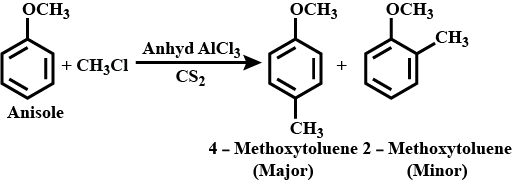
(i) Anisole is treated with CH3CI/anhydrous AICl3?
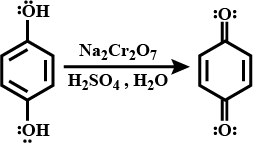
(ii) Phenol is oxidised with Na2Cr2O7/H+?
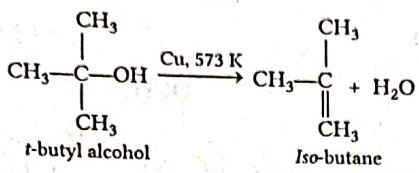
(iii) (CH3)3C-OH is heated with Cu/573 K?
Write chemical equation in support of your answer.
9.
Give the structure of the major product expected from the following reactions:
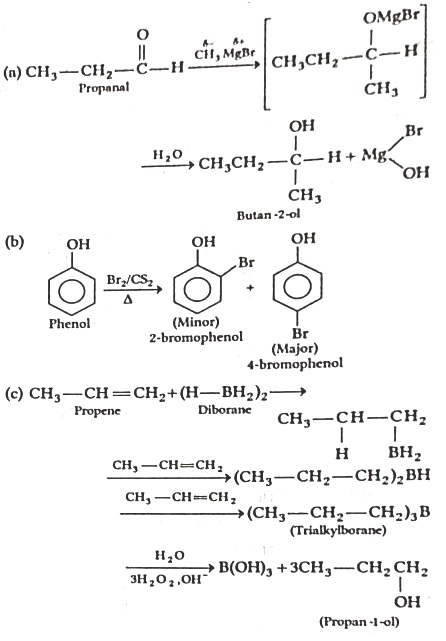
(a) Reaction of propanal with methyl magnesium bromide followed by hydrolysis.
(b) Reaction of phenol with Br2 in CS2.
(c) Reaction of propene with diborane followed by oxidation.
10.
Compare the chemistry of the actinoids with that of lanthanoids with reference to the following :
(i) Electronic configuration
(ii) Oxidation states
(iii) Chemical reactivity
11.
From the given data of E0 values, answer the following questions:
| \(E_{(M^{2+}/Mn)}^0\) | Cr | Mn | Fe | Co | Ni | Cu |
| -0.91 | -1.18 | -0.44 | -0.28 | -0.25 | +0.34 |
|---|
(i) Why is \(E_{(Cu^{2+}/Cu)}^0\) value exceptionally positive?
(ii) Why is \(E_{(M^{2+}/Mn)}^0\) value highly negative as compared to other elements?
(iii) Which is a stronger reducing agent Cr2+ or Fe2+? Give reason.
12.
Write the equations involved in the following reactions:
(i) Reimer-Tiemann reaction
(ii) Williamson synthesis
13.
Resistance of a conductivity cell filled with 0.1 mol L-1 KCl solution is \(100 \ Ω\). If the resistance of the same cell, when filled with 0.02 mol L-1 solution, is, calculate \( 520 \ Ω \) the conductivity and molar conductivity of 0.02 mol L-1 solution. (The conductivity of 0.1 mol L-1 KCl solution is 1.29 S/m.
14.
An aqueous solution of copper sulphate, CuSO4 was electrolysed between platinum electrodes using a current of 0.1287 ampere for 50 minutes. (Atomic mass of Cu=63.5 g mol-1].
(a) Write the cathodic reaction.
(b) Calculate:
(i) Electric charge passed during electrolysis.
(ii) Mass of copper deposited at the cathode
[Given : 1F = 96,500 C mol-1]
15.
Williamson's synthesis of preparing dimethyl ether is a/an
SN1 reaction
elimination reaction
SN2 reaction
nucleophilic addition reaction
16.
Salicylic acid reacts with Zinc dust on heating to give
Benzene
Benzoic acid
Phenol
None of these
17.
Phenol can be distinguished from ethanol by the reactions with ___________
Br2/water
Na
Neutral FeCl3
All the above
18.
\(\text { Phenol } \stackrel{\mathrm{Zn} \text { , dust }}{\longrightarrow} \cdot \mathrm{X}^{\prime} \frac{\mathrm{CH}_{3} \mathrm{Cl}}{\text { Anhy. } \mathrm{AICl}_{3}} \cdot \mathrm{Y}, \frac{\text { Alkaline }}{\mathrm{KMnO}_{4}} \text { ' } \mathrm{Z} \text { ' }\)
The product 'Z' is
Benzaldehyde
Benzoic acid
Benzene
Toluene
19.
Which of the following method is used for the preparation of symmetrical and unsymmetrical ether?
Williamson's synthesis
Riemer-Tiemann reaction
Kolbe's reaction
None of the above
20.
IUPAC name of m- cresol is___________.
3-methylphenol
3-chlorophenol
3-methoxyphenol
benzene-1,3-diol
21.
Transition elements have greater tendency to form complexes because
They have vacant d orbitals
They have large size
They have large charge/ size ratio
They have two electrons in their outermost shells
22.
The actinoids exhibit more number of oxidation states in general than the lanthanoids. This is because
the 5f orbitals extend farther from the nucleus than the 4f orbitals
the 5f orbitals are more buried than the 4f orbitals
there is a similarity between 4f and 5f orbitals in their angular part of the wave function
the actinoids are more reactive than the lanthanoids
23.
Magnetic moment of 2.84 B.M is given by which of the following ion?
Ti3+
Ni2+
Cr3+
Mn2+
24.
Which of the following statements about the interstitial compounds is incorrect ?
They retain metallic conductivity
They are chemically reactive
They are much harder than the pure metal
They have higher melting points than the pure metal
25.
Which of the following reagents may be used to distinguish between phenol and benzoic acid?
Neutral FeCl3
Aqueous NaOH
Tollen's reagent
Molisch reagent
26.
What current is to be passed for 0.25 s for deposition of a certain weight of metal which is equal to its electrochemical equivalent?
4 A
100 A
200 A
2 A
27.
\({ \wedge }_{ m }^{ 0 }\left( { NH }_{ 4 }OH \right) \) is equal to_________________.
\({ \wedge }_{ m }^{ 0 }\left( { NH }_{ 4 }OH \right) +{ \wedge }_{ m }^{ 0 }\left( { NH }_{ 4 }Cl \right) -{ \wedge }^{ 0 }(HCl)\)
\({ \wedge }_{ m }^{ 0 }\left( { NH }_{ 4 }Cl \right) +{ \wedge }_{ m }^{ 0 }\left( NaOH \right) -{ \wedge }^{ 0 }(NaCl)\)
\({ \wedge }_{ m }^{ 0 }\left( { NH }_{ 4 }Cl \right) +{ \wedge }_{ m }^{ 0 }\left( NaCl \right) -{ \wedge }^{ 0 }(NaOH)\)
\({ \wedge }_{ m }^{ 0 }\left( NaOH \right) +{ \wedge }_{ m }^{ 0 }\left( NaCl \right) -{ \wedge }^{ 0 }({ NH }_{ 4 }Cl)\)
28.
Which of the statements about solutions of electrolytes is not correct ?
Conductivity of solution depends upon size of ions
Conductivity depends upon viscosity of solution
Conductivity does not depend upon solvation of ions present in solution
Conductivity of solution increases with temperature.
29.
Which has the highest oxidizing power ?
I2
Br2
F2
Cl2
30.
Electrode potential of any electrode depends on :
nature of the metal
temperature of the solution
molarity of the solution
all of these
31.
(i) What happens when
(a) phenol reacts with bromine water?
(b) ethanol reacts with CH3COCl/pyridine?
(c) anisole reacts with HI?
Write the chemical equations involved in the above reactions.
(ii) Distinguish between
(a) Ethanol and phenol
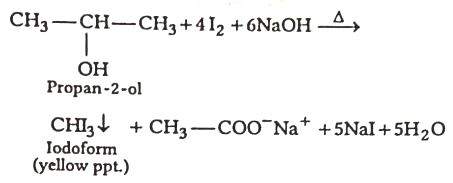
(b) Propan-2-ol and 2-methylpropan-2-o1
32.
(a) State Faraday's first law of electrolysis. How much charge in terms of Faraday's is required for the reduction of 1 mole of Cu2+ to Cu.
(b) Calculate emf of the following cell at 298 K.
Mg(s) IMg2+(0.1 M) II Cu2+(0.01) I Cu(s)
Given, E0cell = +2.71 V,
1F = 96500 C mol-1
33.
(a) Give the preparation of potassium dichromate from chromate ore:
(b) Explain the following:
(i) Transition metals have good tendency to form complexes.
(ii) Transition metals exhibit variable oxidation states.
(c) Write the general electronic configuration of lanthanoids.
34.
EMF of Daniell cell was found using different concentrations of Zn2+ ion and Cu2 ion. A graph was then plotted between Ecell and \(\log { \frac { \left[ { Zn }^{ 2+ } \right] }{ \left[ { Cu }^{ 2+ } \right] } } \) . The plot was found to be linear with intercept on Ecell axis equal to 1.10 V. Calculate Ecell for Zn | Zn2+ (0.1 M) || Cu2+ (0.01 M) | Cu.
35.
An organic compound (A) having molecular formula C6H6O gives a characteristic color with an aqueous FeCl3 solution. (A) on treatment with CO2 and NaOH at 400 K under pressure gives (B), which on acidification gives a compound (C). The compound (C) reacts with acetyl chloride to give (D) which is a popular pain killer.
(i) Compound (A) is
(a) 2-hexanol
(b) dimethyl ether
(c) phenol
(d) 2-methyl pentanol.
ii) Number of carbon atoms in compound (D) is
(a) 7
(b) 6
(c) 8
(d) 9
iii) The conversion of compound (A) to (C) is known as
(a) Reimer- Tiemann reaction
(b) Kolbe’s reaction
(c) Schmidt reaction
(d) Swarts reaction
(iv) Compound (A) on heating with compound (C) in presence of POCl3 gives a compound (D) which is used
(a) in perfumery as a flavoring agent
(b) as an antipyretic
(c) as an analgesic
(d) as an intestinal antiseptic.
36.
Read the passage given below and answer the following questions :
All chemical reactions involve interaction of atoms and molecules. A large number of atoms/molecules are present in a few gram of any chemical compound varying with their atomic/molecular masses. To handle such large number conveniently, the mole concept was introduced. All electrochemical cell reactions are also based on mole concept. For example, a 4.0 molar aqueous solution of NaCI is prepared and 500 mL of this solution is electrolysed. This leads to the evolution of chlorine gas at one of the electrode. The amount of products formed can be calculated by using mole concept.
The following questions are multiple choice questions. Choose the most appropriate answer :
(i) The total number of moles of chlorine gas evolved is
| (a) 0.5 | (b) 1.0 | (c) 1.5 | (d) 1.9 |
(ii) If cathode is a Hg electrode, then the maximum weight of amalgam formed from this solution is
| (a) 300 g | (b) 446 g | (c) 396 g | (d) 296 g |
(iii) In the electrolysis, the number of moles of electrons involved are
| (a) 2 | (b) 1 | (c) 3 | (d) 4 |
(iv) In electrolysis of aqueous NaCl solution when Pt electrode is taken, then which gas is liberated at cathode?
| (a) H2 gas | (b) C2 gas | (c) O2 gas | (d) None of these |
1.
(a) The Kohlrausch law of independent migration of ions state that "limiting molar conductivity of an electrode is the sum of the individual contribution of the cation and the anion of the electrolyte."
(b) The Faraday's first law states that "the amount of chemical reaction occuring at any electrode by passing current is directly proportional to the quantity of electricity passed through the electrolyte.
2.
methyl iodide and phenol
3.

4.
The use of 3d electron for formation of bond increases from Sc to Mn, causing the increase in oxidation state up to +7. The reason for Mn having highest oxidation state of +7 is due to the presence of 7 unpaired electrons in its atom. As the number of unpaired electrons decreases from Fe to Cu so there is the decrease in oxidation state.
5.
\({ \Delta G }^{ \circ }=-n{ F{ E }^{ \circ } }_{ cell }\)
\(=-2\times 1.1\times 96500CV{ mol }^{ -1 }\)
\(=-21227J \ { mol }^{ -1 }\)
\(or \ =-21227 \ kJ \ { mol }^{ -1 }\)
6.
Conductivity of an electrolyte solution decreases with dilution because the number of ions per unit volume furnished by an electrolyte decreases with dilution.
7.
Pt(IV) is more stable than Ni(IV) because energy required to remove four electrons is less in case of Pt than in Ni.
8.
(i) When anisole is treated with CH3Cl in presence of anhydrous AlCl3, a mixture of ortho and para methyl anisole is produced.
Anisole undergoes Friedel-Crafts alkylation reaction with an alkyl halide in presence of Lewis acid AlCl3 as a catalyst.
(ii) When phenol is oxidized with Na2Cr2O7 in presence of H+ (acid), a conjugated diketone (benzoquinone) is produced.
In the presence of air, phenols are slowly oxidized to dark-colored mixtures containing quinones.
(iii)
9.
10.
(i) Electronic configuration
Lanthanoids = [Xe] 4f0-14 5d0-1 6s2
Actinoids = [Rn] 5f0-14 6d0-1 7s2
(ii) Oxidation states In lanthanoids, +3 oxidation state is most common along with + 2 and + 4. While in actinoids, there is a greater range of oxidation states because 5f, 6d and 7s levels are of comparable energies.They show + 2, + 3, + 4, + 5, + 6 and + 7 oxidation states. Common oxidation state in actinoids is + 3.
(iii) Chemical reactivity Lanthanoids are less reactive than actinoids. Actually, earlier members of lanthanoids are quite reactive similar to calcium but with increasing atomic number, they behave more like aluminium. Lanthanoids react with dilute acids to liberate H2 gas while actinoids react with boiling water and gives a mixture of oxide and hydride.
11.
(i) Sum of enthalphy of atomisation and ionisation is greater than enthalphy of hydration. Thus, \(E_{(M^{2+}/Mn)}^0\) is positive for copper.
(ii) Ionisation enthalpy is lower than hydration enthalphy due to stable 3d5 configuration. Thus, \(E_{(M^{2+}/Mn)}^0\) is more negative.
(iii) Cr2+ is a stronger reducing agent because it can lose electron to form Cr3+ which has stable 3d3 configuration (half-filled t2g3). Further is more negative than Fe2+
12.
(i) Reimer-Tiemann reaction
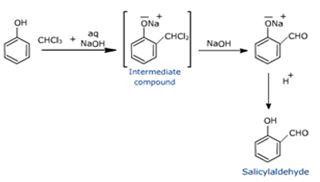
(ii) Williamson syntheses:
\(\underset { Alkyl halide\ Sodium\ alkoxide }{ R-X+\overset { + }{ Na } -\overset { - }{ O } -{ R }' } \longrightarrow R-O-{ R }'+NaX\)
\(\underset { Alkyl\ halide\ Sodium\ alkoxide }{ { CH }_{ 3 }-{ CH }_{ 2 }-Br } +\underset { sodium\ ethoxide }{ \overset { + }{ Na } -\overset { - }{ O } -{ CH }_{ 2 }-{ CH }_{ 3 } } \longrightarrow \underset { Diethyl\ ether }{ { CH }_{ 3 }-{ CH }_{ 2 }-O-{ CH }_{ 2 }-{ CH }_{ 3 } } +NaBr\)
13.
The cell constant is given by the equation:
Cell constant = G* = conductivity × resistance
= 1.29 S/m × 100 \(\Omega\) = 129 m–1 = 1.29 cm–1
= \(\frac{G^{*}}{R}=\frac{129 \mathrm{~m}^{-1}}{520 \Omega}\) = 0.248 S m–1
Concentration = 0.02 mol L–1
= 1000 × 0.02 mol m–3 = 20 mol m–3
Molar conductivity = \(A_{m}=\frac{\kappa}{c}\)
= \(\frac{248 \times 10^{-3} \mathrm{Sm}^{-1}}{20 \mathrm{~mol} \mathrm{~m}^{-3}}\) = 124 × 10–4 S m2mol–1
Alternatively, \(\kappa=\frac{1.29 \mathrm{~cm}^{-1}}{520 \Omega}\) = 0.248 × 10⁻² S cm–1
and Λ m = κ × 1000 cm3 L–1 molarity–1
= \(\frac{0.248 \times 10^{-2} \mathrm{~S} \mathrm{~cm}^{-1} \times 1000 \mathrm{~cm}^{3} \mathrm{~L}^{-1}}{0.02 \mathrm{~mol} \mathrm{~L}^{-1}}\)
= 124 S cm2 mol–1
14.
\(t=50\times 60=3000s\)
\(I=0.1287A\)
\((a) \ { Cu }^{ 2+ }+{ 2e }^{ - }\longrightarrow Cu(s) \ At \ cathode\)
\((b)(i) Q=I\times t=0.1287\times 3000=386.1C\)
\((ii) \ m=Z\times I\times t=\frac { 63.5 }{ 2\times 96500 } \times 386.1=0.127g\)
15.
(c)
SN2 reaction
16.
(b)
Benzoic acid
17.
(a)
Br2/water
18.
(b)
Benzoic acid
19.
(b)
Riemer-Tiemann reaction
20.
(a)
3-methylphenol
21.
(a)
They have vacant d orbitals
22.
(a)
the 5f orbitals extend farther from the nucleus than the 4f orbitals
23.
(b)
Ni2+
24.
(b)
They are chemically reactive
25.
(a)
Neutral FeCl3
26.
(a)
4 A
27.
(b)
\({ \wedge }_{ m }^{ 0 }\left( { NH }_{ 4 }Cl \right) +{ \wedge }_{ m }^{ 0 }\left( NaOH \right) -{ \wedge }^{ 0 }(NaCl)\)
28.
(c)
Conductivity does not depend upon solvation of ions present in solution
29.
(c)
F2
30.
(d)
all of these
31.
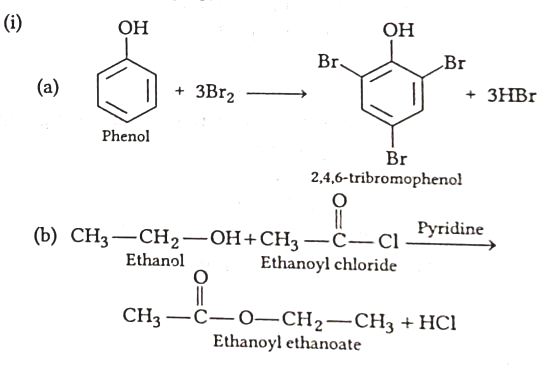
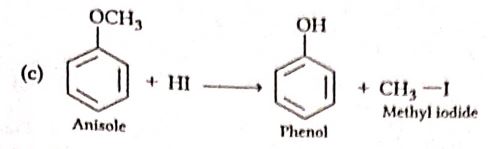
(ii) (a) Phenol gives violet colouration with FeCl3, solution but ethanol does not.

(b) Propan-2-ol when warmed with l2, in NaOHg ives yellow precipitate of iodoform, while 2-methylpropan-2-ol does not respond to this test.
32.
(a) Faraday's first law of electrolysis It states that the amount of chemical reaction occurring at an electrode by passing current is proportional to the quantity of electricity passed through the electrolyte. Charge required for the reduction of 1 mole of Cu2+ to Cu = 2F
(b) \(Cu^{ 2+ }Mg\rightarrow Mg^{ 2+ }+Cu\)
Given, EO Cell = +271 V
By using Nernst equation,
\(E_{ cell }=E^{ 0 }_{ cell }-\frac { 0.059 }{ n } log\frac { Mg^{ 2+ } }{ Cu^{ 2+ } } \)
Here, n = 2 and E0 cell = + 2.71 V
\(\therefore E_{ cell }=2.71-\frac { 0.059 }{ 2 } log\frac { 0.1 }{ 0.01 } \)
\(=2.71-\frac { 0.059 }{ 2 } log10\)
= 2.71- 0.0295
\([\therefore \) log10 = 1]
= 2.68 V
33.
(i) The transition elements exhibit variable oxidation states. The variable oxidation states of transition metals are due to the participation of ns and (n - 1) d-electrons. This is because of the very small difference between the energies of (n - 1) d and ns orbitals. For the first five elements, the minimum oxidation state is equal to the number of electrons ---in the 4s orbitals and the other oxidation states are equal to the sum of 4s and some of the 3d-electrons. The highest oxidation state is equal to the sum of 4s and 3d electrons. For the remaining elements, the minimum oxidation state is equal to electrons in 4s-orbitals and the maximum oxidation state is not equal to the sum of 4s and 3d electrons. In general, the oxidation state increases up to the middle and then decreases.
34.
For Daniell cell, Zn + Cu2+⇾ Zn2++ Cu
\(E_{cell}=E^0_{cell}-{0.0591\over 2}log{[Zn^{2+}]\over [Cu^{2+}]}\)
It is the equation of straight line (y = C + mx).
Intercept = EOcell= 1·10 V (Given)
\(E_{cell}\equiv 1.10-{0.0591\over 2}log{0.1\over 0.01}=1.10-0.0295=1.0705V\)
35.
i. (c) phenol
ii. (d) 9
iii.(b) Kolbe’s reaction
iv.(d) as an intestinal antiseptic.
36.
(i) (b) : \(n_{\mathrm{NaCl}}=\frac{4 \times 500}{1000}=2 \mathrm{~mol}\)
\(\therefore\) \(n_{\mathrm{Cl}_{2}}=1 \mathrm{~mol}\)
(ii) (b) : nNa deposited = 2 mol
\(\therefore\) nNa _ Hg formed = 2 mol
\(\therefore\) Mass of amalgam formed = 2 x 223 = 446 g
(iii) (a)
(iv) (a)

12th Standard CBSE Syllabus & Materials
12th Standard CBSE
CBSE 12th Computer Science Python Revision Tour I - New Previous year Question Papers Study Material - QB365 Set A
NEW12th Standard CBSE
CBSE 12th Business Studies Planning Important Questions And Answers Study Material - QB365 Set A
NEW12th Standard CBSE
CBSE 12th Business Studies Business Environment Important Questions And Answers Study Material - QB365 Set A
NEW12th Standard CBSE
CBSE 12th Business Studies Principles of Management Important Questions And Answers Study Material - QB365 Set A



NCERT Books

Syllabus

Exam Pattern

Sample Question Papers

Previous year Question Papers

Important Notes

MCQ Practice test

NCERT Exemplers

Case study Questions

Image Based Questions

Passage based Questions

HOT Questions

Value Based Questions

Model Questions Papers
NCERT ( Book Back ) Questions

Assertion and Reason
Important Questions And Answers

CBSE 12th Standard CBSE Subjects
CBSE Standards








