
 100% FREE ACCESS
12th Standard CBSE Syllabus & Materials
12th Standard CBSE
CBSE 12th Economics Government Budget and the Economy Previous year Question Papers Study Material - QB365 Set A
NEW12th Standard CBSE
CBSE 12th Computer Science Interface Python with MySQL - New Previous year Question Papers Study Material - QB365 Set A
NEW12th Standard CBSE
CBSE 12th Computer Science Database Concept - New Previous year Question Papers Study Material - QB365 Set A
NEW12th Standard CBSE
CBSE 12th Computer Science Data Communication - New Previous year Question Papers Study Material - QB365 Set A
NEW12th Standard CBSE
CBSE 12th Computer Science Data Structures - New Previous year Question Papers Study Material - QB365 Set A
NEW12th Standard CBSE
CBSE 12th Computer Science Functions - New Previous year Question Papers Study Material - QB365 Set A

Published on: 25/10/2025
Download CBSE Class 12th Standard CBSE Chemistry question papers, sample papers, important questions, and previous year solved papers in PDF format. Get free study materials, NCERT solutions, and exam preparation resources for Class 12th Standard CBSE Chemistry
Questions + Answers key
Take MCQ Chemistry Test
1.
The decomposition of phosphine,
4PH3(g) ⟶ P4(g)+6H2(g)
has the rate law, rate = k [PH3]
The rate constant is 6.0 x 10⁻⁴ s-1 at 300 K and activation energy is 3.05 x10⁵ J mol-1 Calculate the value of rate constant at 310 K
(Given, R = 8.314 JK-1mol-1).
2.
The boiling point elevation of 0.30 g acetic acid in 100 g benzene is 0.0633 K. Calculate the molar mass of acetic acid from this data. What conclusion can you draw about the molecular state of the solute in the solution?
(Given, Kb for benzene = 2.53 K kg mol-1).
3.
Using valence bond theory explain the geometry and magnetic behaviour by [Cr(NH3)6]3+ (At.no.Cr = 24)
Write the IUPAC name of ionization isomer of [Ni(NH3)6]6+
4.
Determine the values of equilibrium constant (K) and \(\triangle G ^{o}\) for the following reaction :
Ni (s) + 2 Ag+ (aq) \(\longrightarrow\) Ni2+ (aq) + 2 Ag (s), E0 = 1.05V (1F = 96500 C mol-1)
5.
Why blue colour of copper sulphate solution gets discharged when zine rod is dipped in it? Given
\({ E }^{ 0 }_{ { Cu }^{ 2+ }/Cu }=-0.34V,{ E }^{ 0 }_{ { Zn }^{ 2+ }/Zn }=-0.76V\)
6.
Give reasons for each of the following:
(i) Transition metal fluorides are ionic in nature, whereas bromides and chlorides are usually covalent in nature.
(ii) Size of trivalent lanthanoid cations decreases with increase in the atomic number.
(iii) Chemistry of all the lanthanoids is quite similar.
7.
The reaction 2NO2 + F2 \(\rightarrow\) 2NO2 F involves the following steps:
\(\mathrm{NO}_{2}+\mathrm{NO}_{2} \rightleftharpoons{ }^{K}{ } \mathrm{~N}_{2} \mathrm{O}_{4}(\text { Fast })\)
N2O4 + F2 \(\rightarrow\) 2 NO2 F (Slow)
Write the rate law. Calculate the overall order of the reaction and what is the rate determining step?
8.
Write the formula of compound in which transition metal is in +6 oxidation state.
9.
The conductivity of a 0.20 M solution of KCl at 298 K is 0.0248 Scm-1. Calculate its molar conductivity.
10.
Account fpr different magnetic behaviour of hexacyanoferrate (III) and hexafluoroferrate (III).
11.
Though copper, silver and gold have completely filled sets of d-orbitals yet they are considerde as transition metals. Why ?
12.
Which solution has higher concentration, 1 molar or 1 molal solution of the same solute ? Give reason.
13.
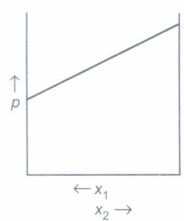
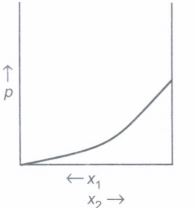
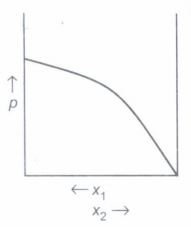
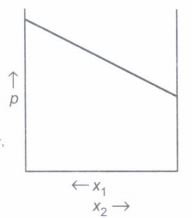
For a binary ideal liquid solution, the variation in total vapour pressure versus composition of solution is given by which of the curves?
14.
Consider the following plot between In k and 1/T,
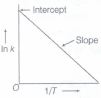
In this plot, the intercept and slope respectively are
\(-\frac{E_{a}}{R} ; \ln A\)
\( \ln A ;-\frac{E_{\alpha}}{R}\)
\(\frac{E_{a}}{R} ;-\ln A\)
\( \frac{E_{a}}{R} ; A\)
15.
Which is/are rechargable batteries?
Nickel-cadmium
Lead-storage
Both (a) and (b)
None of these
16.
Which of the following statements is/are true for the diagram?
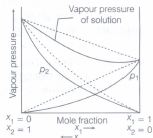
The escaping tendency of molecule decreases for each component
Vapour pressure of the solution decreases
Solution shows negative deviation from Raoult's law
All of the above
17.
The coloured spot of KMnO4 on any article can be bleached by
SO2 + H+
C2\({ O }_{ 4 }^{ 2- }\) + H+
H2O2 + H+
all of these
18.
Which of the following reactions are disproportionation reactions?
\((i)\ { Cu }^{ + }\longrightarrow { Cu }^{ 2+ }+{ Cu }\)
\((ii)\ { 3MnO }_{ 4 }^{ - }+{ 4H }^{ + }\longrightarrow { 2MnO }_{ 4 }^{ - }+{ MnO }_{ 2 }+{ 2H }_{ 2 }O\)
\((iii)\ { 2KMnO }_{ 4 }\longrightarrow { K }_{ 2 }{ MnO }_{ 4 }+{ MnO }_{ 2 }+{ O }_{ 2 }\)
\((iv)\ { 2MnO }_{ 4 }^{ - }+{ 3Mn }^{ 2+ }+{ 2H }_{ 2 }O\longrightarrow { 5MnO }_{ 2 }+{ 4H }^{ + }\)
(i),(ii)
(i),(ii),(iii)
(ii),(iii),(iv)
(i),(iv)
19.
How many EDTA (ethylenediaminetetraacetic acid) molecules are required to make an octahedral complex with a Ca2+ ion?
One
Two
Six
Three
20.
Which of the following shall from an octahedral complex?
d4(low spin)
d8(high spin)
d6(low spin)
all of these
21.
Which of the following statements are correct concerning redox properties ?
(i) A metal M for which E0 for the half life reaction \({ M }^{ n+ }+{ ne }^{ - }\rightleftharpoons M\) is very negative will be a good reducing agent.
(ii) The oxidizing power of the halogen decreases from chlorine to iodine
(iii) The reducing power of hydrogen halides increases from hydrogen chloride to hydrogen iodide
(i), (ii) and (iii)
(i) and (ii)
(i) only
(ii) and (iii) only
(iii) only
22.
Two faradays of electricity are passed through a solution of CuSO4. The mass of copper deposited at the cathode (at mass of Cu = 63.5 amu)
2 g
127 g
0 g
63.5 g
23.
The coordination compound of which one of the following compositions will produce two equivalents of AgCl on reaction with aqueous silver nitrate solution?
CoCl3.3NH3
CoCl3.6NH3
CoCl3.4NH3
CoCl3.5NH3
24.
For the reaction A + B \(\longrightarrow\) C + D, doubling the concentration of both the reactants increases the reaction rate by 8 times and doubling the concentration of only B simply doubles the reaction rate. The rate law is given as
r = k[A]1/2 [B]1/2
r = k[A] [B]2
r = k[A]2[B]
r = k[A] [B}
25.
The molar mass of the solute sodium hydroxide obtained from the measurement of osmotic pressure of its aqueous solution at 27oC is 25 g mol-1. Therefore, its ionization percentage in the solution is
75
60
80
70
26.
If two substances A and B have \({ p }_{ A }^{ o }:{ p }_{ B }^{ o }=1:2\) and have mole fraction in solution 1 : 2, then mole fraction of A in vapours is
0.33
0.25
0.52
0.2
27.
At a given temperature, osmotic pressure of a concentrated solution of a substance .............. .
is higher than that at a dilute solution
is lower than that of a dilute solution
is same as that of a dilute solution
can not be compared with osmotic pressure of dilute solution.
28.
(a) Define:
(i) Interstitial compounds
(ii) Misch-metal
(b) Write one difference between transition elements and p-block elements with reference to variability of oxidation states.
(c) What are-inner transition elements? Give some applications of inner transition elements.
29.
(a) For the reaction 2N2O5(g) ⟶4NO2(g) +O2(g), the rate of formation of NO2(g) is 2.8 x 10- 3 Ms-1. Calculate the rate of disappearance of N2O5(g).
(b) The rate of a reaction increases four times when the temperature changes from 300 k to 320 K. Calculate the energy of activation of the reaction, assuming that it does not change with temperature.
30.
(i) Name the element of 3d transition series which shows maximum number of oxidation states. Why does it show so?
(ii) Which transition metal of 3d series has positive \(E°(M^{ 2+ }/M)\) value and why?
(iii) Out of \(Cr^{ 3+ }\) and \(Mn^{ 3+ }\), which is a stronger oxidizing agent and why?
(iv) Name a member of the lanthanoid series which is well known to exhibit a +2 oxidation state.
(v) Complete the following equation:
\(MnO_{ 4 }^{ - }8H^{ + }5e^{ - }\longrightarrow \)
31.
(a) What is the rate of reaction? Write two factors that affect the rate of reaction
(b) The rate constant of a first-order reaction increase from \(4\times { 10 }^{ -2 }\ to\ 8\times { 10 }^{ -2 }\)when the temperature changes from 27°C to 37°C. Calculate the energy of activation \(\left( { E }_{ \alpha } \right) \) .
\(log\ 2=0.301,\ log\ 3=0.477,\ log\ 4=0.6021\)
or
(a) For a reaction A+B\(\longrightarrow \) , the rate is given by
\(Rate\ =\ k\left[ A \right] \left[ { B } \right] _{ 2 }\)
(i) How is the rate of reaction affected if the concentrated of B is doubled?
(ii) What is the overall order of reaction if A is present in large excess?
(c) A first order reaction takes 23.1 minutes for 50% completion. calculate the time required for 75% completion of this reaction.
\(log\ 2=0.301,\ log\ 3=0.477,\ log\ 4=0.6021\)
32.
33.
Read the passage given below and answer the following questions:
Standard electrode potentials are used for various processes:
(i) It is used to measure relative strengths of various oxidants and reductants.
(ii) It is used to calculate standard cell potential.
(iii) It is used to predict possible reactions.
A set of half-reactions (in acidic medium) along with their standard reduction potential, Eo (in volt) values are given below
\(\mathrm{I}_{2}+2 e^{-} \rightarrow 2 \mathrm{I}^{-} ; \quad E^{\circ}=0.54 \mathrm{~V}\)
\(\mathrm{Cl}_{2}+2 e^{-} \rightarrow 2 \mathrm{Cl}^{-} ; \quad E^{\circ}=1.36 \mathrm{~V}\)
\(\mathrm{Mn}^{3+}+e^{-} \rightarrow \mathrm{Mn}^{2+} ; \quad E^{\circ}=1.50 \mathrm{~V}\)
\(\mathrm{Fe}^{3+}+e^{-} \longrightarrow \mathrm{Fe}^{2+} ; \quad E^{\circ}=0.77 \mathrm{~V}\)
\(\mathrm{O}_{2}+4 \mathrm{H}^{+}+4 e^{-} \longrightarrow 2 \mathrm{H}_{2} \mathrm{O} ; E^{\circ}=1.23 \mathrm{~V}\)
The following questions are multiple choice questions. Choose the most appropriate answer:
(i) Which of the following statements is correct?
| (a) CI- is oxidised by O2 | (b) Fe2+ is oxidised by iodine |
| (c) I- is oxidised by chlorine. | (d) Mn2+ is oxidised by chlorine |
(ii) Mn3+ is not stable in acidic medium, while Fe3+is stable because
| (a) O2 oxidises Mn2+ to Mn3+ |
| (b) O2 oxidises both Mn2+ to Mn3+ and Fe2+ to Fe3+ |
| (c) Fe3-oxidises H2O to O2 |
| (d) Mn3+ oxidises H2O to O2 |
(iii) The strongest reducing agent in the aqueous solution is
| (a) I- | (b) Cl- | (c) Mn2+ | (d) Fe2+ |
(iv) The emf for the following reaction is
\(\mathrm{I}_{2}+\mathrm{KCl} \rightleftharpoons 2 \mathrm{KI}+\mathrm{Cl}_{2}\)
| (a) -0.82 V | (b) +0.82 V | (c) -0.73 V | (d) +0.73 V |
34.
Assertion: Ifblood cells are placed in pure water, they swell and burst.
Reason: Due to osmosis, the movement of water molecules into the cell, dilutes the salt content.
(a) Assertion and reason both are correct statements and reason is correct explanation for assertion.
(b) Assertion and reason both are correct statements but reason is not correct explanation for assertion .
(c) Assertion is correct statement but reason is wrong statement.
(d) Assertion is wrong statement but reason is correct statement.
35.
Assertion: [Al(NH3)6]3+ does npt exist in aqueous solution.
Reason: NH3 is a neutral ligand.
Codes:
(a) Assertion and reason both are correct statements and reason is correct explanation for assertion.
(b) Assertion and reason both are correct statements but reason is not correct explanation for assertion.
(c) Assertion is correct statement but reason is wrong statement.
(d) Assertion is wrong statement but reason is correct statement.
1.
Given, T1= 300K, T2 = 310K,
Ea = 3.05 x 10⁵ Jmol-1
k1 = 6.0 x 10⁻⁴ s-1, k2 = ?
\(log\left( \frac { { k }_{ 2 } }{ { k }_{ 1 } } \right) =\frac { { E }_{ a } }{ 2.303R } \left( \frac { { T }_{ 2 }-{ T }_{ 1 } }{ { T }_{ 1 }.{ T }_{ 2 } } \right) \)
\(log\left( \frac { { k }_{ 2 } }{ { k }_{ 1 } } \right) =\frac { 3.05\times { 10 }^{ 5 } }{ 2.303\times 8.314 } \left( \frac { 310-300 }{ 300\times 310 } \right) \)
\(log\left( \frac { { k }_{ 2 } }{ { k }_{ 1 } } \right) =\frac { 3.05\times 10^{ 5 }\times 10 }{ 2.303\times 8.314\times 300\times 310 } \)
k2/k1 = antilog (1.7128)
k2/k1 = 5.162 x 101 = 51.62
\(\frac { { k }_{ 2 } }{ 6.0\times 10^{ -4 } } \) = 51.62 or k2 = 3.0972 x 10⁻²s-1
2.
Use the formula
\(M_2=\frac{K_b\times W_2 \times 1000}{\Delta T_b \times W_1}\)
i = 0.5. Here i < 1. therefore the solute, acetic acid is associated in benzene.
3.
The comp41ex [Cr(NH3)6 ]3+ is formed by d2sp3 hybridization therefore, it has octahedral geometry. Since it has three unpaired electrons, therefore, it is paramagnetic in nature.
[Cr(NH3)6]3+
Cr = 24 = 4s13d5
Cr3+ = 3d3
(ii) The IUPAC name of ionization isomer of is triamminechloridenickel (II) nitrate.
4.
3.41 \(\times\) 1035, -2 .02 \(\times\) 105 J
5.
E0 cell =1.10 V,i.e.,+ve. Reaction takes place changing blue CuSO4 to colourless ZnSO4
6.
(i) F is more electronegative than CI and Br, therefore, fluorides are ionic; whereas chlorides and bromides are covalent.
(ii) It is due to poor shielding effect off-electrons, effective nuclear charge increases, so, ionic size decreases.
(iii) It is due to similar ionic size which is due to lanthanoid contraction, they resemble in their properties.
7.
N2O4 + F2 \(\rightarrow\) 2 NO2 F is the rate determining step.
\(\frac{d x}{d t}=\) k [N2O4] [F2 ], from slow step ...(i)
NO2 + NO2 \(\stackrel{\mathrm{K}}{\rightleftharpoons}\) N2 O4
\(K=\frac{\left[\mathrm{N}_{2} \mathrm{O}_{4}\right]}{\left[\mathrm{NO}_{2}\right]^{2}}\) from fast step
[N2O4] = K[NO2]
Substituting value of [N2O4] in eqn (i) we get
\(\frac{d x}{d t}=k \times K\left[\mathrm{NO}_{2}\right]^{2}\left[\mathrm{~F}_{2}\right]\)
\(\frac{d x}{d t}=k^{\prime}\left[\mathrm{NO}_{2}\right]^{2}\left[\mathrm{~F}_{2}\right]\)
The overall order is 2 + 1 = 3, i.e. it is a third order reaction.
8.
K2MnO4
9.
Molar conductivity is calculated as,
\(\Lambda ^{ C }_{ m }=\frac { k\times 1000 }{ Molarity } \)
Molar conductivity
\(\Lambda ^{ C }_{ m }=\frac { k\times 1000 }{ Molarity } =\frac { 0.0248\times 1000 }{ 0.20 } \)
=124 S cm-2 mol-1
10.
In [Fe(CN )6]3- , CN- is a strong ligand. Hence, electrons in the d-subshell pair up and there is only one unpaired electron left.In [FeF6]3- ,is a weak ligand. Hence, electrons in the 3 d subshell do not pair up. There are five unpaired electrons in the 3d-subshell. (The hybridization involved is sp3d2 _ outer orbital complex is formed). Hence, [FeF6 ]3- has greater magnetic moment than [Fe(CN ]3- .
11.
These metals in their common oxidation states have incompletely filled d- orbitals, e.g., Cu2+ has 3d9 and Au3+ has 5d8 configuration.
12.
In aqueous solution, 1 M has higher concentration than 1 m. This is because 1 m sol = 1 mol in 1000g of solvent or 1000 cc of solvent. (\(\because \) d = 1g/cc). But 1 M sol = 1 mol in 1000cc of solution which contains less than 1000 cc of the solvent because solute is also present in the solution. Hence , 1000 cc of the solvent will contain more than 1 mole of the solute.
Alternatively, 1 M solution means 1 mole of the solute in 1000 cc of the solution whereas 1 m solution means 1 mole of the solute in 1000 g of water ( = 1000 cc of water). Total volume of 1 m solution > 1000 cc due to presence of extra 1 mole of the solute. Hence, number of moles/cc in 1 m solution will be less than that in 1 M solution. In other words, 1 M is more concentrated than 1 m.
In non - aqueous solution, 1 M can be greater than, less than or equal to 1 m, depending upon the density of the solution.
13.
(a)
14.
(b)
\( \ln A ;-\frac{E_{\alpha}}{R}\)
15.
(c)
Both (a) and (b)
16.
(d)
All of the above
17.
(d)
all of these
18.
(a)
(i),(ii)
19.
(a)
One
20.
(c)
d6(low spin)
21.
(a)
(i), (ii) and (iii)
22.
(c)
0 g
23.
(d)
CoCl3.5NH3
24.
(c)
r = k[A]2[B]
25.
(b)
60
26.
(d)
0.2
27.
\(\pi =CRT,i.e.,\pi \alpha C\)
28.
(a) (i) Interstitial compounds: Transition metals have voids or interstitials in which C, H, N, B, etc. can fit into, resulting in formation of interstitial compounds. They are nonstoichiometric, i.e. their composition is not fixed, e.g. steel. They are harder and less malleable and ductile.
(ii) Misch-metal: It is the alloy of cerium (about 25%) and various other lanthanoid elements. It contains iron upto 5% and traces of sulphur, carbon, silicon, calcium and aluminium. It is a pyrophoric material, hence it is used in lighter flints.
(b) Transition metals show variable oxidation state differ by 1 whereas in p-block, these differ by 2. In heavier elemens of p-block, lower oxidation state is more stable due to inert pair effect. In d-block heavier elements show higher oxidation states more easily.
(c) Thef-block elements (lanthanoids and actinoids) are known as inner-transition elements.
Applications:
(i) Lanthanoids are used in forming alloys.
(ii) Actinoids are used to produce electricity in nuclear reactors.
(iii) Lanthanoids are used as catalyst in the process of petroleum cracking.
(iv) Actinoids are used for the synthesis of transurenic elements.
29.
For the reaction \(2 \mathrm{~N}_{2} \mathrm{O}_{5}(\mathrm{~g}) \longrightarrow \mathrm{4NO}_{2}(\mathrm{~g})+\mathrm{O}_{2}(\mathrm{~g})\)
overall rate of reaction is
\( -\frac{1}{2} \frac{d\left[\mathrm{~N}_{2} \mathrm{O}_{5}\right]}{d t}=+\frac{1}{4} \frac{d\left[\mathrm{NO}_{2}\right]}{d t} \)
\(=+\frac{d\left[\mathrm{O}_{2}\right]}{d t} \)
Given,
\(\frac{d\left[\mathrm{NO}_{2}\right]}{d t}=2.8 \times 10^{-3} \mathrm{Ms}^{-1} \)
\(-\frac{d\left[\mathrm{~N}_{2} \mathrm{O}_{5}\right]}{d t}=? \)
\(-\frac{1}{2} \frac{d\left[\mathrm{~N}_{2} \mathrm{O}_{5}\right]}{d t}=\frac{1}{4} \frac{d\left[\mathrm{NO}_{2}\right]}{d t} \)
Putting the given values in the above equation. we get
\(\frac{-d\left[\mathrm{~N}_{2} \mathrm{O}_{5}\right]}{d t}=\frac{1}{4} \times 2 \times 2.8 \times 10^{-3} \mathrm{Ms}^{-1}\)
\(= 1.4 \times 10^{-3} \mathrm{Ms}^{-1} \)
(b)
\(\log { \frac { { k }_{ 2 } }{ { k }_{ 1 } } } =\frac { { E }_{ a } }{ 2.303R } \left( \frac { 1 }{ { T }_{ 1 } } -\frac { 1 }{ { T }_{ 2 } } \right)\)
\(\log { 4 } =\frac { { E }_{ a } }{ 2.303\times 8.314 } \left( \frac { 1 }{ 300 } -\frac { 1 }{ 320 } \right) \)
\({ E }_{ a }=\frac { 19.147\times 0.6021\times 300\times 320 }{ 20 }\)
\(\)= 55.336 KJ mol-1
30.
(i) Electronic configuration of Mn2+ is [Ar]3d5 which are half filled and hence is stable. Therefore, third ionization enthalpy is very high i.e. third electron cannot be easily removed. In the case of Fe2+, the electronic configuration is 3d6. Therefore, Fe2+ can easily lose one electron to acquire 3d5 stable configuration. Thus, Mn2+is more stable than Fe2+ towards oxidation to + 3 states.
(ii) The high enthalpies of atomization of transition elements are due to the participation of electrons (n - 1) d-orbitals in addition to ns electrons in the interatomic metallic bonding. In the case of zinc, no electrons' from 3d-orbitals are involved in the formation of metallic bonds. On the other hand, in all other metals of 3d series electrons from d-orbitals are always involved in the formation of metallic bonds.
(iii) Lanthanoids show limited the number of oxidation states, such as +2, +3 and +4 (+3 is the principal oxidation state). This is because of the large energy gap between 5d and 4f subshells. On the other hand, actinoids also show principal oxidation state of +3 but a number of other oxidation states also. For example uranium (Z= 92) exhibits oxidation states of+3, +4, +5, +6 and +7 and neptunium (Z = 94) shows oxidation states of +3, +4, +5, +6 and +7. This is because of the small energy difference between 5f and 6d orbitals.
31.
(a) Rate of reaction is defined as the change in concentration of reactants or products per unit time. Factors that affect rate of a reaction
(i) Concentration of reactant
(ii) Temperature
\(log{k_2\over k_1}={E_a\over 2.303R}\left[T_2-T_1\over T_1T_2\right]\)
k1 = 4 x 10⁻² k2
T1= 8 x 10⁻²,
T1 = 273 + 27 = 300K
T2 = 273 + 37 = 310K,
R = 8.314 JK-1mol-1
\(log{2\times10^{-2}\over 4\times10^{-2}}={E_a\over 2.303\times8.314}\left[310-300\over 300\times310\right]\)
\(log2={E_a\over 2.303\times8.314}\times{10\over 300\times310}\)
\(0.301={E_a\over 2.303\times8.314}\times{10\over 300\times310}\)
\(E_a={0.301\times2.3038.314\times300\times 310\over 10}\)
= 53598 J mol-1
= 53.598 kJ mol-1
Or
(a) Rate = k[A][B]2
(i) becomes four times
(ii) second order
(b) For a first order reaction
\(k={2.303\over t}log{[A]_0\over [A]}\)
\([A]+0=a,[A]=a-{a\times50\over 100}=0.50a, t=23.1min\)
\(k={2.303\over 23.1}log{a\over 0.5a}\)
\(={2.303\over 23.1}log2\)
\(={2.303\over 23.1}\times0.301\)
= 0.0300 min-1
\([A]=a-{a\times75\over 100}=0.25a\)
t = ?, k = 0.0300 min-1
\(t={2.303\over k}log{[A]_0\over [A]}\)
\(={2.303\over 0.0300}log{a\over 0.25a}\)
\(={2.303\over 0.0300}log4\)
\(={2.303\over 0.0300}\times0.6021\)
= 46.2min
32.
33.
(i) (c) : The half cell having the higher reduction potential will undergo reduction process.
(ii) (d) : Electrode potential of Mn3+ is higher than O2.
(iii) (a) : Due to least electrode potential value.
(iv) (a) : Half reactions :
| \(\mathrm{I}_{2}+2 e^{-} \rightarrow 2 \mathrm{I}^{-}\) | Reduction Eo = 0.54 V |
| \(2 \mathrm{Cl}^{-} \longrightarrow \mathrm{Cl}_{2}+2 e^{-}\) | Oxidation Eo = -1.36 V |
| ------------------------------- | |
| e.m.f = -0.82 V |
34.
(b): Osmosis is a phenomenon in which the solvent flows from a solution of lower concentration to the solution of higher concentration. Here, movement of water molecules takes place in highly concentrated salt content of blood cell to such an extent that the cell membrane ruptures.
35.
(b): The complex ion[Al(NH3)6]3+ undergoes the change into new complex ion [Al(H2O)6]3+ in aqueous medium due to higher heat of hydration of aluminium ion on account of its small size.
\(\left[\mathrm{Al}\left(\mathrm{NH}_{3}\right)_{6}\right]^{3+}+6 \mathrm{H}_{2} \mathrm{O} \rightarrow\left[\mathrm{Al}\left(\mathrm{H}_{2} \mathrm{O}\right)_{6}\right]^{3+}+6 \mathrm{NH}_{3}\)

12th Standard CBSE Syllabus & Materials
12th Standard CBSE
CBSE 12th Computer Science Python Revision Tour I - New Previous year Question Papers Study Material - QB365 Set A
NEW12th Standard CBSE
CBSE 12th Business Studies Planning Important Questions And Answers Study Material - QB365 Set A
NEW12th Standard CBSE
CBSE 12th Business Studies Business Environment Important Questions And Answers Study Material - QB365 Set A
NEW12th Standard CBSE
CBSE 12th Business Studies Principles of Management Important Questions And Answers Study Material - QB365 Set A



NCERT Books

Syllabus

Exam Pattern

Sample Question Papers

Previous year Question Papers

Important Notes

MCQ Practice test

NCERT Exemplers

Case study Questions

Image Based Questions

Passage based Questions

HOT Questions

Value Based Questions

Model Questions Papers
NCERT ( Book Back ) Questions

Assertion and Reason
Important Questions And Answers

CBSE 12th Standard CBSE Subjects
CBSE Standards








