
 100% FREE ACCESS
12th Standard CBSE Syllabus & Materials
12th Standard CBSE
CBSE 12th Economics Government Budget and the Economy Previous year Question Papers Study Material - QB365 Set A
NEW12th Standard CBSE
CBSE 12th Computer Science Interface Python with MySQL - New Previous year Question Papers Study Material - QB365 Set A
NEW12th Standard CBSE
CBSE 12th Computer Science Database Concept - New Previous year Question Papers Study Material - QB365 Set A
NEW12th Standard CBSE
CBSE 12th Computer Science Data Communication - New Previous year Question Papers Study Material - QB365 Set A
NEW12th Standard CBSE
CBSE 12th Computer Science Data Structures - New Previous year Question Papers Study Material - QB365 Set A
NEW12th Standard CBSE
CBSE 12th Computer Science Functions - New Previous year Question Papers Study Material - QB365 Set A

Published on: 25/10/2025
Download CBSE Class 12th Standard CBSE Chemistry question papers, sample papers, important questions, and previous year solved papers in PDF format. Get free study materials, NCERT solutions, and exam preparation resources for Class 12th Standard CBSE Chemistry
Questions + Answers key
Take MCQ Chemistry Test
1.
What is Freon-12? Why freons are not environment friendly ?
2.
Explain [Co(NH3)6]3+ is an inner orbital complex whereas [Ni(NH3)6]2+ is an outer orbital complex.
3.
What is meant by unidentate, didentate and ambidentate ligands? Give two examples for each.
4.
Relationship between mole fraction of the components of an ideal solution in the liquid phase and vapour phase.
5.
Write the products of the following reactions:
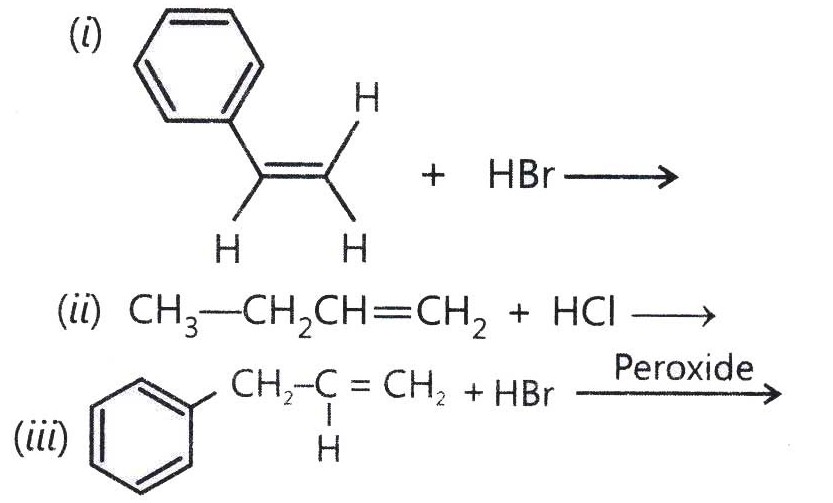
6.
Calculate the amount of sodium of chloride which must be added to one kilogram of water so that the freezing point of water is depressed by 3 K. [Given: K f = 1.86 K kg mol-1, Atomic mass: Na = 23.0 , Cl = 35.5]
7.
What are biocatalysts? Give an example.
8.
Give any two examples of essential amino acids.
9.
Give one example of alkene where addition of HBr gives same product in the presence or absence of peroxide.
10.
Determine the osmotic pressure of a solution prepared by dissolving 2.5 x 10⁻² g of K2 SO4 in 2L of water at 25°C, assuming that it is completely dissociated. (R = 0.0821 L atm K-1 mol-1 , Molar mass of K2 SO4 = 174 g mol-1)
11.
Which one in the following pairs undergoes SN1 substitution reaction faster and why?
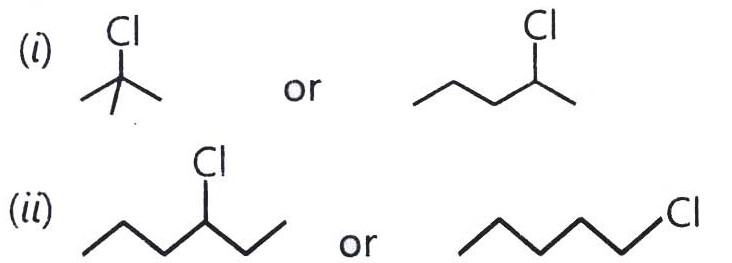
12.
Which type of isomerism is shown by [Co(NH3)5ONO]2+ and [Co(NH3)5NO2]2+?
13.
Write ionisation isomer of [Co(NH3)5 Br]SO4 .
14.
Vitamins represents a group of organic compounds which are needed in small amounts for the healthy growth and maintenance of our body. These are not synthesised by the body and are supplied by the diet. The deficiency of vitamins can be supplemented with medicines.
(i) Which vitamins are water soluble ?
(ii) What are the chemical name of vitamin C and vitamin D ?
(iii) What is the source of vitmain K ?
(iv) How is vitamin K useful ?
15.
(a) Define the following terms:
(i) Molarity
(ii) Molal elevation constant (Kb)
(b) A solution containing 15 g urea (molar mass = 60 g mol-1) per litre of solution in water has the same osmotic pressure (isotonic) as a solution of glucose (molar mass = 180 g mol-1 ) in water. Calculate the mass glucose present in one litre of its solution.
16.
CoSO4Cl.5 NH3 exists in two isomeric forms 'A' and 'B' gives white precipitate with BaCl2 but does not react with AgNO3. Answer the following questions.
(i) Identify 'A' and 'B' and write their structure formulas.
(ii) Name the type of isomerism involved
(iii) Give the IUPAC name of 'A' and 'B'.
17.
Wurtz reaction falils in case of tert-alkyl halides. Explain.
18.
The following reaction gives two products.

Explain the formation of the products and write their structures.
19.
Define the following terms: (i) Mole fraction (ii) Molality (iii) Molarity (iv) Mass percentage.
20.
Write down the IUPAC name for each of the following complexes and indicate the oxidation state, electronic configuration and coordination number. Also give stereochemistry and magnetic moment of the complex:
(a) K[Cr(H2O)2(C2O4)2].3H2O
(b) [CrCl3(py)3]
(c) K4[Mn(CN)6]
(d) [Co(NH3)5Cl]Cl2
(e) Cs[FeCl4]
21.
What should be the correct IUPAC name for diethylbromomethane?
1 -bromo-1, 1-diethylmethane
3-bromopentane
1-bromo-1-ethylpropane
1-bromopentane
22.
Hydrolysis of sucrose is called
inversion
esterification
hydration
saponificatio
23.
Which base is present in RNA, but not in DNA ?
Uracil
Cytosine
Guanine
Thymine
24.
Hydrolysis products of lactose are
glucose and glucose
glucose and fructose
glucose and galactose
none of these
25.
The compounds [Co(SO4)(NH3)5]Br and [Co(SO4)(NH3)]Cl represent
Linkage isomerism
ionisation isomerism
Coordination isomerism
no isomerism
26.
The reaction of tolune with CI2 in presence of light FeCI3 gives X and reaction in presence of light gives Y. Thus, X and Y are
X = benzyl chloride, Y = m-chlororoluene
X = benzyl chloride, Y = o-chlororoluene
X = m-chlororoluene, Y = p-chlororoluene
X = o- and p-chlororoluene, Y = trichloromethylbenzene
27.
The correct IUPAC name of [Pt(NH3)2Cl] is
Diamminedichloridoplatinum (II)
Diamminedichloridoplatinum (IV)
Diamminedichloridoplatinum (0)
Dichloridodiammineplatinum (IV)
28.
The oxidation state of Fe in the brown ring complex [Fe(H2O)5NO]SO4 is
+ 1
+ 2
+ 3
+ 4
29.
Chlorobenzene on treatment with sodium in dry ether gives diphenyl. The name of the reaction is
Fitting reaction
Wurtz-Fitting reaction
Sandmeyer reaction
Gatterman reaction
Wurtz reaction
30.
Which of the following is not chiral?
2-Hydroxypropanoic acid
2-Butanol
2,3-Dibromobutane
3-Bromopentane
31.
Which of the following events does not occur during SN2 reaction mechanism?
Back side attack of nucleophile
Formation of carbonium ion
One step continuous process
100% inversion of configuration
32.
An example of ambidentate ligand is
Ammine
Aquo
Oxalato
Thiacyanato
33.
An azeotropic solution of two liquids has boiling point lower than either of the two liquids when it
shows no deviations from Raoult's law
shows a positive deviation from Raoult's law
shows a negative deviation from Raoult's law
is saturated.
34.
KH value for Ar(g), CO2(g), HCHO (g) and CH4 (g) are 4.39,1.67,1.83 x 10-5 and 0.413 respectively. Arrange these gases in the order of their increasing solubility.
\( \mathrm{HCHO}<\mathrm{CH}_4<\mathrm{CO}_2<\mathrm{Ar}\)
\( \mathrm{HCHO}<\mathrm{CO}_2<\mathrm{CH}_4<\mathrm{Ar} \)
\( \mathrm{Ar}<\mathrm{CO}_2<\mathrm{CH}_4<\mathrm{HCHO} \)
\( \mathrm{Ar}<\mathrm{CH}_4<\mathrm{CO}_2<\mathrm{HCHO} \)
35.
The values of van't Hoff factors for KCI, NaCI and K2SO4, respectively, are ................. .
2,2 and 2
2,2 and 3
1,1, and 2
1,1 and 1
36.
A beaker contains a solution of substance 'A'. Precipitation of substance 'A' takes place when small amount of 'A' is added to the solution. The solution is ................ .
saturated
supersaturated
unsaturated
concentrated
37.
38.
Complex compounds play an important role in our daily life. Werner's theory of complex compounds says every metal atom or ion has primary valency (oxidation state) which is satisfied by -vely charged ions, ionisable where secondary valency (coordination number) is non-ionisable, satisfied by Iigands (+ve, -ve, neutral) but having lone pair. Primary valency is non-directional, secondary valency is directional. Complex compounds are name according to IUPAC system. Valence bond theory helps in determining shapes of complexes based on hybridisation, magnetic properties, outer or inner orbital complex. Complex show ionisation, linkage, solvate and coordination isomerism also called structural isomerism. Some of them also show stereoisomerism i.e. geometrical and optical isomerism. Ambidentate ligand are essential to show linkage isomerism. Polydentate Iigands form more stable complexes then unidentate Iigands. There are called ehelating agents. EDTA is used to treat lead poisoning, cis-platin as anticancer agents. Vitamin B12 is complex of cobalt. Haemoglobin, oxygen carrier is complex of Fe2+ and chlorophyll essential for photosynthesis is complex of Mg2+.
(a) What is the oxidation state of Ni in [Ni(CO)4]?
(b) One mole of CrCI3 . 6H2O reacts with excess of AgO3 to yield 2 mole of AgCI. Write formula of complex. Write IUPAC name also.
(c) Out Cis - [Pt(en)2 CI2 ]2+ and trans (Ptren), CI2 )2+ which one shows optical isomerism?
(d) Name the hexadentate ligand used for treatment of lead poisoning.
(e) What is hybridisation of [CoF6]3- [Co = 27] Give its shape and magnetic properties.
(f) Out [Fe(CO)5], [Fe(C2 O4 )3]3-, [Fe(H2O6)3+, [Fe(CN)6]3-, which is most stable?
(g) What type of isomerism is shown by [Cr(H2O)6] CI3 and [Cr(H2O)5 CI] CI2 . H2O?
1.
Freon-12 is CCI2F2 (dichlorodifluoromethane) and is one of the most common freon in industrial use.
Most freon diffuses unchanged into the stratosphere where it initiates radical chain reactions that upset natural ozone balance.
2.
In [Co(NH 3)6]3+, Co is in +3 state with the configuration 3d6. In the presence of NH 3, 3d electrons pair up leaving two d-orbitals empty. Hence, the hybridisation is d2sp forming an inner orbital complex. In [Ni(NH 3 forming an inner orbital complex. In [Ni(NH 3)6]2+, Ni is in +2 state with the configuration 3d.8. In presence of NH3, the 3d electrons do not pair up. The hybridization involved is sp3d2 forming an outer orbital complex.
3.
A molecule or an ion which has only one donor atom to form one coordinate bond with the central metal atom is called unidentate ligand, e.g.Cl- and NH3.
A molecule or an ion which contains two donor atoms and hence forms two coordinate bonds with the central metal atom is called a didentate ligand, e.g.,
\(\overset { { CH }_{ 2 }{ NH }_{ 2 } }{ \underset { { CH }_{ 2 }{ NH }_{ 2 } }{ | } } and\quad \overset { { COO }^{ - } }{ \underset { { COO }^{ - } }{ | } } \)
a molecule or an ion which contains two donor atoms but only one of them forms a coordinate bond at a time with the central metal atom is called ambidentate ligand, e.g. CN- or NC-and: NO-2 or ONO-
4.
Suppose the two components forming an ideal solution are A and B. Further, suppose that their mole fractions in the liquid phase are xA and xB while in the vapour phase, these are represented by YAand YB respectively. Then \(P_A=X_AP_A^0,P_B=x_Bp_B^0\)
5.
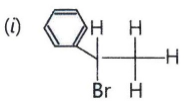


6.
\(NaCI\longrightarrow { Na }^{ + }+{ CI }^{ - }\)
\(\therefore i=2,\triangle { T }_{ f }=i\times { K }_{ f }\times \frac { { W }_{ B } }{ { M }_{ B } } \times \frac { 1000 }{ { W }_{ A } } \)
\(\\ \Rightarrow 3=2\times 1.86\times \frac { { W }_{ B } }{ 58.5 } \times \frac { 1000 }{ 1000 }\)
\(\Rightarrow { W }_{ B }=\frac { 3\times 58.5 }{ 2\times 1.86 } =\frac { 175.5 }{ 3.72 } =47.17\ g\)
7.
Those catalysts which catalyse biochemical reactions are called biocatalysts, e.g. invertase catalyses hydrolysis of cane-sugar to form glucose and fructose.
8.
Valine and Leucine.
9.
Symmetrical alkenes (CH2 = CH2) gives only one addition product.

10.
5.27 x 10⁻³ atm
11.
(i)
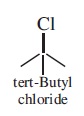
3° halide reacts faster than 2° halide because of the greater stability of tertiary carbocation.
(ii)
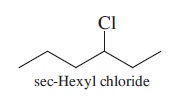
(ii) 2° halide reacts faster than 1° halide because of the greater stability of secondary carbocation than primary.
12.
Linkage isomerism.
13.
[Co(NH3)5 SO4]Br is ionisation isomer of [Co(NH3)5 Br]SO4 .
14.
(i) Vitamin B-complex and vitamin C are water soluble vitamins.
(ii) Vitamin C is chemically ascorbic acid while vitamin D is ergocalciferol.
(iii) Green leafy vegetables like spinach, cabbage, carrot etc.
(iv) It is essentially needed for body. The deficiency of vitamin K leads to blood clotting and even harmorrhage
15.
(a) (i) Molarity: Molarity of a substance in a solution is equal to the number of moles of the substance present in one litre of the solution.
i.e., Molarity = \(\frac { No.\ of\ moles\ of\ substance }{ Volume\ of\ solution\ in\ L } \)
(ii) Molal elevation constant (Kb): It is also called ebullioscopic constant. It is equal to the change in boiling point of one molar solution.
\(\Delta\)Tb = Kb . m
So, when, Molarity = 1,\(\Delta\) Tb = Kb
(b)Given; Mass of urea, WB = 15 g
Molar mass of rea, MB = 60 g
The solution of urea in water is isotonic to that of glucose solution.
So, \(\pi _{ urea }=\pi _{ Glucose }\)
\(C_{ urea }RT=C_{ Glucose }RT\)
\(\frac { { n }_{ urea } }{ V } RT=\frac { { n }_{ Glucose } }{ V } RT\)
\(=\frac { 15 }{ 60 } =\frac { { W }_{ Glucose }V }{ 180 } \)
\(={ W }_{ Glucose }=\frac { 18\times 18 }{ 60 } \)
= 45 g
So, 45 g of glucose is present in 1 L of solution.
16.
(i) As isomer A reacts with AgNO3 to give a white precipitate, CI must be present in the ionization sphere. As it does not react with BaCI2, SO42- must be present in coordination sphere.
Formula of A = [Co(NH3)5SO4] CI (coordination no. of Co = 6) As reactions are reverse for isomer B, formula of B = [Co(NH3)5CI]S04
(ii) Ionization isomerism.
(iii) A = Pentaarnminesulphatocobalt (III) chloride ; B = Pentaamminechloridocobalt (ill) sulphate
17.
tert-Alkyl halides prefer to undergo dehydrohalogenation in presence of a strong base such as Na metal instead of undergoing Wurtz reaction as explained below:
\(\underset{tert-Butyl\ bromide}{(CH_3)_3C-Br}+2Na\longrightarrow\underset{tert-Butylsodium}{(CH_3)_3Na^+}+Na^+Br^-\)
Thus, only rand 2° alkyl halides undergo Wurtz reaction while 3° alkyl halides prefer to undergo dehydrohalogenation to form alkenes.
18.
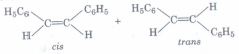
19.
(i) Mole fraction: It is the ratio of the number of moles of one component to the total number of moles of all the components present in the solution. For example, if a binary solution has nA moles of one component and nB moles of second component, then mole fraction of component A(xA) and B(xB) is:
\({ x }_{ A }=\frac { { n }_{ A } }{ { n }_{ A }+{ n }_{ B } } \) and \({ x }_{ B }=\frac { { n }_{ B } }{ { n }_{ A }+{ n }_{ B } } \) and xA + xB = 1
(ii) Molality: It is the number of moles of solute dissolved per 1000 g (or 1 kg) of solvent. If n2 moles of solute are dissolved in w1 g of solvent, then
Molality = \(\frac { { n }_{ 2 } }{ { w }_{ 1 } } \times 1000\)
(iii) Molarity: It is the number of moles of solute dissolved per liter of the solution. If n2 moles of solute are dissolved in V mL of the solution, then
Molarity = \(\frac { { n }_{ 2 }\times 1000 }{ V } \)
(iv) Mass percentage: It is the amount of solute (in grams) per 100 g of the solution. If w2 g of solute are dissolved in w1 g of solvent, then
Mass percentage of solute = \(\frac { { w }_{ 2 } }{ { w }_{ 1 }+{ w }_{ 2 } } \times 100\)
20.
(a) Potassium diaquadioxalatochromate(III) hydrate
In K[Cr(H2O)2(C2O4)2] . 3H2O oxidation state of Cr is (+ 1 + x + 0 - 4 = 0) => x = +3
Coordination No. of Cr is 6
Cr(24) : 4S13d5
(ii) [CrCl3(py)3]
Trichloridotripyridinechromium (III)
Coordination No. of Cr is 6.
Oxidation state is +3.
(iii) K4[Mn(CN)6]
Potassium hexacyanomanganese(II)
+ 4 + x - 6 = a Oxidation state = + 2 , Coordination no. = 6
x = + 2
(iv) [Co(NH3)5Cl]Cl2
Pentaamminechloridocobalt(III) chloride
(v) Cs[FeCl4]
= 5.92 B.M.
21.
(b)
3-bromopentane
22.
(a)
inversion
23.
(a)
Uracil
24.
(c)
glucose and galactose
25.
(d)
no isomerism
26.
(d)
X = o- and p-chlororoluene, Y = trichloromethylbenzene
27.
(a)
Diamminedichloridoplatinum (II)
28.
(a)
+ 1
29.
(a)
Fitting reaction
30.
(d)
3-Bromopentane
31.
(b)
Formation of carbonium ion
32.
(d)
Thiacyanato
33.
(b)
shows a positive deviation from Raoult's law
34.
(c)
\( \mathrm{Ar}<\mathrm{CO}_2<\mathrm{CH}_4<\mathrm{HCHO} \)
35.
(b)
2,2 and 3
36.
(b)
supersaturated
37.
38.
(a) Zero
(b) [Cr(H2O)5Cl]CI2 . H2O, pentaaqua chlorido chromium (III) chloride.
(c) Cis - [Pt(en)2 Cl2]2+ shows optical isomerism.
(d) EDTA4- (ethylene diamine tetra acetate)
(e) Sp3 d2, octahedral, paramagnetic. It is outer orbital complex.
(f) [Fe(CO)5] is most stable because CO is strongest ligand.
(g) Solvate isomerism.

12th Standard CBSE Syllabus & Materials
12th Standard CBSE
CBSE 12th Computer Science Python Revision Tour I - New Previous year Question Papers Study Material - QB365 Set A
NEW12th Standard CBSE
CBSE 12th Business Studies Planning Important Questions And Answers Study Material - QB365 Set A
NEW12th Standard CBSE
CBSE 12th Business Studies Business Environment Important Questions And Answers Study Material - QB365 Set A
NEW12th Standard CBSE
CBSE 12th Business Studies Principles of Management Important Questions And Answers Study Material - QB365 Set A



NCERT Books

Syllabus

Exam Pattern

Sample Question Papers

Previous year Question Papers

Important Notes

MCQ Practice test

NCERT Exemplers

Case study Questions

Image Based Questions

Passage based Questions

HOT Questions

Value Based Questions

Model Questions Papers
NCERT ( Book Back ) Questions

Assertion and Reason
Important Questions And Answers

CBSE 12th Standard CBSE Subjects
CBSE Standards








