
 100% FREE ACCESS
12th Standard CBSE Syllabus & Materials
12th Standard CBSE
CBSE 12th Economics Government Budget and the Economy Previous year Question Papers Study Material - QB365 Set A
NEW12th Standard CBSE
CBSE 12th Computer Science Interface Python with MySQL - New Previous year Question Papers Study Material - QB365 Set A
NEW12th Standard CBSE
CBSE 12th Computer Science Database Concept - New Previous year Question Papers Study Material - QB365 Set A
NEW12th Standard CBSE
CBSE 12th Computer Science Data Communication - New Previous year Question Papers Study Material - QB365 Set A
NEW12th Standard CBSE
CBSE 12th Computer Science Data Structures - New Previous year Question Papers Study Material - QB365 Set A
NEW12th Standard CBSE
CBSE 12th Computer Science Functions - New Previous year Question Papers Study Material - QB365 Set A

Published on: 25/10/2025
Download CBSE Class 12th Standard CBSE Chemistry question papers, sample papers, important questions, and previous year solved papers in PDF format. Get free study materials, NCERT solutions, and exam preparation resources for Class 12th Standard CBSE Chemistry
Questions + Answers key
Take MCQ Chemistry Test
1.
With the help of valence bond theory, compare the magnetic behaviour of\({ \left[ Co{ \left( { NH }_{ 3 } \right) }_{ 6 } \right] }^{ 3+ }\)and \({ \left[ Co{ F }_{ 6 } \right] }^{ 3- }\) complex ions.
2.
Out of C6H5CH2Cl and C6H5CHClC6H5 which is more easily hydrolysed by aqueous KOH?
3.
Predict all the alkenes that would be formed by dehydrohalogenation of the following halides with sodium ethoxide in ethanol and identify the major alkene.
(i) 1-Bromo-1-methylcyclohexane
(ii) 2-chloro-2-methylbutane
(iii) 3-Bromo-2, 2,3-trimethylpentane.
4.
Write the equations for the preparation of 1-iodobutane from
(1) 1-butanol
(2) 1-Chlorobutane
(3) but-1-ene
5.
Write the isomers of the compound having formula C4H9Br.
6.
Haloalkanes react with KCN to form alkyl cyanides as main product while AgCN forms isocyanides as the chief product. Explain
7.
CHF3 is less acidic than CHCl3. Explain
8.
Draw the structures of the following:
(i) Pentaamminenitrito-N-cobalt (III)
(ii) Hexamethyldialuminium.
9.
What is known as a racemic mixture? Give one example.
10.
What is plane polarized light ?
11.
Arrange the following in order of their increasing reactivity in nucleophilic substitution reactions
CH3F, CH3I, CH3Br, CH3CI.
12.
Which is a better nucleophile, a bromide ion or an idodide ion ?
13.
Answer the following questions:
(i) What is meant by chirality of a compound? Give an example.
(ii) Which one of the following compounds is more easily hydrolyzed by KOH and why?
\(CH_3CHClCH_2CH_3\) or \(CH_3CH_2CH_2Cl\)
14.
P-Dichlorobenzene has higher m.pt. and solubility than those of o- and m-isomers. Discuss.
15.
Write the structure of the compound: 4-tert. Butyl-3-iodoheptane.
16.
A solution of KOH hydrolyses CH3 CHCICH2CH3 and CH3CH2CH2CH2Cl. Which one of these is more easily hydrolysed?
17.
What is the coordination number of Fe in [Fe(EDTA)]-?
18.
Name the metal present in
(i) Chlorophyll
(ii) Haemoglobin
(iii) Vitamin B12
(iv) cis-platin.
19.
Write the IUPAC name of [Cr(NH3)6] [Co(CN)6].
20.
Write the IUPAC name of [PtCl(NH2CH3)(NH3)2]CI.
21.
Write the IUPAC name of [Co(CN)2(NH3)4]Cl.
22.
(i) Give name:
(a) the complex used as oxygen carrier in the blood.
(b) the coordination compound of magnesium, which is responsible for photosynthesis.
(ii) Discuss some applications of complex compounds.
23.
Although chlorine is an electron-withdrawing group, yet it is ortho-para-directing in electrophilic aromatic substitution reactions. why ?
24.
What is the relationship between observed colour of the complex and the wavelength of light absorbed by the complex ?
25.
CoSO4Cl.5 NH3 exists in two isomeric forms 'A' and 'B' gives white precipitate with BaCl2 but does not react with AgNO3. Answer the following questions.
(i) Identify 'A' and 'B' and write their structure formulas.
(ii) Name the type of isomerism involved
(iii) Give the IUPAC name of 'A' and 'B'.
26.
Among the isomeric alkanes of molecular formula C5H12, identify the one that on photochemical chlorination yields.
(i) A single monochloride
(ii)Three isomeric monochlorides
(iii) Four isomeric monochlorides.
27.
(R)-2- Bromooctane reacts with NaSH to form (S)-2- octanethiol with inversion of configuration at the stereocentre.How can we obtain (R)-2 octanethiol from (R)-2-bromoctane?
28.
Explain the following in one or two sentences
(i) Displacement of cyanic and amide ion is never observed in nucleophilic substitution reactions.
(ii) RCI is hydrolysed to ROH slowly but the reaction is rapid if a catalytic amount of KI is added to the reaction mixture.
29.
Wurtz reaction falils in case of tert-alkyl halides. Explain.
30.
Draw the structure of all eight structural isomers that have the molecular formula C5H11Br. Name each isomer according to IUPAC system and classify them as primary, secondary or tertiary bromide.
1.
In these complexes, Co (III) has six d-electrons. The first complex ion is diamagnetic and the second has paramagnetic character due to four unpaired electrons. In the [Co(NH3)6]3+complex, the two 3d-electrons get paired up with the other two leaving two vacant orbitals and these vacant orbitals get Sp3d2 hybridized. In the second [CoF]3- complex, the 3d electrons are not disturbed and the outer 4d-orbitals are used for hybridization.
.png)
2.
\({ C }_{ 6 }{ H }_{ 5 }-\overset { \underset { | }{ Cl } }{ CH } -{ C }_{ 6 }{ H }_{ 5 }\) will get hydrolysed easily because carbocation formed will be stabilized by resonance effect of two phenyl groups, whereas in \({ C }_{ 6 }{ H }_{ 5 }{ CH }_{ 2 }Cl\), he carbocation is stabilized by resonance effect of one phenyl group.
3.
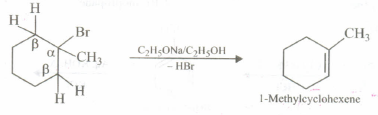
(i) In l-bromo-l-methylcyclohexane, the \(\beta \)-hydrogens on either side of the Br atom are equivalent, therefore, only 1- alkene is formed.
ii) 2-Boro-2-methylbutane has two different sets of equivalent \(\beta \)-hydrogens and hence, in principle, can give two alkenes (I and II). But according to SaytzetT rule, more highly substituted alkene (II), being mor~ stable, is the major product.

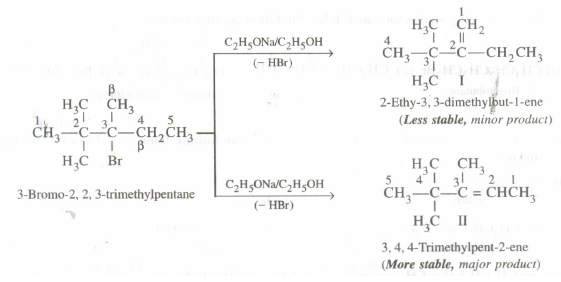
(iii) 3-Bromo-2, 2, 3-trimethylpentane has two different sets of \(\beta \)-hydrogens and hence, in principle, can give two alkenes (I and II). But according to SaytzetT rule, more highly substituted alkene (II), being more stable, is the major product.
4.
(i)

(ii)

(iii)

5.
(i)
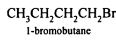
(ii)
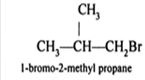
(iii)
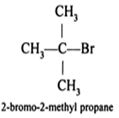
(iv)
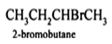
6.
This is nucleophilic substitution reaction. KCN is an ionic compound, it breaks into K+ and CN- in aqueous solution. It attacks 'C' of alkyl halide through carbon since C-C bond is more stable than C-N bond due to lack of polarity. However, AgCN is covalent compound, therefore, bond can form only throu9'h 'N' which has lone pair to donate for forming coordinate bond in isocyanide.
7.
Due to stronger -I-effect of F than CI, CHF3 should be more acidic than CHCI3. But actually reverse is true. This is due to the reason that: CCI3- left after the removal of a proton from CHCI3 is stabilized by resonance due to the presence of d-orbitals on CI but: CF3- left after the removal of a proton from CHF3 is not stabilized by resonance due to the absence of d-orbitals on F.
8.
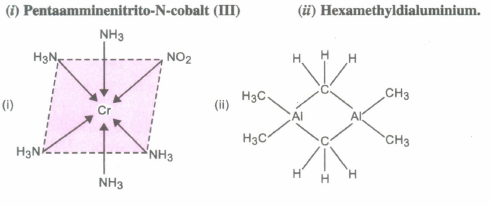
9.
A 50 : 50 mixture of two enantiomers of any optically active compound is called a racemic mixture. It is always optically inactive since rotation caused by the molecules of one enantiomer. For example, an equimolar mixture of (+)-2 bromobutane and (-) -2- bromobutane is called a racemic mixture.
10.
A beam of light which was vibrations in only one plane is called plane polarised light.
11.
Reactivity increases as the carbon-halogen bond dissociation energy decreases, i.e., CH3F < CH3CI < CH3Br < CH3I.
12.
Because of bigger size and lower electronegativity, iodide ion can donate a pair of electrons more easily than bromide ion and hence iodide ion is a better nucleophile than bromide ion.
13.
(i) Chirality: It is a geometrical property of a rigid object ( or molecules ) by which it gets such spatial arrangement of points or atoms that, the molecule becomes non-super imposable of its mirror image.
The chiral molecule of the object does not have any element of symmetry like, a mirror image, centre of inversion (i) etc.
3-bromopent-1-ene is represented as
(ii) Due to +I effect of alkyl groups the 2° carbonium ion CH3—CH+ —CH2—CH3 derived from sec. butyl chloride is more stable than the 1° carbonium ion CH3—CH2—C H2+ derived from n-propyl chloride. Therefore sec. butyl chloride gets hydrolyzed more easily than n-propyl chloride under SN1 conditions.
This is because; iodine is a better leaving group due to its large size. So, it will be released at a faster rate in the presence of an incoming nucleophile
14.
p-Dichlorobenzene is symmetrical, therefore, first into crystal lattice more readily and has higher melting point as compared to o- and m- isomers. Its solubility is higher because it is symmetrical and has more force of attraction with the solvent.
15.
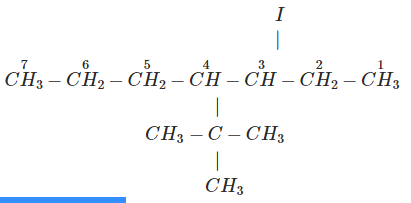
(4-tert-butyl-3-idoheptane)
16.
CH3−CH(Cl)CH2CH3 will be more easily hydrolysed because it will form secondary carbocation which is more stable than primary carbocation.
17.
The coordination number of Fe is 6.
18.
(i) Mg
(ii) Fe
(iii) Co
(iv) Pt
19.
Hexaamminechromium (III) hexacyanocobaltate (III).
20.
Diamminechlorido methanamine platinum(II) chloride.
21.
Tetraamminedicyanocobalt (III) chloride.
22.
(i) (a) Haemoglobin
(b) Chlorophyll
(ii) Applications of complex compounds.
(a) They are used in photography, Le. AgBr forms soluble complex with sodium thiosulphate rn photography.
(b) K[Ag(CN)2] is used for electroplating of silver, K[Au(CN)2] is used for gold plating.
(c) Some of ligands oxidise Co2+ to Co3+ ion.
(d) EDTA is used for estimation of Cla2+ and Mg2+ in hard water.
(e) Silver and gold are extracted by treating zinc with their cyanide complexes.
(f) Ni2+ is tested and estimated by DMG (dimethylglyoxime).
23.
Chlorine withdraws electrons through inductive effect and releases electrons through resonance. Through inductive effect, chlorine destabilises the intermediate carbocation formed during the electrophilic substitution.
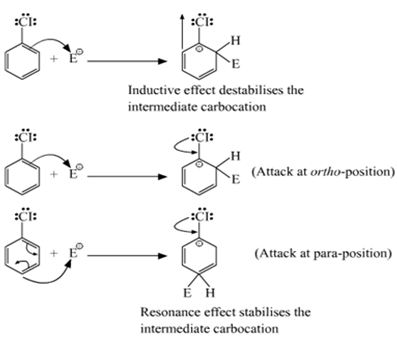
Through resonance, halogen tends to stabilise the carbocation and the effect is more pronounced at ortho- and para- positions. The inductive effect is stronger than resonance and causes net electron withdrawal and thus causes net deactivation. The resonance effect tends to oppose the inductive effect for the attack at ortho- and parapositions and hence makes the deactivation less for ortho- and paraattack. Reactivity is thus controlled by the stronger inductive effect and orientation is controlled by resonance effect.
24.
When white light falls on the complex, some part of it is absorbed. Greater the CFSE, greater is the energy absorbed or shorter is the wavelength absorbed \((E={hc\over\lambda })\). The observed colour is the complementary colour of the colour absorbed.
25.
(i) As isomer A reacts with AgNO3 to give a white precipitate, CI must be present in the ionization sphere. As it does not react with BaCI2, SO42- must be present in coordination sphere.
Formula of A = [Co(NH3)5SO4] CI (coordination no. of Co = 6) As reactions are reverse for isomer B, formula of B = [Co(NH3)5CI]S04
(ii) Ionization isomerism.
(iii) A = Pentaarnminesulphatocobalt (III) chloride ; B = Pentaamminechloridocobalt (ill) sulphate
26.
\((i)\quad { CH }_{ 3 }-\overset { \underset { | }{ { CH }_{ 3 } } }{ \underset { \overset { | }{ { CH }_{ 3 } } }{ C } } -{ CH }_{ 3 }\)
All the H atoms are equivalent.
\((ii)\quad \overset { a }{ { CH }_{ 3 } } -\overset { b }{ { CH }_{ 2 } } -\overset { c }{ \underset { n-Pentane }{ { CH }_{ 2 } } } -\overset { b }{ { CH }_{ 2 } } -\overset { a }{ { CH }_{ 3 } } \)
Replacement of a, b atom gives different products.
\((iii)\quad \overset { a }{ { CH }_{ 3 } } -\underset { \overset { | }{ { CH }_{ 3 } } }{ \overset { b }{ { CH }_{ 2 } } } -\overset { c }{ { CH }_{ 2 } } -\overset { d }{ { CH }_{ 3 } } \)
Replacement of a, b, c and d H atoms give different products.
27.
We know that SN2 reactions proceed with inversion of configuration at the stereocentre. If, however, two SN2 reactions are carried out at the same stereocentre of a compound, retention of configuration will occur. Thus, (R)-2-octanethiol can be obtained from (R)-2-bromooctane by first reacting it with Nal in acetone and then with NaSH in ethanol
28.
(i) HCN (PKa 10) and NH3 (PKa 11·25) are very weak: acids. Therefore, their conjugate bases, i.e., CN- ion and NH2 - are very strong bases. Since strong bases are bad leaving groups, their displacement in nucleophilic substitution reactions is never observed,
(ii) Iodide ion is a powerful nucleophile and hence reacts rapidly with RCI to form RI,
Further because 1- ion is a better leaving group than Cl- ion, therefore, RI is more rapidly hydrolysed than RCI to form ROH,
The I- ion thus regenerated recycles in the above reaction thereby explaining its catalytic effect.
29.
tert-Alkyl halides prefer to undergo dehydrohalogenation in presence of a strong base such as Na metal instead of undergoing Wurtz reaction as explained below:
\(\underset{tert-Butyl\ bromide}{(CH_3)_3C-Br}+2Na\longrightarrow\underset{tert-Butylsodium}{(CH_3)_3Na^+}+Na^+Br^-\)
Thus, only rand 2° alkyl halides undergo Wurtz reaction while 3° alkyl halides prefer to undergo dehydrohalogenation to form alkenes.
30.
| CH3CH2CH2CH2CH2Br | 1-Bromopentane (1o) |
| CH3CH2CH2CH(Br)CH3 | 2-Bromopentane(2o) |
| CH3CH2CH(Br)CH2CH3 | 3-Bromopentane (2o) |
| (CH3)2CHCH2CH2Br | 1-Bromo-3-methylbutane (1o) |
| (CH3)2CHCHBrCH3 | 2-Bromo-3-methylbutane(2o) |
| (CH3)2CBrCH2CH3 | 2-Bromo-2-methylbutane (3o) |
| CH3CH2CH(CH3)CH2Br | 1-Bromo-2-methylbutane(1o) |
| (CH3)3CCH2Br | 1-Bromo-2,2-dimethylpropane (1o) |

12th Standard CBSE Syllabus & Materials
12th Standard CBSE
CBSE 12th Computer Science Python Revision Tour I - New Previous year Question Papers Study Material - QB365 Set A
NEW12th Standard CBSE
CBSE 12th Business Studies Planning Important Questions And Answers Study Material - QB365 Set A
NEW12th Standard CBSE
CBSE 12th Business Studies Business Environment Important Questions And Answers Study Material - QB365 Set A
NEW12th Standard CBSE
CBSE 12th Business Studies Principles of Management Important Questions And Answers Study Material - QB365 Set A



NCERT Books

Syllabus

Exam Pattern

Sample Question Papers

Previous year Question Papers

Important Notes

MCQ Practice test

NCERT Exemplers

Case study Questions

Image Based Questions

Passage based Questions

HOT Questions

Value Based Questions

Model Questions Papers
NCERT ( Book Back ) Questions

Assertion and Reason
Important Questions And Answers

CBSE 12th Standard CBSE Subjects
CBSE Standards








