
 100% FREE ACCESS
12th Standard CBSE Syllabus & Materials
12th Standard CBSE
CBSE 12th Economics Government Budget and the Economy Previous year Question Papers Study Material - QB365 Set A
NEW12th Standard CBSE
CBSE 12th Computer Science Interface Python with MySQL - New Previous year Question Papers Study Material - QB365 Set A
NEW12th Standard CBSE
CBSE 12th Computer Science Database Concept - New Previous year Question Papers Study Material - QB365 Set A
NEW12th Standard CBSE
CBSE 12th Computer Science Data Communication - New Previous year Question Papers Study Material - QB365 Set A
NEW12th Standard CBSE
CBSE 12th Computer Science Data Structures - New Previous year Question Papers Study Material - QB365 Set A
NEW12th Standard CBSE
CBSE 12th Computer Science Functions - New Previous year Question Papers Study Material - QB365 Set A

Published on: 25/10/2025
Download CBSE Class 12th Standard CBSE Chemistry question papers, sample papers, important questions, and previous year solved papers in PDF format. Get free study materials, NCERT solutions, and exam preparation resources for Class 12th Standard CBSE Chemistry
Questions + Answers key
Take MCQ Chemistry Test
1.
Define azeotropes. What type of azeotrope is formed by positive deviation from Raoult's law? Give an example.
2.
(i) CH3CH2I \(\overset { NaCN }{ \longrightarrow } \ ?\ \overset { OH^{ - },\ partial\ hydrolysis }{ \longrightarrow } \)?
(ii) CH3CH2Br
3.
Answer the following questions:
(i) What is meant by chirality of a compound? Give an example.
(ii) Which one of the following compounds is more easily hydrolyzed by KOH and why?
\(CH_3CHClCH_2CH_3\) or \(CH_3CH_2CH_2Cl\)
4.
What is lanthanoid contraction? What are the consequences of lanthananoid contraction?
5.
What the molarity of acetic acid containing 6 g of acetic acid per litre of solution?
6.
Explain why Cu(I) ion is not stable in aqueous solution ?
7.
A 0.5% aqueous solution of KCl was found to be freeze at -0.24°C. Calculate the van't Hoff factor and degree of dissociation of the solute at this concentration. (K f for water = 1.86 Kkg mol-1).
8.
Explain with example the concept of minimum boiling azeotropes and maximum boiling azeotropes.
9.
Calculate the boiling point elevation for a solution prepared by adding 10 g of CaCl2 to 200 g of water. (Kb for water = 0.52 K kg mol-1, molar mass of CaCl2 = 111 g mol-1).
10.
What happens when
(i) Chlorobenzene is treated with CI2/FeCI3,
(ii) Ethyl chloride is treated with AgNO2,
(iii) 2-bromopentane is treated with alcoholic KOH?
Write the chemical equations in support of your answer.
11.
Explain as to why the \(E^{ \ominus }\) value for the \(Mn^{ 3+ }/Mn^{ 2+ }\) couple is much more positive than that for \(Cr^{ 3+ }/Cr^{ 2+ }\) or \(Fe^{ 3+ }/Fe^{ 2+ }\) .
12.
(a) write a chemical test to distinguish between:
(i) Chlorobenzene and Benzyl chloride.
(ii) Chloroform and Carbon tetrachloride.
(b) Why is methyl chloride hydrolysed more easily than chlorobenzene?
13.
The number of unpaired electrons in gaseous species of Mn3+. Cr3+ and V3+ respectively are ........ and most stable species is ......... .
4,3 and 2 and V3+ is most stable
3,3 and 2 and Cr3+ is most stable
4,3 and 2 and Cr3+ is most stable
3,3 and 3 and Mn3+ is most stable.
14.
Which of the following actinoids show oxidation states upto +7 ?
Am
Pu
U
Np
15.
Which of the following are amphoteric oxides ?
\({ Mn }_{ 2 }{ O }_{ 7 },{ CrO }_{ 3 },{ Cr }_{ 2 }{ O }_{ 3 },CrO,{ V }_{ 2 }{ O }_{ 5 },{ V }_{ 2 }{ O }_{ 4 }\)
\({ V }_{ 2 }{ O }_{ 5 },{ Cr }_{ 2 }{ O }_{ 3 }\)
\({ Mn }_{ 2 }{ O }_{ 7 },{ CrO }_{ 3 }\)
\(CrO,{ V }_{ 2 }{ O }_{ 5 }\)
\({ V }_{ 2 }{ O }_{ 5 },{ V }_{ 2 }{ O }_{ 5 }\)
16.
The magnetic nature of elements depends on the presence of unpaired electrons, Identify the configuration of transition element, which shows highest magnetic moment.
3d7
3d5
3d8
3d2
17.
The reactivity order of halides for dehydrohalogenation is
R-F > R-Cl > R-Br > R-I
R-I > R-Br > R-Cl > R-F
R-I > R-Cl > R-Br > R-F
R- > R-I > R-Br > R-Cl
18.
Which of the following are arranged in the decreasing order of dipole moment?
CH3Cl, CH3Br, CH3F
CH3Cl, CH3F, CH3Br
CH3Br, CH3Cl, CH3F
CH3Br, CH3F, CH3Cl
19.
In the reaction : \(NaCI+{ K }_{ 2 }{ Cr }_{ 2 }{ O }_{ 7 }+conc.{ H }_{ 2 }{ SO }_{ 4 }\underrightarrow { heat } X+{ Na }_{ 2 }{ SO }_{ 4 }+{ K }_{ 2 }{ SO }_{ 4 }+{ H }_{ 2 },X\) is a raddish brown gas which gives a yellow solution on passing through water and a yellow precipitate on treating the solution with lead acetate solution X could be
CI2
CrO3
H2CrO4
CrO2CI2
20.
If on dissolving the above amount of NaCl in 1 kg of water, the freezing point is found to be \(-{ 0.344 }^{ \circ }C\), the percentage dissociation of NaCl in the solution is
75%
80%
85%
90%
21.
Which one of the following aqueous solutions will have the lower freezing point?
0.1 molal solution of urea
0.1 molal solution of acetic acid
0.1 molal solution of sodium chloride
0.1 molal solution of calcium chloride
22.
The molal freezing point constant of water is 1.86o C/M. Therefore the freezing point of 0.1 M NaCl solution in water is expected to be
- 1.86oC
- 0.186oC
- 0.372oC
+ 0.372oC
23.
Formation of a solution from two components can be considered as
(i) pure solvent \(\longrightarrow \) seperated solvent molecules, \(\Delta { H }_{ 1 }\)
(ii) pure solute \(\longrightarrow \) seperated solute molecules,\(\Delta { H }_{ 2 }\)
(iii) separated solvent and solute molecules \(\longrightarrow \) solution,\(\Delta { H }_{ 3 }\)
Solution so formed will be ideal if.
\(\Delta { H }_{ soln }=\Delta { H }_{ 1 }+\Delta { H }_{ 2 }+\Delta { H }_{ 3 }\)
\(\Delta { H }_{ soln }=\Delta { H }_{ 1 }+\Delta { H }_{ 2 }-\Delta { H }_{ 3 }\)
\(\Delta { H }_{ soln }=\Delta { H }_{ 1 }-\Delta { H }_{ 2 }-\Delta { H }_{ 3 }\)
\(\Delta { H }_{ soln }=\Delta { H }_{ 3 }-\Delta { H }_{ 1 }-\Delta { H }_{ 2 }\)
24.
Increasing the temperature of an aqueous solution will cause
Decrease in molality
decrease in molarity
decrease in mole fraction
decrease in % w/w
25.
(a) How would you convert the following.
(i) Prop-1-ene to 1-fluoropropane
(ii) Chlorobenzene to 2-Chloro toluene
(iii) Ethanol to Propane nitrile
(b) Although chlorine is an electron withdrawing group, yet it is ortho-, para-directing in electrophilic aromatic substitution reactions. Explain why it is so?
26.
(i) What is van't Hoff factor?
(ii) What possible values can it have if the solute molecules undergo dissociation?
(iii) An aqueous solution containing 12.48 g of barium chloride in 1.0 kg of water boils at 373.0832 K. Calculate the degree of dissociation of barium chloride. (Given, Kb for H2O = 0.52 K m -1; molar mass of BaCl2 = 208.34 g mol-1).
27.
(i) Give the differences (any three) between ideal and non-ideal solutions.
(ii) Which of the following solutions will have the highest and lowest osmotic pressure? and why?
(a) Sugar in water (b) Salt in water
28.
(a) Complete the following chemical equations :
\((i)\ { Cr }_{ 2 }{ O }_{ 7 }^{ 2- }(aq)+{ H }_{ 2 }S(g)+{ H }^{ + }(aq)\longrightarrow \)
\((ii)\ { Cu }^{ 2+ }(aq)+{ I }^{ - }(aq)\longrightarrow\)
(b) How would you account for the following ?
(i) The oxidizing power of oxoanions is the order : \({ VO }_{ 2 }^{ + }<{ Cr }_{ 2 }{ O }_{ 7 }^{ 2- }<{ MnO }_{ 4 }^{ - }\)
(ii) The third ionization enthalpy of manganese (Z = 25) is exceptionally high.
(iii) Cr2+ is stronger reducing agent than Fe2+
29.
30.
Assertion: Dilute solution of benzene and toluene is an ideal solution.
Reason: Benzene and toluene form H-bonding with each other.
Codes:
A) Assertion and reason both are correct statements and reason is correct explanation for assertion.
B) Assertion and reason both are correct statements but reason is not correct explanation for assertion.
C) Assertion is correct statement but reason is wrong statement.
D) Assertion is wrong statement but reason is correct statement.
31.
In the following questions. an Assertion (A) is followed by a corresponding Reason (R) Use the following keys to choose the appropriate answer.
Assertion (A) Nitration of chlorobenzene leads to the formation of ortho and para nitrochloro benzene.
Reason (R) -NO2 group is a o,p-directing group.
Codes:
(a) Both (A) and (R) are correct, (R) is the correct explanation of (A).
(b) Both (A) and (R) are correct, (R) is not the correct explanation of (A).
(c) (A) is correct; (R) is incorrect.
(d) (A) is incorrect; (R) is correct.
32.
In the following questions. an Assertion (A) is followed by a corresponding Reason (R) Use the following keys to choose the appropriate answer.
Assertion (A) SN1 reaction is accompanied by racemisation.
Reason (R) Carbocation is formed in this reaction and attack of nucleophile can be from either side of the leaving group.
Codes:
(a) Both (A) and (R) are correct, (R) is the correct explanation of (A).
(b) Both (A) and (R) are correct, (R) is not the correct explanation of (A).
(c) (A) is correct; (R) is incorrect.
(d) (A) is incorrect; (R) is correct.
33.

34.
Read the passage given below and a.9swer the following questions:
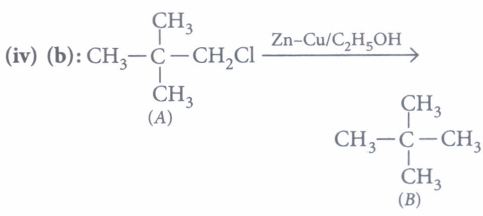
A chlorocompound (A) on reduction with Zn-Cu and ethanol gives the hydrocarbon (B) with five carbon atoms. When (A) is dissolved in dry ether and treated with sodium metal it gave 2,2,5,5 tetramethylhexane. The treatment of (A) with alcoholic KCN gives compound (C).
The following questions are multiple choice questions. Choose the most appropriate answer:
(i) The compound (A) is
| (a) 1-chloro- 2, 2-dimethylpropane | (b) 1-chloro- 2, 2-dimethyl butane |
| (c) 1-chloro-2-methyl butane | (d) 2-chloro-2-methyl butane. |
(ii) The reaction of (C) with Na, C2H5OH gives
| (a) (CH3)3C CH2CONH2 | (b) (CH3)3C NH2 |
| (c) (CH)3C CH2CH2NH2 | (d) (CH3)2CHCH2NH2 |
(iii) The reaction of (C) with Na, C2H5OH is called
| (a) Gilman reaction | (b) Mendius reaction |
| (c) Grooves process | (d) Swart's reaction. |
(iv) Compound (B) is
| (a) n-pentane | (b) 2, 2-dimethylpropane |
| (c) 2-methylbutane | (d) none of these. |
1.
Azeotropes are constant boiling mixtures which distill out unchanged in their composition.
Minimum boiling azeotropes are formed by solutions showing positive deviation, e.g. cyclohexane and ethanol.
2.
(i) CH3CH2CN, CH3CH2CONH2
(ii) CH3CH2CN, CH3CH2CH2NH2
3.
(i) Chirality: It is a geometrical property of a rigid object ( or molecules ) by which it gets such spatial arrangement of points or atoms that, the molecule becomes non-super imposable of its mirror image.
The chiral molecule of the object does not have any element of symmetry like, a mirror image, centre of inversion (i) etc.
3-bromopent-1-ene is represented as
(ii) Due to +I effect of alkyl groups the 2° carbonium ion CH3—CH+ —CH2—CH3 derived from sec. butyl chloride is more stable than the 1° carbonium ion CH3—CH2—C H2+ derived from n-propyl chloride. Therefore sec. butyl chloride gets hydrolyzed more easily than n-propyl chloride under SN1 conditions.
This is because; iodine is a better leaving group due to its large size. So, it will be released at a faster rate in the presence of an incoming nucleophile
4.
The decrease in atomic and ionic size with increase in atomic number in lanthanoids is called lanthanoid contraction.
Consequences:
(i) There is close resemblance between 4d and 5d transition series.
(ii) Lanthanides have similar chemical properties due to similar ionic size.
5.
\(=\frac{W_E}{M_E} \times \frac{1000}{\text { Volume of solution in ml }}=\frac{6}{60} \times \frac{1000}{1000}=0.1 \mathrm{M} \text {. }\)
6.
In aqueous solution, copper (1) undergoes disproportionation reaction.
2Cu (aq) ⟶ Ca³+Co(s)
The highest stability of Cu ion in aqueous solution is due to negative enthalpy of hydration.
Hence, Cu is not known (or unstable) in aqueous solution
7.
\(\text {Given, } K_{f} =1.86 \mathrm{~K} \mathrm{~kg} \mathrm{~mol}^{-1}, W_{2}=0.5 \mathrm{~g}, W_{1}=100 \mathrm{~g} \)
\(\Delta T_{f} =0.24^{\circ}\)
Observed molecular mass of KCl
\(=\frac{1000 \times K_{f} \times W_{2}}{\Delta T_{f} \times W_{1}}\)
\(=\frac{1000 \times 1.86 \times 0.5}{0.24 \times 100}=38.75\)
Normal molecular mass of \( \mathrm{KCl}=38.75+35.5=74.25\)
\(\text {van't Hoff factor }=\frac{\text { Normal molecular mass }}{\text { Observed molecular mass }} \)
\(i=\frac{74.25}{38.75}=1.92\)
\( \underset{(1-\alpha)}{\mathrm{KCl}} \rightleftharpoons \underset{\alpha}{\mathrm{K}^{+}}+\underset{\alpha}{\mathrm{Cl}^{-}} Total \ number \ of\ particles =1-\alpha+\alpha+\alpha=1+\alpha\)
\(i=1+\alpha \quad 1.92=1+\alpha\)
\(So, \alpha=1.92-1=0.92, i.e. 92 \% \ dissociated.\)
8.
Maximum boiling azeotropes
Maximum boiling azeotropes are those which boil at a higher temperature than the boiling point of each component in a pure state,
e.g., 68 % nitric acid and 32 % water by mass.
Minimum boiling azeotropes
Minimum boiling azeotropes are those which boil at a lower temperature than boiling point of each component in the pure state,
e.g., 95.5 % ethyl alcohol and 4.5 % water by mass.
9.
Mass of CaCl2 (W2) =10g
Mass of water (W1) = 200 g
Molar mass of CaCl2 (M2) = 111 g mol-1
Kb=0.512 K kg mol-1
\(m=\frac{W_2\times 1000}{M_2 \times W_1} \Rightarrow m=\frac{10}{111}\times \frac{1000}{200}\)
\(m=0.450 \ kg \ mol^{-1} , \Delta T_b = K_b\times m\)
0 = 0.512 kg mol-1 x 0.450 m = 0.2304 K
10.
(i)
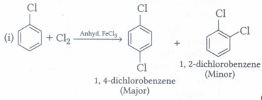
(ii) CH3CH2CI + AgNO2\(\rightarrow\)CH3CH2NO2+AgCI
(iii) CH3CH2CH2CH(Br)CH3 + KOH(alc.)\(\rightarrow\)CH3CH2CH=CH CH3
11.
(i) Zinc (Z= 30, 1822822p6 3823p6 3d10 482)does not have partially filled d-subshell in its elementary state or in its commonly occurring oxidation state (Zn2+: 3dlO). Therefore, it is not regarded as a transition element.
(ii) Transition elements or the d-block elements from a large number of coordination complexes. The transition metal ions bind to a number of anions or neutral molecules in these complexes. The common examples are [Ni(NHJJ2+, [Co(NHJJ3-, [Fe(CN)J3+,
[Fe(CN)J4-, [Cu(NH3)4]2+e,etc. The high tendency of transition metal ions to form complexes is due to
(a) small size of the atoms and ions of transition metals
(b) high nuclear charge
(c) availability of vacant d-orbitals of suitable energy to accept lone pairs of electrons donated by other groups (called ligands).
(iii) Mn2+ has 3d5 electronic configuration. It is stable because of the half-filled configuration of d-subshell. Therefore, Mn has very high third ionization enthalpy for the change from d5 to d4 and it is responsible for much more positive EOvalue for Mn3+/Mn2+couple in comparison to Cr3+/Cr2+couple.
12.
(a) (i) Chlorobenzene and Benzyl chloride Take both the compounds in a test tube. Add 1 - 2 ml of aqueous KOH to each of the test tubes. Acidify with dilute HNO3 and add AgNO3. Benzyl chloride gives white precipitate while chlorobenzene does not.
(ii) Chloroform and Carbon tetrachloride Chloroform on warming with alcoholic KOH and aniline will give foul smell of isocyanide; whereas, Carbon tetrachloride will not show any change.
(b) Methyl chloride hydrolysed more easily than chlorobenzene. It is due to double bond character in chlorobenzene due to resonance which is difficult to break as compared to single bond (C—Cl) in CH3Cl.
13.
(c)
4,3 and 2 and Cr3+ is most stable
14.
(d)
Np
15.
(a)
\({ V }_{ 2 }{ O }_{ 5 },{ Cr }_{ 2 }{ O }_{ 3 }\)
16.
(b)
3d5
17.
(b)
R-I > R-Br > R-Cl > R-F
18.
(b)
CH3Cl, CH3F, CH3Br
19.
(d)
CrO2CI2
20.
(c)
85%
21.
(d)
0.1 molal solution of calcium chloride
22.
\(NaCl\longrightarrow { Na }^{ + }+{ Cl }^{ - },i=2\\ \Delta { T }_{ f }={ iK }_{ f }m=2\times 1.86\times 0.1={ 0.372 }^{ o }C,\\ { T }_{ f }={ 0.372 }^{ o }C.\)
23.
(a)
\(\Delta { H }_{ soln }=\Delta { H }_{ 1 }+\Delta { H }_{ 2 }+\Delta { H }_{ 3 }\)
24.
On increasing the temperature, volume of the solution increases. Hence Molarity decreases.
25.
(a) \(\text { (i) } \mathrm{CH}_{3}-\mathrm{CH}=\mathrm{CH}_{2}+\mathrm{HBr} \stackrel{\text { Peroxide }}{\longrightarrow} \mathrm{CH}_{3} \mathrm{CH}_{2} \mathrm{CH}_{2} \mathrm{Br} \frac{\mathrm{Ag} \mathrm{F}}{\text { Swartz reaction }} \mathrm{CH}_{3} \mathrm{CH}_{2} \mathrm{CH}_{2} \mathrm{~F}\)
Prop-1-ene 1-Bromopropane 1-Fluoropropane
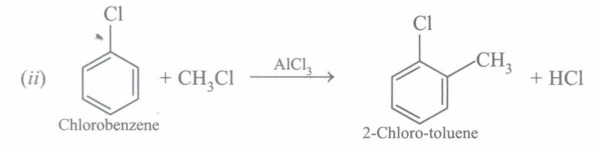
\(\mathrm{CH}_{3} \mathrm{CH}_{2} \mathrm{OH} \stackrel{\mathrm{PCl}_{5}}{\longrightarrow} \mathrm{CH}_{3} \mathrm{CH}_{2} \mathrm{Cl} \quad \stackrel{\mathrm{KCN}}{\longrightarrow} \quad \mathrm{CH}_{3} \mathrm{CH}_{2} \mathrm{CN}\)
Ethanol Chloroethane Propane nitrile
(b) Chlorobenzene is resonance hybrid of following structures:
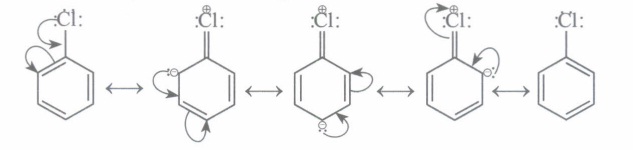
Since, electron density is maximum at o-and p-positions due to +R effect, therefore, electrophilic substitution will take place at o and p-positions.
26.
(i) The van't Hoff factor is a measure of the effect of a solute upon colligative properties such as osmotic pressure, relative lowering in vapour pressure, the elevation of boiling point and freezing point depression.
The van't Hoff factor is the ratio between the actual concentration of particles produced when the substance is dissolved and the concentration of a substance as calculated from its mass.
\(= \frac{observed \ molecular \ mass}{mormal \ molecular \ mass}\)
(ii) The van 't Hoff factor is the ratio between the actual concentration of particles produced when the substance is dissolved and the concentration of a substance as calculated from its mass. if solute particles undergo association then , i<1 and if dissociation then, i > 1.
(iii) M2 = 12.4g
MH2O = 1.0kg
Tb = 373.0832K
Tb0 = 373.15K
Kb = 0.52km−1
M2 = 208.34
α = ?
ΔTb = iKb × m
373.0832 − 373 = \(i=\frac{208.34\times1}{0.52\times12.48\times1000}\)
i = 2.67
BaCl2 →Ba2+ + 2Cl−
n = 3
\(\alpha=\frac{i-1}{n-1}=\frac{2.67-1}{3-1}\)
= 83.55%
27.
| Ideal solution | Non Ideal solution |
| It obeys Raoult's law over the entire range of concentration. | It does not obeys Raoult's law |
| Total vapour pressure of solution is the sum of vapour pressure of individual components. |
Total vapour pressure of solution is not equal to the sum of vapour pressure of individual components. |
| Solute - solvent interactions are nearly same as in pure solvent. |
Solute-solvent interactions are not same as solute- solute or solvent--solvent interactions. |
28.
(a) (i) \( \mathrm{Cr}_{2} \mathrm{O}_{7}^{2-}(a q)+3 \mathrm{H}_{2} \mathrm{~S}(g)+8 \mathrm{H}^{+}(a q) \) \(\longrightarrow 2 \mathrm{Cr}^{3+}+3 \mathrm{~S}+7 \mathrm{H}_{2} \mathrm{O}\)
(ii) \( 2 \mathrm{Cu}^{2+}(a q)+2 \mathrm{I}^{-}(a q) \longrightarrow 2 \mathrm{Cu}^{+}(a q)+\mathrm{I}_{2}(s)\)
(b) (i) It is because V in lower oxidation the state is less stable than Cr which is less stable than Mn. That is why MnO4 is a best oxidizing agent and VO2+ is least.
(ii) M n (2 5) has electronic configuration [Ar]4s23ds, electronic configuration of Mn2+ is [Ar]4so3ds. After losing 2 electrons, it has half filled d-orbital, which is more stable that is why Mn2+ has exceptionally high third ionization energy, i.e. the energy required to remove
the third electron is very high.
(iii) It is because in Cr3+, d3 (half filled t2g orbitals) is more stable in aqueous solution than Fe3+ i.e. Cr3+ is more stable than Fe3+.
29.
30.
C) Assertion is correct statement but reason is wrong statement.
Explanation:
Benzene and toluene do not form H-bonding with each other.
31.
(c) (A) is correct but (R) is incorrect. Presence of - Cl in chlorobenzene activates the ring at ortho and, para-positions and therefore, nitration of chlorobenzene leads to the formation of o- and p-chloro nitro chlorobenzene. NO2 group is a meta-directing group.
32.
(a) In case of optically active alkyl halides, SN1 reactions are accompanied by racemisation. The carbocation formed in the slow step being sp2 -hybridised is planar (achiral). The attack of the nucleophile may be from either side resulting mixture of products. One product has same configuration, while other has opposite configuration. Thus, both (A) and (R) are correct and (R) is the correct explanation of (A).
33.
34.
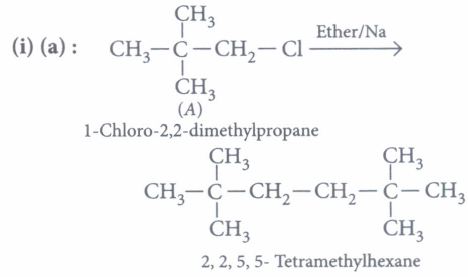
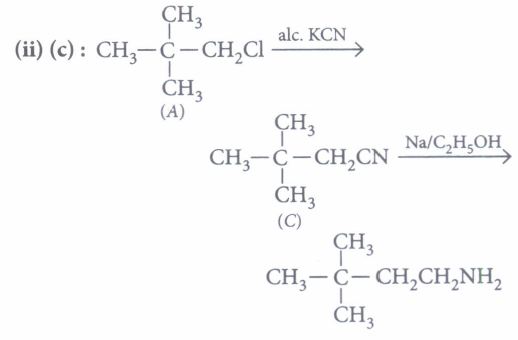
(iii) (b)

12th Standard CBSE Syllabus & Materials
12th Standard CBSE
CBSE 12th Computer Science Python Revision Tour I - New Previous year Question Papers Study Material - QB365 Set A
NEW12th Standard CBSE
CBSE 12th Business Studies Planning Important Questions And Answers Study Material - QB365 Set A
NEW12th Standard CBSE
CBSE 12th Business Studies Business Environment Important Questions And Answers Study Material - QB365 Set A
NEW12th Standard CBSE
CBSE 12th Business Studies Principles of Management Important Questions And Answers Study Material - QB365 Set A



NCERT Books

Syllabus

Exam Pattern

Sample Question Papers

Previous year Question Papers

Important Notes

MCQ Practice test

NCERT Exemplers

Case study Questions

Image Based Questions

Passage based Questions

HOT Questions

Value Based Questions

Model Questions Papers
NCERT ( Book Back ) Questions

Assertion and Reason
Important Questions And Answers

CBSE 12th Standard CBSE Subjects
CBSE Standards








