
 100% FREE ACCESS
12th Standard CBSE Syllabus & Materials
12th Standard CBSE
CBSE 12th Economics Government Budget and the Economy Previous year Question Papers Study Material - QB365 Set A
NEW12th Standard CBSE
CBSE 12th Computer Science Interface Python with MySQL - New Previous year Question Papers Study Material - QB365 Set A
NEW12th Standard CBSE
CBSE 12th Computer Science Database Concept - New Previous year Question Papers Study Material - QB365 Set A
NEW12th Standard CBSE
CBSE 12th Computer Science Data Communication - New Previous year Question Papers Study Material - QB365 Set A
NEW12th Standard CBSE
CBSE 12th Computer Science Data Structures - New Previous year Question Papers Study Material - QB365 Set A
NEW12th Standard CBSE
CBSE 12th Computer Science Functions - New Previous year Question Papers Study Material - QB365 Set A

Published on: 25/10/2025
Download CBSE Class 12th Standard CBSE Chemistry question papers, sample papers, important questions, and previous year solved papers in PDF format. Get free study materials, NCERT solutions, and exam preparation resources for Class 12th Standard CBSE Chemistry
Questions + Answers key
Take MCQ Chemistry Test
1.
Give reasons for the following:
(a) Measurement of osmotic pressure method is preferred for the determination of molar masses of macro molecules such as proteins and polymers.
(b) Aquatic animals are more comfortable in cold 1 water than in warm water.
(c) Elevation of boiling point of 1M KCI solution is nearly double than that of 1M sugar solution.
2.
Give reasons for the following observations:
(i) p-dichlorobenzene has higher melting point than those of 0 and m-isomers
(ii) Haloarenes are less reactive than halo alkanes towards nucleophilic substitution reaction.
(iii) The treatment of alkyl chloride with aqueous KOH leads to the formation of alcohol but in the presence of alcoholic KOH, alkene is the major product.
3.
From the given data of E0 values, answer the following questions:
| \(E_{(M^{2+}/Mn)}^0\) | Cr | Mn | Fe | Co | Ni | Cu |
| -0.91 | -1.18 | -0.44 | -0.28 | -0.25 | +0.34 |
|---|
(i) Why is \(E_{(Cu^{2+}/Cu)}^0\) value exceptionally positive?
(ii) Why is \(E_{(M^{2+}/Mn)}^0\) value highly negative as compared to other elements?
(iii) Which is a stronger reducing agent Cr2+ or Fe2+? Give reason.
4.
A 5% solution by mass of cane sugar, C12H22O11 (molecular weight 342) is isotonic with 0.877% solution of substance 'X'. Find the molecular weight of substance X.
5.
What happens when
(i) Chlorobenzene is treated with CI2/FeCI3,
(ii) Ethyl chloride is treated with AgNO2,
(iii) 2-bromopentane is treated with alcoholic KOH?
Write the chemical equations in support of your answer.
6.
How do you convert:
(i) Chlorobenzene to biphenyl,
(ii) Propene to I-iodopropane,
(iii) 2-bromobutane to but-2-ene.
7.
(a) Assuming complete ionization, calculate the expected freezing point of solution prepared by dissolving 6.00 g of Glauber's salt, Na2SO4. 10H2O in 0.1 kg of H2O. (K f for H2O = 1.86 K kg mol-1) [At. mass of Na = 23, S = 32, O= 16, H = 1 u].
(b) Two liquids X and Y boil at 110 oC and 130 oC respectively. Which of them has higher vapor pressure at 50oC ?
8.
Define the following terms:
(i) Isotonic solutions
(ii) Hypertonic solutions
(iii) Hypotonic solutions
9.
Why the solubility of Glauber's salt (Na2SO4 .10H2O) first increases upto 32.4°C and then decreases?
10.
Write the chemical equations when,
(i) methyl chloride is treated with AgN02.
(ii) bromo benzene is treated with CH3CI in the presence of anhydrous AICl3
11.
Explain the following observations:
(i) Transition elements generally form colored compounds.
(ii) Zinc is not regarded as a transition element.
12.
Explain giving a suitable reason for each of the following:
(i) Transition metals and their compounds are generally found to be good catalysts.
(ii) Metal-metal bonding is more frequent for the 4d and the 5d series transition metals than that for the 3d series.
13.
The colour of KMnO4 is due to
\(L\rightarrow M \) charge transfer transition
\(\sigma \rightarrow { \sigma }^{ * }\) transition
\(M\rightarrow L\) charge transfer transition
\(d \rightarrow d\) transition.
14.
Among the following pairs of ions, the lower oxidation state in aqueous solution is more stable than the other, in
Ti+,Ti3+
Cu+,Cu2+
Cr2+,Cr3+
V2+,VO2+
15.
Arrange the following : CH3CH2CH2CI (I), CH3CH2CHCICH3 (II), (CH3)2CHCH2CI (III) and(CH3)3C__CI (IV) in order of decreasing tensency towards SN2 reactions
I > III > II > IV
III > IV > II > I
II > I > III > IV
IV > III > II > I
16.
Which one is most reactive towards SN1 reaction ?
C6H5CH2Br
C6H5CH(C6H5)Br
C6H5CH(CH3)Br
C6H5C(CH3)(C6H5)Br
17.
The arrangements of following compounds :
(i) bromomethane
(ii) bromoform
(iii) chloromethane
(iv) dibromomethane
in the increasing order of their voiling point is
(iv) < (iii) < (i) < (ii)
(i) < (ii) < (iii) < (iv)
(iii) < (i) < (iv) < (ii)
(ii) < (iii) < (i) < (iv)
18.
Which of the following is not chiral?
2-Hydroxypropanoic acid
2-Butanol
2,3-Dibromobutane
3-Bromopentane
19.
Which of the following factor may be regarded as the main cause of lanthanide contraction ?
Poor shielding of one of the 4f - electrons by another in the subshell
Effective shielding of one of the 4f - electrons by another in the subshell
Poorer shielding of 5d electrons by 4f electrons
Greater shielding of 5d electrons by 4f electrons.
20.
Which of the following ion is colourless in aqueous solution ?
Fe2+
Mn2+
Ti3+
Sc3+
21.
In first transition series which of the following has lowest enthalpy of atomisation ?
Sc
Cu
Yi
Zn
22.
At a given temperature, osmotic pressure of a concentrated solution of a substance .............. .
is higher than that at a dilute solution
is lower than that of a dilute solution
is same as that of a dilute solution
can not be compared with osmotic pressure of dilute solution.
23.
The depression in freezing point for 1 M urea, 1 M glucose and 1 M NaCI are in the ratio
1:2:3
3:2:2
1:1:2
None of these.
24.
Van't Hoff factor for 0.1 M ideal solution is
0.1
1
-0.01
none of these
25.
If an aqueous solution of glucose is allowed to freeze, then crystals of which will be separated out first ?
glucose
water
both of these
none of these
26.
12.0g of urea is dissolved in 1 litre of water and 68.4g sucrose is dissolved in 1 litre of water. The relative lowering of vapour pressure of urea solution is
greater than sucrose solution
less than sucrose solution
double that of sucrose solution
equal to that of sucrose solution
27.
(a) Define the following terms:
(i) Ideal solution
(ii) Azeotrope
(iii) Osmotic pressure
(b) A solution of glucose (C6H12O6) in water is labelled as 10% by weight. What would be the molality of the solution?
(Molar mass of glugose = 180 g mol-1)
28.
(a) Give reasons for the following:
(i) \(\\ Mn^{ 3+ }\) is a good oxidising agent.
(ii) \(E°_{ M^{ 2+ }/M }\) values are not regular for first row transition metals (3d series).
(iii) Although 'F' is more electronegative than 'O' the highest Mn fluoride is \(MnF_{ 4 }\),
(b) Complete the following equations:
(i) \(2CrO_{ 4 }^{ 2- }+2H^{ + }\longrightarrow \)
(ii) \(KMnO_{ 4 }\overset { Heat }{ \longrightarrow } \)
29.
What happens when
(i) n-butyl chloride is treated with alcoholic KOH.
(ii) bromobenzene is treated with Mg in the presence o dry ether.
(iii) Chlorobenzene is subjected to hydrolysis.
(iv) methyl bromide is treated with sodium in presence of dry ether.
(v) methyl chloride is treated with KCN?
30.
Assertion: Dilute solution of benzene and toluene is an ideal solution.
Reason: Benzene and toluene form H-bonding with each other.
Codes:
A) Assertion and reason both are correct statements and reason is correct explanation for assertion.
B) Assertion and reason both are correct statements but reason is not correct explanation for assertion.
C) Assertion is correct statement but reason is wrong statement.
D) Assertion is wrong statement but reason is correct statement.
31.
Assertion: Mn2+ is more stable than Mn3+.
Reason: Mn2+ has half-filled configuration.
Codes:
(a) Assertion and reason both are correct statements and reason is correct explanation for assertion.
(b) Assertion and reason both are correct statements but reason is not correct explanation for assertion.
(c) Assertion is correct statement but reason is wrong statement.
(d) Assertion is wrong statement but reason is correct statement.
32.
The d-block of the periodic table contains the elements of the groups 3 to 12 and are known as transition elements. In general, the electronic configuration of these elements is \((n-1) d^{1-10} n s^{1-2}\). The d-orbitals of the penultimate energy level in their atoms receive electrons giving rise to the three rows of the transition metals i.e. 3d, 4d and 5d series. However Zn, Cd and Hg are not regarded as transition elements. Transition elements exhibit certain characteristic properties like variable oxidation stables, complex formation, formation of coloured ions, alloys, catalytic activity etc. Transition metals are hard (except Zn, Cd and Hg) and have a high melting point.
(a) Why are Zn, Cd and Hg non-transition elements?
(b) Which transition metal of 3d series does not show variable oxidation state?
(c) Why do transition metals and their compounds show catalytic activity?
(d) Why are melting points of transition metals high?
(e) Why is Cu2+ ion coloured while Zn2+ ion is colourless in aqueous solution?
33.
Read the passage given below and answer the following questions:
At 298 K, the vapour pressure of pure benzene, C6H6 is 0.256 bar and the vapour pressure of pure toluene
C6H5CH3 is 0.0925 bar. Two mixtures were prepared as follows:
(i) 7.8 g of C6H6 + 9.2 g of toluene
(ii) 3.9 g of C6H6 + 13.8 g of toluene
The following questions are multiple choice questions. Choose the most appropriate answer:
(i) The total vapour pressure (bar) of solution 1 is
| (a) 0.128 | (b) 0.174 | (c) 0.198 | (d) 0.258 |
(ii) Which of the given solutions have higher vapour pressure?
| (a) I | (b) II |
| (c) Both have equal vapour pressure | (d) Cannot be predicted |
(iii) Mole fraction of benzene in vapour phase in solution 1 is
| (a) 0.128 | (b) 0.174 | (c) 0.734 | (d) 0.266 |
(iv) Solution I is an example of a/an
| (a) ideal solution | (b) non-ideal solution with positive deviation |
| (c) non-ideal solution with negative deviation | (d) can't be predicted |
1.
(i) The osmotic pressure method has the advantage over other methods as pressure measurement is around the room temperature and the molarity of the solution is used instead of molality.
(ii) Oxygen is present in dissolved state in water. As per Henry's law when temperature rises, solubility of a gas decreases in solvent, it means solubility of oxygen in warm water is less than cold water. This makes aquatic species respirate comfortably in cold water.
(iii) Elevation in boiling point is directly proportional to 'i'. ΔTb ∝ i. Now as given in the question, elevation of boiling point of 1 M KCl solution is nearly double than that of 1 M sugar solution. It is because KCl being ionic, dissociates into K+ and CI- and therefore it's van't Hoff factor, i is 2 whereas for sugar van't Hoff factor is 1 as it does not undergoes such a dissociation
2.
symmetry of the molecule is related to its crystallattice structure and hence, to its melting point and solubility. A highly symmetrical structure has a higher melting point
The melting point of p-isomer of dichlorobenzene is higher than that of o- and m-isomers. This is because p-isomer has symmetrical structure due to which its molecules can easily pack closely in crystal lattice. Thus, it has stronger intermolecular forces of attraction than o- and m-isomers.
Difference lies in the mode and extent of dissociation of KOH in the presence of different solvents OH- is a good nucleophile while C2H3O- is a strong base. In aqueous solution, KOH is almost completely ionised to give OH- ions which being a strong nucleophile gives a substitution reaction on alkyl halide to form alcohol.
But an alcoholic solution of KOH contains alkoxide ions RO- which being much stronger base than OHions preferentially eliminates a molecule of HCI from an alkyl chloride to form alkenes.
3.
(i) Sum of enthalphy of atomisation and ionisation is greater than enthalphy of hydration. Thus, \(E_{(M^{2+}/Mn)}^0\) is positive for copper.
(ii) Ionisation enthalpy is lower than hydration enthalphy due to stable 3d5 configuration. Thus, \(E_{(M^{2+}/Mn)}^0\) is more negative.
(iii) Cr2+ is a stronger reducing agent because it can lose electron to form Cr3+ which has stable 3d3 configuration (half-filled t2g3). Further is more negative than Fe2+
4.
Given, W(cane sugar) = 5 g
W(X) = 0.877 g
M(cane sugar) = 342 g mol-1
\(\pi (cane \ sugar)= \pi(X)\)
\(\frac{W(cane\ sugar)\times 1000}{M(cane \ sugar) \times V}= \frac{W(X)\times 1000}{M(X)\times V}\)
\(\frac{5 g}{342 g}=\frac{0.877 g }{M(X)}\)
M(X) = 59.9 g mol-1 or 60 g mo-1.
5.
(i)
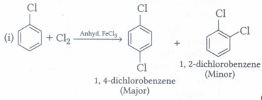
(ii) CH3CH2CI + AgNO2\(\rightarrow\)CH3CH2NO2+AgCI
(iii) CH3CH2CH2CH(Br)CH3 + KOH(alc.)\(\rightarrow\)CH3CH2CH=CH CH3
6.
(i) Chlorobenzene to biphenyl: When two chlorobenzene combine with sodium metal in the presence of dry ether it forms biphenyl.
(ii) Propene to 1-iodopropane :
CH3CH = CH2 + HI \(\overset { Peroxide }{ \underset { Anti-Markovnokov's\ rule }{ \longrightarrow } } \)CH3CH2I + CH3CHICH3
(Major) (Minor)
CH3CH = CH2\(\overset { HBr/Peroxide }{ \longrightarrow } \)CH3CH2CH2Br\(\overset { NaI/acetone }{ \longrightarrow } \)CH3CH2CH2I
(iii) 2 - bromobutance to but-2-ene
\({ H }_{ 3 }C-{ CH }_{ 2 }-\underset { \overset { | }{ Br } }{ CH } -{ CH }_{ 3 }\overset { Alc.KO }{ \longrightarrow } \quad { H }_{ 3 }C-\underset { But-2-ene\\ \quad \quad (80%) }{ CH } =CH-{ CH }_{ 3 }+{ CH }_{ 3 }-\underset { But-1-ene\\ \quad \quad (20%) }{ { CH }_{ 2 } } -CH={ CH }_{ 2 }\)
7.
(i) Dispersion forces
(ii) Dispersion forces
(iii) Ion-dipole attraction
(iv) H-bound and dipole-dipole attraction
(v) Dipole -dipole attraction.
8.
(i) Isotonic solutions : An isotonic solution refers to two solutions having the same osmotic pressure across a semipermeable membrane. This state allows for the free movement of water across the membrane without changing the concentration of solutes on either side.
(ii)Hypertonic solution: A hypertonic solution is a particular type of solution that has a greater concentration of solutes on the outside of a cell when compared with the inside of a cell.
(iii) Hypotonic solution: The solution having lower osmotic pressure than another solution.
9.
With rise in temperature, it loses water of crystallization.
10.
\(\underset { Methyl\\ Chloride }{ CH_{ 3 }CI } +AgNO_{ 2 }+AgCI\)
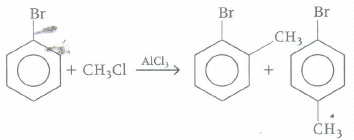
11.
(i) It is due to presence of unpaired electrons in d-orbitals therefore, they undergo d-d transitions by absorbing light from visible region and rediate complementary colour.
(ii) It is because neither Zn nor Zn2+ ion has incompletely filled d-orbital.
12.
(i) It is because these metals show variable oxidation states and form unstable intermediate which readily change into product.
(ii) It is due to less energy required for more number of electrons to take part in metal-metal bonding in 4d and 5d series.
13.
(a)
\(L\rightarrow M \) charge transfer transition
14.
(a)
Ti+,Ti3+
15.
(a)
I > III > II > IV
16.
(d)
C6H5C(CH3)(C6H5)Br
17.
(c)
(iii) < (i) < (iv) < (ii)
18.
(d)
3-Bromopentane
19.
(a)
Poor shielding of one of the 4f - electrons by another in the subshell
20.
(d)
Sc3+
21.
(d)
Zn
22.
\(\pi =CRT,i.e.,\pi \alpha C\)
23.
Urea and glucose do not dissociate. NaCI dissociates to give 2 particles.
24.
In a ideal solution, solute does not undergo dissociation or association. Hence, van't Hoff factor = 1.
25.
As solute is solid, the solvent, i.e., water will freeze out.
26.
(d)
equal to that of sucrose solution
27.
(a) (i) Ideal solution: Those solutions which follow Raoult's law at specific temperature over the entire range of concentration are called Ideal solution.
(ii) Azeotrope: A liquid mixture which distills at constant temperature without under going any changes in composition is called Azeotrope.
(iii)Osmotic pressure: The minimum excess pressure that has to be applied on the solution side to prevent the entry of the solve t into the solution through the semi-perable membrane is called osmotic pressure.
(b) Given : Mass of solute, \(\omega \) = 10 g
Mass of solvent, W = 90 g
Molar mass of solute, M = 180
\(Molality=\frac { \omega \times 1000 }{ M\times W } \)
\(=\frac { 10\times 1000 }{ 90\times 180 } \)
= 0.6172 \(\approx \) 0.62 mol kg-1
28.
(i) Mn3+ (3d4) on changing to Mn2+ (3d5) becomes stable, half filled configuration has extra stability. Therefore, Mn3+ can be easily reduced and acts as a good oxidizing agent.
(ii) EO(M2+/M) values are not regular in the first transition series metals because of irregular variation of ionization enthalpies (IE1 + IE2) and the sublimation energies.
(iii) Among transition elements, the bonds formed in +2 and +3 oxidation states are mostly ionic. The compounds formed in higher oxidation states are generally formed by sharing of d-electrons.
(a) The transition elements show variable oxidation states because their atoms can lose a different number of electrons. This is due to the participation of inner (n - 1) d-electrons in addition to outer electrons because the energies of the ns and (n - 1) d-subshells are almost equal.
(i) Manganese
(ii) Scandium
(b) The steady decrease in atomic and ionic sizes of lanthanide elements with increasing atomic number is called lanthanide contraction. In the lanthanoids, there is a regular decrease in the size of atoms and ions with an increase in atomic number. For example, the ionic radii decrease from Ce3+(111 pm) to Lu3+ (93 pm). Cause of lanthanoid contraction. As we move through the lanthanoid series, 4f-electrons are being added, one at each step. The mutual shielding effect of electrons is very little, even smaller than that of d-electrons. This is due to the shape of f-orbitals.
The nuclear charge, however, increases by one at each step. Hence, the inward pull experienced by the 4f-electrons increases. This causes a reduction in the size of the entire 4f' shell. The sum of the successive reductions gives the total lanthanoid contraction.
The important alloy is misch metal.
29.
\(\underset { n-Butylchloride }{ { CH }_{ 3 }{ CH }_{ 2 }{ CH }_{ 2 }{ CH }_{ 2 }CI } +KOH(alc.)\overset { \triangle }{ \longrightarrow } \underset { But-l-ene }{ { CH }_{ 3 }{ CH }_{ 2 }CH={ CH }_{ 2 }+KCI+{ H }_{ 2 }O } \)
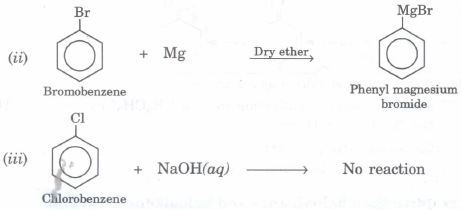
\((iv)\quad { 2CH }_{ 3 }Br+2Na\overset { Dry\quad ether }{ \underset { \quad Wurt\\ reaction }{ \longrightarrow } } \underset { Ethane }{ { CH }_{ 3 }{ CH }_{ 3 } } +2NaBr\)
\(\\ (vi)\quad \underset { Methyl\\ chloride }{ { CH }_{ 3 }CI } +KCN\longrightarrow \underset { Methyl\\ chloride }{ { CH }_{ 3 }CN } +KCI\)
30.
C) Assertion is correct statement but reason is wrong statement.
Explanation:
Benzene and toluene do not form H-bonding with each other.
31.
(a): A half-filled or fully-filled orbital is more stable than incompletely filled orbital.
32.
(a) It is because neither they nor their ions have incompletely filled d-orbitals.
(b) Scandium (Sc) and Zinc (Zn).
(c) It is because they show variable oxidation state, can form intermediate complexes and have large surface area for adsorption of gases.
(d) It is due to strong interatomic forces of attraction due to presence of unpaired electrons.
(e) It is because Cu2 + has one unpaired electron and undergoes d-d transition by absorbing light from visible region and radiate blue colour, where as Zn2 + is colourless due to absence of unpaired electron.
33.
(i) (b) : Moles of C6H6 = \(\frac{7.8}{78}=0.1\)
Mole C6H5CH3 = \(\frac{9.2}{92}=0.1\)
Mole fraction of C6H6 = \(\frac{0.1}{0.1+0.1}=0.5\)
=> Mole fraction of C6H5CH3 = 0.5
Vapour pressure of toluene = Vapour pressure of pure toluene x mole fraction of toluene
= 0.0925 x 0.5 = 0.04625
Vapour pressure of benzene = 0.256 x 0.5 = 0.128
Total vapour pressure of solution = 0.17425
(ii) (a) : Moles of benzene in solution-II = \(\frac{3.9}{78}=0.05\)
Moles of toluene in solution-II = \(\frac{13.8}{92}=0.15\)
Vapour pressure of solution
= 0.256 x 0.05 + 0.0925 x 0.15
= 0.0128 + 0.013875 = 0.026675
(iii) (c) : Mole fraction of benzene in vapour phase
\(y_{\text {benzene }}=\frac{p_{\text {benzene }}}{P_{\text {total }}}=\frac{0.128}{0.17425}=0.734\)
(iv) (a) : Benzene and toluene form an ideal solution.

12th Standard CBSE Syllabus & Materials
12th Standard CBSE
CBSE 12th Computer Science Python Revision Tour I - New Previous year Question Papers Study Material - QB365 Set A
NEW12th Standard CBSE
CBSE 12th Business Studies Planning Important Questions And Answers Study Material - QB365 Set A
NEW12th Standard CBSE
CBSE 12th Business Studies Business Environment Important Questions And Answers Study Material - QB365 Set A
NEW12th Standard CBSE
CBSE 12th Business Studies Principles of Management Important Questions And Answers Study Material - QB365 Set A



NCERT Books

Syllabus

Exam Pattern

Sample Question Papers

Previous year Question Papers

Important Notes

MCQ Practice test

NCERT Exemplers

Case study Questions

Image Based Questions

Passage based Questions

HOT Questions

Value Based Questions

Model Questions Papers
NCERT ( Book Back ) Questions

Assertion and Reason
Important Questions And Answers

CBSE 12th Standard CBSE Subjects
CBSE Standards








