
 100% FREE ACCESS
12th Standard CBSE Syllabus & Materials
12th Standard CBSE
CBSE 12th Economics Government Budget and the Economy Previous year Question Papers Study Material - QB365 Set A
NEW12th Standard CBSE
CBSE 12th Computer Science Interface Python with MySQL - New Previous year Question Papers Study Material - QB365 Set A
NEW12th Standard CBSE
CBSE 12th Computer Science Database Concept - New Previous year Question Papers Study Material - QB365 Set A
NEW12th Standard CBSE
CBSE 12th Computer Science Data Communication - New Previous year Question Papers Study Material - QB365 Set A
NEW12th Standard CBSE
CBSE 12th Computer Science Data Structures - New Previous year Question Papers Study Material - QB365 Set A
NEW12th Standard CBSE
CBSE 12th Computer Science Functions - New Previous year Question Papers Study Material - QB365 Set A

Published on: 25/10/2025
Download CBSE Class 12th Standard CBSE Chemistry question papers, sample papers, important questions, and previous year solved papers in PDF format. Get free study materials, NCERT solutions, and exam preparation resources for Class 12th Standard CBSE Chemistry
Questions + Answers key
Take MCQ Chemistry Test
1.
An organic compound \({ C }_{ 8 }{ H }_{ 18 }\) on monochlorination gives a single monochloride.Write the structure of the hydrocarbon.
2.
[NiCl4]2- is paramagnetic while [Ni(CO)4] is diamagnetic though both are tetrahedral. Why?
3.
Define the following, giving one example of each:
(i) Zwitter ion
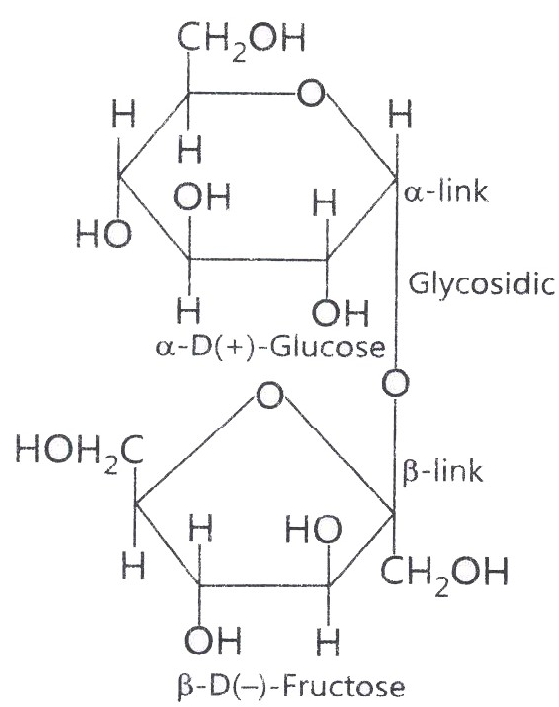
(ii) Glycosidic linkage
4.
For the complex [Fe(en)2Cl2]Cl, identify the following:
(i) Oxidation number of iron.
(ii) Hybrid orbitals and shape of the complex.
(iii) Magnetic behavior of the complex.
(iv) Number of its geometrical isomers.
(v) Whether there may be optical isomer also.
(vi) Name of the complex.
5.
What would be the molar mass of a compound if 6.21 g of it dissolved in 24.0 g of chloroforms a solution that has a boiling point of 68.04oC. The boiling point of pure chloroform is 61.7 oC and the boiling point elevation constant, kb for chloroform is 3.63 oC/m.
6.
What is meant by enantiomers?
7.
How do amino acids form proteins?
8.
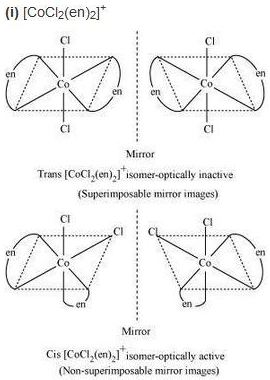
Draw all the possible geometrical and optical isomerism of[Co(NH3)2CI2(en)]+.
9.
Define the following terms:
(i) Isotonic solutions
(ii) Hypertonic solutions
(iii) Hypotonic solutions
10.
Amongst the following ions which one has the highest magnetic moment value?
(i) [Cr(H2O)6]3+
(ii) [Fe(H2O)6]2+
(iii) [Zn(H2O)6]2+
11.
(a) Define the following terms:
(i) Azeotrope
(ii) Osmotic pressure
(iii) Colligative properties.
(b) Calculate the molarity of 9.8% (w/w) solution of H2SO4 if the density ofthe solution is 1.02 g mL-1. (Molar mass of H2SO4 = 98 g rnol-1)
12.
(a) State Raoult's law for a solution containing volatile components. Name the solution which follows Raoult's law at all concentrations and temperatures.
(b) Calculate the boiling point elevation for a solution prepared by adding 10 g of CaCl2 to 200 g of water. (Kb for water = 0.512 K kg mol-1, Molar mass of CaCI2 = 111 g mol-1)
13.
Vitamins represents a group of organic compounds which are needed in small amounts for the healthy growth and maintenance of our body. These are not synthesised by the body and are supplied by the diet. The deficiency of vitamins can be supplemented with medicines.
(i) Which vitamins are water soluble ?
(ii) What are the chemical name of vitamin C and vitamin D ?
(iii) What is the source of vitmain K ?
(iv) How is vitamin K useful ?
14.
Why are different colours observed in octahedral and tetrahedral complexes for the same metal and same ligands ?
15.
Using valence bond theory, explain the following in relation to the complexes given below :
\([Mn(CN)_6]^{3-}, [Co(NH_3)_6]^{3+}, [Cr(H_2O)_6]^{3+}, [FeCl_6]^{4-}\)
(i) Type of hybridisation
(ii) Inner or outer orbital complex.
(iii) Magnetic behaviour.
(iv) Spin only magnetic moment value.
1.
Since the hydrocarbon gives a single monochloride all the I8H atoms are equivalent. This means it has six \({ CH }_{ 3 }\) groups attached to the interlinked C atoms.
Therefore, its structure is
\({ CH }_{ 3 }-\overset { \underset { | }{ { CH }_{ 3 } } }{ \underset { \overset { | }{ { CH }_{ 3 } } }{ C } } -\overset { \underset { | }{ { CH }_{ 3 } } }{ \underset { \overset { | }{ { CH }_{ 3 } } }{ C } } -{ CH }_{ 3 }\)
2.
In [NiCl4]2-, Ni is +2 oxidation state with the configuration 3d84s0. Cl- is weak ligand. It cannot pair up the electrons in 3d orbitals. Hence, it is paramagnetic. In [Ni(CO)4], Ni is in zero oxidation state with the configuration 3d84s2. In the presence of CO ligand, the 4s electrons shift to 3d to pair up 3d electrons. Thus, there is no unpaired electron present. Hence, it is diamagnetic.
3.
(i)The ion whose one end is positively charged and other end is negatively charged is called Zwitter ion, e.g.,
\({ H }_{ 2 }N-CH_{ 2 }-COOH\rightleftharpoons { H }_{ 3 }^{ \oplus }N-CH_{ 2 }-COO^{ - }\)
(ii) Glycosidic Linkage: The oxide linkage between monosachharide units in oligo and polysachharide is called glycosidic linkage, e.g.
4.
(i) +3 (III)
(ii) dsp, octahedral
(iii) paramagnetic
(iv) Two geometrical isomers
(v) Yes, there may be optical isomer also due to presence of polydentate ligand.
(vi) Dichlorido bis-(ethane 1, 2-diamine) Iron (III)
5.
\(Elevation \ in \ boiling \ point, \)
\(\triangle { T }_{ b }=68.04-61.7\)
= 6.34 K
Mass of substance.
WB = 6.21 g, Mass of chloro form = 2.40 g
\( { K }_{ b }=3.63°C/m,\)
\({ K }_{ b }=\frac { \triangle { T }_{ b }\times{ M }_{ b }\times{ W }_{ A } }{ { W }_{ B }\times1000 } \)
\(\\ or \ \ { K }_{ b }=\frac { K_{ b }\times{ W }_{ b }\times{ 1000 } }{ \triangle { T }_{ b }\times{ W }_{ A } } \)
\(=\frac { 3.63\times6.21\times1000 }{ 6.34\times24 }\)
\( =148.15g \ mo{ l }^{ -1 }\)
6.
The stereoisomers which are non-superimposable mirror images are called enantiomers, e.g. d(+) glucose and l(-) glucose are enantiomers.
7.
More than 100 amino acid residues are joined together by peptide linkage to form a linear chain polymer (protein).
8.
9.
(i) Isotonic solutions : An isotonic solution refers to two solutions having the same osmotic pressure across a semipermeable membrane. This state allows for the free movement of water across the membrane without changing the concentration of solutes on either side.
(ii)Hypertonic solution: A hypertonic solution is a particular type of solution that has a greater concentration of solutes on the outside of a cell when compared with the inside of a cell.
(iii) Hypotonic solution: The solution having lower osmotic pressure than another solution.
10.
The oxidation states are : Cr (III), Fe (II) and Zn (II).
E.C. of Cr3+ = 3d3, unpaired electrons = 3 (inner orbital complex)
E.C. of Fe2+= 3d6 , unpaired electrons = 4 (outer orbital/high spin complex)
E.C. of Zn2+= 3d10 , unpaired electrons = 0 (outer orbital complex)
\(\mu =\sqrt { n\left( n+2 \right) } \) Hence (ii) has highest magnetic moment.
11.
(a) (i) Azeotrope: Those solutions which distill out unchanged in their composition are called azeotropes. They are constant boiling mixtures.
(ii) Osmotic pressure: It is an extra pressure which must be applied on solution side so as to stop the flow of solvent molecules into solution when both are separated by a semipermeable membrane.
(iii) Colligative property: The property which depends on the number of particles of solute and not on the nature of solute is called colligative property.
(b) Molarity (M)
= \(\frac{W_{B}}{M_{B}} \times \frac{1000}{\text { Volume of solution in } \mathrm{mL}}\)
= \(\frac{9.8}{98} \times \frac{1000}{\frac{\text { Mass of solution }}{\text { density of solution }}}\)
= \(\frac{9.8}{98} \times \frac{1000}{\frac{100}{1.02}}=1.02 \mathrm{~mol} \mathrm{~L}^{-1}\)
12.
(a) Positive Deviation from Raoults Law: Those non-ideal solutions, in which partial pressure of each component 'A' and 'B' is higher than that calculated from Raoult's law show positive deviation from Raoult s law, e.g. water and ethanol show positive deviation because the force of attraction between ethanol-water is less than between ethanol-ethanol and water-water molecules, therefore, vapour pressure is high.
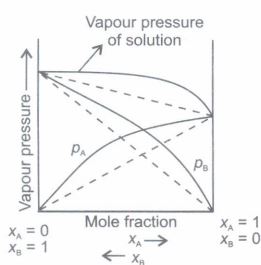
A solution that shows positive deviation from Raoult's law.
Ideal solution follows Raoult's law at all concentrations and temperatures.
(b) CaCl2 \(\longrightarrow\) Ca2+ + 2CI- ;
Given; WB = 10g M = 111 g mor-1, i = 3
Kb = 0.512 K kg mol-1 and WA = 200 g.
Now, \(\Delta T_{b}=i K_{b} \times \frac{W_{B}}{M_{B}} \times \frac{1000}{W_{A}}\)
\(\Rightarrow \quad \Delta T_{b}=3 \times 0.512 \times \frac{10}{111} \times \frac{1000}{200}\)
= \(\frac{76.8}{111}=0.692 \mathrm{~K}\)
13.
(i) Vitamin B-complex and vitamin C are water soluble vitamins.
(ii) Vitamin C is chemically ascorbic acid while vitamin D is ergocalciferol.
(iii) Green leafy vegetables like spinach, cabbage, carrot etc.
(iv) It is essentially needed for body. The deficiency of vitamin K leads to blood clotting and even harmorrhage
14.
\({ \triangle }_{ t }=\left( \frac { 4 }{ 9 } \right) { \triangle }_{ 0 }\). Thus, \({ \triangle }_{ t }\) is smaller than \({ \triangle }_{ 0 }\). Hence, less energy (higher wavelength) is absorbed by tetrahedral complexes than by octahedral complexes of the same metal and ligands. Therefore, the observed colour are different.
15.
\([Mn(CN)_6]^{3-}\)
d2sp3, (ii) inner orbital complex, (iii) paramagnetic, (iv) 2.87 B.M.
(i) d2sp3 (ii) Inner orbital complex, (iii) diamagnetic, (iv) \(\mu=0\)
(i) d2sp3, (ii) Inner orbital complex, (iii) paramagnetic, (iv) 3.87 B.M.
(i) sp3d2, (ii) outer orbital complex (iii) paramagnetic (iv) 4.9 B.M.

12th Standard CBSE Syllabus & Materials
12th Standard CBSE
CBSE 12th Computer Science Python Revision Tour I - New Previous year Question Papers Study Material - QB365 Set A
NEW12th Standard CBSE
CBSE 12th Business Studies Planning Important Questions And Answers Study Material - QB365 Set A
NEW12th Standard CBSE
CBSE 12th Business Studies Business Environment Important Questions And Answers Study Material - QB365 Set A
NEW12th Standard CBSE
CBSE 12th Business Studies Principles of Management Important Questions And Answers Study Material - QB365 Set A



NCERT Books

Syllabus

Exam Pattern

Sample Question Papers

Previous year Question Papers

Important Notes

MCQ Practice test

NCERT Exemplers

Case study Questions

Image Based Questions

Passage based Questions

HOT Questions

Value Based Questions

Model Questions Papers
NCERT ( Book Back ) Questions

Assertion and Reason
Important Questions And Answers

CBSE 12th Standard CBSE Subjects
CBSE Standards








