
 100% FREE ACCESS
12th Standard CBSE Syllabus & Materials
12th Standard CBSE
CBSE 12th Economics Government Budget and the Economy Previous year Question Papers Study Material - QB365 Set A
NEW12th Standard CBSE
CBSE 12th Computer Science Interface Python with MySQL - New Previous year Question Papers Study Material - QB365 Set A
NEW12th Standard CBSE
CBSE 12th Computer Science Database Concept - New Previous year Question Papers Study Material - QB365 Set A
NEW12th Standard CBSE
CBSE 12th Computer Science Data Communication - New Previous year Question Papers Study Material - QB365 Set A
NEW12th Standard CBSE
CBSE 12th Computer Science Data Structures - New Previous year Question Papers Study Material - QB365 Set A
NEW12th Standard CBSE
CBSE 12th Computer Science Functions - New Previous year Question Papers Study Material - QB365 Set A

Published on: 25/10/2025
Download CBSE Class 12th Standard CBSE Chemistry question papers, sample papers, important questions, and previous year solved papers in PDF format. Get free study materials, NCERT solutions, and exam preparation resources for Class 12th Standard CBSE Chemistry
Questions + Answers key
Take MCQ Chemistry Test
1.
What happpens when :
(i) CH3 -CI is treated with aqueous KOH?
(ii) CH3 -CI is treated with KCN?
(iii) CH3 -Br is treated with Mg in the presence of dry ether ?
2.
Amongst the isomeric alkanes of molecular formula C5H12 , identify the one that on photochemical chlorination yields a single monochloride.
3.
Identify all the possible monochloro structural isomers that would be expected to form on free radical chlorination of (CH3)2CHCH2CH3
4.
Which compound in each of the following pairs will react faste in SN2 reaction with OH-?
(a) CH3Br or CH3I
(b) (CH3)3CCl or CH3Cl
5.
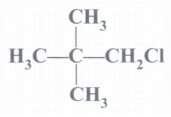
Write the IUPAC name of the following compound:
6.
Which one of the following has the highest dipole moment?
(i) CH2Cl2
(ii) CHCl3
(iii) CCl4
7.
Give reasons for the following observations.
(i) p-dibromobenzene has higher melting point than those of o- and m-Isomers.
(ii) Out of chlorobenzene and chloromethane, which is more reactive towards nucleophilic substitution reaction?
(iii) Racemisation occurs in SN1reaction.
8.
How do you convert:
(i) Chlorobenzene to biphenyl,
(ii) Propene to I-iodopropane,
(iii) 2-bromobutane to but-2-ene.
9.
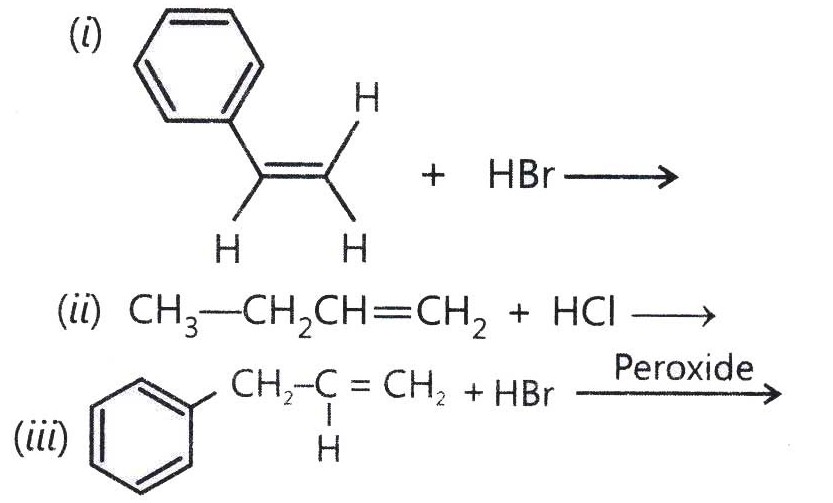
Write the products of the following reactions:
10.
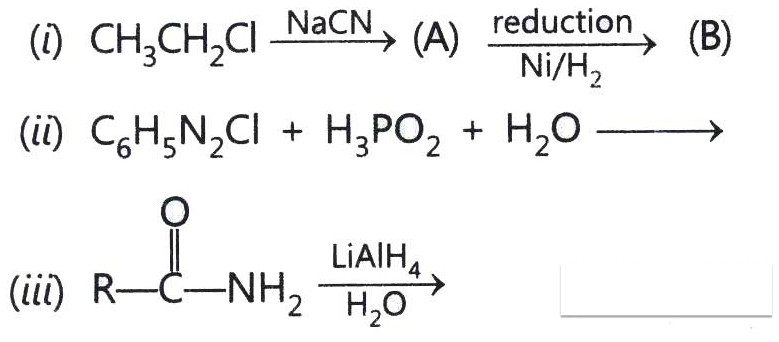
Complete the following chemical equations:
11.
Some halogen containing compounds are useful in daily life. Some compounds of this class are responsible for exposure of flora and fauna to more and more of UV light which causes destruction to a great extent. Name the class of these halo compounds. In your opinion, what should be done to minimise harmful effects of these compounds.
12.
Although chlorine is an electron-withdrawing group, yet it is ortho-para-directing in electrophilic aromatic substitution reactions. why ?
13.
Explain the following in one or two sentences
(i) Displacement of cyanic and amide ion is never observed in nucleophilic substitution reactions.
(ii) RCI is hydrolysed to ROH slowly but the reaction is rapid if a catalytic amount of KI is added to the reaction mixture.
14.
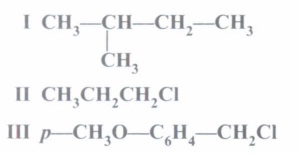
The increasing order of reactivity towards SN1 mechanism is
III < II < I
II< I< III
I < III < II
II< III < I
15.
With which mixture carbylamine test is performed in the presence of alc. KOH?
Chloroform and silver powder
Tri halogenated methane and one primary amine
One alkyl halide and one 10 amine
One alkyl cyanide and one 10 amine
16.
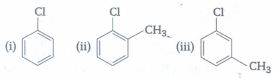
(i) < (ii) < (iii)
(i) < (iii) < (ii)
(iii) < (ii) < (i)
(ii) < (iii) < (i)
17.
Which of the carbon atoms present in the molecule given below are asymmetric?
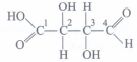
1, 2, 3, 4
2, 3
1,4
1, 2, 3
18.
Arrange the following : CH3CH2CH2CI (I), CH3CH2CHCICH3 (II), (CH3)2CHCH2CI (III) and(CH3)3C__CI (IV) in order of decreasing tensency towards SN2 reactions
I > III > II > IV
III > IV > II > I
II > I > III > IV
IV > III > II > I
19.
20.
1.
(i) CH3 - CI + KOH\(\rightarrow\)CH3OH + KCI
(aq) Methanol
(ii) CH3 - CI + KCM \(\rightarrow\) CH3 CN + KCI
Methyl cyanide
(iii) CH3 Br + Mg \(\overset { Dry\ ether }{ \longrightarrow } \)CH3MgBr
Methyl magnesium bromide
2.
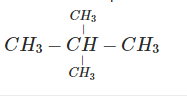
Neopentane or 2, 2-Dimethylpropane
3.
In the given molecule, there are four different types of hydrogen atoms. Replacement of these hydrogen atoms will give the following four monochloro derivatives.
(i) (CH3)2CHCH2CH2Cl
(ii) (CH3)2CHCH(Cl)CH3
(iii) (CH3)2C(Cl)CH2CH3
(iv) CH3CH(CH2Cl)CH2CH3
4.
In the SN2 mechanism, the reactivity of halides for same halides group increase down the group. Because increase in size increase, the halide becomes a better leaving group. Therefore, CH3I will react faster than CH3Br in SN2 reactions with OH-.
5.
1-Chloro-2, 2-dimethylpropane.
6.
Dichloromethane has highest dipole moment among CH2Cl2, CHCl3 and CCl4. The decreasing order of dipole moments is CH2Cl2>CHCl3>CCl4. These molecules have tetrahedral geometry due to sp3 hybridization of carbon atom.In CCl4, the individual C−Cl bond dipoles cancel each other which results in zero dipole moment.
Hence, CCl4 is non polar.
7.
(i) In case of dichlorobenzenes, para isomer is more symmetrical than ortho and meta isomers. Hence, in the crystal lattice, para isomer fits more closely than ortho and meta isomers. Due to this, more energy is required to break the crystal lattice of para isomer. Hence, p-Dichlorobenzene has higher melting point than those of o- and m-isomers.
(ii) Out of chlorobenzene and chloromethane, chloromethane is more reactive towards nucleophilic substitution reactions since it is an alkyl halide. Chlorobenzene is less reactive towards nucleophilic substitution reaction because of the resonance effect and polarity of C−Cl bond.
(iii) Racemisation occurs in SN1 reaction. both inversion and retention of the configuration.
8.
(i) Chlorobenzene to biphenyl: When two chlorobenzene combine with sodium metal in the presence of dry ether it forms biphenyl.
(ii) Propene to 1-iodopropane :
CH3CH = CH2 + HI \(\overset { Peroxide }{ \underset { Anti-Markovnokov's\ rule }{ \longrightarrow } } \)CH3CH2I + CH3CHICH3
(Major) (Minor)
CH3CH = CH2\(\overset { HBr/Peroxide }{ \longrightarrow } \)CH3CH2CH2Br\(\overset { NaI/acetone }{ \longrightarrow } \)CH3CH2CH2I
(iii) 2 - bromobutance to but-2-ene
\({ H }_{ 3 }C-{ CH }_{ 2 }-\underset { \overset { | }{ Br } }{ CH } -{ CH }_{ 3 }\overset { Alc.KO }{ \longrightarrow } \quad { H }_{ 3 }C-\underset { But-2-ene\\ \quad \quad (80%) }{ CH } =CH-{ CH }_{ 3 }+{ CH }_{ 3 }-\underset { But-1-ene\\ \quad \quad (20%) }{ { CH }_{ 2 } } -CH={ CH }_{ 2 }\)
9.
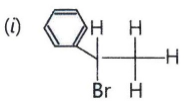


10.
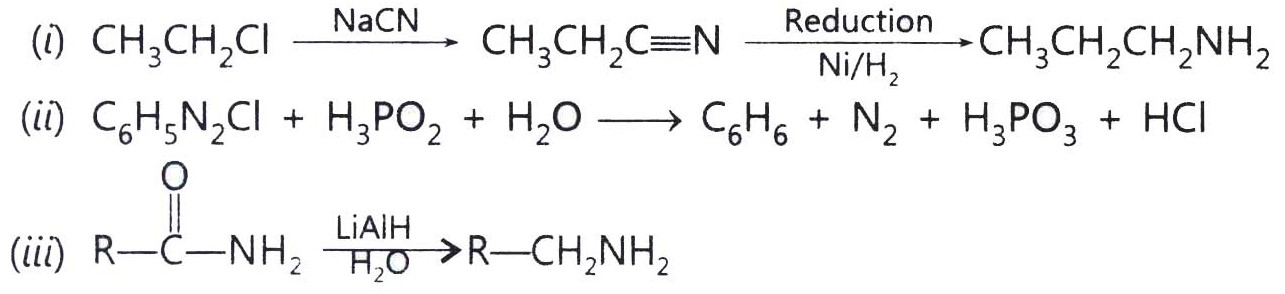
11.
CFC (chlorofluoro carbons) are responsible for the destruction of ozone layer and UV light can reach earth which may cause skin cancer and affect flora and fauna.
These compounds should be banned and their use should be made to minimum extent.
12.
Chlorine withdraws electrons through inductive effect and releases electrons through resonance. Through inductive effect, chlorine destabilises the intermediate carbocation formed during the electrophilic substitution.
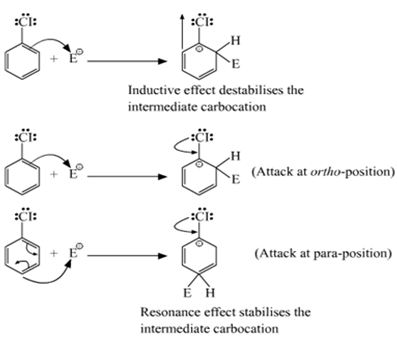
Through resonance, halogen tends to stabilise the carbocation and the effect is more pronounced at ortho- and para- positions. The inductive effect is stronger than resonance and causes net electron withdrawal and thus causes net deactivation. The resonance effect tends to oppose the inductive effect for the attack at ortho- and parapositions and hence makes the deactivation less for ortho- and paraattack. Reactivity is thus controlled by the stronger inductive effect and orientation is controlled by resonance effect.
13.
(i) HCN (PKa 10) and NH3 (PKa 11·25) are very weak: acids. Therefore, their conjugate bases, i.e., CN- ion and NH2 - are very strong bases. Since strong bases are bad leaving groups, their displacement in nucleophilic substitution reactions is never observed,
(ii) Iodide ion is a powerful nucleophile and hence reacts rapidly with RCI to form RI,
Further because 1- ion is a better leaving group than Cl- ion, therefore, RI is more rapidly hydrolysed than RCI to form ROH,
The I- ion thus regenerated recycles in the above reaction thereby explaining its catalytic effect.
14.
(b)
II< I< III
15.
(b)
Tri halogenated methane and one primary amine
16.
(d)
(ii) < (iii) < (i)
17.
(b)
2, 3
18.
(a)
I > III > II > IV
19.
20.

12th Standard CBSE Syllabus & Materials
12th Standard CBSE
CBSE 12th Computer Science Python Revision Tour I - New Previous year Question Papers Study Material - QB365 Set A
NEW12th Standard CBSE
CBSE 12th Business Studies Planning Important Questions And Answers Study Material - QB365 Set A
NEW12th Standard CBSE
CBSE 12th Business Studies Business Environment Important Questions And Answers Study Material - QB365 Set A
NEW12th Standard CBSE
CBSE 12th Business Studies Principles of Management Important Questions And Answers Study Material - QB365 Set A



NCERT Books

Syllabus

Exam Pattern

Sample Question Papers

Previous year Question Papers

Important Notes

MCQ Practice test

NCERT Exemplers

Case study Questions

Image Based Questions

Passage based Questions

HOT Questions

Value Based Questions

Model Questions Papers
NCERT ( Book Back ) Questions

Assertion and Reason
Important Questions And Answers

CBSE 12th Standard CBSE Subjects
CBSE Standards








