
 100% FREE ACCESS
12th Standard CBSE Syllabus & Materials
12th Standard CBSE
CBSE 12th Economics Government Budget and the Economy Previous year Question Papers Study Material - QB365 Set A
NEW12th Standard CBSE
CBSE 12th Computer Science Interface Python with MySQL - New Previous year Question Papers Study Material - QB365 Set A
NEW12th Standard CBSE
CBSE 12th Computer Science Database Concept - New Previous year Question Papers Study Material - QB365 Set A
NEW12th Standard CBSE
CBSE 12th Computer Science Data Communication - New Previous year Question Papers Study Material - QB365 Set A
NEW12th Standard CBSE
CBSE 12th Computer Science Data Structures - New Previous year Question Papers Study Material - QB365 Set A
NEW12th Standard CBSE
CBSE 12th Computer Science Functions - New Previous year Question Papers Study Material - QB365 Set A

Published on: 25/10/2025
Download CBSE Class 12th Standard CBSE Chemistry question papers, sample papers, important questions, and previous year solved papers in PDF format. Get free study materials, NCERT solutions, and exam preparation resources for Class 12th Standard CBSE Chemistry
Questions + Answers key
Take MCQ Chemistry Test
1.
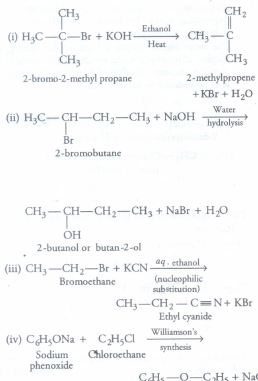
Write the structure of the major organic product in each of the following:
\((a)\ { \left( { CH }_{ 3 } \right) }_{ 3 }CBr+{ H }_{ 2 }O\ \overset { Heat }{ \longrightarrow } \)
\(\\ (ii) \mathrm{CH}_{3} \mathrm{CH}(\mathrm{Br}) \mathrm{CH}_{2} \mathrm{CH}_{3}+\mathrm{NaOH} \stackrel{\text { Water }}{\longrightarrow}\)
\(\\ (c)\ { CH }_{ 3 }{ CH }_{ 2 }Br+KCN\ \overset { aq.ethanol }{ \longrightarrow } \)
\(\begin{equation} \text { (iv) } \mathrm{C}_{6} \mathrm{H}_{5} \mathrm{ONa}+\mathrm{C}_{2} \mathrm{H}_{5} \mathrm{Cl} \longrightarrow \end{equation}\)
2.
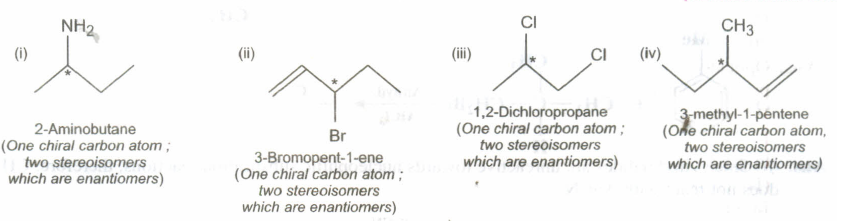
Identify and indicate the presence of centre of chirality, if any, in the following molecules? How many stereoisomers are possible for each.
(i) 2-Aminobutane
(ii) 3-Bromopent-1-ene
(iii) 1,2-Dichloropropene
(iv) 3-Methyl-1-pentene
3.
Why first ionisation enthalpy of Cr is lower than that of Zn?
4.
A 10% solution of urea is isotonic with 20% solution of 'x' at same temperature. Calculate molecular weight of x.
5.
What the molarity of acetic acid containing 6 g of acetic acid per litre of solution?
6.
(a) Why are alkyl halides insoluble in water?
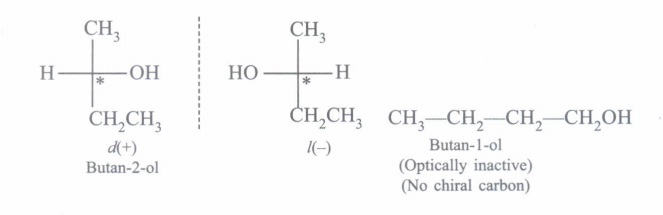
(b) Why is Butan-l-ol optically inactive but Butan-2-ol is optically active?
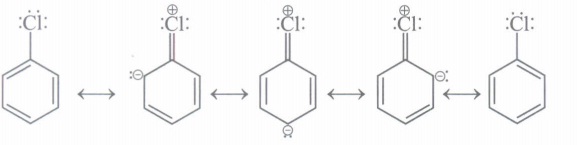
(c) Although chlorine is an electron withdrawing group, yet it is ortho-, para- directing in electrophilic aromatic substitution reaction. Why?
7.
A solution is prepared by dissolving 5 g non-voltale solute in 95 g of water. It has vapour pressure of 23.375 mm ofHg at 25°C. Calculate the molar mass of solute. (Vapour pressure of pure water at 25 °C = 23.75 mm of Hg).
8.
How will you bring about the following conversions?
(i)1-bromobutane to 2-bromobutane
(ii) Aniline to chlorobenzene
9.
Give reasons for the following:
(a) Measurement of osmotic pressure method is preferred for the determination of molar masses of macro molecules such as proteins and polymers.
(b) Aquatic animals are more comfortable in cold 1 water than in warm water.
(c) Elevation of boiling point of 1M KCI solution is nearly double than that of 1M sugar solution.
10.
How would you account for the following?
(i) Metal-metal bonding is more extensive in the 4d and 5d -series of transition elements than 3d -series.
(ii) Mn (III) undergoes disproportionation reaction easily.
(iii) Co (II) is easily oxidised in the presence of strong ligands
11.
(a) How would you account for the following?
(i) Highest fluoride of Mn is MnF4 whereas the highest oxide is Mn2O7.
(ii) Transition metals and their compounds show catalytic properties.
(b) Complete the following equation:
3MnO42- + 4H+ ⟶
12.
(a) write a chemical test to distinguish between:
(i) Chlorobenzene and Benzyl chloride.
(ii) Chloroform and Carbon tetrachloride.
(b) Why is methyl chloride hydrolysed more easily than chlorobenzene?
13.
The case of dehydrohalogenation of alkyl halides with alcholic KOH is
3o < 2o < 1o
3o > 2o > 1o
3o < 2o > 1o
3o > 2o < 1o
14.
KMnO4 acts as an oxidising agent in acidic medium. The number of moles of KMnO4 that will be needed to react with one mole of sulphide ions in acidic solution is
\(\frac { 2 }{ 5 } \)
\(\frac { 3 }{ 5 } \)
\(\frac { 4 }{ 5 } \)
\(\frac { 1 }{ 5 } \)
15.
A primary alkyl halide would prefer to undergo ...........
SN1 reaction
SN2 reaction
\(\alpha\)-elimination
Racemisation
16.
Which of the following reactions are disproportionation reactions?
\((i)\ { Cu }^{ + }\longrightarrow { Cu }^{ 2+ }+{ Cu }\)
\((ii)\ { 3MnO }_{ 4 }^{ - }+{ 4H }^{ + }\longrightarrow { 2MnO }_{ 4 }^{ - }+{ MnO }_{ 2 }+{ 2H }_{ 2 }O\)
\((iii)\ { 2KMnO }_{ 4 }\longrightarrow { K }_{ 2 }{ MnO }_{ 4 }+{ MnO }_{ 2 }+{ O }_{ 2 }\)
\((iv)\ { 2MnO }_{ 4 }^{ - }+{ 3Mn }^{ 2+ }+{ 2H }_{ 2 }O\longrightarrow { 5MnO }_{ 2 }+{ 4H }^{ + }\)
(i),(ii)
(i),(ii),(iii)
(ii),(iii),(iv)
(i),(iv)
17.
The most reactive nucleophile amoung the following is
CH3O-
C6H5O-
(CH3)2CHO-
(CH3)3CO-
18.
In the presence of peroxide, hydrogen chloride and hydrogen iodide do not give anti-Markovinikov's addition to alkenes because
both are highly ionic
one is oxidising and the other is reducing
one of the steps are exothermic in both the cases
all the steps are exothermic in both the reactions.
19.
When Chlorine is passed through propene at 400oC, which of the following is formed?
PVC
Allyl chloride
Vinyl chloride
1,2-Dichloroethane
20.
Addition of HBr gives same product in the presence or absence of peroxide when alkene is
1-butene
2-methylpropene
propene
2-butene
21.
Which of the following statement about transition elements is incorrect ?
They show variable oxidation states
All the ions are coloured
They exhibit diamagnetic and paramagnetic properties
They exhibit catalytic property
22.
The maximum oxidation state of osmium is
+6
+7
+8
+5
23.
A solution of urea (mol.mass 56 g mol-1) boils at 100.18oC at the atmospheric pressure. If Kf and Kb for water are 1.86 and 0.512 K kg mol-1 respectively, the above solution will freeze at
- 6.54oC
- 0.654oC
6.54oC
0.654oC
24.
Two liquids X and Y form an ideal solution. The mixture has a vapour pressure of 400 mm at 300 K when mixed in the molar ratio of 1:1 and a vapour pressure of 350 mm when mixed in the molar ratio of 1:2 at the same temperature. The vapour pressures of the pure liquids X and Y respectively are
250 mm, 550 mm
350 mm, 450 mm
350 mm, 700 mm
500 mm, 500 mm
550 mm, 250 mm
25.
How many grams of concentrated nitric acid solution should be used to prepare 250 mL of 2.0 M HNO3 ? The concentrated nitric acid is 70% HNO3
45.0 g conc HNO3
90.0 g conc HNO3
70.0 g conc HNO3
54.0 g conc HNO3
26.
Concentrated aqueous sulphuric acid is 98% H2SO4 by mass and has a density of 1.80 g mL-1. Volume of the acid required to make one litre of 0.1 M H2SO4 solution is
5.55 mL
11.10 mL
16.65 mL
22.20 mL
27.
A 5.5 molal aqueous solution of methyl alcohol, CH3OH, is supplied. What is the mole fraction of methyl alcohol in the solution ?
0.190
0.086
0.050
0.100
28.
KH value for Ar(g), CO2(g), HCHO (g) and CH4 (g) are 4.39,1.67,1.83 x 10-5 and 0.413 respectively. Arrange these gases in the order of their increasing solubility.
\( \mathrm{HCHO}<\mathrm{CH}_4<\mathrm{CO}_2<\mathrm{Ar}\)
\( \mathrm{HCHO}<\mathrm{CO}_2<\mathrm{CH}_4<\mathrm{Ar} \)
\( \mathrm{Ar}<\mathrm{CO}_2<\mathrm{CH}_4<\mathrm{HCHO} \)
\( \mathrm{Ar}<\mathrm{CH}_4<\mathrm{CO}_2<\mathrm{HCHO} \)
29.
(a) How would you convert the following.
(i) Prop-1-ene to 1-fluoropropane
(ii) Chlorobenzene to 2-Chloro toluene
(iii) Ethanol to Propane nitrile
(b) Although chlorine is an electron withdrawing group, yet it is ortho-, para-directing in electrophilic aromatic substitution reactions. Explain why it is so?
30.
(a) Calculate the freezing point of solution when 1.9 g of MgCI2 (M = 95 g mol-1) was dissolved in 50 g of water, assuming MgCI2 undergoes complete ionization. (Kf for water = 1.86 K kg mol-1)
(b) (i) Out of 1 M glucose and 2 M glucose, which one has a higher boiling point and why?
(ii) What happens when the external pressure applied becames more than the osmotic pressure of solution?
31.
(a) What is meant by the term 'lanthanoid contraction? What is it due to and what consequences does it have on the chemistry of elements following lanthanoids in the periodic table?
(b) Explain the following observations :
(i) Cu+ ion unstable in aqueous solution
(ii) Although Co2+ ion appears to be stable, It is eaily to Co3+ on in the presence of a strong ligand.
(iii) The \({ E }_{ { Mn }^{ 2+ }/{ Mn } }^{ o }\) value for manganese is much more than expected from the trend for other elements in the series
32.
Read the passage given below and answer the following questions:
When haloalkanes with \(\beta\)-hydrogen atom are boiled with alcoholic solution of KOH, they undergo elimination of hydrogen halide resulting in the formation of alkenes. These reactions are called \(\beta\)-elimination reactions or dehydrohalogenation reactions. These reactions follow Saytzeff's rule. Substitution and elimination reactions often compete with each other. Mostly bases behave as nucleophiles and therefore can engage in substitution or elimination reactions depending upon the alkyl halide and the reaction conditions.
The following questions are multiple choice questions. Choose the most appropriate answer:
(i) Among the following the most reactive towards alcoholic KOH is
|
(a) \(\mathrm{CH}_{2}=\mathrm{CHBr}\) |
(b) \(\mathrm{CH}_{3} \mathrm{COCH}_{2} \mathrm{CH}_{2} \mathrm{Br}\) |
(c) \(\mathrm{CH}_{3} \mathrm{CH}_{2} \mathrm{Br}\) |
(d) \(\mathrm{CH}_{3} \mathrm{CH}_{2} \mathrm{CH}_{2} \mathrm{Br}\) |
(ii) The general reaction, \(R-X \stackrel{\text { aq. } \mathrm{OH}^{-}}{\longrightarrow} R \mathrm{OH}+X^{-}\) is expected to follow decreasing order of reactivity as in (t- Bu = tertiary Butyl group)
| (a) t-BuI> t-BuBr > t-BuCI > t-BuF | (b) t-BuF> t-BuCI > t-BuBr > t-BuI |
| (c) t-Bu'Br> t-BuCI > t-BuI > t-BuF | (d) t-BuF> t-BuCI > t-BuI > t-BuBr |
(iii) Reaction of t-butyl bromide with sodium methoxide produces
| (a) sodium t-butoxide | (b) t-butyl methyl ether |
| (c) iso-butane | (d) iso-butylene. |
(iv) In the elimination reactions, the reactivity of alkyl halides follows the sequence
| (a) R - F > R - Cl > R - Br > R - I | (b) R - I > R - Br > R - Cl > R - F |
| (c) R - I > R - F > R - Br > R - Cl | (d) R - F > R-I > R-Br > R-CI |
33.
Read the passage given below and answer the following questions:
An ideal solution may be defined as the solution which obeys Raoult's law exactly over the entire range of concentration. The solutions for which vapour pressure is either higher or lower than that predicted by Raoult's law are called non-ideal solutions.
Non-ideal solutions can show either positive or negative deviations from Raoult's law depending on whether the A-B interactions in solution are stronger or weaker than A - A and B - B interactions.
The following questions are multiple choice questions. Choose the most appropriate answer:
(i) Which of the following solutions is/are ideal solution(s)?
(i) Bromoethane and iodoethane (ii) Acetone and chloroform
(iii) Benzene and acetone (iv)n-heptane and n-hexane
| (a) only 1 | (b) I and II | (c) II and III | (d) I and IV |
(ii) Which of the following is not true for positive deviations?
| (a) The A-B interactions in solution are weaker than the A -A and B -B interactions. |
| (b) \(P_{A}<P_{A}^{\circ} x_{A} \text { and } P_{B}<P_{B}^{\circ} x_{B}\) |
| (c) Carbon tetrachloride and chloroform mixture is an example of positive deviations. |
| (d) All of these |
(iii) For water and nitric acid mixture which of the given graph is correct?
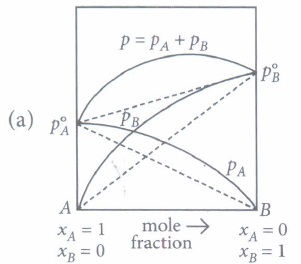 |
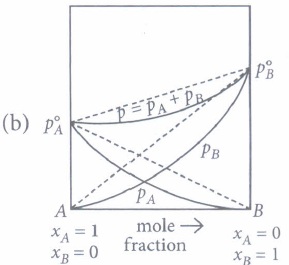 |
| (C) Both of these | (d) None of these |
(iv) Water- HCl mixture
I. shows positive deviations II. forms minimum boiling azeotrope
III. shows negative deviations IV. forms maximum boiling azeotrope
| (a) I and II | (b) II and III |
| (c) I and IV | (d) III and IV |
1.
2.
3.
It is due to stability of 3d5 (half filled d-orbitals) after losing one electron in Cr as compared to zinc which does not become stable after losing one electron from 4s orbital.
4.
M1 = M2, where M1 and M2 are molarities
\(
\Rightarrow \frac{10}{60} \times \frac{1000}{100}=\frac{20}{x} \times \frac{1000}{100} \\
\Rightarrow x=120 \mathrm{~g} \mathrm{~mol}^{-1}
\)
5.
\(=\frac{W_E}{M_E} \times \frac{1000}{\text { Volume of solution in ml }}=\frac{6}{60} \times \frac{1000}{1000}=0.1 \mathrm{M} \text {. }\)
6.
(a) Alkyl halides are insoluble in water because they can neither form H-bonds with water nor they can break H-bonds between water molecules.
(b) Butan-l-ol is achiral, i.e. does not have chiral 'C' atom which is attached to four different groups, therefore, it is optically inactive.
Butan-2-ol is chiral, i.e. has chiral 'C' atom, attached to four different groups.
(c)
7.
Given: \(p_{A}^{\circ}\) = 23.75 mm Hg, PA = 23.375 mm Hg,
WA = 95 g, WB = 5 g, MA = 18 g, MB = ?
\(\frac{p_{A}^{\circ}-p_{A}}{p_{A}^{\circ}}=x_{B}=\frac{\frac{W_{B}}{M_{B}}}{\frac{W_{A}}{M_{A}}+\frac{W_{B}}{M_{B}}}=\frac{\frac{W_{B}}{M_{B}}}{\frac{W_{A}}{M_{A}}}\) \(\left[\because \frac{W_{B}}{M_{B}} \ll<\frac{W_{A}}{M_{A}}\right]\)
\(\Rightarrow \frac{23.75-23.375}{23.75}=\frac{\frac{5}{M_{B}}}{\frac{95}{18}}\)
\(\Rightarrow \quad \frac{5}{M_{B}} \times \frac{18}{95}=\frac{0.375}{23.75}\)
\(\Rightarrow \quad M_{B}=\frac{23.75 \times 90}{95 \times 0.375}\)
= \(\frac{2137.5}{35.625}=60 \mathrm{~g} \mathrm{~mol}^{-1}\)
8.
(i) Dehydrohalogenation followed by Markovnikov's addition.
(ii)
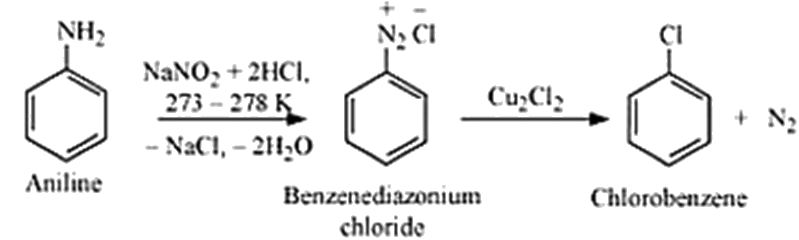
9.
(i) The osmotic pressure method has the advantage over other methods as pressure measurement is around the room temperature and the molarity of the solution is used instead of molality.
(ii) Oxygen is present in dissolved state in water. As per Henry's law when temperature rises, solubility of a gas decreases in solvent, it means solubility of oxygen in warm water is less than cold water. This makes aquatic species respirate comfortably in cold water.
(iii) Elevation in boiling point is directly proportional to 'i'. ΔTb ∝ i. Now as given in the question, elevation of boiling point of 1 M KCl solution is nearly double than that of 1 M sugar solution. It is because KCl being ionic, dissociates into K+ and CI- and therefore it's van't Hoff factor, i is 2 whereas for sugar van't Hoff factor is 1 as it does not undergoes such a dissociation
10.
In + 3state, Mn is unstable. It is intermediate oxidation state, so it gets reduced to more stable Mn2+ and oxidised to more stable higher oxidation states like Mn7+.
11.
(a) (i) Transition metals show variable oxidation states, therefore, they and their compounds act as catalyst.
(ii) Oxygen can form double bond, therefore, it can form Mn2O7 , whereas 'F' cannot form double bonds, so, it can form MnF4 .
(b) \(3 \mathrm{MnO}_{4}^{2-}+4 \mathrm{H}^{+} \longrightarrow \mathrm{MnO}_{2}+2 \mathrm{MnO}_{4}^{-}+2 \mathrm{H}_{2} \mathrm{O}\)
12.
(a) (i) Chlorobenzene and Benzyl chloride Take both the compounds in a test tube. Add 1 - 2 ml of aqueous KOH to each of the test tubes. Acidify with dilute HNO3 and add AgNO3. Benzyl chloride gives white precipitate while chlorobenzene does not.
(ii) Chloroform and Carbon tetrachloride Chloroform on warming with alcoholic KOH and aniline will give foul smell of isocyanide; whereas, Carbon tetrachloride will not show any change.
(b) Methyl chloride hydrolysed more easily than chlorobenzene. It is due to double bond character in chlorobenzene due to resonance which is difficult to break as compared to single bond (C—Cl) in CH3Cl.
13.
(b)
3o > 2o > 1o
14.
(a)
\(\frac { 2 }{ 5 } \)
15.
(b)
SN2 reaction
16.
(a)
(i),(ii)
17.
(a)
CH3O-
18.
(c)
one of the steps are exothermic in both the cases
19.
(b)
Allyl chloride
20.
(d)
2-butene
21.
(b)
All the ions are coloured
22.
(c)
+8
23.
(b)
- 0.654oC
24.
(e)
550 mm, 250 mm
25.
(a)
45.0 g conc HNO3
26.
(a)
5.55 mL
27.
(b)
0.086
28.
(c)
\( \mathrm{Ar}<\mathrm{CO}_2<\mathrm{CH}_4<\mathrm{HCHO} \)
29.
(a) \(\text { (i) } \mathrm{CH}_{3}-\mathrm{CH}=\mathrm{CH}_{2}+\mathrm{HBr} \stackrel{\text { Peroxide }}{\longrightarrow} \mathrm{CH}_{3} \mathrm{CH}_{2} \mathrm{CH}_{2} \mathrm{Br} \frac{\mathrm{Ag} \mathrm{F}}{\text { Swartz reaction }} \mathrm{CH}_{3} \mathrm{CH}_{2} \mathrm{CH}_{2} \mathrm{~F}\)
Prop-1-ene 1-Bromopropane 1-Fluoropropane
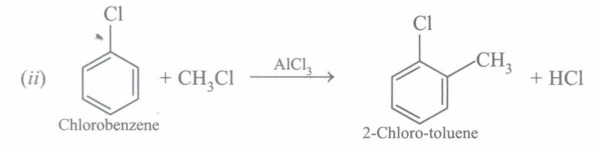
\(\mathrm{CH}_{3} \mathrm{CH}_{2} \mathrm{OH} \stackrel{\mathrm{PCl}_{5}}{\longrightarrow} \mathrm{CH}_{3} \mathrm{CH}_{2} \mathrm{Cl} \quad \stackrel{\mathrm{KCN}}{\longrightarrow} \quad \mathrm{CH}_{3} \mathrm{CH}_{2} \mathrm{CN}\)
Ethanol Chloroethane Propane nitrile
(b) Chlorobenzene is resonance hybrid of following structures:
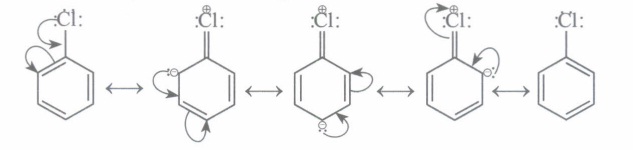
Since, electron density is maximum at o-and p-positions due to +R effect, therefore, electrophilic substitution will take place at o and p-positions.
30.
(a) \(\Delta { T }_{ f }=i\frac { { K }_{ f }{ W }_{ b }\times 1000 }{ { M }_{ b }\times { W }_{ a } } \)
\(\Delta { T }_{ f }=3\times \left( \frac { 1.86\times 1.9 }{ 95\times 50 } \right) \times 1000\)
= 2.23 K
\(\Delta { T }_{ f }-{ \Delta T }_{ f }^{ ' }=\frac { 273.15-2.23 }{ 273-2.23 } \)
\({ T }_{ f }^{ ' }\) = 270.92 K or 270.77 K
(b) (i) 2 M glucose has a higher boiling point because higher the number of particles lesser is the vapour pressure.
(ii) Reverse osmosis.
31.
In the lanthanoids, there is a regular decrease in the size of atoms and ions with an increase in atomic number. This decrease of ionic and atomic radii in the lanthanoid elements is called lanthanoid contraction. For example, the ionic radii decrease from Ce3+(111 pm) to Lu3+ (93 pm). Cause of lanthanoid contraction. As we move through the lanthanoid series, 4f-electrons are being added, one at each step. The mutual shielding effect of electrons is very little, even smaller than that of d-electrons. This is due to the shape of th~ f-orbitals. The nuclear charge, however, increases by one at each step. Hence, the inward pull experienced by the 4f-electrons increases. This causes a reduction in the size of the entire 4ft shell. The sum of the successive reductions gives the total lanthanoid contraction. Consequences of lanthanoid contraction. The important consequences of lanthanoid contraction are:
(i) It has a very important effect on the relative properties of the elements which follow the lanthanoids with those which proceed the lanthanoids. We know that there is a regular increase in size as we go from Sc to Y to La in group 3. Similarly, we expect normal, increase in size in other groups from
32.
(i) (d): In alkyl halides, polarity of C - Br bond increases with increase in chain length.
(ii) (a): The order of reactivity of alkyl halides: iodide > bromide > chloride (nature of the halogen atom)
tertiary> secondary> primary (type of halogen atom).
(iii) (d) : Iso-butylene is obtained.
(iv) (b): The order of bond dissociation energy: R - F > R - CI > R - Br > R - I. During dehydrohalogenation C - I bond breaks more easily than C - F bond. So reactivity order of halides R - I > R - Br > R - CI > R - F
33.
(i) (d) : II represents negative deviations and III represents positive deviations.
(ii) (b): For positive deviations \(p_{A}>p_{A}^{\circ} x_{A} \text { and } p_{B}>p_{B}^{\circ} x_{B}\)
(iii) (b): Water and nitric acid mixture shows negative deviations from Raoult's law, hence \(p_{A}<p_{A}^{\circ} x_{A} \text { and } p_{B}<p_{B}^{\circ} x_{B}\)
(iv) (d): Water-HCl mixture shows negative deviations from Raoult's law and solutions showing negative deviations from ideal behaviour form maximum boiling azeotrope.

12th Standard CBSE Syllabus & Materials
12th Standard CBSE
CBSE 12th Computer Science Python Revision Tour I - New Previous year Question Papers Study Material - QB365 Set A
NEW12th Standard CBSE
CBSE 12th Business Studies Planning Important Questions And Answers Study Material - QB365 Set A
NEW12th Standard CBSE
CBSE 12th Business Studies Business Environment Important Questions And Answers Study Material - QB365 Set A
NEW12th Standard CBSE
CBSE 12th Business Studies Principles of Management Important Questions And Answers Study Material - QB365 Set A



NCERT Books

Syllabus

Exam Pattern

Sample Question Papers

Previous year Question Papers

Important Notes

MCQ Practice test

NCERT Exemplers

Case study Questions

Image Based Questions

Passage based Questions

HOT Questions

Value Based Questions

Model Questions Papers
NCERT ( Book Back ) Questions

Assertion and Reason
Important Questions And Answers

CBSE 12th Standard CBSE Subjects
CBSE Standards








