
 100% FREE ACCESS
12th Standard CBSE Syllabus & Materials
12th Standard CBSE
CBSE 12th Economics Government Budget and the Economy Previous year Question Papers Study Material - QB365 Set A
NEW12th Standard CBSE
CBSE 12th Computer Science Interface Python with MySQL - New Previous year Question Papers Study Material - QB365 Set A
NEW12th Standard CBSE
CBSE 12th Computer Science Database Concept - New Previous year Question Papers Study Material - QB365 Set A
NEW12th Standard CBSE
CBSE 12th Computer Science Data Communication - New Previous year Question Papers Study Material - QB365 Set A
NEW12th Standard CBSE
CBSE 12th Computer Science Data Structures - New Previous year Question Papers Study Material - QB365 Set A
NEW12th Standard CBSE
CBSE 12th Computer Science Functions - New Previous year Question Papers Study Material - QB365 Set A

Published on: 25/10/2025
Download CBSE Class 12th Standard CBSE Chemistry question papers, sample papers, important questions, and previous year solved papers in PDF format. Get free study materials, NCERT solutions, and exam preparation resources for Class 12th Standard CBSE Chemistry
Questions + Answers key
Take MCQ Chemistry Test
1.
Why does vapour pressure of liquid decrease when a non - volatile solute is added into it ?
2.
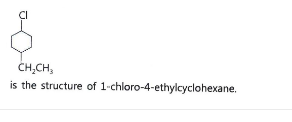
Write the structure of the compound:
1-chloro-4-ethylcyclohexane.
3.
A solution of KOH hydrolyses CH3 CHCICH2CH3 and CH3CH2CH2CH2Cl. Which one of these is more easily hydrolysed?
4.
When outer shell of two eggs are removed, one of the eggs is placed in pure water and other is placed in saturated solution of NaCl. What will be observed and why?
5.
Give reason when 20ml of ethyl alcohol and 30 ml of water are mixed, the volume of resulting solution is more than 60 ml.
6.
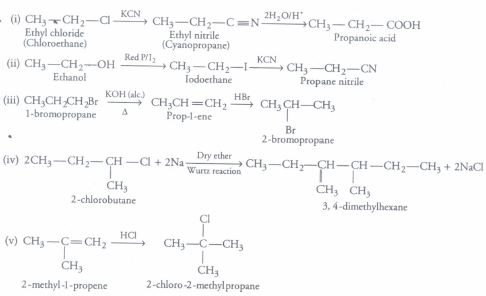
How can the following conversions be carried out?
(i) Ethyl chloride to propanoic acid
(ii) Ethanol to propane nitrile
(iii) 1-bromopropane to 2-bromopropane
(iv) 2-chlorobutane to 3, 4-dimethylhexane
(v) 2-methyl-I-propene to 2-chloro-2-methylpropane
7.
What is the solubility of a solid in liquid? Describe the various factors on which the solubility of a solid in a liquid depends?
8.
(a) Define the following terms:
(i) Molarity
(ii) Molal elevation constant (Kb)
(b) A solution containing 15 g urea (molar mass = 60 g mol-1) per litre of solution in water has the same osmotic pressure (isotonic) as a solution of glucose (molar mass = 180 g mol-1 ) in water. Calculate the mass glucose present in one litre of its solution.
9.
Wurtz reaction falils in case of tert-alkyl halides. Explain.
10.
Predict all the alkeness that would be formed by dehydrohalogenation of the following halides with sodium ethoxide in ethanol and identify the major alkene
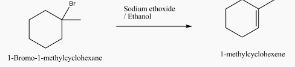
(a) 1-Bromo-1-methylcyclohexane
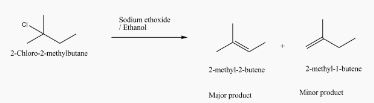
(b) 2-Chloro-2-methylbutane
(c) 2, 2, 3-Trimethyl-3-bromopentane.
11.
(a) Define the terms osmosis and osmotic pressure. Is the osmotic pressure of a solution a colligative property? Explain.
(b) Calculate the boiling point of a solution prepared by adding 15.00 g of NaCl to 250.0 g of water.
(K b for water = 0.512 K kg mol-1, molar mass of NaCl = 58.44 g)
12.
Chlorobenzene is extremely less reactive towards a nucleophilic substitution reaction. Give two reasons for the same.
13.
Common salt \((NaCI)\) and calcium chloride \((CaCI_{ 2 })\) are used to clear snow on the roads. The cost of sodium chloride and calcium chloride is almost the same. As a student of chemistry which salt would you prefer to purchase and why?
14.
Calculate the molarity of pure water (density of water \(=1\quad g\quad mL^{ -1 }\)).
15.
An organic compound 'A' having molecular formula C4H8 on treatment with dil. H2SO4 gives 'B'. 'B' on treatment with conc. HCl and anhydrous ZnCl2 gives 'C' and on treatment with sodium ethoxide gives back 'A'. Identify the compounds 'A', 'B' and 'C' and write the equations involved.
16.
Answer the following:
(i) Haloalkanes easily dissolve in organic solvents, why?
(ii) What is known as a racemic mixture? Give an example.
(iii) Of the two bromoderivatives, C6H5CHI(CH3)Br and C6H5CH(CH5)Br which one is more reactive in SN1 substitution reaction and why?
17.
The synthesis of alkyl flurides is best acomplished by
Finekelstein reaction
Swarts reaction
free radical fluourination
Sandmeyer's reaction
18.
Which of the following compounds has the highest boiling point?
CH3CH2CH2Cl
CH3CH2CH2CH2Cl
CH3CH(CH3)CH2Cl
(CH3)3CCl
19.
A 0.1 molal aqueous solution of a weak acid is 30% ionized. If Kf for water is 1.86o C/m, the freezing point of the solution will be
- 0.18oC
- 0.54oC
- 0.36oC
- 0.24oC
20.
Colligative properties depend on .............. .
the nature of the solute particles dissolved in solution
the number of solute particles in solution
the physical properties of the solute particles dissolved in solution
the nature of solvent particles
21.
200 mL of water is added to 500mL of 0.2 M solution. What is the molarity of the dilluted solution ?
0.5010 M
0.2897 M
0.7093 M
0.1428 M
1.
Some liquid molecules at the surface are replaced by the molecules of the solute which are non - volatile.
2.
3.
CH3−CH(Cl)CH2CH3 will be more easily hydrolysed because it will form secondary carbocation which is more stable than primary carbocation.
4.
The egg placed in pure water will swell, whereas the egg placed in saturated solution of NaCl will shrink.
5.
It is because forces attraction between ethyl alcohol and water are less than ethanol-ethanol and water-water. It shows positive deviation.
6.
7.
Solubility of Solids In Liquids:
Solubility is the interaction between particles of the solute and the solvent. Hence, it depends on the nature of the solute and the solvent, as well as on the temperature and pressure. But the solubility of solids in liquids is independent of pressure.
Factors affecting solubility
1. Temperature. Basically, solubility increases with temperature.
2. Polarity. In most cases solutes dissolve in solvents that have a similar polarity.
3. Pressure. Solid and liquid solutes.
4. Molecular size.
5. Stirring increases the speed of dissolving.
8.
(a) (i) Molarity: Molarity of a substance in a solution is equal to the number of moles of the substance present in one litre of the solution.
i.e., Molarity = \(\frac { No.\ of\ moles\ of\ substance }{ Volume\ of\ solution\ in\ L } \)
(ii) Molal elevation constant (Kb): It is also called ebullioscopic constant. It is equal to the change in boiling point of one molar solution.
\(\Delta\)Tb = Kb . m
So, when, Molarity = 1,\(\Delta\) Tb = Kb
(b)Given; Mass of urea, WB = 15 g
Molar mass of rea, MB = 60 g
The solution of urea in water is isotonic to that of glucose solution.
So, \(\pi _{ urea }=\pi _{ Glucose }\)
\(C_{ urea }RT=C_{ Glucose }RT\)
\(\frac { { n }_{ urea } }{ V } RT=\frac { { n }_{ Glucose } }{ V } RT\)
\(=\frac { 15 }{ 60 } =\frac { { W }_{ Glucose }V }{ 180 } \)
\(={ W }_{ Glucose }=\frac { 18\times 18 }{ 60 } \)
= 45 g
So, 45 g of glucose is present in 1 L of solution.
9.
tert-Alkyl halides prefer to undergo dehydrohalogenation in presence of a strong base such as Na metal instead of undergoing Wurtz reaction as explained below:
\(\underset{tert-Butyl\ bromide}{(CH_3)_3C-Br}+2Na\longrightarrow\underset{tert-Butylsodium}{(CH_3)_3Na^+}+Na^+Br^-\)
Thus, only rand 2° alkyl halides undergo Wurtz reaction while 3° alkyl halides prefer to undergo dehydrohalogenation to form alkenes.
10.
The reactions are given above:
(i) 1-methylcyclohexene is the major product.
Only one alkene is formed at beta H atoms on either side of Br atoms are equivalent.
(ii) 2-methyl-2-butene is the major product.
Two different alkenes are formed. More substituted alkene is the major product as it is more stable. This is in accordance with Saytzeff's rule.
(iii) 3,4,4-Trimethylpent-2-ene is the major product.
Two different alkenes are formed. More substituted alkene is the major product as it is more stable. This is in accordance with Saytzeff's rule.

11.
(a) Osmosis is the flow of solvent from solution of lower concentration to higher concentration through a semi-permeable membrane.
Osmotic pressure is the excess pressure which must be applied to a solution to prevent the passage of solvent through a semi-permeable memberane.
It has been found experimentally that for n moles of the solute dissolved in V litres of the solution, the osmotic pressure (π) at temperature T is
πV=nRT
Where R is a gas constant.
or \(\pi={n\over V}RT\)
= C RT
Where Cis the molar concentration ofthe solution.For a solution at given tempeature, both R and T are constant, so that
π ∝ C
Thus, osmotic pressure depends upon the molar concentration ofsolution and therefore, is a colligative property.
(b) \(ΔT_b={iK_b\times1000\times W_2\over W_1\times M_2}\)
NaCI dissociates as:
NaCI ⇾ Na+ + Cl-
i = 2
W2 = 1.5.0g, W1 = 250.0 g, M2 = 58.44 g mol-1 Kb = 0.512 K kg mol-1
\(\Delta T_b={2\times 0.512\times1000\times15.0\over 250.0\times58.44}\)
= 1.05 °C
Boiling point of solution = 100 + 1.05
= 101.5° C
12.
Haloarenes are much less reactive than haloalkanes towards nucleophilic substitution reactions because of the following reasons:
1. Resonance effect: In haloarenes, there is delocalisation of electrons due to resonance. For example, chlorobenzene is considered to be a resonance hybrid of the following structures:
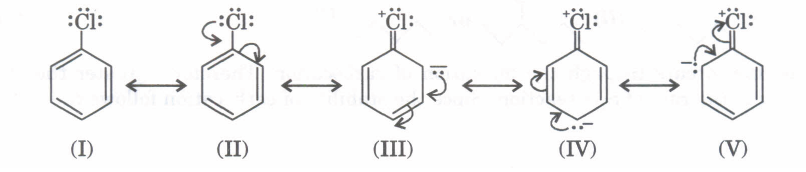
It is evident that, the contribution of structures III, IV and V imparts a partial double bond character to the carbon-chlorine bond. This is confirmed by X-ray analysis which shows that the C - CI bond length in chlorobenzene is 1.69A while the C-CI bond length in ethyl chloride molecule is 1.82A. The shortening of bond length imparts stability to aryl halides and the bond cleavage becomes rather difficult. The aryl halides are, therefore, less reactive than alkyl halides.
2. Different hybridisation states of carbon atom: In haloalkanes the carbon atom of the C - X bond is sp3 hybridised while in haloarene halides, the carbon atom is sp2 hybridised. The Sp2 hybridised carbon atom with a greater s-character is more electronegative. It can hold the electron pair of the bond more tightly than the Sp3 hybridised carbon atom in alkyl halides. Therefore, it has less tendency to release electrons to the halogen. As a result, the bond cleavage in aryl halides is some what more difficult than in alkyl halides.
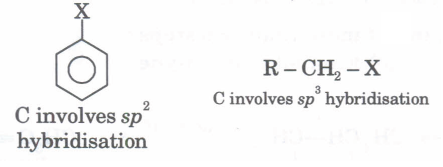
Thus haloarenes are less reactive towards the substitution reactions than haloalkanes.
13.
Sodium chloride \((NaCI)\) is preferred over calcium chloride \(({ CaCI }_{ 2 })\).This is because less amount of sodium chloride is needed in order to bring about same depression in freezing point. For example, if it is desired to decrease the freezing point by 10°C,the amount of NaCI d CaCl2 needed to be dissolved in
1 kg of water can be calculated from the formula:
\(\triangle { T }_{ f }=\frac { { iK }_{ f }\times { W }_{ B }\times 1000 }{ { W }_{ A }\times M_{ B } }\)
\(ForNaCI,\quad NaCI\rightleftharpoons { Na }^{ + }{ CI }^{ - }\quad i=2\)
\(\triangle { T }_{ f }={ 10 }^{ \circ },{ W }_{ A }=1000g,{ K }_{ f }=1.86 \ K{ m }^{ -1 },{ W }_{ B }=?,\)
\( { M }_{ B }=58.5\)
\( 10=\frac { 2\times1.86\times{ W }_{ B }\times1000 }{ 1000\times58.5 } \)
\( or \ \ \ \ { W }_{ B }=\frac { 10X1000X58.5 }{ 2X1.86X1000 } =157.26g\)
\( For \ { CaCI }_{ 2 },{ CaCI }_{ 2 }\rightleftharpoons { Ca }^{ 2+ }+2{ CI }^{ - } \ i=3\)
\( \triangle { T }_{ f }={ 10 }^{ \circ },{ W }_{ A }=1000g,{ K }_{ f }=1.86 \ K{ m }^{ -1 },{ W }_{ B }=?{ M }_{ B }=111\)
\(10=\frac { 3\times1.86\times{ W }_{ B }\times1000 }{ 1000\times111 } \)
\( or \ { W }_{ B }=\frac { 10\times1000\times111 }{ 3\times1.86\times1000 } =198.92g\)
Therefore, less amount of NaCI is needed and it should be preferred.
14.
Density of water \(=1\ g\ mL^{ -1 }\)
Mass of 1000 mL of water = Volume\(\times \)Density
=1000\(\times \)1 = 1000 g
Moles of water \(\\ =\frac { 1000 }{ 18 } =55.5\)
\(\therefore \) 55.55 moles of \({ H }_{ 2 } O\) are present in 1000 mL or 1 L of water
Molarity = 55.55 M.
15.
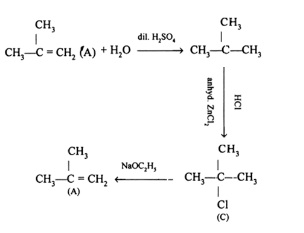
16.
i) Haloalkanes can easily dissolve in organic solvents of low polarity because the new forces of attraction set up between haloalkanes and the solvent molecules are of same strength as the forces of attraction being broken.
(ii) A mixture of equal amounts of two enantiomers is known as racemic mixture. For example : When a 3° halide undergoes substitution with KOH, the reaction proceeds through SN1 mechanism forming the racemic mixture in which one of the products has the same configuration as a reactant, while the other product has an inverted configuration.
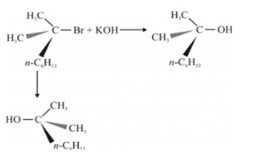
More stable the carbocation, more reactive will be substrate .the carbocation formed by two compounds are as follows:
Compound (C6H5)2CHBr = carbocation (C6H5)2CH+
Compound C6H5CH(CH3)Br = carbocation C6H5(CH3)CH+
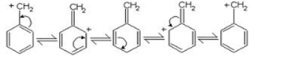
Out of these two carbocations (C6H5)2CH+ is more stable than C6H5(CH3)CH+ because the carbocation(C6H5)2CH+ is resonance stabilised by two benzene rings therefore (C6H5)2CHBr is more reactive than C6H5CH(CH3)Br. Resonance stabilisation of carbocation with one benzene ring is shown :
17.
(b)
Swarts reaction
18.
(b)
CH3CH2CH2CH2Cl
19.
(d)
- 0.24oC
20.
(b)
the number of solute particles in solution
21.
(d)
0.1428 M

12th Standard CBSE Syllabus & Materials
12th Standard CBSE
CBSE 12th Computer Science Python Revision Tour I - New Previous year Question Papers Study Material - QB365 Set A
NEW12th Standard CBSE
CBSE 12th Business Studies Planning Important Questions And Answers Study Material - QB365 Set A
NEW12th Standard CBSE
CBSE 12th Business Studies Business Environment Important Questions And Answers Study Material - QB365 Set A
NEW12th Standard CBSE
CBSE 12th Business Studies Principles of Management Important Questions And Answers Study Material - QB365 Set A



NCERT Books

Syllabus

Exam Pattern

Sample Question Papers

Previous year Question Papers

Important Notes

MCQ Practice test

NCERT Exemplers

Case study Questions

Image Based Questions

Passage based Questions

HOT Questions

Value Based Questions

Model Questions Papers
NCERT ( Book Back ) Questions

Assertion and Reason
Important Questions And Answers

CBSE 12th Standard CBSE Subjects
CBSE Standards








