
 100% FREE ACCESS
12th Standard CBSE Syllabus & Materials
12th Standard CBSE
CBSE 12th Economics Government Budget and the Economy Previous year Question Papers Study Material - QB365 Set A
NEW12th Standard CBSE
CBSE 12th Computer Science Interface Python with MySQL - New Previous year Question Papers Study Material - QB365 Set A
NEW12th Standard CBSE
CBSE 12th Computer Science Database Concept - New Previous year Question Papers Study Material - QB365 Set A
NEW12th Standard CBSE
CBSE 12th Computer Science Data Communication - New Previous year Question Papers Study Material - QB365 Set A
NEW12th Standard CBSE
CBSE 12th Computer Science Data Structures - New Previous year Question Papers Study Material - QB365 Set A
NEW12th Standard CBSE
CBSE 12th Computer Science Functions - New Previous year Question Papers Study Material - QB365 Set A

Published on: 25/10/2025
Download CBSE Class 12th Standard CBSE Chemistry question papers, sample papers, important questions, and previous year solved papers in PDF format. Get free study materials, NCERT solutions, and exam preparation resources for Class 12th Standard CBSE Chemistry
Questions + Answers key
Take MCQ Chemistry Test
1.
Common salt \((NaCI)\) and calcium chloride \((CaCI_{ 2 })\) are used to clear snow on the roads. The cost of sodium chloride and calcium chloride is almost the same. As a student of chemistry which salt would you prefer to purchase and why?
2.
The decomposition of Cl2O7 at 400K in the gas phase to Cl2 and O2 is a first order reaction.
(i) After 50 seconds at 400K,the pressure of Cl2O7 falls from 0.062 to 0.044 atm. Calculate the rate constant
(ii) Calculate the pressure of Cl2O7 after 100 sec of decomposition at this temperature.
3.
When a current of 0.75 A is passed through CuSO4 solution for 25 min, 0.369 g of copper is deposited at the cathode. Calculate the atyomic mass of copper.
4.
Calculate the freezing point of a 1 molar aqueous solution of KCl.
(Density of solution = 1.04 g cm-3,
K f = 1.86 K kg mol-1, At wt. of K = 39 and Cl = 35.5)
5.
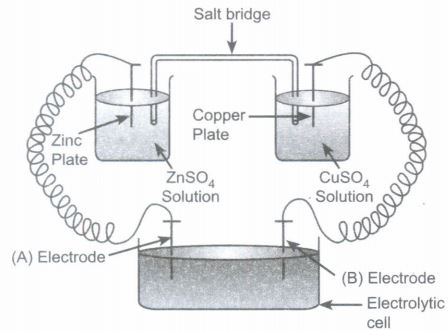
Consider the following diagram in which an electrochemical cell is coupled to an electrolytic cell. What will be the polarity of electrodes 'A' and 'B' in the electrolytic cell?
6.
Give an example of a compound in which hydrogen bonding occurs.
7.
(i) Illustrate graphically the effect of catalyst on activation energy.
(ii) Catalysts have no effect on the equilibrium constant, why?
8.
For a reaction: A + H2O \(\longrightarrow\) B, Rate \(\propto \) A]. What is its (i) Molecularity (ii) Order of reaction?
9.
Consider a cell given below:
\(Cu\left| { Cu }^{ 2+ } \right| \left| { CI }^{ - } \right| { CI }_{ 2 },Pt\)
Write reactions that occur at anode and cathode.
10.
Solubility of gases in liquids decreases with rise in temperature because dissolution is an
endothermic and reversible process
exothermic and reversible process
endothermic and irreversible process
exothermic and irreversible process
11.
Which of the following cell is used in inverter?
Fuel cell
Mercury cell
Lead storage cell
Dry cell
12.
The rate constant of a reaction A \(\rightarrow\) B is 0.6 x 10- 3 mole per second. If the concentration of [A] is 5 M, then what will be concentration of [B] after 20 months?
0.36 M
0.72 M
1.08 M
3.60 M
13.
Consider the following plot between In k and 1/T,
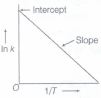
In this plot, the intercept and slope respectively are
\(-\frac{E_{a}}{R} ; \ln A\)
\( \ln A ;-\frac{E_{\alpha}}{R}\)
\(\frac{E_{a}}{R} ;-\ln A\)
\( \frac{E_{a}}{R} ; A\)
14.
Select the correct statement for
⋀m =⋀om - AC1/2
This equation is for weak electrolyte
Intercept is equal to ⋀m
Slope is 'A'
Value of A depends on the charges of cation and anion
15.
6 A current with 75% efficiency is passed through a cell for 6 h? (z = 4 x 10- 4). The amount of metal deposited will be
22.4 g
36.0 g
32.4 g
38.8g
16.
Which one of the following is not correct ?
Every biomolecular collision does not result into a chemical reaction.
collosion theory is not applicable to unimolecular reaction
according to collision frequency, k = PZ AB e-E/RT where Z AB is collision frequency and P is steric factor
Collision theory assumes molecules to be hard speres
17.
For first reaction A \(\longrightarrow\) P, the temperature (T) dependent rate constant (k) was found to follow the equation log k = -(2000)\(\frac {1}{T}\) +6.0.
The pre-exponential factor A and the activation energy Ea respectively, are
1.0 \(\times 10^{6}s^{-1}\) and 9.2 kJ mol -1
6.0 \(s^{-1}\) and 16.6 kJ mol -1
1.0 \(\times 10^{-1}s^{-1}\) and 16.6 kJ mol -1
1.0 \(\times 10^{6}s^{-1}\) and 38.3 kJ mol -1
18.
A solution containing 0.10 g of non - volatile solute X (molar mass : 100) in 200 g of benzene depresses the freezing point of benzene by 0.25oC while 0.50g of another non - volatile solute Y in 100 g of benzene also depresses by 0.25oC. What is the molecular mass of Y ?
50
100
150
1000
19.
How many grams of concentrated nitric acid solution should be used to prepare 250 mL of 2.0 M HNO3 ? The concentrated nitric acid is 70% HNO3
45.0 g conc HNO3
90.0 g conc HNO3
70.0 g conc HNO3
54.0 g conc HNO3
20.
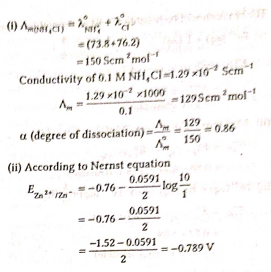
(i) The molar conductivities of NH+4, and Cl- ion are 73.8 S cn cm² mol-1 and 76.2 S cm² mol-1 respectively. The conductivity of 0.1 M NH4Cl is 1.29 x10⁻² Scm-1. Calculate its molar conductivity and degree of dissociation.
(ii) Calculate the half-cell potential at 298 K for the reaction
Zn2+ + 2e- → Zn
if [Zn2+] = 0.1 M and EoZn2+/Zn =-0.76 V.,
21.
(a) Boiling point of water at 750 mm Hg pressure is 99.68°C. How much sucrose (Molar mass = 342 g mol-1) is to be added to 500 g of water such that it boils at 100°C?
(Kb for water = 0.52 K kg mol-1).
(b) State Henry's law and write its any one application.
22.
(a) What is the rate of reaction? Write two factors that affect the rate of reaction
(b) The rate constant of a first-order reaction increase from \(4\times { 10 }^{ -2 }\ to\ 8\times { 10 }^{ -2 }\)when the temperature changes from 27°C to 37°C. Calculate the energy of activation \(\left( { E }_{ \alpha } \right) \) .
\(log\ 2=0.301,\ log\ 3=0.477,\ log\ 4=0.6021\)
or
(a) For a reaction A+B\(\longrightarrow \) , the rate is given by
\(Rate\ =\ k\left[ A \right] \left[ { B } \right] _{ 2 }\)
(i) How is the rate of reaction affected if the concentrated of B is doubled?
(ii) What is the overall order of reaction if A is present in large excess?
(c) A first order reaction takes 23.1 minutes for 50% completion. calculate the time required for 75% completion of this reaction.
\(log\ 2=0.301,\ log\ 3=0.477,\ log\ 4=0.6021\)
23.
Find the solubility product of Ag2CrO4 in water at 298 K if the e.m.f. of the cell Ag/Ag+ (saturated Ag2CrO4 soln.) || Ag+ (0.1 M)Ag is 0.164 V at 298 K.
24.
25.
Assertion: Solutions show deviations from Raoult's law.
Reason: The cause for these deviations lies in the nature of interactions at the molecular level.
Codes:
A) Assertion and reason both are correct statements and reason is correct explanation for assertion.
B) Assertion and reason both are correct statements but reason is not correct explanation for assertion.
C) Assertion is correct statement but reason is wrong statement.
D) Assertion is wrong statement but reason is correct statement.
26.
27.
Assertion (A) : Hydrolysis of an ester follows first order kinetics.
Reason (R) : Concentration of water remains nearly constant during the course of the reaction.
(a) Both Assertion and Reason are correct, Reason is the correct explanation of Assertion.
(b) Both Assertion and Reason are correct, Reason is not the correct explanation of Assertion.
(c) Assertion is correct; Reason is incorrect.
(d) Assertion is incorrect; Reason is correct.
28.
In the following questions.an Assertion (A) is followed by a corresponding Reason (R) Use the following keys to choose the appropriate answer.
Assertion (A) Conductivity always increases with decrease in concentration for strong and weak electrolytes.
Reason (R) Number of ions per unit volume decreases on dilution.
Codes:
(a) Both (A) and (R) are correct, (R) is the correct explanation of (A).
(b) Both (A) and (R) are correct, (R) is not the correct explanation of (A).
(c) (A) is correct; (R) is incorrect.
(d) (A) is incorrect; (R) is correct.
29.
30.
Read the passage given below and answer the following questions:
The concentration of potassium ions inside a biological cell is at least twenty times higher than the outside. The resulting potential difference across the cell is important in several processes such as transmission of nerve impulses and maintaining the ion balance. A simple model for such a concentration cell involving a metal M is M(s) | M+(aq.; 0.05 molar) || M+(aq; 1 molar) |M(s).
The following questions are multiple choice questions. Choose the most appropriate answer:
(i) For the above cell,
| (a) \(E_{\text {cell }}<0 ; \Delta G>0\) | (b) \(E_{\text {cell }}>0 ; \Delta G<0\) | (c) \(E_{\text {cell }}<0 ; \Delta G^{\circ}>0\) | (d) \(E_{\text {cell }}>0 ; \Delta G^{\circ}<0\) |
(ii) The value of equilibrium constant for a feasible cell reaction is
| (a) < 1 | (b) = 1 | (c) > 1 | (d) zero |
(iii) What is the emf ofthe cell when the cell reaction attains equilibrium?
| (a) 1 | (b) 0 | (c) > 1 | (d) < 1 |
(iv) The potential of an electrode change with change in
| (a) concentration of ions in solution | (b) position of electrodes |
| (c) voltage of the cell | (d) all of these |
1.
Sodium chloride \((NaCI)\) is preferred over calcium chloride \(({ CaCI }_{ 2 })\).This is because less amount of sodium chloride is needed in order to bring about same depression in freezing point. For example, if it is desired to decrease the freezing point by 10°C,the amount of NaCI d CaCl2 needed to be dissolved in
1 kg of water can be calculated from the formula:
\(\triangle { T }_{ f }=\frac { { iK }_{ f }\times { W }_{ B }\times 1000 }{ { W }_{ A }\times M_{ B } }\)
\(ForNaCI,\quad NaCI\rightleftharpoons { Na }^{ + }{ CI }^{ - }\quad i=2\)
\(\triangle { T }_{ f }={ 10 }^{ \circ },{ W }_{ A }=1000g,{ K }_{ f }=1.86 \ K{ m }^{ -1 },{ W }_{ B }=?,\)
\( { M }_{ B }=58.5\)
\( 10=\frac { 2\times1.86\times{ W }_{ B }\times1000 }{ 1000\times58.5 } \)
\( or \ \ \ \ { W }_{ B }=\frac { 10X1000X58.5 }{ 2X1.86X1000 } =157.26g\)
\( For \ { CaCI }_{ 2 },{ CaCI }_{ 2 }\rightleftharpoons { Ca }^{ 2+ }+2{ CI }^{ - } \ i=3\)
\( \triangle { T }_{ f }={ 10 }^{ \circ },{ W }_{ A }=1000g,{ K }_{ f }=1.86 \ K{ m }^{ -1 },{ W }_{ B }=?{ M }_{ B }=111\)
\(10=\frac { 3\times1.86\times{ W }_{ B }\times1000 }{ 1000\times111 } \)
\( or \ { W }_{ B }=\frac { 10\times1000\times111 }{ 3\times1.86\times1000 } =198.92g\)
Therefore, less amount of NaCI is needed and it should be preferred.
2.
0.0312 atm.
3.
63.3.
4.
Mass of solution = 1000 x 1.04 = 1040 9
Mass of solute = 74.5 9
Mass of solvent = 1040 - 74.5 = 965.5 9
\(m={W_B\over M_B}\times{1000\over W_A}={74.5\over 74.5}\times{1000\over 965.5}\)
=1.0357
ΔTf = i x m x Kf = 2 x 1.0357 x 1.86
⇒ ΔTf = 3.852 K
Freezing point of solution
= 273 K - 3.852 K
= 269.148 K
5.
'A' will have negative polarity, whereas 'B' will have positive polarity.
6.
Acetic acid.
7.
(a)
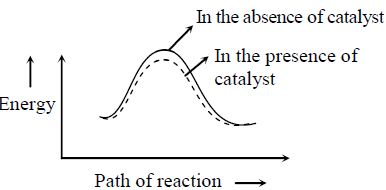
Effect of catalyst on activation energy.
(b) Because catalyst catalyses the forwards as well as backward reaction to the same extent.
8.
(i) pseudo-unimolecular
(ii) order = 1
9.
\(C u \rightarrow C u^{2+}+2 e^{-} \text {At anode, }\)
\(\mathrm{Cl}_2+2 e^{-} \rightarrow 2 \mathrm{Cl}^{-} \text {At cathode. }\)
Cu is anode because it is getting oxidised, Cl2 is cathode as it is getting reduced.
10.
(b)
exothermic and reversible process
11.
(c)
Lead storage cell
12.
(b)
0.72 M
13.
(b)
\( \ln A ;-\frac{E_{\alpha}}{R}\)
14.
(d)
Value of A depends on the charges of cation and anion
15.
(d)
38.8g
16.
(b)
collosion theory is not applicable to unimolecular reaction
17.
(d)
1.0 \(\times 10^{6}s^{-1}\) and 38.3 kJ mol -1
18.
(d)
1000
19.
(a)
45.0 g conc HNO3
20.
21.
(a) Given,
Boiling point of pure water = 99.68°C
Elevation in boiling point, (\(\Delta\)Tb) =100 - 99.68 = 0.32°C
Kb = 0.52 K kg mol-1
Molar mass of sucrose = 342 g mol-1
Amount of water (WA) = 500 g
We know that, \(\Delta\)Tb = Kb \(\times\) molality ....(i)
\(\text { Molality }=\frac{\text { Mass of solute } \times 1000}{\text { Molar mass of solute } \times \text { Mass of solvent }}(\mathrm{g})\)
Let, x g of sucrose be added
\(\therefore \text { Molality }=\frac{x \times 1000}{342 \times 500}=\frac{x}{171}\)
Putting the value in Eq. (i), we get
\(\begin{aligned} 0.32 & =0.52 \times \frac{x}{171} \end{aligned}\)
\(\begin{aligned} x & =\frac{0.32 \times 171}{0.52}=105.23 \mathrm{~g} \end{aligned}\)
Therefore, 105.23 g of sucrose must be added.
(b) Henry's law states that, at a constant temperature, the solubility of a gas the in a liquid is directly proportional to the partial pressure of the gas present above the surface of liquid or solution.
One of the application of Henry's law is in the production of carbonated beverage To increase the solubility of CO2, in soft drinks and soda water, the bottle is sealed under high pressure.
22.
(a) Rate of reaction is defined as the change in concentration of reactants or products per unit time. Factors that affect rate of a reaction
(i) Concentration of reactant
(ii) Temperature
\(log{k_2\over k_1}={E_a\over 2.303R}\left[T_2-T_1\over T_1T_2\right]\)
k1 = 4 x 10⁻² k2
T1= 8 x 10⁻²,
T1 = 273 + 27 = 300K
T2 = 273 + 37 = 310K,
R = 8.314 JK-1mol-1
\(log{2\times10^{-2}\over 4\times10^{-2}}={E_a\over 2.303\times8.314}\left[310-300\over 300\times310\right]\)
\(log2={E_a\over 2.303\times8.314}\times{10\over 300\times310}\)
\(0.301={E_a\over 2.303\times8.314}\times{10\over 300\times310}\)
\(E_a={0.301\times2.3038.314\times300\times 310\over 10}\)
= 53598 J mol-1
= 53.598 kJ mol-1
Or
(a) Rate = k[A][B]2
(i) becomes four times
(ii) second order
(b) For a first order reaction
\(k={2.303\over t}log{[A]_0\over [A]}\)
\([A]+0=a,[A]=a-{a\times50\over 100}=0.50a, t=23.1min\)
\(k={2.303\over 23.1}log{a\over 0.5a}\)
\(={2.303\over 23.1}log2\)
\(={2.303\over 23.1}\times0.301\)
= 0.0300 min-1
\([A]=a-{a\times75\over 100}=0.25a\)
t = ?, k = 0.0300 min-1
\(t={2.303\over k}log{[A]_0\over [A]}\)
\(={2.303\over 0.0300}log{a\over 0.25a}\)
\(={2.303\over 0.0300}log4\)
\(={2.303\over 0.0300}\times0.6021\)
= 46.2min
23.
\(E_{cell}={0.0591\over n}log{c_2\over c_1}\)
\(0.164={0.0591\over 1}log{0.1\over _1}\ or\ log{0.1\over c_1}=2.7750\ or\ 0.1/c_1=5.957\times10^2c_1=1.679\times10^{-4}\)
i.e., [Ag+] in saturated Ag2CrO4 = 1.679 x 10⁻⁴M
Ag2CrO4 ⇌ 2 Ag+ +/CrO42-
\([Ag^+]=1.679\times10^{-4}M,\ [CrO^{2-}_4]={[Ag^+]\over 2}={1.679\times10^{-4}\over 2}M\)
\(K_{sp}=[Ag^+]^2[CrO_4^{2-}]=(1.679\times10^{-4})^2\times\left(1.6798\times10^{-4}\over 2\right)=2.37\times10^{-12}\)
24.
25.
A) Assertion and reason both are correct statements and reason is correct explanation for assertion.
Explanation:
On mixing two dissimilar substances, their molecular environment changes. Suppose the two components that are mixed to form a non-ideal solution are A and B. When A - B interactions A - A or B - B interactions, there is a negative deviation from Raoult's law.
26.
27.
(a) (a) Both Assertion and Reason are correct, Reason is the correct explanation of Assertion.
Consider the hydrolysis of an ester
\( \mathrm{CH}_3 \mathrm{COOC}_2 \mathrm{H}_5+\mathrm{H}_2 \mathrm{O} \longrightarrow \mathrm{CH}_3 \mathrm{COOH}+\mathrm{C}_2 \mathrm{H}_5 \mathrm{OH}\)
\(\text { Rate }=k\left[\mathrm{CH}_3 \mathrm{COOC}_2 \mathrm{H}_5\right]\left[\mathrm{H}_2 \mathrm{O}\right] \)
Hydrolysis of an ester follows first order because the concentration of water, \(\left[\mathrm{H}_2 \mathrm{O}\right]\) remains nearly constant and the change in the concentration of acid will result in very negligible change in the concentration of \(\mathrm{H}^{+} / \mathrm{OH}^{-}\)ion during the course of the reaction.
Thus, both (A) and (R) are correct and (R) is the correct explanation of (A).
28.
(d) Conductivity always decreases with decrease in concentration for weak and strong electrolytes. This is explained by the decrease in the number of ions per unit volume that carry current in solution on dilution. Thus, (A)is incorrect but (R)is correct.
29.
30.
(i) (b) : \(\begin{array}{l} M \longrightarrow M^{+}+e^{-} \\ (1 \cdot M)(0.05 M) \end{array}\)
For concentration cell, \(E_{\text {cell }}=-\frac{0.059}{1} \log \frac{0.05}{1}\)
\(E_{\text {cell }}=-\frac{0.059}{1} \log \left(5 \times 10^{-2}\right)\)
\(E_{\text {cell }}=-\frac{0.059}{1}[(-2)+\log 5]-0.059(-2+0.698)\)
= -0.059(-1.302) = 0.0768
\(\Delta G=-n F E_{\text {cell }}\)
If Ecell is positive, \(\Delta G\) is negative.
(ii) (c) : \(K=\operatorname{antilog}\left(\frac{n E^{\circ}}{0.0591}\right)\)
For feasible cell, Eo is positive, hence from the above equation K > 1 for a feasible cell reaction.
(iii) (b)
(iv) (a)

12th Standard CBSE Syllabus & Materials
12th Standard CBSE
CBSE 12th Computer Science Python Revision Tour I - New Previous year Question Papers Study Material - QB365 Set A
NEW12th Standard CBSE
CBSE 12th Business Studies Planning Important Questions And Answers Study Material - QB365 Set A
NEW12th Standard CBSE
CBSE 12th Business Studies Business Environment Important Questions And Answers Study Material - QB365 Set A
NEW12th Standard CBSE
CBSE 12th Business Studies Principles of Management Important Questions And Answers Study Material - QB365 Set A



NCERT Books

Syllabus

Exam Pattern

Sample Question Papers

Previous year Question Papers

Important Notes

MCQ Practice test

NCERT Exemplers

Case study Questions

Image Based Questions

Passage based Questions

HOT Questions

Value Based Questions

Model Questions Papers
NCERT ( Book Back ) Questions

Assertion and Reason
Important Questions And Answers

CBSE 12th Standard CBSE Subjects
CBSE Standards








