
 100% FREE ACCESS
12th Standard CBSE Syllabus & Materials
12th Standard CBSE
CBSE 12th Economics Government Budget and the Economy Previous year Question Papers Study Material - QB365 Set A
NEW12th Standard CBSE
CBSE 12th Computer Science Interface Python with MySQL - New Previous year Question Papers Study Material - QB365 Set A
NEW12th Standard CBSE
CBSE 12th Computer Science Database Concept - New Previous year Question Papers Study Material - QB365 Set A
NEW12th Standard CBSE
CBSE 12th Computer Science Data Communication - New Previous year Question Papers Study Material - QB365 Set A
NEW12th Standard CBSE
CBSE 12th Computer Science Data Structures - New Previous year Question Papers Study Material - QB365 Set A
NEW12th Standard CBSE
CBSE 12th Computer Science Functions - New Previous year Question Papers Study Material - QB365 Set A

Published on: 25/10/2025
Download CBSE Class 12th Standard CBSE Chemistry question papers, sample papers, important questions, and previous year solved papers in PDF format. Get free study materials, NCERT solutions, and exam preparation resources for Class 12th Standard CBSE Chemistry
Questions + Answers key
Take MCQ Chemistry Test
1.
Why is molality considered better for expressing concentration of solution than molarity?
2.
Primary alkyl halide C4H9Br (A) reacted with alcholicKOH to give compound (B). Compound (B) is reacted will NBr to give (C) which is an isomer of (A). When (A) is reacted with Na metal , if gives a compound (D), C8H18 which is different from the compound formed when n-butyl bromide is reacted with sodium. Give the structural formula of (A) and write the equations for all the reactions.
3.
Alcohols are comparatively more soluble in water than hydrocarbons of compounds of comparable molecular masses. Explain this fact.
4.
The partial pressure of ethane over a saturated solution containing 6.56 \(\times\) 10-3 g of ethane is 1 bar. If the solution contains 5.00 \(\times\) 10-2 g of ethane then what shall be the partial pressure of the gas?
5.
When outer shell of two eggs are removed, one of the eggs is placed in pure water and other is placed in saturated solution of NaCl. What will be observed and why?
6.
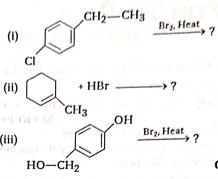
Draw the structures of the major monohalo product for each of the following reactions.
7.
At 300 K, 36 g of glucose present in a litre of its solution has an osmotic pressure of 4.98 bar. If the osmotic pressure of the solution is 1.52 bar at the same temperature, what would be its concentration?
8.
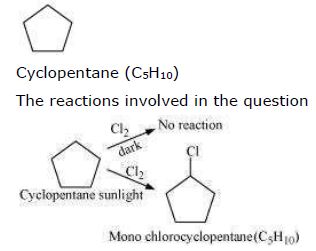
A hydrocarbon C5H10 does not react with chlorine in dark but gives a single monochloro compound C5H9Cl in bright sunlight. Identify the hydrocarbon.
9.
The correct order of basic strength is
H2O<OH-<CH3O-
CH3OH<H2O<CH3O-<OH-
H2O<CH3OH<OH-<CH3O-
OH-H2O<CH3O-<CH3OH
10.
Propene on hydroboration-oxidation produces
CH3CH2CH2OH
CH3CHOHCH3
CH3CHOHCH2OH
CH3CH2CHO
11.
Alkyl halides are prepared from alcohols by treating with
HCl+ZnCl2
Red P+Br2
H2SO4+KI
All the above
12.
What is the osmotic pressure of a 0.0020 mol dm-3 sucrose (C12H22O11) solution at 20oC ? (Molar gas constant, R = 8.314 JK-1mol-1)
4870 Pa
4.87 Pa
0.00487 Pa
0.33 Pa
13.
The molal freezing point constant of water is 1.86o C/M. Therefore the freezing point of 0.1 M NaCl solution in water is expected to be
- 1.86oC
- 0.186oC
- 0.372oC
+ 0.372oC
14.
An organic compound (A) on treatment with CHCl3 and KOH gives two compounds B and C.Both B and C give the same product (D) when distilled with zinc dust.Oxidation of D gives E having molecular formula C7H6O2.The sodium salt of E on heating with soda-lime gives F which may also be obtained by distilling A with zinc dust.Identify A to F
15.
In the following questions. an Assertion (A) is followed by a corresponding Reason (R) Use the following keys to choose the appropriate answer.
Assertion (A) One molar aqueous solution has always higher concentration than one molal.
Reason (R) The molality of a solution depends upon the density of the solution whereas molarity does not.
(a) Both (A) and (R) are correct, (R) is the correct explanation of (A).
(b) Both (A) and (R) are correct, (R) is not the correct explanation of (A).
(c) (A) is correct; (R) is incorrect.
(d) (A) is incorrect; (R) is correct.
16.
In the following questions. an Assertion (A) is followed by a corresponding Reason (R) Use the following keys to choose the appropriate answer.
Assertion (A) The vapour pressure of 0.1M sugar solution is less than that of 0.1M potassium chloride solution.
Reason (R) Lowering of vapour pressure is directly proportional to the number of species present in the solution.
(a) Both (A) and (R) are correct, (R) is the correct explanation of (A).
(b) Both (A) and (R) are correct, (R) is not the correct explanation of (A).
(c) (A) is correct; (R) is incorrect.
(d) (A) is incorrect; (R) is correct.
17.
An organic compound (A) having molecular formula C6H6O gives a characteristic color with an aqueous FeCl3 solution. (A) on treatment with CO2 and NaOH at 400 K under pressure gives (B), which on acidification gives a compound (C). The compound (C) reacts with acetyl chloride to give (D) which is a popular pain killer.
(i) Compound (A) is
(a) 2-hexanol
(b) dimethyl ether
(c) phenol
(d) 2-methyl pentanol.
ii) Number of carbon atoms in compound (D) is
(a) 7
(b) 6
(c) 8
(d) 9
iii) The conversion of compound (A) to (C) is known as
(a) Reimer- Tiemann reaction
(b) Kolbe’s reaction
(c) Schmidt reaction
(d) Swarts reaction
(iv) Compound (A) on heating with compound (C) in presence of POCl3 gives a compound (D) which is used
(a) in perfumery as a flavoring agent
(b) as an antipyretic
(c) as an analgesic
(d) as an intestinal antiseptic.
1.
Molality does not change with temperature while molarity changes with temperature.
2.
\({ CH }_{ 3 }-\overset { \underset { | }{ { CH }_{ 3 } } }{ CH } -{ CH }_{ 2 }Br+KOH(a/c)\longrightarrow { CH }_{ 3 }-\overset { \underset { | }{ { CH }_{ 3 } } }{ CH } ={ CH }_{ 2 }\overset { HBr }{ \longrightarrow } { CH }_{ 3 }-\overset { \underset { | }{ { CH }_{ 3 } } }{ \underset { \overset { | }{ Br } }{ C } } -{ CH }_{ 3 }\)
'A' 'B' 'C'
'C' is the isomer of 'A'.
\(2{ CH }_{ 3 }-\overset { \underset { | }{ { CH }_{ 3 } } }{ CH } -{ CH }_{ 2 }Br+2Na\overset { Dry }{ \underset { ether }{ \longrightarrow } } { CH }_{ 3 }-\overset { \underset { | }{ { CH }_{ 3 } } }{ CH } -{ CH }_{ 2 }-{ CH }_{ 2 }-\overset { \underset { | }{ { CH }_{ 3 } } }{ CH } -{ CH }_{ 3 }+2NaBr\)
\(\\ 2{ CH }_{ 3 }{ CH }_{ 2 }{ CH }_{ 2 }{ CH }_{ 2 }Br+2Na\overset { Dry }{ \underset { ether }{ \longrightarrow } } { CH }_{ 3 }-{ CH }_{ 2 }-\overset { 'D'(C_{ 8 }{ H }_{ 18 }) }{ \underset { n-Octane(C_{ 8 }{ H }_{ 18 }) }{ { CH }_{ 2 }-{ CH }_{ 2 }-{ CH }_{ 2 } } } -{ CH }_{ 2 }-{ CH }_{ 2 }-{ CH }_{ 3 }\)
'D' and n-octane are different.
3.
It is because alcohol can form H-bonds with H2O, whereas hydrocarbons cannot, that is why alcohols are soluble in water.
4.
We know that, m = KH \(\times\) P
\(\therefore\) 6.56 \(\times\) 10-2g = KH \(\times\) 1 bar ...(i)
\(\therefore\) 0 5.00 \(\times\) 10-2 g = KH \(\times\) P.........(ii)
KH = 6.56 \(\times\) 10-2/1 bar (from i)
KH = 5.00 \(\times\) 10-2//p bar (from ii)
\(\therefore \quad \frac{6.56 \times 10^{-2}}{1}=\frac{5.00 \times 10^{-2}}{p}\)
\(\therefore \quad P=\frac{5 \cdot 00}{6 \cdot 56}=0.762 \text { bar. }\)
5.
The egg placed in pure water will swell, whereas the egg placed in saturated solution of NaCl will shrink.
6.
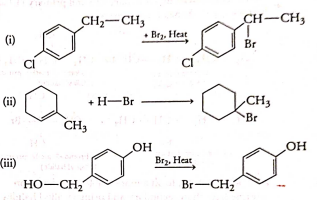
7.
\(\pi=C R T=\frac{n}{V} R T=\frac{W_{2} \times R T}{M_{2} \times V}\)
For both solutions, R, T and V are constant.
ஃ In the first case, (M2 = 180 for glucose)
\(98=\frac{36}{180} \times \frac{R \times 300}{V}\) ----(i)
In the second case,
\( 1.52=\frac{W_{2}}{M_{2} V} \times R \times 300\\ \) ------(ii)
On dividing Eq. (ii) by Eq. (i), we get
\(\frac{W_{2}}{M_{2} V} \text { or } C=0.061 \mathrm{~mol} \mathrm{~L}^{-1}\)
8.
A hydrocarbon with the molecular formula, C5H10 belongs to the group with a general molecular formula CnH2n. Therefore, it may either be an alkene or a cycloalkane. Since hydrocarbon does not react with chlorine in the dark, it cannot be an alkene. Thus, it should be a cycloalkane. Further, the hydrocarbon gives a single monochloro compound, C5H9Cl by reacting with chlorine in bright sunlight. Since a single monochloro compound is formed, the hydrocarbon must contain H−atoms that are all equivalent. Also, as all H−atoms of a cycloalkane are equivalent, the hydrocarbon must be a cycloalkane.
9.
(c)
H2O<CH3OH<OH-<CH3O-
10.
(a)
CH3CH2CH2OH
11.
(a)
HCl+ZnCl2
12.
\(\pi =CRT\\ C=0.002\quad mol\quad { dm }^{ -3 }=2\quad mol\quad { m }^{ -3 }\\ R={ 8.314JK }^{ -1 }{ mol }^{ -1 },T=293K\\ \pi =2\times 80314\times 293=4872\quad Pa\)
13.
\(NaCl\longrightarrow { Na }^{ + }+{ Cl }^{ - },i=2\\ \Delta { T }_{ f }={ iK }_{ f }m=2\times 1.86\times 0.1={ 0.372 }^{ o }C,\\ { T }_{ f }={ 0.372 }^{ o }C.\)
14.
(i) Since compound (A) on treatment with CHCI3 and KOH (i.e., Reimer-Tiemann reaction), gives two products Band C, therefore, A must be phenol and Band C must be o-hydroxybenzaldehyde and P: hydroxybenzaldehyde respectively or vice-versa.
(ii) Since both Band C on distillation with Zn dust give the same compound (D), therefore, D must be benzaldehyde.
(iii) Since oxidation of D gives E with M.F. C7R602, therefore, E must be benzoic acid.
(iv) Since sodium salt of E, i.e.benzoic acid upon heating with soda-lime gives compound (F), therefore.
(F) must be benzene. Zn dust distillation of A would also give benzene (F).
15.
(b) Both (A) and (R) are true but (R) is not the correct explanation of (A). The correct explanation is that one molar aqueous solution has 1 mole in less than 1000 g of water. Hence, 1000 g of water will be associated with more than 1 mole while 1 molal has 1 mole in 1000 g of water
16.
(d) Lowering of vapour pressure is directly proportional to the number of species present in solution. Sugar is a non-electrolyte however KCI is an electrolyte and dissociates in solution to give particles. Hence, there is greater lowering in vapour pressure in case of KCl. Hence, the vapour pressure of 0.1 M sugar solution is more than that of 0.1M potassium chloride solution. Thus, Assertion (A) is incorrect but Reason (R) is correct.
17.
i. (c) phenol
ii. (d) 9
iii.(b) Kolbe’s reaction
iv.(d) as an intestinal antiseptic.

12th Standard CBSE Syllabus & Materials
12th Standard CBSE
CBSE 12th Computer Science Python Revision Tour I - New Previous year Question Papers Study Material - QB365 Set A
NEW12th Standard CBSE
CBSE 12th Business Studies Planning Important Questions And Answers Study Material - QB365 Set A
NEW12th Standard CBSE
CBSE 12th Business Studies Business Environment Important Questions And Answers Study Material - QB365 Set A
NEW12th Standard CBSE
CBSE 12th Business Studies Principles of Management Important Questions And Answers Study Material - QB365 Set A



NCERT Books

Syllabus

Exam Pattern

Sample Question Papers

Previous year Question Papers

Important Notes

MCQ Practice test

NCERT Exemplers

Case study Questions

Image Based Questions

Passage based Questions

HOT Questions

Value Based Questions

Model Questions Papers
NCERT ( Book Back ) Questions

Assertion and Reason
Important Questions And Answers

CBSE 12th Standard CBSE Subjects
CBSE Standards








