
 100% FREE ACCESS
12th Standard CBSE Syllabus & Materials
12th Standard CBSE
CBSE 12th Economics Government Budget and the Economy Previous year Question Papers Study Material - QB365 Set A
NEW12th Standard CBSE
CBSE 12th Computer Science Interface Python with MySQL - New Previous year Question Papers Study Material - QB365 Set A
NEW12th Standard CBSE
CBSE 12th Computer Science Database Concept - New Previous year Question Papers Study Material - QB365 Set A
NEW12th Standard CBSE
CBSE 12th Computer Science Data Communication - New Previous year Question Papers Study Material - QB365 Set A
NEW12th Standard CBSE
CBSE 12th Computer Science Data Structures - New Previous year Question Papers Study Material - QB365 Set A
NEW12th Standard CBSE
CBSE 12th Computer Science Functions - New Previous year Question Papers Study Material - QB365 Set A

Published on: 25/10/2025
Download CBSE Class 12th Standard CBSE Chemistry question papers, sample papers, important questions, and previous year solved papers in PDF format. Get free study materials, NCERT solutions, and exam preparation resources for Class 12th Standard CBSE Chemistry
Questions + Answers key
Take MCQ Chemistry Test
1.
Write the IUPAC name of
(i) (CH3)2CHCH(CI)CH3.
(ii)
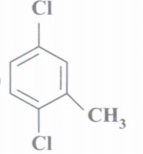
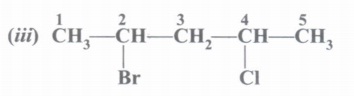
2.
2g of benzoic acid (C6H5COOH) dissolved in 25 g of benzene shows a depression in freezing point equal to 1.62 K. Molar depression constant for benzene is 4.9K kg mol-1. What is the percentage association of acid if it forms double molecules (dimer) in solution?
3.
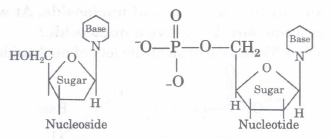
What is the difference between a nucleoside and a nucleotide ?
4.
Classify the following compounds as primary, secondary and tertiary halides.
(i) 1-Bromobut-2-ene
(ii) 4-Bromopent-2-ene
(iii) 2-Bromo-2-methylpropane
5.
[NiCl4]2- is paramagnetic while [Ni(CO)4] is diamagnetic though both are tetrahedral. Why?
6.
Define the following, giving one example of each:
(i) Zwitter ion
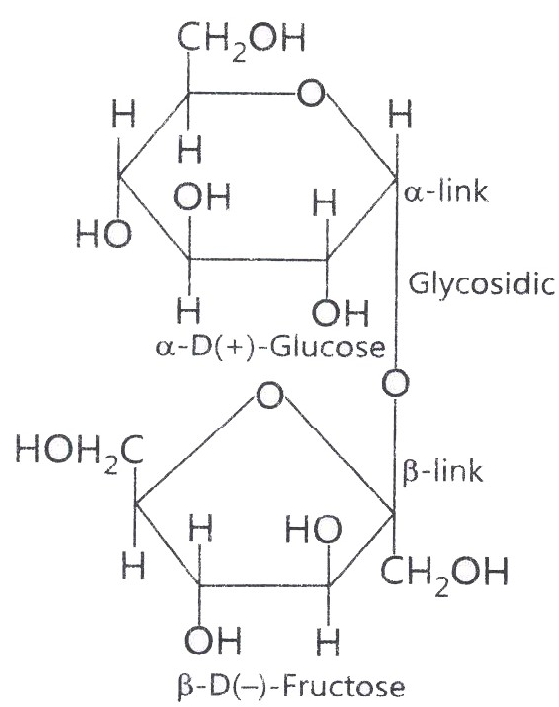
(ii) Glycosidic linkage
7.
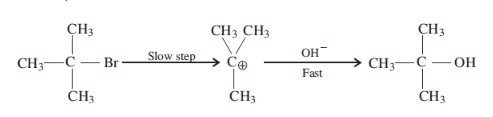
How would you differentiate between SN1 and SN2 mechanisms of substitution reactions? Give one example of each.
8.
Calculate the amount of sodium of chloride which must be added to one kilogram of water so that the freezing point of water is depressed by 3 K. [Given: K f = 1.86 K kg mol-1, Atomic mass: Na = 23.0 , Cl = 35.5]
9.
(a) Define the following terms:
(i) Azeotrope
(ii) Osmotic pressure
(iii) Colligative properties.
(b) Calculate the molarity of 9.8% (w/w) solution of H2SO4 if the density ofthe solution is 1.02 g mL-1. (Molar mass of H2SO4 = 98 g rnol-1)
10.
Among the isomeric alkanes of molecular formula C5H12, identify the one that on photochemical chlorination yields.
(i) A single monochloride
(ii)Three isomeric monochlorides
(iii) Four isomeric monochlorides.
11.
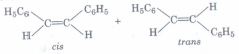
The following reaction gives two products.

Explain the formation of the products and write their structures.
12.
Discuss the nature of bonding in the following coordination entities on the basis of valence bond theory:
(a) [Fe(CN)6]4-
(b) [FeF6]3-
(c) [Co(C2O4)3]3-
(d) [CoF6]3-
13.
Out of [CoF6]3- and [Co(C2O4)3]3-, which one complex is
(i) diamagnetic
(ii) more stable
(iii) outer orbital complex and
(iv) low spin complex?
(Atomic no. of Co = 27)
14.
tert-Butyl bromide reacts with aq.NaOH by SN1 mechanism while n-butyl bromide reacts by SN2 mechanism. Why?
15.
Calculate molality of 2.5 g of ethanoic acid (CH3COOH) in 75 g of benzene.
16.
What are different types of RNA found in the cell?
17.
What are ambident nucleophiles? Explain with an example.
18.
Which reagent is required for one step conversion of benzene diazonium chloride to bromobenzene?
PBr3
HBr
Cu2Br2
Br2
19.
Racemisation occurs in
SN1 reaction
SN2 reaction
Neither SN1 and SN2 reaction
SN2 reaction as well as SN1 reactions
20.
The IUPAC name of iso-butyl bromide is ______.
1-bromo-3-methylbutane
3-bromo-2-methylpropane
2-bromo-2-methylpropane
1-bromo-2-methylpropane
21.
The bases that are common in both DNA and RNA are
adenine, guanine and cytosine
adenine, guanine and thymine
adenine, uracil and cytosine
guanine, uracil and thymine
22.
Deficiency of which of the following vitamins causes pernicious anaemia?
Vitamin B1
Vitamin B2
Vitamin B6
Vitamin B12
23.
Which of the following is a polysaccharide?
Glucose
Maltose
Glycogen
Lactose
24.
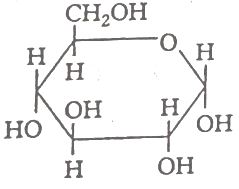
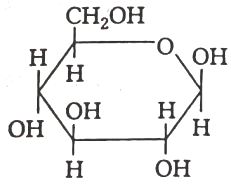
Which of the following structures represents \(\alpha\)-D-glucose?
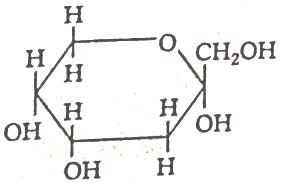
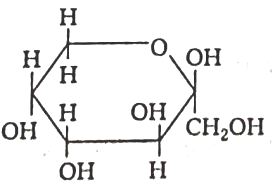
25.
Which of the following is an outer orbital complex?
[Fe(CN)6]4-
[FeF6]3-
[Co(NH3)6]3+
[Co(CN)6]2+
26.
The hybridisation of Fe in K4[Fe(CN)6] is
dsp2
sp3
d2sp3
sp3d2
27.
The complexes [Co (NH3)6] [Cr (CN)6] and [Cr(NH3)6] [Co(CN)6] are the examples of which type of isomerism?
Geometrical isomerism
Linkage isomerism
Ionization isomerism
Coordination isomerism
28.
IUPAC name of [Pt(NH3)3Br(NO2)Cl]Cl is
Triamminechloridobromidonitroplatinum (IV) chloride
Triamminebromidonitrochloridoplatinum (IV) chloride
Triamminebromidochloridonitroplatinum (IV) chloride
Triamminenitrochloridobromidoplatinum (IV) chloride
29.
In the depression of freezing point experiment, it is found that
The vapour pressure of the solution is less than that of pure solvent
The vapour pressure of the solution is more than that of pure solvent
Only solute molecules solidity at the freezing point
Only solvent molecules solidity at the freezing point.
30.
A solution containing 50 g of ethylene glycol in 200 g water is cooled to - 9.3oC. The amount of ice that will seperate out will be (Kf = 1086 Km-1)
18.71 g
28.71 g
38.71 g
48.71 g
31.
The molarity of 900 g of water is
50 M
55.5 M
5 M
cannot be calculated
32.
Which of the following units is useful in relating concentration of solution with its vapour pressure ?
mole fraction
parts per million
mass percentage
molality
33.
Van't Hoff factor for 0.1 M ideal solution is
0.1
1
-0.01
none of these
34.
Read the passage given below and answer the following questions:
A primary alkyl halide (A) C4H9Br reacted with alcoholic KOH to give compound (B). Compound (B) is reacted with HBr to give compound (C) which is an isomer of (A). When (A) reacted with sodium metal, it gave a compound (D) C8H18 that is different than the compound obtained when n-butyl bromide reacted with sodium metal
The following questions are multiple choice questions. Choose the most ap appropriate answer:
(i) Compound (A) is
| (a) \(\mathrm{CH}_{3} \mathrm{CH}_{2} \mathrm{CH}_{2} \mathrm{CH}_{2} \mathrm{Br}\) | (b) 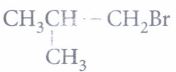 |
(c) 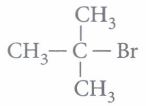 |
(d) \(\mathrm{CH}_{3} \mathrm{CH}_{2} \mathrm{CH}_{2} \mathrm{Br}\) |
(ii) Which type of isomerism is present in compound (A) and (C)?
| (a) Positional | (b) Functional | (c) Chain | (d) Both (a) and (c) |
(iii) IUPAC name of compound (D) is
| (a) n-octane | (b) 2,5-dimethylhexane | (c) 2-methylheptane | (d) 3,4-dimethyl hexane. |
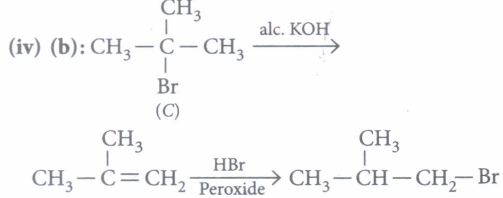
(iv) When compoound (C) is treated with alc. KOH and then treated with HBr in presence of peroxide, the compound obtained is
| a) |
(b) 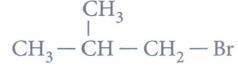 |
| (c) \(\mathrm{CH}_{3} \mathrm{CH}_{2} \mathrm{CH}_{2} \mathrm{CH}_{2} \mathrm{Br}\) | (d) 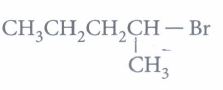 |
35.
Read the passage given below and answer the following questions:
Coordination compounds are formulated and named according to the IUPAC system.
Few rules for naming coordination compounds are:
(I) In ionic complex, the cation is named first and then the anion.
(II) In the coordination entity, the ligands are named first and then the central metal ion.
(III) When more than one type of ligands are present, they are named in alphabetical order of preference without any consideration of charge.
The following questions are multiple choice questions. Choose the most appropriate answer:
(i) The IUPAC name of the complex \(\left[\mathrm{Pt}\left(\mathrm{NH}_{3}\right)_{3} \mathrm{Br}\left(\mathrm{NO}_{2}\right) \mathrm{Cl}\right] \mathrm{Cl}\) is
| (a) triamminechlorobromonitroplatinum (IV) chloride |
| (b) triamminebromonitrochloroplatinum (IV) chloride |
| (c) triamminebromidochloridonitroplatinum (IV) chloride |
| (d) triamminenitrochlorobromoplatinum (IV) chloride |
(ii) The lUPAC name of [Ni(CO)4] is
| (a) tetracarbonylnickel (II) | (b) tetracarbonylnickel (0) |
| (c) tetracarbonylnickelate (II) | (d) tetracarbonylnickelate (0). |
(iii) As per IUPAC nomenclature, the name of the complex \(\left[\mathrm{Co}\left(\mathrm{H}_{2} \mathrm{O}\right)_{4}\left(\mathrm{NH}_{3}\right)_{2}\right] \mathrm{Cl}_{3}\) is
| (a) tetraaquadiamminecobalt (II) chloride | (b) tetraaquadiamminecobalt (III) chloride |
| (c) diamminetetraaquacobalt (II) chloride | (d) diamminetetraaquacobalt (III) chloride |
(iv) Which of the following represents correct formula of dichloridobis( ethane-1, 2-diamine ) cobalt (III) ion?
| (a) [CoCl2(en)]2+ | (b) [Co(ONO)(NH3)5]SO4 | (c) [Co(NO2)(NH3)4] (SO4)2 | (d) [Co(NO)(NH3)4] (SO4)2 |
1.
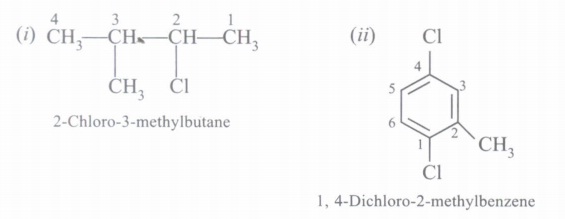
(iii) 2-Bromo-4-chloropentane
2.
The given quantities are: w2 = 2 g; Kf = 4.9 K kg mol–1; w1 = 25 g,
Observed ΔTf = 1·62 K; Kf = 4.9 K kg mol-1
Substituting these values in equation
\(M_2 ={1000g\ kg^{-1}\times4.9K\ kg\ mol^{-1}\times2.0g\over 1.62K\times25.0g}=242g\ mol^{-1}\)
Thus, experimental molar mass of benzoic acid in benzene is
= 241.98 g mol–1
Now consider the following equilibrium for the acid:
\(2 \mathrm{C}_6 \mathrm{H}_5 \mathrm{COOH} \rightleftharpoons\left(\mathrm{C}_6 \mathrm{H}_5 \mathrm{COOH}\right)_2\)
If x represents the degree of association of the solute then we would have (1 – x ) mol of benzoic acid left in unassociated form and correspondingly \(\frac{x}{2}\) as associated moles of benzoic acid at equilibrium.
\(1-x+\frac{x}{2}=1-\frac{x}{2}\)
Thus, total number of moles of particles at equilibrium equals van’t Hoff factor i.
But i = \(\frac{\text { Normal molar mass }}{\text { Abnormal molar mass }}\)
\( =\frac{122 \mathrm{~g} \mathrm{~mol}^{-1}}{241.98 \mathrm{~g} \mathrm{~mol}^{-1}} \\ \text {or } \quad \frac{x}{2} =1-\frac{122}{241.98}=1-0.504=0.496 \\ \text {or } \quad x =2 \times 0.496=0.992 \)
Therefore, degree of association of benzoic acid in benzene is 99.2 %.
3.
A nucleoside contains only two basic components of nucleic acids namely a pentose sugar and a nitrogenous base.
A nucleotide contains all the three basic components of nucleic acids namely a phosphoric acid group, a pentose sugar and a nitrogenous base.
4.
\((i)\ { { C }H }_{ 3 }CH=CH-\overset { { 1 }^{ \circ } }{ { C } } { H }_{ 2 }Br\ \ (ii){ { C }H }_{ 3 }-\overset { { 2 }^{ \circ } }{ { C } } { H }Br-CH=CH-{ { C }H }_{ 3 }\ \ (iii){ { C }H }_{ 3 }\overset { { 3 }^{ \circ } }{ - } \overset { \underset { | }{ { CH }_{ 3 } } }{ \underset { \overset { | }{ { CI } } }{ C } } -Br\ \)
1-Bromobut-2-enc 4-Bromopent-2-ene 2-Bromo-2-methylpropane
(1o Alkyl halide) (2o Alkyl halide) (3o Alkyl halide)
5.
In [NiCl4]2-, Ni is +2 oxidation state with the configuration 3d84s0. Cl- is weak ligand. It cannot pair up the electrons in 3d orbitals. Hence, it is paramagnetic. In [Ni(CO)4], Ni is in zero oxidation state with the configuration 3d84s2. In the presence of CO ligand, the 4s electrons shift to 3d to pair up 3d electrons. Thus, there is no unpaired electron present. Hence, it is diamagnetic.
6.
(i)The ion whose one end is positively charged and other end is negatively charged is called Zwitter ion, e.g.,
\({ H }_{ 2 }N-CH_{ 2 }-COOH\rightleftharpoons { H }_{ 3 }^{ \oplus }N-CH_{ 2 }-COO^{ - }\)
(ii) Glycosidic Linkage: The oxide linkage between monosachharide units in oligo and polysachharide is called glycosidic linkage, e.g.
7.
SN1 Reactions: They are substitution nucleophilic unimolecular reactions in which the rate of the reaction depends on the concentration of only one reactant. Product formation takes place by the formation of carbo cation as reaction intermediate. For example:
SN2 reactions they are substitution nucleophilic bimolecular reactions in which rate of the reaction depends on the concentration of two reactants. For example:
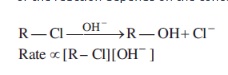
The product formation takes place by formation of transition state.
8.
\(NaCI\longrightarrow { Na }^{ + }+{ CI }^{ - }\)
\(\therefore i=2,\triangle { T }_{ f }=i\times { K }_{ f }\times \frac { { W }_{ B } }{ { M }_{ B } } \times \frac { 1000 }{ { W }_{ A } } \)
\(\\ \Rightarrow 3=2\times 1.86\times \frac { { W }_{ B } }{ 58.5 } \times \frac { 1000 }{ 1000 }\)
\(\Rightarrow { W }_{ B }=\frac { 3\times 58.5 }{ 2\times 1.86 } =\frac { 175.5 }{ 3.72 } =47.17\ g\)
9.
(a) (i) Azeotrope: Those solutions which distill out unchanged in their composition are called azeotropes. They are constant boiling mixtures.
(ii) Osmotic pressure: It is an extra pressure which must be applied on solution side so as to stop the flow of solvent molecules into solution when both are separated by a semipermeable membrane.
(iii) Colligative property: The property which depends on the number of particles of solute and not on the nature of solute is called colligative property.
(b) Molarity (M)
= \(\frac{W_{B}}{M_{B}} \times \frac{1000}{\text { Volume of solution in } \mathrm{mL}}\)
= \(\frac{9.8}{98} \times \frac{1000}{\frac{\text { Mass of solution }}{\text { density of solution }}}\)
= \(\frac{9.8}{98} \times \frac{1000}{\frac{100}{1.02}}=1.02 \mathrm{~mol} \mathrm{~L}^{-1}\)
10.
\((i)\quad { CH }_{ 3 }-\overset { \underset { | }{ { CH }_{ 3 } } }{ \underset { \overset { | }{ { CH }_{ 3 } } }{ C } } -{ CH }_{ 3 }\)
All the H atoms are equivalent.
\((ii)\quad \overset { a }{ { CH }_{ 3 } } -\overset { b }{ { CH }_{ 2 } } -\overset { c }{ \underset { n-Pentane }{ { CH }_{ 2 } } } -\overset { b }{ { CH }_{ 2 } } -\overset { a }{ { CH }_{ 3 } } \)
Replacement of a, b atom gives different products.
\((iii)\quad \overset { a }{ { CH }_{ 3 } } -\underset { \overset { | }{ { CH }_{ 3 } } }{ \overset { b }{ { CH }_{ 2 } } } -\overset { c }{ { CH }_{ 2 } } -\overset { d }{ { CH }_{ 3 } } \)
Replacement of a, b, c and d H atoms give different products.
11.
12.
There are coordinate bonds in the following complexes.
(a) [Fe(CN)6]4-
Fe(26) has electronic configuration [Ar] 4s23d6.
Fe2+ has electronic configuration 4s03d6
CN- ion causes pairing of electrons because it is a strong field ligand.
It has octahedral shape and is diamagnetic in nature due to the absence of unpaired electrons.
(b) [FeF6]3-
F- is weak field ligand, does not cause pairing of electrons.
(c) [Co(C2O4)3]3-
(d) [CoF6]3-
F- is weak field ligand, cannot cause pairing of electrons.
13.
(i) [Co(C2O4)3]3- is more stable.
(ii) [CoF6]3- is outer orbital complex.
(iii) [Co(C2O4)3]3- is low spin complex.
14.
tert-Butyl bromide readily loses Be ion to form stable tert-butyl carbocation. Therefore, it undergoes reaction by SNI mechanism which occurs in two steps. In the first step, tert-butyl carbocation is formed. This step is slow and hence is the rate determining step of the reaction. In the second step, the tert-butyl carbocation is readily attacked by OH- ion to form tert-butyl alcohol.
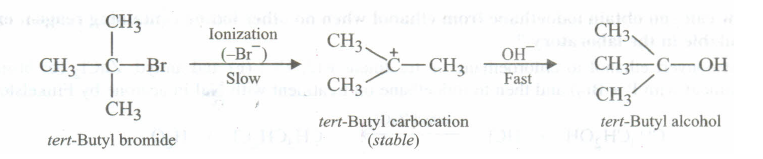
On the other hand, n-butyl bromide does not undergo ionization to produce n-butyl carbocation because it is not stable. Therefore, it prefers to undergo reaction by SN2 mechanism which occurs in one step through a transition state involving nucleophilic attack of the OH- ion. from the back side with simultaneous expulsion of Br- ion from the front side.

15.
Molar mass of C2H4O2: 12 × 2 + 1 × 4 + 16 × 2 = 60 g mol-1
\(\text {Moles of } \mathrm{C}_{2} \mathrm{H}_{4} \mathrm{O}_{2}=\frac{2.5 \mathrm{~g}}{60 \mathrm{~g} \mathrm{~mol}^{-1}}=0.0417 \mathrm{~mol}\)
\(\text {Mass of benzene in } \mathrm{kg}=75 \mathrm{~g} / 1000 \mathrm{~g} \mathrm{~kg}^{-1}=75 \times 10^{-3} \mathrm{~kg}\)
\(\text {Molality of } \mathrm{C}_{2} \mathrm{H}_{4} \mathrm{O}_{2}=\frac{\text { Moles of } \mathrm{C}_{2} \mathrm{H}_{4} \mathrm{O}_{2}}{\text { kg of benzene }}=\frac{0.0417 \mathrm{~mol} \times 1000 \mathrm{~g} \mathrm{~kg}^{-1}}{75 \mathrm{~g}}\)
= 0.556 mol kg-1
16.
There are 3 main types of RNA
1. mRNA - Messenger RNA
2. tRNA - Transfer RNA
3. rRNA - Ribosomal RNA
17.
Ambident Nucleophile- An anionic nucleophile, which has two nucleophilic centers, or two negative sites is known as an ambident nucleophile. This negative charge is delocalized due to resonance.
Example – Cyanide and Thiocyanate are examples of ambident nucleophiles.
-C≡N ↔ :C=N-
S=C=N- ↔ -S - C≡ N
18.
(c)
Cu2Br2
19.
(a)
SN1 reaction
20.
(d)
1-bromo-2-methylpropane
21.
(a)
adenine, guanine and cytosine
22.
(d)
Vitamin B12
23.
(c)
Glycogen
24.
(a)
25.
(b)
[FeF6]3-
26.
(c)
d2sp3
27.
(c)
Ionization isomerism
28.
(a)
Triamminechloridobromidonitroplatinum (IV) chloride
29.
(a)
The vapour pressure of the solution is less than that of pure solvent
30.
(c)
38.71 g
31.
(b)
55.5 M
32.
\(\frac { { p }^{ o }-{ p }_{ s } }{ { p }^{ o } } ={ x }_{ 2 }\) (mole fraction of solute in solution) - Raoult's law.
33.
In a ideal solution, solute does not undergo dissociation or association. Hence, van't Hoff factor = 1.
34.
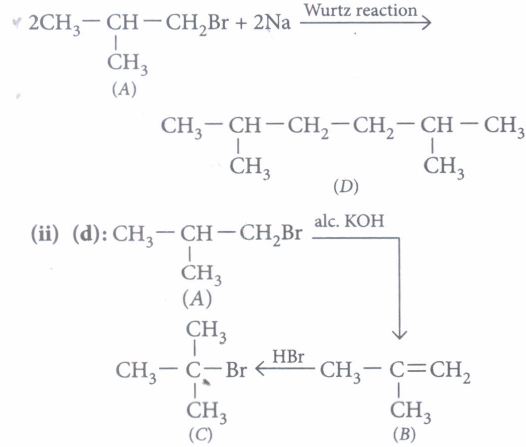
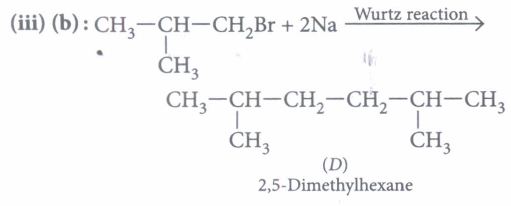
(i) (b): When compound (A) reacted with Na-metal, it gave a compound D(C8H18) which is different from the compound obtained when n-butyl bromide reacted with Na metal and hence the
compound (A) must be isobutyl bromide.
\(2 \mathrm{CH}_{3} \mathrm{CH}_{2} \mathrm{CH}_{2} \mathrm{CH}_{2} \mathrm{Br}+2 \mathrm{Na}\) \(\overset{Wurtz reaction}\rightarrow\) \(\mathrm{CH}_{3} \mathrm{CH}_{2} \mathrm{CH}_{2} \mathrm{CH}_{2} \mathrm{CH}_{2} \mathrm{CH}_{2} \mathrm{CH}_{2} \mathrm{CH}_{3}\)
35.
(i) (c): Ligands are named in alphabetical order irrespective of their charge.
(ii) (b)
(iii) (d)
(iv) (d)

12th Standard CBSE Syllabus & Materials
12th Standard CBSE
CBSE 12th Computer Science Python Revision Tour I - New Previous year Question Papers Study Material - QB365 Set A
NEW12th Standard CBSE
CBSE 12th Business Studies Planning Important Questions And Answers Study Material - QB365 Set A
NEW12th Standard CBSE
CBSE 12th Business Studies Business Environment Important Questions And Answers Study Material - QB365 Set A
NEW12th Standard CBSE
CBSE 12th Business Studies Principles of Management Important Questions And Answers Study Material - QB365 Set A



NCERT Books

Syllabus

Exam Pattern

Sample Question Papers

Previous year Question Papers

Important Notes

MCQ Practice test

NCERT Exemplers

Case study Questions

Image Based Questions

Passage based Questions

HOT Questions

Value Based Questions

Model Questions Papers
NCERT ( Book Back ) Questions

Assertion and Reason
Important Questions And Answers

CBSE 12th Standard CBSE Subjects
CBSE Standards








