
 100% FREE ACCESS
12th Standard CBSE Syllabus & Materials
12th Standard CBSE
CBSE 12th Economics Government Budget and the Economy Previous year Question Papers Study Material - QB365 Set A
NEW12th Standard CBSE
CBSE 12th Computer Science Interface Python with MySQL - New Previous year Question Papers Study Material - QB365 Set A
NEW12th Standard CBSE
CBSE 12th Computer Science Database Concept - New Previous year Question Papers Study Material - QB365 Set A
NEW12th Standard CBSE
CBSE 12th Computer Science Data Communication - New Previous year Question Papers Study Material - QB365 Set A
NEW12th Standard CBSE
CBSE 12th Computer Science Data Structures - New Previous year Question Papers Study Material - QB365 Set A
NEW12th Standard CBSE
CBSE 12th Computer Science Functions - New Previous year Question Papers Study Material - QB365 Set A

Published on: 01/12/2018
Chemistry has revolutionized the world and changed lives for the better. From medical applications to gene studies, having a foundation knowledge of Chemistry better equips students to theorize concepts and bring applications to life. The CBSE Class 12 Chemistry NCERT Solutions have been written by some of the best educational experts in the country, thus making concepts easy to understand and grasp quickly. The Chemistry Class 12 NCERT solutions covers chapters and topics which appear in various entrance exams, like the JEE. Different types of questions that are asked in the textbooks can be repetitive or confusing, but NCERT Chemistry PDF solutions help deal with any problems while answering the questions or solving equations. Useful in individual and group studies, by practicing these solutions, students can thoroughly prepare for academic exams and understand topics from a practical perspective. This acts as a gateway to the mind of the examiner.
In this post Class 12 Chemistry Chapter 15 - Polymers solved by Expert Teachers as per NCERT (CBSE) Book guidelines. All Chapter 15 - Polymers Exercise Questions with Solutions to help you to revise complete Syllabus and Score More marks.
Get 100 percent accurate NCERT Solutions for Class 12 Chemistry Chapter 15 (Polymers) solved by expert Chemistry teachers. We provide solutions for questions given in Class 12 Chemistry text-book as per CBSE Board guidelines from the latest NCERT book for Class 12 Chemistry.
After studying this chapter, students will be able to visualize the importance of Chemistry in daily life; explain the term ‘chemotherapy’; describe the basis of classification of drugs; explain drug-target interaction of enzymes and receptors; explain how various types of drugs function in the body; know about artificial sweetening agents and food preservatives and discuss the chemistry of cleansing agents.
NCERT Grade 12 Chemistry Chapter 15 - Polymers holds a total weightage of 3 marks in the final examination.
Download CBSE Class 12th Standard CBSE Chemistry question papers, sample papers, important questions, and previous year solved papers in PDF format. Get free study materials, NCERT solutions, and exam preparation resources for Class 12th Standard CBSE Chemistry
Questions + Answers key
Take MCQ Chemistry Test
1.
Write the monomer units of bakelite.
2.
Can enzyme be called a polymer ?
3.
What is the repeating structural unit in polythene polymer ?
4.
Which of the following polymers soften on heating and harden on cooling? What are the polymers with this property collectively called? What are the structural similarities between such polymers Bakelite, urea-formaldehyde resin, polythene, polyvinyl, polystyrene.
5.
What is vulcanization?Discuss its main purpose.
6.
Give one example each of
(i) addition polymers
(ii) condensation polymers
7.
Define thermoplastics.
8.
Name the sub-groups into which polymers are classified on the basis of magnitude of intermolecular forces.
9.
Write the names and structures of the monomers of the following polymers:
(i) Bakelite
(ii) Nylon-6
(iii) Polyethene
10.
Write chemical equations for the synthesis of
(a) terylene
(b) neoprene
(c) teflon
11.
Explain the following terms giving a suitable example for each :
(i) Elastomers
(ii) Condensation polymers
(iii) Addition polymers
12.
What are biodegradable polymers ? Give an example of such a polymer and mention its uses.
13.
How does the presence of double bonds in rubber molecules influence their structure and reactivity ?
14.
Which of the following are addition homopolymers?
Teflon
SBR
PVC
Natural rubber
15.
Which polymers occur naturally?
Starch and Nylon
Starch and Cellulose
Proteins and Nylon
Proteins and PVC
16.
Which of the following polymers can be used for lubrication and as an insulator?
SBR
PVC
PTFE
PAN
17.
Which of the following is not a thermoplastic?
Polythene
Bakelite
Nylon 6,6
Teflon
18.
Rayon is a
natural polymer
semi - synthetic
synthetic polymer
none of these
19.
Nylon 6,10 is obtained by condensation polymerization of ......... with.........
20.
Formaldehyde is a constituent of a number of polymers also called resins. These are non-volatile solids or semi-solids which are obtained from certain plants and also be synthesized in the laboratory.
(i) Name the main formaldehyde resins.
(ii) Mention the major components of these resins also called polymers.
(iii) Which out of these is useful in the manufacture of crockery?
(iv) Formaldehyde is obtained from plants. Similarly we obtain many useful things from plants. Is it worth to destroy plants for obtaining useful material ?
21.
After the ban on plastic bags, students of a school decided to make people aware of the harmful effects of plastic bags on the environment and Yamuna River. To make the awareness more impactful, they organised a rally by partnering with other schools and distributed paper bags to vegetable vendors, shopkeepers and departmental stores. All the students pledged not to use polythene bags in the future to save the Yamuna River.
After reading the above passage, answer the following questions:
(i) What values are shown by the students?
(ii) What are bio-degradable polymers ? Give one example.
(iii) Is polyethene a condensation or an addition polymer?
1.
()
phenol (C6H5OH) and formaldehyde (CH2=O)
2.
()
Yes. Enzymes are biocatalyst which are proteins, polymers of amino acids.
3.
()
\((-{ CH }_{ 2 }-{ CH }_{ 2 }-)_{ n }\)
4.
Polythene, polyvinyl and polystyrene soften on heating and harden on cooling. Such polymers are called thermoplastic polymers. These possess intermolecular forces of attraction whose strength lies between strength of intermolecular forces of elastomers and. fibers. These polymers are linear or slightly.
5.
During vulcanization, natural rubber is heated with 3-5% sulphur. The function of sulphur is to introduce sulphur (or disulfide) bridges or cross- links between polymer chains
thereby imparting more tensile strength, elasticity, and resistance to abrasion
6.
Addition polymers are those 'which are formed from unsaturated monomers without loss of small molecules like HP, NH3, etc., e.g. polyethene. Condensation polymers are those which are formed from monomers having multi-functional groups with the loss of small molecules like HP, NH3, etc., e.g. Nylon-66.
7.
Polymers which can be repeatedly softened on heating and hardened on cooling and can be used again and again without any change in their chemical composition and mechanical strength are called thermoplastics. For example, polythene, Teflon, polystyrene, nylon, PVC, PAN, etc.
8.
(i) Elastomers
(ii) Fibres
(iii) Thermoplastics
(iv) Thermosetting polymers.
9.
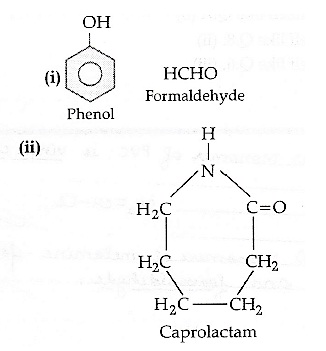
(iii) CH2=CH2(Ethene)
10.
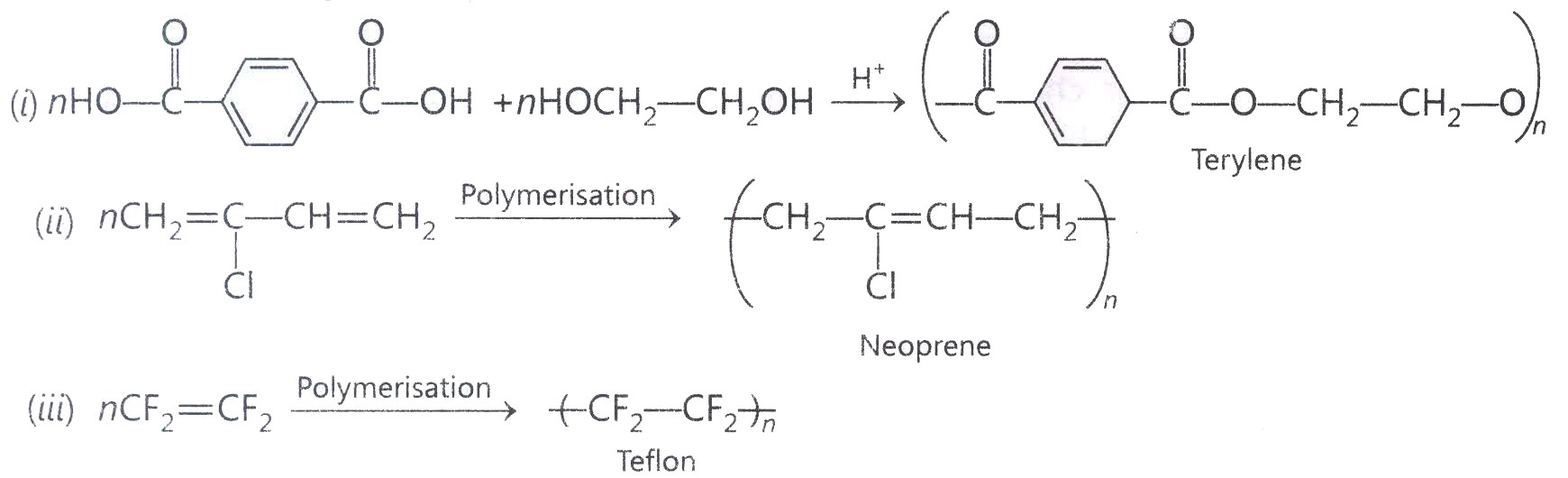
11.
(i) Elastomers: The polymers in which polymer chains are held together by the weakest intermolecular forces.These weak forces permit the polymer to be stretched.A few 'cross-links' are introduced in between the chains which held the polymer to retract to its original position after the force is released, as in vulcanised rubber
(ii) Condensation polymers: It involves a series of condensation reaction generally involving two monomers.Each monomer normally contains two functional groups.The condensation reactions result in the loss of small molecules usually water and ammonia, e.g. nylon, terylene, bakelite are condensation polymers.This process is Known as 'condensation polymerisation'
(iii) Addition polymers: The polymers which are formed by repeated addition of monomers to the polymer chain.The monomers are unsaturated compounds and commonly derivatives of ethene.the addition polymers have same empirical as their monomers, e.g
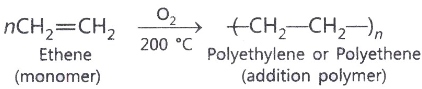
This process is 'addition polymerisation'.
12.
Biodegradable polymers: Those polymers which are biodegradable, i.e. decomposed by microorganisms and do not create water pollution, e.g. PHBV.
Poly (Glycolic acid) and Poly (Lactic acid) are biodegradable polymers such as sutures.Dextron was the first bioabsorbable suture made from biodegradable polyester for post operative stiches
13.
The natural rubber is linear cis-1, 4-polyisoprene.The double bonds are located between C2 and C3 of isoprene units.This cis - configuration about double bonds do not allow the chains to come closer for effective attraction due to weak intermolecular force of attraction.That is why, the natural rubber has a coiled structure and shows elasticity.
14.
SBR (styrene-butadiene rubber) is an addition copolymer.
15.
(b)
Starch and Cellulose
16.
(c)
PTFE
17.
(b)
Bakelite
18.
(b)
semi - synthetic
19.
()
sebacic acid,hexamethyllenediamine
20.
(i) Main formaldehyde resins: Bakelite, melamine formaldehyde and urea Formaldehyde.
(ii) Bakelite: Phenol and formaldehyde.
Melamine formaldehyde: Melamine and formaldehyde.
Urea formaldehyde: Urea and formaldehyde.
(iii) Melamine is used for this purpose.
(iv) In the modern world, polymer industry has a major role. No doubt, natural polymers are also useful but synthetic polymers have an impact on most of our daily house hold necessity items. It may range from kitchen, bed room and also all luxury items. But it is not worth to destroy plants as they are life giving.
21.
(i) From the given passage, we can conclude that the students show awareness about the environment.
(ii) A polymer that can be decomposed by microorganisms within a definite period of time so that the polymer or its degraded product does not cause any harm to the environment, is called a bio-degradable polymer. For example, poly- \(\beta\)- hydroxybutyrate-co-\(\beta\)-hydroxy valerate.
(iii) Polythene is an addition polymer that is formed by the addition of ethene molecules.

12th Standard CBSE Syllabus & Materials
12th Standard CBSE
CBSE 12th Computer Science Python Revision Tour I - New Previous year Question Papers Study Material - QB365 Set A
NEW12th Standard CBSE
CBSE 12th Business Studies Planning Important Questions And Answers Study Material - QB365 Set A
NEW12th Standard CBSE
CBSE 12th Business Studies Business Environment Important Questions And Answers Study Material - QB365 Set A
NEW12th Standard CBSE
CBSE 12th Business Studies Principles of Management Important Questions And Answers Study Material - QB365 Set A



CBSE 12th Standard CBSE Subjects
CBSE Standards










